The first kingdom, then, here represented by the head of gold, was that of Babylon. Let me first briefly notice what is said about it in the Word of God, and in what respects that which was prophesied of it has been fulfilled. You will always perceive that one kingdom passes from the stage the moment that the other comes on. In other words, the Persian kingdom was constructed from the ruins of the Babylonian; the Greco-Macedonian was constructed from the ruins of the Persian; and the Roman kingdom rose upon the ruins of all that preceded it.
About 612 B. C. Nebuchadnezzar destroyed Nineveh; or, in the language of Scripture, as shown to be true by the disclosures of Layard, “made its grave;” burying in the deep and silent earth all its grandeur, its pomp, and its splendor. And when Nineveh, till that time the greatest kingdom upon earth, was thus entombed in its grave, Babylon ascended the throne, and swayed the scepter over all the nations of the world. The walls of the city of Babylon, as we read not only in Scripture, but in Xenophon, the beautiful and classical Greek historian, were of gigantic size, measuring sixty miles in circumference; and the breadth of these walls, which were very solid, being built of brick cemented with bitumen, a substance produced upon the soil, were capable of allowing six chariots, each with two horses, to drive abreast upon them. The city had one hundred gates of solid brass. The temple of Bel, or of Belus, as it is called by classic writers, had a circumference of half a mile, and was upward of one thousand feet in height, or nearly three times the height of St. Paul’s Cathedral [in London]. The fertility of the whole region of Chaldea, watered by the Tigris and the Euphrates, was so great that classical historians, Herodotus and Strabo, tell us that it produced two hundredfold; that is, that one seed of corn [wheat], if I may use this mode of illustration, produced in the ear two hundred seeds; a degree of fertility unrivaled in any modern country. This I state to justify the description of the prophet, when he calls Babylon “the excellency of Chaldea,” and literally “the glory of kingdoms.” Again, what is the sign of it in Nebuchadnezzar’s dream?—“The head of *gold;” in its natural and physical properties the most valuable of the four metals.
[Dr. Cumming then quotes the various prophecies concerning Babylon and its downfall, introducing his quotations with these words: “I will give, I say, first of all the predictions of God, as these were uttered many years before its fall, and then I will read the facts recorded in history by impartial writers who did not even know of the prophecy, and who could not have the least design or intention of showing its fulfilment.” The portions of Scripture referred to are the following: Jer. 25: 11, 12; Isaiah 13 and 14; Jeremiah 50 and 51. He then continues.—Ed.]
I have thus read the leading parts of that great burden of prophecy against Babylon. I now quote in evidence of the fulfilment of these the prophecies of God, the dispassionate testimony of the heathen historians: and I shall then give you an account not only of the rise, as I have already briefly done, but also of the fall, of the head of gold, previous to the silver empire taking its place, and its order in succession onward to the end.
First, then, in these prophecies, Cyrus is specified as the general who was to march his forces against Babylon. Xenophon directly states that such was the fact. Babylon, trusting in its gigantic walls, and in its provisions for twenty years, adequate to maintain it in case of its being besieged, instead of preparing to repel the invading army, gave itself, its whole population, from the prince upon the throne down to the meanest of its subjects, to debauchery, riot, profligacy, and drunkenness. In the next place, Cyrus, after he had come in array against Babylon, besieged it for years without success, and at last fell upon the expedient of digging trenches round the walls of Babylon, ostensibly for blockade, but really to divert the waters of the Euphrates from their accustomed course, and leave in the empty channel a pathway for his soldiers to march into the city. It was, as I have described, surrounded by vast walls; but the river Euphrates rolled through the midst of it. There was therefore an opening thus formed through the center of the city; only there were walls on each side, or on each bank of the river, with gates to each street leading down to it; and the plan of Cyrus was therefore to divert the waters of the Euphrates into the trenches he had dug, and to make the dry central channel a road for his troops to march down in order to gain possession of the city. Herodotus, the father of historians, relates that, even after having marched along the bed of the river, the obstacles to his entrance were just as great as elsewhere; for there were gates to each street leading to the banks of the river; and if these had been secured, the obstruction to the entrance of Cyrus would have been complete. But there was a prophecy—part of which I read to you—that these gates should not be shut; and the Babylonians, not suspecting the stratagem of Cyrus in diverting the waters of the river, left their gates open as if in conscious possession of impregnable security; when part of the army, therefore, entered at one side of the city, marching up the bed of the river, and another part of his troops at the other side of the city, marching down the bed of the river, they found each of these gates open, which would not have been the case had not the people been indulging in feasting and drunkenness;
the troops therefore entered by every gate; and before the Babylonians were aware that the enemy was so near at hand, their great and impregnable capital was in the hands of the next empire, the empire of the Persians.
We notice another minute point that was singularly fulfilled. It was predicted that the enemy should come upon them unawares, and that “one post should run to meet another in the midst of the siege.” Now, that such was literally the fact is recorded by Herodotus, for he says that those at one end of the city were in the hands of Cyrus before those at the other end of the city were aware of his attack, and before they had time to give the alarm; thus fulfilling the prediction of the prophet, that post should run to post, and watchman to watchman, to give the awful and startling alarm that the forces of Cyrus were upon them.
Then it is predicted by the prophet, that “they that were drunken should sleep a perpetual sleep;” and that “the two-leaved gates should be thrown open.” It is stated by the historian that the monarch was indulging in a feast, and was intoxicated with wine, surrounded by all his princes, nobles, and courtiers, at the very moment when the city had fallen into the hands of the Persian army; and hearing a noise outside the palace, he insisted on knowing what it was; and when some of the chief princes rushed to the gates of the palace in order to ascertain the cause, and threw them open for that purpose, they thus fulfilled the prophecy,—the troops of Cyrus instantly rushed in, and Belshazzar and his princes were slaughtered in the midst of their festival: “the drunken slept a perpetual sleep.” Thus you have every prediction that God gave by the mouth of Isaiah and Jeremiah fulfilled to the very letter; and that fulfilment is recorded by the dispassionate pens of the historians of ancient Greece.—“Prophetic Studies; or Lectures on the Book of Daniel,” by John Cumming, D. D., London, 1850, pages 47-55.
Babylon, the Head of Gold
“‘This image’s head was of fine gold’ (verse 32), which Daniel interprets (verse 38), ‘Thou art this head of gold,’ thou, and thy family, and thy representatives. The Babylonian therefore was the first of these kingdoms; and it was fitly represented by the ‘head of fine gold,’ on account of its great riches; and Babylon for the same reason was called by Isaiah (Isa. 14:4) ‘the golden city.’ The Assyrian is usually said to be the first of the four great empires; and the name may be allowed to pass, if it be not taken too strictly. For the Assyrian empire, properly so called, was dissolved before this time; the Babylonian was erected in its stead; but the Babylonians are sometimes called Assyrians in the best classic authors, Herodotus, Xenophon, Strabo, and others, as well as in the Holy Scriptures.”—“Dissertations on the Prophecies,” by Thomas Newton, D. D., London, 1840, page 206.
Why Do We Worry?
By Sarah K. Bolton
Why do we worry about the nest?
We only stay for a day,
Or a month, or a year, at the Lord's behest,
In this habitat of clay.
Why do we worry about the road,
With its hills or deep ravine?
In a dismal path or a heavy load
We are helped by hands unseen.
Why do we worry about the years
That our feet have not yet trod?
Who labors with courage and trust, not fears,
Has fellowship with God.
— Sarah K. Bolton.
The Mother and Her Child
By Mrs. M. C. Du Bois
ONE has said: “For no other memory can we be so thankful as for one that goes back so far that it seems to be the first of all impressions,—the face and form and influence of a Christian mother. That picture, of all pictures the most beautiful, is a talisman at every step on the life-road.”
Yes, better than rare heirlooms of diamonds or other sparkling gems to hand down to our children is the memory picture of a mother’s faithful, tireless work in forming the character of her children. Would that every mother who may read these lines could realize at all times the extent of her influence over her children. It is indeed measureless.
One has said, “In the home [not at the ballot-box] the mother makes the character of nations.” Who has not read, of the mothers of Napoleon Bonaparte, George Washington, and John Wesley! What wonderful women they were! Every mother can not give to the world a Washington; but she can and ought to do her best to give to the world pure, healthy, well-trained children.
Now, since my children have gone out into the world to take their places and perform their duties in life, I realize as never before the power of a mother over her children’s future life. The older I grow, the more sacred the work of a mother appears to me. Day by day she is doing work which will last through all eternity. We may properly call her an artist, painting pictures which the hand of time can not erase, tarnish, or cause to fade. The colors of the mother-artist must wisely be chosen, and mixed with earnest prayer and purpose, and ground fresh each day for that day’s particular work.
I once knew a mother who was very particular about her personal appearance in her home. She was a hard-working woman, but she never failed to make some changes in her attire for the afternoon. Some dainty article was added that would make her look more attractive; for she said, “I want my boys to remember me as a neat, tidy mother.” She has been sleeping for a number of years; but the memory picture of that mother is undimmed to her children to this day.
A woman’s first and grandest work, if she is a mother, is due her own children; and the mother who, in her zeal to work for God, neglects her own children either physically or spiritually, is doing a great wrong. I have known mothers who loved “the truth” and desired “to work in the cause,” and yet they neglected the very work God had given them to do. Some may say, “You would have a woman selfish, and do only for her own.” Not so; I would have every mother true and faithful to her own, careful to cultivate the home field first, and then reach out after others as the way opens.
The relation of the mother to her child is most sacred; but it has come to pass that the office of motherhood is no longer held sacred by many. Mothers can turn coldly from their offspring, to engage in pleasure, or the so-called work of the Lord, while their children are left to run in the streets, or are turned over to the care of others. This may sound severe to some; but when the mother is brought to realize the greatness of her work, she will see the matter in a new light.
Children should not be left to learn from others the mysteries of their own bodies. Most mothers are very remiss in this duty, from false modesty or some other cause. Far too many children are left to gain this knowledge from older schoolmates, and long before most mothers dream of such a thing, the mind of the child is filled with impurities and false ideas, and often very young children are led into evil practises long before the mother has any thought that her child has any idea of the origin of life. If every mother would in the fear of God give her boy and girl right instruction upon these important subjects, she would build a strong bulwark against impurity and vice.
The greatest care should be exercised by the mother, as her children grow older, to retain their affection and confidence. It is a sad day when mother is left out of the confidence of her child, as she will be unless she is careful. Encourage them to trust you. Be social; take an interest in their associates. Many a boy or girl forms acquaintances of which the mother knows nothing, and from these associates, harmful and impure habits are learned. A mother should be watchful of the company her child keeps. A child should not be allowed to run upon the streets at night. Home should be made so bright and pleasant that the children will not care to go down-town or to the country store to spend their evenings.
I hear a mother say, “I am glad to get them out of the way for a little time, so I can have a few minutes’ quiet and rest.” Ah, mother, you are resting at a fearful cost, if your child is in bad company! These are fearful times for the young. Traps and pitfalls abound on every side. Satan is doing his best to ruin our children. Parents, in the fear of God, do all in your power to save them from destruction.—Mrs. M. C. Du Bois.
Reading, and Reading
A MOTHER was very much delighted to know that her young son was so fond of reading, and spoke of his thoughtful and studious habits. It developed, however, that he was reading the most trashy books in the line of exciting and sensational yellow-back literature. He had no taste for what was substantial and instructive, and his taste for reading was, in its way and directed as it was, a very injurious tendency.
Physiologists tell us that we do not drink enough, ordinarily, and urge that two or three pints of water daily should be taken into the system. The one who should drink a great deal of beer and wine and other intoxicating liquor, and delude himself that he is living in accordance with this physiological requirement, would make no more surely a great mistake than the one who, reading flashy and evil books, flatters himself that he is cultivating his literary taste and satisfying his intellectual needs.—Herald and Presbyter.
Self-Slaughter
A NEW form of suicide, called by the doctor “automatic poisoning,” is reported in the London Globe of September 23. A carman was admitted to St. Bartholomew’s Hospital on September 2 with a fractured ankle. The fracture was set, and he appeared to be getting better, but on the seventeenth he was found to be in a comatose condition, and died shortly after. At the inquest it was stated by the house surgeon that “death was due to slow poisoning; deceased had been automatically poisoned. He had been such a heavy drinker that when he had the accident and had to be still, the liver refused to do its ordinary duties, and the poison accumulating, he actually poisoned himself automatically.”
The victim perhaps thought that in his arduous work he needed the strong drink, but he was actually committing slow suicide, fatally undermining his health. This was made evident when the accident tested his physical condition. The case simply indicates what every consumer of alcohol is in some degree doing to himself.—Present Truth.
Difficulties to Be Encountered In Turkey
By C. D. AC MOODY
C. D. AC MOODY
The spirit of Turkey is as much opposed to Christianity as was the spirit of the Saracen conquerors who went forth to push the banner of Mohammed into the heart of Europe centuries ago. It is only because of the severe pressure brought to bear upon Turkey by the powers of Europe that Christianity is even tolerated within her borders. The spirit of Mohammedanism possesses just as much hatred against Christianity as ever. As the weapon of Mohammedanism is the sword of steel, instead of the sword of the Spirit, so her methods to-day in principle are those of force, and not of persuasion.
Frequently some Mohammedan leader declares that the armies of united Mohammedanism will yet conduct a successful campaign against Europe. Of course this is more the expression of individual sentiment than of the prevailing intention and belief of the people. As I have already expressed in an article to the REVIEW a few months ago, it is the prevailing belief among many Moslems that the sultan of Turkey will soon be forced to move from his present seat of government.
The first statement reveals the spirit of Mohammedanism itself; this latter expresses the conclusion drawn from the political situation of Turkey to-day. The condition to which expression is given in the first statement is that under which we have to carry on our work. The conditions which produce the latter conclusion are those which are bringing about the fulfilment of the prophecies regarding the “sick man of the East.”
At this writing I desire to speak of those conditions which directly affect our work in Turkey. The only freedom granted to the non-Mohammedan sects or communities is restricted toleration. To convey a better understanding of the position in which we are placed, I will first show the general condition under which all denominations have to carry on their work. There is no civil government in Turkey. Primarily the Turkish government is the Mohammedan Church. Every tolerated non-Mohammedan sect is treated as independent, not only ecclesiastically, but nationally and civilly. Every citizen of Turkey who is not a Mohammedan is treated as a citizen of the sect to which he belongs, rather than as a citizen of Turkey. Thus each recognized denominational or sect organization is fully organized to administer, to a degree, both ecclesiastical and civil affairs.
Of course the civil functions are limited to the laws of Mohammedan administration. For example: every denomination has its headship. Each denomination is required to register all its members, and to appoint and maintain, at its own expense, men to administer such civil duties as are imposed upon them by the government. The government demands a tithe as a tax from all its subjects. This tithe is estimated by the government to the various denominational communities, and handed to their respective heads, who apportion the same among their people. All marriage permits and burial rights and privileges are secured from the denominational heads, and not directly from the government. Accordingly, in the case of marriage, the Armenian, Gregorian, and the
Orthodox Greek Churches demand that the parties to be married partake of their communion before the marriage can be solemnized.
In some cases the Protestants are very kind to our people; but, on the other hand, when they choose to turn against us, our people are laid before the government as violators of the law. However, it does not always require the disfavor of a religious community to involve our people with the government; because the authorities are thoroughly apprised of the existence and activity of our people, and of the fact that we are not recognized by any of the accepted religious communities.
From this brief outline of the administration of affairs in this country, it can readily be seen that Seventh-day Adventists, having no headship whatever, from a government standpoint (though One is our head, even Christ), are placed in an embarrassing position before the government. The Protestants do not recognize our work in Turkey. Consequently, those who unite with our companies must still be recognized by the government as members of the society, or denomination, out of which they came. Every citizen holds a private paper, showing what his religion is—to what sect he belongs. Whenever a native desires to travel, he must take, in addition to this private paper, a paper known as the teskereh, which permits him to travel to whatever point is designated therein. This teskereh must be secured through his religious head—if he be Protestant, by the Protestant head; if he be Gregorian, by the Gregorian head; etc. After people profess the faith of Seventh-day Adventism, their privileges of traveling, or of receiving any kind of rights civilly or ecclesiastically, rest in the will of the heads of the religious communities out of which they came. There are many difficulties arising from this situation, which place and time would not permit me to mention.
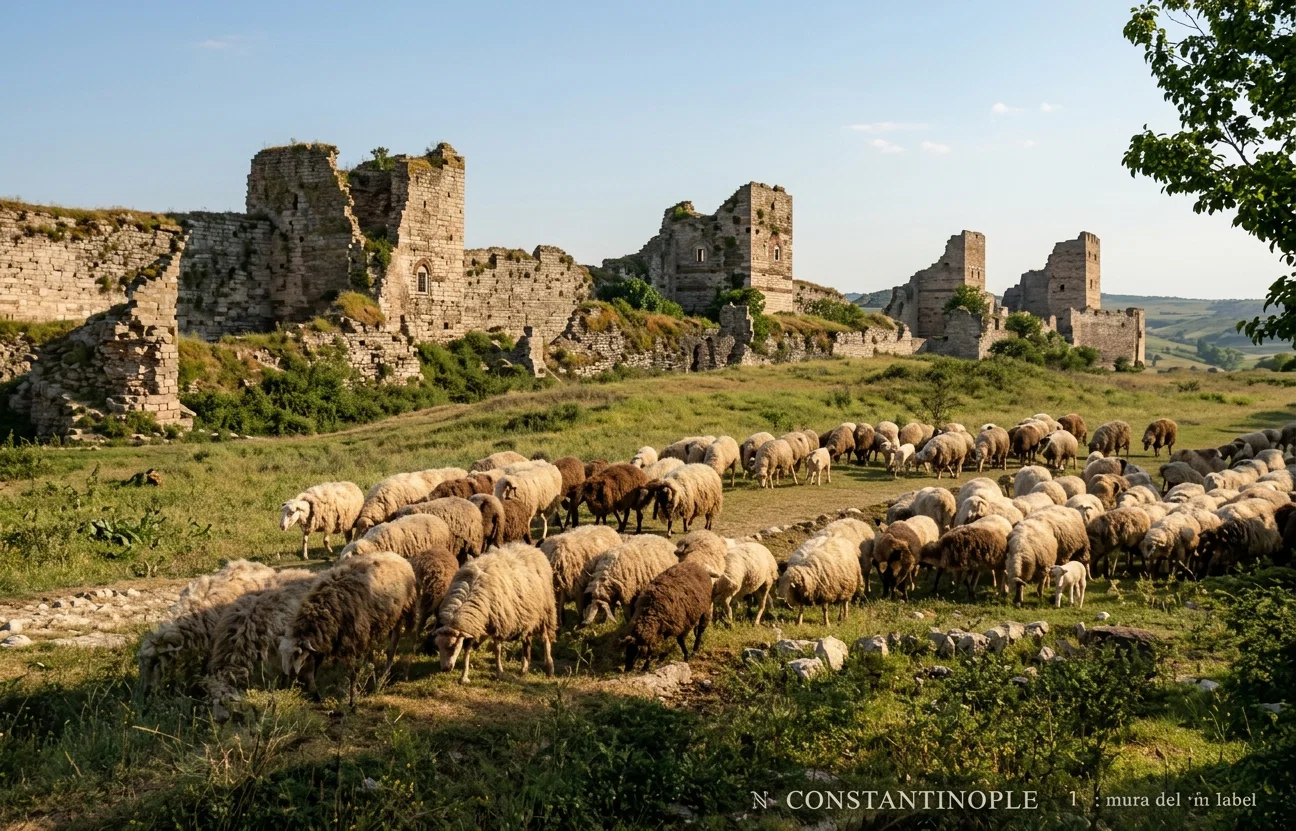
PART OF THE ANCIENT WALL BUILT BY CONSTANTINE THE GREAT, SEPARATING CONSTANTINOPLE FROM THE EUROPEAN MAINLAND
Since last May our religious services have been strictly prohibited here in Constantinople . Our people have been meeting in the open of a large common in one of the suburbs. So during the summer we have spent many pleasant Sabbath days under the cover of a large English walnut-tree, on the Asiatic shore of the Bosporus. The last Sabbath in July the writer baptized seven persons in Constantinople. Our company, together with the candidates for baptism, went by steamer to a remote suburb on the Asiatic shores of the Marmora Sea. After first enjoying a service under a large tree, we proceeded to the baptism. At this point two policemen appeared on the scene, to interfere with our work. They asked what we were about to do. When they learned that we were going to baptize, they forbade it. They wrote down the names of all the brethren, and proceeded to take four of them off to court. I intervened, and through my interpreter persuaded the police that there was no law forbidding us to wade into the edge of the sea, insisting that it made no difference whether the operation be called baptism, or swimming, or anything else,15as far as the legal status was concerned. This kind of logic will not always work in Turkey; but above all was the protecting, overruling hand of our Heavenly Father, and the police were dissuaded from their first course, and they permitted us to perform the rite. As three of those taken into custody were candidates for baptism, these were released. But one, the deacon of our Constantinople church, was held for the whole company, that he might appear before the court, to answer questions concerning what we were doing.
He was held in ward twenty-four hours, and then released on bail. He appeared two days later for examination by the proper officials. In the meantime we sought the Lord to overrule all for the best. When the time for his examination came, only a few simple questions were put to him, and he was released. Thus, what appeared at first, in view of former prohibitions, to be a matter which might develop seriously, turned out to be a complete victory for the truth. Considering that three of the four who were first taken by the police were candidates for baptism, it was no small test of their fidelity to the cause which they had chosen to follow. Of those baptized, two were Jews, two Greeks, and three Armenians.
In Brusa our work is closed up more than in Constantinople. Our brethren there have been forbidden to meet together under any condition whatever. Recently three of them were arrested for meeting together on the Sabbath day, and were fined twenty-five piastres (a dollar United States money) each. These brethren were threatened with exile, if they were found meeting together again. Since this arrest our people have been watched so closely that they have not even ventured upon outdoor services in the edge of the city. I expect to visit Brusa next week. We are seeking the Lord for wisdom, to know how to act under present trying conditions, that no mistakes may be made.
In spite of all these difficulties, the work is gradually progressing, souls are baptized every few weeks, and, with the exception of a very few, our brethren are firm to the principles of our faith. We are planning on holding a general meeting in this western part of the Turkish Mission in the late fall. We hope to gather to this session a good representation of the one hundred seventy believers in this part of the field. Elder Conradi has promised to be present. The meeting will be held in a retired place, where we are not likely to be molested by the authorities.
At present it is impossible to foretell in just what way the Lord will intervene in our behalf, that we may have liberty to preach the gospel. He has wrought for us, and the work is firmly established; and, knowing that he will continue to champion this cause, we are of strong courage in him. Remember Turkey before the throne of grace.
Constantinople, Turkey.
W. A. BARLOW
By W. A. Barlow
Santalia and the Santals—No. 3
W. A. BARLOW
Among the nine million inhabitants of India variously described as aborigines, jungle tribes, demon worshipers, or animists, the Santals are the largest tribe. The Santali-speakers, including both heathen and Christian Santals, number 1,830,143.
Their origin is obscure, but they differ as widely from their Hindu and Mohammedan neighbors as one race of human beings can differ from another. These aboriginal peoples, who are believed to have been the inhabitants of India before the Aryan invasion, have been divided by ethnologists into three groups—the Dravidian, the Kolarian, and the Tibeto-Burman. Mr. H. H. Risley, whose “Tribes and Castes of Bengal,” recently published by the Bengal government, is now regarded as the authoritative work on the subject, describes the Santals as “typical examples of the pure Dravidian stock.” They are dark, often almost jet black in color, with coarse, often curly, black hair, sturdily built, with fine muscular development, and broad, but not unpleasant features, wiry and vigorous, perhaps lazily inclined, but capable of great endurance, and very fond of a free, active, open-air life.
Santal traditions tell of an Adam and Eve, Pilchu Haram and Pilchu Budhi by name, who sprang from two eggs laid by a wild goose. Later, when a deluge of rain-fire destroyed the inhabitants of the earth, a single pair was preserved in the cleft of a mountain.
If the Brahman looks upon the Santal with supreme contempt, regarding him as the offscouring of the earth, little if any higher than the beasts of the field, the Santal repays his scorn with interest. The independent spirit of the Santals has saved them from the common fate of the aboriginal tribes of India, that is, from becoming absorbed into the Hindu system, to become hewers of wood and drawers of water to the more highly civilized races. They are not as a rule cringing or obsequious or prone to self-abasement, but to those who speak their language they are frank and genial. They do not grovel on the ground, nor wipe the dust off your shoes with their foreheads. They stand erect, and look you in the face. In their own language the word for a Santal means a man.
It can not be said that civilization apart from Christianity improves the Santal. The tendency is for him to lose his few virtues and to acquire new vices. The exclusiveness of past ages is breaking down, and where the Santals have not been influenced by Christianity, there is a distinct tendency toward moral and physical degeneracy through more intimate contact with the Hindus.
The suggestion that the Santals are of Mongolian origin is refuted by ethnologists on the ground that the Santal skull belongs to a different type from the Mongolian, as it approaches the dolichocephalic, or long headed, the Mongolian being typically brachycephalic, or short headed.
The tribe is divided into twelve sub-tribes, or septs, of which seven have existed from the beginning, being descended from the sons of Pilchu Haram and Pilchu Budhi, or Adam and Eve. Five more have been subsequently added. Each sept has a password, or shibboleth, peculiar to itself. These septs, again, are subdivided into an almost indefinite number of sub-septs.
The religion of the Santals is little more than a fetish. They are demonolaters. When things are going well with him, the Santal is very little concerned with religion; but when any trouble comes, when there is severe illness in the family, or an epidemic in the village, when the cattle are being carried off by disease, or the crops are dying from want of rain, the Santal believes that these calamities are due to the ill will of the demon-gods, whose anger must be appeased by means of sacrifice. He offers up his fowls, sheep, goats, buffaloes, and as late as 1878 a human sacrifice is known to have been offered.
On the outskirts of each village is a grove of sal-trees, often the finest trees in the neighborhood, for they are not as a rule allowed to be cut down. This grove is sacred to the principal demons, or borgas, each of whom is represented by a piece of quartz, daubed with red paint, at the foot of one of the trees.
In this grove, at festival times, the men of the village assemble,—the women have nothing to do with religion,—and sacrifices are offered by the village priest in the name of the community. (I may say here that the village priest of Babolmohal, where we have our Seventh-day Adventist Santal Mission No. 2, is the chief's youngest son, and I call him Raska, or Joyful. He is a very bright young man, and his work is to look after his father's cattle. It was through this young priest Raska that I secured land on which to start our mission school.) Combined with this there is a form of religion in some respects similar to the ancestor-worship of the Chinese. In the main street of the village a rude shed is found, a thatch supported by five posts, one in the center and one at each corner. At the foot of the central post is a stone or roughly carved piece of wood, sacred to the names of the deceased village chief or head man. Here, too, sacrifices and offerings of various kinds are offered by the villagers. But these by no means exhaust the list of demons. Everything mysterious, everything disastrous, is due to demon agency. Borgas people earth, and air, and water; and every family has its household demon as well, whose name is kept a secret by the head of the house till just before he dies. Then he whispers it to his eldest son. The object of this secrecy is not to give offense to other demons, who are all consumed with jealousy, by letting them know which demon is specially honored with this family's patronage. This demonology also explains the curious custom of giving each child two names, its real or “inner” name, which is kept secret, and its “upper” name by which it is known to the16public.
If the demons were to learn the child's real name, it would give them too much power over it. Another reason is that the child is probably named after some relative whom it is not considered correct etiquette for some members of the family to mention by name.
When preaching to a crowd of Santals, if you ask them if their offerings and sacrifices to the stocks and stones, where they believe the borgas dwell, can do them any good, they will reply, “No, but they can do us a great deal of harm.” That, in a word, is the sum and substance of Santal theology, their body of divinity. They never dream of a god as one who could do them good; such an idea never entered their minds. A god of love would be a contradiction in terms. Their gods are evil, and only evil, and continually evil, and their only idea of worship is the propitiation of their anger by means of sacrifice. Nor has the ill-will of the demons any relation to the evil conduct of men. A demon is a born demon, naturally malignant, and respite from his evil influence is only to be obtained by satiating his thirst for bloody sacrifices. The description of the human sacrifices that once were offered by the Santals and other tribes is of the most revolting nature, because the more blood spilled, the greater suffering inflicted, the better the gods were pleased, and the more efficacious was the sacrifice.
Of the future life the Santal's ideas are exceedingly hazy. Every male must have a number of marks burned upon the extensor surface of the left forearm between the elbow and the wrist, and every female must have the arms and chest tattooed. These ceremonies, it is said, facilitate entrance to the spirit-land, and secure the comfort of the spirit there. After death the body is burned, but a number of charred bones are carefully preserved in an earthenware pot by the nearest relative until it is convenient for him, accompanied by other relatives, to carry them to the sacred river of the Santals, the Damoodah, to the waters or sands of which they are committed with ceremonies that signify that all has now been done that filial duty and a desire for the well-being of the deceased demand.
The Santals speak of Jom-Raj as the king of death, at whose summons they must leave this world, but this is evidently borrowed from Yama, the Hindu god of death. There is a myth among the Santals that in the future world all departed spirits are engaged in grinding the bones of the dead, from which the bodies of new-born infants are supposed to be made; and only two excuses will procure exemption from this toil—if men say they are preparing tobacco for chewing, or if the women plead that they are nursing babies.