Your ShelfYour Projects

Signs of the Times, Vol. 41, No. 39.

Stir Up the Mighty Men
Earlier text: Stir Up the Mighty Men

The Kingdom of God Is Preached

Christ in His Supreme Conflict—His Signal Victory—His Kingdom Everlastingly Assured— Hence the Kingdom Is Now the Theme By FRANCIS MONROE BURG
“The law and the prophets were until John: since that time the kingdom of God is preached, and every man presseth into it.” Luke 16: 16. The paramount question from the beginning has been, Who shall reign and have dominion over God’s creation? Who is the rightful king? It was the will of God that in all things Christ should have preeminence. Col. 1: 18.
Lucifer questioned this right, and instigated a rebellion against God and His Son. As a result, he was cast out of heaven. Rev. 12: 9. We are now waiting for the consummation of the great plan that was devised to vindicate the throne of God and to redeem a disaffected world, when “every knee” shall bow, and “every tongue” shall “confess that Jesus Christ is Lord, to the glory of God the Father.” Phil. 2: 10, 11.

THE DEVIL CHERISHED A HOPE

When it was planned in heaven that the Son of God should become the Son of man,—that He should take upon Him the frailties of humanity, by His incarnation,—the devil began to cherish a hope that he might take advantage of Christ’s human weakness, and by overcoming Him, thwart His plan to save the world.
So it is written that “the dragon stood before the woman, . . . for to devour her Child as soon as it was born.” Rev. 12: 4. In other words, Satan anticipated the coming of Christ into the flesh, hoping to overcome Him, and thus to triumph in the plot that he devised in heaven before he was cast down to earth. He was permitted to make this last futile attempt to overthrow the Son of God, that the venom of his spirit might be fully manifested, and all question concerning his assumed right to reign be dissipated forever.

HIS ATTEMPTS TO DESTROY CHRIST

His first attempt was to destroy the Child that was born. To accomplish this, he inaugurated a wholesale slaughter of innocent children. But the manner of his frustration is familiar to all who have read the simple and pitiful story.
Then the enemy sought to tempt the Son of God and lead Him into sin. Notice his artful and wicked tactics. More than once he insinuates a doubt as to our Lord’s relationship to Him with whom He had been from eternal ages,—“If Thou be the Son of God.” But though weak and emaciated, the Principal of this conflict in the desert withstood the temptations and the cunning of His wily foe, and His confidence in Him who had sent Him remained unshaken.
Another and a last attempt was made to swerve Jesus from His allegiance to His Father. All the splendor of the world was caused to pass in panorama before Him, and was offered Him if He would acknowledge and worship the great usurper. O, the wickedness of this subtle plot to overcome and to overthrow the Son of God! Again Satan is defeated, and retreats before the words that were written, “Thou shalt worship the Lord thy God, and Him only shalt thou serve.”
Then the malicious and murderous spirit could no longer be concealed. The enemy laid a wicked plot to take the life of Jesus. He still hoped to triumph over the One who had been recognized as Prince of the heavenly host. The Son of God was murdered and laid in a stone sepulcher. The seal of the Roman Empire was put upon the mouth of the cave, and a Roman guard stood by. Thank God, in a few short hours the last spark of hope in the heart of Satan was to perish forever! It vanished with the triumphant coming forth of Him of whom it has been triumphantly said ever since, “I am He that liveth, and was dead; and, behold, I am alive forevermore, Amen; and have the keys of hell and of death.” Rev. 1: 18. All tension relaxes, and the triumphant shout goes up to heaven, “Now is come salvation, and strength, and the kingdom of our God, and the power of His Christ: for the accuser of our brethren is cast down”—is conquered.
At this point, attention is called to the fact that the great dragon who awaited the birth of the Child is represented as having “seven crowns upon his heads.” As already noted, a crown signifies a kingdom. Seven means perfection, completeness, fulness. This symbol would suggest that when Satan encountered the Son of God in the flesh, he claimed all right to rule—all right to kingship. The seven crowns would suggest this fact. So the conflict at that time was identical with that in heaven when Lucifer said, “I will sit also upon the mount of the congregation, in the sides of the north: . . . I will be like the Most High.” Isa. 14: 13, 14.
The battle was fought, and the rightful Lord and Sovereign broke the fetters by which the enemy had bound Him, and came forth triumphant forever, with the “keys of the kingdom.”

TRIUMPHANT, AND VESTED WITH POWER

On that resurrection morning, Mary would have worshiped Him as her Master—her King. But He forbade her, saying, “Touch Me not; for I am not yet ascended to My Father.” John 20: 16, 17. He must be assured first that He is recognized in heaven as the rightful Sovereign.
He ascends to God with a “multitude of captives.” As He approaches the gate of the city, His attendants command in clarion tones that the gates be opened and the everlasting doors be lifted, that the King of glory may come in. There comes back the question, as if no other in that intense hour engaged the attention of heaven’s inhabitants, “Who is this King of glory?” In clearest and triumphant accents the answer rings out, “The Lord strong and mighty, the Lord mighty in battle.” Ps. 24: 7, 8.
He enters the city of Zion, her everlasting King. He is vested by His Father with all power—authority—in heaven and in earth. Matt. 28: 18. And to His servants His commission is given, and a full vestment of power, to go forth and win all nations to Him. To them He gave the “keys of the kingdom,” with the promise that the gates—authority—of hell should not prevail against them. When this work is completed, He will come, King of kings, and Lord of lords, to reign forever and ever. He is crowned with many crowns. Rev. 19: 12, 16. “This gospel of the kingdom shall be preached in all the world for a witness unto all nations; and then shall the end come.” Matt. 24: 14.

THE GOSPEL IN THE SETTING OF THE KINGDOM

So now the gospel message is preached in the setting of the kingdom of God. It is the proclamation of the same salvation that was preached by Moses and the prophets, through the same Christ whose charms inspired all the messages of these men of old. Since He is risen and holds the keys, the story of His redeeming grace is set in the framework of the proclamation of His soon-coming kingdom; and we are waiting and praying that His kingdom may come, and His will be done on earth as it is in heaven.
In describing the church under the symbol of a woman who is to give all nations the good tidings of the coming kingdom of God; the revelator represents her as wearing a “crown of twelve stars.” A crown signifies a kingdom—a very fitting symbol of the authority that is now vested in the church, since the conflict of her Lord, and His triumph over the very last of His foes, when He came forth from the fetters of death; and also a fitting symbol of the victorious career of the church under the leadership of her triumphant Lord. In chapter six, the revelator again suggests the same thought. The gospel work is symbolized by a rider upon a white horse, and to him is given a crown; and he goes forth conquering and to conquer.

THE KINGDOM AND THE GOSPEL ARE PREACHED

From the thoughts that have been presented, it is clear why John the Baptist, when he began his preaching in the desert, said to the people, “Repent ye: for the kingdom of heaven is at hand.” Matt. 3: 2. Jesus also gave the same admonition to those who came to hear Him. Matt. 4: 17. And in sending forth the twelve, He told them to say, “The kingdom of heaven is at hand.” Matt. 10: 7.
So the gospel heralds now preach the message of the coming King, the while telling the story of His redeeming love,—the same story of love and free salvation that prior to John was preached by and through the law and the prophets.
“Think not that I am come to destroy the law, or the prophets.” Matt. 5: 17.

Sabbath Desecration and Apostasy

The Jews Carried Captives to Babylon — Clear Testimony as to Why It Was Done — Thousands Slaughtered When They Would Not Fight on the Sabbath — Jewish Leaders Change Their Plans in Consequence
By WILLIAM COVERT
THE prophet Jeremiah was left in the land of Judah when the princes and many of the people were carried into Babylon as captives; but Ezekiel, a contemporary prophet, was God’s spokesman for the captives, and was carried into Babylon.
Jeremiah wrote of the state of things in Jerusalem after the people were carried away. He spoke of the solitary condition of that city which had been so great. Her few poor people would weep in the night until their cheeks were wet with tears, because of the reverses that had overtaken them. He said: “Jerusalem remembered in the days of her affliction and of her miseries all her pleasant things that she had in the days of old: . . . the adversaries saw her, and did mock at her Sabbaths.” Lam. 1: 2-7. The people passing by would hiss, and say in derision, “Is this the city that men call The perfection of beauty, The joy of the whole earth?” Lam. 2: 15.

THE HARVEST OF TRANSGRESSION

Their transgressions had borne fruit, and they were reaping the harvest of their own sowing. We follow the captives into the land of their exile, and listen to their prophet reciting to them the steps which led to their dispersion. It was idolatry mingled with Sabbath desecration that brought them into their troubles. Study Ezekiel, chapters 20-22, entire.
Toward the end of the seventy years of captivity in Babylon, there was a partial reformation on the part of Israel, and they were permitted to occupy again the land where their fathers had dwelt, and Jerusalem was rebuilt. It was then that Nehemiah, in a prayer in the presence of that people, said to God, “Thou camest down also upon Mount Sinai, and spakest with them from heaven, and gavest them right judgments, and true laws, good statutes and commandments: and madest known unto them Thy holy Sabbath, and commandedst them precepts, statutes, and laws, by the hand of Moses Thy servant.” Neh. 9: 13, 14.

TOOK PLEDGE OF SABBATH-KEEPING

This prayer was uttered about 445 B. C. The people were impressed with the importance of renewing their obedience to God, so they made a covenant, and set their seal to it, to refrain from Sabbath transgression from that time. Neh. 9: 38. The pledge they took read, “And if the people of the land bring ware or any victuals on the Sabbath day to sell, that we would not buy it of them on the Sabbath.” Neh. 10: 31.
But Nehemiah did not abide with the people constantly, and so they again became negligent, and their covenant was forgotten. Then Nehemiah returned about B. C. 434; and he says: “In those days saw I in Judah some treading wine-presses on the Sabbath, and bringing in sheaves, and lading asses; as also wine, grapes, and figs, and all manner of burdens, which they brought into Jerusalem on the Sabbath day: and I testified against them in the day wherein they sold victuals. There dwelt men of Tyre also therein, which brought fish, and all manner of ware, and sold on the Sabbath unto the children of Judah, and in Jerusalem. Then I contended with the nobles of Judah, and said unto them, What evil thing is this that ye do, and profane the Sabbath day? Did not your fathers thus, and did not our God bring all this evil upon us, and upon this city? yet ye bring more wrath upon Israel by profaning the Sabbath. And it came to pass, that when the gates of Jerusalem began to be dark before the Sabbath, I commanded that the gates should be shut, and charged that they should not be opened till after the Sabbath: and some of my servants set I at the gates, that there should no burden be brought in on the Sabbath day. So the merchants and sellers of all kind of ware lodged without Jerusalem once or twice. Then I testified against them, and said unto them, Why lodge ye about the wall? if ye do so again, I will lay hands on you. From that time forth came they no more on the Sabbath.” Neh. 13: 15-21.
The testimony of this leader of Israel shows conclusively that the destruction of Jerusalem and their captivity came because of Sabbath transgression.

REFUSED TO FIGHT ON THE SABBATH

With this citation we are brought to the end of the Old Testament history of the Sabbath; but there is Jewish history of importance relating to the Sabbath and to the experience of the Jews in regard to the Sabbath before we reach the birth of Christ. At times during this period of more than four hundred years, the Jews suffered much persecution from the heathen on account of their religion.
In the reign of Antiochus Epiphanes, king of Syria, about B. C. 170, there was great oppression of the Jews, and thousands of them were slain. Probably no people ever suffered more intensely for their religious faith than did many of the Jews during this time. History tells how a thousand men, women, and children were slaughtered on the Sabbath day without resisting their executioners. They were simply hiding in the wilderness because they had refused to obey the heathen king’s decree, which said they should profane the Sabbath day.
Also about the same time, King Antiochus sent twenty-two thousand soldiers into Jerusalem, who, pretending peace, waited until the holy Sabbath day came, then followed the people to their places of worship, and murdered great multitudes, and running through the city with instruments of destruction, slew great numbers without trial or mercy.

JEWISH LEADERS CHANGE TACTICS

But the Jews, seeing that their heathen enemies were selecting the Sabbath as a day on which to slaughter the non-resisting Sabbath-keepers, changed their conduct, and gave commandment to give battle when assaulted on the Sabbath day. The historian says that Mattathias, the father of Judas Maccabeus, and his friends, decreed that “whosoever shall come to make battle with us on the Sabbath day, we will fight against him; neither will we die all, as our brethren that were murdered in the secret places.” 1 Mac. 2: 41.
Therefore, just before the days when Christ was upon the earth, the Sabbath question was in contention, and multitudes were slain in the controversy. The wicked “King Antiochus wrote to his whole kingdom, that all should be one people, and every one should leave his laws: so all the heathen agreed, according to the commandment of the king.” 1 Mac. 1: 41, 42. This unholy decree, like all others of its kind, when interfering with men in matters of conscience, resulted in great cruelty. Many thousands were slain in the struggle which ensued. So will it ever be when men try to be conscience for their fellow men.

The Sin of Being Sick Unnecessarily

AS "none of us liveth to himself, and no man dieth to himself," so one's state of health affects others, not only as it bears upon the question of his living or dying, but also as it tends to mark the degree to which he helps or hinders those whose lives touch his.
The trite assertion that many a prisoner has been hanged because of the judge's indigestion, recognizes one aspect of this subject. And as a person's digestion is controlled, in large measure, by his own habits, he is in the same measure responsible for the ills that result from its impairment.
Doubtless many errors against health are due to ignorance, but an unimpeachable authority reckons ignorance as sin. It certainly is not a thing to be hugged to one as a shield against self-conviction and reform.
In matters of health, as in those considered more strictly spiritual, the worst transgressors are the self-complacent—those who, while ignorant of the most important principles, either consider their fragmentary knowledge as all-inclusive, or else think the entire subject unimportant, mayhap even glorying in their disregard of its laws.
However, many failures to guard the health are due not to ignorance, but to indolence, or vanity, or greed, or appetite, or other equally ignoble causes. Few persons of ordinary intelligence are not cognizant of the fact that physical exercise is essential to health, and that a restriction of any organ of the body is incompatible with its normal function, also that chilling of the feet and ankles is a cause of divers maladies. Neither do many persons lack the knowledge that too long continued exertion of muscles or mind not only endangers the organs thus taxed, but also interferes with the operations of other organs, specially by keeping from them the supply of blood they need.
Not a few of those who despise the gormand and the drunkard, are themselves victims of pampered appetite—appetite for confections, or for too highly seasoned foods, or for the ordinary stimulating table beverages, as tea, coffee, and chocolate. That these beverages are stimulants merely, and not nutrients, is coming to be generally acknowledged by people who have given intelligent study to the subject.
Another fact that is becoming more widely recognized each year, is that the food of many persons consists too largely of protein, specially meat, such a diet tending to rheumatism, disease of the kidneys, and innumerable other ills.
When the meat used includes shell-fish, as lobsters, crabs, and oysters, or the equally objectionable swine, still another element of danger is added.
Wholesome habits of life bring abundant reward in freedom from depression and pain, in vigor and endurance.
ADELAIDE D. WELLMAN.

The Last Truce

UNENLIGHTENED by Bible prophecy, the people of earth have persisted in declaring that the nations had become too civilized ever to use the mighty implements of war frantically constructed in the past several years. These false assurances were foretold in Isa. 2:3 and other scriptures. The present terrible conflict has therefore taken the untrue prophets by surprise, and again confirmed the word of God.
The awful war drama of the day has caused many trembling hearts to ask whether there will be peace again on earth. Now, it is evident from the description of the last battle, in Rev. 16: 14, 16, that to-day's war is not the final battle. The last battle is fought during the sixth plague, in the "great day of God," after the close of the day of salvation. The plagues have not yet begun to fall, and, praise the Lord, salvation still lingers!
We get a definite clue to the situation by carefully examining Rev. 7: 1-3: "And after these things I saw four angels standing on the four corners of the earth, holding the four winds of the earth [war and strife from every point of the compass], that the wind should not blow on the earth, nor on the sea, nor on any tree. And I saw another angel ascending from the east, having the seal of the living God: and he cried with a loud voice to the four angels, to whom it was given to hurt the earth and the sea, saying, Hurt not the earth, neither the sea, nor the trees, till we have sealed the servants of our God in their foreheads [the seat of intellect, the mind]."
An analysis of the above three verses results in the following conclusions:
The winds of war were held. It was given to hurt the earth. A truce was called.
It seems clear, from the above, that we have passed the time of the restraining providence which held in check the passions of men.
We are plunged into the period designated as hurting the earth. This is certainly accomplished in Europe to-day.
In answer to the cry that God's servants have not yet been reached and sealed for the kingdom, the great war must be halted, and a truce established.
This truce occupies a short period of great intensity, and the sole purpose of such a moment in God's providence is the finishing of the gospel message to the world.
From the statement that this truce lasts "till" the servants of God are sealed, it follows that the last sounds of this pleading, warning message will usher in the final time of war, in which there will be no truce, and which culminates in the dreaded Armageddon on Turkish territory in Palestine.
It is time for us to seek a hiding-place from the storm. "I will say of the Lord, He is my refuge and my fortress: my God; in Him will I trust." Ps. 91: 2.
EUGENE A. BROWN.

Superstitious Use of the Bible

THE Bible is God's word, and should be used reverently and thoughtfully. Some make a practise of opening the Bible at random, and being guided by the first passage they see. While it may be that God has sometimes directed the mind in this way, yet as a rule it is not safe thus to risk the possibility of letting the devil guide the hand. The Bible tells us to search the Scriptures, and not use them in a haphazard way.
Texts taken from their proper setting are used by Satan to blind the eyes of those who are fanatical or superstitious. This use of the Bible savors of magic. A certain minister was once cured of this habit by consulting his Bible on an important matter, and opening it to the text, "Hell from beneath is moved for thee to meet thee at thy coming."
ELIZA H. MORTON.

In Whose Hands Are the Keys?

GREAT stress is laid by some upon what they count as a fact, that the keys to the kingdom of heaven are in the human hand of Saint Peter. There is no word of Scripture confirming this, which, were it true, would be the greatest calamity that could befall a sinful race.
Ah, no! the keys are in another hand, the hand of the mighty Son of God, human, to be sure, but infinitely more, being also divine. Jesus says, "I am the door." "No man cometh unto the Father, but by Me." "Fear not; I am the first and the last, and the Living One; and I was dead, and behold, I am alive forevermore, and I have the keys."
Not only is Jesus the door, but the keys are in His hand. The Son of God knows the innermost motives of the soul. He is the One who searches the reins and the heart, and makes no mistake—being the Sinless One. He holds the keys to the tomb, and His bruised hand holds also the keys to the gates of Paradise. And no one enters there until His hand swings back the gates of pearl upon their glittering hinges. For this let us ever thank God.
T. E. BOWEN.

Humbugs

MANY substances advertised as pure, genuine, unadulterated, and some even under the "pure food law," belong to the spurious category. They should come under the head of frauds, fakes, humbugs, and quackery. Beware of them.
No expense is spared in contriving large and showy advertisements of "sure cures" for every ailment. Some advertisers resort to one method, and some to another.
Hundreds of testimonials are easily drawn up, by persons employed for that purpose, declaring marvelous cures effected by these so-called remedies; and by such testimonials, many persons are deceived.
Some forty-eight years ago, I passed through an experience of this kind, which taught me a lesson never to be forgotten. Several testimonials were given me by charlatans, and I spent half a day searching for four or five of the writers. Not one of them ever lived at the places designated.
Mrs. H. E. Sawyer-Hopkins.

Help for Stranded Sailors

A PLEA is made for funds to help the impecunious sailors stranded in San Francisco on account of the war. The money expended in one day in that city for drink and lust would keep these stranded sailors for a year, and the men who lost the drink and lust indulgence would be infinitely better off without them. W.

PREDICTED RELIGIOUS DESPOTISM

Is Twentieth Century Civilization to See It?—Numerically Strong Religious Combines Are Dangerous—The Principles Involved in Sunday Laws

ONE of the measures to be voted on at the election in California this fall is a one-day-of-rest-in-seven law. Regular weekly rest days, without any question, have their basis in religion, and one of the principal factors in the history of this world has been religious despotisms.
But the people of this age have been assuring us that history will not repeat itself in this thing, for our civilization, we are told, has advanced beyond the point of permitting it. But we have also been assured that our civilization has reached the place where we would have no more wars; yet the great war of this present year, 1914, in the Old World, with its inhuman, barbarous butcheries, ought to be sufficient to dispel that delusion. And it ought to lead us to an intelligent realization of the fact that we can not depend upon mere civilization to prevent anything. Hence our civilization may not be a sufficient bulwark against any future religious despotism.

THE MOST CRUEL AND TYRANNICAL

Of all the despotisms that may curse humanity, religious despotisms have ever been the worst, the most cruel, and the most tyrannical. In fact, some form of religion—either idolatrous heathenism or else perverted Bible religion—has been the foundation of the tyrannies and the cruelties that have cursed and tortured humanity.
Looking about us to-day, are there any indications that history might repeat itself by giving us a twentieth century religious autocracy? The world is full of moral, political, and social problems that are staggering the best of men as they seek to cope with them. The sentiment is growing stronger every day that the only power that can meet the situation, that can give us peace among the nations, that can still the strife between capital and labor, that can deal with the political bosses who are corrupting cities and states and nation, that can cope with the white slave traffic—in a word, the only power that can successfully handle all the problems that are confronting us—is the power of the combined church. Hence well-meaning men in every nation of the world are seeking for a combination that will concentrate the great influence of the church, both Protestant and Catholic, upon evils that are threatening our civilization and existence.

BASED ON MERE FORCE OF NUMBERS

But while these men have high hopes for their success, yet these hopes are based upon the mere force of their numbers. Their plans are of a political order rather than the gospel plan of depending upon the Spirit and power of God regardless of numbers. "Not by might, nor by power, but by My Spirit, saith the Lord of hosts." Zech. 4:6.

ALWAYS RESULT IN TYRANNY

Such church combines in all the history of the world have invariably resulted in tyrannies. It matters not whether these combines have been in the form of the polytheism that threw the Hebrew children into the fiery furnace, or in the form of the Jewish religion that crucified the Christ Himself, or in the form of the avowed followers of the Crucified One who have cruelly put millions of people to death in His name.
In passing upon the question of Sunday mails in 1829, our United States Senate, among many other important things, had the following to say:
"Extensive religious combinations to effect a political object are, in the opinion of the committee, always dangerous. . . . If admitted, it may be justly apprehended that the future measures of the government will be strongly marked, if not eventually controlled, by the same influence. All religious despotism commences by combination and influence; and when that influence begins to operate upon the political institutions of a country, the civil power soon bends under it; and the catastrophe of other nations furnishes an awful warning of the consequence."
Lord Macaulay said:
"The experience of many ages proves that men may be ready to fight to the death, and to persecute without pity, for a religion whose creed they do not understand, and whose precepts they habitually disobey."

ONE OF THE MOST GRAPHIC PROPHECIES

One of the most graphic prophecies in the Bible, without question, foreshadows a religious despotism that will yet arise and be world dominant. That prophecy reads:
"And I beheld another beast coming up out of the earth; and he had two horns like a lamb, and he spake as a dragon. And he exerciseth all the power of the first beast before him, and causeth the earth and them which dwell therein to worship the first beast, whose deadly wound was healed. And he doeth great wonders, so that he maketh fire come down from heaven on the earth in the sight of men, and deceiveth them that dwell on the earth by the means of those miracles which he had power to do in the sight of the beast; saying to them that dwell on the earth, that they should make an image to the beast, which had the wound by a sword, and did live. And he had power to give life unto the image of the beast, that the image of the beast should both speak, and cause that as many as would not worship the image of the beast should be killed. And he causeth all, both small and great, rich and poor, free and bond, to receive a mark in their right hand, or in their foreheads: and that no man might buy or sell, save he that had the mark, or the name of the beast, or the number of his name." Rev. 13: 11-17.

INVARIABLY A RELIGIOUS DESPOTISM

The symbolic beast power spoken of in such prophecies as this, invariably refers to religious despotisms. Sometimes it is the despotism of a heathen religion; sometimes it is the despotism of the professed but apostate followers of the God of the Bible. Observe that this beast power that is to arise, and which forms an image to the preceding beast spoken of in the first part of this thirteenth chapter of Revelation, demands worship, and enforces its worship by miracles. That this is a religious power goes without question, for outside of religion men mock at the idea of miracles. This power demands worship else it will inflict the death penalty. This is an invariable characteristic of religious tyrannies.
This power appeals to the people by "saying to them that dwell on the earth, that they should make an image to the beast, which had the wound by a sword, and did live." This shows that it will be a popular movement, and that the great masses, through influential leadership, will be called to decide upon the question.
There will also be power actually to give life to the beast mentioned in the first part of the chapter, and it will have the power granted to it to demand worship. In civil society such power resides in the state itself. This shows that this ecclesiastical despotism will actually get control of the state.

MAKES USE OF THE BOYCOTT

Furthermore, it uses the boycott in its method, because it utters the decree that no man might buy or sell unless he would receive the mark and authority of this man-made church organization.
These times in which we live are characterized most strongly by the development of that sentiment known as the boycott, which will destroy a man's business, his trade, or whatever may be his occupation, unless he subscribes to the ideas and views of those who are in authority. The boycott is not confined by any manner of means to labor organizations, although in the main they get the blame for it. The men of wealth operate the boycott in principle, and the laboring men have learned it from them. And the church herself is even taking it up in some of her lines of work.

ALIVE AT THE CLOSE OF TIME

That the great power of which this prophecy speaks is a living, active agency at the close of time is certain, for we read:
"And the beast was taken, and with him the false prophet that wrought miracles before him, with which he deceived them that had received the mark of the beast, and them that worshiped his image. These both were cast alive into a lake of fire burning with brimstone." Rev. 19: 20.
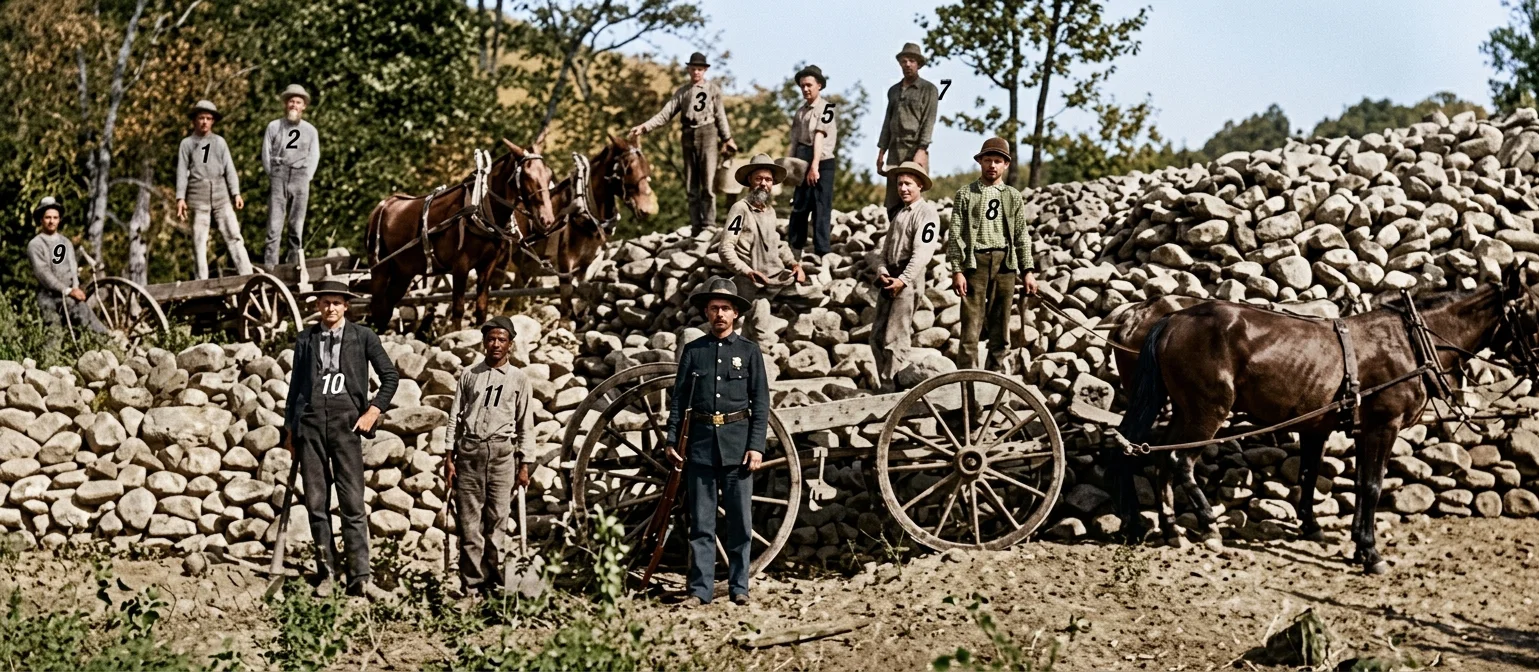
Photograph of men working in the chain-gang in our free and liberty-loving America. Some are Seventh-day Adventists, and their only crime was that of working on Sunday after they had conscientiously kept Saturday, the seventh-day Sabbath of the Bible. Nos. 1-7 are Sabbath-keeping Christians; 8, teamster; 9-11, common criminals; 12, guard with gun.
This verse unmistakably refers to the power under consideration, as noted in the thirteenth chapter, and shows that it will be on the stage of action, living and active, when Christ comes, and that it is thereby destroyed.

A FEARFUL WARNING

Against this power of apostasy and despotism that will seek to coerce the consciences of men, there is the following warning:
"And the third angel followed them, saying with a loud voice, If any man worship the beast and his image, and receive his mark in his forehead, or in his hand, the same shall drink of the wine of the wrath of God, which is poured out without mixture into the cup of His indignation; and he shall be tormented with fire and brimstone in the presence of the holy angels, and in the presence of the Lamb: and the smoke of their torment ascendeth up forever and ever: and they have no rest day nor night, who worship the beast and his image, and whosoever receiveth the mark of his name. Here is the patience of the saints: here are they that keep the commandments of God, and the faith of Jesus." Rev. 14: 9-12.
One of the planks that is put in the forefront by all these federated bodies of Christian workers, is that we must have a universal Sunday law. They tell us that our civilization depends upon it; that in overthrowing the evils of the time, it is essential that we have a law in favor of Sunday, not only that men may have time to worship, but that the laboring man may have rest with his family at home.
There can be no objection to any man's observing Sunday or any other day that he may choose; but when it comes to enforcing the day by a state law, the state is asked by the church to take sides in a religious controversy, and to enforce a day that is essentially a church affair.
It is well for the men of this time to remember that the great religious despotism of the Dark Ages was prefaced by the universal Sunday law of Constantine. And is not history struggling to repeat itself through a religious despotism that is now coming to the forefront in its vigorous efforts to compel every individual to keep Sunday? The prophetic utterances quoted in these paragraphs concerning a religious despotism that is to be formed, are from the infallible words of Jehovah. It is well for each individual to study carefully what God has so definitely said.

A WORD TO OUR READERS

We send no papers from this office to individuals without pay in advance. When persons receive copies without ordering them, they are sent by other parties, and we can give no information in regard to them. Persons thus receiving copies of the SIGNS are not indebted to the office, and will not be called upon to pay for them. Please read the papers you may receive, and hand them to your friends to read.

DATE OF EXPIRATION

The SIGNS wrapper bears date of last issue due on your subscription. Unless renewed in advance, paper stops with expiration date.
If herewith is an order-blank, you will know you have overlooked sending renewal. You will not wish to miss a single issue. Back numbers often can not be furnished.

SCRIPTURE QUOTATIONS

Our authority for the doctrines we teach is the Bible. Quotations are usually from the King James Version or the American Standard Revised.
Continue reading: THEY ARE RELIGIOUS BLUE LAWS