Your ShelfYour Projects

Signs of the Times, Vol. 41, No. 39.

Stir Up the Mighty Men
Earlier text: The Kingdom of God Is Preached

THEY ARE RELIGIOUS BLUE LAWS

Recent Occurrences of Intolerance in the United States — Do We Want Laws That Make Such Things Possible?

THERE has come to hand a pamphlet from the secretary of state, containing a list of the forty-eight amendments and statutes to be voted upon in the coming November election in California. On page 84 appear the arguments pro and con regarding the proposed law demanding one day of rest in seven. In the affirmative argument (?) is found this statement about Sunday laws throughout the United States: "No one has been so bold as to claim that in so doing [making these laws] religious or blue laws are being forced upon the people."

IMPRISONED FOR THEIR RELIGION

Had the author of that statement been well informed, he would not have made it. Let him read of the persecutions in Eastern and Southern states for Sunday labor during the last twenty-five years, and he will learn that within that time no less than seventy-six Seventh-day Adventists were made to suffer imprisonment, or serve terms in the chain-gang. Such usage was endured in Tennessee, Maryland, Arkansas, and also in Canada. The names of most of these sufferers, as well as their terms of imprisonment, can be readily furnished.
But it may be asked, Was it understood that such prosecutions were for the violation of religious statutes? Let court statements during some of these trials answer the query. In the trial of three men in Paris, Tennessee, the sheriff remarked, as he turned over his prisoners to the court, that they all seemed very conscientious in their course. To this the judge replied, "Let them educate their consciences by the laws of Tennessee."

SINGLED OUT THE ONE MAN

Again, in the case of the state versus King, another prosecution for working on Sunday was before the Supreme Court of Tennessee in 1890. This trial was incited by a vigilance committee of church-members, all sworn to uphold Sunday observance, in opposition to the observance of another day of rest. Any others in that region, except seventh day observers, hunted and fished on Sunday as they chose, and in many instances did common labor on that day without fear of molestation.
In the prosecution of Mr. King, the attorney-general said, among other things, regarding interference with rights of conscience, as introduced by the defendant's attorney: "No, sir; away with all such foolishness, and everything of the sort! I do not care anything about the Adventists, whether they are right or not. When they come here they must walk up to the rack, and eat the same fodder that our folks eat."

THE LANGUAGE OF INTOLERANCE

Such language tastes strongly enough of religious persecution; and Mr. King was persecuted to his death, over this one point of Sunday labor. It was the only offense.
This makes an act which is perfectly legitimate on six days of the week, indictably wrong when performed on Sunday. It is therefore not the deed done that constitutes the affront, but the day on which it is done. Why, then, single out a certain day on which an act performed is accounted wrong, when the same deed may be done with impunity on every other day of the week? It can be for no other reason than that Sunday is considered sacred time, and the law is demanded to continue it so.
This fastens the conviction that all prosecution for Sunday labor is for religious reasons; and no one can well deny this, because all Sunday legislation, and all prosecutions for Sunday labor, in the history of this nation, have grown from religious regard for Sunday as a day of rest. Come, then, and let us be reasonable in our course of conduct, and allow others the same right of choice we claim for ourselves. J. O. C.

WANTED—600,000 MEN

In a "War Extra" of September 4, this item was found: "War Secretary Kitchener wants 600,000 men before the middle of the coming week." This additional call for England's young men to follow the many thousands already sent to the carnage fields of Europe, was a startling summons, which brought forth expressions of surprise on the part of some, and of ominous forebodings of others. A small number, however, saw in it an omen of prophetic latter-day fulfilment. The following verses by Edwin Kingsley Hurlbut, which appeared in the Los Angeles Tribune for September 13, set forth the awful condition calling for this great national sacrifice, and then, as though comprehending something of inspired prophecy relating to this time, ask the great question about Armageddon's era, which so many are now studying. Here are the interesting lines which so vividly portray the dire situation:
"Wanted, six hundred thousand more Of Britain's best and bravest sons, O'er fields of France their blood to pour, And feed their flesh to German guns. Ten thousand now are lying slain Of those they sent but yesterday, And thousands more on beds of pain With shattered limbs their tribute pay.
"Ten thousand rush to fill the breach Where Death's hand reaps the human grain, And farther than the eye can reach Fresh victims surge across the plain. Into this gorge of fire and blood Vast armies pour their battle tide In vain attempt to stem the flood And save from stain each nation's pride.
" 'Wanted.' Who wants them and for what? 'Lord Kitchener calls them for King George!' And forth they swarm, from peasant hut, From city mart and mine and forge; From Scotland's heathered hills and vales, Killarney's lakes and Shannon's banks, With dauntless sons and sires of Wales.— Onward they press to fill the ranks.
"The columns march, the ships are manned, For England's honor, pride, and name. Midst ringing cheers they leave the strand, Some doomed to death, some marked for fame. But who shall ease the orphan's pain And heal the widow's broken heart, And till the fields and sow the grain, When crimson war has played its part?
"And where is God? Each nation prays To Him for victory in the fight. And where is Christ, whom war betrays, Quenching with blood each beacon light? Is this the 'Armageddon' doom In Revelation's book foretold? Soon, bursting through war's lurid gloom, Will earth her Saviour's form behold."
J. O. C.

26 — GOD IS SPIRIT

It seems to me that the spiritual body may be and is visible to the mortal eye, and that spiritual beings can carry on conversation with mortals in their own mortal familiar language. See Luke 24: 39; John 4: 24. The Saviour ate fish and honeycomb after His resurrection, and I understand He was a spiritual being.
There is a difference in the meaning of the various uses of the term "spirit." Sometimes it means simply the life, the life God-given; sometimes it means a spiritual being. In such a way it is used in John 4: 24, "God is a spirit," or, as the margin of the Revised Version reads, "God is spirit."
These spiritual beings seem to have the power to make themselves visible or invisible to humanity. Angels of God are around His children on every occasion. "The angel of the Lord encampeth round about them that fear Him, and delivereth them." Ps. 34: 7. Sometimes these angels have been made visible. Generally they are not. Sometimes they appear as men. Our Lord, as a spiritual being, walked with the disciples on their way to Emmaus, ate with them at the table, and then vanished from their sight. He returned an invisible being with them to Jerusalem, although they did not know that He was present. But shortly after they had met with the disciples at Jerusalem, He again appeared to them, and said to them, "Handle Me, and see; for a spirit hath not flesh and bones, as ye see Me have." The evident thought implied in Luke 24: 39 is that the disciples themselves thought Jesus was a ghost.
It is preeminently true of fishermen that they are superstitious; so they thought it was a ghost they saw when Jesus walked on the sea. His purpose in eating before them was to show that He was not a mere phantom; He was a real being with substance—flesh and bones. He showed them His hands and His feet that had the marks of the nails.
In fact, spiritual beings are more real beings than these mortal beings. They are composed of finer material, but it is not the less substantial material. "The first man Adam became a living soul. The last Adam became a life-giving spirit." 1 Cor. 15: 45. And so, according to the previous verse, there is the natural body and there is also a spiritual body. Flesh and blood, mortal man, corruptible man, shall not inherit the kingdom of God; but the purified spiritual beings shall enter it.

27 — THE LORD'S ANSWER TO THE THIEF

Did the Lord grant the request of the thief the same day that it was made? Luke 23: 43. C. M. D.
The request of the thief was this: "Lord, remember me when Thou comest into Thy kingdom." One of the common subjects in our Lord's preaching was the kingdom and the setting up of that kingdom. He taught the prayer, "Thy kingdom come." In the parable of the pounds, as recorded in Luke 19, the kingdom of God is likened to a man that called his servants to him and divided among them money, and on his return called them to account. He himself went away for a time. When he comes again, he will receive his kingdom. See Luke 19: 11-13. Jesus is the nobleman that went into a far country to receive to himself a kingdom and to return.
Matt. 25: 31 teaches the same truth,—that the kingdom will be set up, or that Christ will sit on the throne of His glory, when He comes the second time; and verse 34 of the same chapter shows that His own children will not inherit the kingdom until the Judgment is over. That kingdom is this earth, for it is the kingdom that is 'prepared for you from the foundation of the world.' The same thing is taught in Dan. 7: 27. 'And the kingdom and the dominion, and the greatness of the kingdoms under the whole heaven, shall be given to the people of the saints of the Most High: His kingdom is an everlasting kingdom, and all dominions shall serve and obey Him.'
Once more in Rev. 11: 15 we read: 'And the seventh angel sounded; and there followed great voices in heaven, and they said, The kingdom of the world is become the kingdom of our Lord, and of His Christ: and He shall reign forever and ever.'
What was the request of the thief?—'Lord, remember me when Thou comest into Thy kingdom.' It could not be fulfilled that day, could it? That would be utterly impossible, for Christ did not then enter His kingdom. He had not even ascended to the Father; for the third day after this, He said to Mary, who was about to clasp His feet in her ardent worship of the Master, 'Touch Me not; for I am not yet ascended unto the Father.' John 20: 17. The Father dwells in Paradise. 2 Cor. 12: 2, 4. In Paradise is the tree of life. Rev. 2: 7. And the tree of life is near the throne of God. Rev. 22: 2. That Paradise, and that tree of life, and that city in which these are, will descend out of heaven, and the city will become the capital of the new earth. Rev. 21: 1, 2. Then it is that Christ will fully enter into His kingdom, and then it is that the request of the thief will be fulfilled.
Jesus answered him that day, but the answer will not be met until our Lord enters His kingdom in the New Jerusalem. Therefore His words, 'Verily I say unto thee to-day, Shalt thou be with Me in Paradise,' or to put it in the way we usually would, 'Thou shalt be with Me in Paradise.' This is simply a different form of putting a declaration. It is common in Old English. See, for instance, Rev. 2: 7, 'Will I give,' equivalent to 'I will give'; also verse 26, 'Will I give authority,' equivalent to 'I will give authority,' even as it reads in verse 28, 'I will give him the morning star.'
What then was the import of the words of Jesus?—Simply this,—that in the darkest hour of Christ's sojourn here upon the earth, when He was dying as a malefactor upon the cross, the thief's faith pierced the darkness, and embraced Him as the Son of God, who would come according to His promises, and save His people. He doubtless had been among the throngs that had heard Christ preach. He wanted a part in that future kingdom of which the perfect character dying at his side should be the King. And as the thief had faith in that dark hour, to express his belief, so Jesus had the assurance to answer, 'I say unto thee to-day, Shalt thou be with Me in Paradise.'
'To-day' is an adverbial phrase which might modify the verb 'say' or the verb 'shalt be.' The whole tenor of Scripture demands that the adverb 'to-day' shall modify 'say.' 'Verily I say to-day unto thee, Thou shalt be with Me in Paradise'; that is, when He comes to set up His kingdom.

28 — DEATH OF HEROD THE GREAT

At what time did Herod the Great die? I would like to know from the Bible or history, or both. C. M. D.
We have no record in the Bible as to when Herod the Great died. We must not confound Herod the Great with other Herods that followed. Herod really was the family name, and the Herodian family included not only Herod the Great, but Archelaus, Herod Antipas, Philip, Herod Agrippa I, and Herod Agrippa II.
Herod the Great was placed in power by Rome. His whole career was one of cruelty and bloodshed. His father died by poison, and he assassinated the poisoner. His equally wicked or more wicked sister, Salome, urged him to crime. He gave orders that his own wife Mariamne, the Asmonean, should be put to death if he did not return when he went to meet Mark Antony. Two men, learning of this secret, were both executed. One of his wives he murdered, another he cast aside. Mariamne learned of his order concerning her, and hated him intensely as a result. Not daring to dispose of her secretly, he charged her with adultery, and she was executed. Two of Herod's sons, becoming too popular after they had been educated in Rome, were charged with treason, which resulted in their death. Augustus left the sentence of his last son to Herod. The son was put to death. His son Antipater was put to death five days before the father died, upon which it is said that the Roman emperor remarked, "I had rather be Herod's sow than Herod's son." He died at the age of sixty-nine, a few days before the Passover, B. C. 4. His death scene, it is reported, was awful as regards both his mind and his body. See any good Bible encyclopedia.

30 — JACOB AND ESAU

I can not understand why God should love Jacob better than Esau, for Jacob and his mother were deceitful, and told a lie. Why should God bless him more than Esau?
We do not know how many lies Esau told. The Lord does not tell us that. Somehow or other, He has told us about all the sins that His people committed which hindered. It has been Satan's special object to get God's people to commit sin. This has ever been true; and so the devil must have planned preeminently to destroy Jacob, the one through whom the promised Seed should come.
But it is worth while to know that in the great choice which the two brothers made — an eternal choice, a choice involving eternal character — unconverted though Jacob was, he stood for God's plan. The birthright was everything. Esau was willing to sell it for a mess of pottage. Jacob longed for it above everything else, and being unconverted, he was willing to use any worldly means he could to secure it. We find, however, his humble and heartfelt repentance following. As he returns from Syria and meets Esau, he could tell the Lord that he was unworthy of the least of all His mercies. In his wrestling with the angel at the ford Jabbok, the heart of Jacob is emptied and yielded to God forever; and as a result, we find the change of his name, indicative of the change of character. No longer should his name be called Jacob, the supplanter, but Israel, the prevailer with God. See Gen. 32: 22-30.
It is character, then, to which God refers in saying, "Jacob have I loved, but Esau have I hated." The passage is found in Mal. 1: 2, 3. But you can readily see, by reading the context, that it is not Jacob as an individual, but Jacob as a people, and Esau as a people. The reason why God loved the one was because the one sought Him and followed Him. The other not only turned away from God, but turned their hands against every man.
Neither does it mean, by "hate," that God cherished evil feelings against Esau. It is the Lord's own prophet, Isaiah, through whom He pleads. "Look unto Me, and be ye saved, all the ends of the earth." And Esau is included among those whom the Lord would save.
It is well for us to remember that these persons who stand out in the Old Testament are frequently taken for types of character, as for instance, Cain and Abel, Esau and Jacob, Ishmael and Isaac, Jezebel and Elijah. To remember this will help us to understand some of the references made to them in later scriptures.

29—THE DATE OF THE DELUGE

Will you kindly inform me why the date of the Flood in the Bible is 2348 B. C., and historical works credit the Babylonian and Egyptian dynasties with passing on down beyond that date, without any reference to the Flood, claiming that the dates were obtained from unearthed tablets?
A more exact date for the Deluge would not be a date B. C., but a date A. M. (Anno Mundi). That would be 1656 A. M., that is, the year of the world. According to Archbishop Usher's chronology, that was 2348 years before Christ. The Septuagint gives a number of years more than this. There is a general agreement, however, concerning the first 1656 years. This can be learned from the age of the patriarchs from Adam to Noah.
The dates gleaned from the tablets by archeologists are very uncertain. Some of the most learned archeologists declare that there is nothing as yet found that would in any wise upset the general Bible chronology, that is, that would carry civilization back farther than the Bible carries it. Some of these things that are found may have antedated the Deluge. We do not know anything that would forbid this. It is safe to say that we can hold in a general way to the commonly received Biblical chronology. The dates of the archeologists yet are too uncertain to be depended upon.

31—FACTS REGARDING THE BIBLE

Will you please state if you consider the whole Bible written by inspiration? Some of our teachers say that only part of it is inspired. S. C. H.
We have no reason to regard any part of the Bible as more inspired than any other parts. Concerning the Old Testament Scriptures, the Scriptures which were in existence in the days of the apostle Paul—for the New Testament was not written then—we read, "All Scripture is given by inspiration of God,"—literally, "God-breathed." 2 Tim. 3:16. We do not understand by this, however, that the translation is inspired, but the original Scriptures are inspired. The translation is simply turning the Scriptures into another language. There are many other expressions which indicate the same thing. In Acts 1:16, for instance, in referring to the Psalms, Luke does not say that they were David's words, but, "The Holy Spirit spake before by the mouth of David." The same thought is expressed in Heb. 3:7. Peter tells us that "holy men of God spake as they were moved by the Holy Ghost." 2 Peter 1:21. The apostle Paul says of his own writings, "Which things also we speak, not in the words which man's wisdom teacheth, but which the Spirit teacheth." 1 Cor. 2:13.
In many instances inspiration records the words of others; and many times the words of others recorded in the Scriptures are not inspiration. For instance, we read in Genesis 3 that Satan said so and so. Satan's words were not God-breathed, but the record that tells us about them is. So in the case of some of Job's friends. They said many good things. They made wrong application of the good things. Their words were not necessarily inspired, but the record which gives their words is inspired.
If we were to judge as to what is inspired and what is not inspired, in a little while all the word of God would be set aside. Whatever did not agree with us, or with our judgment, or with our tastes, or with our desires, would be set aside as not of inspiration. Others would reject other parts, until nothing would be left of the Bible but the covers. Better it is, it seems to us, to regard the Word even as our Lord Jesus Christ did. He ever spoke of it reverently. He never questioned. He quoted from Isaiah and Jeremiah, from the Psalms, from Moses, but He always regarded it as the word of God.

SYSTEMATIC BIBLE STUDY

As a mental stimulus in divine things, the proverbs of Solomon, that we will be reading for the next few weeks, are superexcellent. They are made up of divine wisdom, presented in such terse sentences that the student is entertained, and at the same time mentally energized and spiritually built up. In the chapters for this week, personified Wisdom tells us of her wonderful powers. And this personification of wisdom really represents Christ Himself, who, as we have already found in Isa. 9:6, was to be called Wonderful, Counselor, the mighty God, the everlasting Father, the Prince of peace. In 1 Cor. 1:30, a similar thought is expressed: "Christ Jesus, who of God is made unto us wisdom, and righteousness, and sanctification, and redemption." And in the twenty-fourth verse of the same chapter, we read, "Christ the power of God, and the wisdom of God." In Him "are hid all the treasures of wisdom and knowledge." Col. 2:3. The individual who is connected with Christ, is connected with the fountainhead of all wisdom.

SCHEDULE FOR THE WEEK ENDING OCTOBER 10

Read three chapters each week-day, and five on the Sabbath.

Marvelous Providences in Mission Fields

The On-Moving Forces Can Not Be Stopped — Prophecies of Men and Movements That Fulfil God's Plans — Strong Prediction of a Great World-Wide Warning Message

By ROSS C. PORTER
Superintendent of the Asiatic Division of Our Mission Work
MISSION life is not a romance, but there are numerous experiences in frontier mission fields that are more interesting than are fables. Real life in missions is so varied as to require the most resourceful plans to meet conditions.

TO BE CARRIED BY PERSONAL TOUCH

Infinite wisdom ordained the plan of carrying the gospel to a lost world through the personal touch of man with his fallen brother. In frontier fields where cannibals await their prey, or in interior places where fear of invasion, or desire for piracy or plunder, has made the way exceedingly dangerous, the missionary, inspired by the spirit of his great commission, has gone, expecting to succeed or die in the service of his Master.
Mission work has developed the greatest heroes of history. It led apostles to face prisons, beatings, scourgings, and perils of every kind, in their endeavor to carry the gospel message to a world in darkness. It led Luther to face the fury of Rome at Spires and Worms, and his associate reformers and their followers to face the fagots, the stake, and the Inquisition.

REMAINS OF INQUISITION VICTIMS

When, in 1868, roads were laid out through the elevated piece of ground north of Madrid, "known as the Quemadero, or burning place, of the Inquisition, exposing to view the long buried remains of its victims, the sight of bones, singed hair, charred wood, and rusty chains" reminded the world of the heroic labors of missionaries who could not be swerved from their mission by bribes, nor driven from it by fear of torture or death. Such are the noblest examples of heroism the history of the world has ever recorded.
The early African missionaries were really the pioneer explorers and settlers of the country. Hostile natives and wild animals combined to check their advance, but they pressed boldly forward. Famine, pestilence, fever, and plague were met and passed, on their triumphant march through the interior. Their march was inspired by prayer rather than by martial music. Lions were overpowered and slain by men more used to the pen than to the sword; and when David Livingstone, the great leader of mission advance, finally succumbed to the dread African fever, he was found cold and stiff in the embrace of death, in the attitude of prayer.
Why did God suffer this godly man to fall at his post on this pioneer journey? It was not because He was not able to rebuke the fever. He who sees the end from the beginning had a wise design in permitting this check in mission advance for a time. The news of the death of Livingstone, and his attempted rescue by Stanley, turned the eyes of Christendom toward the condition and the needs of dark Africa. It was the occasion of such a mission awakening as has seldom been witnessed since apostolic days.

ONLY A SEEMING DEFEAT

This seeming defeat was, under divine Providence, made a marvelous mission awakening. It was God's call to a slumbering church to arise and make a fearless advance into the wilds of Africa. The call was timely. The response was remarkable. Soon the trail of Livingstone was ablaze with gospel light. Other portions were explored and entered, until from every part of that dark continent, where men were found in the superstition accompanying heathenism, the voice of prayer and praise now ascends to the throne of God.
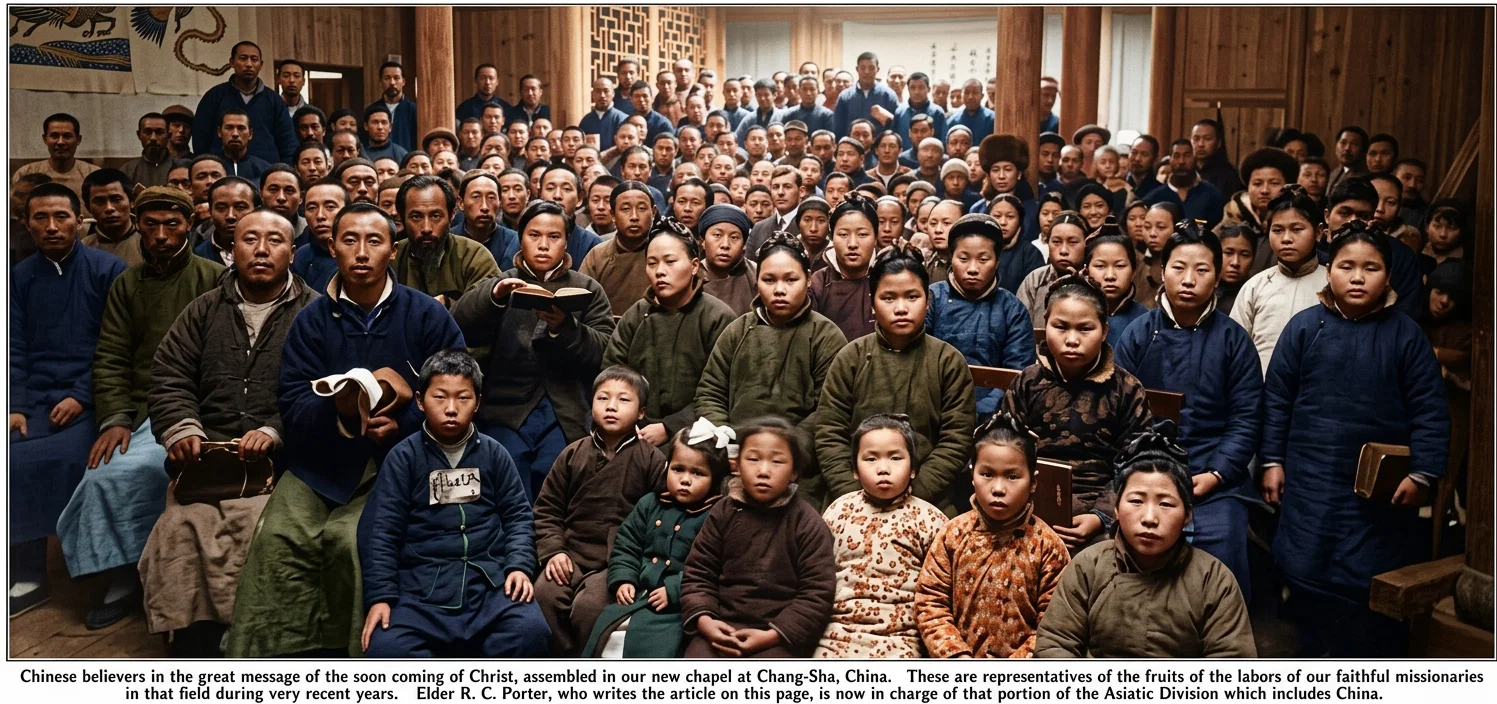
Chinese believers in the great message of the soon coming of Christ, assembled in our new chapel at Chang-Sha, China. These are representatives of the fruits of the labors of our faithful missionaries in that field during very recent years. Elder R. C. Porter, who writes the article on this page, is now in charge of that portion of the Asiatic Division which includes China.
When in 1894 we began our mission operations near Bulawayo, 1,500 miles interior from Cape Town, it was necessary to travel 700 miles by ox-teams from Vyburg, which was then the terminus of the railway. The government was then under British supervision.

THE CRUELTY OF NATIVE KINGS

For thirty years prior to this date Moselikatze, king of the Matabele, and Lobengula, his successor, had forbidden their people to attend mission schools or church services. When a girl or a boy was reported to be interested in mission teaching, the king called the offender to his place, and he disappeared, and nothing more was ever heard of him. In 1893 the war between the Matabele and Great Britain opened the country for mission operations, under British rule.

REMARKABLE PROPHECY OF CYRUS

Such extraordinary transformations as were accomplished in this instance remind one of God's remarkable providences in the case of Cyrus, king of the Medes and Persians. God planned his mission nearly two centuries before his birth. Isa. 44:24-28; 45:1-13. He was to overthrow the city and kingdom of Babylon, in order to liberate the people of Israel from oppression, restore their city, their temple, its services, and their dominion.
His grandfather endeavored to kill Cyrus when he was but a child. He supposed that he had accomplished this through a command given his most trusted servant. Years passed before he learned that by a special providence, the child of an old mountain shepherd had died the very day the trusted servant had passed the child over to him in his mountain retreat, to be slain by his hand. The mother exchanged the clothing of the two children, and passed her dead child on for burial in the clothing of the infant Cyrus. Thus the child Cyrus was preserved by as remarkable a providence, when it had been decreed by the king Astyages that he should be slain, as was the child Jesus when Herod had decreed His death.

BOOK NOTICES

"THE KALLIKAK FAMILY," by Henry Herbert Goddard, Ph. D. New York, the Macmillan Company. 121 pages octavo. Price $1.50.
This volume presents, in popular form, a study of the inheritance of mental traits, on the line of study made some years ago in connection with the famous Jukes family.
Jukes, as those who are familiar with the investigation know, was a degenerate whose posterity was traced through a number of generations, and the large number of criminals, degenerates, and general undesirables listed. The family of Jonathan Edwards was traced as forming a striking contrast with that case.
In the Kallikak family, two lines of posterity are traced from the same father. One line came from an illegitimate offspring of this senior Kall-kak—name fictitious—and a simple-minded girl; while the other line of posterity comes through the legitimate line of his lawful union with a high-minded and intelligent woman.
As well as showing the influence of heredity, which is the main design of the book, it shows incidentally but strikingly the effects of alcohol and of the lack of proper training.

Disgraceful ISN'T IT?

Who Is to Blame, the Drunkard, the Saloon-Keeper, the Liquor Manufacturer, or—Well, Never Mind. It Might Be Embarrassing to Answer the Question.
IN some places, the sight of a drunken man is only a memory. But what brought about changed conditions? Did the clean, decent element sit back with folded hands and merely shout "Hurrah" when the victory was won?—No, indeed, they did not. They first sensed their own responsibility; and realizing that it was possible to overthrow Demon Rum, they went to work. They talked, and they agitated, and they distributed temperance papers, tracts, and leaflets. Without doubt the latter agency has proved the most effective of all.
Better publications for such a campaign than those listed below can not be found. If your community is still cursed with the saloon, why not arouse your church, woman's club, or other civic betterment organization, to action? Call their attention to these excellent tracts and leaflets, and make an effort. If they fail to respond, why not get a supply, and do your own little part?

The Demons' Council

A unique document written in allegorical style. 100 ............................50c

Prohibition or the Liquor Traffic—Which?

contains admissions from the opponents of prohibition as to the evils growing out of the liquor traffic. This is one of the strongest arguments favoring prohibition. 100 ............................50c

Story of a Dry Town

An interesting story of a town as it was with its seven saloons, and the results two years after it went dry. 100 ............................25c

Why Does the Saloon Exist?

The saloon man says he has a legal right to do business. Has he? This publication presents the "legal right" phase of the question. 100 ............................$1.00

Dark Valley Railroad

In two colors, in the form of a railroad timetable. Gives names of stations, time of arrival of trains, and shows map of the route. Cigaretteville, Mild Drink, Tipplersville, are some of the stations. 100 ............................$1.50

It Doesn't Pay

The question as to whether the liquor traffic pays is much debated. This tract considers the saloon from this standpoint. 100 ............................$1.00

The Wine Industry and Prohibition

The claim is made that prohibition will throw thousands out of employment, and make valueless amounts of land. Will it? This tract answers this contention negatively, and satisfactorily to all. 100 ............................$1.00

For the Sake of the Other Man

A touching story which impresses the reader with his duty to his weaker brother. 100, 25c.

Pocket Package No. 4

400 pages of the above tracts assorted, in a strong Manila envelope, for 25c. Postage prepaid.

Signs of the Times

Temperance number. Striking, forceful, interesting-impelling. "One of the best things on the subject that I have ever seen." 3c a copy; 40 or more, 2½c a copy.
These may be obtained from our depository in your state. Pacific Press Publishing Association MOUNTAIN VIEW, CALIFORNIA

HELD HIS RIGHT HAND

Not only had the Lord declared the mission of Cyrus, but He declared that He would hold his right hand, to subdue nations before him; and when he entered upon his kingly mission, he emphatically proclaimed, "Thus saith Cyrus king of Persia, All the kingdoms of the earth hath the Lord God of heaven given me; and He hath charged me to build Him an house in Jerusalem, which is in Judah." 2 Chron. 36:23.
The Lord had not only held his right hand, to subdue nations before him, but He was watching over His word of announcement made through the prophet Jeremiah. He would see that at the right time, that word was fulfilled. Verse 22.
With God there are no perplexities that baffle His plans. When He takes a man or a movement in hand by which to accomplish a work in the earth, makes a proclamation concerning its mission, and outlines its results, though the combined powers of evil men and devils conspire to defeat that movement, it goes triumphantly forward to success. There is no failure with God.

PREDICTION OF DEFINITE MOVEMENT

God has spoken definitely of the success of a last-day movement to carry the last warning message of the gospel commission "to every nation, and kindred, and tongue, and people." He has declared its standard to be, "The patience of the saints," "The commandments of God, and the faith of Jesus." Rev. 14:9-12. In verse 14 He announces that the proclamation ends with the second advent of Christ, and the movement triumphant.
Can that movement fail? The same God who watched the prophetic Word which had declared the movement under Cyrus, is, from His throne, still watching this final prediction of His prophet; and as He held the right hand of His servant then, to subdue nations before him in the fulfilment of his commission, so He is holding the hands of His servants who go forth to give this message.
If nations can stop the falling snow and rain, the ebb and flow of the tide, the seasons appearing in their order, the tornado, the earthquake, and the vivid lightning flashes, then may they stop the onward march of this last-day message.
The world is the parish for this movement. To the whole world God has decreed it shall go, and to the world it will go. If need be, He will subdue nations before its onward march, as in the days of Cyrus. Happy is that people who discern God's movements, and consecrate themselves for service under His divine commission.

Cuneiform Parallels to the Old Testament

"Cuneiform Parallels to the Old Testament," translated and edited by Robert William Rogers, Ph. D. (Leipzig), Litt. D., LL. D., F. R. G. S. New York, Eaton & Mains; Cincinnati, Jennings & Graham, 1912. 470 pages octavo, with numerous plates, diagrams, etc. Price $4.50 net.
This volume gives many photographic illustrations of the tablets that the investigators and archeologists have been rescuing from the archives of old Babylonia and Assyria. The object is to give an English translation of the whole body of documents illustrating the religion, culture, and history that developed contemporaneously with that of the Old Testament in those Eastern countries. There is besides, a great deal of study and research evidenced in the outline of history that accompanies the translations, and which is written in an easy style. Because of the reproductions of these originals and the history connected therewith, the book is very valuable for those who are interested in the study of those ancient times, the history of which is so closely interwoven with that of Bible lands and peoples.

FOR SALE OR EXCHANGE

Owner's restored health and change of occupation throw this beautiful home ranch on the market.
Eighty acres four miles from Alamogordo, New Mexico, located on a good road, in a desirable locality. Improvements include a five-room house with sleeping-porch, cistern, cellar, good well, windmill and tank, three hundred feet of pipe and garden hose. One and one half acres family orchard, eleven varieties; shade-trees, lawn, and hedge. Twenty acres of land cleared, ten acres bordered. Good pasture, barns, and outbuildings.
If sold at once, will include four milch cows, two calves, chickens, one mare, two colts, harness, buggy, tools, implements, garden and feed crop. Price only $2,400. Further particulars and terms may be obtained from A. F. Menger, Alamogordo, N. M.

College & School Expenses

of young men and women can be met in part by devoting their spare time to taking subscriptions for and selling the

SIGNS OF THE TIMES MAGAZINE

Forty per cent commission given on subscriptions, and 50% to 60% allowed on sales.
Why not defray at least part of your expenses in this way? The work is educational, healthful, and remunerative too.
Here is a suggestion that is worthy of more than passing attention: Sell 25 and earn $1.25, or 50 and earn $3.00. Your tract society secretary will help you get started.

SIGNS OF THE TIMES

Continue reading: Promising Young Man Wrecks His Home