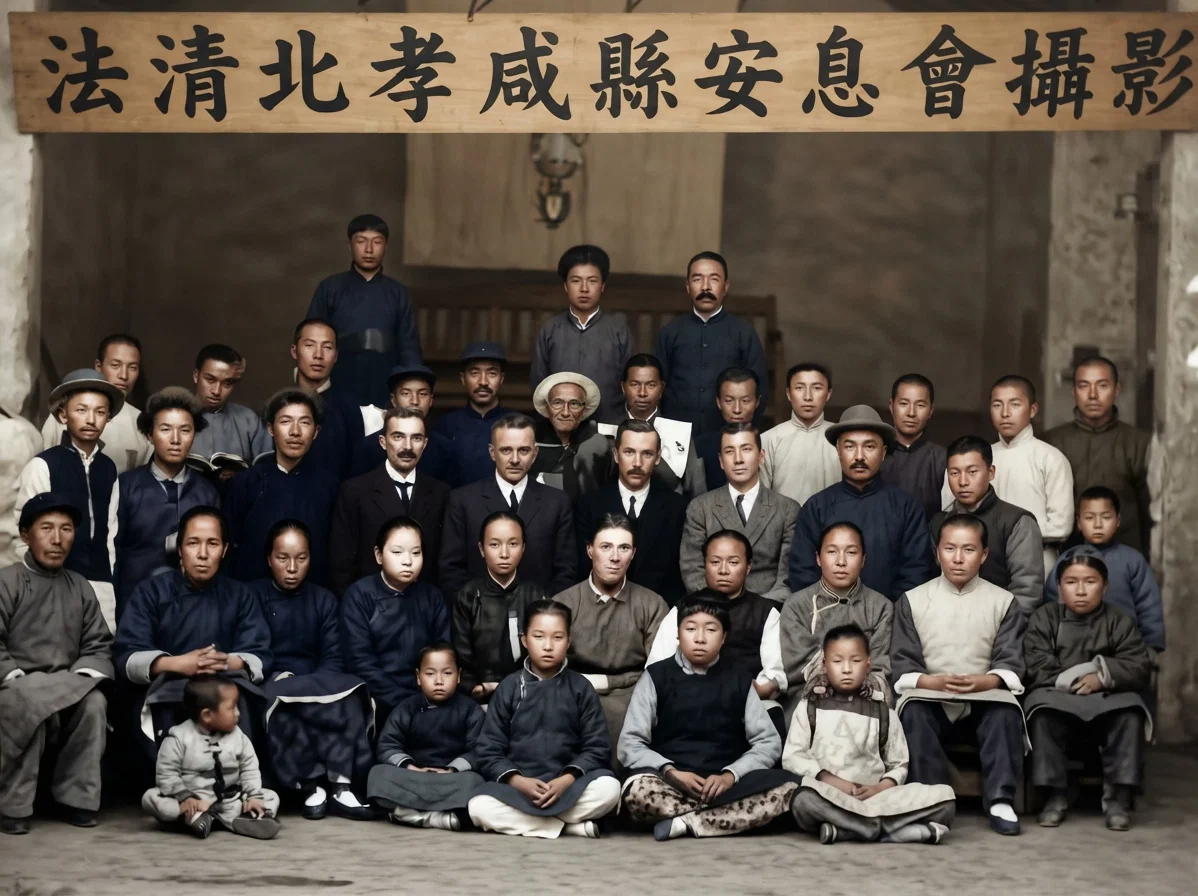
RECENTLY we moved from Nanking to Hankow. Since coming to this place we have held a workers' meeting, and I have been busy getting acquainted with my new surroundings. I am glad to be able to report that the message is progressing in this territory in which the revolution in China was started, and which has suffered the greatest loss.
The chapel we rented was destroyed when Hankow was burned almost to the ground. We were unable to find a suitable place for another chapel until just recently. We are now fixing up a new one which we have rented. It is in the district that was burned. We use the disaster that befell this place as an illustration of the coming destruction which God is to bring on this wicked world.
WORKERS AND BELIEVERS ATTENDING THE GENERAL MEETING AT HANKOW, CHINA
I have just returned from our workers' meeting, which was held farther inland. Brethren I. H. Evans and F. A. Allum were with us for five days. During the two weeks' meeting God's Spirit was especially manifested several times both in the meetings for the heathen and in the meetings for our workers. We presented the need of doing more efficient work by guarding the moments and opportunities of every day. We also urged more personal work to be done with those who come to our meetings and seem interested. We had a program printed, showing what a good day's work is. All the workers seemed pleased to have this suggestion as to how to improve their time every day, and agreed to follow it. The program is about the same as we follow in our tent work at home. There is a time for personal Bible study and prayer every morning, then about two hours for visiting in the morning, after which comes noon-hour prayer. In the afternoon they are to go out visiting, or go into the country and hold a meeting with the farmers. Then in the evening there is the regular meeting. On this program we cited texts showing how Christ worked, the reward of the diligent, and the value of personal effort and of system in our work.
During this meeting we gave the workers an example by going out with them and showing them how to do personal work. We had Bible studies only in the morning, and went out visiting in the afternoon. Sometimes we would hold street meetings, or go into the country and hold a meeting. In this way we would get a good crowd to come to our meetings every night.
On the opening day of our general meeting, we divided into four companies, and these companies went to the four gates of the city and held meetings in two different places. Thus we had about eight meetings that afternoon, and very soon every one knew that the Seventh-day Adventists were having a special meeting in Hankow. We had a very good attendance. In presenting the truths of this message, I never saw better attention than these poor heathen gave.
At the close of each meeting we worked for souls, endeavoring to persuade them to give themselves to Christ. We got the names and addresses of those who responded, and visited them the next day. In this way we secured the names of one hundred during the meeting. Some handed in their names for various reasons, but out of these there are, I believe, a score or more who have really been touched with the message.
One night when we spoke on the plan of salvation, the Spirit of God seemed to be in the midst, and all sat very attentive during the hour. As soon as we appealed to them to give themselves to him who had done so much for them, a score or more came almost at once to the front. That night thirty names were given in. While many of these may fall out by the way, yet we know that the seed of the gospel has been sown in their hearts. At this meeting Brother Allum baptized thirteen. This makes a membership of forty in the province of Hupeh.
Hankow is the most central city in China. Many from most of the provinces pass through this city. Since being here, I have had opportunity to give the truth to men from three different provinces. We expect that sometime the capital of China may be established here. We are anxious to improve the time and get a good foundation laid for our work.
The Balkan War
By C. Voigt
C. VOIGT
A TERRIBLE war is reaping a bloody harvest in the Macedonian fields. The lamentations of the torn sacrifices of deluded human hopes for greatness and happiness ring out into the dead silence of the cold winter nights. The tragedy of the dissolution of the mighty Turkish Empire, which has covered nearly a century, is now being enlarged by a new chapter; and a new page in the history of mankind is being filled with reports of battles, and of the dead and wounded.
It is possible that Macedonia will be divided between the Balkan kingdoms of Bulgaria, Greece, Servia, and Montenegro, after peace has been signed. The development of these countries, especially of the first-named three, during the last ten years seems to show that they could use the rich treasures of European Turkish soil to better advantage than it has been used heretofore. Without doubt, as far as management is concerned, the lot of the Balkan peoples as independent peoples would be better than under Turkish rule, although one must acknowledge that the Turkish government has tried to do what it could in this respect, with its limited means, during the past few years. One hindrance has been the continued need of money, since Turkey used most of its means for the equipment of its military and naval forces. Another was the inefficiency of many of the lower officials, and a certain irregularity in promises and measures taken by leading individuals.
This war has been called a crusade in the declarations made by the four combined kingdoms, or a continuation of the middle-age campaigns of Occidental knights toward the East to establish Christian kingdoms in the lands where Christianity was first known. As a support of these campaigns, however, there was the same power which proclaimed the crusades against the heretics, such as the Waldenses and the Albigenses; namely, the Papacy. The unchristlike trait showed itself then in the endeavor to spread Christianity by means of fire13and the sword. The Saviour also taught his disciples quite clearly: "Put up again thy sword into his place: for all they that take the sword shall perish with the sword." Paul says: "Take . . . the sword of the Spirit, which is the word of God." "For the word of God is quick, and powerful, and sharper than any, two-edged sword." To use the power of Christianity for a warlike purpose is a derogation of religion. But of course, it must be acknowledged that the religious views of the Balkan peoples in these struggles are to a great extent mixed with politics.
The conflict still rages, and it is doubtful whether or not the Turkish army will be entirely routed by the combined forces of the enemy. The Turkish people know little or nothing concerning the war and its progress, as the spreading of unfavorable news would be likely to cause local disturbances. Even the Turkish capital is in the dark concerning the condition of things.
It is rather difficult to say what influence this war is likely to have upon the work of God, and the progress of the last message of grace. At present our work is practically at a standstill, since there are no means of traffic or communication, and in many places the sieges are in progress, and all the young men have been called to arms. Flight into other countries seems to be general, especially in the case of promising youth. In Macedonia itself the work was begun but a short time ago. The future will show whether it is easier to labor under Turkish government which does not trouble about the different denominations, or under the rule of the orthodox Balkan States, whose chief supporters are the fanatical clergy of the Oriental confession.
Constantinople.
The Abyssinian New Year
By Anol Grundset
ANOL GRUNDSET
THE Abyssinian new year began September 11, according to our calendar. When there is a leap-year, the year begins September 12. The Abyssinians count thirty days to the month, making three hundred sixty days in twelve months, so that they have an extra month. This thirteenth month is called Pagumien, and has five days, except in a leap-year, when it has six. There is also a difference of several years between their reckoning and ours. Sept. 11, 1912, according to their calendar, is New-year's, Jan. 1, 1905. But the majority of the people know very little about what year or time it is. They hold that all such knowledge belongs to the priests, from whom they are willing to receive instruction and orders. Few of the common people know even their own ages. All knowledge is supposed to be centered in the priests and teachers of the church.
The new year is opened with the feasts of St. Bartholomew and John the Baptist. For nearly a month previous the boys of the villages have been gathering dried shrubbery and sticks, which they tie together in long, oblong form, and on the evening in question they light these bundles and march through the villages carrying them and shouting, "Hoi! Hoi!" When they have finished their marching, they throw down the remains of their burning brush and begin jumping over the fire. It is a weird spectacle to see these half-naked people in their excitement jumping through the flames. It reminds one that they are not wholly separated from the jungle and the wilds, though it is all done in the name of Christianity.
The next morning everybody rises very early, and all are supposed to go through a sort of purification. All who can do so go to some body of water, where they bathe from head to foot. Those who can not go, perform this rite of purification in their homes. Later they gather at the village church, and the priest announces the feast-days for the coming year. These are too numerous to mention. The Abyssinians fast about half the year, and feast the other half.
Another very interesting thing is to see in the early morning all the people bringing their live stock—oxen, sheep, goats, donkeys, etc.—to the churchyard, to march around the church a certain number of times.
Thousands of the native people can not read. Dear reader, thank God for the open Book, the Bible, and pray that the truth-laden Word, earth's greatest and most effective disseminator of truth and remover of darkness, may find its way to Abyssinia's millions. Every year more are learning to read. Already three camel-loads of Bibles and Protestant literature have crossed the borders into Abyssinia, and two mules loaded with Galla literature have left Asmara for the land of Galla. Thus a beginning has been made, which we hope will spread mightily, that the inhabitants of this benighted land may also be included among those who "shall see the salvation of our God."
Mission Station Kihuiro, East Africa
By A. C. Enns
A. C. ENNS
WITH farming, building, gardening, bookkeeping, medical work, teaching, preaching, and visiting, the foreign missionary has plenty to engage his time.
Of late I have felt a keen burden for those fields that have not been entered. The present developments show that the end is rapidly approaching, and there is an enormous work before us yet to be done. Satan is not only trying to hinder the seed of the word from taking hold in the hearts of men, but here he forces Mohammedanism with great power upon the people, and still more desperately does he battle against us. It is indeed hard to keep up courage under the immense pressure of temptation.
Leaving the conference in Europe, we came to the mountain station Vunta, where we had an out-school operated by a native teacher, and a mission house nearing completion. It was not exactly what might be called an easy place. It took about four months to win the confidence of the people. But after that, our work made rapid progress in every way, and when we were called, in June, to the Kihuiro station, which lies in the lowland at the foot of the mountains, we left a central school with over two hundred children attending, and three out-schools with an enrolment of two hundred eighty-nine children.
We were called to Kihuiro to take the place of one of the workers who had to go to the mountains on account of poor health. Here the work has always gone hard. Of the two thousand inhabitants about sixty per cent are Mohammedans, all of whom are missionaries, teaching and baptizing from the day they themselves are baptized. The general idea is that Islam, the strongest religion, is the right one, and of course the only one worth following. Christianity is known as the religion of children, as most of our members are young people. The attendance on Sabbath consisted entirely of the youth and children. Our one-promising school of one hundred sixty-five had dwindled to an attendance of twenty or thirty.
I had long felt a burden for the Kihuiro field, knowing that it needed a most thorough revival. We went to work at once, after seeking power from the Most High, and we can say that God was with us, that he sent angels ahead of us, and that he did a great work. Could we have beheld these spiritual forces at work, I imagine it would have been a profoundly interesting and inspiring scene.
The attendance on the Sabbath has gradually improved, and the school work has been reformed. The old students had to be dismissed and new ones encouraged to come. But the Lord helped us, and to-day our school has a larger enrolment than ever in the past, the number, including those in the out-schools, being about five hundred.
The Kihuiro school plays an important part in the work here in this field. It has provided a number of schools with teachers. Five of the six teachers at Vunta are from Kihuiro. There are three Kihuiro teachers at Vuasu, two at Friedenstal, and we still have seven here. This speaks well for the work done in Kihuiro.
In spite of Islam, God has done a great work here, and has shown that he alone has his way among the nations of this world. Our work has been greatly blessed. The harder the battle goes, the clearer we can see that in his desperation the enemy is fearing defeat. On a recent Sabbath eight new converts made their covenant with God. Ninety or a hundred more are being prepared for baptism. The outlook for the future is very promising. Now is the time to do aggressive work, for soon will come the final rush for victory.
The Noon-Hour Prayer
By Editor
OUR every need is a call to prayer. The Heavenly Father has promised deliverance to "the needy . . . and him that hath no helper." The very need that burdens and perplexes you, dear reader, is the condition and pledge of divine blessing. The moment you come to a need, remember also you have come to a promise which you can claim in faith because, in the profoundest sense, there is no unanswered prayer. Every one who prays receives something. The closet of prayer is heaven's base of supplies, and no one is turned away empty-handed.15
"Sometimes we ask for something which is not according to God's will. Then as we pray, it is in the midst of our prayer that we are led to give up our own will, and come into humble submission to God's better will. This was Paul's experience. He prayed three times, and God did not give the thing he asked for, but God gave submission to his divine will, and abounding grace for the weakness which remained. . . .
You and I have gone into the place of prayer with the life of some loved one trembling in the balance. How hard it was for us to ask anything else than that God might show forth his healing power. We prayed on and on; and as we prayed, we saw that this might not be his will. As we realized that, instead of rebellion, we found God pouring out upon us a conscious spirit of submission. Then and there we said, 'Thy will be done.' If we had no other blessing in prayer, this alone would be enough, for there is no more precious blessing in all life than that of a will wholly yielded to God. This comes in prayer, whether we receive the specific thing we are asking for or not."
Requests for Prayer
18. An anxious mother, writing from New Hampshire, asks prayer for the conversion of two wayward daughters.
19. A Michigan sister requests our united prayers for the conversion of her husband and son. She has been praying for them for many years.
20. A sister in California, whose husband is a drinking man refusing to support his family, wishes us to pray that she may have physical and spiritual strength in her trouble, and wisdom to know just what to do. Her mother has just died, and our sister is passing through severe trials.
21. From Michigan a sister sends the request that prayer be offered for her healing, and also that her husband may give up the use of tobacco and accept Christ as his personal Saviour.
22. A Texas Bible worker, who is very sick and seems to be growing worse, asks us to pray for her recovery, if this is God's will for her.
23. From the same State (Texas) another sister writes asking prayer for the conversion of her husband and five children.
24. An afflicted sister requests that we pray for her healing. She has suffered from stomach trouble and a nervous disease for about fifteen years, and is an invalid. She also desires that we pray for the conversion of her husband, two children, parents, brothers, and sisters, who are all Catholics.
25. A Minnesota sister asks prayer for the conversion of her children and their families; for the healing of a brother in the church who is suffering from cancer; for a sister in the truth who is just now passing through severe trials; and for herself that she may be healed of an affliction from which she has suffered for many years.
Physical Exercise
By James D. Montgomery
JAMES D. MONTGOMERY
Physical activity is necessary to physical well-being. There has never been an exception to this rule since Adam was placed in the garden of Eden to "dress it and to keep it." There never will be an exception to the rule in this life nor in that to come. Even in the earth made new we shall "build houses, and inhabit them;" and "shall plant vineyards, and eat the fruit of them." Isa. 65:21.
To Adam it was said, "Cursed is the ground for thy sake; in toil shalt thou eat of it all the days of thy life." It could not be said that the ground was cursed for man's punishment. It was for his sake, for his benefit. How could it be for the good of man unless work was a blessing to him? He should eat of the fruits of his toil until his death. It is very rare now that a man is physically able to work after he begins to reach old age. He usually spends his declining years in idleness.
The motive underlying the physical culture of the Christian is not that of the self-centered systems of the world, but is an entirely different incentive. It is a self-sacrificing practise meant to help the helpless and to succor the fatherless and the widow. All that is selfish in this method is that the Christian regains his lost health, or else retains his health for the purpose of being all that God made him to be. He may then be a true helper to those less fortunate than himself. As is said in James 1:27, "Pure religion and undefiled before God and the Father is this, To visit the fatherless and widows in their affliction, and to keep himself unspotted from the world." There is no better outlet for bodily activity than such work. It is a potent factor in both retaining and regaining the health. It is also an outlet for spiritual activities, thus being the practical demonstration of a rounded life.
"Is not this the fast that I have chosen? to loose the bands of wickedness, to undo the heavy burdens, and to let the oppressed go free, and that ye break every yoke? Is it not to deal thy bread to the hungry, and that thou bring the poor that are cast out to thy house? when thou seest the naked, that thou cover him; and that thou hide not thyself from thine own flesh? Then shall thy light break forth as the morning, and thine health shall spring forth speedily: and thy righteousness shall go before thee; and the glory of the Lord shall be thy rereward." Isa. 58:6-8. To use our spare time among our poor neighbors, breaking the bands of wickedness, relieving heavy burdens, breaking yokes, feeding the hungry, bringing in the outcasts and caring for them, would afford an abundance of physical activity. It would also promote the health and advance our righteousness, as well as assure us of a protection to the rearward. Nothing short of this is to be put forth as meeting the requirements of the Bible on this topic.
In the judgment scene portrayed in Matthew 25, certain misled individuals inquired: "When saw we thee an hungered, or athirst, or a stranger, or naked, or sick, or in prison, and did not minister unto thee?" The answer given to this query is identical with the demands of Isaiah 58, from which we have quoted. Those who are the most active in this work are the ones who are placed at the right hand of our Lord in that great day.
Regarding it as a practical science, we find that the right kind of physical culture is a remedy for physical ills and a veritable panacea for spiritual ills, such as envy, discouragement, petulance, and jealousy. And as a preventive against both physical and spiritual diseases it has no equal. It is always mentioned in the Bible as a useful work, and never as one that "beateth the air" in so-called "exercises." "So built we the wall," said Nehemiah; "for the people had a mind to work." Neh. 4:6. In the parable the Saviour asks, "Why stand ye here all the day idle?" and I may say that many in poor health are so because of inactivity, and would readily recover should they heed the injunction: "Son, go work to-day in my vineyard." Taken in the physical sense, this is excellent advice to those who are physically idle.
Adam was not only to till the ground and eat the fruit of it by the sweat of his face, but he was to do it until he returned to the ground — all his lifetime. The second Adam was a worker. "Is not this the carpenter, the son of Mary?" In fact, there were no idlers among the holy men of old. Says Paul: "Let him that stole steal no more: but rather let him labor, working with his hands the thing which is good." Eph. 4:28. And in another place: "For . . . this we commanded you, that if any would not work, neither should he eat." 2 Thess. 3:10.
Speaking of the virtuous woman, Solomon gives her various qualifications, one of which is useful industry: "She worketh willingly with her hands. . . . She layeth her hands to the spindle, and her hands hold the distaff." And by her physical exertion in useful labor she "girdeth her loins with strength, and strengtheneth her arms." See Proverbs 31. A strong body is the result of useful labor. The doer is benefited as well as those who receive the help. Whether it is in the family or in the neighborhood, this kind of work operates for the good of the operator.
The circumstances in the beginning were such that the earth brought forth of its strength; yet man was placed in the garden to dress it and to keep it. After the fall the ground was cursed for the sake of man, and he was compelled to work for his living. Ever since that time there have been opposing elements in life that have required more or less effort to overcome. This effort has at times developed sturdy bodies and well-developed minds. Should these opposing elements be removed from our pathway by others, we are not the gainers but the losers. We need to do our own work for the good of our bodies and the clearness of our minds. The idle man has no encouragement in the Bible. He is condemned for his slothfulness and urged to reform. Idleness in a land of plenty is sure to breed every evil thing. One of the sins of Sodom was "fulness of bread, and abundance of idleness." It is a common saying that "Satan finds work for idle hands to do." And it is also said, "The idle brain is the devil's workshop."
Newark, Ohio.
Home, Sweet Home
By William Brickey
LET others sing of "home, sweet home,"
And feed on joys forever past;
But I will sing of joys to come,
And home where pleasures ever last.
There let me bask in Eden's bloom,
And sing in triumph o'er the tomb;
There, there, I'll sing of home, sweet home,
In heaven-born, sweet release.
Lord, grant me such a home as this,
On that eternal, peaceful shore
Where none can rob me of its bliss,
Where none are ever sick or poor.
I want no "home, sweet home," for me
In this vain world, on land or sea;
I want it in eternity,
I want it evermore.
Kamiah, Idaho.
Los Angeles (Cal.) City Work
By J. W. McCord
Nearly three years ago Elder St. John and the writer began evangelistic work in Los Angeles, and the Lord has graciously granted a harvest of souls for the seed sown. During the first year Elder St. John and the writer worked together. When Brother St. John was transferred to Portland, Elder A. S. Booth took his place with the tent company.
The results of the work have been good. Up to date more than 230 persons, nearly all of whom are adults, have been baptized, and the expense of our tent-meetings for the past three years (about $2,300) has been nearly covered by the donations.
This last summer's work was a precious season indeed. The Lord came into the meetings in power, and a tender spirit prevailed throughout the services. As the result of this work in Boyle Heights, East Los Angeles, eighty-two adults have accepted the truth, seventy of whom have been baptized thus far.
The expense of the last three tent efforts amounted to $634.50, and the donations for the same time amounted to $628.50.
Much of this success is due not only to the fact that the ministers worked together like brethren, but also to the faithful work of our Bible workers and to the earnest cooperation of the churches. To the Lord belongs the glory for all that has been done, and we are truly thankful to have a part in a movement where results are possible.
While a number of these new Sabbath-keepers have joined other city churches, enough remain at Boyle Heights to about double the membership. This will necessitate the enlargement of the church building, for which purpose an offering of $600 was pledged last Sunday evening.
We have had many rich experiences during our labor here. For the privilege of being workers together with God, we humbly thank the Lord, and gladly surrender ourselves to do his will, and to be used by him wherever he may lead us.
J. W. McCORD.
Illinois
By K. C. Russell
CHICAGO.—Since the close of my tent effort the last of September, I have been devoting considerable time to the work of developing and establishing the company that embraced the truth as a result of the tent-meetings.
We already have a Sabbath-school organized, with an average attendance of from forty to fifty. We have also organized a tract and missionary society. A number of our members have begun the payment of tithe and offerings. We hope to organize a church here in the near future, consisting of twenty-five or more members.
For some weeks we have been contemplating conducting a series of evangelistic meetings near the center of the city on the West Side, to open Sunday evening, January 5. We have been successful in securing at a reasonable rental a beautiful stone church building, with a seating capacity of sixteen hundred. It has a pipe organ and other up-to-date equipment. The church stands at the corner of Ashland Boulevard and Monroe Street, only twenty minutes' walk from the business center of the city. It can be reached from any part of the city with a five-cent fare.16
Sabbath, December 7, a union meeting consisting of a large number of the members of the Seventh-day Adventist churches in Chicago was held in this church. The object of this meeting was to seek the Lord together for a deeper consecration to his work, and to plan for a vigorous soul-winning campaign to be carried on during the winter months.
We have districted the section of the city in the vicinity of the church, and a goodly number of volunteers from the members of our various churches in the city are visiting the homes of the people with our magazines. One of the chief objects of this house-to-house canvass with the magazines is not only to sell the regular issues of our journals, but to seek out the interested persons so that when we are ready to begin our meetings we shall be reasonably sure of a good congregation.
We are urging our people in the city to make a special effort to induce their neighbors and friends who are interested in the truth to attend the contemplated series of meetings.
We earnestly request that those living throughout the country who have relatives or friends residing in the city of Chicago would write to them immediately, urging them to attend these meetings during the months of January and February, not failing, of course, to give them the location of the church.
We earnestly solicit the prayers of our people that the Lord may bless to the salvation of many souls this important evangelistic campaign. The writer will be assisted in these meetings by Dr. D. H. Kress and Elder M. H. Serns. There also will be others connected with the effort. K. C. RUSSELL.
THE FIELD WORK
A Call to Service
By Mrs. C. H. Barr
MRS. C. H. BARR
THERE'S a stir among the nations,
There's a maddening sound of strife;
There's an awful undercurrent
That is bursting into life.
There's a fearful din of battle,
Sounding from across the sea;
Can it be that Armageddon
Lurks in this calamity?
True the time is ripe for struggle;
Clouds are rising fierce and black;
Can it be the winds of heaven
Can no longer be held back?
Let us, then, arouse to action,
Every soldier for the right;
Let us gird the armor tighter,
And be ready for the fight.
There's a world-wide call to service;
God is calling you and me,
Saying, Hasten to the harvest,
Lest the sheaves ungathered be.
Some must go to far-off China,
And the blessed news proclaim
Of a soon-returning Saviour
And salvation through his name.
We're so glad that some are going
In response to Heaven's call.
O that more would heed the summons,
For there's work enough for all!
There's no time to faint or falter,
For the day is nearly done,
And the harvest will be ended
At the setting of the sun.
Let no light go out in darkness,
Let no banner trail the dust,
Let no weapon God has given
Lie in idleness to rust;
For the time is short for gleaning,
Not a moment must be lost;
If the hours are spent in idling,
'Twill be done at fearful cost.
Hasten, then, before the battle
Grows so fierce we can not find
Where the precious grain is lying,
And some sheaves are left behind.
Riverside, Cal.
Argentine Conference and Camp-Meeting
By F. L. Perry
THE annual session of the Argentine Conference and camp-meeting was an interesting and profitable gathering. It was held at Nogoya, in the province of Entre Rios, October 10-20. The public services were held in a large tent, while the brethren in attendance were lodged in a large hall and in houses rented for the occasion.
While the conference membership is over seven hundred, there were present only about two hundred, as the brethren are scattered over a very extensive territory. Besides the regular conference workers and Elder J. W. Westphal, president of the South American Union, Elder F. H. Westphal, president of the Chile Conference, and the writer were asked to attend.
As a large portion of the attendance was German, the day meetings were necessarily carried on in Spanish and German, while the evening services were in Spanish. A very encouraging attendance of those not of our faith was secured, and at times as many as one hundred persons stood outside the tent, unable to obtain seats. An orderly, respectful attitude was maintained, and we believe that a lasting impression in favor of the truth was made upon the city. A company of workers was left to follow up the interest. The conference was favored during one day by the presence of Pastor F. G. Pensotti, general agent of the American Bible Society in South America. He gave two much-appreciated addresses. The brethren showed their sympathy with the cause he represents by a liberal offering.
Because of drought and the plague of locusts, the conference has been passing through a period of financial stringency of late, but the work is onward. About one hundred were baptized during the last year. When the treasurer's report was read, showing the great need of means to meet the necessities of the work, without any solicitation different brethren arose and pledged sums varying from five to two thousand pesos each, until more than three thousand five hundred pesos was given. [This equals about $1,750 of American money.] This was a great encouragement to those who have charge of the work, not only because of the amount of money given, but also because of the spirit of confidence and liberality manifested.
All were highly gratified at the arrival, while the conference was still in session, of Prof. and Mrs. Harley U. Stevens, who have come to take charge of the union conference academy at Camarero.
The different lines of conference work are carried on here in about the same manner as in the States. Indeed, were it not for the difference of language, we should hardly believe that we are in a foreign country. The resolutions passed showed that the brethren have a clear idea of the needs of the work. Especial interest was shown in plans to quickly prepare many of our young people for a part in active service.
As a large portion of the membership is German, and as these brethren made an urgent plea that the executive be one who had a knowledge of the German language, Elder F. H. Westphal, of Chile, was secured to take the presidency of the conference. Brother Guillermo Emmenegger was chosen secretary and treasurer. The outlook is promising for the progress of the message in this great country.
F. L. PERRY.
Northeast Bight, Bonacca
By F. E. Cary
It has been some time since I reported to the good old REVIEW. In the meantime I have spent six months away from the islands. I taught in Florida for five months, and found the change very beneficial to my health.
Shortly after my return to the island, I had the privilege of attending the annual camp-meeting of the Central American Conference. This was the first camp-meeting ever held on this island, and resulted in the baptism of fourteen candidates by Elder N. V. Willess, the conference president. Elder U. Bender, of the West Indian Union Conference, rendered valuable service throughout the meetings.
The school work is onward in this place. I have an enrolment of twenty pupils. I was indeed made glad to see a number of the young people of my school go forward in baptism. Although Satan is working hard to win the young people, still we are trying to keep up the young people's society, and are taking the Reading Course as outlined in the Instructor.
A minister's visits are few and far between here, as this is a difficult field to work, owing to the mode of travel, which is mainly by boats. We all welcome Elder I. Baker to this field to fill the place left vacant by the return of Elder Willess to the States.
That millions are groping in darkness, not only here but throughout the entire harvest-field, plainly reveals the fact that "the harvest truly is great, but the laborers are few." Our constant prayer should be, Lord, send more reapers into the whitened harvest.