A POOR widow spoke one morning to her five young children:
“My dear children, I can give you nothing to eat this morning. I have no bread, no meal, not even an egg in the house. Ask the dear Lord to help us. He is rich and mighty, and has said himself, ‘Call upon me in the day of trouble, and I will deliver thee.’”
Little Hans who was scarcely six years old, went very hungry and sad on his way to school. As he passed by the open door of the church, he went in, and kneeled down before the altar. As he saw no person in the church, he prayed with a loud voice.
“Dear Father in Heaven, we children have nothing to eat. Our mother has no bread, no meal, not even an egg. O, help us. Give us and our dear mother something to eat. Thou art rich and mighty, and can easily help us.”
So prayed little Hans in his childish simplicity, and afterward went to school. When he came home, he saw upon the table a large loaf of bread, a dish of meal, and a basket of eggs.
“Now, thanks to God,” cried he, joyfully; “he has heard my prayer. Mother, has an angel brought all these things through the window?”
“No,” said the mother; “but still God has heard your prayer. As you kneeled at the altar, a good lady was kneeling also in her place in the church. You could not see her, but she saw you and heard your prayer. She has sent us these things. She is the angel through whom God has helped us. Now, thank God, and never forget through your whole lives to ‘call upon God in the day of trouble.’”
THE COLORS OF GEMS.
CAN science explain the coloring of gems? Everybody knows that the white light which reaches us from the sun and other heavenly bodies can be decomposed into a number of colored rays by passing it through a triangular prism. A child blowing a soap-bubble produces colors as splendid. In fact, a thin plate of any transparent substance whatever becomes colored under white light. Striated surfaces also offer effects not less brilliant; so that, to clothe certain insects more vividly, nature has grooved the tissue that envelops them. The rainbow, which the sun paints in so many colors in the drops of the falling shower, is the transcendent effects of decomposed light. Nature, with a palette, so to speak, charged only with white, knows the art of spreading over all her pictures the magic and glow of the most brilliant coloring. But we have not exhausted all the resources of this coloring, the secret of which is the light itself. Here science is at fault; and we must still say what Huyghens said at the end of the seventeenth century, “In spite of the labors of Newton, no one has yet fully discovered the cause of the color of the bodies.” We must then admire, without penetrating their secret, the peerless red of the oriental ruby, the pure yellow of the topaz, the unmingled green of the emerald, the soft blue of the sapphire, and the rich violet of the amethyst. —Journal of Chemistry.
Influence of Christian Character.
THE gorgeous autumn flowers were in full bloom. Love for the beautiful in nature caused me to pause and admire the deep-tinted, well-shaped dahlias that nodded their royal heads as I passed by. The many varieties, contrasting so well with the dark green foliage, presented an admirable picture. Solomon in all his glory truly was not arrayed like one of these.
A lady gave me a delicate white flower, which, were it not for its rich perfume, would scarcely be noticed among its party-colored companions. Though small, it was so scentful as to fill my room with its fragrance. The bright flowers were only pleasing to the eye, but this had greater charms.
As I held this sweet flower in my hand, and inhaled its delicious odor, I could not but think how truly the Christian character is represented by it. Dear reader, what influence are you shedding around you from day to day? Is it a savor of life unto life? If your life is hid with Christ in God, you will be constantly, though perhaps unconsciously, shedding a holy influence.
Some may have great beauty of form or feature, and attract admiration by their brilliancy; but the true Christian, however humble his position in life, will cast a sweetness upon the path of others, will be a blessing wherever he goes, and can easily be distinguished by his holy influence.
Dear reader, are you an earnest Christian?
TRY IT.
By Jennie Merriam
I HAVE just been reading about a little girl who thought it could not be that it was more blessed to give than to receive.
She said “How can that be, mother? I am always so pleased when you give me anything. I don’t think it would make me as happy to give away.”
“Try it,” said her mother. “I know you give money to the poor, but then all your wants are supplied; there is but little self-denial in that. But if you possess any article you value very much, and, seeing another person who really needs it more than you, deny yourself, and give it up, then you will taste the blessedness of giving, and feel much happier in parting with your treasure than you did in receiving it.”
Amy was but a little girl; so this appeared a difficult lesson; but as it was mother who spoke, she thought it must be true.
The next day, as Amy was going to school, she overtook one of her school-mates. It was a bitter cold morning, and as the keen, frosty air brought the color into Amy’s cheeks, and made her eyes sparkle, she said, “Oh! what a nice morning.” The little girl at her side said, “Oh! but I am so cold.” Amy, for the first time, noticed how blue and purple her hands looked, and how thinly clothed she was, and ill-protected from the cold wind.
Amy was not a hard-hearted child, but thoughtless. She had not noticed how Emma (for that was the little girl’s name) tried in vain to make her small shawl shield her from the cold, piercing wind; nor that her hands had no covering, and were almost frozen. Protected herself by cloak, furs, mittens, and hood, she did not feel the wind as it swept past them with its icy breath.
Amy thought, I will give her my mittens, and took them off. They were a new pair her grandmother had knit for her, of a bright scarlet color, and as Amy looked at them, she thought, Oh! how pretty they are. I can’t give them away. I wish she had some so I could keep them. Amy knew Emma needed them more than she did, and as she thought of what her mother said, she felt ashamed that she had hesitated a moment.
“Here, Emma,” she said, “take my mittens, I do not need them and a muff too,” and she handed them to Emma. She took them and put them on; and as Amy saw how delighted she was, and heard her, “Thank you, Amy, they are so soft and warm,” she felt that what her mother had said was true.
When Amy returned home at night, she told her mother what she had done, and added, “Oh! mother, I am so glad I gave her my mittens, I have tried it, and I know it is more blessed to give than to receive.” And her smiling, happy face was evidence that she felt what she said.
Here is a lesson for you, dear reader. Try for yourself. Do not think you know until you do try. How much do you sacrifice to make others happy? Seek to make others happy, and in so doing, you will be happy yourself. Try it.
JENNIE MERRIAM.
Battle Creek, Mich.
SEED SOWN ON GOOD GROUND.
A LADY desiring her nephew to read the INSTRUCTOR, accordingly sent his name and address, with the subscription price, to this Office. He read it, and was delighted with it. He tried to find out who sent it, that the person might be rewarded in some way.
He did not succeed in finding out, so he resolved to have it sent to a little girl who had no religious reading. Her parents loved the fashions and follies of the world. They did not profess religion, so their daughter did not have the advantage of such training.
Some time after this, the lady first mentioned visited the family of the little girl. While there, she found the girl kneeling at prayer, and said to her, “Who taught you to pray?” She replied that she had received a youth’s paper that taught her to pray, and that her mother permitted her to do so.
“Yes,” said the mother; “and I don’t know what we shall do; for we cannot go to balls and parties any more while our child is praying for us, and begging us not to go, and we shall have to join with her if she continues this way.” Prayers and dancing do not go well together.
Can we not hope that the good seed sown may spring up, and bear abundant fruit? Let us be of good cheer, and continue to spread the gospel light. Who will join in the good work of circulating the INSTRUCTOR?
—Chambers’ Journal
DECEMBER, fat and rosy, strides,
His old heart warm, well clothed his sides,
With kindly work for young and old,
The cheerier for the bracing cold;
Laughing a welcome, open flings
His doors, and as he does it, sings.
—Chambers’ Journal
WORDS OF CHEER.
By A. Smith
DEAR CHILDREN: I am so well pleased with the neat appearance of the INSTRUCTOR, and with the excellent reading matter it contains, that I esteem it a pleasure to join with you in words of good cheer for those to whom God has intrusted its publication; and, above all, in heartfelt thanksgiving to Heaven for the bright light that shines upon your pathway through its pages. May the Lord bless the instruction you thus receive to your spiritual good.
If I could take each of you by the hand, and express my strongest desire in your behalf, it would be that you seek and find the Saviour while you are young. You need not expect to become men and women; time is too short. There is a solemn event just before us; it is that of Jesus leaving the sanctuary, and thus closing probation. If you are not saved then, you will be forever lost. If you could know that you should live till Jesus comes, would it be right for you to put off salvation, and thus presume upon the mercy of God, when he has done so much to warn and instruct you, and provide for your comfort and happiness?
Make your lives useful. With the advice of your parents you can procure subscribers for the INSTRUCTOR. Who would be better qualified to recommend it to others than you who are so well acquainted with its excellent qualities? and what parents could resist your plea to subscribe for your excellent paper for their children?
Honor your parents. As children, this is your chief duty. If your parents are true Christians, they will properly direct you in regard to particular duties. Cultivate a cheerful disposition. Make it a rule never to fret or scold, no matter what the provocation. If you have done wrong, confess it before you go to your bed, that you may close your eyes in sleep with the glad assurance of conscious innocence; and awake in the morning, like the birds—full of song. Do not forget to pray. Jesus will give you power to overcome every sin, and will send holy angels to guard you against the enemy.
A. SMITH.
BEAUTIFUL ILLUSTRATION.
If a child had been born, and spent all his life, in the Mammoth Cave, how impossible would it be for him to comprehend the upper world! Parents might tell him of its life, its light, its beauty, and its sounds of joy; they might heap up the sands into mounds, and try to show him by stalactites how grass, flowers, and trees, grow out of the ground; till at length, with laborious thinking, the child would fancy he had gained a true idea of the unknown land.
And yet, though he longed to behold it, when it came that he was to go forth, it would be with regret for the familiar crystals and rock-hewn rooms, and the quiet that reigned therein. But, when he came up, some May morning, with ten thousand birds singing in the trees, and the heavens bright and blue and full of sunlight, and the wind blowing softly through the young leaves, all a-glitter with dew, and the landscape stretching away green and beautiful to the horizon, with what rapture would he gaze about him, and see how poor were all the fancyings and interpretations which were made within the cave of the things which grew and lived without; and how he would wonder that he could ever have regretted to leave the silence and dreary darkness of his old abode! So, when we, at the resurrection of the just, emerge from this cave of earth into that land where spring growths are, and where is eternal summer, how shall we wonder that we could have clung so fondly to this dark and barren life!—Advent Herald.
THE CELESTIAL RAILROAD.
By J. E. White
AN EASY ROUTE TO THE CELESTIAL CITY.
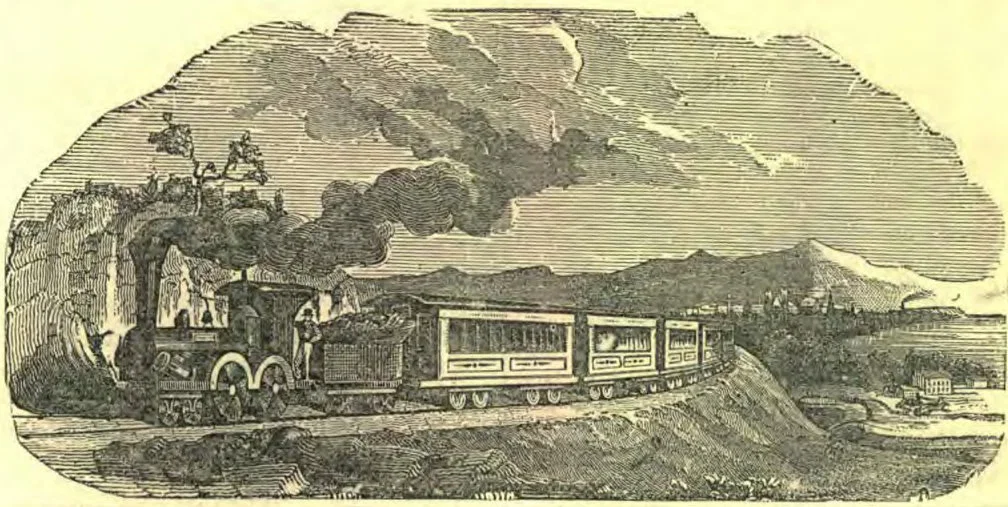
The ease with which the devil makes people believe they can serve him, and still obtain a final entrance into Heaven, is well illustrated by a small tract published at this Office, entitled the “Celestial Railroad.” It is written in the style of Bunyan’s Pilgrim’s Progress, and represents a man living in the city of destruction. He became alarmed in regard to his condition as he heard that the city was to be burned by fire and brimstone, as Sodom and Gomorrah had been in the past. He was so affected by this idea that he ran through the streets, crying, “What shall I do to be saved.”
Unfortunately at this time, instead of meeting with old Evangelist who had guided Christian, he met the Rev. Mr. Smooth-it-away, a popular minister of the place, who, instead of telling him how he could escape from the wrath to come, tried to persuade him that his fears were groundless, and that there was no danger at present, at least. But circumstances were such that he could not be persuaded to give up going to the Celestial City, and putting his fingers in his ears he ran through the City, crying, “Life, life, eternal life!”
But here he was met by an agent of the Rev. Mr. Smooth-it-away, who told him if he must go to the Celestial City, that there were better facilities offered now than in Mr. Bunyan’s day, as a fine railroad had been built leading directly from the City of Destruction to the Celestial City. The temptation to go to the Celestial City in this way, and thus avoid all the trials and troubles necessary upon going the old way, on foot, was so strong, and as he just then came to the depot where the train was ready to start, he took his seat in the cars. The train started, and he was being borne along as he thought to the Celestial City.
He felt many times on the road that this was not the road that self-denying Christians should take, but it was so easy and pleasant to glide along without any exertion or effort on his part, that he stifled his own conscience, and passed along.
He often feared that the termination of the route would be different from what it had been represented to him. And thus it proved, for Christ has said, “He that would come after me, let him deny himself, take up his cross and follow me.”
Dear young friends, let us take warning from this. The general effort of the present day is to find some easy route to Heaven. There is but one way to Heaven, and that is the narrow way our Saviour trod before us, of which he says, “Strait is the gate, and narrow is the way, which leadeth unto life, and few there be that find it.”
J. E. WHITE.
MEMORY
By J. L. Ings
Fond memory will recall the forms
Of those we loved, though passed away,
Free from the troubles and the storms,
That here beset the pilgrim way.
None tread a thornless path below,
Though roses greet us through the shower;
And in the genial, sunlight glow,
Oft sorrow lurks beneath the flower.
Though specious phases life may wear,
And many a pleasing mask put on;
How soon will fade the bright and fair,
How soon life's golden hour be gone.
The dear companions of our way,
Who fought the fight, whose race is run.
Have borne the burden of the day,
Now sweetly sleep in yonder tomb.
Those forms if found among the blest
Will soon again appear;
And we, if faithful, can unite
With those we hold so dear.
J. L. Ings.
Battle Creek, Mich.
THE SABBATH CRADLE.
By Mary Martin
On our trip to Block Island, we stopped over night in Newport, R. I., and visited places of interest, among which was the first Seventh-day Baptist meeting-house ever erected in America. Its exterior and interior are very plain, and it has withstood the ravages of time wonderfully. In the pulpit is a large Bible, with this inscription inside, “Presented to the Sabbatarian Church by the women of this Society, for the use of the Pastor, Dec.25, 1796.” On the wall (back of the speaker’s head when he stands in the pulpit) are two tablets, one containing the first four, the other the last six, of the ten commandments in gilt letters, with this added: “Do we then make void the law through faith? God forbid; yea, we establish the law.” Rom. 3:31. How different the belief of those who had these lines inscribed from the disbelief of some who, not finding it in the Bible, search the writings of “the Fathers” for some excuse for first-day observance.
It is said that during the Revolutionary War, when churches were used for barracks for soldiers, a British officer and his men entered this; but when he saw the law of God, said no church containing that should be molested, and withdrew.
So here was the cradle of the infant Sabbath cause in America, and from this humble starting point have gone forth those who were strong in God, armed with Bible truth. The once faithful pastor, and those who listened so devoutly, with the little children who could just lisp, “Remember the Sabbath day to keep it holy,” all, all have passed away, and beneath the green turf and budding daisies wait for the trump of God to call them forth.
But God’s truth was not to lie hidden forever, and now in many places are faithful men proclaiming to the world that “the seventh day is the Sabbath.” Blessed are they that do his commandments, that they may have right to the tree of life, and may enter in through the gates into the city. Rev. 22:14. MARY MARTIN.
Doing Good to Others
THE best way to do good to ourselves is to do it to others; the right way to gather is to scatter.
How to Obey
How to OBEY.—Do it at once. Never wait to be told a second time. Do just what you are told to do. Do not try to have your own way, even in part. Do it cheerfully. Do not go about it in a surly, cross, peevish way. Don't fret, and grumble, and talk back. Only cheerful obedience can be pleasing to God and man.
Speak Evil of No Man
Speak evil of no man.
CREEPING UP CLOSE TO GOD.
I will say of the Lord, He is my refuge and my fortress: my God; in him will I trust.
Dattie, a bright little girl, was once traveling with her father on a railway train. When night came, she was afraid and restless. Her father wrapped her up in shawls, folded her to his breast, and bade her sleep, saying he would keep watch over her. Still the child was fearful, and every now and then peeped out from her wraps, and said, “O father, I am afraid to go to sleep here.” Again her father soothed her with kind and gentle words, until her heart grew calm and she fell into a long, dreamless sleep, from which she did not awake until morning brought her to the station near her home.
Having arrived at her home, her mother embraced her fondly, and asked, “Did not my little girl find her night journey long and wearisome?” “Oh! no, mother; not at all,” replied the child; “I had such a good sleep, and father watched over me all night. At first I was afraid to go to sleep in that strange place; but he told me to lean against him, and shut my eyes, and rest easily, for he would stay awake and take care of me. So I crept close to him, and before I knew it, I was really and truly asleep, and father stayed awake and took care of me all night. How I do love him for it.”
Now this sweet trust of the child in her earthly father touchingly illustrates the faith of the psalmist in the text quoted above. She crept close to her father, and her fears were quieted. The psalmist was creeping close to his Heavenly Father when, trembling before the hosts of enemies which environed him, he forced himself to exclaim, “I will say of the Lord, He is my refuge and fortress.” Mark! he does not say the Lord is my refuge. He was too much afraid of his enemies, too weak in faith for that; but he was trying to creep close enough to God to be able to say it, and so he cried, “I will say of the Lord, He is my refuge and fortress. In him will I trust.” That he succeeded is apparent from the remaining part of the psalm (the ninety-first), which closes with the most triumphant expressions of a victorious faith.
Let this be your lesson, children! Your heart trembles and is afraid. You feel unequal to victorious contest with the foes which gather so thickly about you. You are filled with misgivings and doubts. These fears can be calmed by nothing but the act of creeping close to your Heavenly Father, and saying, “The Lord is my refuge and my fortress.” That faith will quell all your alarms, calm your fears, and spread more than a summer evening’s quiet over your spirit. Go, then, trembling soul, to the cross of Christ, and resolutely cry,
“Forever here my rest shall be,
Close to thy bleeding side;
This all my hope, and all my plea,
For me the Saviour died.”
You will not long use these words earnestly before you will be a glad believer, singing:
“My God with me in every place!
Firmly does the promise stand,
On land or sea, with present grace
Still to aid us near at hand.
If you ask, ‘Who is with thee?’
God is here, my God with me!
“No depth, nor prison, nor the grave,
Can exclude him from his own:
His cheering presence still I have,
If in crowds or all alone.
In whatever state I be,
Everywhere is God with me!”
—Good News.
OUR THOUGHTS.
HOW would it purify, exalt, hallow—in a word, Christianize—our thoughts, if we habitually strove to cherish only such as we would wish to be found cherishing were our Lord suddenly to appear!
Need I remark how agonizing, on the one hand it would be to be surprised by our Redeemer, at his coming, brooding over impure, resentful, envious, repining, or any shape or shade of sinful thoughts? But how delightful, on the other hand, to be found meditating on the Saviour’s matchless love, and all the proofs of it he crowded into his life of suffering, and his death of shame—or the divine beauties of his character—or the inestimable privileges of his people, or the innumerable tokens we have ourselves received of his unwearied loving-kindness, sympathy, and care—or contriving some benevolent scheme by which we might be enabled, in a spirit of grateful affection, to advance his glory, or, in his own sweet spirit of divine philanthropy, to mitigate the amount of human misery, and increase the sum of human happiness, as far as our influence extends.
The vast importance of using such a standard to regulate our thoughts, and keeping such a constant guard over them, will appear, if we reflect on the immense influence which the thoughts we voluntarily cherish exercise in the formation of our character and the regulation of our conduct. Were our thoughts habitually fixed on God, and Christ, and Heaven, how would it tend to impart to us more and more of the character of God, the spirit of Christ, and the temper of Heaven. On the other hand, it is actually frightful to consider what a terrific series of sinful actions may flow, by natural consequence, from the deliberate indulgence of a single sinful thought—not honestly and prayerfully resisted, when first flashed on us, either by some external object, the workings of our own deceitful and desperately wicked hearts, or the diabolical inspiration of the author of all evil!—Sel.