Early in June the Imperial Press Conference convened in London. The delegates were representative men of the press from all parts of the British Empire. On Saturday evening, June 5, the “Daily Press” of the United Kingdom gave a banquet to the delegates from over sea. There were over one thousand representatives of the newspapers of the Empire in attendance. Lord Rosebery, ex-premier, was the orator of the evening. In opening his address he expressed an appreciation of the power of the press by likening it to the cave of King Aeolus of Virgil’s Aeneid. This cave was supposed to embrace all the winds of heaven, and over them King Aeolus held sway. At a touch or sign from him these gales swept out of the cavern—ready either as hurricanes to spread wreck and devastation all over the world, or else, in the form of balmy breezes, to bring blessing and health wherever they might attain.
Lord Rosebery did not show very clearly who was King Aeolus in the present instance, but he did make clear that the press and the influence of the press represented the cave and the winds. And he expressed the belief that this press influence would be exerted for the benefit of the Empire. He spent nearly one half of the time of his address, and all the flowers of his eloquence,—he is one of the best speakers in the Empire,—in invoking the winds to blow for Imperial defense.
Under this division of his address he said (Boldface ours):
Naval Defense
“Now you will forgive me if I come next and at once to what is by far the most vital topic that you will have to discuss at this Conference or which concerns our Empire as a whole—I mean that of Imperial defense. (Cheers.) I do not know that in some ways I have ever seen a condition of things in Europe so remarkable, so peaceful, and in some respects so ominous as the condition which exists at this moment. There is a hush in Europe, a hush in which you may almost hear a leaf fall to the ground. There is an absolute absence of any questions which ordinarily lead to war. One of the great empires which is sometimes supposed to menace peace is entirely engrossed with its own internal affairs. Another great Eastern empire which furnished a perpetual problem to statesmen has taken a new lease of life and youth in searching for constitutional peace and reform.”
Significant War Preparations
“All forebodes peace; and yet at the same time, combined with this total absence of all questions of friction, there never was in the history of the world so threatening and so overpowering a preparation for war. That is a sign which I confess I regard as most ominous. For forty years it has been a platitude to say that Europe is an armed camp, and for forty years it has been true that all the nations have been facing each other armed to the teeth, and that has been in some respects a guarantee of peace. Now, what do we see? Without any tangible reason we see the nations preparing new armaments. They can not arm any more men on land, so they have to seek new armaments upon the sea, piling up these enormous preparations as if for some great Armageddon—and that in the time of profoundest peace. We live in the midst of what I think was called by Petrarch tacens bellum—a silent warfare, in which not a drop of blood is shed in anger, but in which, however, the last drop is extracted from the living body by the lancets of the European statesmen. There are features in this general preparation for war which must cause special anxiety to the friends of Great Britain and the British Empire, but I will not dwell upon these. I will only ask you who have come to this country to compare carefully the armaments of Europe with our preparations to meet them, and give your impressions to the Empire in return. (Cheers.) I myself feel confident in the resolution and power of this country to meet any reasonable conjunction of forces. But when I see this bursting out of navies everywhere, when I see one country alone asking for twenty-five millions ($125,000,000) of extra taxation for warlike preparation, when I see the absolutely unprecedented sacrifices which are asked from us on the same ground, I do begin to feel uneasy at the outcome of it all, and wonder where it will stop, or if it is nearly going to bring back Europe into a state of barbarism (hear, hear), or whether it will cause a catastrophe in which the working men of the world will say, We will have no more of this madness, this foolery which is grinding us to powder.” (Cheers.)
The Message
“We can and we will build Dreadnoughts—or whatever the newest type of ship may be (loud cheers)—as long as we have a shilling to spend on them or a man to put into them. (Loud cheers.) All that we can and will do; but I am not sure that even that will be enough; and I think it may be your duty to take back to your young dominions across the seas this message and this impression—that some personal duty and responsibility for national defense rests on every man and citizen. (Loud and prolonged cheers.) Yes, take that message back with you. Tell your people—if they can believe it—the deplorable way in which Europe is lapsing into militarism and the pressure which is upon this little island to defend its liberties—and yours.”
At the meeting of the Conference on Tuesday Mr. McKenna, First Lord of the Admiralty, spoke on the need of the navy in keeping the seas open for the English Empire. The Empire was a sort of Imperial Venice, the different parts of her dominions being separated by the seas, and so long as the seas were kept open, all the colonies, separated by thousands of miles as they are, remain contiguous. To keep these seas open requires a navy that gives the supremacy of the seas.
Sir Edward Grey, Secretary of Foreign Affairs, followed with a short address, and stated that he indorsed every word Lord Rosebery had said on the gravity of the European situation.
Arthur Balfour, leader of the opposition in the House of Commons, said the MARITIME PREDOMINANCE “was the very essence of our being.” In speaking on the matter of the fate of the Empire depending upon fleet predominance, he declared that the superiority must be shown in home waters. The German Ocean, the Channel, possibly the Mediterranean—these were the theaters on which, if there was to be an Armageddon, the Armageddon would take place.
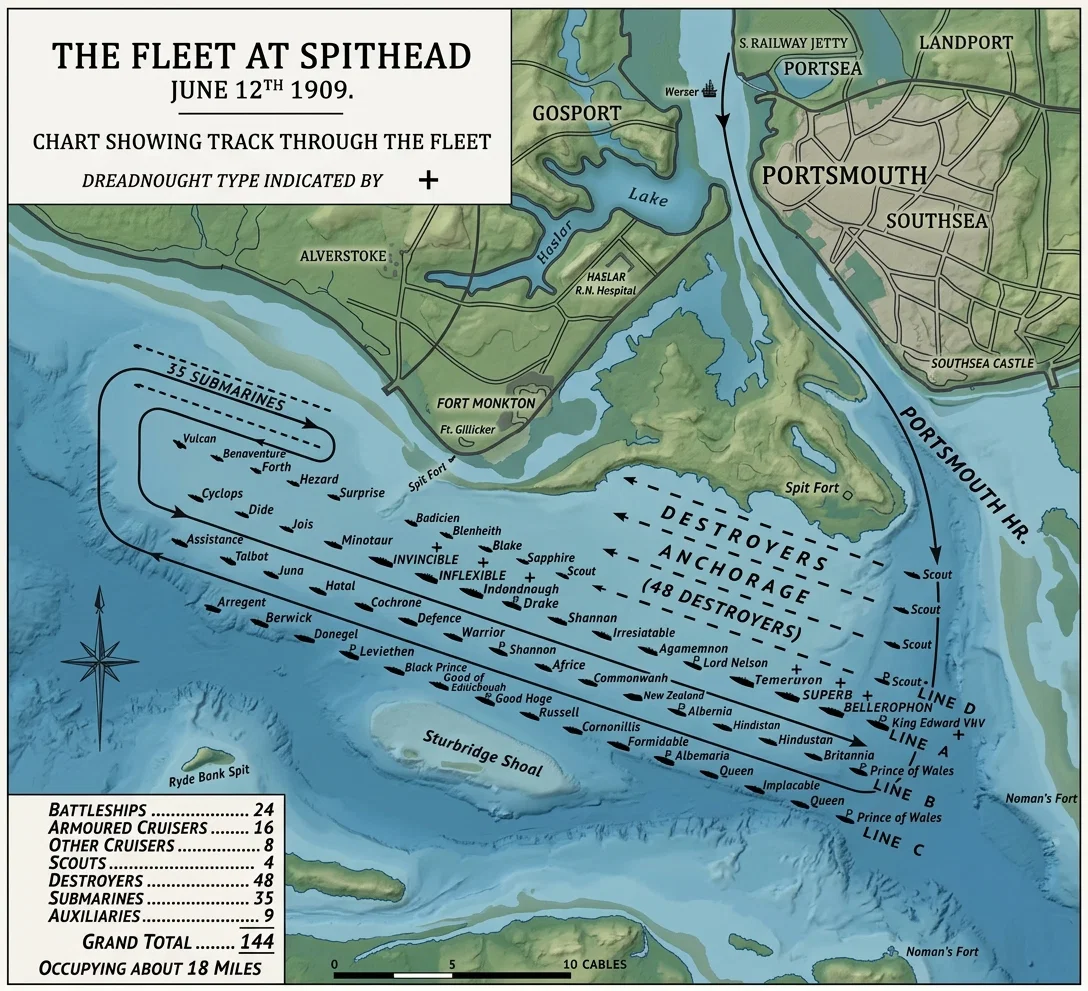
The delegates were taken by the admiralty on an excursion to Portsmouth to inspect the fleet, the most powerful naval force ever brought together in the history of the world. The ships of the Home Squadron numbered 144, the total cost of which was nearly $400,000,000. If placed end to end the vessels would have formed a double line eighteen miles long. R.
The Rationale of the Anglo-German Disturbance
By R.
An article in the June 17th “Independent” by Mr. W. T. Stead, seeks to make plain to Americans the reason for England’s nervousness respecting the German naval situation. To make his point clear he likens Americans to a man on dry ground where to kill a fellow might be unjustifiable murder, and the Germans to11a man about to drown who chokes his brother for clutching him in the deep water and is about to drag him down to death. As America is free from any sudden attack that might destroy her navy and cripple the nation, we need have no fear of war attack or the designs of an enemy. But with Germany and England the situation is different.
The German Empire was founded by the deep-water ethics, where the leaders did not know what a day might bring forth. At any moment a combination of hostile neighbors or an internal revolution might bring to the ground the imperial fabric which they had built up with such infinite pains.
England once stood in the same position. During the Napoleonic wars, Pitt is said to have declared that whenever any European power built four ships of the line, England ought at once to destroy them, lest at some future time they might be used against her. And so without declaration of war by England the British Government destroyed the Danish fleet at Copenhagen, believing that the Danes, willingly or unwillingly, would be certain to place their fleet at the disposal of the French. So like pirates they swooped down upon Copenhagen and carried off all the Danish ships that were not sent to the bottom or burned in the battle.
The English, according to Mr. Stead, have now developed the dry-land ethics, but the Germans do not believe it. The Germans realize that they are still in the deep-water, struggling-for-life ethics, and they believe that the British are no further advanced than themselves. To quote from Mr. Stead:
“The Germans know that if they were in the same relative superiority to the English at sea that the English are to them, they would long ago have swooped down upon the nascent fleet and destroyed it before it had time to grow strong enough to be a menace to their safety. And to this hour the Germans can not understand why the English have not taken advantage of their overwhelming naval supremacy to send the German fleet to the bottom before it became too strong.”
Mr. Stead then goes on to give incidents showing that Germany has been afraid of this very thing for a number of years. He also calls attention to the fact that the more ships Germany builds the more nervous she becomes as to a possible English attack, because England’s maintaining a two-to-one standard with Germany puts all the ships of the weaker power in the hollow of England’s hand. He says:
“They are but hostages in the hand of the more powerful fleet. When Germany had no battle-fleet to speak of, she was practically invulnerable against England. Every new man-of-war she puts on the high seas until she is in a position of naval equality to England is the addition of a new hostage for her good behavior, and as the addition of every new battle-ship is naturally regarded as a provocation and a challenge by the other power, the Germans feel very ill at ease. They are in the position of a lion-tamer who has for the time put his head into the jaws of the lion, and he never knows when the brute may bite it off. While giving assurances that the fleet-building has no hostile intent, they are pushing it to the position to contest with some chance of success the sovereignty of the seas so long held by England.”
The English naturally regard the growth of a powerful German fleet within a day’s steaming of their coast with uneasiness. The regular army of Great Britain is a hundred fifty thousand strong, whereas the Germans can summon to the battle-line two million trained soldiers. England is the imperial Venice of the world. Without her dominions over sea, Britain is but forty millions to the German sixty. The sovereignty of the sea maintains the British Empire. “Hence the English feel instinctively that the moment any foreign navy comes near enough to endanger their supremacy the knife is at their throat.”
When the present government took office, the British navy was nearly three times as strong as the German. It is now about twice as strong. But in three years it will not have even twice as strong a navy. And now German sentiment in some quarters urges that England is feeling the pace set for her, and that if Germany will but push on, the “trident of the seas” will be hers. On the other hand, England intends to maintain the two-power standard at any cost. To the English it is a matter of life or death.
Mr. Stead then asks Americans a very pointed question:
“Suppose that by some convulsion of nature, Japan could suddenly be transported across the Pacific to within one day’s steaming of your coast. Do you think it quite inconceivable that, under those changed conditions, some Americans might feel their nerves a little jumpy when they thought of what might happen? But Japan can never threaten the existence of the American Republic as Germany can menace the British Empire.”
R.
Facing a Crisis
[From an article by John Graham Brooks, "La Follette's."]
Every religious body faces to-day a crisis at least as great as slavery and one that will test her as by fire. If she fails, her tragedy will be this, that the very wrong-doers to whom she truckles will lose respect for their clerical apologists. Plenty of our great law-breakers know perfectly well that much they do is morally indefensible. A man of this type was once mildly chided by a clergyman for the free use of round and hardy oaths. He listened to the half-hearted rebuke and answered: “Come, now, parson, you and I are quits; I swear and you pray, but we don’t either of us mean anything by it.” A witty dean of a theological seminary in the East was asked by a parishioner why the devil was so often painted with a smile. The dean replied: “I am afraid it is because he has found out that many of us clergymen do his devil work so much better than he can do it, that it tickles him.” Never had the church a nobler field for regenerating service than she has to-day, and her bitterest enemy could wish her nothing worse than that she should be silent, faltering, and inarticulate in hours like these. So far as she sides against reform her awakening will be rude and her penalty costly and heavy to bear. Even now, quickened moral energies of our youth are seeking other channels outside her sanctuary.
Presbyterian Creed Obsolete.
Three recent graduates of Union Theological Seminary were licensed to preach by the New York Presbytery June 22. The young men had been refused such license at the April meeting on the ground of insufficient conviction regarding some of the substantial tenets. A committee examined them separately in May and advised the Presbytery to hear them again. Six hours were spent in the examination by that body. At the roll-call the candidates won out, but only by majorities. One of the candidates did not accept the virgin birth of Christ, tho he accepted His divinity. He did not believe in the resurrection of the body; it was the spiritual body of Christ that rose. The case of Lazarus was to convey a moral lesson and not literal truth; and he was not certain about the incarnation. He did not believe that original sin came in through eating the forbidden fruit, and the story was given to convey simply the commission of sinful and forbidden acts. The roll-call showed a vote of 36 to 59 in favor of sustaining the young man in his skepticism and granting him license to preach. The other two young men held substantially the same views as those given by the first candidate. Each received substantial majorities, and they were informed that licenses would be granted them to preach. One of the young men will start at once to take up missionary work in China. While this action of the Presbytery is inconsistent with the faith once delivered to them, and violates the foundation principles of their organization, yet it is perfectly consistent in this, that if they are to maintain a theological school where such sentiments and beliefs are to be systematically taught and inculcated, they are logically bound to license the product. The theological schools lie at the root of the trouble, and if the schools are established and maintained by the denomination and their methods and principles concurred in, it is too late to deal with the graduates individually when they come forth from it. The trouble lies right here in the fact that thousands of ministers and teachers are rejecting the fundamental doctrines of Christianity; all our schools and colleges are developing a school of skepticism that is undermining the faith once delivered to the saints; and nowhere is this poisonous teaching more subtle and constant than in the theological institutions of the various churches: the stream of learning is being poisoned at the fountain.
The Cretan Crisis and Delayed Evacuation
The temporary solution of the impending Cretan crisis is foreshadowed in the report that the European powers in occupation of the island since 1898 will postpone their evacuation until the situation in the Levant becomes clearer. Crete was administered, after the disastrous war which Greece fought against Turkey in 1897, by a Christian government guaranteed by England, France, Italy, and Russia, the resident high commissioner being designated by the king of Greece. In February, 1907, a new constitution was granted and the powers made preparations to withdraw entirely, believing no doubt that Greece would annex the island in spite of Turkey’s nominal sovereignty, and be morally sustained by the concert of Europe. At least, such was the program mapped out in Greece and Crete, and last October the Cretan Assembly directly voted in favor of annexation to the Hellenic kingdom. But this is an outcome which under present conditions in Turkey would probably embarrass seriously the Young-Turk government. The new regime at Constantinople has already suffered the empire to be technically dismembered by Austria and Bulgaria, and if Greece should now absorb Crete, the Young-Turk power might suffer gravely in prestige among the Moslem population of the empire. It is understood, in fact, that the present government of Turkey has given the powers to understand that Greece must not have Crete. The postponement of the evacuation by the occupying powers, consequently, seems necessary for the tranquillity of the countries surrounding the Egean Sea. The ultimate fate of Crete seems more uncertain than it did prior to the Turkish revolution.
Sinful Extravagance
Sinful Extravagance.— So The Farm Journal calls the profligacy that is manifest in this country at the present time. For instance, the national government is launching out in the building of immense and numerous great battle-ships with a deficit of $100,000,000 staring it in the face. The Journal remarks: “There are thousands of women in this country who pay from $100 to $200 for a collection of feathers, ribbons, and velvets to wear on their heads and that several times a year; men and women who pay $500 or $1,000 for an overcoat or a cloak. Some women declare that they can not dress decently on less than $60,000 a year.” A woman who has figured recently in a divorce court declares that $40,000 a year is necessary to dress properly and that it is utterly beneath her position in society to wear a dress more than once whatever its cost. This extravagance is imitated all the way down until men and women, as The Journal expresses it, “pawn their homes, and their furniture, and their salaries in order to get the money to buy diamonds and other follies.” And it well asks: “Where will it all end? And how long must America wait for the ‘voice of one crying in the wilderness’ to tell us of our folly and warn us of our danger?” It was even thus that the Roman Republic before its destruction indulged in extravagance and folly.
Emperors Meet in Gulf of Finland
Emperor William of Germany and Emperor Nicholas of Russia, it is reported, met June 17 for a conference in the Gulf of Finland.
Child Wives in India
IN India a girl must be married before she reaches the age of twelve, or she and often her whole family is ostracized and suffers the loss of caste. Caste enforces rules and regulates marriages. A man may be infirm, insane, loathsome, diseased, cruel, and utterly reprobate, yet he can receive into his power through marriage and deal with her as he will a little girl of any age under twelve if the caste relations between them are according to the laws of that system.
Accepting these sacrifices to be duty and suffering under caste compulsion themselves, the parents place and often even drive their helpless little daughters into the most cruel unions.
The census of 1891 gives these returns of early marriages in British India:
Females under four years of age, 258,760; females from five to nine years of age, 2,201,404; females from ten to fourteen years of age, 6,016,759, and these to men of all ages.
In 1901 two women traveled through India investigating these dreadful conditions. With hearts rent with what they had discovered they returned to the United States and spread their knowledge wherever opportunity permitted.
Thus they succeeded in enlisting practical sympathy, which has been embodied in the Indo-American Woman's Restoration League. The purpose of this organization is to aid in bringing about the enactment of a special law to protect the little girls of India until they are sixteen from child marriage. Great Britain in its treaty with India agreed never to interfere with the customs of the Hindu people. No change in laws can therefore be made until India petitions that such laws be passed. The Indo-American Woman's Restoration League is working to organize the sentiment of the most thoughtful and advanced men of the Indian race thus to petition Great Britain.
Race pride and the conviction that child marriages are causing the deterioration of the Indian race may cause a change. The status of women in India is so low that such a change must be made for other reasons than pity for helpless childhood. The movement is one that must be kept distinct from missionary work, for the Hindu would not cooperate in any effort which savored of interference with his religion.—National Congress of Mothers' Magazine.
Korean Liberality
Korean Men in Native Dress
In one church three Korean Christians put their heads together to plan how much they could give. They had given their “tenth,” and was not that enough? “No, we must give something to this cause,” said one. “This past summer was a good one for our rice-crop. We have the largest crop of rice ever reaped off our paddies,” said another. The third said, “Yes, and it was God who gave the rain, who made the sun to shine, who made the ground to yield, who gave us the strength to care for the grain and to harvest it. It has all been a gift from His hand!” They began by planning to give another one-tenth, but the sum seemed too small. Finally they decided to sell all their rice, and with the proceeds to buy millet for their winter food. This is a cheap grain and makes much poorer diet. The difference in cost amounted to nearly six dollars, which they gave toward the missionary. The self-sacrifice thus entailed went on all through the winter and spring, and they were reminded of it three times a day, at every meal they ate. Many Christian families in Korea are living almost wholly on millet, that they may have something to give toward spreading the Gospel.—The Bible in the World.
Poverty Among India’s Village Christians
EXCEPT to those who have been in India, it is difficult for one to realize the exceeding poverty of the ordinary village Christian. There are thousands of them who, if they are unable to obtain a daily wage of from two to four annas (an anna is equal to two cents), will with their families have to13forego their evening meal. For many it is a steady fight against starvation for nearly twelve months of the year. At transplanting time and at the reaping there is usually a sufficiency, but for the rest of the year it is a steady contest, not with want but with actual starvation. The problem of self-support under such circumstances becomes well-nigh insoluble.— World-Wide Missions.
Will There Be Any Stars in My Crown?
“I AM thinking to-day of that beautiful land,
I shall reach when the sun goeth down;
When through wonderful grace by my Saviour I
stand,
Will there be any stars in my crown?
“Will there be any stars, any stars in my crown,
When at evening the sun goeth down?
When I wake with the blest,
In the mansions of rest,
Will there be any stars in my crown?
“In the strength of the Lord let me labor and pray,
Let me watch as a winner of souls;
That bright stars may be mine in the glorious
day,
When His praise like the sea-billow rolls.
“O, what joy will it be when His face I behold,
Living gems at His feet to lay down;
It would sweeten my bliss in the city of gold,
Should there be any stars in my crown.”
Gospels Used as Mongolian Reading Primers
THE Mongols have no literature beyond their Buddhist liturgical books, and it is somewhat significant that numbers of the British and Foreign Bible Society’s Gospels are now used as reading primers in the little schools which are found in most Mongolian settlements or encampments.—The Bible in the World.
Experiences in Medical Missions
AN English woman—a physician—has just returned from a period of service in Burma as a missionary. She relates one incident that is characteristic, not alone of the natives among whom she labored, but of idol-worshiping people everywhere. When she arrived at her station in Burma the missionary found that cholera was making great ravages among the people. Deaths were occurring almost hourly, and the residents of the town seemed to be in utter despair. The missionary immediately made a house-to-house canvass of certain parts of the town, during which she gave advice as to the treatment of cholera patients and, wherever there was sickness, she left medicine. Within a short time she had effected an unusual number of cures. She then went to other villages and towns of the district and treated the inhabitants of those places. She was absent from her headquarters for some time and when she finally returned was surprised to be greeted by the village headsman. “Teacher,” he said, “we have come over to your side. The medicine that you gave us did us so much good and resulted in the saving of so many lives that we have decided to accept your God. We can not afford not to ally ourselves with a deity that is so all-powerful.” The missionary, of course, was much encouraged by these words, and when the headsman suggested that she accompany him to his home for worship, she readily consented to go. He took her at once into the room of the house set aside for religious purposes and pointing toward a shelf, declared: “There is the evidence of our devotion.” On the shelf were arrayed the bottles that had contained the medicine used in the cholera treatment. Before the missionary could determine what course she should pursue the village headsman and his entire family bowed down before the shelf and were praying fervently to the medicine bottles for their future protection from the cholera scourge.—Woman’s National Daily.
Church Bells for African Missions
“In kraals or villages of East Central Africa, in churches where there is no bell, the sexton calls the people to worship by blowing upon a horn. Such a call is necessary because the natives have no clocks or watches and do not keep track of the passing hours. As the sexton is frequently the only man who can blow the horn, his absence practically stops operations. It is because of this that requests for church bells come from so many mission stations in Africa.”
Our Work and Workers
FOUR members have been added to the church at Wade, Ohio, by baptism.
AT the close of the camp-meeting at Jamestown, N. Dak., fifty-four persons presented themselves for baptism.
IN one month two workers in India, Miss Shryock and Mrs. James, gave medical attention to two thousand people.
BROTHER F. I. RICHARDSON writes that he organized a Sabbath-school of twenty members at Le Mesa, Cal., early in June.
BROTHER T. B. WESTBROOK baptized seventeen candidates at Hornell, N. Y., as a result of his hall meetings at that place.
AT Castle Rock, Wash., Brethren J. A. Holbrook and W. E. Gillis have conducted meetings which have brought six to accept present truth.
A DANISH-NORWEGIAN church was organized at Plainview, Neb., recently by Brother H. Hansen. Twenty-one were united in the church fellowship.
MEETINGS conducted by F. E. Brown and C. W. Fuller and wife at Lindsay, Cal., have added six to the ranks of believers in the third angel’s message.
DURING the winter and spring months Brother T. Godfrey labored at Creston and Modale, Iowa. Eight accepted of present truth through these labors, six of whom were baptized.
A CLASS of ten finished the three-year nurses’ course at Glendale (Cal.) Sanitarium June 1. Brother E. J. Hibbard gave the address, Dr. J. E. Colloran presenting the diplomas.
BRETHREN C. M. GARDNER and J. W. Bressie followed up the interest created by the spring camp-meeting at Chico, Cal. Ten were baptized at the close of the camp-meeting, and seven more have stepped out into the light since.
BROTHER L. G. MOOKERJEE, a native worker at Calcutta, India, tells of the conversion of a young man whose early life was spent as a Brahman pilgrim. He speaks several languages, including English, and is making a devoted Christian worker.
Christ Our Saviour.
By Mrs. E. G. White.
We have in this book the life of Christ our Saviour from His birth to ascension, given in simple and direct language. It is printed in large, clear type, and is finely illustrated by engravings made especially for it. The simplicity with which this “Old, Old Story” is told, the aptness of the illustrations, and the general appearance of the better-bound styles, will attract and hold the reader’s attention to the very close. 182 large octavo pages, and bound as follows: Fine English cloth, 75c; cloth back, board covers, in colors, 50c.
Also in German, Danish, Spanish, and Swedish at same prices. Address this office.
Mrs. Stuttle's HOME SERIES
These three books by Mrs. L. D. Avery-Stuttle furnish to the parent a much-needed help in the instruction and entertainment of their children
Making Home Happy
Pictures before the reader in interesting story form the relations that should exist and the lines of influence that should be guarded and cultivated in every home. (200 pp.)
Making Home Peaceful
Is the sequel to the above, and every one reading the first book will want to learn more about “Deacon Beardsley's” family, and how an unhappy home was made peaceful. (227 pp.)
Those Bible Readings
While especially suited to the needs of the young, there is an attractiveness in the arrangement and presentation of these readings that will hold the interest of all, old and young. (206 pp.)
These books are beautifully bound and may be obtained singly at 75 cents each, or the entire set of three for $2.00.
Pacific Press Publishing Assn.
Mountain View, California
Portland, Ore. Regina, Sask., Can. Kansas City, Mo.
53,000 Copies
By Editor
of the July Number of the SIGNS MONTHLY are being circulated. Its flag is not yet “hauled down.” Orders are still being filled, and yours can be.
At the request of many of our field workers, the August Number will give special attention to the Alaska-Yukon-Pacific Exposition, its purposes, and the great Northwest which it represents. Our editor visited the Exposition with this in mind and gathered information and photographs which will make this feature a very valuable one. The cover in three colors is from a painting of Lewis and Clarke gaining their first impressions of the Northwest.
The general articles and departments touch upon each feature of the Gospel Message for to-day, as the following partial outline indicates:—
General Alaska-Yukon-Pacific Exposition; Current Topics.
Prophetic “Westward the Course of Empire”—A review of the rise and development of nations, showing the historical and prophetic setting of the last (The United States) with its attending progress and prosperity. By Eld. M. C. Wilcox.
Bible “Needs of the Soul, and How Supplied,” by Eld. Wm. Covert; “I Am the Resurrection and the Life,” by Mrs. E. G. White; “The Law of Faith,” by Eld. S. W. Nellis; “Man’s Station Between the Present and the Future Life,”—Bible Reading—by Eld. J. O. Corliss; “Shall We Recognize Matter, or Spirit Only?”—Dealing with principles of Christian Science—by Eld. R. A. Underwood.
Religious Liberty “Fundamental Principles of Religious Liberty,” by Eld. W. A. Colcord.
Health and Temperance “Dangers in Use of Milk,” by Dr. H. F. Rand; “Prohibition Progress in Canada.”
Twenty-five copies cost $1.00; they sell for $2.50. 100 cost $4.00. You sell them for $10.00. Order of your Tract Society. Ask for the SIGNS WORKER which contains selling points and suggestive canvasses.
Signs of the Times
MOUNTAIN VIEW, CALIFORNIA
Selling One Hundred Magazines Daily
One agent celebrated the 4th of July week by “selling one hundred copies of the July magazine every day.”
The LORD'S DAY
A Brief but Comprehensive Treatise covering the History and Doctrine of the Sabbath and Sunday
The LORD'S DAY
The Test of the Ages
Controversy from Creation to the Present. Truth supported by Scripture, Historical Fact, and Argument. A Multum in Parvo on the Sabbath Question. Illustrated; 128 pp; price, 10 cents post-paid.