How many sisters have ever stopped to think that “on an average the American woman spends seven eighths of her time indoors”? I am indebted to Dr. Jackson for the statement. To me it was a new, and I may say almost startling, revelation. The more thought and study I gave it, the more convinced I was that it was true. Let us make a little calculation. All night we stay in the house, whether our own or another matters not. So, then, for darkness, ten hours; for meals, one hour each, three hours; for work, visiting, or receiving visitors, eight hours; total in each day, twenty-one hours.
These figures I think will cover all classes, and are not overestimated when the average of a woman’s life is made up. Now that being the case, is it any wonder that not one woman in ten can honestly say that she is perfectly well and strong? No animal nor vegetable organization could withstand deterioration and be thus treated. How quickly we can note the difference between our house plants which have had the sunlight and those which have not. Are we not much more “fearfully and wonderfully made”?
I know the excuses which are given for this perpetual indoor confinement, and have often made them myself. The work which the laboring woman has to do in the home and for her family, is not for one hour, one day, nor one week. It is an unceasing round of toil and duties that will take up our every minute if we let it. The question has often presented itself to me, Is there no remedy? I first tried order,—“a place for everything and everything in its place.” It was a wonderful improvement, yet I still found some duty for every hour of the day. Duty, did I say? Well, duty I then thought it. Imagine the shock I received one day upon being called an idler. It was only human that I should resent it, which I immediately did, but I have since learned what idleness means. As I now understand it, it means any occupation which is trivial, ineffectual, unimportant, and unprofitable; none the less so because those engaged in it work busily, and fancy themselves usefully employed. I am certain that should every sister look into her own life with an honest purpose to sift out all that is useless and unimportant, she would be surprised to see how little there is left.
Simplicity is not only a rare ornament, but a virtue as well; and the nearer we get to it, the more Christian we become. The time spent out of doors in the open sunlight, which we have heretofore idled away, will bring us more real joy, health, and contentment, born of love for the beauty of nature and the great Creator who made it all, and it will give to the home a better wife, a nobler mother, and a far more helpful sister.
Experiences in the Mission Field
By Arthur Currow
ARTHUR CURROW
THERE is, perhaps, no other word in the English vocabulary that so fully conveys to the mind the qualifications necessary to render one an efficient worker in the mission field as does the word “adaptability.” It is the qualification needed above all others; for without it one is almost out of place.
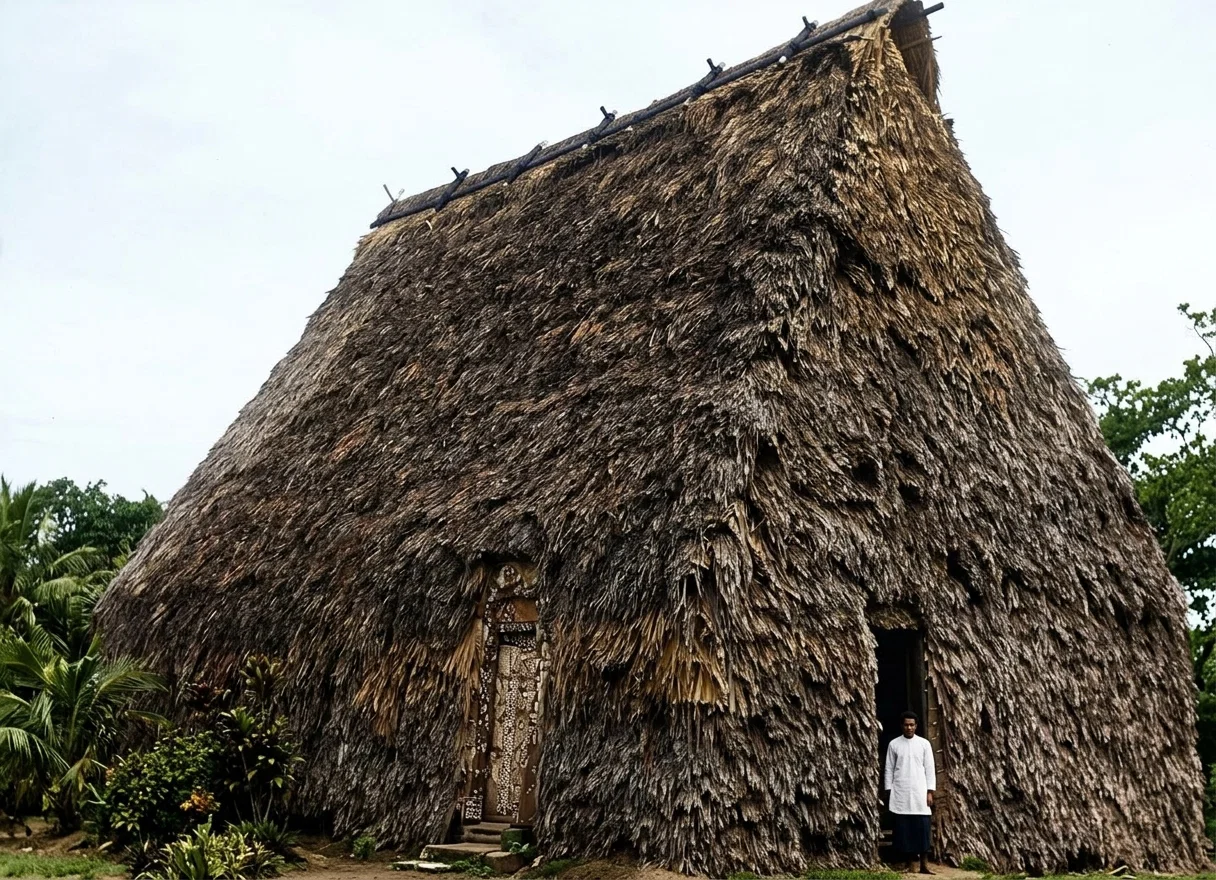
NATIVE HUT (EXTERIOR)
At every step of the way fresh and unexpected needs and difficulties arise, which must be met and overcome by the worker. He must turn his hands to work in building, in cultivating the soil, in sailing, in printing, in treating the sick, and in ministering the Word. One cannot obtain a clear conception of the duties that devolve upon the missionary in a foreign field, especially where civilization is but little advanced, unless he has had some experience of the kind.
The missionary has need of every useful branch of knowledge that can readily be put to good use in ministering to the wants of all around him. Unless he is a practical man, very little will be accomplished with the means usually at his disposal.
Somehow, the native has the idea that a missionary must be a doctor, or a person capable of advising him in everything, if he assumes to lead the people. And why not? It is with this in view that he rushes to the missionary for aid in case of accident or illness. A sketch of the work of a few days in the mission will show the truthfulness of this statement. While engaged at printing the paper, a cry is heard, “Come quickly; the buli [native district chief] has cut his finger off—mashed it to pieces—tried to stick it on—come! Come at once!” The next hour is occupied with a broken and mashed finger. The sufferer is eased, and a case is on our hands to attend to for a fortnight or more. We go on with the printing, finish it, send the papers away, get ready for another issue, as we intend to visit a group of islands seventy or more miles away, where there is a great stir about the new religion, and an effort is being made to expel the new lotu. We toil on until nightfall, rest awhile, then make ready to retire. Just as the light is about to be extinguished, a sudden cry is heard. The superintendent calls out in the still darkness, “A young man is bleeding from the lungs, and vomiting large quantities of blood; they want you at once!” “What can I do to help you?” cries another voice from an adjacent room. The inevitable reply is, “Get ready some hot water as soon as possible, and send it over.” We seize the vaporizer with a prayer that it will render assistance, lay hold upon a piece of cloth to serve as a compress, and hasten away to the native village, which is in deep anxiety.
We reach the house, stoop and enter; and what a sight is before our eyes! Twenty or more stalwart natives are squatting around in grim and hideous stillness, closely watching a fine young man slowly bleeding,—no, he bleeds rapidly,—supported by his aged father, who weeps at the sight. I glance around the corner where the young man is, and there large quantities of life fluid are spread on the floor mat. That is not all—he still coughs it up. It is impossible to get a definite idea of the loss of blood; but the situation calls for prompt action. The father and the brothers cast longing, desperate glances to catch any ray of hope afforded by our efforts. The word is given to heat plenty of water outside, the crowd is ordered outside, doors are opened wide, the vaporizer is applied with desperate energy, cold compresses being placed over the lungs. But there is no hot water as yet.
We labor on, looking up to heaven as we sense our helplessness. While we thus work, the natives begin crowding and chattering, and some enter, smoking the vile weed, tobacco. They are soon dismissed. In ten minutes or a little longer the treatment is having its effects. The hot-water bag arrives. It is quickly placed behind the lungs, the patient’s feet are placed in hot water, the cold compresses applied vigorously with fans in action all around. With what gratitude we see the sufferer becoming easier and the blood diminishing! We work steadily for an hour, and the breathing is slower and freer, the patient begins to sleep. Perfect silence is requested. It is now half-past eleven, and the bleeding is stopped; and but for an occasional cough, which brings up a little mucus slightly tinged, all seems well. We wait a little longer, he sleeps well, and we take our leave, giving strict injunctions that he be kept perfectly quiet, and that we be sent for at once should any further bleeding occur.
From the Scientific American
NATIVE HUT (INTERIOR)
With minds much relieved we return home, and retire. Early in the morning13we hasten to see our patient, and find that he has had an undisturbed rest. The relatives are again admonished to have quietness, and not to have him move about. Directions are given for nourishment, and he is left to the care of his friends. We return and continue our work.
At eleven o’clock, while just in the act of applying a fomentation to another patient at the mission, I pass the remark that it is “only a brittle thread that holds the life of that young man, and if he should move around carelessly, all would be over with him in a short time.” The words scarcely fall ere a messenger in great haste steps on the veranda, and calls in agony for us to come, as the hemorrhage is worse than before. Away we speed. The place is packed this time with eager, anxious persons, most of whom are waiting mournfully. A glance reveals the situation as hopeless. The young man has bled too much already, and he turns his face upward with an agonizing look, and says, gasping, “Sa oti, sa oti, talatola!” (“It is finished, preacher; it is finished.”)
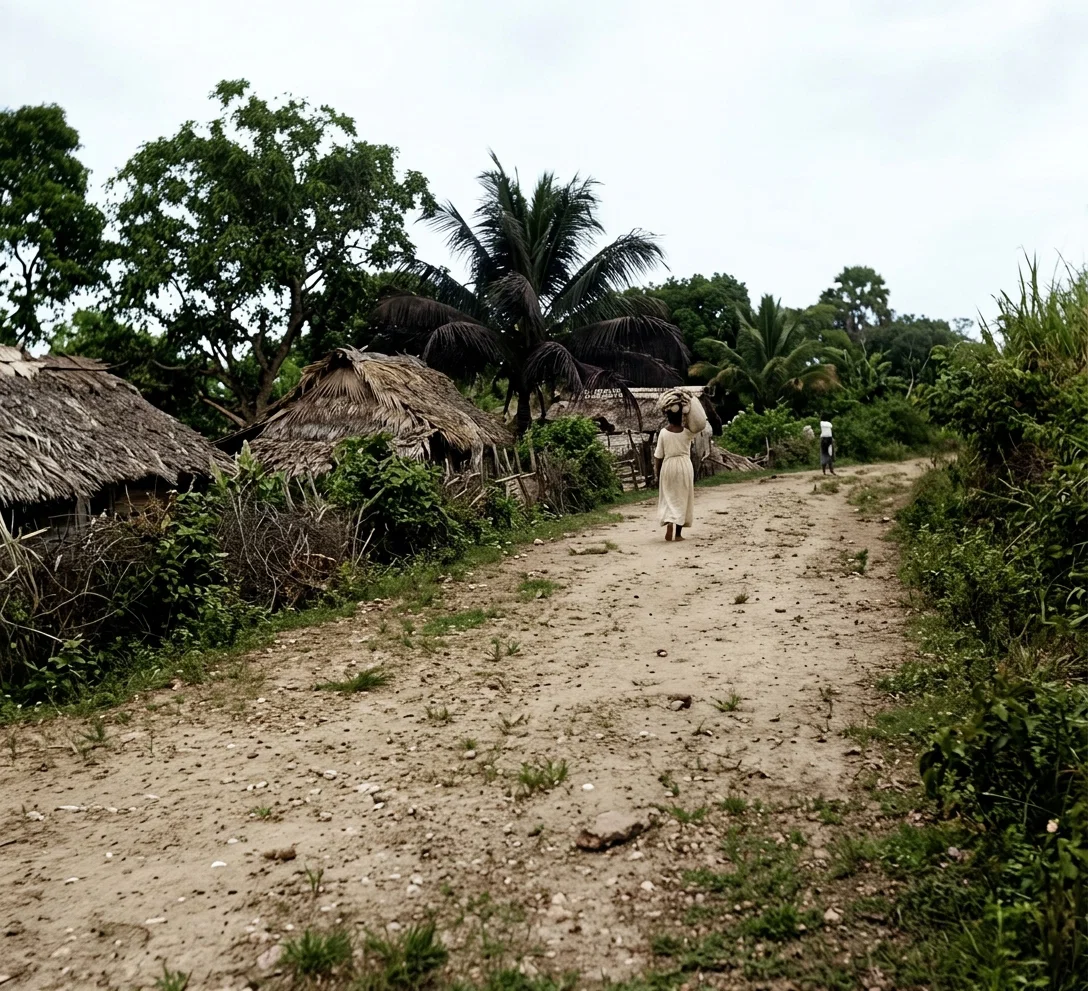
A VILLAGE IN BRITISH GUIANA
And so it was. He bled to death. But we had the privilege of making his last minutes easy. Even when so close to death’s door, the treatment had its desired effect in stopping the hemorrhage; but it was too late to save his life. We made inquiries before leaving, and learned that he had actually and willfully arisen, and walked up and down hill for some distance, intending to catch fish. The next day he was carried to his grave, and there he rests peacefully. In the morning he had been talked to about giving his heart to the Lord in gratitude for sparing his life. Apparently he took no heed, and in a few hours his probation ceased forever. It was with sad feelings that we took part in the funeral service the day following; but we felt that our garments, although stained actually with his blood, were free from guilt. It is true that we are a savor of life unto life, or of death unto death.
The foreign missionary must lay down his life for the sheep; he must die daily; he must count all things but loss, that he may win souls for the kingdom of God.
Suva Vou, Fiji.
British Guiana Council Meeting
By D. C. Babcock
D. C. BABCOCK
A GENERAL meeting for the Guianas was held in Georgetown, British Guiana, from May 29 to June 8. The object of the meeting was to give instruction to church, Sabbath-school, and missionary officers, also to prepare our canvassers for more efficient work.
Elder A. J. Haysmer was present, and gave valuable instruction in all departments of the work. All the laborers of this field were in attendance, and assisted in the meetings.
Valuable instruction was given each day upon the principles of healthful living, by Mrs. Philip Giddings, who has been trained at the Battle Creek Sanitarium. This was much appreciated by all the brethren and sisters, and it is hoped that an advance step will be taken, in the temperance work in these colonies. One evening each week was set apart for the temperance work, and much enthusiasm was manifested by the public upon the principles set forth. More than seventy signed the pledge the first evening, and quite a number at the last meeting. Ministers were present from other denominations, and took an active part in the program. Sister Giddings has spoken in other churches, and the way is opening for our work in the city. For all this we praise our Heavenly Father.
Each day was begun with a praise service, at 5:30 A. M., which was well attended. About twenty minutes were devoted to reading selections from the Testimonies, and the remaining forty minutes were given to personal experience and thanksgiving.
From 10 A. M. to 12:45 the temperance, evangelistic, canvassing, and church work were considered. Valuable instruction was given in these different phases of the work, much time being given to church organization and management.
Harmony prevailed throughout the entire meeting, and all felt that the few days spent together in seeking God were not only a blessing to each one as an individual, but that we were brought closer to God, our own hearts were more closely united, and thus we became one in Christ.
A few hours were devoted in the afternoon to actual field work, and, like the seventy, the workers returned with rejoicing. There was no time wasted; but all worked for the upbuilding of God’s kingdom.
From the very first evening service, our hall, which was in the central part of the city, was well filled. When the council meeting closed, we found such an interest that we could not stop the meetings. At this writing, June 24, our hall, which accommodates about three hundred, is full each night, and more than fifteen have expressed their determination to walk in the way of all God’s commandments.
Brethren Giddings, Downer, and the writer have remained in the city to assist Elder Morrow for a time in the work. We are all of good courage in the Lord.
Georgetown, British Guiana.
Mission Notes
THE interest which leading Chinamen take in educational institutions carried on in their country, even under Christian auspices, has just received a fresh illustration in the gift of $3,800 recently made by several Chinamen in Shanghai, among the number being several viceroys. The college receiving the gift was the St. John's College of Shanghai, conducted by the Protestant Episcopal Church.
THE Koreans are well known to be a very backward as well as lazy people, yet the gospel is accomplishing wonders among them. The Christians of Korea have a reputation for earnestness of desire to spread the knowledge of Christ among their fellow countrymen. A writer in the Missionary Review of the World tells an interesting story of the progress of Christianity in one city of seventy thousand inhabitants, which in 1893 was first entered by three missionaries. After eight years of missionary labor the message from this city comes over the sea, “A thousand at a midweek prayer meeting on a rainy night.” Truly, this is the Lord’s doings, and marvelous in our eyes. To these people the third angel’s message is due. Pray the Lord of the harvest to thrust forth laborers into his harvest.
Press On
By Clarence Leland Miller
THINKS'T thou the babbling throng can change
The issue of a single day?
Can add one cubit to the way
That leads us on through regions strange?
The eye of God is over all;
And as he led his little band
From Egypt to the promised land,
So now he leads, whate'er befall.
Ofttimes a burning stretch of sand
The weary feet must journey o’er;
Fear not — Jehovah walks before;
He knows how much the flesh can stand.
Speed on, then, heart, devoid of fear,
Despite the Red Sea’s hollow roar;
The land of Canaan lies before,
Press on, O heart, and persevere.
— Clarence Leland Miller.
Central America
By L. O. Corwin
UTILA, BAY ISLANDS.—We have just closed a six weeks’ vacation. Our schoolhouse is still unfinished; as times have been hard here this year, we have not been able to raise money to complete the work.
I believe we told you some time ago that most of the people here were English. About a month ago an English man-of-war came here, and informed the people that all who were on the island when it was ceded to Spanish Honduras by England in 1860, were not English subjects if they remained in Spanish Honduras. This also included their children born here. This has made quite a stir among the people of the Bay Islands, as it included many of the best families, and they declare that they will not be subjects of Honduras. So they must make their homes elsewhere. Some have already gone, and others expect to leave soon. The hard part of it is that there is no one to buy their homes. The people seem to be afraid to spend a cent now, so many of them have taken their children out of school. This has brought our attendance down from seventy to about thirty-five. We do not know how long this state of affairs will continue. We trust in God, and wait. The tuition in this country is low, and with the present attendance our income is only fourteen dollars a month.
We are trying to show the people that this is only one of the signs of Christ’s soon coming, but nothing seems to have much impression on them. Utila has been warned repeatedly by good workers, and although still indifferent, the people like the school.
Some of the young people manifest a little interest, and are anxious to take part in the social meetings by reciting verses of Scripture. The little native girl staying with us is making many changes for the better. She also takes part in worship with us. She was about as wild a little girl as there was in Utila when we took her. Every one speaks of the change. We thank God for the little good done, and long to see more.
There is truly much work to be done among the Spanish people here, as well as among the other classes. We have purchased some Spanish books, and are trying to study the language. The little girl with us used to talk nothing but Spanish, so we hope to be able to do something for this class of people. However, there are not many of them in Utila.
A good Seventh-day Adventist doctor and a nurse are needed here very much. Although our knowledge is so limited, we are kept quite busy, as there is no doctor here at all. The people suffer much from fever. Most of them are afraid of water, especially when it is cold. We are of good courage to press onward in our efforts to do all we can for the Master. Pray for the work here.
L. O. CORWIN.
The Virginia Camp Meeting
By H. W. Cottrell
THE Virginia camp meeting was held about four miles from Lynchburg, August 8-18, in a beautiful grove directly on the line of the electric cars. Although the encampment was rather too far from the city, yet the attendance from the outside was excellent.
The people of the conference were well represented. All the conference ministers were in attendance, and besides these, Professors Griggs and Neff, Brother S. N. Curtiss, and the writer, each rendered willing service. We were much disappointed in not having other ministers present with whom arrangements had been made; but circumstances had so changed with them that they could not meet their appointments.
The Lord gave power in the presentation of his word, and much liberty was enjoyed by the speakers. The third angel's message was delivered unveiled to the general congregation, and it only increased the desire on the part of the people to hear further. On the last Sabbath of the meeting, twenty presented themselves for baptism, and none of these were re-baptism of our church people. The larger number were young people just entering the service of Christ. It was truly a time of rejoicing for those comprising the little conference of Virginia.
The conference is still over three thousand dollars in debt. This is the old tract department debt. However, arrangements were more fully completed, the carrying out of which will enable them to secure this entire amount of money between now and Jan. 1, 1903; and I am sure that these plans will be carried out, and the debt lifted. All are of good courage. We look for great results the coming year.
Elder R. D. Hottel was re-elected conference president. The other officers are the same as last year.
The interest created by the camp meeting will be followed up by a series of tent meetings. H. W. COTTRELL.
The Educational Conference
By M. Bessie DeGraw
It was the oft-repeated expression of those privileged to attend the summer school and educational conference at Berrien Springs that this was the most pleasant and the most profitable season they had ever spent. It was the original plan to extend a general invitation to all persons interested in Christian education to attend the conference, but as the students of the summer school approached one hundred and fifty in number, it became necessary to abandon that idea because of inadequate facilities. Consequently the invitations were limited to conference presidents, educational secretaries, and the heads of institutions.
The regular work of the summer school was dropped with reluctance when the time came for opening the conference. Students were deeply interested in their studies. This is the first summer school in which a definite, well-defined course of instruction has been given. Heretofore the work of the summer term has followed the lecture method; this season there was thorough class work. Each student was classified according to his most urgent needs. One regular subject received the student's undivided attention. Consequently15when the term closed, pupils felt that they had gained something which repaid them for the time spent.
When the conference opened, the students themselves took a leading part. The central thought during the entire summer had been “the need of an educational system which provides free schools for every child,” and “the means of support for such a system.” The study of the summer had impressed these questions so firmly upon the minds of all, that it mattered little what subject was before the convention for discussion, these central thoughts were made to appear.
How I was educated; why I left the public schools; experiences in teaching a church school without special training; mistaken views concerning Christian education; the object of Christian education; methods of attaining that object; periods of child development, and how Christian education is adapted to each; universal free schools, and methods for their support; text-books; character of teachers; training for teachers; duties of educational superintendents; scope of work for church schools, intermediate schools, colleges, and training schools,— these are some of the subjects discussed. In most cases the subject was presented by one or more students, and then discussed by the body.
Prof. Clinton D. Smith, of Michigan Agricultural College, spent one day at the convention, and addressed the students twice on the subject of Practical Agriculture the Basis of Nature Study. R. M. Kellogg, of Three Rivers, Mich., widely known as a cultivator of fine strawberries, addressed the students twice, giving valuable instruction concerning the raising of berries, and encouraging teachers to begin this work in church and intermediate schools. Both Professor Smith and Mr. Kellogg advocate farming on the intensive plan; both sound the cry, Away from the cities! Get into the country! The students had the privilege of listening to Col. Henry Hadley, of Chicago, a worker in the New School of Temperance, which pleads for simple food, well cooked, free from condiments, as the foundation of temperance. Colonel Hadley spoke more fearlessly for health reform than does many a Seventh-day Adventist who claims to have known this truth for years. Dr. Paulson created a wave of enthusiasm by his animated presentation of the subject of mission fields for Christians. He told of the opening doors before him and his workers in Chicago; he showed the need of consecrated workers, and inspired every teacher with a desire to work for perishing souls. In a few minutes over four thousand yearly subscriptions were taken for the Life Boat. Professor Sutherland showed the teachers how they could co-operate with the movement into which the doctor is putting his life, and almost all the teachers subscribed for a club of the Life Boat, to be used in their schools, and distributed by their pupils. Professor Cady, of Healdsburg College, was present during the closing days of the convention, and his talks on nature study were highly appreciated. Professor Griggs, of South Lancaster, made a hurried visit to the white city among the trees, but was unable to remain long on account of the summer school in session at South Lancaster. Elder W. A. Spicer spent several days on the grounds during the regular term, and his instruction on foreign missions stirred the hearts of his hearers. Sister Cora Blodgett, of Union College, left the grounds a few days before the close of the convention to prepare for her future field of labor in South Africa.
There were other features of the convention decidedly instructive, but perhaps none more entertaining than the lecture by Professor Newton, of Union College, in which he described his trip through Europe, illustrating it with stereopticon views.
It proved to be necessary, because of the Wisconsin and Michigan camp meetings, to close the conference three days earlier than had been intended. Sunday, the last day of the session, and the following Monday, were busy days. The educational secretaries were counseling with teachers, and locating them for the year. Numerous requests have been received for teachers, but the States that were represented among the students and whose secretaries were on the ground, received the first appointments. The value of trained teachers is everywhere recognized; and as the educational system is more completely organized, this fact will impress itself more deeply on the minds of patrons and school boards. A public school, conducted in a church building for Seventh-day Adventist children by a Seventh-day Adventist teacher, will not save the children. Christian education is more than that. It is a complete revolution—a reformation in methods and principles.
It was voted to publish a synopsis of the proceedings of the conference in the October issue of the Advocate. This issue of the journal will be enlarged to meet this demand. Parents and teachers should give this matter wide circulation. The conference which has just closed marks a crisis in the work. We cannot afford to let this phase of the message pass us by. M. BESSIE DEGRAW.
H. C. GOODRICH
By H. C. Goodrich
BELIZE, BRITISH HONDURAS.—We are all well, and of good courage in the Lord. Mrs. Goodrich has begun her school with six pupils — just the children of our own people. The interest in the mission is still good, and the attendance full. Five have begun the observance of the Sabbath, and many others are deeply interested. We are being denounced by the ministers, but the people love to hear the simple story of the cross, and so continue to attend our meetings.
H. C. GOODRICH
The Mississippi Camp Meeting
By H. W. Pierce
THIS meeting was held in a beautiful grove in the city of West Point. A more pleasant location could not have been selected.
The Lord was there by his blessed Spirit, hearts were melted, and burdens were lifted from souls that had been under a cloud. The sunshine of God's love caused rejoicing in the camp. Such expressions as, “I am free in the Lord,” “I am happy,” told more than can be told with the pen.
We were favored with the labors of Elder G. I. Butler, whose earnest testimony will long be remembered. Elder J. E. Tenney presented the subject of Christian education in its different phases, with his usual earnestness and zeal. His instruction was well received, and we hope that it will be carried out in this conference as fast as possible. Elder S. B. Horton was with us part of the time, and presented some of the leading points of our faith to the people assembled in the tent.
The field agent for “Christ's Object Lessons” awakened in the campers a desire to do their part in selling this valuable book. This conference had already sold a good part of its quota of “Christ's Object Lessons,” and a goodly number were subscribed for on the ground.
Two who have just begun the observance of the Sabbath gave their first testimony at this meeting.
The business meetings passed off harmoniously, and we see no reason why success cannot attend the efforts put forth to spread the truth in this State the coming year. H. W. PIERCE.