The Youth’s Instructor, Vol. LII, No. 34

The Passing of Finland

The Youth’s Instructor

August 23, 1904

Review and Herald Publishing Assn. · Washington, D. C. · August 23, 1904

“The Passing of Finland”
HEAVEN is but earth with one word lost from its vocabulary,—selfishness. Were all the misery, wretchedness, sorrow, falsity, and sin of all hearts in all the world and of all the ages crowded into one living picture, it should be labeled selfishness. Just that bit which has sometimes been found in one isolated human heart, has made thousands of other hearts bleed for long years. A strong, greedy, conquering nation is but the combined, multiplied selfishness of the millions; and earth’s history is but a record of the woe and devastation wrought upon sensitive souls by such fearful combinations.
Fresh in the minds and hearts of a people of superior culture, and with a distinct literature and art of its own,—a law-abiding, industrious, prosperous people,—is the record of a recent event caused by a nation’s selfishness. Russia in 1899 laid her iron hand upon the little country of Finland, and it resulted in a tragedy that has touched the heart of the world. To-day, Finland is dying.
Since 1362 this country has enjoyed home rule; it had been in possession of its political rights, having had representative right in the Swedish Parliament, for Finland was long subject to Sweden. A prosperous, progressive country, enjoying all the blessings of liberty, no better form of government was desired by the Finns.
In 1808, however, Russia concluded that a change in affairs would be well for “The Bear” if not for Finland; whereupon, like a bolt from the blue, the Russians crossed the eastern frontier, and forcibly wrested, on Feb. 12, 1808, the little country from Sweden. Whether from policy or from the kindness of the reigning czar, Alexander II, the Finns were allowed to keep their own independent government. In fact, the czar promised not to disturb their peace or prosperity in any way,—all things were to continue as they were, save that he would be commander-in-chief of the army, and would direct in the management of foreign affairs. The change was to be regarded more as annexation than conquest. The Finns accepted gratefully this promise of Alexander II.
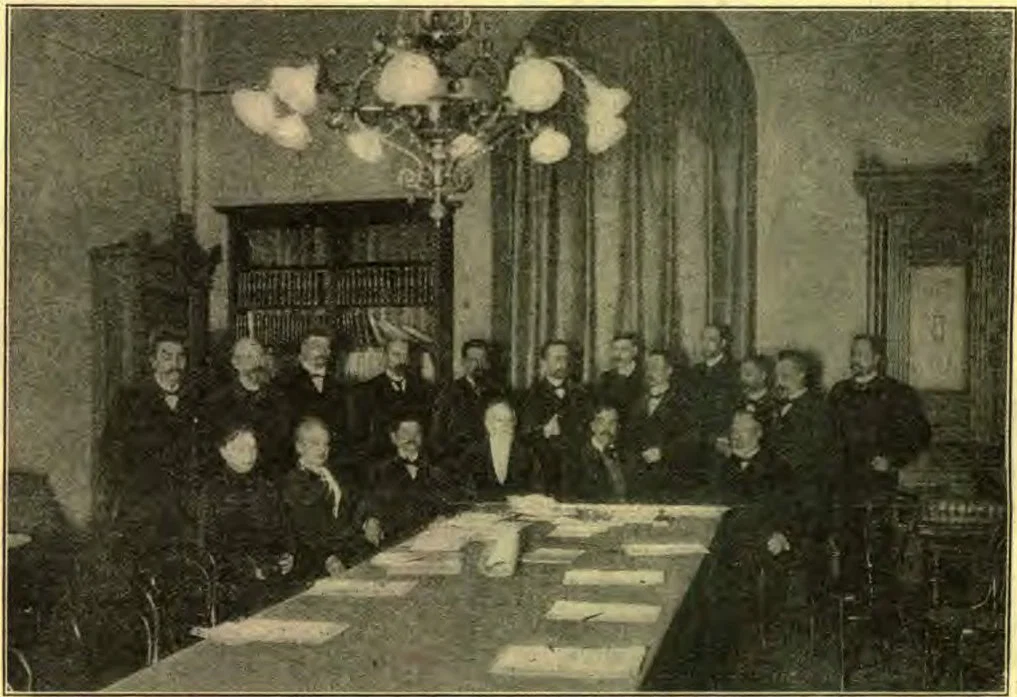
GUESTS OF THE SECRET DINNER AT DR. SALZMA'S HOUSE
Not until 1899 did the people come to realize the full meaning of the invasion of 1808. But on that fatal day in 1899 Nicholas II, with one stroke of his pen, broke the heart of the justly proud and sensitive Finland. That stroke said that “it was necessary that Finland be united by closer bonds to the empire of Russia,” and the humane czar proceeded to effect the closer union by abolishing the Diet of Finland, promising in future himself to legislate for the country without her assistance. He furthermore demanded that the Finland army be disbanded, and the soldiers scattered throughout Russia’s wide domains.
By all this Finland was not angered so much as crushed. The reception of the czar’s edict put the whole country in mourning; every man, woman, and child wore black, and the public buildings were draped in crape. A force resistance meant simply the utter extinction of the race; therefore the people thought it wise to appeal. Delegates and petitions were hastened to St. Petersburg; but the “humane czar” received neither. In silence, however, his iron hand continued to execute his determinations. The leading men of Finland were arrested, imprisoned, or exiled; statesmen, writers, educators, men of wealth,—all alike. Then began the exodus of the people, the Russian persecution forcing many to leave their country. Incredible as it may seem, Nicholas II was the originator of The Hague peace document that called The Hague Peace Council a few years ago. The Finnish tragedy succeeded very quickly that temporary pacific outburst of the czar.
“In 1898 the number of Finn immigrants to America was less than three thousand. In 1899, when the czar issued the fatal decree, the number increased to twelve thousand; in 1900 to twenty-five thousand; and in 1903 to half a hundred thousand. Since 1898 more than one hundred fifty thousand Finns have come to the United States, and there are now over two hundred thousand under the American flag.” Italy sends annually more immigrants than any other country; but only one sixty-fourth of her population is now here, while one tenth of all Finland’s inhabitants has come to this country since 1898. What this great exodus stands for in sorrowing hearts, broken homes, lost property, maltreatment, and wretchedness in general, only the Finns themselves can tell.
So loyal are the leading men, that they will not leave until their goods are confiscated, and they are forced to leave by order of the czar. They remain even at the risk of being banished to Siberia, regarding it the duty of the educated and influential men to “stick to their country to the last, the same as a captain to a ship,” thus helping to hold the peasants, and prevent a panic that would utterly depopulate the country.
Russia for some time had held quite a strong censorship over the press of Finland. No paper was allowed to go from the press without examination, and whole issues were ofttimes withheld until revised. Papers coming into the country were also noted, and anything that the authorities preferred not to have the receiver read, was marked out with black ink. After the trouble, no public meetings were allowed, it having been decreed that not more than three persons of different families were to assemble without first supplicating permission from the Russian dictator; and Russian spies were ever on the alert to prevent any evasion of His Majesty’s commands.
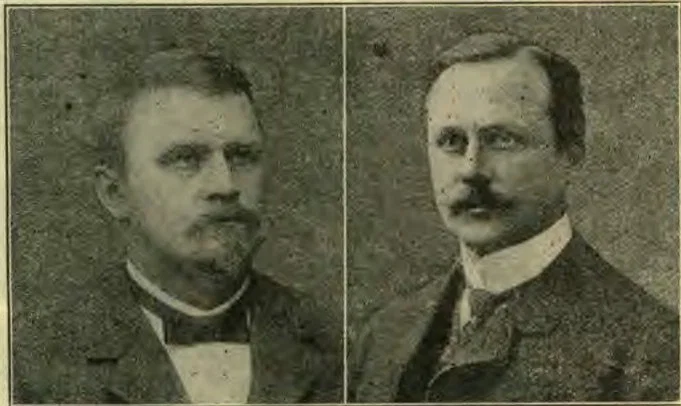
Secret councils were held by the leading men, but at a very great risk to all in attendance. One of the illustrations shows a company secretly gathered at the home of Dr. Salzma, the leader of the Finnish National Party, and a man of wide reputation. At this dinner were present senators, the mayor of the chief city, professors from the university at Helsingfors, editors, a minister, and the chief architect of the capital city. One American then visiting in the country was invited, and to him we doubtless are indebted for the picture of the illustrious gentlemen in attendance. In less than forty days after this meeting, ten of the men were bidden to leave the country. Three are now in the United States, forced to begin life anew on a foreign shore.
Such is one picture in the long, dark history of selfishness. May the Saviour soon come to establish his rule of justice and peace upon the whole earth.

Wonders of Photography

Two novel applications of photography have been recently made which are interesting and worthy of special attention. One is testing butter by photography, the other is tailoring by photography.
J. A. Hummel, State chemist of Minnesota, by a combination of Nicol prisms, microscopes, a lensless camera, and a sensitive plate, has hit upon a plan to detect good butter from the spurious article at a glance. It appears that pure butter contains only amorphous fat, and any heating process will generate crystals. Consequently, if the butter is free from crystals, and therefore pure, when it is photographed, there are no polarized rays, and only a dull translucent light will pass through to the plate. But if there are crystals, as in oleomargarine, butterine, etc., the bright and dark spots will come together and form a peculiarly shaded picture on the negative that is unmistakable. The proof is said to be absolute and convincing.
From Paris comes a new patented process, entitled “Tailoring by Photography.” The person to be measured is placed before the camera, and between them is introduced a network that is photographed at the same time, and serves as a standard. Certain artifices are necessary to obtain a complete result: thus, certain hidden parts, like the armpits, etc., must be indicated by objects visible from without, and, finally, several views must be taken from various standpoints. These parts may, however, be marked directly on the person instead. The relative positions of the camera, the network, and the subject are carefully adjusted so that the subject appears always on the same scale, and then the photograph is taken from the various necessary standpoints. And now photography, like Alexander of old, is seeking for new worlds to conquer.—Photo-Era.

Who Should Study Stenography?

Courtesy of "Everybody's Magazine"
Quite likely one reason why first-class stenographers are not more frequently met, is that shorthand is not generally regarded as the important art it really is. Young people are often heard to make such remarks as, “I am going to take a few lessons in shorthand, and be a stenographer.” The writer has heard this very remark. What a mistake, to suppose that “a few lessons” can impart a knowledge of this highly important and very valuable accomplishment. As well might one expect to become a proficient pianist in a few weeks. No; shorthand, to be really acquired, so that it can be satisfactorily and successfully used, means a great deal more than a few weeks’ or even a few months’ study. It involves many months of hard and diligent work before any one can use it with a degree of confidence and reliability. Any one who speaks with a knowledge of the subject will testify that this is so. If one would become an artist in this work, it is a mistake to look upon shorthand merely as a stepping-stone. The wide-spread use of this art has raised it almost to the dignity of a profession, and surely the young man or woman who takes up the study of shorthand should aim to become a thoroughly capable user of it. Then, let shorthand be looked upon as a calling worthy of one’s highest endeavor and noblest achievement. Besides, even though one does not intend or expect to always be a writer of shorthand to earn a living by it, yet the art can not fail to be of permanent and ever-increasing value as long as one lives. Possibly the position of stenographer may lead to a post of great trust and responsibility; even so, is it not evident that the more competent and efficient the person is as a stenographer, the more likely will it be that the same qualities will be maintained in the higher position? And it would seem probable that a young person who regarded shorthand as something to be merely used as a stepping-stone to something higher, and who therefore paid little attention to the cultivation of efficiency in that art, would be scarcely liable to foster the qualifications which would be essential in the higher post.
A story is told of a certain reply received in answer to an advertisement for a stenographer. It ran something like this: “Dear Sir, I beg to apply for the position of stenographer. I have had a few weeks’ experience with the typewriter, though I do not know anything of shorthand; however, I believe I could do it if I was shown once.” While this may be a somewhat exaggerated instance, it affords some idea of the popular opinion regarding this valuable art.
Another thing may be mentioned, regarding the persons who should take up the study of stenography. Not every one is naturally adapted to this calling. Sound intelligence, and readiness to grasp principles and rules, must be possessed by the student who would make a success of it. A natural aptitude for language work also is very valuable. Some degree of dexterity in handling a pen or pencil is requisite. In short, a person who is naturally slow, is hardly the one to succeed as a shorthand writer, whether as amanuensis or otherwise. And it may be stated that a course in shorthand and typewriting at a business college is no guarantee of a person’s success. It may be a good thing for the pocket-books of those who maintain the college, to have all who feel they would like to take up shorthand attend the school for six months, regardless of any natural adaptability in this direction; but experience has shown that many persons go to such schools and spend month after month in a disappointing attempt to become shorthand writers, when as a matter of fact they should be spending their time in acquiring the rudiments of an ordinary education. A knowledge of shorthand can never take the place of a substantial knowledge of reading, writing, and arithmetic.
A word in passing may be said about the delusive advertisements issued by many schools and colleges professing to prepare persons for stenographic positions. To the uninitiated, an advertisement appearing in the paper in April or March, and reading, “Prepare for positions in the autumn,” may seem very alluring, but such announcements are deceptive and absurd; for it is next to impossible for any one to acquire in a few months that which can be obtained only by experience and much hard study, extending over a considerable period of time. Unless the student has a thorough knowledge of English, and a good all-round elementary education, he can not qualify for a stenographer’s post by simply taking a course in shorthand and typewriting, for much more than that is required if he would keep a position.
R. E. PORTER.

Faithfulness to a Fellow Boarder

(Concluded)
FINALLY the day for my departure was at hand. After my last dinner at this house, I went to my room, regretting that I had never said a word for Christ to one in whose welfare I was interested, although I sat at the same table with him, day after day, for weeks. I remembered my life-resolve, and felt that I was not living up to it in this case. It did not satisfy me when I proffered to my heart the excuse that I had never been alone with him, nor had had a fitting occasion for conference. Was it not worth while seeking and securing an occasion, when the interests of a soul were involved?
I spoke of the matter to my room-mate and companion, for whose health I was in the South. I suggested that perhaps it was my duty to go to the room of my fellow boarder that very afternoon, and say a word to him for Christ. He might, indeed, take offense at it, but, again, he might not. Was it not worth while taking such a risk for a soul’s sake, and for Christ’s? The decision was made. We knelt together in our room, and asked God’s blessing on my undertaking. Then I arose and started out. The room of my fellow boarder and his wife was across the hall from ours; yet it was not an easy task to venture on knocking at that room door, in the fulfilment of my purpose and my duty.
At my knock, the young gentleman whom I sought opened the door, and invited me in. His wife sat on a sofa. They welcomed me cordially, and when I told them that I purposed leaving the place the next morning early, they expressed regret, saying that our intercourse of the past few weeks had been very pleasant. I replied that I had enjoyed knowing them, and that it was because of my growing personal interest in them that I had now called at their room. Then I explained that my joy in Christ’s service was the greatest possession of my life, and that because I longed for my fellow boarders to have that joy, I had come to say so. The gentleman said that it was kind of me to say this, and that he had been thinking that he would like to know more about the religious belief I had, so that he might share it. Would I tell him what books he should read, in order to learn about this?
I replied that I could mention good books for him, but that I should much prefer to talk on the subject with him personally in detail.
“It would be very pleasant,” he said, “to put myself under your guidance, if you would instruct me.”
“But I leave town early to-morrow morning,” I said, “and I am cut off by this from helping you.”
On his asking where I was going, and learning that I was to visit another part of the South, he responded that he would be glad to accompany me. On his asking his wife if that would be agreeable to her, she expressed her willingness to make the move, and it was arranged accordingly. Early the next morning the boarder who had wanted to leave that house when he found that a clergyman was coming there, with whom he could have no sympathy, finally left the house with that clergyman in order that he might be personally instructed in the religion which he had come to desire as his own possession. Surely God was leading. And God ever leads those who are willing to be led, even though they often follow reluctantly.
There was no opportunity for a quiet conversation during the first day, while we were constantly within hearing of others who were about us in the crowded public conveyance on which we journeyed; but I embraced the first opportunity. We had a precious season together. The Lord came very near, and from that hour he was an earnest, devoted follower of Christ. He became a close student of the Bible. He and his wife together made an open confession of their new faith, and connected themselves with a prominent church in New York City. They became active in mission-school work, and in that field he devoted his trained business mind to perfecting methods and systems of work, so that he was known widely throughout the country as a leader and guide in that field. He became, after a time, prominent as one of the most influential workers, and director of other workers, in the entire country. Then I was, indeed, glad that God would not let me leave that winter-resort boarding-house without going to the room of that fellow boarder and telling him of my desire for his spiritual welfare.
What a Saviour we have, both to trust and to tell others of; and how good it is to work for him!—H. Clay Trumbull.

Heaven's Golden Gate Opens to the Humble

“HEAVEN’S golden gate opens not to the self-exalted. It is not lifted up to the proud in spirit. But the everlasting portals will open wide to the trembling touch of a little child.”

Persons Who Helped Themselves

DAVID LIVINGSTONE said, on graduating at Glasgow, “I never had a dollar that I did not earn.” He used to carry his Latin book to his loom, and study. Yet he was buried in Westminster Abbey, and on the site of his hut in the heart of Africa’s jungles is now a large town with electric lights and a railway.
Frances Willard and her brother Oliver started a paper at fourteen. They used to talk to each other about what they would do when they were grown up. Frances often went hungry and walked long distances, because she had no money to buy bread or pay car-fare; but she came to occupy a foremost place among women.
Lucy Stone, the great champion of higher education for women, made up her mind, when a tiny bit of a girl, that she would go to college. She picked berries and nuts and sold them to buy books; she lived on fifty cents a week, and at last she was graduated from Oberlin College.
Mary A. Livermore taught school for a little money to fit herself for life’s work.
Lincoln studied by the light of pine knots.
Emerson sawed wood to help himself through Harvard College.
Rev. Charles M. Sheldon worked as a waiter in a summer hotel to get money to complete his education.— Junior Endeavor World.

An Incident

IN the issue of the INSTRUCTOR for Sept. 29, 1903, was published a “personal” letter of Mr. Guy Dail’s, in which he described his visit to William Carey’s chapel, in Leicester, England. I read the letter with interest, and thought that there might be some among the INSTRUCTOR readers who would enjoy a bit of one experience in my life that brought me in close contact with something that was William Carey’s.
It was in Oakland, California. Great preparations had been made in San Francisco for the sixteenth convention of the Christian Endeavor Society. Oakland was enthusiastic over the matter, too, even though she was not so much decorated for the occasion as San Francisco; still, the colors, purple and gold, were everywhere displayed.
The First Presbyterian church was crowded to its utmost capacity for the opening meeting of the series. The vast audience waited for the speakers that had been announced for this service. The hour passed, and still they waited. There seemed a spirit of restlessness, and of mild excitement as to what might be the cause of the delay, when a few gentlemen were ushered in, and Dr. Coyle, the pastor, addressing the assembly, said, “We are sorry to announce to you that owing to circumstances, the speakers we have been looking for will not be able to be present to-night, but I trust that you will be reconciled when I announce, in their stead, the name of Dr. Francis E. Clark, the founder of the Society of Christian Endeavor.”
The immediate response to the unlooked-for welcome words was a waving of a forest of white handkerchiefs, as the enthusiastic audience with difficulty restrained their applause.
A moment later, Dr. Clark took the stand, and received the hearty welcome that was accorded him. He then gave a rapid account of his tour around the world, telling of the most stirring incidents that happened, and dwelling with peculiar pleasure on his visit to Andrew Murray, in South Africa. He told of Mr. Murray’s work there, of his family, and how the various members of that family were engaged in work in the Master’s service. But what stirred my spirit most was his intensely interesting description of his visit to the scene of William Carey’s labors in India, and his warm reception by, and pleasant intercourse with, “William Carey the Third,” as he styled him. The speaker’s face lighted up with pleasure as he described his visit, and his enjoyment at being privileged to hear so much of the life and labors of William Carey the First, from the lips of his grandson. The latter gave to Dr. Clark the hammer that was used by his devoted grandfather in his shoemaking business, “and,” said the speaker, “if my trunk turns up, . . . the gavel that shall be used to call the meetings to order will be William Carey’s cobbler’s hammer.” How my heart was moved within me! From the very earliest days of my recollection, I was wont to listen to my beloved father, speaking of the missionary who cobbled shoes and taught the gospel of Christ, and now to listen to one who had only lately visited the scenes of the long-gone past, seemed too strange to be true. But a nearer acquaintance with the almost sacred old hammer was to be made.
Two days later I passed in with the surging crowd that filled the Calvary Presbyterian church in San Francisco. A lady, Mrs. George Coleman, of Boston, presided over that meeting. A number of good speakers addressed the church that day. One interesting feature of the meeting was Mrs. Coleman’s invitation to all who wished to do so to come to the rostrum and take a closer look at William Carey’s hammer. I gladly availed myself of the invitation, and, with many others, waited my turn to take it up and hold the relic that connected the present with the long-gone past, and which recalled so many hallowed memories of the loved ones gone before.
In addition to the hammer, there was a well-preserved letter written by William Carey in 1803 to a missionary in America. The letter was neatly written, and although the ink was faded, the words were quite distinct. How I did enjoy it all, and how my thoughts reverted to my own revered father, who taught me, with the rest of his many children, to love and imitate the example of those whose lives were devoted to the Master’s service, as the noblest lives that could be lived on earth.
In looking back to the pleasant scenes I visited in California seven years ago, and the many dear friends who helped to render my visit an enjoyable one, I number, among all, as one of the very pleasantest incidents, my personal acquaintance and contact with the cobbler’s hammer that once belonged to William Carey, India’s devoted missionary. ROSALIND A. YOUNG.
Pitcairn Island.

Honor the Farmer

“Which is king—iron or agriculture?” asks the Wall Street Journal of New York, and then proceeds to answer its own question thus:—
“At the present time the business interests of the country have their eyes on the iron and steel trade, trying to read in that barometer the measure of business depression. But do not the agricultural conditions of the country constitute a more perfect barometer? Would it not be better now to look at what the crops are doing for this country, instead of descending into depths of depression on account of the reaction in the iron and steel trade?
“The annual report of the secretary of agriculture makes this question very pertinent. The secretary points out that in the last fourteen years the balance of trade in favor of American farm products was $4,806,000,000, while in products other than those of the farm the balance of trade was adverse to this country to the extent of $865,000,000. Thus the farms of our country have paid all our foreign indebtedness, and placed a large balance to the credit of the United States. In a general way this fact has been known, but the secretary has certainly put it in a very telling shape. Moreover, the situation to-day depends so largely upon the crops that they, and not the iron trade, constitute the most significant feature of the situation. It is the exports of our farm products, especially those of cotton, at high prices, that are now increasing the trade balance in favor of this country, and keeping rates of foreign exchange at the import point, notwithstanding the frantic efforts of foreign bankers to maintain their gold reserve intact. Meanwhile the foreign demand for cotton keeps up, and the strength of the Liverpool market is responsible for another big advance in the market price of the cotton, so that in spite of high prices, it appears that Europe must continue to draw her supplies from this country.
“We owe to agriculture the fact that there has not been a panic in this country. We owe to it that in spite of depression in iron and steel we are to work out of our condition of business congestion. We owe to it that the promoters and speculators have not completely prostrated the business of the country. And it is significant in this connection that our farms have not been subject to the same concentration of control that has taken place in the iron and other trades, and that in agriculture there has been no substantial abridgment of competition.”—Week’s Progress.

THE WEEKLY STUDY

The Early History of Saul of Tarsus

REFERENCE STUDY: “Sketches from the Life of Paul,” by Mrs. E. G. White, Chapter One; “Conybeare and Howson;” and any good work on the life of Paul.
OUTLINE OF TOPICS:—
  • Name.
  • Birthplace.
  • Lineage.
  • Family and kinsfolk.
  • Citizenship.
  • Trade.
  • Religious training.
  • A persecutor.
  • Zealousness.
  • His part in the stoning of Stephen.

Notes
Have as many as possible take part in the exercise.
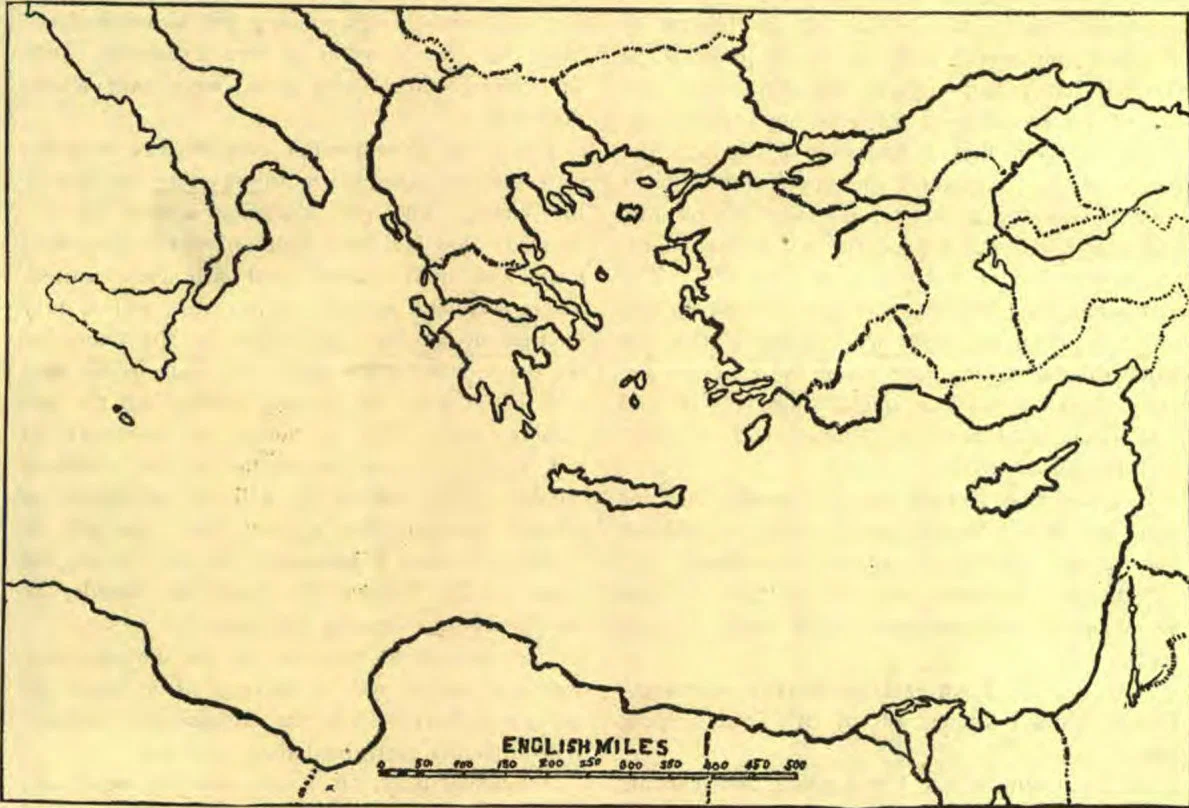
Locate Tarsus on the map, and have some one give a brief history of the city and province of Cilicia.
Devote a few minutes to a sketch of Paul’s lineage and the origin of the tribe of Benjamin.
So far as possible we hope all will give that most excellent book, “Sketches from the Life of Paul,” by Mrs. E. G. White, a careful study. If all do not have a copy of the book, secure a copy from some source, and read selections from it at each meeting. Conybeare and Howson, Schaffs-Herzog Encyclopedia, and other standard works of reference should be consulted. Study the lesson scriptures till you can give the Bible history of this great missionary.
“Saul of Tarsus was a Jew, not only by descent, but by the strongest ties of lifelong training, patriotic devotion, and religious faith. Though a Roman citizen, born in a Gentile city, he was educated in Jerusalem, by the most eminent of the rabbis, and diligently instructed in all the laws and traditions of the Fathers. Thus he shared, to the fullest extent, the hopes and aspirations, the lofty pride and unyielding prejudice of his nation.”—“Sketches from the Life of Paul.”
“We should be glad to know something of the mother of St. Paul. But though he alludes to his father, he does not mention her. He speaks of himself as set apart by God ‘from his mother’s womb,’ that the Son of God should in due time be revealed in him, and by him preached to the heathen. But this is not all. We find notices of his sister and his sister’s son, and of some more distant relatives: but we know nothing of her who was nearer to him than all of them. He tells of his instructor Gamaliel; but of her, who, if she lived, was his earliest teacher, he tells us nothing.”—Conybeare and Howson.
“It was a custom among the Jews that all boys should learn a trade.”—Id.
“The accounts of Paul’s youth are meager. The date of his birth is unknown. . . . But his character was formed under the strict Jewish discipline of his home and his training at Jerusalem. The time of his going to Jerusalem is not stated; but the statement that he was brought up there (Acts 22: 3), and that he was a ‘young man’ (Acts 7: 58) at the death of Stephen, lead us to suppose that he left Tarsus at an early age.”—Schaff.
“Paul inherited the dignity of Roman citizenship. How his ancestors or father had secured the title is unknown.”—Id.
“From among the most bitter and relentless persecutors of the church of Christ, arose the ablest defender and most successful herald of the gospel.”—“Sketches from the Life of Paul.”
“‘He made havoc,’ This word is commonly applied to wild beasts, to lions, wolves, etc., and denotes the devastations which they commit. Saul raged against the church like a wild beast—a strong expression, denoting the zeal and fury with which he engaged in persecution.”—Barnes.
“The priests and rulers who witnessed the wonderful manifestation of the power that attended the ministration of Stephen, were filled with bitter hatred. Instead of yielding to the weight of evidence he presented, they determined to silence his voice by putting him to death.”—“Sketches from the Life of Paul.”
“As Stephen stood face to face with his judges, to answer to the crime of blasphemy, a holy radiance shone upon his countenance. . . . Many who beheld the lighted countenance of Stephen trembled and veiled their faces; but stubborn unbelief and prejudice never faltered.”—Id.
“The martyrdom of Stephen made a deep impression upon all who witnessed it. It was a sore trial to the church, but resulted in the conversion of Saul. . . . Saul seemed to be imbued with a frenzied zeal at the scene of Stephen’s trial and death. He seemed to be angered at his own secret convictions that Stephen was honored of God at the very period when he was dishonored of men.”—Id.
“After the death of Stephen, he was elected a member of the Sanhedrim council, in consideration of the part he had acted on that occasion. This learned and zealous rabbi was a mighty instrument in the hand of Satan to carry on his rebellion against the Son of God; but he was soon to be employed to build up the church he was now tearing down. A mightier than Satan had selected Saul to take the place of the martyred Stephen, to preach and suffer for his name, and to spread far and wide the glad tidings of salvation through his blood.”—Id.
It seemed like a great loss to the early church in its apparent weakness to lose so valuable a laborer as Stephen. But while the Lord’s workmen may be buried, he carries on his work just the same. Out of this dark experience came perhaps a more able laborer than Stephen. Stephen willingly laid down his life, though little realizing the mighty influence of his death.
G. B. T.

Report from Bethel, Wisconsin

We have organized a Society of eighteen members. Our work consists largely in helping our fellow students to get a Christian experience, and to do all we can for the prosperity of the school. We have taken thirty-seven copies of the Family Bible Teacher, and the members are distributing these lessons weekly. Our meetings are held on Friday evening of each week. We are of good courage, and willing to do anything the Lord may want us to do. FRANK PORT.

As Lies the Babe with Close-Shut Eyes

“As lies the babe with close-shut eyes, Nor feels the mother o’er him bending, His lightest breath her thought attending, Yet sleeps, watched o’er by care unending; So we, soul-dulled, but worldly wise, Heed not the Father o’er us bending, Our constant needs his care attending, Yet live watched o’er by love unending.”

Outline Map for Tracing Paul's Missionary Journeys

It having been suggested that the members of the Young People’s Societies would find it interesting and profitable personally to trace from week to week the missionary journeys of Paul, an outline map for this purpose has been put in this number of the INSTRUCTOR. This can be preserved, and the new tours and stations indicated in ink as the study progresses.

Pansy

OPEN your eyes, my Pansy sweet, Open to me, open to me. Where did you get that purple hue? Did a cloud smile as you came through?
Open your eyes, my Pansy sweet, Open to me, open to me. Did a little sunbeam bold Kiss on your cheeks that tint of gold?
— Selected.
Continue reading: Some Plants I Have Known