HAVE known a great many plants, and have been fond of them all. Some have been beautiful and interesting for one reason, and some for another. And all of them, from the seeds and slips that refused to grow, to my most cherished palms and geraniums, have been among my choicest friends. One of my first acquaintances was the pansy, a charming flower. It has a bright little face, which will smile back into your own if you look at it with the right eyes. If you hardly believe this, examine the first pansy that you find, unless it happens to be one of solid color. Another of my early acquaintances was a geranium which bore striped scarlet and white florets, and pure scarlet florets in the same cluster. The blossoms were single.
I know of a lady who says that she once planted a packet of choice carnation seeds, but when they came up, they were tomatoes! The florist, you see, had made a mistake. I never had quite so exciting an adventure as that, but I have known a number of freak plants of which I will tell you. In my garden there is a rose-bush which bears, at the same time, solid, deep-pink flowers, together with nearly white flowers having bright pink centers. This came to me as a striped rose, and as the colors grow less pronounced every year, the bush may, in time, blossom as originally expected.
I once came across a fine specimen of “Bouncing Bet,” which was bearing handsomely variegated foliage of white, cream, and green. Regardless of the fact that the plant might spread and cause me trouble, I took it home, and gave it a place of honor in my flower garden. But it did not take kindly to the roses and phlox, and it soon died. Since then I have seen the foliage of clover, corn, and potatoes marked in the same way as the saponaria officinalis that refused to live in my garden. I once had a Marguerite carnation that bore both double and single flowers. It was quite a curiosity, and many people would hardly believe their eyes when they were looking directly at it.
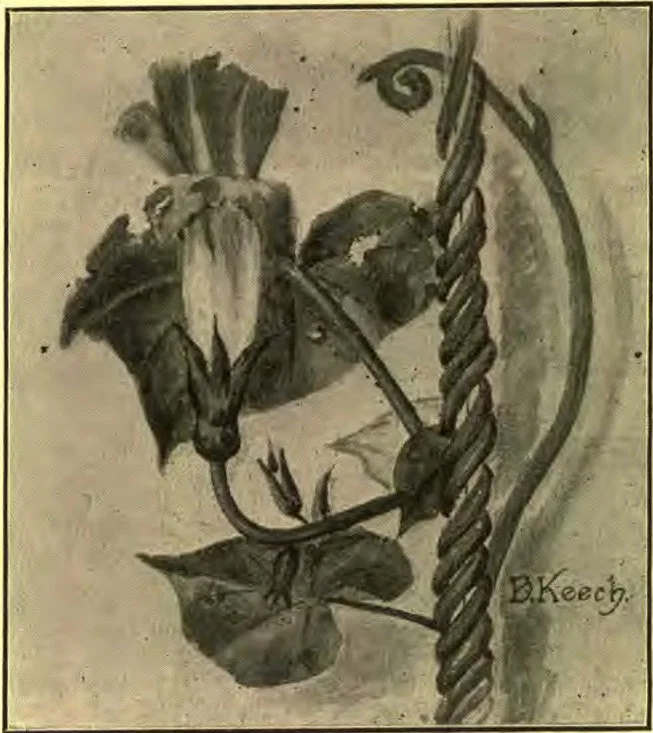
Each plant, you will find, has interesting habits and “ways of its own.” While sitting near a vine-shaded window one day, I spied a morning-glory trying to bloom by thrusting its little head up through a hole in a leaf that grew directly above it. I got my paints and made a picture of the flower, which is reproduced on this page. Morning-glories, by the way, are very satisfactory vines to cultivate; any one can grow them. It is a pleasure to drop the little black or white seeds in the earth; for you are almost sure they will “come up” and do well. It is also fun to provide the little vines with strings upon which to clamber. One can almost see them grow.
The wild cucumber is another interesting and satisfactory vine. It is a rapid grower, and with assistance will soon reach the roof. It can be made to shade a porch or window; and, if desired, will run over the ground or climb a fence in an equally obliging manner. It bears fragrant, white, spray-like blossoms, which in time “turn into” small, fat, prickly “cucumbers.” Last summer, in a distant city, I became acquainted with a collection of orchids, and so admired them that it was really difficult for me to leave them. Orchids are certainly beautiful; their coloring is exquisite, and their manner of growth interesting. But I wonder if there are not a great many plants better known than the orchid which are really as beautiful. It is their commonness that makes them seem less interesting.
HOW A MORNING-GLORY TRIED TO BLOSSOM
For instance, there is the gladiolus, which possesses colors that any orchid might covet. Then, again, there is the iris, the texture and coloring of which are all that could be desired. I have known many beautiful roses, a number of which have become to me particular favorites. I wonder if most of my readers can not invest in a little rose called Clothilde Soupert. This plant is very free-flowering, and has small, compact, white blossoms with peach-pink centers. It is not difficult to grow with success. A good companion for Clothilde is Champion of the World, which has bright pink blossoms freely produced. Meteor is another fine and easily cultivated rose. It has rich scarlet blossoms. See if you can not have these plants, sometime.
I have known many ferns in their native woods, and have liked them so well that I have adopted them, and given them a permanent home on the north side of the house. They always interest me, and I can not resist them. I have there likewise hepaticas, violets, and other wild flowers. Almost any one can start a similar garden. I renew my acquaintance with hyacinths, crocuses, and other bulbs every winter, and like them more the longer I grow them. Did you plant a few, as advised in this paper last autumn? If so, you have also begun to know a very satisfactory and beautiful class of plants. Continue to cultivate them. I hope you are also familiar with Chinese primroses; for these excellent little flowers are among one’s choicest acquaintances.
Sometimes a person will learn to like a plant so well that he will call it endearing names. I have a nice big palm that I call “’Rastus.” I don’t know why it should be ’Rastus more than John or Harry, but ’Rastus appealed to me, and ’Rastus he is. His real name is Kentia belmoreana, and perhaps that’s the reason I changed it. It is much easier to say, “I think I’ll give ’Rastus a bath this morning,” “’Rastus must have some nice new plant-food to-day,” than to announce that Kentia belmoreana would like a drink. ’Rastus and I like each other very much. I have several palms that have no names except their Latin ones; perhaps some day I’ll find better names for them. But don’t fail to make friends with the plants; they can teach you many things even of eternal worth, and give you a wealth of pleasure every day.
BENJAMIN KEECH.
Mother’s Last Stitches
I HAD been finding fault with some sewing which my mother had done for me, when Aunt Ruth called me aside, and told me a story which I now pass on to other girls.
“When I was much younger than at present,” said Aunt Ruth, “I was one day finding fault with a garment which my mother was making for me. It was not just as I wanted it, and I told her so in no very gracious mood. Poor, patient mother had tried hard to please me, and she sighed heavily as she took the garment from me, and turned it over and over in perplexity. At length she said, ‘Ruth, I am afraid that I shall not be able to suit you. I have done my best, and really I do not see how you can think the garment ill-made.’”
“‘It is beautifully done, so far as the sewing goes, but can you not see that it lacks style?’ I replied.
“‘I can not see that, my child,’ she answered, without showing any displeasure; but I could see that she was very weary. She appeared to be thinking intently, and after a few moments said, ‘If you could wait a few days, I could get Hester Ann to come and help me.’”
“Hester Ann was Hester Ann Brown, the village dressmaker. We seldom employed her in our family on account of our limited means, and generally I liked my mother’s work as well as hers.”
“I did not myself like to sew, and thought that I had no time, with my school work and my music lessons to prepare. I did not stop to think where mother’s time came from, she was always so willing to help me, and I accepted her great kindness as a matter of course. So it was not strange that I replied, ‘I don’t want Hester Ann to do it; besides, I can not wait. You could have6given my waist a little more style, mama, you know you could.’”
“It was seldom that I spoke so unkindly to her, but I had set my heart on having the waist exactly as I had planned. Mother turned her head, and her eyes filled with tears. I then said, ‘Don’t cry, mama; but you can not know how disappointed I am.’”
“That night before I retired, I looked into the sewing-room to say good-night to mother. I saw that she was very pale, and that her hands trembled; but I saw, too, that the work which she had ripped out and done over was better suited to my liking, and I said, ‘You will get it right, after all, mama.’”
“She smiled a slow, sweet smile, but her face again took on the same weary, anxious look, and I had the grace to ask, ‘Can you not put away this work for to-night, and finish it to-morrow?’”
“‘No, dear. To-morrow will be full of other duties. Some things have been put off too long already.’”
“So I kissed her and retired. In the morning my mother was unable to leave her bed. She called me to her and said, ‘Ruth, I almost finished the work. When I feel a little better, I will take the few last stitches. My strength gave out entirely last night.’”
“Those last stitches were never taken. The waist was a bright-colored one, and I never wore it. Some one laid it away just as it dropped from mother’s hand, and Hester Ann had to come to make a black dress for me. Mother never left her bed.”
“I was very remorseful, and my friends tried to comfort me, saying that mother had long been a frail woman. But a frail woman overworked, and a frail woman helped over hard places, are conditions widely apart.”
Here Aunt Ruth could not speak for the choke in her voice. When she did speak, it was to say, “Anna, come with me.”
I followed her to the garret, and, opening an old trunk, she took up a bright-colored waist, belonging to the fashion of other days, and showed me a needle rusted in a fold upon the sleeve. I began to pull it out, but she said, “Leave it where I have left it. It is only a rusty needle, but it has done much to cure me of selfishness; and it is just possible that you may need a lesson from it also.”
I could not be angry with dear Aunt Ruth, she is so gentle, and I knew it was more than possible that I needed a lesson. I hurried downstairs, and putting my arms around my mother’s neck, I said, “Mama, I was unreasonably particular. Please forgive me.”—Girls’ Companion.
Walking with Christ Alone
By Frances Ayers
LIFE'S rude path is rugged and thorny,
Strewn with sorrow, tears, and pain;
Sometimes sunny, sometimes clouded,
All its pleasures are but vain.
'Tis a path we all must travel,—
Travel till we reach the throne,—
But 'tis easy if we only
Walk with Christ, and him alone.
Every earthly friend may fail us,
Many seek our faith to bend.
We may leave the world behind us
With so faithful, true a friend.
He will tread the path beside us,
Guide us to his Father's throne.
It will make the path grow brighter
If we walk with Christ alone.
Leave your worldly cares behind you,
All your pride and vanity.
Seek the path that leads to heaven,
“Upward” let your motto be.
Ever climbing, ever striving,
Aim to reach the Father's throne,
And your friend will be beside you,
Walk with him, and him alone.
FRANCES AYERS.
Age, fifteen years.
Roger Williams
By Roy T. Wiltse
ROGER WILLIAMS lived in the seventeenth century. He believed in religious liberty. He was exiled from Boston because of his belief. He left his home in midwinter, and wandered fourteen weeks in the forest, and finally reached some Indians who let him live with them. In the spring of 1626 he founded the province of Rhode Island. He planted two fields, and kept them for himself, and gave all the rest to the people.
Many persons came from Boston to his colony; so that Rhode Island became a home for persecuted religious people. Acts 5:29 says, “We ought to obey God rather than men;” and this should be done whatever the cost.
Roy T. Wiltse.
How Nyangandi Swam to Church
NYANGANDI lived in West Africa, near the Ogowe River. She was going away from the missionary’s house one afternoon, where she had been to sell bunches of plantains to the missionary, when his wife said: “Now, you must not forget that you have promised to come to-morrow to church.”
“Yes,” the girl replied, “I will surely come if I am alive.”
But the next morning she found somebody had stolen her canoe, and no one would lend her one to go to church in. But she had promised to go, and she felt that she must. She swam all the way! The current was swift, the water deep, and the river fully a third of a mile wide, but by swimming diagonally she succeeded in crossing the river.
Remember this little heathen girl in West Africa when you feel tempted to stay away from the house of God for some trivial reason.—Selected.
Praise to Our Redeemer
By Oscar G. Bartle
O, JESUS has come to redeem us!
He is ready and willing to-day
To cleanse us from every corruption,
And wash every dark sin away.
CHORUS
O praise him with hearts overflowing!
O praise him, ye children of men!
For Jesus has come to redeem us,
And soon he is coming again,
And soon he is coming again,
And soon he is coming again.
O praise him, the blessed Redeemer,
For soon he is coming again!
O Jesus, my blessed Redeemer!
In mercy, O save me, I pray!
For though I often have grieved thee,
I turn to thee humbly to-day.
Thy love is as high as the heavens,
O glorious Saviour divine!
Thy mercy a deep, healing fountain;
O Saviour, come near and be mine!
O let me partake of thy mercy,
And wash me from my every stain,
And make me thine own humble agent
To carry thy truth to all men.
OSCAR G. BARTLE.
Age, thirteen years.
The Newfoundland Dog
By David L. Wiltse
THE Newfoundland dog is found chiefly in Newfoundland and England. It is a large dog about thirty inches high. Its hair is long and curly. Its tail curls up at the end, and is bushy. Its color is black, with gray or brown.
In Labrador and Newfoundland they are used as beasts of burden to carry wood and provisions. They are used by bird hunters when there are brush, vines, or water in the hunter’s path.
DAVID L. WILTSE.
The Robin
By Zora Cummings
[THE description of the robin that follows came in response to the editor’s request that some one write of his favorite bird. Zora is the first to respond.]
I think all kinds of birds are very pretty, and I dearly love to hear them sing their sweet little songs. The robin and wren are my favorites, but this time I will tell about the former. Robins are usually from four to six inches in length, and have a beautiful red breast. They are often seen in flocks on the hillsides. I suppose most of you have seen the robin’s egg. I think it is about one seventh or eighth as large as a hen’s egg.
The robins can sing very sweetly. I love to hear them sing their praises to the great Creator who made them. ZORA CUMMINGS.
Black
How Landseer Worked
THE man who can accomplish work at a dash is probably the one who has spent patient years in preparation for it. An enthusiastic English sportsman, Mr. Wells, of Redleaf, Penshurst, had engaged Landseer to paint the portrait of his favorite dog. But the artist was one of those who put off their duties, and one day Wells, who had been growing more and more impatient, showed his feelings by some sharp expression.
“I know I have behaved shamefully,” said Landseer, “but I will come down next Thursday and stay till Monday, and the picture shall be done before I leave.”
On Thursday he arrived, just in time to dress for dinner, and his first remark was, “Oh, your man tells me you are going to drag the great pond to-morrow! Hurrah! I am just in time. That is a subject I have often meant to paint, and I shall get any number of sketches done.”
This was an unpleasing announcement; but the host bore it. Landseer did a capital day’s work for himself, and the next morning, when he came down to breakfast, he said:—
“Mr. Wells, I hear you are going to shoot to-day. I’ve been looking forward to that for a year or two.” So it went on until Sunday, and then Wells, who was particular about seeing his guests at the early service, said to Landseer: “I suppose you are going to church?”
“I don’t feel like going,” said Landseer. “I think you must excuse me.”
“Oh,” said Wells, in a blaze, “do just as you think best! You know well enough that this is liberty hall — for you, at all events.”
“Thank you,” said Landseer. “And I am going to ask you to let me keep Charles Mathews with me, to amuse me.”
Wells vouchsafed no answer, and away the people went, leaving these two to their own devices. The minute the house was clear, they hurried to another room, which Landseer had specially arranged for the purpose. The head gamekeeper was there, holding the dog, and Mathews assisted when there was need, at the same time amusing Landseer. When the party returned from church, the picture was painted, finished, and framed on the wall. Written on the trunk of a tree in the background were the words: “Painted at Redleaf in two hours and a half.”— Selected.
MEMORY VERSE: “Greater is he that is in you, than he that is in the world.” 1 John 4:4.
After these things, Sennacherib, king of Assyria, came against the fenced cities of Judah, and took them. When Hezekiah heard what he was doing, he built up all the wall that was broken down around Jerusalem, and made everything ready to defend the city. Thousands of men and women and children from all Judah gathered together in Jerusalem; and Hezekiah spoke comfortably to them, saying: “Be strong and courageous, be not afraid nor dismayed for the king of Assyria, nor for all the multitude that is with him: for there be more with us than with him: with him is an arm of flesh; but with us is the Lord our God to help us.”
Finally the host of the Assyrians encamped against Jerusalem. Three men from the city went out to talk with the captain of the host, but he spoke scornfully of Israel, and of the God in whom they trusted. He also cried with a loud voice to the Jews who stood on the wall, offering them reward if they would make an agreement with his master. “Let not Hezekiah deceive you,” he said; “for he shall not be able to deliver you. Neither let Hezekiah make you trust in the Lord, saying, The Lord will surely deliver us: this city shall not be delivered into the hand of the king of Assyria. . . . Beware lest Hezekiah persuade you, saying, The Lord will deliver us. Hath any of the gods of the nations delivered his land out of the hand of the king of Assyria?”
The king also wrote letters “to rail on the Lord God of Israel, and to speak against him, saying, As the gods of the nations of other lands have not delivered their people out of mine hand, so shall not the God of Hezekiah deliver his people out of mine hand.”
One of these letters, telling of his great victories in other countries, Sennacherib sent to Hezekiah. “And Hezekiah received the letter from the hand of the messengers, and read it: and Hezekiah went up unto the house of the Lord, and spread it before the Lord. And Hezekiah prayed unto the Lord, saying: Incline thine ear, O Lord, and hear; open thine eyes, O Lord, and see: and hear all the words of Sennacherib, which hath sent to reproach the living God. Of a truth, Lord, the kings of Assyria have laid waste all the nations, and their countries, and have cast their gods into the fire: for they were no gods, but the work of men's hands, wood and stone. . . . Now therefore, O Lord our God, save us from his hand, that all the kingdoms of the earth may know that thou art the Lord, even thou only.”
Then the Lord sent Isaiah the prophet to Hezekiah with this message: “Thus saith the Lord concerning the king of Assyria, He shall not come into this city, nor shoot an arrow there, nor come before it with shields, nor cast a bank against it. By the way that he came, by the same shall he return, and shall not come into this city, saith the Lord. For I will defend this city to save it for mine own sake, and for my servant David’s sake.”
That night the angel of the Lord went forth in the camp of the Assyrians, and smote a hundred eighty-five thousand of their soldiers,—“all the mighty men of valor, and the leaders and captains.” So Sennacherib “returned with shame of face to his own land.” “Thus the Lord saved Hezekiah and the inhabitants of Jerusalem from the hand of Sennacherib the king of Assyria, and from the hand of all others, and guided them on every side.”
We are serving the same God that Hezekiah and Isaiah served; and he is just as able and just as willing to give us the victory in the battle that each one of us must fight against sin, as he was to save Jerusalem from the hand of the blasphemous Assyrian king. Hezekiah not only spoke comfortably to the people, but he humbled himself before the Lord, and prayed earnestly. So must we go forward with trust and confidence, not forgetting to seek the Lord with earnest prayer for the victory.
Questions
In the days of Hezekiah, what king took the fenced cities of Judah? When Hezekiah heard of it, what did he do? Who came to Jerusalem?
How did Hezekiah speak to the people? Who was with Israel, to help them?
When the Assyrians were encamped around Jerusalem, who went out to talk with the chief captain? How did he speak to the men?
What did the captain offer to the Jews who stood on the wall? How did he try to make them afraid?
What kind of letters did Sennacherib write? Of what did he boast? What did he threaten?
To whom did he send one of these letters? When Hezekiah had read it, where did he take it? What did he do with it there? Repeat all you can of his prayer. For what special purpose did he ask the Lord to save them from the hand of Sennacherib? Isa. 37:20.
By what prophet did the Lord send a message to Hezekiah? What did he say about the king of Assyria? Why would the Lord spare Jerusalem?
Tell what happened that night. How did Sennacherib return to his own country?
What good lesson may we learn from this trying experience of King Hezekiah? What reason have we to be encouraged when we meet the enemy who would like to destroy our souls? See Memory Verse. What should we not forget to do?
Destruction of Sennacherib’s Army
By Lord Byron
THE Assyrian came down like the wolf on the fold,
And his cohorts were gleaming in purple and gold;
And the sheen of their spears was like stars on the sea
When the blue wave rolls nightly on deep Galilee.
Like the leaves of the forest when summer is green,
That host with their banners at sunset were seen;
Like the leaves of the forest when autumn hath blown,
That host on the morrow lay withered and strown.
For the Angel of Death spread his wings on the blast,
And breathed in the face of the foe as he passed;
And the eyes of the sleepers waxed deadly and chill,
And their hearts but once heaved, and forever grew still!
And there lay the steed with his nostrils all wide,
But through it there rolled not the breath of his pride;
And the foam of his gasping lay white on the turf,
And cold as the spray of the rock-beating surf.
And there lay the rider, distorted and pale,
With the dew on his brow and the rust on his mail;
And the tents were all silent, the banners alone,
The lances unlifted; the trumpet unblown.
And the widows of Asshur are loud in their wail,
And the idols are broke in the temple of Baal;
And the might of the Gentile, unsmote by the sword,
Hath melted like snow in the glance of the Lord!
What effect will his coming have upon the wicked? 2 Thess. 1:9; 2:8.
What view of the coming of the Lord was presented to the prophet on the isle of Patmos? What is said of the reward and punishment he brings? Rev. 19:11.
Describe the One who sat on the white horse. Verse 12. What is he called? Verse 11. What did he have on his head?
How was he clothed? What is his name? Verse 13. See also John 1:14. What name is on his vesture? Rev. 19:16.
Who accompanies the King? How are they clothed? Verse 14; note 2.
A tourist who went through the Cave of the Winds at Niagara tells how the spray blinded him, the noise deafened him, and he felt a dreadful sense of loneliness in the midst of that terrifying tumult, relieved only by the touch of his guide’s hand. It was a strong, steady hand, and he did not feel afraid. The guide held him and drew him forward, and he had nothing to do but to follow, step by step, until he was safely through. The soul knows such lonely passages; but there is no reason to fear. The hand of the Guide is strong and tender; it will neither fail nor mistake; and if we yield trustfully to Christ’s leading, we shall come safely through.
Mrs. Sangster tells of being obliged once to leave a blocked railway train to find food and shelter. It was in a strange part of the country, and very dark. A gentleman offered to be her guide to a village. She hesitated, and asked, “Are you sure that you know the road?” He said: “I have been over the road often. I am familiar with every foot of it. It is very rough, but I am going to take my wife over it first, and then, if you can trust me, I shall be glad to guide you.” She got through safely; but when she saw the road next morning, she said, “I never could have gone over it by light.” So many times we have to take God’s hand in the dark, and follow him because he knows the way. He sent his own Son over it first, and it is safer—
*“To walk with him in the dark
Than to go alone in the light.”
—Christian Endeavor World.*
“Better Than Ever”
By Editor
A LETTER was recently received in which two aged pioneers expressed their appreciation of the INSTRUCTOR, and said that it seemed to them it “is better than ever.” A number of letters from others have expressed the same idea. The editor and the publishers appreciate these kind words, and they inspire us to do better still. Another series of articles which will be very helpful to all the readers of the INSTRUCTOR, under the title of “Good Manners,” will begin to appear shortly.
We trust that Sabbath-school officers and teachers will see to it that clubs of the INSTRUCTOR are taken wherever there are young people in attendance. Sometimes the young people do not attend Sabbath-school because it is not made interesting for them. If a club of INSTRUCTORS was provided for their use, and the school made a place where they would want to go, a safeguard would thus be thrown around them which might, perhaps, keep them from going off into the world. If they have the INSTRUCTOR to read, they will not be so likely to seek after reading which is not so good.
The leaders of Young People’s meetings will find the outlines published each week in the INSTRUCTOR of great service as an aid in planning their weekly programs. The following letter was just received: “We have organized a Young People’s Society, and would like a club of five YOUTH’S INSTRUCTORS sent to my address for three months.” This is a good beginning, and other Societies will do well to follow this example.
The subscription list of the INSTRUCTOR has increased very materially since the removal of the office of publication to Washington. We know there are still thousands of other young people who would be benefited by reading it, and we ask our friends to assist us in bringing it to the attention of such. Sample copies will be sent free to any who wish to use them in introducing the paper to those who do not take it.
Address Circulating Department, Youth’s Instructor, 222 North Capitol St., Washington, D. C.
Working for the Lord's Family Through the Home Circle
By our faithful interest for the home circle, we are fitting ourselves to work for the members of the Lord’s family, with whom, if loyal to Christ, we shall live through eternal ages.
From Our Sharp-Eyed Boys and Girls
By Editor
THE editor has several letters on hand for the Letter Box corner, but allowed these to give place this week to contributions from some of the youngest readers. Look for the heading, “From Our Sharp-eyed Boys and Girls.”
Age of the Earth
ONLY a few weeks ago Professor Rutherford, of Montreal, created a sensation while lecturing before a scientific audience in London by suggesting that the earth is much younger than astronomers and physicists have believed. That possibility occurred to him in consequence of the rapid rate at which radium decays. Supposing this to be uniform, he estimates that all which is at present in existence will have disintegrated in a thousand years, and that all which existed a thousand years ago must now have become transformed into something else—helium, perhaps.
Professor Joly, of Dublin, reaches an astonishingly different conclusion concerning the earth’s age, by confining his attention to the behavior of another metal, uranium. Adopting the standard of decay of this metal, Professor Joly says that ten billion years may be regarded “a minor limit to the antiquity of matter in our part of the universe.” Exacting biologists and geologists of the past have modestly demanded only a hundred million years, while Lord Kelvin’s estimate of its age since fitted to maintain life is between ten and twenty million—a definiteness befitting the lack of dependable data for drawing conclusions. Notwithstanding these awe-inspiring figures, resting on “the baseless fabric of a vision,” we are forced to say, as did Sir William Thompson once in a lecture on the age of the sun, “After all, they don’t know anything about it;” because the only reliable record—that given by Moses in Genesis—is utterly ignored.
Needed a Half-Holiday
A GENTLEMAN who was traveling in California was dining with a friend who had a fine orchard in the San Jose valley. The topic of conversation had turned upon Chinese as servants—a subject suggested by the presence of a Chinaman, who, with a noiseless step and stolid face, waited on the table.
“I have heard,” said the Easterner, “upon very good authority, that these Celestials are not only dishonest, but their chief fault is their absolute unfaithfulness to their employers. They are inclined to sacrifice their employers’ interests to their own, and are absolutely unreliable in their actions when their help is most needed.”
“You are mistaken,” said the Californian. “My experience shows the opposite to be true. A Chinaman is most faithful, never complains, and is willing to do work which he is not bound to do. Now I will call Hip Wo and tell him that he can go if he wishes, and he will probably insist upon staying to wait on us. So sure am I that, if he does not, I will make you a present of a new silk hat.”
Thereupon he pressed the bell. The Chinaman appeared, solemn and speechless, and waited for his orders.
“You needn’t wait on us any more to-day, Hip,” said his master. “We will get everything ourselves.”
Hip smiled broadly, “T’anks, I go,” he said.
The master looked astounded, “Why, Hip,” said he, “why would you leave us?”
The Easterner laughed.
“Me leave because my house been on fire one half-hour!” returned the Celestial, bowing his way out.
“Well, I guess you needn’t buy me that hat,” said the Easterner.—Youth’s Companion.
Study the Life of Paul: Begin With the First Lesson
ARE you planning to study the lessons on the life of Paul? Begin with the first of the series.