ETERNAL life has been defined as "the existence of a moral being according to God's idea of such existence." Of course, that was exactly how Jesus lived. He was the true man, made in the image of God. He had the wonderful consciousness of perfect fellowship with God. He lived in the world the life of God. That was His great significance. To speak of eternal life as the life of God, has not very much meaning to us, because we can know so little of the life of the Infinite. We can not even conceive His manner of existence. His thoughts are not our thoughts, neither are His ways our ways. But in Jesus we have seen what the life of God is, under human and finite conditions. The Word became flesh, and dwelt among us full of grace and truth. Divinity was naturally expressed in beautiful righteousness and love. What Jesus meant by life, was seen in the fair dealing in the little shop at Nazareth, and in the kindness of the home life in the house of Joseph and Mary; in the truth that characterized all His intercourse with men, and the graciousness of His loving ministry; in His personal soul-purity, and the uninterrupted sense of oneness with the Father. Any other way of living, Jesus would not call life. Life without God and love and truth, He would think unworthy of the name.
A marked characteristic of this kind of life, which justifies the application to it of the epithet "eternal," is that it is founded on a sense of eternal values. Jesus Himself might have been a popular king, but He conceived it of infinitely more worth to lead men to God. The devil showed Him all the kingdoms of the world. But Jesus would not exchange truth for all the glory of them. Napoleon thought otherwise. With magnificent opportunity to serve his generation in all honor, he preferred rather to satisfy personal ambition, and he lost eternal life. That is to say, Napoleon apparently lost the opportunity to live for eternal interests, choosing rather to live for the things that perish. And there was, therefore, nothing left at the end.
"The world he loved so much
Had turned to dust and ashes at his touch."
That is why the New Testament makes such strong contrast between Christianity and the world. Not that we are to live the otherworldly life, looking for heaven, but that we are to live each day with reference to eternal interests. There are things that perish, tho they may not be evil in themselves,—silver, gold, raiment, tinsel, popularity, applause, and all the sensuous,—"the world passeth away, and the lust thereof." There are things that abide,—faith, hope, love. Judas' thirty pieces of silver are long since gone, but Mary's broken vase and perfume are lasting forever. He that has eternal life is the man who puts a proper proportionate value on these various things. Money is good, of course, but truth is better. If it should come to a choice, as sometimes it does, the Christian must choose with reference to the higher value. Houses and lands are to be desired, but love is the greatest thing in the world. And not seldom there are alternatives. The recent biography of the noble Hugh Price Hughes, reminds us again of the words of his good mother to him, on his choice of a vocation: "I would rather see you a Methodist preacher than Lord Chancellor of England." It is a good thing to sit on the woolsack, but it is a greater to win sinners to repentance. And these choices in the spirit of Christ are not made in order to gain eternal life, but because the choices themselves are eternal living.
When, therefore, Jesus offers eternal life, He is not simply promising immortality. He is promising that which alone can make immortality desirable,—a true quality of being. He offers us the difference between John, the beloved disciple, and the ambitious young fisherman; between Paul, the apostle to the Gentiles, and "the rising hope of the stern, unbending" rabbis. To men in full physical and intellectual vigor, He said: "I came that they may have life, and may have it abundantly." And some have learned what He meant. They know something of the promise: "Blessed are they that hunger and thirst after righteousness; for they shall be filled," and of the other promise: "Blessed are the pure in heart; for they shall see God," and of the truth of His Word: "It is more blessed to give than to receive." To be sure, there has come some self-denial. They have yielded a little reluctantly sometimes the things that perish, and have sometimes had to shut their eyes to the things that allure and destroy. But the Master's promise has been fulfilled. They have lived, and, to a degree at least, have lived abundantly.
RESURGAM.
By Helen Hunt Jackson
THE fool asks: "With what flesh? in joy or pain?
Helped or unhelped? and lonely, or again
Surrounded by our earthly friends?"
I know not; and I glory that I do
Not know; that for eternity's great ends
God counted me as worthy of such trust
That I need not be told
Out to the earthward brink
Of that great tideless sea,
Light from Christ's garment streams.
Believing thus, I joy, altho I lie in dust.
I joy, not that I ask or choose,
But simply that I must.
I love, and fear not; and I can not lose,
One instant, this great certainty of peace.
Long as God ceases not, I can not cease;
I must arise.
—Helen Hunt Jackson.
JOY IN SERVICE.
By Hillis
I AM a man who spends his time in mixing tonics to try to get up an appetite in you who are gorged to the point of gluttony. Here you are, eating many kinds of food, pouring rich wines down your throats, saturating yourselves with all kinds of ease and luxury, and then preparing to die out of life, when God has put you here for something better. You are not happy, but in seven days I could make you happy. Organize the resources of life in the interest of the poor and weak, and for misery you'll have happiness, for selfishness that corrodes you will have a blade that flashes more and more, and then you will know real luxury—the luxury of service.—Hillis.
THE MIRAGE OF DEATH VALLEY.
By Uthai Vincent Wilcox
BY UTHAI VINCENT WILCOX.
THERE is no place so melancholy and desolate as Death Valley, California, described by one writer as "Nature's last word of horror and desolation." There no living thing grows or can dwell; its burning sand drinks up rivers. Many are the tales that it might tell of those who have sought for its fabled mineral wealth. Two hundred and ten feet below the level of the placid Pacific, seven miles in length, and so hot in summer that its temperature has never been recorded!
Inside of this jagged rent in the earth's crust, this "abomination of desolation," where men have gone mad while in no apparent need because of the ghastliness of the surroundings, and the furnace-like aridity of the air, two young men, seduced by its oft-repeated tales of unlimited wealth, are toiling through nature's forbidden spot, when they discover that the water has diminished below the danger line. Eagerly they drain the last few muddy drops, which serve only to aggravate their thirst; and, as the burning sand fills their parched mouths, their ears and eyes, they would sacrifice anything for water. No vegetation, save here and there, half buried in the sand, starved grease root, which only serves to actuate the general appearance of death and desolation; and over the whole scene hangs a most profound and impressive silence, a silence that to the superstitious is frightful.
In this tortured state of mind, the sun and the scorching breeze sucking every drop of moisture from the skin, the thirsty seeker suddenly sees, through the blinding sands and blistering heat, an object just ahead, that to his surprise has escaped his notice before; there are cool mountain streams pouring down on alfalfa fields, where cattle are quietly grazing.
Reanimated by the vision, he presses eagerly forward for another hundred yards, when, as suddenly as it appeared, it vanishes, and he is aroused to the fact that he has been pursuing a mirage of the desert; and, instead of cool rivers and dales, he beholds the bleaching bones of his predecessors. His mind is unable to withstand the awful strain, and instead of pushing forward to the valley's outlets, he wanders in circles, goes raving mad, and finally expires where he has worn his fingers to the bone vainly digging for water.
Such is the mirage of nature, an optical illusion! But, journeying across the wilderness of this world, many men thirst for happiness, altho Christ proclaims Himself the Living Fountain, at which the tired and thirsty pilgrim might quench his thirst and be satisfied. But the majority of those who pursue after terrestrial glory and joys, yea, all, find that they are as illusive as the mirage. As one is deceived by the mirage of pleasure, so another is by the mirage of wealth; and as each successive one vanishes a new one appears, until the unsuspecting victim is swallowed up in the Valley of Death, and the pleasing illusion is gone forever.
"In vain the erring world inquires
For some substantial good;
While earth confines their low desires,
They live on airy food.
"Illusive dreams of happiness
Their eager thoughts employ;
They wake and see the boasted bliss
Was visionary joy."
Such is the mirage of life. Altho some men have drawn the highest prizes in life's lottery, yet in forsaking the Fountain of the living waters, they find that they failed to give permanent, lasting happiness, and, according to the words of the wise man, "all is vanity and vexation of spirit."
We may learn, if we will, by the mistakes and warnings of others, to trust in Him when passing through the dark trials and tribulations on earth, for He is "a great Rock in a weary land, a Shelter in the time of storm."
But to any weary-hearted wanderer who has long chased the mirage, we would tender the Saviour's invitation to forsake all the inviting visions of wealth, honor, or riches, and take up His cross and follow Him to the place where the desert shall blossom as the rose, and where the parched ground shall become streams of water that recede not nor pass away. It shall prove the portal through which you shall enter upon joys infinite in degree and everlasting in duration, while through eternity you will bless that divine grace which first led you to abandon forever the vain pursuit of the Mirage of Death. See Isa. 55:1-3.
CLEANLINESS AND GODLINESS.
By S. S. Times
CLEANLINESS may be next to godliness when we are considering merely the surface of our bodies; but cleanliness conditions godliness when we get to the spiritual life. No unclean heart or mind can harbor God. There is not enough room for both. Impurity can not be kept in a corner by itself; it taints the whole man; and God must have the whole man or none. There would be fatal discouragement here for us all, but for the fact that the most tainted heart and life is not beyond instant cleansing when that cleansing is honestly sought. Then the loving Father rejoices to show His power over uncleanness. His cleansing forgiveness never stops short of a result that is "whiter than snow" To-day that purity may be ours.
WHO WAS MELCHIZEDEK?
By G. W. Reaser
BY G. W. REASER.
IN identification of the "order" of priesthood called the "Melchizedek," we will raise an inquiry as to the original plan for the high-priesthood of this world. In whom was this office vested? In the patriarchal dispensation, from Adam to Moses, the priesthood was vested in the father of each family; hence the name of the dispensation is taken from patri, meaning father. Naturally, then, Adam was the first priest of this world, and by right, its high priest. He would have retained an endless, unchangeable priesthood, if he had not surrendered the rulership of the world to the usurper. Because of this surrender, Adam lost his priesthood, and Satan became "the prince of this world;" but he did not thus become the "Melchizedek" of our human family, for, in character, he is the direct opposite of the King of Righteousness, and of the Prince of Peace. His seat of government is more fittingly described by the term "Babylon"—confusion, than by "Salem,"—peace.
Conceding that all worlds in space are not created in vain, and are therefore inhabited (Isa. 45:18), each planet would naturally have its Melchizedek, that is, its representative, its everlasting father, its high priest.
When our world had lost its rightful representative, its father, its high priest, its Melchizedek, it was not left by the Creator in this sad condition. Its Representative, its Everlasting Father, its High Priest, its Melchizedek, was immediately foreshadowed in the institution of the sacrificial service, which, for 4,000 years, focused upon the second, or "last, Adam." Yet during this period, Satan had access to heaven as the representative of this world. Rev. 12:10; Job 1:6.
There are, doubtless, appointed times when the representatives, the priests "after the order of Melchizedek," from all unfallen worlds in the universe, joyfully assemble in heaven to worship the Creator. Such occasions are clearly indicated in the first and second chapters of the book of Job (chapters 1:6 and 2:1). That the individuals here mentioned as "sons of God" were representatives of their respective planets, is indicated by the fact that, in the interview between Jehovah and Satan, the latter is conceded to have been the representative of our earth, a position which he wrested from Adam, thereby becoming "the prince of this world." John 12:31.
As additional evidence that these "sons of God" were the heads (the Melchizedeks) of other worlds, it is worth while to note that, in designating Adam as the first man of this world, he is also called "the son of God." Luke 3:38.
Perhaps the most forceful evidence that Adam would have been the high priest (the Melchizedek) of this world had he not sinned, is found in the fact that, until Christ was born11into the world as a member of our human family, and became sin's sacrifice and thereby Satan's conqueror, He did not become our high priest "after the order of Melchizedek." But, coincident with His becoming our Melchizedek, He became the second or "last Adam." Heb. 2:16, 17; 6:19, 20; 1 Cor. 15:45. The logical conclusion is that, had Adam retained his sinless state, he would have been a priest "after the order of Melchizedek," and therefore that this "order" is composed of representatives of worlds, who were created and given dominion over their respective spheres, as Adam was created and placed over the planet, known to us by the name of "Earth."
Christ came into this world to be our Priest-King, our Melchizedek, which, being interpreted, "is King of Righteousness," and King of His own city of peace, for "the name of the city from that day shall be, The Lord is there." Eze. 48:35; Zech. 6:13, 14; Rev. 21:1-6.
It is a point of special interest, and one which adds strength to our argument, to note that, in the only prophetic announcement of the forthcoming of our High Priest "after the order of Melchizedek," He is thus designated, at the time when He will have taken to Himself His great power, as King over all the earth.Ps. 110:4. This rightful sovereignty He secured by becoming the "last Adam," and by vanquishing the conqueror of the first Adam.
At this point in His glorious triumph, He is appropriately called "King of kings." The reason for the conferring of this title is apparent, when we realize that each Melchizedek is a priest-king, reigning in righteousness and peace in his world; Christ, the Redeemer of our world, is transcendent in power, glory, and majesty above them all, hence the title, "King of kings."
The explanation of a text (Isa. 9:6, 7), a portion of which has been obscure to many, is suggested in the foregoing paragraphs. The query is, How is the expression "everlasting Father," fittingly applied to Christ? The significance of "father" is, possessing power to beget and sustain life in his offspring; the founder of a race or family. Adam would have been the "everlasting father" of our human family, had he not, by sin, forfeited the right, and lost the power to impart everlasting life to his posterity. He so far lost the power essential to everlasting fatherhood, that he could not perpetuate his own existence, or maintain his everlasting fatherhood, and, instead of imparting to his children eternal life, they inherited from him death. Jesus Christ, "who is our life," took upon Himself the everlasting fatherhood of His children. Thus, when His everlasting kingdom is established, as set forth in the text, He occupies the position lost by Adam; He is our "everlasting Father," our Melchizedek.
The conclusion being beyond controversy, that the Melchizedek to whom the "father of the faithful" paid tithes, was not a member of our human family, and that his kingdom was not of this world, but, instead, that he was the Adam, the everlasting father, of another planet; the query naturally arises, How came he into our world, and what was the purpose of his visit?
The possibility of his coming, as well as his ability to come, is proven in the fact of the gathering of the "sons of God" from their various worlds, to worship in the immediate presence of the Creator. The purpose of his visit is suggested in the statement that the people of this world "are made a spectacle [theater] . . . to angels, and to men." 1 Cor. 4:9.
There is full Scripture evidence that our world is the only one in the universe that has fallen; our Adam, the only head of a world who has plunged his descendants into the gulf of sin, with all of its attendant wretchedness, terminating in death.
This world, then, is the battle-ground where the great controversy between righteousness and sin, is being fought to a finish. It is also the only complete object-lesson of the direful results of sin, to be found in all the boundless expanse of space.
The visit of Melchizedek to this world, would afford him opportunity to behold what utter ruin and wo sin has wrought; to compare the gloom of this "vale of tears" with the unsullied brightness and unalloyed, happiness of his sinless homeland. As angels came to Eden to warn Adam and Eve of the terrible danger of joining the tempter in rebellion, Melchizedek, with the direful results of sin indelibly impressed upon his mind, and with that desire intensified which would naturally burn in the bosom of every right-minded father, to preserve his own household from ruin, when beholding the desolation of another; would return to his "Salem," call a general assembly of his blissful family, and, vividly describing to them some of the woful scenes of a sin-polluted world, warn them to avoid the sad mistake which resulted in the awful plunge of our world into its state of misery. He would exhort them to retain their "first estate" of innocence, purity, holiness, and loyalty to God, by which only their supreme happiness would continue, their homes be preserved from sickness, bloodshed, insanity, and from the ravages of the king of terrors—Death; their land be saved from the terrorizing and death-dealing agencies of storms, uncontrollable fires, hot thunderbolts, floods, cyclones, tidal waves, earthquakes. Continuing his comparison of the two worlds, reference would naturally be made to such familiar scenes of our world as drunkenness, homeless children, broken hearts, death-bed partings, populous cities of the dead, and battle scenes.
What an opportunity would thus be afforded him to make the desired impression upon minds which have never been dulled by the deadening influence of sin! what a wonderful contrast between the two worlds! And yet the redeemed inhabitants of this world will, by the spending of their entire mortal lives in beholding the present object-lesson of sin, finally have a greater dread of yielding to its power, than the people of any other world in the universe. This, on the principle that the child who has once felt the pain produced by contact with fire thereafter avoids danger of experiencing its scorching effects.
(Continued next week.)
IS MAN IMMORTAL?
By G. E. Hollister
(An Acrostic, by G. E. Hollister.)
Does Man Go to Heaven When He Dies?
"If I wait, the grave is mine house, I have made my bed in the darkness." Job 17:13.
"So man lieth down, and riseth not; till the heavens be no more, they shall not awake, nor be raised out of their sleep." Job 14:12.
"Man that is in honor, and understandeth not, is like the beasts that perish." Ps. 49:20.
"Also their love, and their hatred, and their envy, is now perished; neither have they any more a portion forever in anything that is done under the sun." Eccl. 9:6.
"Nevertheless man being in honor abideth not; he is like the beasts that perish." Ps. 49:12.
"If a man die, shall he live again? all the days of my appointed time will I wait, till my change come." Job 14:14.
"Man that is born of a woman is of few days, and full of trouble. He cometh forth like a flower, and is cut down, he fleeth also as a shadow, and continueth not." Job 14:1, 2.
"My soul, wait thou only upon God; for my expectation is from Him." "For the wages of sin is death; but the gift of God is eternal life through Jesus Christ our Lord." Ps. 62:5; Rom. 6:23.
"O that Thou wouldst hide me in the grave, that Thou wouldst keep me secret, until Thy wrath be passed, that Thou wouldst appoint me a set time, and remember me!" Job 14:13.
"Remember how short my time is; wherefore hast Thou made all men in vain? What man is he that liveth, and shall not see death? shall he deliver his soul from the hand of the grave?" Ps. 89:47, 48.
"The dead praise not the Lord, neither any that go down into silence." Ps. 115:17.
"All go unto one place; all are of the dust, and all turn to dust again." Eccl. 3:20.
"Like sheep they are laid in the grave; death shall feed on them; and the upright shall have dominion over them in the morning; and their beauty shall consume, the grave being an habitation to every one of them." Ps. 49:14, margin.
Are the questions answered?
Chino, Cal.
In Debt to the Lord
In all of our churches is to be found a class of people who can not contribute anything toward the running expenses of the church and special funds because they are in debt, and feel that the money they hold is not their own. Yet if these good people are observed closely, it will be noted that this objection does not seem to have much weight with them when they want some delicacy for the table, or when they enter the confectionery or ice-cream parlor, or when there is to be an excursion, or if there is something special in town in the way of a lecture, or when they want some desirable article of dress. When the desire is strong upon them they forget for the time that they are in debt. How can people afford all these things when they are in debt? Isn't it strange that they think so suddenly and powerfully about it when God's call for funds comes to them? And, after all, are not the most of us in debt to the Lord?—Zion's Herald.
THE PENALTY OF SIN.
1. What is the final consequence of sin?
"The wages of sin is death." Rom. 6:23.
"Sin, when it is finished, bringeth forth death." James 1:15.
"The soul that sinneth, it shall die." Eze. 18:4, 20.
2. By what were sinners represented in the typical sanctuary service?
They were represented by slain animals. See Leviticus 4.
David testifies that "the wicked shall perish, and the enemies of the Lord shall be as the fat of lambs; they shall consume; into smoke shall they consume away." Ps. 37:20.
Thus David saw the end of the wicked when he went into the sanctuary. See Ps. 73:1-3, 16-18.
3. Where shall both the righteous and the wicked be "recompensed"?
"The righteous shall be recompensed in the earth; much more the wicked and the sinner." Prov. 11:31.
4. How and by whom will the wicked be "recompensed"?
"The Lord Jesus shall be revealed from heaven with His mighty angels, in flaming fire, taking vengeance on them that know not God, and that obey not the Gospel of our Lord Jesus Christ; who shall be punished with everlasting destruction from the presence of the Lord, and from the glory of His power." 2 Thess. 1:7-9
5. How complete will be the annihilation of the wicked?
"Behold, the day cometh, that shall burn as an oven; and all the proud, yea, and all that do wickedly, shall be stubble; and the day that cometh shall burn them up, saith the Lord of hosts, that it shall leave them neither root nor branch." Mal. 4:1.
6. What will be the fate of this sin-cursed earth?
"The world that then was [before the Flood], being overflowed with water, perished; but the heavens and the earth, which are now, by the same Word are kept in store, reserved unto fire against the day of judgment and perdition of ungodly men." 2 Peter 3:6, 7.
"The day of the Lord shall come as a thief in the night; in the which the heavens shall pass away with a great noise, and the elements shall melt with fervent heat, the earth also and the works that are therein shall be burned up." Verse 10.
7. Then what promise will be fulfilled?
"Nevertheless we, according to His promise [Isa. 65:17, 18], look for new heavens and a new earth, wherein dwelleth righteousness." Verse 13.
8. Who will inherit this new earth?
"The meek shall inherit the earth; and shall delight themselves in the abundance of peace." Ps. 37:11.
9. Then what will have become of the wicked?
"Evildoers shall be cut off; but those that wait upon the Lord, they shall inherit the earth. For yet a little while, and the wicked shall not be; yea, thou shalt diligently consider his place, and it shall not be." Verses 9, 10.
10. What contrast does Jesus draw between the two classes?
"He that believeth on the Son hath everlasting life; and he that believeth not the Son shall not see life; but the wrath of God [death] abideth on him." John 3:36.
WITH THE SOLDIERS IN JAPANESE HOSPITAL AND PRISON.
By Missionary Herald
UNDER date of January 12, Dr. Pettee, from Okayama, reports some of the opportunities he has had for service in connection with both Japanese and Russian soldiers:
‘I had the privilege last month of spending a few days in Hiroshima and Matsuyama, two of the great military centers of Japan. At Hiroshima there are seven great hospitals, each containing on an average 1,200 sick and wounded soldiers. The chief of the whole local military medical staff, Dr. Onishi, is a sincere Christian, and was formerly a member of the Tottori Kumi-ai church. By his favor the missionaries and Japanese Christians of various denominations have free access, at certain hours of the day, to the hospitals, where they are doing a large amount of helpful ministry by means of song and preaching services, tract distribution, and personal conversation. The work is now well organized, and is very effective, considering the lamentably small number of skilled workers.
‘I give my attention to hospital No. 7, mainly because half a score of the older lads in the Okayama Orphanage had received the appointment of storekeepers and barbers for this one hospital compound. Altho assisted by two or three Hiroshima Christians, the boys are kept on the jump all day, except for a few minutes at meal times, supplying the wants of 1,300 invalid soldiers just home from Manchuria. The lads who are making a marked success of the venture, and are winning laurels for themselves and their institution, are Christian Endeavorers.
‘I gave two entertainments with my phonograph, made two formal speeches, and held personal conversation with a number of the wounded men. I was impressed, as every such worker is, with the patience of the sufferers, and their earnest desire to recover, and return to the front. The poor fellow who sat directly in front of my phonograph horn at one of the entertainments had no hope, however, of again facing the Russian foe in battle, as he had lost both his legs, amputated above the knee. He was evidently very fond of music, and involuntarily kept time to the stirring marches with his mangled stumps. One of the most pathetic sights in those hospitals is to see men with one or both feet amputated (or in process of amputation) because of frost bites. Such men lay out all night—in a few cases for two or three days—after being wounded. They lay on the hills around Port Arthur in plain sight of both armies, but could not be rescued, as a flag of truce was not allowed. Fortunately, that barbarous period of the long siege is over. Even before the final capitulation occasional armistices had been arranged, and many of these sufferers rescued.
‘Thanks to a special permit from the minister of war, to Miss Parmelee's good standing at the local barracks, and to a Christian officer who took our party in charge, we were able to cut red tape off short, and secure admission at once to the long wooden sheds hastily constructed behind Matsuyama castle hill, where fully 900 Russians are held as prisoners of war. Officers and men gave us a warm welcome, and were profuse in their expressions of pleasure and gratitude.
‘The first record was purposely unannounced, and it broke the men all up as soon as they recognized the familiar strains of their grand old martial tune, ‘The Russian Hymn.’ Every man was on his feet in an instant, and tears and sobs, as well as smiles and chuckles, were in abundant evidence. Such expressions as: ‘It was very kind of you to take this trouble,’ ‘We haven't had such a pleasure since we left Russia,’ ‘I could shut my eyes and think I was in Moscow or Petersburg,’ ‘This is a real Christmas treat for us,’ more than repaid one for the bother of carrying a heavy phonograph 160 miles on its mission of cheering comfort.
‘Hastily formed impressions should be offered with great hesitancy, but I can not help remarking that I was most favorably impressed with the refinement of some of the officers, but less pleasantly with their apparent inability to recognize the military necessities of the situation, and to adapt themselves to the irksome trials incident to a state of even lenient imprisonment. Several have lost their reason as the result of ennui and homesickness. The Japanese are treating them better than they do their own soldiers, but at best the situation is a cheerless one, and very few of the Russians care to while away the time profitably by work or study. May this, as well as other distressing results of the war, soon cease by the coming of peace and freedom. The missionaries in those cities should be specially remembered in these days of added burdens and well-nigh overwhelming responsibilities.’—Missionary Herald.
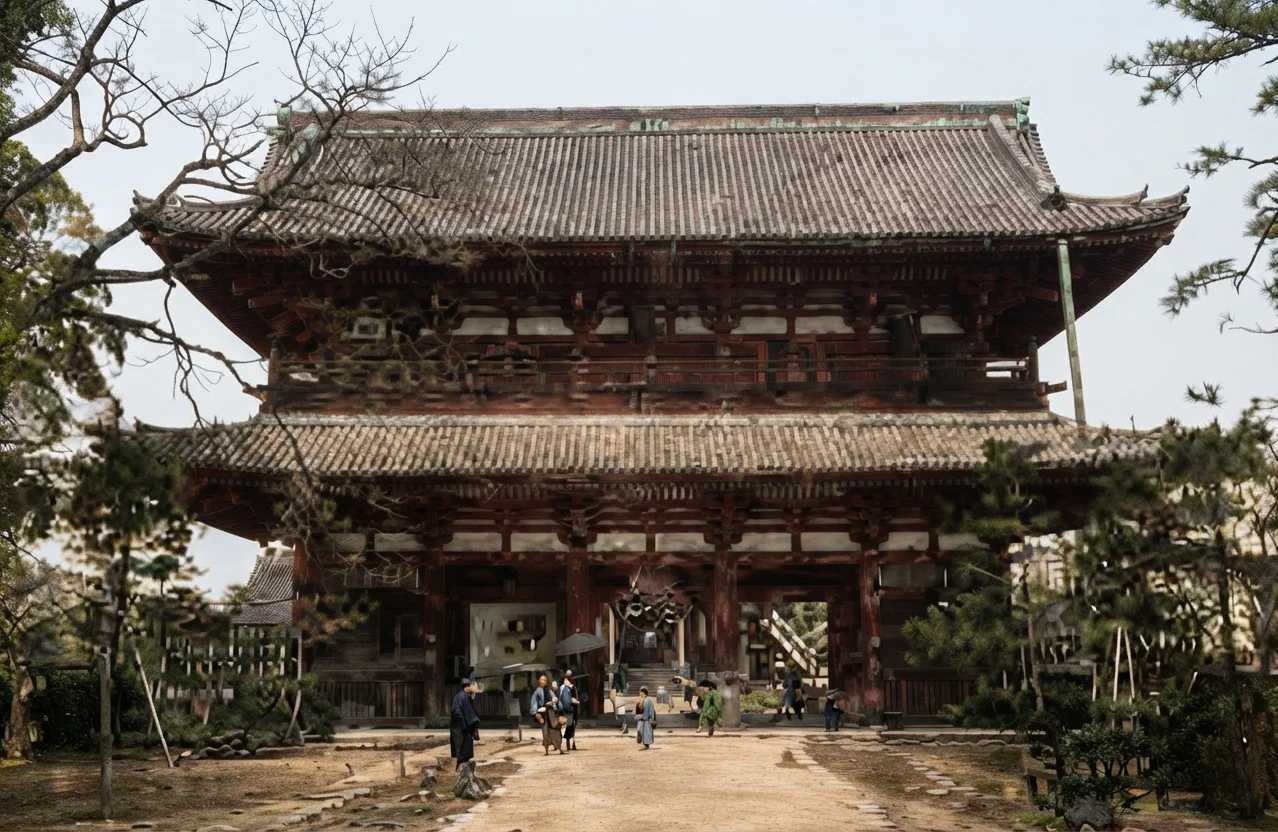
A Temple in Which the Japanese Pay Homage to Buddha.
IN THE MADURA DISTRICT, INDIA.
CONCERNING the many difficulties to be encountered in the Madura District, Rev. H. C. Hazen, missionary of the American Board, says:
"It is thought by some that car-drawings, such as used to be witnessed at Juggernaut, have been abolished by government. This is a mistake. I know from personal observation that idol-cars are annually drawn at five different places in the Madura Districts. In fact, the car-drawing is the principal business at the festival; that is the climax to which all look forward. Government has prohibited the voluntary immolation of victims before the car, but men and women roll behind the car, and occasionally, without any warning, or before any one has a suspicion of what is going to take place, a woman will throw herself in front of the moving car, and be crushed before it can be stopped. This is, of course, suicide, with religious fanaticism as the supposed cause, helped along, no doubt, by misery in the home life.
"Incredible tho it may seem, 'hook-swinging' is still practised in the Madura District. A hook is passed through two strong muscles in the back, and then the man is swung high into the air, and the car is slowly moved along. A vast throng is eager to catch the flowers which he scatters, which are supposed to contain great merit, as if they had fallen from heaven. The man who endures all that is looked upon as a god, and makes enough money by it to live in idleness during the remainder of his life.
"Many of the lower castes in Southern India are devil worshipers. They worship the devil because they are afraid of him. The wily priests prophesy to the people, when they try to become Christians, that many calamities will overtake them, if they forsake their father's god; houses will take fire, crops will be destroyed, cows and sheep will die, children will sicken and die, etc. These unscrupulous priests have ways of fulfilling their own prophecies, and all the heathen are with them in the plot. We have many sad illustrations of this statement. One entire family was wiped out one after another by poison, the priest warning the wife and mother at each step; but she held out, true to Christ, till all were gone, and she was carried to a distant place, and never heard of afterward."
WORK.
By Henry Van Dyke
LET me but do my work from day to day,
In field or forest, at the desk or loom,
In roaring market-place or tranquil room,
Let me but find it in my heart to say,
When vagrant wishes beckon me astray,
“This is my work, my blessing, not my doom;
Of all who live, I am the one by whom
This work can best be done in the right of way.”
Then shall I see it not too great, nor small,
To suit my spirit and to prove my powers;
Then shall I cheerful greet the laboring hours.
And cheerful turn, when the long shadows fall
At eventide, to play and love and rest,
Because I know for me my work is best.
—Henry Van Dyke.
MISSIONS THREATENED IN THE KONGO STATE.
TRADERS and missionaries in the Kongo State have repeatedly declared that the pledges of King Leopold, to give equal rights to all, have been broken, that natives are maltreated, trade restricted to concessionaries, and the very life of the Protestant missions is threatened.
The missions most affected are those of the Baptist Society and Kongo Bololo Mission, of England, and the Baptists and Southern Presbyterians of America. Letters from Rev. Motte Martin, of the Presbyterian mission, show that a part of the work in Africa seems to be in particular peril. Mr. Martin says that King Lukenga, of the Bakaba tribe, was summoned to Luebo to meet a state officer, and was treated with such indignity that he went back greatly incensed against the state. A later cablegram from Mr. Morgan, of the English mission, states that the Bakaba tribe is in revolt, and that the mission station at Ibanj has had to be evacuated. This will probably bring on a state punitive expedition, in which it is to be feared African Christians will suffer in common with the other members of their tribe. It is said that Leopold and the state authorities have determined, if possible, to drive out the Protestant missionaries from their territory.—Missionary Review.
YOUR CALL.
By Christian Advocate
THE world is dark, but you are called to brighten
Some little corner, some secluded glen;
Somewhere a burden rests that you may lighten,
And thus reflect the Master's love for men.
Is there a brother drifting on life's ocean,
Who might be saved if you but speak a word?
Speak it to-day. The testing of devotion
Is our response when duty's call is heard.