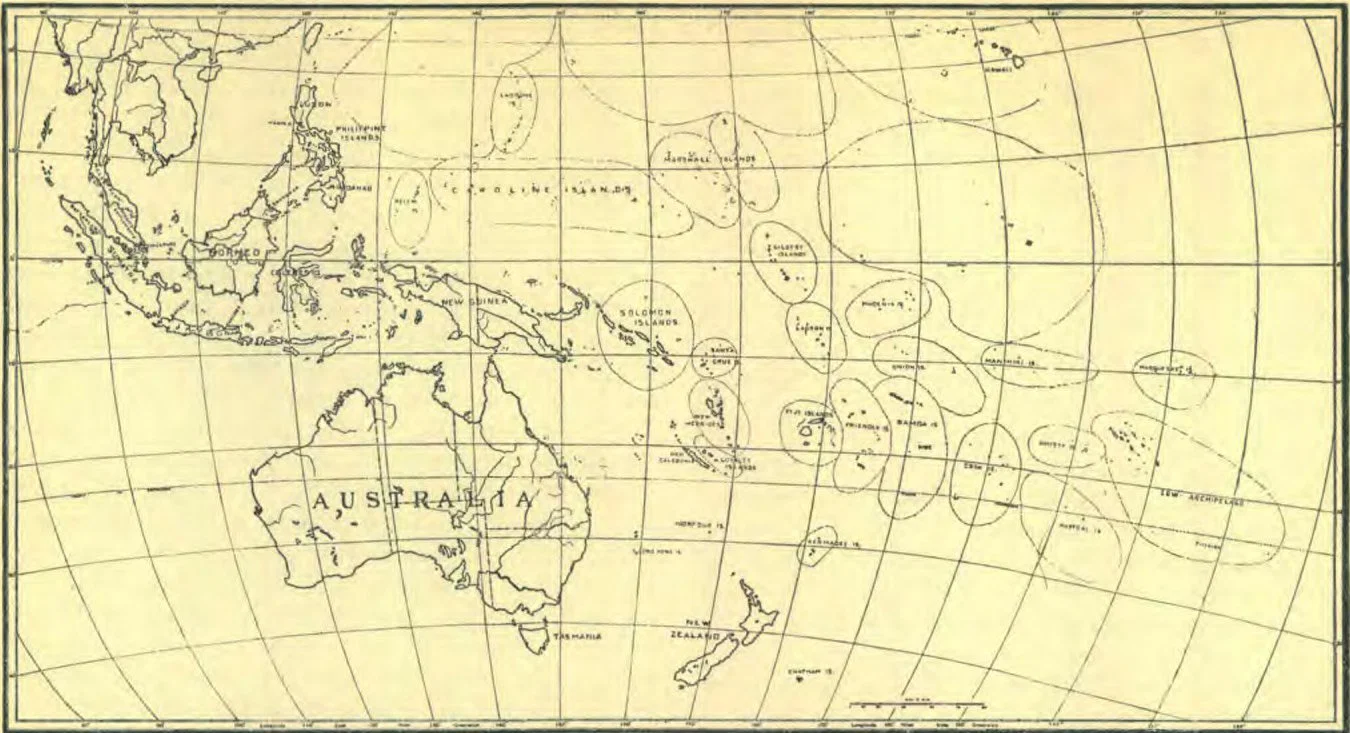
The South Pacific Islands Mission Field consists of three divisions,—Melanesia, Micronesia, and Polynesia. Melanesia takes in the western islands, those nearest to Australia. First in importance in this group is the large island of New Guinea, where the population is largely heathen. The western half is under Dutch rule, and is attached to the Malaysian Mission. The remainder is in the Australasian Union Conference mission field and marks its western boundary.
The Bismarck Archipelago consists of the Admiralty group, New Hanover, New Ireland, the Duke of York group, New Britain, and a chain of volcanic islands bordering the mainland. Most of the natives are savages, a race of totally naked cannibals. In places missionaries have exerted some influence over them. These islands, with a part of New Guinea, formerly belonged to Germany, but were captured by Australia early in the present war.
The British islands of New Guinea, though perhaps as numerous, are by no means as important as those formerly belonging to Germany. The Louisiade Archipelago, the D’Entrecasteaux, Trobiand, and Woodlark Islands, are the chief of them. The people in some parts are cannibals. Some of the natives have a strong admixture of Polynesian blood, and are well disposed.
The Solomon group consists of a double row of islands extending southeast from the Bismarck Archipelago for a distance of about seven hundred miles. It comprises seven chief islands. There are numbers of small islands as well. The people are mostly of the Papuan type, and are the most dangerous of all the natives of Melanesia. The islands are not thickly populated, but a different language is spoken in almost every one of them.
The Santa Cruz Islands lie about two hundred miles east of the southern islands of the Solomon group. None of them are large. The people are of Papuan origin, and apparently good-natured and well disposed, but not to be trusted.
The New Hebrides extend for a distance of over five hundred miles in a direction roughly north and south, midway between the Santa Cruz and Loyalty groups. There are about forty islands in the group, some of which are of considerable size. The natives of the north are for the most part of a friendly disposition, differing from those of the southern part of the group. The larger part of the people are of Papuan origin. Christian missions have been established in these islands, chiefly in the south, and in Aneityum the people are all professed Christians.
New Caledonia is the most southerly of the Melanesian islands. It is two hundred and fifty miles long and averages thirty-five miles in breadth. It is owned by the French, and is used by them as a penal settlement. The natives are a well-made race, with frizzly hair, dark skin, and pronounced features. They are divided into tribes, and the languages are numerous.
The Loyalty Islands consist of three principal islands. The population a few years ago was estimated at 10,000, but is said to have diminished. The people are the most civilized of any Melanesians, except perhaps those of Aneityum.
The Fiji Islands complete the Melanesian groups. These are divided into two great divisions, and consist of a large number of islands, of which a few are of considerable size. They have come under Christian influences.
Polynesia
The Tonga or Friendly Islands, the Samoan, Cook, and Society Islands all belong to this division, and have all been entered by the message.
Savage Island, or Niue, situated nearly midway between the Tongan and Samoan groups, is a small and very fertile island about nine miles long. The people are of mixed Samoan and Melanesian blood, and are now all nominal Christians. The population is about 5,000.
The little Tokelau or Union group consists of three small islands, inhabited by a Christianized people closely resembling the Samoans, and speaking an allied dialect.
The Ellice group consists of a number of low coral islands and atolls, arranged in nine clusters. The population numbers about 2,500, and almost all are Christians. All can read, and most can write. The inhabitants of Niue speak the language of the Gilbert Islands. All the others speak a Samoan dialect.
The Austral or Tubuai group is seldom visited. It consists of four chief volcanic islands. The population does not exceed 1,000.
The Paumota, Tuamotu, or Low Archipelago, forms a cluster of about eighty islands, about sixty of which are inhabited. They are scattered over a vast area, and have a population of less than 6,000 persons.
The Gambier Islands consist of five high volcanic islets inhabited by Roman Catholic converts, whose numbers were increased in 1879 by the immigration of the bulk of the inhabitants of Easter Island, 300 in number.
Pitcairn Island lies at the extreme southeastern limit of the Low Archipelago.
North of the Low Archipelago, and almost nine hundred miles from Tahiti, are the Marquesas, of which seven are inhabited. The population is estimated to be over 6,000. The aborigines are usually described as the very finest of all the South Sea islanders. Their complexion is of a pure, healthy yellow, with a soft, ruddy bloom on the cheeks. Few of them remain, however. About fifty years ago there were fewer than five hundred. The efforts of missionaries to evangelize this group were long fruitless, but recently the majority of the natives are said to have adopted the Roman Catholic religion. Nevertheless they still remain savages.
North of the Society group lie several widely scattered islets that are seldom visited. Caroline or Thornton Island, Manihiki, Penrhyn or Tongareva, and perhaps Suwarrow may be regarded as forming the Manihiki, or, as it is called by some, the Penrhyn group. North of these are Starbuck and Malden.
Another group of islets is the Phoenix group. Most of these are scantily populated. In most of these groups the people are nominally Christian.
Easter Island is far out in the mid-Pacific, 1,400 miles9beyond lonely Pitcairn. There are now about one hundred inhabitants, all Christians. This island marks the eastern boundary of this great mission field.
Micronesia
North of the equator, between New Guinea and the south coast of Japan, the great ocean is studded with countless little islands, which in consequence of their remarkably small size are collectively called Micronesia.
The Gilbert Archipelago consists of sixteen islands, nowhere more than twenty feet above the sea. There is no fern nor grass. A little taro is grown in trenches with great care. The food of the people is mostly procured from the sea, and ranges from the whale to the slug. The islands are thickly populated, the population of the whole group being estimated at 40,000. The natives are tall and stout, and appear to be a mixed race.
The Marshall Archipelago is arranged in two parallel chains, that to the east being known as the Radack group, and that to the west as the Ralik group. There are forty-six islands, and the population is estimated to be 10,000. The natives are decreasing rapidly in number.
The Caroline Islands occupy a vast area. The majority of the islands are low and coralline. The climate is very healthful, and where sufficient soil is found, fruits flourish. The people are believed to number about 30,000. They exhibit a considerable mixture of race and variation in color, from very dark copper in the west to almost a light brown in the eastern islands. Many are of unusually tall stature and strongly built.
The Pelew Islands consist of one large island and a few small ones. Their population is between 12,000 and 14,000. The people are smaller in stature and darker than those of the Caroline Islands. They are friendly in disposition, and intelligent.
The Ladrone or Mariana Islands extend in a chain about five hundred miles from north to south. The chain consists of seventeen islands, with a total population of a little over 10,000. The islands are peopled by Tagals and Visayans from the Philippines, with a few Caroline islanders, and numerous half-breeds, and also by the mixed descendants of natives of South American tribes. These islands are not often visited, being out of the regular trade routes. Guam, now in the possession of the United States, is a coaling station.
It will be seen, from this survey of the South Pacific islands mission field, that the giving of the warning message all through it is a difficult proposition. But in some way it must be done before the Lord comes in glory.
For the Finding-Out Club
Answers to Questions in “Instructor” of January 18
Part I
Dr. Clara A. Swain
1. “In all Asia there was no hospital for women until Jan. 1, 1874, when Dr. Clara A. Swain opened a hospital for women in Bareli, India. When Dr. Swain went to India as a missionary physician, people in America thought that the women of India would be too superstitious to take treatment from a woman, but she treated in the first year one thousand two hundred and twenty-five patients. She at once opened a medical college, and three years later thirteen girls were granted certificates to practice medicine. A Hindu woman said, ‘Your God must be a very kind, good God to send a doctor to the women. None of our gods ever sent us a doctor.’”
Gen. Samuel Chapman Armstrong
2. “Jan. 30, 1839, was the birthday of Samuel Chapman Armstrong. His early home was in the Hawaiian Islands, where his parents had the Hilo Manual Labor School. The boys paid their expenses by carpentering, housework, gardening, etc. At the close of the Civil War in the United States, General Armstrong said, ‘We must have a school like the Hilo school, for these colored boys,’ and he started the famous Hampton Normal and Agricultural Institute of Virginia. Among the most noted pupils of this school was Booker T. Washington, who later founded a similar school at Tuskegee, Alabama.”
Joseph H. Neesima
3. “Jan. 14, 1843, was the birthday of Joseph Hardy Neesima. At that time no Japanese was permitted, under penalty of death, to leave his country, nor was any foreigner allowed to land on the shores of Japan. But young Neesima heard of the schools and the learning of other countries. He found a Bible, which he read at the risk of his life. He managed to escape on a ship, and arrived in America. Alpheus Hardy and his wife, of Boston, took the boy to their home and sent him to school. After graduation he returned to Japan, where he was gladly received. Joseph Hardy Neesima founded the great Doshisha University, the first Christian university in Japan.”
Adoniram Judson
4. “‘At last, it is done,’ said Adoniram Judson on Jan. 31, 1834, at Moulmein, Burma, after he had completed the translation of the Bible into Burmese. He and his wife, Ann of Ava, had left the United States twenty-two years before. During all these years his main work had been the translation of the Bible. For a time he was in prison. To save his manuscript from being lost, his wife sewed it up in a pillow. The pillow was so hard that no wicked jailer stole it, and after several years the manuscript was printed. His contribution to literature is immeasurable.”
Part II
1. Cover the table with a silence cloth, which is usually made of double-faced Canton flannel or felt. On the silencer lay a pure-white damask cloth. A well-laundered cloth is a matter of prime importance; it should be ironed almost without starch, and in as few creases as possible. When spread, its long central crease should divide the area of the board exactly in half, and it ought to be wide enough to hang in folds to within twelve or eighteen inches of the floor.
Place a service plate in the center of the space allowed for each person, allowing from twenty-five to thirty inches in length and fifteen inches in depth for each cover. The plate, as well as all cutlery and silver, is set about one-half inch from the edge of the table.
Place knives at the right of the plate, with the cutting edge toward the plate; spoons to the right of the knives; and forks to the left of the plate, with the prongs up. Bread-and-butter plates (not used at formal dinners) are placed at the upper left-hand of the service plates, and the glasses at the upper right-hand, near the knives.
2. Men’s cards are smaller than those of women, being both narrower and shorter.
3. A gentleman is always to be introduced to the lady, never the lady to the gentleman, except in case of one greatly superior in rank or age.
Ready for Church
By Lucy Fairbanks Alvord
ARE you ready, girls?” Father’s voice sounded a bit sternly up the stairs. “The bell’s tolling, and Cousin Helen’s been waiting ten minutes.”
“Oh, never mind me!” said the guest, smiling, as the two sisters stumbled down, donning jackets and grabbing Sunday school quarterlies on the way.
“How is it you’re always slick and serene, Helen, while we’re just scrabbling our things together, and usually late to service at that?” asked Gladys, tearing her new gloves in her haste.
“Why, you see, I begin getting ready the Monday before!”
“Monday?” chorused her cousins.
“Yes. I brush my best things and put in fresh ruching or strengthen buttons if need be before I put them away. Then in the evening I study my lesson: you know there’s seldom anything on that night.”
“H’m’m,” reflected Dorothy, “there’s that hook still off my coat. I never thought of it since last Sunday.”
Just then the church door was reached, so the topic wasn’t continued till after dinner, when the invalid mother asked for the text.
“Well,” giggled Gladys, “the pins in my hat were all sticking into me so I only heard half the minister said. I forgot to trim it till late last night, so there wasn’t time to sew the ribbon on.”
“And when we stood up to sing,” chimed in Dorothy, “I just remembered my shirt waist wasn’t more than half buttoned: we were in such a rush, and I never thought I’d take off my jacket. That mixed me up so I never heard a word; but Helen gets ready a week before, so she can tell you, mother.” Her cousin gave the required information, and added, on request, a brief sketch of the sermon.
“If I were as forehanded as you, I shouldn’t have anything to do Sunday morning,” joked Dorothy.
“Oh, but I find plenty to do!” replied her guest soberly.
“Tell them what, dear,” begged her aunt. “I think preparation of mind and heart is the most important.”
“Yes, do,” pleaded the older sister, “it’s always been too much for us to get clothed in time, to say nothing about being in our right mind as well.”
“Why, you see,” hesitated Helen, blushing, “I found I had to spend half the church time getting quieted down in order to take part in the service and listen to the sermon.”
“My, sometimes I spend the whole of it!” groaned Gladys, honestly.
“So I decided to try to get ready for church before I went——”
“Be silent, my soul, before God,” quoted mother.
“Yes, you understand what I mean. Just the time you bow your head on going in isn’t enough. I most always read a psalm at home, or on communion Sundays the sixth of John.”
“Oh, about the bread of life! And do you really find that ‘quiet hour’ helps?” Gladys was serious now.
“Indeed I do. Truly girls, church means twice as much now. It’s worth getting up a few minutes early for.”
“You’re the best preacher we’ve heard yet,” interrupted Dorothy. “Let’s call her our new minister, shan’t we, mother?”—Lucy Fairbanks Alvord, in the Wellspring.
Counting Their Blessings
It was the day before Thanksgiving. In her tiny kitchen, pretty little Margaret Lane was preparing a Thanksgiving dinner, the first one in the pretty home over which she had come to preside but a short six months before.
Her nimble fingers were busy fashioning a plum pudding. Her heart was so light that almost unconsciously she burst into song. The room was small and the day warm, so she had left the door partly11open, and her sweet voice floated out into the street.
A man passing by paused to listen:—
“When upon life's billows you are tempest-tossed,
When you are discouraged, thinking all is lost,
Count your many blessings, name them one by one,
And it will surprise you what the Lord has done.”
The man passed on, but the words seemed to ring in his ears. A cynical smile curled his lips. “Count my blessings, indeed,” he muttered; “I wonder what they are. I presume that sweet little singer would say my wealth, but it has never brought me one happy moment, not one.”
Then some way, it seemed to him that the pages of his life swept back, and he saw again a fair face bend above him, a face so pure it might have been an angel's. She was gone now, but his whole life had been softened by her influence. Surely he must count the memory of a Christian mother among his blessings.
There was another, too, away back in his younger days, whom he had named the sweet name wife, and a tiny daughter nestled in his arms. But not for long. God took them from the sorrow here; yet the happiness of those short months was very dear to him.
His face grew thoughtful. Was it not a blessing to have had such treasures? Tears came to the eyes that had long been strangers to them, as the meaning of the song seemed to be brought home to him, and he said, “I will arise and go to my Father.”
And Margaret sang on:—
“Are you ever burdened with a load of care?
Does the cross seem heavy you are called to bear?
Count your many blessings, every doubt will fly.
And you will be singing as the days go by.”
The woman across the street shut her door with a slam. “Little she knows about it. Wait until she has to work as I do, and she won't find time to sing or count her blessings, either.”
But the words of the song were with her. Burdened she surely was, for her health was not good, and there were three little ones to do for, and yet— “Count your many blessings, name them one by one.” The words came to her in spite of the closed door, and she smiled grimly as she thought, “Tom is well and has plenty of work, that is one, I suppose; and does not spend his money for strong drink as some do. Then our home is paid for, and the children are well, and good to help me.”
A look of surprise came over her face, and she wondered if there was not much for her to be thankful for after all. The words of the song held a new meaning for her, and she found herself trying to hum the air as she went about her many tasks.
“When you look at others with their lands and gold,
Think that Christ has promised you his wealth untold.
Count your many blessings; money cannot buy
Your reward in heaven, nor your home on high.”
A young girl heard the words as she hurried to school. “I believe I needed just those words to set me right,” she thought. “I am afraid I was envious this morning because Mabel had such a beautiful new suit and I must wear my old one. I was cross about it, too, and it will worry mamma, for she is doing all she can for me, and—” Her face paled as she thought: “Mabel has no mamma; I am sure she would be willing to wear old clothes if she could only have her dear mamma. What would I care for money without my dear mother to share it? I will never worry her again, never; and I will tell her so at noon, too,” and she passed into the schoolroom.
“So amid the conflict, whether great or small,
Do not be discouraged, God is over all;
Count your many blessings, angels will attend,
Help and comfort give you to your journey's end.”
“It will not be long, either,” murmured a poor old woman, as she toiled painfully along. “The end is not far off, and my greatest blessing is that it is so. I was feeling discouraged this morning to think my Master kept me waiting so long, but he knows best. Aye, he will help and comfort me to the end. I am glad I heard the singer; God bless her!”
The pudding was finished, and so was the song, and Margaret, with a high heart, began putting the little kitchen to rights, not knowing that while she sang, four souls had been brought nearer to their Maker, and that on the morrow each would return thanks for blessings overlooked in the hurry of the world until a song, heard by chance, set them right.
Was it really chance, or a part of God's divine plan? Who can say?—Michigan Christian Advocate.
What Mary’s Mother Learned from the Swimming Lesson
A MOTHER had for several days been watching her little daughter’s swimming lessons in the lake.
“Splendid for her, isn’t it?” said another mother.
“Yes, splendid,” said Mary’s mother. “But do you know that these swimming lessons have taught me in Mary’s case, as nothing else could have done, what sleep means to a child? When I saw that on the days after she had had her full allowance of sleep she could swim twice to the float and back, and when she had been up late she could only reach the float and back once, it set me thinking. I began to see just what I had been doing to my child by being careless about the bed hour. If we had company, she would sit up a little later; if we got interested in playing some game, she sat up a little later; if she was interested in her reading, I let her sit up a little later; if I got lazy and forgot to notice the time, she sat up a little later; and so on for every excuse. After that swimming lesson revelation I reasoned that each time I let her lose any of her regular allowance of sleep, I was actually pinching just so much good muscle right off her little bones. She is not a very rugged child, and it is my fault; I might just as well have bled her a little every night as to have let her lose her sleep. Now Mary goes to bed on time. Company or no company, game or no game, book or no book, Mary goes to bed on time. And look at her! Three times to the float and back, and yet not winded!”
This mother saw truly what so few mothers see: that insufficient sleep absolutely prevents the normal development, both physical and mental, of a child. A child should go to bed so early that he will awaken in the morning of his own accord, not only willingly but also glad to get up. If he has to be awakened, or if he begins the day languidly and seems to lack energy and enthusiasm, an earlier bed hour is distinctly in order.—The Ladies’ Home Journal.
The West
Out where the handclasp’s a little stronger,
Out where the smile dwells a little longer,
That’s where the West begins.
Out where the sun is a little brighter,
Where the snows that fall are a trifle whiter,
Where the bonds of home are a wee bit tighter,
That’s where the West begins.
Out where the skies are a trifle bluer,
Out where friendship’s a little truer,
That’s where the West begins.
Out where a fresher breeze is blowing,
Where there’s laughter in every streamlet flowing,
Where there’s more of reaping and less of sowing,
That’s where the West begins.
Out where the world is in the making,
Where fewer hearts in despair are aching,
That’s where the West begins.
Where there’s more of singing and less of sighing,
Where there’s more of giving and less of buying,
And a man makes friends without half trying,
That’s where the West begins.
— American Bar Association Journal.
Decay of the Caste System
THE Bible, which has been touching the life of students through many different agencies, is doing much to destroy the system of caste which for centuries has blocked the progress of India.
A professor in one of the cities which I visited, invited a number of Bible students to his home for a social evening. There were present both Hindu and Mohammedan university men. When refreshments were served, the professor prepared two tables, in accordance with the usual custom, since the Hindu students were not expected to touch food which had been offered to those not of their own faith. It chanced that the Hindu students ate all their cakes, and being still hungry, inadvertently remarked to their host that they would not object to a second helping. After investigation, the professor found that all the cakes had been served; whereupon the Hindu students, perceiving that there were still refreshments remaining upon the tables where the Mohammedan young men had been eating, suggested that the Mohammedans' cakes would be quite satisfactory. The professor, astonished, said, “But you are Hindus.” The answer came from a bright-faced Brahman of high social position, “We have changed our view somewhat in relation to this matter as we have studied together the principles of the Founder of Christianity concerning his social order.”—The Christian Herald.
BABY BOSSY'S JOKE.
By Minnie Rosilla Stevens
A Tale of a Tail.
“And there he lay as comfortable as a bossy could be.”
BABY BOSSY had frisked and played till he was quite tired out, his stomach was full of good green grass and leaves, and he was looking for a comfortable spot in which to lie down and chew his cud while dozing and resting. Baby Bossy was an aristocratic, thoroughbred little Jersey, but he cared not a fig about that, nor thought a thing about it. He enjoyed galloping through the cornstalks or over the lawn with his tail held wildly out behind, almost standing on his head at times, and kicking his hind feet high in the air in anything but a dignified and aristocratic way, and exactly as the most lowly born little calf does when in good spirits and a playful mood.
But Baby Bossy's eyes were very soft and purplish and velvety, his black markings were very handsome, while the general hue of his smooth coat was a rich brownish-fawn color, which to see was to admire. Moreover, it was by means of that same brownish-fawn-colored coat of his that Baby Bossy played his practical joke on Girlie.
Some of the leaves on trees and bushes were already turning brown, but not from frost. A prolonged drought with the heat of summer had ripened them prematurely, and they had turned to autumn tints while yet in the midst of summer weather. Baby Bossy wished his resting spot to be cool as well as otherwise comfortable, so he crossed the garden patch and paused where the hot sunshine was somewhat tempered by the shade of a cluster of trees. A low thicket of running oak grew under these trees on the border of the garden, and toward it Baby Bossy turned his soft eyes. It seemed to be the very spot he sought, for without more ado he walked over and lay down at once in the edge of the thicket, with his back to the garden gate; and there he lay as comfortable as a bossy could be, chewing, chewing, and flipping his black-tipped tail regularly up and down like a jumping jack, to keep all troublesome flies away.
Now the running oak thicket where Baby Bossy had made his bed was one of the bush clumps which had ripened in the summer drought. The leaves were still thick upon it, but they had turned a brownish-fawn color, and were only waiting to loosen their hold and fly away in a passing breeze. Baby Bossy did not go deep into the thicket, but only into the edge of it, where the bushes were not high enough to cover him. Yet, when he lay down, he seemed at once to disappear from sight, because, because,—can't you guess why? The leaves of the thicket and Bossy's coat were so nearly the same color that they blended as one, and even when his delicate ears moved to and fro, as they did occasionally, they seemed but large brown oak leaves, fluttering in the wind. Only Bossy's black, jumping-jack tail tip seemed to be out of place and not belonging to the spot, but it had to be there for Baby Bossy's use in playing his joke, as well as switching flies.
Out of the back door of the big farmhouse, under the catalpa trees, and through the garden gate, came Girlie. She had business in the garden that kept her some little time, but she had no need to hurry. A glance toward the farther edge of the garden showed her a half-grown chicken, in the running oak thicket, jumping up and seemingly making desperate efforts to capture bug, worm, or other choice morsel of food, in a bush too far above its head to be reached. Girlie was used to seeing chickens picking and foraging in the garden, so, at first, she paid little attention to the one in the thicket. But presently its persistent jumping caused her to notice it more closely. Jump, jump, jump, went the chicken, without ever seeming to tire or grow discouraged. Girlie watched it with more and more interest and curiosity. The regular jumps continued. “Whatever can there be in the bush that that chicken wants so badly and is so determined to have?” thought Girlie. “I believe I'll go and see.”
So she started across the garden toward the chicken, which did not take fright and run away at her approach, as might have been expected, but kept up its jumping as regularly as ever, and paid not the slightest attention to her. Jump! jump! Girlie was quite near now. But all at once she stopped abruptly. The toss of a head, the flip of two ears, or perhaps the shifting of a body suddenly revealed Baby Bossy's graceful proportions, very close indeed to the jumping chicken. Chicken! Girlie looked again, and then flounced off toward the garden gate, quite provoked and disgusted. The chicken she had come to see was only Baby Bossy's black tail brush, switching flies.
But Girlie's disgust lasted only a minute, and then she saw the joke, and laughed gayly to think Baby Bossy should trick her in so cunning a fashion. Out of the garden gate and back to the big farmhouse went Girlie, leaving Baby Bossy still jumping his “chicken” in the brown oak thicket. But if he played the joke on any one else that afternoon, we never heard anything about it.