The Youth’s Instructor, Vol. 64, No. 11.

Miscellaneous Notes and Brief Items

The Youth’s Instructor

Mar 14, 1916

Review and Herald Publishing Assn. · Takoma Park Station, Washington, D. C. · Mar 14, 1916

Miscellaneous Notes and Brief Items

IT was said of Athens that it was easier to find a god there than a man.
ALUMINUM is by far the most plentiful of the metals in the earth’s crust.
IT is recommended that a woman sleep in her own guest room at least once a month.
THERE are 380 members, or 72 per cent, of the present Congress who report collegiate education. They represent 173 institutions. The University of Michigan has 27 representatives, while Johns Hopkins and Stanford have none.
DAVID LLOYD-GEORGE is minister of munitions in England, and Albert Thomas has the equivalent post in France. Not so many years ago, as a poor boy in a country town, Albert Thomas delivered bread for a baker, earning money for a college education.
LOUIS D. BRANDEIS, President Wilson’s recent appointee as justice of the Supreme Court in the place of the late Justice Lamar of Georgia, was born in Louisville, Kentucky, of Jewish parents. He was graduated at the head of his class in the Harvard Law School at twenty years of age.
DURING 1915 there were in this country sixty-nine lynchings, seventeen more than in 1914. In four cases it was later proved that the victims were innocent. Three of those lynched last year were women. Leading universities of the Southern States are starting a movement to put an end to this lawlessness, which is a disgrace to the country.
A NEW electric auto horn has been invented by U. P. Seng, of Chicago. Within the steering wheel is a metal or signal ring, which takes the place of the electric button, and the driver may operate it without removing either hand from the steering wheel. It takes a simple pressure of one of the fingers against any part of the ring to “trip” this switch, and the chauffeur loses no time in feeling around for the button before he sounds the horn.
THE steam locomotive may give way to the electric locomotive. The Pennsylvania Railroad Company has inaugurated an electric train service over its main line between Philadelphia and Paoli. The Norfolk and Western Railway Co. also is operating an electric service between Bluefield, West Virginia, and the coal mines. The advantage of the change is shown in the fact that because of steep grades and a heavy freight traffic, the steam-operated trains made only seven and one-half miles an hour, while the electric trains haul heavier loads at twice the speed.
A DRY-CLEANING establishment in Cincinnati, employing about three hundred persons, has come to the conclusion that if these people hear music at frequent intervals while they work, it will not only make them happier, more contented workers, but that they will do more work than if they were without the music. So, following this theory, the enterprising firm has installed throughout the big establishment enough phonographs to keep lively music playing almost all day long. It is like one big entertainment. The phonograph has solved better than any shop foreman or superintendent the problem of promoting voluntary “speeding up” among employees. Nearly every South American establishment has its musicians to play for its employees during business hours.
THE size of American universities, as indicated by their registration on Nov. 1, 1915, is indicated by the order in which they are named: Columbia (11,888 students), California (10,555), Chicago (7,968), Pennsylvania (7,404), Wisconsin (6,810), Michigan (6,684), New York (6,656), Harvard (6,351), Cornell (6,351), Illinois (6,150), Ohio State (5,451), Minnesota (5,376), Northwestern (4,408), Syracuse (4,012), Missouri (3,868), Texas (3,572), Pittsburgh (3,569), Nebraska (3,356), Yale (3,303), Iowa (3,138), Kansas (2,806), Cincinnati (2,524), Indiana (2,347), Tulane (2,160), Stanford (2,061), Western Reserve (1,825), Princeton (1,615), Johns Hopkins (1,586), Washington (1,254), Virginia (1,008).

Missionary Volunteer Pledge

A pledge against the use of tobacco in any form, known as the Anti-Cigarette Pledge, has been printed on a neat card for the use of our Missionary Volunteers. Every true Missionary Volunteer is an enemy to tobacco; should sign the pledge, and labor earnestly to persuade others to do the same. This pledge is “Missionary Volunteer Pledge No. 8;” price, 1 cent each. Order from your tract society.

For Thirty Years an Employer

THE National Advocate gives the following testimony from a business man who for thirty years has employed young men:—
“I have never given employment to any young men who have acquired the use of tobacco or liquor in any manner, shape, or form. In our banks, when a young man makes application for a position, we ask him a good many questions, but there are three on which I lay emphasis:—
“Do you use liquor in any form?
“Do you use tobacco in any form?
“Are you a member of any church?
“The answers to these three questions have a great deal to do with giving a young man a position, and I have never yet employed a young man who said he used tobacco or liquor. I do not want to be classed as a fanatic or a crank in regard to the use of tobacco. I have a good many business associates, men in whom I have great confidence, who, unfortunately, are users of tobacco, but there can be no question in my mind about one thing: The young man who starts in life divested of this habit has a great advantage over the other fellow.”

Elijah — the Man of Invincible Courage

Lessons from Elijah’s Life

  • (Concluded from Instructor of February 29)*
C. C. LEWIS

The Weakness of Humanity

LET us learn, also, how quickly and to what depths even a man of such courage may fall, cut off from the sustaining power of God and left to his own unaided resources.
Could ever a man’s discomfiture have been more complete? Elijah lay down on that fateful night a conquering hero, but arose a craven coward, and fled from the threat of a woman as if he had never stood undaunted before the king and the priests of Baal. There was neither sense nor reason in his conduct. He did not stop to consider. His only thought was to put as much space as possible between himself and Jezebel. Did he not know that God still lived and would continue to protect him? Were not the people with him who swept to their doom in a moment the hundreds of priests of Baal? And would they not have closed about him like a wall of adamant to protect him from any attempt upon his life? Jezebel herself did not dare to injure him, else she had not suggested waiting till the morrow. The same messengers that bore her threat of vengeance could, humanly speaking, have taken his life if that had been her purpose, and she had been ready to reap the result at the hand of an infuriated populace. And he had plenty of time to secrete himself among the now friendly people. From neither a human nor a divine viewpoint was there ground for serious alarm. But none of these considerations had any effect upon him. On he went for the desert as fast as his feet could carry him. And, withal, he suffered a complaining spirit of disappointment and dissatisfaction to take possession of his heart, and wished that he might die.
Patiently the Lord tried to lead him to see his wrong and put it away by repentance and confession. Twice—once before and again after the great parable in nature on Mt. Horeb—did the Lord ply him with that piercing question that should have revealed to him his sin in not looking to Jehovah for guidance in his extremity, and in not waiting for the word of the Lord before deciding what to do,—that intensely personal question, “What doest thou here, Elijah?” But although his heart seemed a bit softened by the still, small voice, the answer was the same as before—that he had been very jealous for Jehovah; that Israel had forsaken the covenant, thrown down the altars of Jehovah, and slain his prophets; that he alone remained faithful, and his life was sought by the enemies of the very God for whom he had been so jealous. All this implied that he had not been properly supported, but had been left to himself in the time of greatest danger. There is no sincere repentance, no taking hold of the arm of the Lord by faith.

Lessons of Warning

And so the work of reformation, which even now might have been resumed and carried on to a successful consummation, had to be delayed until the burden could be transferred to other shoulders not yet prepared to receive it. How sudden and how sad the downfall! And cannot we perceive the causes?—the giving way to a sudden reaction upon overstrained nerves, the letting go of the arm of God by the casting away of confidence, unseemly haste in fleeing from danger before inquiring the mind of the Lord, cherishing a spirit of complaining, and stubbornly refusing to return to God through frank and full-hearted repentance. Let us note these sins and shun them faithfully; for they have marred many a great man’s work in the cause of God,—Moses, who for a moment’s impatience and speaking unadvisedly with his lips was denied entrance into the Promised Land; Saul, who was utterly rejected as king of Israel because he waited not for Samuel, but offered sacrifice himself, and was otherwise disobedient; Peter, who through shame denied his Lord, but by heartfelt sorrow and repentance was fully restored to his place in the Master’s work; and Elijah, who fled from his post of duty, and never fully recovered his former position, although honored of God by translation. All these examples were recorded for our instruction, not to make us think we must fail because they did, but to teach us how to avoid their mistakes, and to warn him that thinketh he standeth to take heed lest he fall.

Quiet Forces and Gentle Measures

Behold now the power of quiet forces and gentle measures in accomplishing moral ends. What else can be the meaning of that “beautiful natural parable,” as Meyer calls it, which the Lord presented to Elijah on the mount? Let the lesson be conveyed in the eloquent words of this author: “Presently there was the sound of the rushing of a mighty wind; and in another moment a violent tornado was sweeping past. Nothing could withstand its fury. It rent the mountains, and brake in pieces the rocks before the Lord; the valleys were littered with splintered fragments; but the Lord was not in the wind. And when the wind had died away, there was an earthquake. The mountain swayed to and fro, yawning and cracking; the ground heaved as if an almighty hand were passing beneath it; but the Lord was not in the earthquake. And when the earthquake was over, there was a fire. The heavens were one blaze of light, each pinnacle and peak glowed in the kindling flame; the valley beneath looked like a huge smelting furnace; but the Lord was not in the fire.”
“How strange! Surely these were the appropriate natural symbols of the divine presence. If we had been asked to describe it, we should have used these first of all. But hark! a still, small voice, like the trembling echoes of a flute which is being played among the hills. It touched the listening heart of the prophet. If the more tumultuous outburst of power had expressed the storm and tumult of his nature, this elicited and interpreted a sweeter, nobler self, and cast a softening spell over his tempest-tossed spirit, and seemed to be the tender cadence of the love and pity of God which had come in search of him. Its music drew him from the cave, into the innermost recesses of which he had been driven by the terrible convulsions of nature. ‘And it was so, when Elijah heard it, that he wrapped his face in his mantle, and went out, and stood in the entering in of the cave.’
“What was the meaning of all this? It is not difficult to understand. Elijah was most eager that his people should be restored to their allegiance to God; and he thought that it could be done only by some striking and wonderful act. He may have often spoken thus with himself: ‘Those idols will never be swept from our land unless God sends a movement swift and irresistible as the wind, which hurries the clouds before it. The land can never be awakened except by a moral earthquake. There must be a baptism of fire.’ And when he stood on Carmel, and beheld the panic among the priests and the eagerness among the people, he thought that the time—the set time—had come. But all that died away. That was not God’s chosen way of saving Israel. And because he did not go on working thus, Elijah thought that he was not working at all; and abandoned himself to the depths of despondency.
“But in this natural parable God seemed to say: ‘My child, thou hast been looking for me to answer thy prayers with striking signs and wonders; and because these have not been given in a marked and permanent form, thou hast thought me heedless and inactive. But I am not always to be found in these great visible movements; I love to work gently, softly, and unperceived; I have been working so; I am working so still; and there are in Israel, as the results of my quiet, gentle ministry, seven thousand, all the knees which have not bowed unto Baal, and every mouth which hath not kissed him.’ Yes, and was not the gentle ministry of Elisha, succeeding the stormy career of his great predecessor, like a still, small voice after the wind, the earthquake, and the fire? And is it not probable that more real good was effected by his unobtrusive life and miracles than was even wrought by the splendid deeds of Elijah?
“We often fall into similar mistakes. When we wish to promote a revival, we seek to secure large crowds, much evident impression, powerful preachers,—influences comparable to the wind, the earthquake, and the fire. When these are present, we account that we are secure of having the presence and power of God. But surely nature herself rebukes us. Who hears the roll of the planets? Who can detect the falling of the dew? Whose eye has ever been injured by the breaking of the wavelets of daylight on the shores of our planet? ‘There is no speech nor language, where their voice is not heard.’ At this moment the mightiest forces are in operation around us; but there is nothing to betray their presence. And thus was it with the ministry of the Lord Jesus. He did not strive, nor cry, nor lift up, nor cause his voice to be heard in the streets. While men were expecting him at the front door with the blare of trumpet, he stepped into his destined home in the disguise of a peasant’s child. His going forth is ever prepared as the morning. He comes down as showers on the mown grass. His Spirit descends as the dove, whose wings make no tremor in the still air. Let us take heart. God may not be working as we expect, but he is working; if not in the wind, yet in the zephyr; if not in the earthquake, yet in the heartbreak; if not in the fire, yet in the warmth of summer; if not in thunder, yet in the still, small voice; if not in crowds, yet in lone hearts, in silent tears, in the broken sob of penitents, and in multitudes, who, like the seven thousand of Israel, are unknown as disciples.”

The Tenderness and Mercy of God

Throughout the experiences of Elijah, we see the infinite tenderness and mercy of God in dealing with his wayward children. When Elijah fell fainting beneath the juniper tree, the Lord gave him what he most needed—sleep and food to restore his exhausted physical powers. There was as yet no word of reproach. “Arise and eat,” were the Lord’s words through the angel; “because the journey is too great for thee.” And when the favorable time came for reproof, it was not given with severity, but in question form,—“What doest thou here, Elijah?”—designed to open the eyes of his servant to the fact that he had left his post of duty without due authority, through groundless fear. And then the Lord gave him the parable to further open his mind to the true issues of the situation, and repeated the question through the still, small voice—“What doest thou here, Elijah?” And when this failed to restore the prophet to that position where God could carry forward his work according to his original plan, still he dealt with his servant tenderly; commissioned him to anoint Elisha as prophet in his stead, but directed the latter to accompany him for a time as his servant and pupil; gave him a peaceful close to his stormy career, through his imparting to the young men of the schools of the prophets valuable lessons from his long experience in the things of God; and finally caught him up to heaven without his tasting death, to become the type of those who shall be translated when our Lord shall appear.

Concluding Exhortation

O the goodness, and the mercy, and the long-suffering tenderness of our God! Let us all learn to love him more fervently and serve him more loyally. Let us be of good courage in the Lord, be loyal to his truth, go forth in our places in his cause in the spirit and power of Elijah. In times of darkness and perplexity, may we not let go of his mighty hand, but look unto him for direction, and patiently wait for the unfolding of his plans. Let us not cast away our confidence in him, but ever remember that he is our loving heavenly Father, who has promised never to leave nor forsake his children. So shall our lives be fruitful in loving words and gentle deeds, and a little while from now, from our various fields of labor throughout the earth, we shall be caught up, like Elijah, to meet the Lord in the air, and go with him to the heavenly city, there to renew the sweet fellowship one with another begun here upon earth, and together enjoy his blessed communion forever.

Results of Colporteur Work in Australia

Results

A STORY comes to us from far-off Australia which beautifully illustrates the results of the work of the colporteur, though often unseen by him. We pass it on to our young people through the YOUTH’S INSTRUCTOR, feeling assured that it will not only be read with interest, but prove a blessing as well in giving confidence in the printed page as an agency for reaching people with the gospel message. The story is related by the colporteur himself, who was showing a lady one of our large books.
“Oh! I have a splendid book on that very subject. I bought it of a man in Dunedin,” she said, as we spoke of the policy of Rome. ‘And,’ she continued, ‘I lent it to a lady friend of mine who was about to marry a Catholic gentleman, and it broke off the engagement. After a vain attempt to win him from that church, she gave him up.’
“Miss Irvine had given me this lady’s name, requesting me to call on her, and I was anxious to win her confidence and later hold Bible studies with her. Miss Irvine had met her while canvassing for Life and Health.
“‘Yes, and what did you say was the name of the book?’ I inquired.
“‘Let me see, “The Great Controversy.” It’s an Adventist publication, but I like it. I got their temperance paper, Life and Health, from a young woman at my door a few days ago. Yes, “Great Controversy” is a splendid book. A few months ago I was asked to write an essay on “The Church during the Dark Ages” for our teachers’ Mutual Improvement Society, and I copied most of it from that book. By the way, the man who sold it to me said he hoped to train for a missionary.’
“‘Do you know his name?’ I asked, now deeply interested. I was thinking of our ‘Great Controversy’ campaign in Dunedin three years ago, and the canvassers who sold the books. ‘Who was it?’ I thought.
“‘A Mr. Johnston,’ she said.”
Then followed the account of a colporteur by the name of Johnston having sold “The Great Controversy” in that territory three years before, and though he knew nothing of it, a young woman had been saved from what doubtless would have proved an unfortunate marriage, and according to report was about ready to accept the whole message. In his letter the colporteur adds:—
“Is it not wonderful the way in which the Lord works? Truly ‘God moves in a mysterious way his wonders to perform.’ No doubt there are persons to whom you have brought a knowledge of the truth who are now waiting for further help to bring them into the full light of gospel truth. Will you not join with us in praying for this woman?”
Surely we will all join in praying for this young woman, and thousands of others who, like her, have been and are being saved from the deceptions of the last days through the excellent work done by consecrated colporteurs in the circulation of the printed page.
Another interesting feature of the story is that the young man “Johnston” who sold the copy of “The Great Controversy,” had himself been brought into the message by a book sold to him by a colporteur. Thus the seeds of truth sown by Christian workers take root and grow, and bring forth fruit. “He that goeth forth and weepeth, bearing precious seed, shall doubtless come again with rejoicing, bringing his sheaves with him.” Ps. 126:6. W. W. EASTMAN.

Missionary Volunteer Work in the Orange Free State

MRS. O. K. BUTLER, Missionary Volunteer secretary of the Orange Free State, South Africa, gives some facts about the Missionary Volunteer work in that land which I am sure will be very interesting to the majority of INSTRUCTOR readers:—
“I am often surprised at the eagerness with which the young people here grasp the few opportunities we are able to offer them, and at the good use they make of them.
“I must tell you a little about the work in the Free State, that you may the better understand our needs. This province, with the exception of the northeast corner, is principally a flat, hot, dry plateau, divided into farms containing anywhere from six hundred to six thousand acres. The former is considered a very small farm. You can see that this would entail a very scattered population. We have but one church in the conference that can hold regular Sabbath meetings as a church, and that is here at Bloemfontein. The rest of the churches are broken up into little Sabbath schools, usually composed of one or two families. The church as a whole seldom meets oftener than once a quarter, then for quarterly meeting.
“At first it seemed to me impossible, under these conditions, to have any regularly organized Missionary Volunteer Societies; but we have organized three, all of which are doing good work. None of them, I think, can meet as a whole every Sabbath, but they meet in bands as they can get together, and do the best they can to carry on the work. I am sure that the fact that they have an organization which they must keep up is an inspiration to them.
“Besides this we have the conference society, with seven or eight members. Practically all the young people have and use the Morning Watch Calendar, and a great many of our older people are using it too. Its study is the first habit that I try to establish with a young person, for I am sure the study of the Bible is at the foundation of all successful Christian experience and work.
“We have three candidates for the Standard of Attainment examination this spring (it is late spring here now), but as yet none of us have received the examination questions. We hope they will reach us soon. I think these young people will have no difficulty in passing creditably. Others are studying, and we hope for more candidates in the fall.
“Our first experience with the Reading Course was last year, and it was not altogether successful. For one thing, we could not obtain the current course books, and had to use some old ones that were at the office. While no doubt these were just as good, we missed the inspiration and help of the INSTRUCTOR outlines, and some of the young people felt that they were being served rather stale fare.
“The books for the present course have just arrived, and we are going to try to do better this year. I ordered twelve sets each of the Senior and Junior for our conference, and we hope to use them all.
“Of course any figures that we can give of our work are woefully small compared with the work at home. Twenty-four Reading Course sets would be nothing there; but conditions are very different here, and we must do the best we can.”
Thus in spite of difficulties our Missionary Volunteer work is winning its way into all parts of the world, and carrying hope, inspiration, and the means for increasing the efficiency in service to our young people. M. E. KERN.

Let Nothing Disturb Thee

Let nothing disturb thee, Nothing affright thee; All things are passing, God never changeth. — Longfellow.

Difficulties and the Grandeur of Life

MANY men owe the grandeur of their lives to their tremendous difficulties.—Spurgeon.

MRS. C. M. SNOW

On the Boundless Deep—No. 3

The Paradise of the Pacific

MRS. C. M. SNOW

The days grow longer, as on and on we sail. Yet before daybreak of December 13 many passengers on the “Sierra” were on deck, peering into the distance, to catch the first outline of the Hawaiian Islands. Finally a faint opal tint in the east began to blur out the stars as it crept higher and higher. Suddenly the islands threw off their cloudy robes and bathed in the bright morning air. In green and russet they were clothed, with a white ruffle skirting the beach, and a few night clouds lingered caressingly about their spire-like steeps.
Molokai is the first land sighted. Forty miles long and seven broad, it is a beautiful and fertile island. A small peninsula at the north, fenced off from the rest of the island by a lofty and almost vertical precipice, is the leper settlement. Most of Molokai’s land is devoted to pasturage.
There are eight habitable islands in the group, in order of size as here named: Hawaii, Maui, Oahu, Kauai, Molokai, Lanai, Niihau, and Kahoolawe. They lie between 18 and 23 degrees north latitude, and 154 and 161 degrees west longitude, in the North Pacific Ocean, not the South Seas as often stated.
Hawaii’s vast mountains attract most attention. Three mighty domes are seen from the ocean, the two highest often wearing snow caps and glistening like gems amid the clouds. Mauna Loa holds in its lap, at an elevation of four thousand feet, the great active volcano of Kilauea, in whose crown is one of the largest active craters in the world. At intervals of years tremendous bursts of molten lava roll down the mountain side. The table-lands of Hawaii are used for pasture or to raise sugar cane and the coffee shrub. Its bold cliffs are streaked with cascades. A few streams rush madly downward until lost in the briny surf. It has many deep and dangerous gulches, black and jagged reefs, and two wide bays, Hilo and Kealakeakua.
Maui is composed of two mountains, the tallest of which is a cluster of jagged ridges, the loftiest peak being 5,800 feet high. The other mountain is a vast volcanic dome, named Haleakala. It is 10,030 feet high, and contains in its summit the vastest extinct crater on the globe. The mountain slopes and lower levels are in rich cultivation,—fruits, grains, vegetables, and sugar plantations without end. Here, too, is one of the best schools in the Hawaiian government free school system. It was started by American missionaries nearly eight years ago.
Oahu is first in commerce and manufactures, and, according to its size, in agriculture. It is mountainous, with peaks over four thousand feet high. Its harbors can accommodate the largest steamships. Its area is about six hundred square miles. It is distinguished for holding the capital city of the group, Honolulu.
Kauai is called the garden isle, because of its rich vegetation. Its center is the large mountain Waialeale. This island has more living streams and beautiful cascades than any of the others.
Niihau, its sisterly neighbor, with its seventy thousand acres, is as picturesque, in miniature. It all belongs to one firm of sheep raisers.
Lanai, one of the most beautiful of the islands, is devoted to pasturage and agriculture.
Kahoolawe is fourteen miles long by six broad. Cattle and goats have so depleted the pastures that parts of the island are blown away to sea in clouds of red dust. The government is taking over the island for conservation purposes.
After six days at sea, we welcomed these emerald hills in the azure blue, as the islands rose from the sea. Everywhere along the coast of the Hawaiian Islands, grandeur of outline broken by delectable vistas up valleys and between mountain ranges, catches and holds the eye. “Nearer Oahu: the verdant palis, or precipices, of the latter rise like green walls from the blue sea. Everything is superlative; even the Oahu lighthouse, now sighted, is the largest of its kind in the world.
“The lighthouse at Makapuu Point is passed, the open crater of Koko Head draws nearer, and the great spouting horns at its base send geysers of sea water high in air. Koko Head is outlined against the sky, like a lion couchant on guard, for beyond Diamond Head is Honolulu, and within this peaceful-looking crater is one of the greatest fortifications of modern times. Guns, miles away, concealed in smiling coconut groves, may be aimed and fired with unerring accuracy at approaching vessels by a man hidden within that peak of rock crowning peaceful Diamond Head.
“Half an hour, and Waikiki and its surf-riders, royal coconut groves, and famous hotels, are glided by. The anchor is dropped, and the doctor climbs aboard.”
Evidently we are expected; there are a number of puffy, important-looking little tugs out to meet us. Small fishing craft is scattered about us; so we no more feel alone on the broad deep.
From the outer harbor Honolulu is seen in all its radiant glory. The young Hawaiian on board helps us locate the points named in our guidebook, and correctly to pronounce the musical names whose vowels are so many.
The gap in the mountains far away is the famous pali, over which Kamehameha the Great, the Hawaiian conqueror or Napoleon of the island, drove the Oahuan army a hundred years ago.
“The mountains on either side are from three to four thousand feet high. The great green plains at the foot of the mountains, stretching to the sea, are the sugar plantations, the most productive in the world. Behind them are the largest pineapple fields in any land, pines planted in rows miles in length. The hill seemingly in the center of the city is Punch Bowl, five hundred feet high. The great square stone structure in the foreground is the Alexander Young, a million-dollar hotel, the stones of which were quarried in the States and brought to Honolulu, to be put in place. The large white house jutting out into the sea is the private residence of J. B. Castle, one of the sugar magnates.
“The real Honolulu is hidden, however, behind the thick foliage of banyan trees, coconut and royal palms, scarlet frangipani, and the brilliant red and purple bougainvillea vines that climb over villas and encircle church spires with their gorgeous cascades of color.
“The doctor through his examination, in half an hour the vessel steams up the channel between the breakers that pound incessantly upon the coral reefs. And soon a score or more of brown-skinned Hawaiian boys are seen swimming out to meet the ship—and dive for nickels and dimes. The penny is unknown in Hawaii. These boys clamber aboard, climb to the highest rigging, and leap, feet foremost, sixty, seventy, or even a hundred feet, to the water below, for a nickel that is thrown over. They are the crack swimmers among the Hawaiian youth. No matter how much of a start the bright bit of metal gets, the bronze diver will follow it down, down till he gets it and places it in his mouth for safe-keeping. Don’t throw pennies. The boys won’t dive for them.
“From the wharf come the strains of ‘Aloha Oe’ (love to you), the national song of Hawaii, composed by ex-Queen Liliuokalani, who still resides in her old capital, Honolulu,” though not in her former palace. This is the Royal Hawaiian Band, which is still supported by the government.
Marvelously beautiful are the trees and shrubbery of Honolulu, all of which are imported from tropical and subtropical climates, and the flowers from everywhere. Over fifty thousand varieties have been imported. The two most valuable trees of the Hawaiian Islands are the coconut and the algaroba. The algaroba is the honey-making tree. It gives food for cattle, and grows out of the very rocks, disintegrating them and making rich soil. The coconut provides man with food and drink.
We felt the charm of the languid beauty of this rich island at the crossroads of the Pacific, and would willingly have remained to enjoy and explore for a month or more. It is said that from the heart of Honolulu one may take a different walk every day all the day long, for three hundred and sixty-five days in the year, and still not exhaust its gemlike beauties. “Mountain and sea, valley and plain, ever within an hour of one another—a world in a nutshell.” There are a hundred trails and footpaths leading out of Honolulu into the mountains.
We went through several valleys, everywhere finding the same scenic grandeur and quiet, almost indolent beauty. Pauoa valley is said to be the most fascinating of all the valleys. The Emma Street car line goes up a mile into the valley. Thence an automobile road is built halfway up the valley, then up the side of the cliffs to Pacific Heights.
Our last trip was on the car whose signboard read, “Kahili and Waikihi” (To the Aquarium, Kapiolani Park, and Waikihi Beach). This aquarium rivals the world-famed one in Naples. Here are seen the wonderful multicolored fish of Hawaii. A live shark is usually kept in a great tank.
Half a mile beyond the aquarium is Wakihi Beach. Swimming is indulged in the year round, and our party enjoyed an hour’s sport in the water. The breakers along this beach form the finest coasting place of the surf-board riders. Both whites and natives come riding in for a quarter of a mile perhaps, standing erect upon a tiny board. Here, too, the outrigger canoe shoots before the waves at a speed of forty miles an hour, under the guidance of expert Hawaiian helmsmen. Body surfing, or shooting before the waves with only the head out of the water, is another Wakihi accomplishment.
The vague, languid smell of Asia is over all. A gentle, indolent ease seems resting over the place, sort of a bone-idle feeling, as it were. But it is said that in the evening and until an early morning hour, certain parts of the city are wild with hilarity of every kind. There are more varied nationalities represented in Honolulu than in any other place of its size in the world, and each vies with the others in presenting its favorite sports. It is at once a buckler to America, holding a strategic position, like Gibraltar to Britain and like Helgoland to Germany, and at the same time is a vast playhouse, where the pleasure lover may find whatever amusement he desires.
All religions are represented here. The Emma Street car took us past the Mormon church. And places for almost every form of worship, from the most ancient to the most modern, are easy of access.
An appetizing lunch was served us at the mission, with tropical fruit such as we had never seen. We ate of the fruit of the magic isle, and passed under its spell. We sailed away with orange-colored wreaths around our necks, and with our newly made friends waving to us from the shore, until this Pearl of the Pacific was lost in the distance.

That New Year's Resolution

I WONDER if all our young people appreciate the value of “My New Year's Resolve” in the Morning Watch Calendar?
In Venezuela, where our work is just getting started, the little company appreciate it very much. Elder S. A. Oberg, our missionary there, writes:—
“All are enjoying the texts of the calendar, and the resolution has simply captivated us. Our leader said, by way of explanation of thoughts in it last Sabbath, that as a temptation came to him during the week, he said to himself, ‘No, that is not what I resolved to do; I have resolved not to do that any more.’ His argument so impressed us that we all have decided to commit to memory the resolution, taking a part every week, to be recited with the memory verses until it has become a part of our natures.”
This company of Spanish Sabbath keepers has set us an excellent example. Let us commit this resolution, if we have not already, and make it a part of our lives.
M. E. KERN.

Englishman and the Hindu Priest Prophecy
An Englishman in India was watching not long ago the great ceremonial in the Hindu temple. When it was over, he said to the priest, “How long has this worship been going on?”—“Two thousand five hundred years.” “And I suppose,” said the Englishman, “it will go on for another two thousand five hundred years?” The priest said, “No.” “And why?” asked the Englishman. Then the priest raised his eyes and spread out his hands, and said one word—“Jesus.”
American Issue
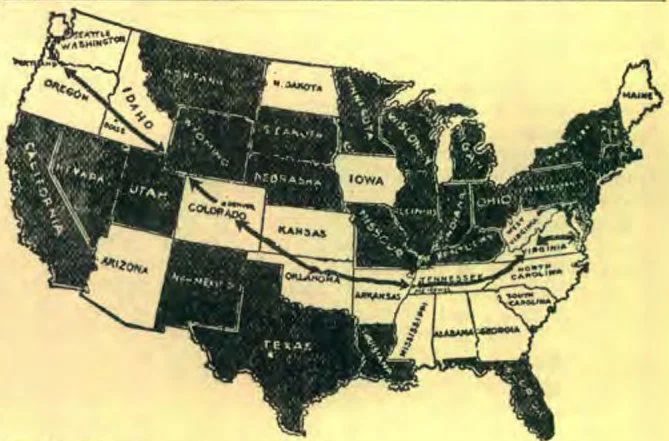
A Rumless Road from Coast to Coast
American Issue A Rumless Road from Coast to Coast
Continue reading: The South Pacific Islands Mission Field