Your ShelfYour Projects

Signs of the Times, Vol. 37, No. 10.

God's Assurance
Earlier text: The Work of the Holy Spirit in Conversion

The Overreaching Power of Wealth

A Prophecy of To-day
ISRAEL was nearing the end of its prosperity. Apostasies innumerable had taken place in the religious life of the nation. With apostasy, greed had entered the hearts of men; oppressive laws had been enacted; crimes had been winked at by the authorities until in a small way, as compared with what we see it now, wealthy men were controlling the nation. It was a demonstration of what Goldsmith later shaped in his famous lines,
"Ill fares the land, to hastening ills a prey, When wealth accumulates, and men decay."
God used that time as a type of this time. He used the overweening power of wealth there as a type of the overweening power of wealth here; and He used the calamities that were to come upon that nation as a result of the course that we are pursuing, as the type, the prophecy of what would come upon this nation and the other various nations of the world who follow the same course.
In the person of the prophet Habakkuk, who became the voice of the oppressed people, the appeal goes up to God against the exactions and oppressions of wealth. He cries:
"Art not Thou from everlasting, O Jehovah my God, my Holy One? we shall not die. O Jehovah, Thou hast ordained him for judgment; and Thou, O Rock, hast established him for correction. Thou that art of purer eyes than to behold evil, and that canst not look on perverseness, wherefore lookest Thou upon them that deal treacherously, and holdest Thy peace when the wicked swalloweth up the man that is more righteous than he; and makest men as the fishes of the sea, as the creeping things, that have no ruler over them? He taketh up all of them with the angle, he catcheth them in his net, and gathereth them in his drag: therefore he rejoiceth and is glad." Hab. 1:12-15.
He tells us that instead of worshiping God, the oppressor worships the work of his own hands, the schemes and plans that he has laid for the gathering in of men; and then the prophet declares he will watch to see what God will do, and the Lord commands him to "write the vision, and make it plain upon tablets, that he may run that readeth it. For the vision is yet for the appointed time, and it hasteth toward the end, and shall not lie: tho it tarry, wait for it; because it will surely come, it will not delay." Chapter 2:1-3.
The writer of Hebrews uses this very text from Habakkuk, and applies it to the time preceding Christ's second coming. Heb. 10:37, 38. Then the righteous God points out the career of those who have no regard for their fellows, whose soul is set upon themselves and their own plans: "Behold, his soul is puffed up, it is not upright in him; but the righteous shall live by his faith. And also because his wine is treacherous, he is a haughty man, that keepeth not at home; who enlargeth his desire as Sheol, and he is as death, and can not be satisfied, but gathereth unto him all nations, and heapeth unto him all peoples." (Margin.)
Another prophet referring to the same time thus speaks: "Wo unto them that join house to house, that lay field to field, till there be no room, and ye be made to dwell alone in the midst of the land!" Isa. 5:8.
One sees the colossal antitype of Israel's condition and Israel's evils in the present time. A number of men who can almost be numbered by the fingers on two hands control the great mass of wealth in America; interests, industries, all the great colossal organizations of the country in the hands of a few.
A few years ago a mighty struggle was waged over the great life insurance companies in which had been poured the savings of thousands of individuals as a safeguard for their loved ones against death and old age. They found that men were exploiting these for their own personal interests; and the one-man power seemed to be checked, so at least it could no longer exploit these great New York companies.
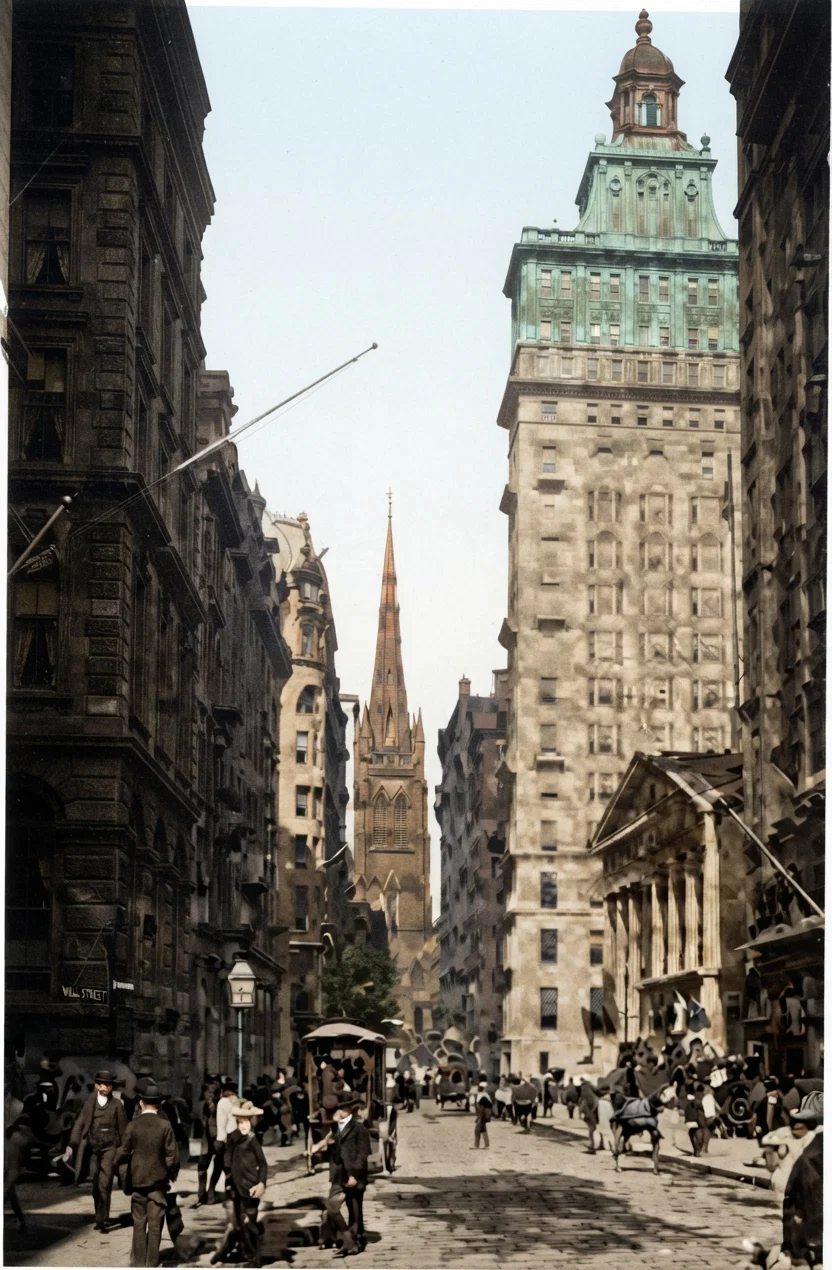
Wall Street, the great money center of America, and one of the greatest, if not the greatest, in the world. Mr. Thomas Lawson, and others in official life, as well as great papers, are demanding reform in its gambling methods. There will first have to be a reform in its kings and princes.
A short time ago it seemed that a few years bade fair that one man would control practically all the transportation interests of the nation; but Mr. E. H. Harriman died, and it was thought that there would be no one to follow him who could master and control the great railway lines of the nation; but there is one in power now who seems to possess not simply the power of Harriman and Ryan and others, but who has combined, with himself as a center, vastly more than has ever been controlled or managed by any one individual before in all the history of this world. By various purchases, by combining corporations, by community interest, there is now a power, at the head of which is J. P. Morgan, which embraces banking, trust, insurance, industrial, and transportation companies, and controls or influences capital amounting to more than $6,000,000,000. The New York "World" gives what is considered a conservative estimate of the companies controlled by this one man, and in this estimate it does not include the four Morgan banking-houses of New York, London, Paris, and Philadelphia. The companies and trusts controlled by this combination are as follows:

Life Insurance Companies

ASSETS
Equitable Life Assurance Society $462,000,000
New York Life Insurance Company 557,000,000
$1,019,000,000

Banks and Trust Companies

RESOURCES
First National Bank $139,600,000
National Bank of Commerce 226,500,000
Mercantile Trust Company 68,475,000
Equitable Trust Company 63,800,000
Guaranty Trust Company 88,960,000
Astor Trust Company 15,200,000
Bankers' Trust Company 53,900,000
Chase National Bank 107,280,000
Mechanics' National Bank 51,360,000
National Copper Bank 40,300,000
Liberty National Bank 24,700,000
Fifth Avenue Trust Company 19,100,000
Standard Trust Company 18,450,000
$917,625,000

Industrials

STOCKS BONDS
U. S. Steel Corporation $868,809,000 $593,231,000
Haggin-Morgan Peruvian Copper Mines 25,000,000
United Dry Goods Co. 51,000,000
International Harvester Co. 120,000,000
$1,064,809,000 $593,231,000
1,064,809,000
$1,658,040,000

Railroad and Transportation Companies

STOCKS BONDS
Southern Railway $179,900,000 $228,701,000
International Mercantile Marine 120,000,000 72,684,000
Northern Pacific 247,905,000 282,499,000
Great Northern 275,129,000 97,955,000
Reading Co. 140,000,000 106,654,000
Central R. R. of N. J. 27,436,000 52,851,000
Lehigh Valley R. R. 40,441,000 81,639,000
N. Y., N. H., and H. 100,000,000 56,849,000
Boston and Maine 31,394,000 30,373,000
Hocking Valley Ry. 26,000,000 19,912,000
Chi. G. W. R. R. 57,015,000 28,000,000
N. Y., Ont., and W. R. R. 58,113,000 27,173,000
Hudson and Manhattan R. R. 50,000,000 57,920,000
$1,353,333,000 $1,143,210,000
1,353,333,000
$2,496,543,000

Miscellaneous Companies

Anglo-American Nitrate Syndicate in Chili $12,500,000
North American Company 29,779,000
$42,279,000

Recapitulation

Railroads, etc. $2,496,534,000
Industrials 1,658,040,000
Banks, etc. 917,625,000
Life Insurance Companies 1,019,000,000
Miscellaneous Companies 42,279,000
Grand total $6,133,478,000
The New York "World" points out just what the power of such a combination of capital may exercise. It can dictate interest rate and so make money cheap or dear. "Controlling huge resources, it can, if it will, interfere with the natural course of markets and of distribution, manipulate bank reserves, establish confidence or destroy it, encourage new enterprises or blast them, and by vicious assaults upon credit create panic among the people and menace the Government itself. Good times or hard times, prosperity or ruin, inflation or contraction, for many people, all lie in the hollow of its plutocratic hand. Where shall this 'Morganizing end?'"
A striking cartoon represents Mr. Morgan as sitting in a great chair of state and holding the lines in his hands of all these various companies, controlling them as a master driver controls his multiple spans of chariot horses.
Of course the state, the nation, ought to be able to control in some way the use and abuse and distribution of wealth. It seems not to be able to do it, however. Just as long as men's minds are corrupt, such vast amount of wealth controls not only all these various industries, but controls men; buys legislators, corrupts judges, influences juries, and so almost wholly escapes punishment. In fact, where such great trusts or syndicates control so much, authorities themselves are afraid to meet the issue. They do not know what great calamities may follow. It were well for the statesmen and people to read not only the prophecy of such great power, but to read the end of it as well. Such concentration of power must arouse envy and hence enmity among the poor, especially among those who do not trust in God. The man who truly trusts in God has riches beyond all the wealth of Morgan and Rockefeller; riches which he knows if faithful will surely come to him after this brief span of life is over, and the King shall come; but in those whose hopes are set in this world, there is aroused everlasting enmity against the possessor of such power and wealth, and so the prophet declares:
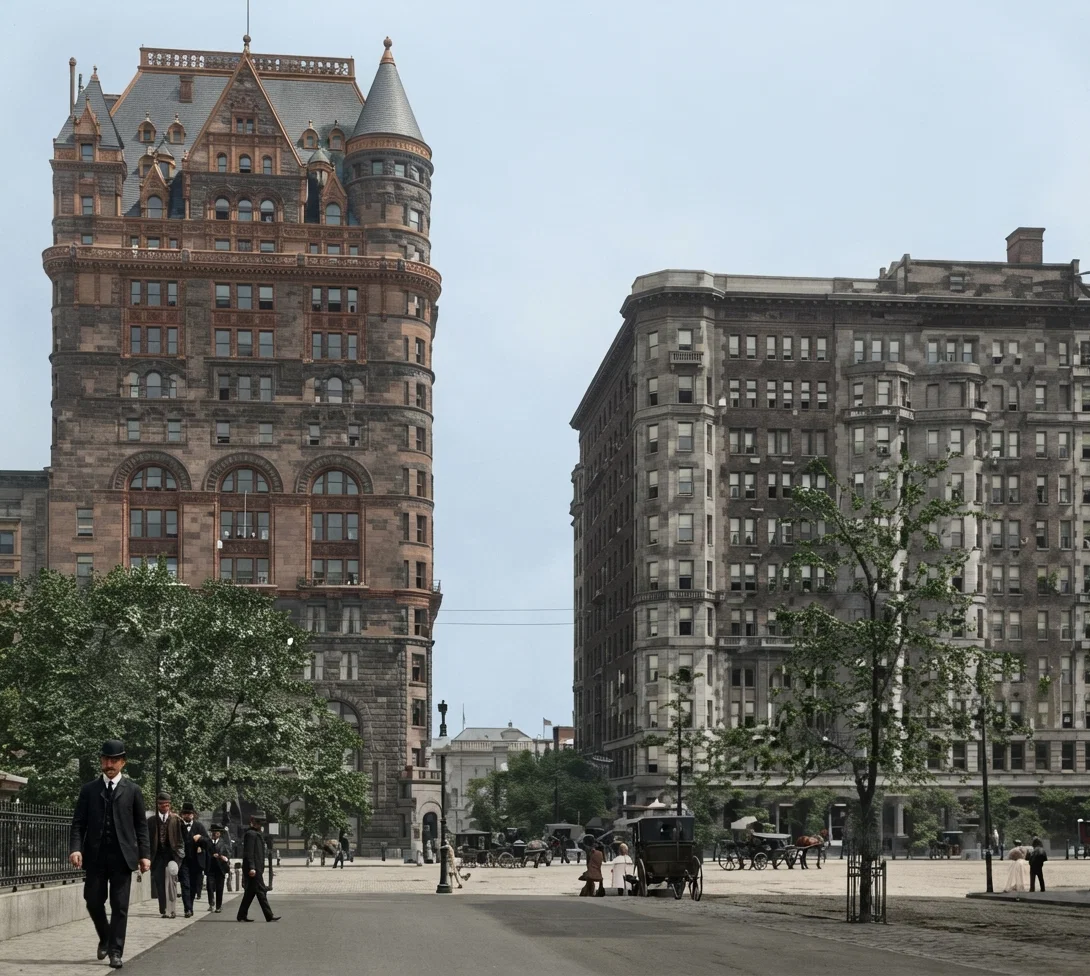
A Plaza in Central New York in one of the great wealthy districts
"Shall not all these take up a parable against him, and a taunting proverb against him, and say, Wo to him that increaseth that which is not his! how long? and that ladeth himself with pledges! Shall they not rise up suddenly that shall bite thee, and awake that shall vex thee, and thou shalt be for booty unto them? Because thou hast plundered many nations, all the remnant of the peoples shall plunder thee, because of men's blood, and for the violence done to the land, to the city and to all that dwell therein. Wo to him that getteth an evil gain for his house, that he may set his nest on high, that he may be delivered from the hand of evil!' Hab. 2:6-9.
And there is much more that might be quoted not alone from this prophet, but from Isaiah, from Amos, and from the New Testament prophecy, so frequently referred to, in James 5:1-8. We are not desiring the wo; we are not wishing or pleading for the revolution. We would do everything in our power
to stay its red hand. We believe that the worst government on the face of the earth is better than anarchy; but just as surely as such unbalanced conditions continue, just as long as worthy men who love wife and children see the unholy inequality which exists, the seeds of revolution will be sown, and anarchy and bloodshed are bound sooner or later to follow. It is not we who are saying it; it is the prophets of God in both the Old and the New Testament. It would be well if these wealthy men who profess the religion of Christ would listen to the words of His apostle, 'Go to now, ye rich men, weep and howl for your miseries that shall come upon you.' And it would be well with them if they would take the counsel of another apostle that they should with their money do good, be ready to distribute, liberal in giving, anxious and interested in ameliorating the condition of those who are poorer; so could they lay up themselves wealth for the good time to come. In God's plan what a man gives is saved, and what a man keeps and gathers to himself is lost. The gold of character is better than all the gain of greed, and the conscience that is void of offense toward God and man is better than all the palaces and bank-notes that can be piled up. God does not condemn men for having ability to make money. It is He who gives it, but He would have them use all of it as a trust committed to them and for which they will be held responsible in the great day.
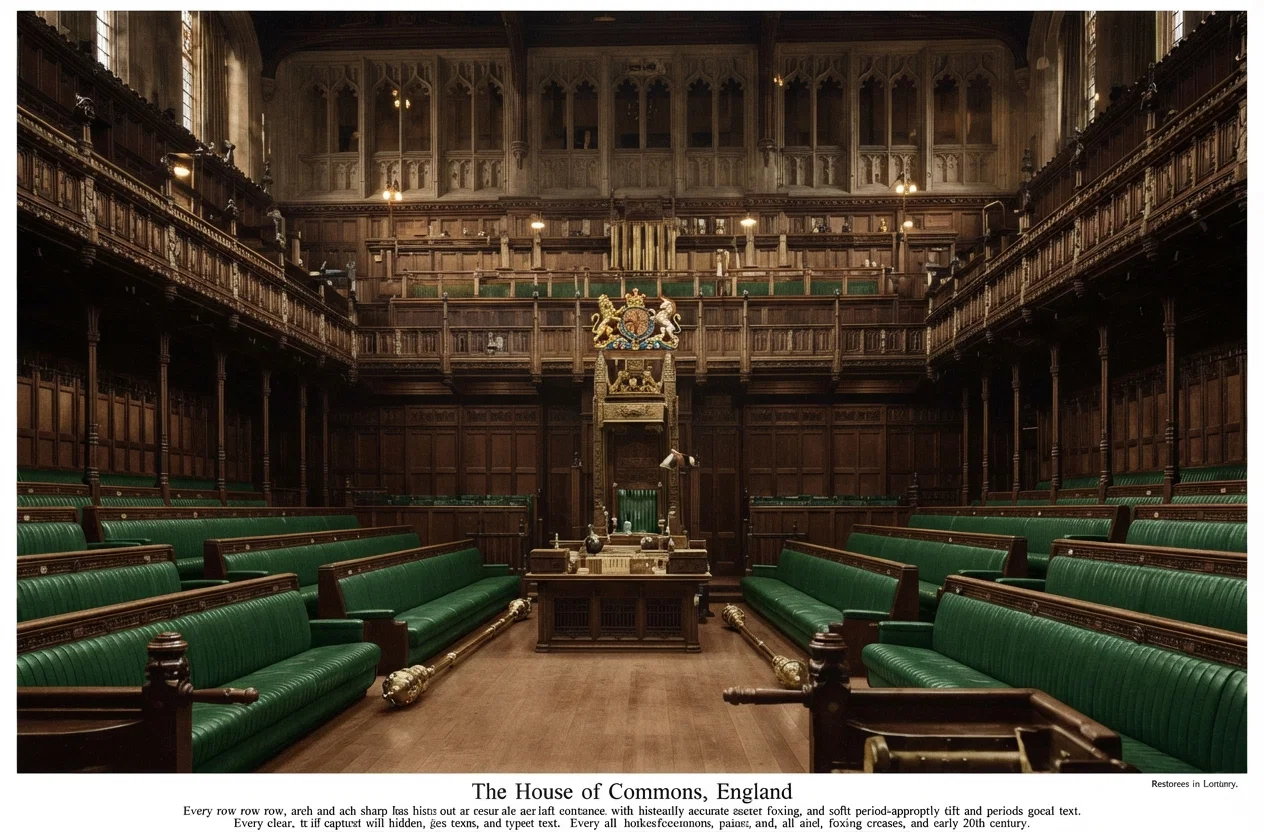
The House of Commons, England
This vast amount of wealth piled up 'in the last days' is another evidence that we are nearing the end, that Christ's coming is at hand.

Canals on Mars

This journal has from time to time during years past given the opinion of some of the best astronomers that there was no such thing as canals on Mars or any artificial waterways whatsoever; and yet we see every once in a while in the sensational daily press some marvelous article about the canals on Mars, and the new canals even that are being dug, and we are told with wonderful detail how Mars could be signaled by the people of the earth and so inter-planetary communication set up. This of course is all nonsense to the best astronomers.
Mr. Antoniadi, at the special request of the Astro-Physical Observatory of Paris, has just completed a study of the planet Mars with the great equatorial telescope at Meudon, the most powerful in the Old World. We gather this from the "Literary Digest" of February 12; and he declares under good seeing, in observations which have been kept up for months, there was no trace of a geometrical network of canals. And he refers to what Professor Frost of the Yerkes Observatory declares, that the great telescope of the Chicago University was "too powerful for canals." Professor Barnard is also quoted that in using the large telescopes of Lick and Yerkes he never saw any spider's webs on the planet. We are told however that Mr. Schiaparelli, who first suggested the idea of canals, had a much inferior telescope, and that the dark spots on Mars in unsatisfactory definition seem to be lines and streaks. And the conclusion of Mr. Antoniadi is as follows:
"The impossibility of the Martian canal network was demonstrated theoretically by Mr. Maunder, of the Royal Observatory, Greenwich; by Dr. Cerulli, president of the Societa Astronomica Italiana; and by the great American astronomer, the late Professor Newcomb. The results of 1909 now establish that the would-be existence of artificial canals on Mars is further disproved by the otherwise weighty evidence of observation."
Parallel to the Martian are the many other theories of scientists which seek to set aside the Word of God.

Away from the Bible

We are glad to note the orthodox stand which some of the Baptist journals are taking regarding the present drift in theological matters. Some weeks ago the Baptist "Examiner" of New York, according to "Current Literature," said:
"There is unmistakable evidence of a trend toward a denial of the divinity of our Lord; toward the doctrine of universal salvation, and repudiation of the atonement of the cross, and a conception of the kingdom of God as a society not of men and women redeemed by the blood of Christ, but of all respectable, well-behaved people, whether they believe on the Lord Jesus Christ or not. Such ideas as these are being proclaimed from our pulpits and professorial chairs with constantly increasing boldness, and they are having their effect. Our own is not the only denomination infected by them. They are in the air, and are regarded by many as necessary expression of the spirit of the age. Multitudes of Baptists are mourning to-day over the assaults of their own leaders upon the integrity of the Bible, to which they are compelled to listen, and over the attempts to subvert the ordinances of Christ in the name of the pseudo liberality. Will they always be content to mourn? The orthodox Congregationalists were once compelled to withdraw from associating with aggressive Unitarianism of the time. It may, alas, it may be that orthodox Baptists will find themselves reluctantly forced to take a similar step."
This editorial of the "Examiner" has aroused a perfect storm of protest. Among others Dr. Aked, Mr. Rockefeller's pastor, whose liberal views are quite well known, demanded proof of the "Examiner's" charges. Speaking of the "Examiner's" remark on the atonement, he calls it "your theory of the atonement." He further says: "There may be such a trend. For all I know, I may be in it myself, for I have not fully learned what your theory of the atonement is." To this, the "Examiner" replies:
"As to a theory of the atonement, we have none. We simply and in full faith accept the clear, easily understood declarations of the New Testament, and humbly make them our creed. All the shuffling argumentation in the world can not change their plain meaning. The trouble has been and is that men construct theories instead of believing that which is written. Now it would overtax the ingenuity of a Philadelphia lawyer to reconcile some theories we have heard from the pulpit and read in books, with the plain statement of the New Testament. It is not a question between my 'doxy' and your 'doxy,' but between any 'doxy' and the inspired declarations."
And the "Examiner" speaks truly. Men are setting up their own standards, own theories, own devices, own dreams, against the Word of the living God. Very a propos are the words of the prophet: "The prophet that hath a dream, let him tell a dream; and he that hath My Word, let him speak My Word faithfully. What is the straw to the wheat? saith Jehovah."

Shiloh: the Man of Sorrows

Copyright, 1910, Pacific Press Publishing Association
By Mrs. L. D. Avery-Stuttle

Chapter II—Uncertainty and Faith

"The magi! the magi! did they also see and worship Him? Ah, Shiloh, the Messiah! why may not mine eyes behold Thee also,—the Anointed of Jehovah—the Desire of Israel?"
Great tears rolled down the thin cheeks of the old man, and splashed over the silvery beard, as he paused to listen to the reply of Sylvanus:
"Yes, my father, the stranger assured me that he and all his company both saw and worshiped. They also presented Him gifts, royal gifts,—the gold, the frankincense, and the myrrh of the richest princes and the wisest men of Persia,—for even such they were."
Again the patriarch interrupted the narrator:
"Hold; doth not Isaiah the prophet say even thus: 'And the Gentiles shall come to thy light, and kings to the brightness of thy rising'? And again, David saith of the Messiah, 'The kings of Arabia and Seba shall bring Thee gifts.'"
"True," replied Sylvanus. "But I asked them why they journeyed southward toward Hebron, and returned not northward toward Jerusalem; why they chose not the way by which they came, even as Herod bade them. As I asked this question, my attention was directed toward another of the company. He was still mounted upon his beast—a gigantic camel covered with gorgeous trappings, which glinted and shone as the slanting rays of the setting sun fell upon them. The man's countenance was comely, but his cheek was swarthy, and his eye like the eagle's. His beard was black and glossy, and his locks fell unbound upon the rich mantle that covered his shoulders.
"'Why should we journey back to Jerusalem?' he asked. 'Shall Herod, the crafty Edomite, fall upon us that we die? We have seen and have worshiped at the feet of Shiloh. Now we do hasten into our own country, but not by way of Jerusalem.
'Listen, stranger; last night I dreamed.'
'What sawest thou?' I asked.
The countenance of the man grew sad, as he turned his face over his shoulder toward the north, and waving his jeweled hand in the direction of Jerusalem, he made answer:

The Vision of the Magi

"'I slept, and behold, the bright star that had led us O'er desert and mountain, o'er valley and fen, That beckoned us on toward the Shiloh of Jacob, Appeared in the east, and was leading again.
'But ah, it led not to the palace of Herod— The palace so fair of the Edomite king; But southward it sped toward the mountains of Judah, While high in the heavens loud voices did ring: "Beware ye of Herod—of Herod the king!" While over the palace of Herod so fair, A sword red as crimson hung high in the air.'"
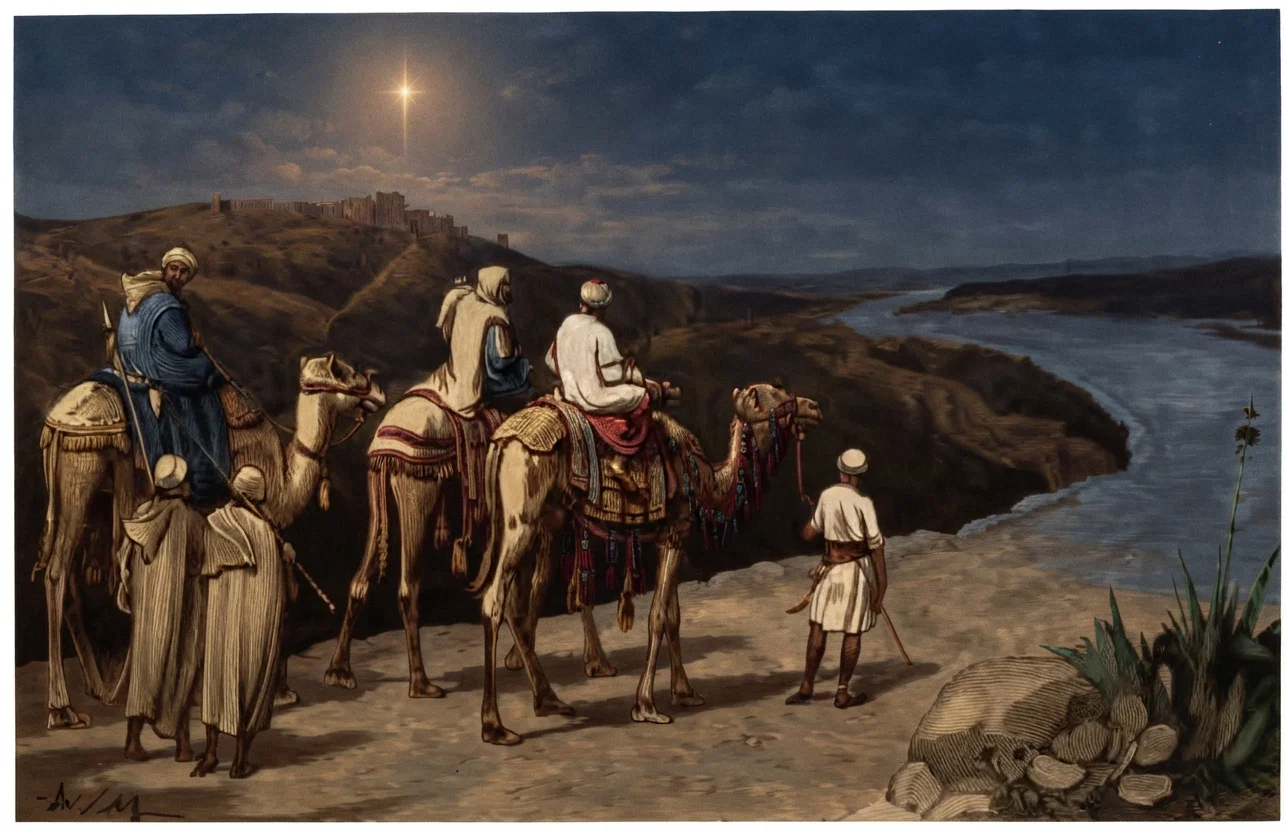
The Magi Following the Star
"I can not wonder that ye return not to Herod!" I exclaimed; "he is an old man and full of days, but age hath not taught him wisdom, nor hath time softened his tyrant heart. Much I fear it would have gone ill with you had ye returned to Jerusalem."
"Then," continued Sylvanus, "I wished them Godspeed, and they hastened on their journey."
"But art thou not fearful for their safety, my husband?" queried Esther, in a tone of anxiety.
"Yes," interrupted Bar-jona, "did they not fear that since Jerusalem lieth so near to Bethlehem, the tyrant might learn of their departure, through spies mayhap, and despatch a centurion with his band to overtake and capture them?"
Before Sylvanus could reply, the trembling voice of Eliab was heard:
"My son, hast thou forgotten that the God of Abraham, Isaac, and Jacob lives? Dost thou not remember the godly Daniel and his companions?"
"In very truth," declared Sylvanus, "the men appeared neither fearful nor in unseemly haste; but the camel maketh good speed, you know, and they must soon be out of reach among the mountains of Moab. But verily I fear much for the safety of the holy Babe."
"I trust they may have found a safe retreat by this time," cried Esther, clasping her babe Matthias closer in her arms.
"My daughter, my daughter!" protested Eliab, "where is thy faith? Doth the Keeper of Israel slumber? Hath sleep closed His eyelids? Is His hand shortened that it can not save?"
"Nay, Father Eliab," replied Esther; "verily I believe in the God of Israel; and also Sylvanus is a man of faith, but he knoweth the temper of the king."
"Yes; his pathway to the throne was red with blood. Alas that it must be said that he is of the faith of Israel! I tell thee, Father Eliab, the king will brook no rivalry. Already much I fear he meditateth the murder of the infant King, and unless protected by Jehovah—"
"It shall not be!" interrupted the young guest, Bar-jona, impulsively. "Shall we not seek the Babe and His parents on the morrow, and speak unto them words of warning? Thinkest thou the family are yet in Bethlehem?"
"That I can not tell; I only know that when the strangers from the East visited them, they were no longer in the place where my shepherd companions and I visited them and bent low to worship. Now they abide in an house, and here the strangers gave the gifts. But I have heard that their home is in Nazareth, and that the father is by trade a carpenter. They may have returned home in peace."
"Thinkest thou not," ventured Esther, "that they would at least remain either at Bethlehem or at Jerusalem, until the Babe might be presented at the holy temple according to the law? I will venture that if they be gone, it is but lately."
"I tell thee," again declared Eliab, "I tell thee that the Lord Jehovah will preserve His Anointed. I know not how; I only know the time is come, according to the prophets, when the long-promised Shiloh must appear. 'Behold, a virgin shall conceive, and bear a Son, and they shall call His name Immanuel.' Now, thinkest thou, Sylvanus," continued the old man, his dim eyes shining, "thinkest thou that God will not preserve Him who must bruise the head of the serpent?"
"True, father; but thou dost forget that the Almighty sent the daughter of King Pharaoh to preserve the life of the infant Moses. Who knoweth but it be His will that we seek at least to warn the parents of the Babe, that Herod's soldiers smite them not! I tell thee, father, I like not the dream of the magi. It bodes no good: "'Beware ye of Herod—of Herod the king!'" "I verily believe the tyrant will be angry at the departure of the strangers, who have dared to disobey his command; that he will pursue after them, and failing to find them—ah, I dare not think or say what he might do. I only know King Herod stoppeth not for youth or age; he respecteth not the person of any who stand in his pathway."
And so it was agreed that on the morrow the carpenter of Nazareth must be warned.

The Beautiful

THERE is a fine passage from the pen of John Ruskin, in which he rebukes a certain section of the men of his time for their indifference to the beautiful and their neglect of its elevating power. “People speak,” he says, “in this working age, as if houses, and lands, and food, and raiment, were alone useful; and as if sight, thought, and admiration, were all profitless. They would turn, if they had their way, themselves and their race into vegetables; men who think, as far as such can be said to think, that the meat is more than life, and the raiment than the body; who look to the earth as a stable, and to its fruit as fodder; vine-dressers and husbandmen, who love the corn they grind, and the grapes they crush, better than the gardens of the angels upon the slopes of Eden; hewers of wood and drawers of water, who think that the wood they hew and the water they draw are better than the vine forests that cover the mountains like the shadow of God, and than the great rivers that move like His eternity.” To such is awarded the curse of Nebuchadnezzar, whose crown of kingship was taken from his brow, while he herded with the beasts who are blind to the beautiful and unstirred by its divine appeal.—Great Thoughts.

SEWING MACHINES AND PIANOS

I am agent for the Singer and Wheeler & Wilson machines and also a very fine, high grade piano. I am selling to our people at a great reduction. Will deliver any place in the United States. If interested, write me.
S. H. Colvin, Turlock, Cal.

California Medical Missionary and Benevolent Association

Annual Meeting

THE thirteenth annual meeting of the California Medical Missionary and Benevolent Association, for the purpose of electing four or more members of the Board of Directors, and transacting any other business that may properly come before the meeting, will be held at Sanitarium, Napa County, Cal., on Wednesday, March 9, 1910, at 12 o'clock M.
L. M. BOWEN, President. H. E. RANDALL, Secretary.

Help Wanted

We are desirous of securing the services of ten graduated or trained nurses at once. Apply St. Helena Sanitarium, Sanitarium, Cal.

Good Homes for Sale

Two good farms for sale in a rich section of the Northwest adjoining the new Cedar Vale Academy, conducted under the auspices of the Upper Columbia Conference of the Seventh-day Adventists. May be exchanged for city or suburban property in California. Prices and terms reasonable. For further information, address J. W. Shields, Viola, Idaho.

Prsvryprfctmnvrkpthsprcptstn

To show the importance of the vowel “e” in all writings, one needs only to refer to the above heading, an inscription over the Decalogue in a country church. It remained unread for 200 years. Insert the letter “e” in the proper places, and it will read, “Persevere, ye perfect men; ever keep these precepts ten.”—Anon.

Notice

THE next class in the St. Helena Sanitarium and Hospital Training School for medical missionary nurses will be organized Monday, April 4, 1910.
Owing to the large number and great variety of cases that flock to this institution for relief, and the wide experience thus offered the students both in surgical and general hospital nursing, the course is especially strong from a practical missionary standpoint. In addition to the opportunities for missionary work at the sanitarium, the San Francisco Dispensary, which the institution has taken over, affords training in city mission work. The institution has also undertaken to open up mission work in China the present year, thus giving those who desire, a definite foreign mission field for which to prepare and upon which to enter when their course is completed.
Twenty-five consecrated young men and women, whose desire it is to enter the work for the sake of fallen humanity and not for profit, are wanted to join this class.
There are also classes in Bible, history, and music for the regular workers.
Send for the training school catalog by addressing: Dr. H. F. Rand, superintendent, or Mrs. S. J. Whitney, secretary, Sanitarium, Napa County, Cal.

LIBERTY

THE OFFICIAL ORGAN OF THE RELIGIOUS LIBERTY BUREAU

AN illustrated, 48-page, quarterly magazine, published as an exponent and advocate of true religious liberty; defending Christianity and the rights of conscience; upholding the Bible as the infallible word of God; recognizing the church and state as ordained of Heaven for specific and distinct purposes, but vigorously protesting against the alliance of the church with the state in the attempt to advance religion and to promote the state. Price 25 cents per year. Liberal terms to agents.
Address, LIBERTY, Takoma Park, D. C.

Life and Health

A PRACTICAL health journal, published with a view of meeting hygienic needs in every home; teaching how to care for the health and how to preserve life; prescribing simple home treatments to assist nature in throwing off diseases rather than adding more poison by using drugs or unnatural stimulants as remedies: teaching how to avoid disease as far as possible, how to manage in the home when sickness does come, and how to combat the disease by simple remedies which nature provides.
Send for sample copy and special rates to agents. Price 10 cents per copy or $1.00 per year.
Address, LIFE & HEALTH, Takoma Park, D.C.

Science in the Bible

"Science in the Bible," the A B C of teaching the Bible in Nature and Nature in the Bible. In this little book the Scripture references are alphabetically arranged so that the student of nature may readily find any text bearing on true science as founded in the Word of God. 113 pages. Cloth bound. Price, post-paid, 30 cents. Address this office.

3 WEEKS FREE

The best children’s paper,—OUR LITTLE FRIEND,—Three Weeks Absolutely Free

All you pay is the postage on your letter. "My, but you are getting generous," you say. Perhaps so. But after all it is a matter of business with us. Listen while we explain. We really think OUR LITTLE FRIEND is the best children’s paper in the world. Fact is we are so sure you will think so too, after reading a few copies, that we willingly risk losing on the proposition. ¶ Sixty cents for a paper of eight pages every week for a whole year, isn’t much. The price will be long forgotten while the memory of happy hours spent in reading the paper lingers. ¶ The Bible, moral, bird, animal, and nature stories and lessons make better boys and girls. ¶ The above offer is open until April 1 only. In ordering specify “3 weeks free” offer.

OUR LITTLE FRIEND

MOUNTAIN VIEW CALIFORNIA

Wisdom from the World

In speaking of the coming fight between two great pugilists, Jeffries and Johnson, in which the white race will be pitted against the black, and in which sporting men have so great interest just now, the New York "Journal" predicts that Jeffries will be defeated, and gives the reason why:
"Quantities of whisky, every drop of it poison, every drop of it making the brain less efficient than it was, have been absorbed by that huge fighter. It is very likely that whisky will tell its story in the ring. The man may appear to be in perfect condition, he may skip the rope five hundred times, which all admire; he may strike the bag with terrific force, but that means nothing in battle. The whisky does not keep him from skipping the rope, it does not keep him from running five miles if he stops drinking for three months and trains hard. Whisky slows up the whole system; it makes the pause between brain and nerve. That pause defeated Sullivan. It will be very interesting to see whether or not it defeats Jeffries."
Another paragraph well says:
"If human beings were civilized, if they had real ambition instead of the ambition of the fist, they would care nothing at all about the result of this fight. If they tolerated it in the least, it would be as an interesting test in endurance and quickness. They would insist upon the utmost fairness for the black man. Those believing in the superiority of the white race, would hope for the white man's defeat as a sign of real superiority. If you begin at the top of animal life on this planet, you will find that the lower down you get the better the fighting quality in proportion to size. Any brutal, ignorant, low-browed individual of average strength, could probably defeat ninety per cent of all the really great men that have ever lived."
All of which is true. Christians should deplore it. Many states make laws against it, while the same states permit the constant sale of whisky and all its allied poisons that embrutalize men far more than prize-fights even. It is a pitiable thing that men should be weighed or measured by mere brute force or mere physical skill, neither of which ever brings any real happiness or elevation to humanity.

Religious Progress

The Christian Advocate of January 27, 1910, contains a table giving the statistics of the churches in 1909 in the United States, compiled by Dr. H. K. Carroll. The gains of 1909 amount to 4,023 ministers, 4,726 churches, and 791,713 communicants. One of the causes of increase is the bringing in of new bodies discovered by the census. In some bodies there has been notable decrease. The Catholic figures are based on the official estimate of Catholic population; 15 per cent being deducted for children not yet admitted to their first communion. Estimates are not considered accurate.
The aggregate value of church property of all denominations is $1,257,575,867. The increase in 16 years is 85 per cent. In sixteen years the Utah branch of Mormons has increased 281 ministers, 258 organizations, 71,444 members. The total number of Roman Catholics is given as 12,354,596; of Methodists, 3,159,913; Baptists, South, 2,139,080; of Baptists colored, 1,874,261. In denominational rank, counting simply the various families of churches, Catholics stand first with twelve million (we give round numbers only); Methodists, with six million; Baptists, five million; Lutherans, two million; Presbyterians, nearly two million; Episcopalians, 900,000; Reformed, 400,000; Latter-day Saints, 400,000; United Brethren, 300,000; Jews, 143,000; Dunkard Brethren, 122,000; Friends, 119,000; Adventists, 91,000. More than two thirds of the Adventist body as counted are Seventh-day Adventists.
Continue reading: Eating to Live