The Youth’s Instructor, Vol. 64, No. 10.

Cigarette Smoking Harms Boys and Their Health
Earlier text: Leech Killers

The Will Wanting

ONE of the editors of the Christian Endeavor World recently said, “I was speaking with a friend who indulges in the tobacco habit — a man of influence whose example I knew was leading boys in the community to smoke. For a while he defended his practice, and then rather weakly, said, ‘You may be right; but even if you are, I would not give up smoking, for I don’t want to give it up.’”
This is the secret of the widespread tobacco habit, in face of the irrefutable testimony of men of science, medicine, and morals that it is a harmful practice. All sense of personal responsibility as to one’s example is subordinated to one’s disinclination to relinquish the habit. Surely this is not a high standard of action. There’s no heroism, no true manhood, in it.
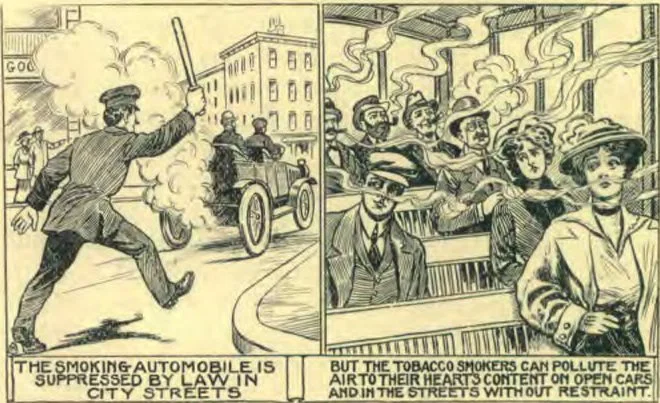
THE SMOKING AUTOMOBILE IS
SUPPRESSED BY LAW IN
CITY STREETS
BUT THE TOBACCO SMOKERS CAN POLLUTE THE
AIR TO THEIR HEARTS' CONTENT ON OPEN CARS
AND IN THE STREETS WITHOUT RESTRAINT.
THE SMOKING AUTOMOBILE IS SUPPRESSED BY LAW IN CITY STREETS BUT THE TOBACCO SMOKERS CAN POLLUTE THE AIR TO THEIR HEARTS' CONTENT ON OPEN CARS AND IN THE STREETS WITHOUT RESTRAINT.
Happily there are some men made of better material. For example, at one of the conferences on prison work the evil effect of the cigarette habit was pointed out as one of the open doors to drink and crime. An Endeavorer pulled a box of cigarettes from his pocket, and threw it out of the window. “God helping me,” he said, “I will never smoke another cigarette.”

The Truth About Smoking

Some years ago I was spending a few days in a certain city, when I received an invitation to dine with a small but select club. The members of this club were all brainy men, and the excellent menu served was rendered more enjoyable by “the feast of reason and the flow of soul.” When I saw that the gentlemen were about to light their cigars, I rose and said, “Gentlemen, will you kindly permit me to withdraw? The odor of tobacco is obnoxious to me.” “No! no! no!” clamored the company. “Don’t you really smoke? You don’t know what paradise is. How is it you never learned to smoke—such a traveler as you are? We are curious to know. Cannot you tell us how it came about?” “Certainly,” I replied, “if you will agree not to light your cigars until I have left the room.” The promise being given, I proceeded to relate the following story:—
We didn't smoke.
We didn't smoke.
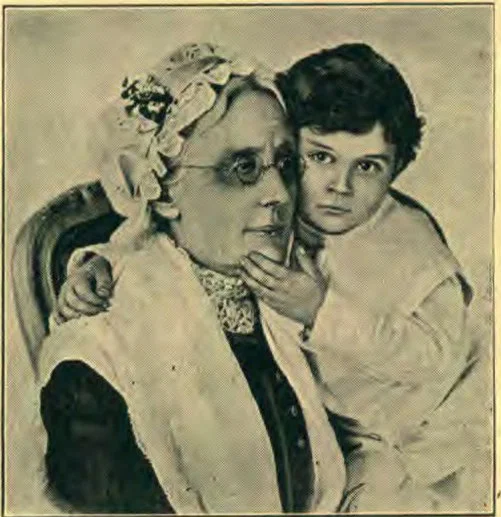
“When I was a boy, I thought I had the dearest grandmother that ever lived. She was very fond of me, and I delighted in going to visit her; but I could not endure my grandfather. Unless he was eating or sleeping, he always had a vile-smelling pipe in his mouth. My grandmother once confided to me that it was the one great trial of her life that she had to endure such a detestable odor. She said she did not wish my father to learn to smoke, but grandfather took him into the barn and made him smoke.”
“When I was between sixteen and seventeen, I began to realize what a fine-looking man my father was. He was tall and perfectly proportioned; his features were handsome, and he had a most pleasing smile. He used to say he liked to see a fine-looking man smoking a good cigar, and he usually had a cigar between his lips.”
“Shortly after this, he developed cancer of the tongue. I was almost his only nurse during the months of excruciating suffering which followed; and when he had his tongue cut out, I believe that I suffered fully as much as he did. After his tortures were over, and his body had been put under the sod, I said over and over to myself, ‘What fools men are! what utter idiots! to deliberately choose to acquire a habit which overmasters them, and which brings such terrible consequences.’”
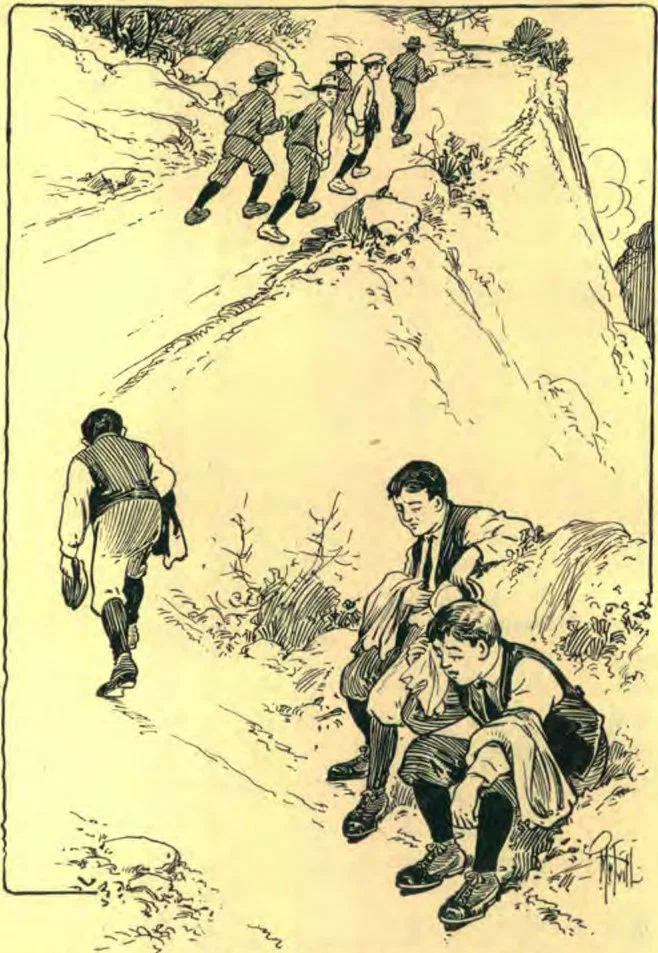
“The boys who had been smoking were playing out.”
Then rising I said, “Gentlemen, I wish to thank you for a pleasant evening, and I trust you will pardon me if I leave you now.”
Man is the most wonderful creature in the universe. By aspiration he may rise to heights illimitable, and become a master—a creator of conditions. By transgressing or ignoring certain laws, he will sink into the lowest depths of degradation. The choice is yours. Which will you choose for yourself and for your children?
HAMILTON A. PHILLIPS.

Beware of the Little Devils

“MOTHER, if I’m not naughty, if I am really a very good boy, will God let me have just one little devil to play with when I go to heaven?” This is the way many boys feel about smoking. They have been told that it is harmful, but they have a strong desire to be allowed just this one little devil to play with. They forget that the little devil will grow into a larger one that may completely wreck the life. Beware, boys, of even the little devils.

Cigarettes “Got” Them

“I TOLD you cigarettes would get you,” was the twitting remark that the boys called back to the fellows who could not stand the pace and were dropping back as they climbed the hill on a recent hike in Shenandoah County, Virginia.
The group had started on a hike, and to learn their habits the leader had given them free rein. Several of the boys brought out cigarettes, and showed they were forming a habit, unknown to the most of their parents, which would surely mar their manhood. The leader let them smoke, only reminding them that they must have forgotten the talk the doctor had given them on the effects of alcohol and tobacco on the body. Finally the group arrived at the hill, where their wind and endurance would be tested. When about halfway up, some of the boys began to complain about the pace and to drop back. It was noticed and remarked that the boys who had been smoking were playing out. But few words from their leader were necessary to drive home the object lesson, which seemed to have more effect than the doctor’s lecture.— Virginia Men and Boys.

Fathers and Teachers Must Lead Boys by Example

REFORM must be made by fathers and teachers who by their example say to boys, Follow me.—D. H. Kress, M. D.

What Men Have Said

Ex-President Andrew D. White, of Cornell University
“I NEVER knew a student to smoke cigarettes who did not disappoint expectations, or, to use our expressive vernacular, ‘kinder peter out.’ I have watched this class of men for thirty years, and cannot recall an exception to this rule. Cigarette smoking seems not only to weaken the young man’s body, but to undermine his will and to weaken his ambition.”
Master of the German Air Navy
“Zeppelins have neither bar, kitchen, pantry, nor dining room. Zeppelins are teetotalers. We have got to have clear heads up there, and cool, steady nerves, nerves which spirits don’t necessarily furnish. And we can’t while away our time between firing bombs—for we call it firing, too—and dodging shrapnel, by smoking. No drinks and no smokes for the Zeppelin.”
Vice President Parker, of the Chicago & Rock Island Railroad
“In my judgment it is impossible for a cigarette smoker to make a good railroad man. As a rule, smokers are dull and half asleep most of the time. These are not the kind of man the Rock Island wants to operate its trains and its great system, which is daily responsible for the lives of thousands of people.”
The Geo. W. Alden Company, Rangers and Refrigerators, Brockton, Massachusetts
“We would not employ a man who smoked cigarettes if we knew he smoked them. Our reason is that with the prevailing knowledge as to the injury to the mind, body, and morals by the cigarette habit, a man who will keep on using them has not enough self-will to meet our standards, nor enough regard for personal appearance. Our observation of those who use cigarettes has led us to believe that the use of the same is one of the most degenerating of habits, and does more to weaken one’s regard for good morals than any other habit.”
“One insurance company has estimated that the use of tobacco shortens life on an average of eight years.”
Dr. O. M. Stone, of Boston
“The idea that tobacco prevents disease is an error. A tobacco user’s chances of recovery from malignant disease are lessened fifty per cent.”
Capt. G. B. Pettingill, many years commander of vessels between Boston and Cuba, and Mexico and South America
“Very few tobacco users recover from yellow fever. I once lost half my crew with it in Havana. Every man who died used tobacco, and every one who lived did not use it.”
Dr. Harris, of the New York City Dispensary, where more diseases are treated than in any other place in America
“It is scarcely possible to cure a syphilitic sore or unite a fractured bone in a devoted smoker.”
P. S. Wales, Surgeon-General United States Navy
“After disastrous results from permitting the use of tobacco by the cadets at West Point, in 1881 the authorities prohibited smoking absolutely.” Dr. Larned later wrote of the results of this order: “My conviction of the unmingled benefits accruing to the graduates of the military academy by the prohibition of tobacco, is absolute. Unquestionably the most important matter in the health history of the students at this academy is that relating to the use of tobacco. I have urged upon the superintendent that the future health and usefulness of the lads educated at this school required the absolute interdiction of tobacco. In this opinion I have been sustained, not only by all my colleagues, but by all sanitarians in military and civic life whose views I have been able to learn.”
Dr. Hitchcock, of Amherst College
“In separating the smokers from the nonsmokers, it appears that in the item of weight the nonsmokers have increased 24 per cent more than the smokers; in growth in height they have surpassed them 37 per cent, and in chest girth 42 per cent. In lung capacity there is a difference of 8.36 cubic inches (this is about 75 per cent) in favor of the nonsmokers.”
Dr. T. H. Marble, of Clarksville, Tennessee
“The cause of cigarette smoking is that boys are very fond of imitating their elders. Smoking in public places ought to be discouraged. Every man, when he smokes in public, ought to think that he is encouraging some boy to smoke.”
The Noted Dr. John Lizars
“During the prevalence of cholera, I have had repeated opportunities of observing that individuals addicted to the use of tobacco are more disposed to attacks of that disease, and generally in its most malignant and fatal form.”
Ex-President Webster Merrifield, of the University of North Dakota
“The use of tobacco in all forms is strictly forbidden at the State University of North Dakota, not only out of deference to public opinion in this State, but as the result of long observation of the evil effects of tobacco upon immature students.”

Automobile Factory Closes Its Doors to the “Little White Slaver”
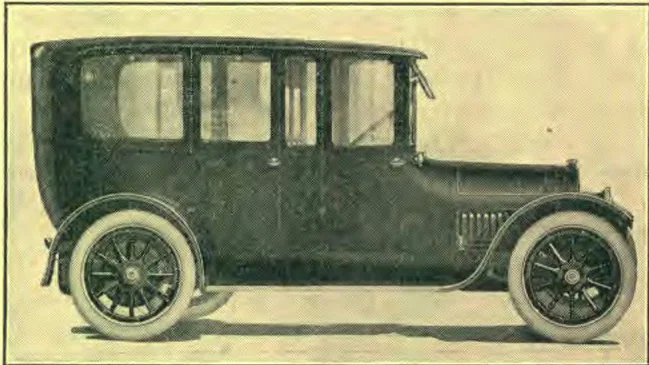
THE Cadillac Motor Car Company of Detroit, Michigan, several years ago made a study of the effect upon the morals and efficiency of men in their employ addicted to the cigarette habit, and found, according to the company’s statement, “that cigarette smokers invariably were loose in their morals and very apt to be untruthful, and were far less productive than men who were not cigarette smokers.” The company therefore posted conspicuously throughout their factories the following notice:—
“Notice
“Cigarette smoking is acquiring a hold on a great many boys in our community. The habit has grown in the last year or two. Since it is such a bad practice and is taking such hold upon so many people, we think it is a disgrace for a grown man to smoke cigarettes, because it is not only injurious to his health, but is such a bad example to the boys.
“Boys who smoke cigarettes we do not care to keep in our employ. In the future we will not hire any one whom we know to be addicted to this habit. It is our desire to weed it entirely out of the factory as soon as practicable. We will ask all in our factory who see the seriousness of this habit to use their influence in having it stamped out.”
The company allows no cigarette smoking about the plant. None of the prominent or executive men in the company use cigarettes. If cigarette smoking is really harmless, as some boys would have us believe, why should a motor car company concern itself about the matter?
No, cigarettes are not harmless. Their poison affects very seriously the tender, growing cells of the human body, especially those of the nervous system.
There is an abundance of testimony to this effect. It is conceded that the poison of tobacco does not produce so deadly an effect upon the body or brain of a full-grown person as upon those of youth; but it is harmful to man, producing in time hardening of the arteries, blindness, Bright’s disease, cancer, and other ills. It allows no tender, growing tissue to escape unharmed. Boys and girls, then, who have proper respect for themselves, should shun tobacco as they would a viper.
A Cadillac car — not made by cigarette users.
If Pres. Woodrow Wilson, with his great responsibilities, does not find it necessary to smoke, why should any boy? Mr. Bryan, having eschewed smoking, must have had a good reason for doing so. Mr. Roosevelt, it is said, does not smoke; he, too, must refrain because of the knowledge that tobacco may do one harm. Why not line up with some of the greatest of men, rather than with the common man?
No scholarships are granted to students who smoke, by the faculty of the Syracuse University. Chancellor J. R. Day of the university says, “A young man who smokes is a fool, at least in that particular. He ought to take better care of his nerves, and present a cleaner exhibit of himself.” Boys, why not do more serious thinking before taking up such a questionable habit? “Look before you leap,” is sound counsel.

What's the Matter with My Pulse?

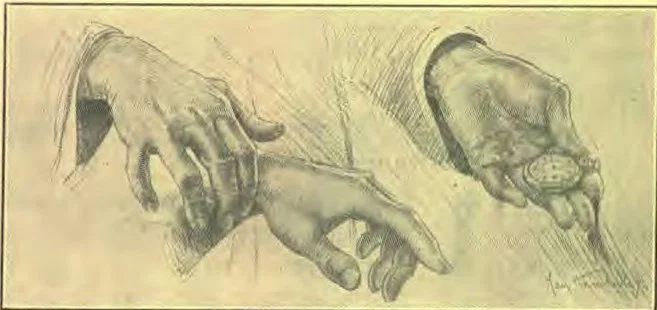
CERTAIN experiences and observations led me to take my pulse when I was smoking and when I was not smoking. I found that my heart, after thirty-six hours' abstinence from tobacco, would be beating from seventy to seventy-two times a minute. Three days' indulgence in cigarettes would raise this to about ninety when I first awoke in the morning, and to one hundred and ten or more at night.
I took occasion one day to ask a physician what the effect of this would be.
“I suppose it would not impress you,” he said, “if I were to tell you that it will tend in time to produce arteriosclerosis, or hardening of the arteries. But perhaps I can put it in a way you will appreciate more: If you had a gasoline engine which the maker had designed to run at twelve hundred revolutions a minute, and you found a way by which you could make it run at eighteen hundred, and you continued to do that, how would it affect the engine?”
“It would wear it out,” I answered, “in two thirds or less of its natural time.”
“That is what you are doing,” he said. “You are wearing yourself out.”
I began to understand why I had found it so difficult to stop smoking, now that I realized that for years I had been running my engine — my heart — about half again as fast as it was designed to go.
“I found out why my pulse beat 110 times a minute instead of 72.”
About this time my father, who had smoked cigarettes for thirty-five years, began to suffer a slowly increasing paralysis of his left side. It commenced with a stiffness of the fingers of his left hand, spread to the arm, and then to the left leg. The doctor told him at once that he must stop smoking. My father answered that he could not do that, but would try to put any limit on his smoking which the doctor decreed. The doctor made him an allowance of three cigarettes a day, and my father straightway purchased the strongest cigarettes he could find. He carried an umbrella now all the time, using it as a cane. On the street I could tell him farther than I could recognize his figure, by the dragging of his left leg.
On the day before he was to leave on a vacation, I went around to the office to get him, and we started together to the bank to cash a check. The bank was about half a dozen blocks away. In the first three blocks my father made his fight to stay in the world of active men, and failed. Moment by moment he leaned more heavily upon me. Finally he halted, helplessly, with the first look of defeat I had seen upon his face.
I found a seat for him near where we had stopped, and got a taxicab and took him home. He never went on that vacation, although he lived for many months in increasing helplessness.
Until my father's death I did not know that physicians take into account the prolonged use of tobacco in diagnosing the ills of middle age. It would have made no difference, I suspect, if I had known before; probably I should have smoked anyway, even if I had been told that Bright's disease, arteriosclerosis, derangements of heart and digestion are the common lot in middle age of those who have used tobacco through their youth.
When I gave up cigarette smoking,—and incidentally all other use of tobacco has followed naturally with me,—I found that, without realizing it, I had been tired for twenty years. It amazes me now to think how customary it was with me, on entering a room, to look around first of all for a place to sit down, and to recollect how usual it was for me, when no demand was made upon me, to pass the evening stretched upon a couch.
Since I stopped smoking, I have become more active; I am more eager to meet and mix with people. My self-confidence has returned, and with it the world has seemed to fall into a new perspective. I find that while I was a cigarette smoker, I was living a sort of dream life, in which things showed themselves in wrong proportion and in incorrect positions in the scale. Now I have changed from a pessimistic dreamer into a man who is beginning to do things. I have the pleasure of knowing that I am doing good work and receiving recognition for it.—George H. Cleveland, in Ladies' Home Journal.

Strange Affinities

BUTTERNUT trees have been found to be weed eradicators, at least so far as our pretty cinquefoil, with its dainty flowers, is concerned. A shrubby variety of this little golden favorite among our Eastern wild flowers has, by its prolific abundance in portions of Vermont, made itself a pest. But observers have found that it does not thrive where the butternut tree grows. These trees are therefore being planted to reclaim large tracts of land that have been overrun by cinquefoil.
Despite the deadly effect the butternut roots have upon the cinquefoil plant, the cinquefoil seems to attract the roots of the butternut to themselves, thus inviting their own destruction. This is strange; but not half so mysterious is this unwholesome relationship in the plant world as is the relation between the much-denounced cigarette and the intelligent boy. The cigarette destroys the boy — body and soul; but the boy eagerly consumes it, and thus works his own undoing.
What can be done to overcome this unhappy affinity? The men already have the secret; but selfishness forbids its application. When they stop smoking, the boys will throw away their cigarettes.

The Boys’ Anti-Tobacco Pledge

Since tobacco is a narcotic poison that seriously injures the growing body, and since the fumes of tobacco are very offensive and frequently injurious to abstainers, I solemnly promise by God’s help not to use the narcotic in any form before I am twenty-one.
Name ........................................
Date ........................................

No More Cigarette Advertisements

THE Curtis Publishing Company, publishers of the Ladies’ Home Journal, the Saturday Evening Post, and the Country Gentleman, have decided that, after present contracts are fulfilled, they will publish no more cigarette advertisements. This was for many years the policy of these magazines, but through overpersuasion a few such advertisements were accepted. The management is now convinced that this lapse from former high principles was a mistake, and hence cigarettes will again be excluded.
If cigarettes are not worthy of being advertised, they are certainly not worthy of being used by our American boys.

The Pity of It

A REELING, blear-eyed drunkard we pity. We pity him because he has suffered himself to be caught in such an evil trap; we pity his weakened manhood; we pity his family; we pity him for his present and future bodily sufferings; we pity him because he is without hope, either for this world or the next. He is dead to earth and heaven.
With a similar feeling of absolute pity all intelligent, well-informed persons look upon the boy who smokes cigarettes. Just as the boy knows the evil that whisky brings to the man, so does the State, the church, the scientist, the thinking man and woman, know the evil the cigarette may bring to the growing boy.
Just as the boy thinks the drunkard ought to be ashamed to allow himself to drink stuff that will make him a silly jabbering idiot, unfit for any place but the gutter, so do wise men think about the bright boy who allows himself to begin the use of tobacco.

Could Not be Bribed to Betray Boys

A COMPANY manufacturing a certain brand of cigarettes was very eager to print an autographed photograph of a noted baseball player on little cards that could be inserted in the boxes. They sent a man to see him in his home. The delegate was wise enough to secure an intermediary, a Pittsburgh newspaper man, who knew the player well. The newspaper man was to close the deal and receive a generous commission. He offered the player $500 for the use of his name, then $1,000. Finally he handed him a blank check, and told him to write in his own figures.
“No,” said he determinedly.
“Why not?” asked the newspaper man in amazement. “I thought all you ball players were money crazy.”
“I’ll tell you,” he said, “it isn’t worth the money to me to encourage any boy to smoke cigarettes. If my name and picture on a card will have that result, I’m not going to sign up, no matter how high you go with your offers.”

Men's Anti-Tobacco Pledge

Since science and experience have shown that tobacco is a poison that does the human body no good, but may do it great harm; and since as an adult my example must influence boys to smoke, upon whom the poison has a decidedly ill effect, I solemnly promise by God's help to abstain from its use.
Name ..............................................
Date ..............................................

Anti-Cigarette Pledge Cards Notice

SEE INSTRUCTOR of March 14 for notice of Anti-Cigarette Pledge Cards.

Words of the Wise

TOBACCO is the worst natural curse of modern civilization.— John Ruskin.
I feel a great interest in any effort to check the pernicious habit of tobacco using. It is not only a nuisance, but a moral and physical evil, and a shame to our boasted refinement and civilization.— John G. Whittier.
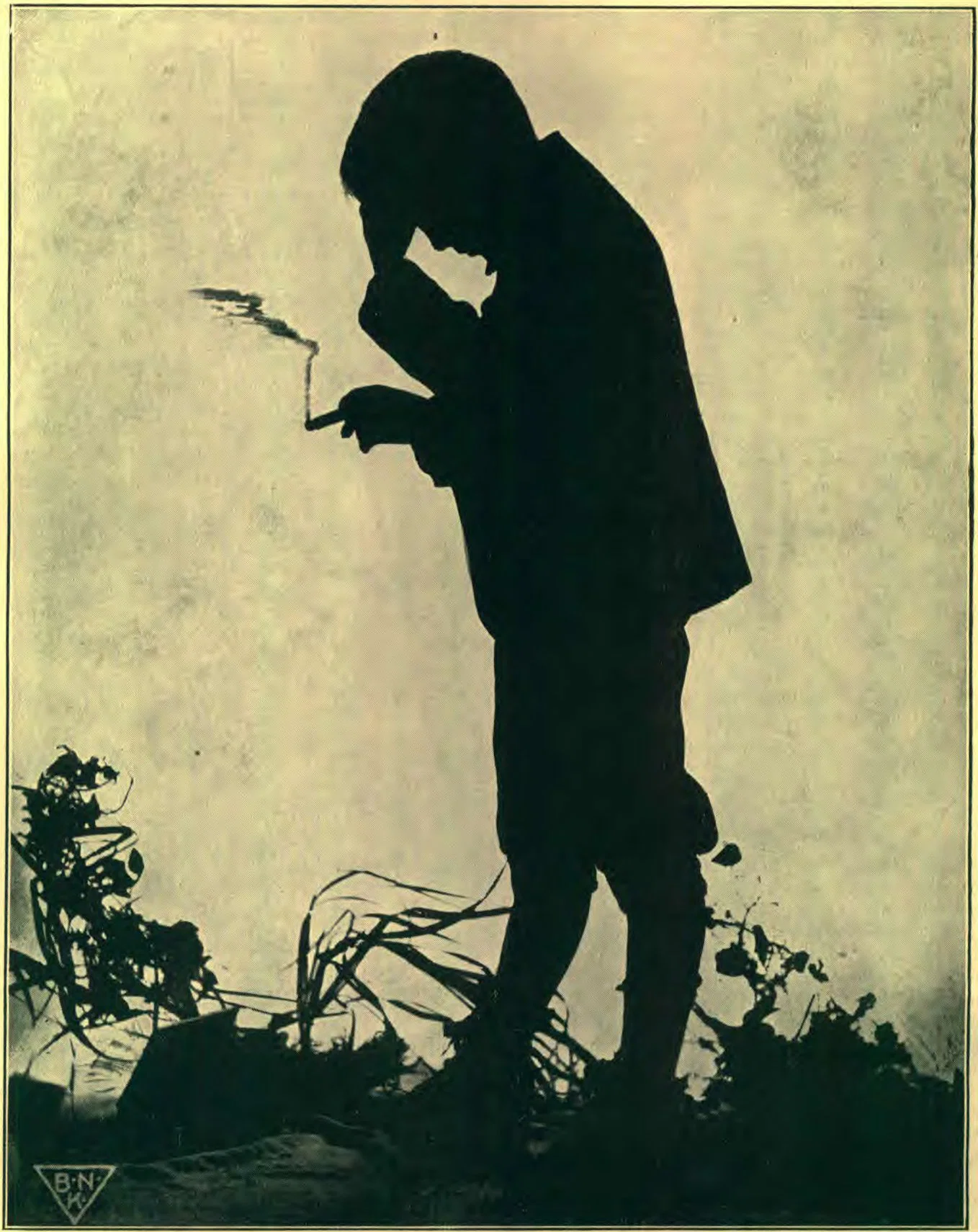
ONE OF FATHER'S CIGARS — ASPIRING TO BE A MAN

You have reached the end of this edition.

The Youth’s Instructor · Mar 7, 1916