It was Saturday evening in one of the oldest military academies in the United States. The boys of the Second Room Company had returned from the swimming pool, and were preparing for the weekly debate before retiring to the dormitories. This was to be an impromptu discussion. No question had been selected. Captains were chosen and sides drawn. Then came a period of casting about for a theme. The discussion which followed several suggestions made by the boys themselves, led to a more earnest approach than on other week-end discussions to a consideration of the evil effects of habits formed in early years.
The teacher in charge saw the opportunity for which he had been waiting for many weeks. There had been an unexplained but very real tendency on the part of several of the boys of this company to break the rules of the school by smoking cigarettes.
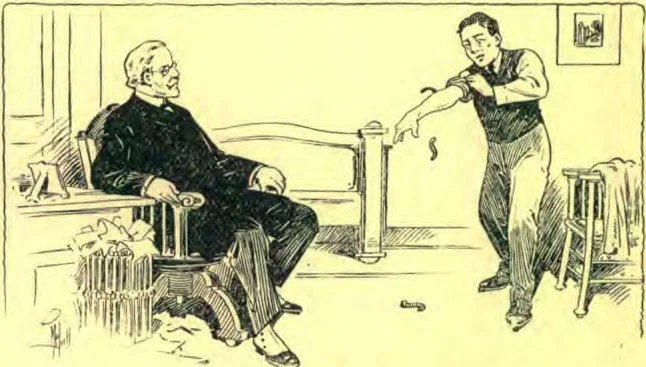
Suddenly one of the disputants turned to the teacher with a challenge for his opinion on the effects of smoking upon boys. The young man arose, spoke moderately of the undesirable methods used in many factories where cigarettes are made; he mentioned the uncleanly habits of workers in cheap tobacco, the apparent necessity for treating the “filler” of the paper tubes with drugs to disguise its unfitness for human consumption. He distributed an outline of the evil effects of smoking of all kinds upon boys of growing age, and told of an experiment he had witnessed in the office of a prominent physician. A youth of sallow complexion, who would not heed the advice of his physician, was plainly in need of convincing proof of the doctor’s wise counsel. The physician therefore put three leeches upon the arm of the lad, and told him to watch them. They buried their noses eagerly in the flesh above the elbow; but one by one they released their hold upon his arm, and fell to the floor.
“What are they doing, Doc?” said the astonished boy.
“They are dying,” replied the doctor; “they have been poisoned by the nicotine in your blood.”
“Well,” said the fellow, serious at last, “if I am as much of a leech killer as that, they must have got me pretty bad.”
“Yes,” said the physician, “you will be as they are pretty soon if you don’t take my advice. Nicotine will kill boys as well as leeches, if they get enough of it in their blood.”
“Forgive me,” said the young man, as he picked the leeches from the floor. “I was too wise in my own conceit to take advice; I assure you my leech-killing days are ended.”
“Give me some medicine, Doctor,” said he, turning to the physician. “I want to drive this poison from my system.”
“This first,” answered his adviser, and he handed him a pledge card to sign; “when you have put your name to this, I will help you.”
The lesson was evident. From his desk the teacher of the cadets drew a parcel of pledges, which he had purchased so as to be ready for the opportunity for which he was waiting, and he passed them to the boys. They signed them, every one, and sent them to their parents for safe-keeping. The teacher does not know that they ever broke their word of honor.—Charles H. Rominger, M. A.
Playing the Fool
By D. H. Kress, M. D.
D. H. Kress, M. D.
Several years ago a man took a ten-dollar bill from his pocket and deliberately struck a match and set fire to it. He had money to burn. Fortunately I was able to snatch the bill out of his hand before it was destroyed. The man was under the influence of drink, and was therefore irresponsible and possibly excusable. He was, however, playing the fool.
There is more than one way of playing the fool. If a boy should buy ten dollars’ worth of cigarettes and carry them into an alley and just for fun set fire to them and burn them up, we would say, Young man, you are playing the fool. Suppose he should instead take them into his mouth and set fire to them, burning them up one by one, and in addition would inhale the poisonous smoke, he would assuredly be playing the fool, for not merely would he be burning up the ten dollars, but by inhaling the smoke he would sustain a physical injury.
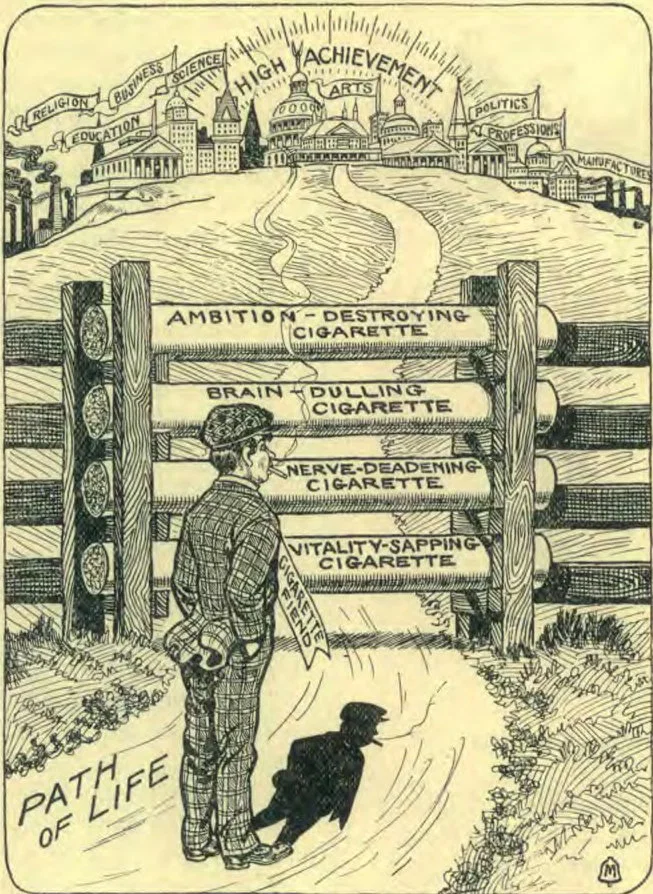
The Cigarette Bars.
There are thousands of boys and young men in every community who are playing the fool in this way. They are burning up their money as truly as did the drunken man, and in addition are inhaling the poisonous fumes from the cigarettes.
The cigarette smoker imagines he is smoking tobacco. This would be bad enough, for the nicotine, liberated by the slow burning tobacco, is present in the smoke, and is a deadly poison. But the cigarette smoker is not merely smoking tobacco, as he supposes; he is smoking tobacco plus some other products, as glycerin, rum, licorice, etc., which are sometimes added in the manufacture of cigarettes for the purpose of keeping the tobacco moist and giving it color. Some of the products which are thus added may be harmless in themselves, but in burning them, poisons are developed which are even more injurious than nicotine.
Today cigarette making is an art, and in this probably lies the greatest evil connected with their use. The purpose is to make a cigarette which is velvety, agreeable in flavor, and which does not bite the tongue when smoked. To accomplish this, various other products are added. These products may differ slightly in different brands of cigarettes, for each cigarette manufacturer has his own secret process; but in no case are they added to improve the cigarette from a health viewpoint: they are added solely for commercial purposes. One of the products developed from smoking cigarettes containing glycerin is furfural. A few years ago one of Thomas Edison’s assistants, in conducting some experiments in the laboratory, chanced to inhale the fumes of burning glycerin, with almost fatal results. Furfural is deadly.
Yet the boy who smokes cigarettes is continuously inhaling these deadly fumes. Furfural is especially injurious to the nervous system, and when inhaled for a prolonged period will bring about a degeneracy of the brain and nerve cells of an incurable nature. The boy who smokes cigarettes becomes restless, irritable, coarse, and careless in his deportment. He develops nervous symptoms of a marked character, and in time criminal tendencies may manifest themselves. The earlier in life the habit is formed the greater the injury sustained.
The symptoms developed by the smoking of cigarettes are quite different from the symptoms associated with tobacco smoking, merely. This is generally recognized—cigarette smokers are not reliable. Many business firms refuse to employ cigarette smokers. In Chicago even a tobacco dealer rejected thirty-eight out of forty-two young applicants for a position, because they were smokers of cigarettes. The tobacco dealer said, “The boys of today are not what boys of ten years ago were, and it is due largely to the cigarette evil. They come here with their ill manners, stained fingers, dopey-eyed cigarette faces, and cigarette breaths, and they are saucy and dirty.”
Recently in passing through a department in the Cash Register Company, in Dayton, the one who conducted me said, “In this department the work is of such a delicate nature that only young women can be employed and trusted with it.” Young men could not stand the nerve tension connected with work requiring such delicacy of touch.
Mr. Burbank, of California, the plant wizard, made a similar discovery.
He says, “Men who smoke even one cigar a day cannot be trusted with some of the most delicate work. These men, while able to do the rough work of farming, call budding and other delicate work ‘puttering,’ and have to give it up, owing to an inability to concentrate their nerve force. Cigarettes are even more damaging than cigars, and their use by boys is little short of criminal, and will produce in them the same results that sand placed in a watch will produce—destruction.”
The boy who pays out his hard-earned money for cigarettes, and then burns them up by inhaling the smoke, is more certainly playing the fool than did the man who, while under the influence of drink, attempted to burn the ten-dollar bill.
The definition given of a cigarette, as “a little tobacco rolled in a piece of paper, with a fire at one end and a fool at the other,” is possibly as true a definition as could be given.
How to Combat the Tobacco Evil
Dr. Bruce Fink, Ph. D., professor of botany, Miami University, Oxford, Ohio, was appointed by President Hughes of the university as chairman of a committee to investigate the effect of tobacco upon students. That committee’s investigations disclosed unexpected data. This led Dr. Fink to continue his investigation of the tobacco problem, until, as a teacher of young men, he has felt compelled to sound the strongest possible note of warning to both old and young. He counsels men to sense their responsibility as examples to youth, and warns boys and young men of the grave results that will surely follow their use of tobacco. The accompanying article, and the striking one on page eleven, are excerpts from Dr. Fink’s valuable pamphlet, “The Tobacco Habit.”
The efforts of an individual here and there cannot make much headway against the tobacco evil. A thorough study of the tobacco habit among boys has convinced Prof. W. A. McKeever that prevention is the only way to cope with the evil. He says:—
“Prevention is the only practical solution of the cigarette or boy-smoking question. Boys take up the practice in innocence, just for fun, and are usually its victims before the matter is detected by their parents. Any normal, healthy boy will learn to smoke if thrown among young smokers without any caution or restraint from those in authority over him. After parents discover the fault, there is often a pathetic struggle, perhaps attended by many maternal tears, and then a compromise; that is, the boy tries in vain to quit, and finally agrees to compromise on a pipe. But he will likely violate every rule of good conduct ever taught him by his parents before he will give up the habit entirely. But parents must learn more about the nature of this insidious habit, and prevent its being taken up.”
“The following methods of prevention are reported effective: (1) Begin to talk to the boy about the matter as early as his sixth or seventh year, and make a strong appeal to his sense of honor. Do not be too insistent and threaten to inflict punishment, but indicate rather that you think him too worthy to take up such a practice. (2) Offer to set aside some material or pecuniary reward to be paid when he becomes of age, provided he continues his total abstinence, and add to his sentiment that he may then do as he pleases. Never ask the boy to pledge away in advance the years of his manhood. (3) Remind the boy in every possible way how much concern you have for his well-being, how much you are willing to sacrifice for him, and how anxious you are to be true to him and to help him. He will then likely never break faith with you. (4) Keep in touch with the boy, and know at all times his joys and hopes and aspirations. Be his companion and adviser and true friend, and he will respect your wishes in regard to him.”
Mary A. Hunt states that graded instruction will do much to stop the cigarette evil. She says:—
“The only sure way of preventing cigarette smoking in the high school is to begin in the first primary grade to teach the boy, with other laws of health, simple physiological reasons adapted to his capacity, that show why he should not smoke, and continue this instruction as a more progressive study with new matter which gives each year more of the physiological reasons for abstinence from tobacco in all forms, as well as for the observance of other hygienic laws. If this study is thus properly graded, it will be a progressive development and not a repetition, and will send the boy to the high school, having been too well informed from the first to dull his brain or to limit his future possibilities by nicotine.”
“The public school study of hygiene and temperance, which includes warning instructions as to the nature of tobacco and its effects upon the human system, is legally ingrafted upon the public school system of this entire nation. This legislation began quite generally to go into force about fifteen years ago. If, during this time, school committees, school boards, trustees, and school superintendents had more generally made a place in the school curriculum for enough well-graded lessons to cover the subject,—say twenty per year in the primary and thirty per year in the grammar and the first year of high school,—with good books in the hands of the pupils who have books in other studies, there would be fewer cigarette smokers today. To limit this instruction to the high grades is to wait until the mischief is begun. We cannot undo this wrong to the children in the past, but innocent faces of the little ones in the primary grades appeal to us against the repeating of it in the future.”
This plan for cooperation of teachers and parents in eliminating the cigarette was tried by a certain school, the following, in the form of a circular letter, being sent to parents:—
“We desire to call the attention of parents to the fact that a large majority of the boys in this city are smoking cigarettes; that the boys who smoke are, on an average, years behind the boys who do not smoke, and still farther behind the girls in the same grades; that the mental, moral, and physical condition of these boys is extremely deplorable, and will certainly continue to grow worse unless the habit is stopped; that while the schools are insisting that this and all other unclean and undesirable habits shall not be practiced in or about our schoolhouse or grounds, still crowds of boys are seen daily around the saloons and loafing places of our streets, smoking, loafing, swearing, and cultivating other undesirable habits. We ask that parents cooperate with us in eliminating these conditions as far as possible, to the end that we may give our future generations of young men not only an education, but healthy bodies, minds, and morals. We would ask parents to observe, from the table given, that the cigarette smoker is already on his way to the conditions which indicate crime, trampdom, the jail, and general worthlessness. Memory goes first, closely followed by low deportment, low rank in studies, bad physical condition, and general degeneracy.”
“We would also point out to parents that while pupils are within our domain as teachers (the school yard and schoolhouses) there will be no smoking, and that while we shall do all in our power to discourage it anywhere, we are helpless to stop the difficulty without the personal cooperation of the parents; and we may as well add that we are unable to teach anything to the cigarette fiend, as his memory is a blank, his power to reason damaged, ability to study ruined, and usually his ambition to excel is entirely gone. We would further point out to the parents of the boy who smokes that the desirable places in the business world are being rapidly closed to the cigarette smokers, and that already the banks, railroads, and many other businesses by which the ambitious young man expects to climb to fortune and success, have closed their doors as tightly to the cigarette smokers as to the drunken sot. Why?—Because the business world has found by experience, as we teachers observe continually, that the cigarette smoker is untruthful, deceitful, untrustworthy, and inefficient.”
This letter had an immediate effect. Within a few months it was estimated by the marshal of the town that seventy-five per cent of the cigarette smoking by boys had stopped, and the moral and industrial condition of the school was wonderfully improved. What had been called the worst school in the country was spoken of as doing good work. The school board raised the salary of the teachers and principals twenty-five per cent. The people were pleased, and the improved condition of the boys was noticeable in their language, dress, manners, efficiency, and in their moral tone.
Prof. Author Holmes, of the University of Pennsylvania, says: “If men did not smoke, boys would not. All the appeals and all the legislation possible, therefore, which would suppress the open and overuse of tobacco, are good. Herein women can play an important part by the rigorous exclusion of smoking from their presence.”
A recent issue of the Northwestern Christian Advocate has the following: “A movement of more than passing importance has been started in Kansas by the young women who have organized into a Good Habits Club, the purpose of which is to decline the attention of any young men who drink, smoke, gamble, or use profane language. Reports come that in communities in other States the young women have adopted the program, and that already the effect is seen in a lessened indulgence in these needless and harmful vices. The young women must come to realize that they are a prime factor in the moral character of the young men.”
Men are sometimes heard to say that there is another side to the tobacco question, but the writer knows not one strong argument in its favor. Arguments on the ground of sense gratification and social advantage seem to him pure sophistry when coupled with a habit that is amply proved to be one of the most dangerous to mankind. It seems perfectly safe to repeat that mankind will one day rise against this great evil and make it as unpopular as are now some other drug habits. The sooner the fight against tobacco is won, the better for us all.
The Way of the Transgressor
By Len G. Shaw
I SHALL not mention their names. That would be revealing identities that might better not be disclosed, for the sake of both. Neither shall I sketch the two careers too intimately. If I did, it is more than likely that even in his pitiable mental state the one would recognize the portrait of himself, and there is no desire on my part to add one jot to the mental anguish he must suffer when, in the few lucid moments he is permitted, he looks back over opportunities that were worse than wasted.
It was in the heat of a gubernatorial campaign in Michigan that I first met them—two fellows whom to know was to like. One was the star political writer on a metropolitan newspaper, the other a reporter on a small city daily.
They had struck up an acquaintance during the afternoon, while one of the gubernatorial candidates the political writer was accompanying on a spellbinding tour, was making a speech at the county fairgrounds.
We sat up late that night in the hotel lobby, swapping stories and talking over matters of mutual interest, and I was impressed with the striking similarity of characteristics in the two men. Both were splendid physical specimens of manhood, clean-cut, alert, immaculately attired,—men who would attract attention in a crowd.
Scarcely had we settled down in our chairs when the political writer produced a box of cigarettes, and after extracting one for his own consumption passed them to his new-found acquaintance. They were declined with thanks.
“Ha,” laughed the political writer, jokingly, “you have no small vices, eh?”
The reporter looked grave. “I am not sure that is such a small vice,” he replied slowly.
“Oh, well, we’ll not quarrel over that,” went on the political writer. “I do not smoke much myself.”
But during our session that evening he emptied one box, and made serious inroads on a second.
It was some months later, in Lansing, that I met them. They were “covering” the legislature for rival papers in the same city, but this fact had no bearing on their friendship. They were inseparable, and had come to be known as Damon and Pythias, so devoted were they to each other’s interests: only, wherever Damon was encountered he would be found puffing at a half-burned cigarette, or with feverish haste rolling a fresh one.
The years rolled by. I had kept close track of the small-town reporter, who had developed into a star metropolitan man, and was turning his attention to theatrical reviewing, with marked success. But the political writer had dropped from view, following a disagreement with the newspaper he had served.
One day a shadow fell across my path, and I looked up to come face to face with the one-time star. He was bronzed. His clothes were in sore need of a valet, and his linen had not been on speaking terms with a laundry for some time back. He grinned at my gasp of astonishment.
“I don’t wonder you are surprised,” he went on. “You see, I’ve been down in Georgia, working on a peach farm. I had to do something, so I thought I’d cut out the old life for a time. I’m pretty near down and out—but I’ll come back. I’m just as good today as I ever was, and I’ll show those fellows that have turned against me. By the way, can you spare me a cigarette?”
A month or so later I was wandering along the docks, watching the operations of a gang of lumber shovers, when an overalled figure separated itself from the rest of the party and came shuffling over to where I stood. There was something familiar about the man, yet I had to look a second time before certain as to the identity of the grimy, perspiring individual.
“Yes, it’s I,” he volunteered, extending a calloused hand, on the fingers of which the telltale yellow of cigarette stains showed through the dirt. “You’d never have thought it of me, would you?”
There was a wistfulness in his tones, and it seemed almost as if tears glistened in the shifting eyes.
“You see,” he went on, “it was a little dull in the newspaper business, and I had to live while something was turning up in the old game, so I’m down here for a little while. It doesn’t pay very much,—and it’s awful hard work,—but it’s enough to keep me going until I get back. I can make good again. All I need is a fair show. I’ve got the stuff in me if I get a chance. And by the way—”
I hadn’t. If I had possessed a cigarette, I think it would have been his without the asking. He craved it as a man recovering from a long spree craves a drink of whisky to slake his thirst.
From time to time strange stories reached me concerning the one-time political writer. He was successively panhandler, hobo, and potato peeler in the kitchen of the county infirmary, to which he obtained admittance through the good offices of men who had known him in the prime of his career.
It was a crisp October morning suggestive of winter apparel. At a down-town corner stood a gaunt figure, from whose parchment-like countenance two fishy eyes stared forth uncomprehendingly. Under his arm he carried a small bundle of newspapers that he essayed unsuccessfully to dispose of to passers-by. And as he called the papers in a rasping monotone, he pulled away at a cigarette “butt” he had picked from the gutter.
I saw him again the other day, moving unsteadily along the street, having eyes but not seeing, possessed of ears yet not hearing. The overalls that partly encased his withered limbs were frayed at the bottom and flapped about forlornly with every step. A checked blouse took the place of a coat. A ragged straw hat, whose original color had long since disappeared beneath a coat of grime, surmounted his tousled hair. His face resembled that of a coal heaver at the end of a day’s toil. His hands, swinging loosely at his sides, were dark as those of an African.
I have seen men in the throes of delirium tremens, screeching for help at the top of their voices, while hospital attendants fought to restrain them, but I had never seen so horrible a spectacle as was presented by this one-time Beau Brummell, who had forfeited every claim to consideration, and sunk to unbelievable depths—victim of the little white slaver.
Not one of his former acquaintances would have recognized him in this pitiable condition—and it was well.11
Possibly before you read these lines, death will have mercifully laid hold on this human derelict, and he will have passed to the great beyond.
The other man—the one who had “no small vices”? He is today dramatic editor of one of the leading New York newspapers, standing well toward the head of his profession,—a man who is known personally by every actor and actress of consequence in the country, and whose opinions are accepted as authoritative.—Len G. Shaw, in “The Case Against the Little White Slaver.”
Who Are the Quitters?
By Bruce Fink
We hope to give enough evidence on the evil of tobacco using to prove that no boy should begin to use tobacco; and what will appear below could be multiplied many times. We will not cite the evidence from medical experts; nor will we consider the delinquency and degeneracy caused by cigarette smoking, or the growing hostility of business to the tobacco habit; but will only consider a few of the statistics gathered from the studies of superintendents, principals, and teachers in the public schools.
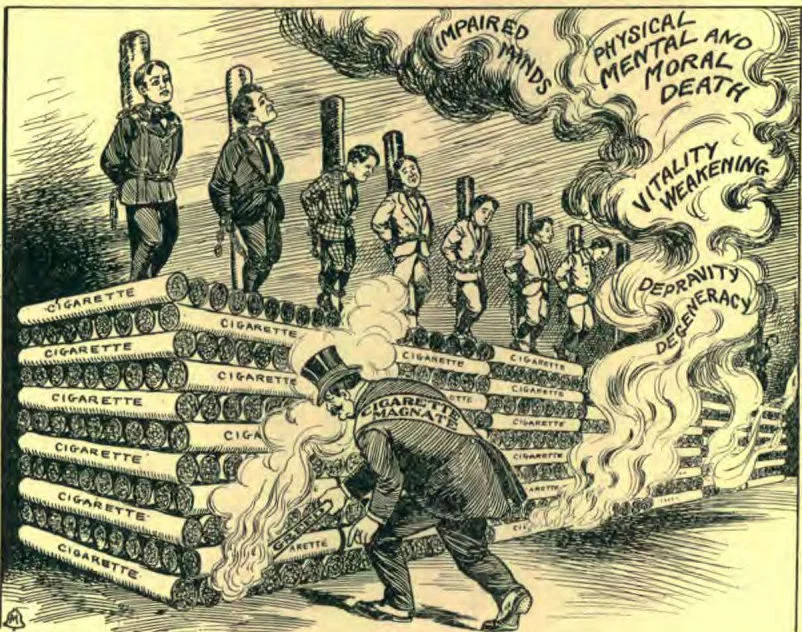
Burning the boys at the stake with “the devil’s kindling wood.”
A careful study of the effect of tobacco on high school boys at Highland Park, Illinois, is given in the School Review for 1912, pp. 623–625. Not a single graduate of the school was a habitual smoker while in school. The 45 quitters were all smokers and in poor standing in their classes, their average grades being below the passing mark. The average grade of 77 nonsmokers was 84 per cent, of 24 reformed smokers 79 per cent, of 55 smokers 76 per cent. The grades of those who had recently learned to smoke had fallen from 85 per cent to 78 per cent. One boy who was smoking heavily, quit, and his grades came up 10 per cent within six weeks. Principal R. L. Sandwick gives some excellent arguments with his statistics. We will consider more startling statistics from other sources, but none which indicate more clearly a direct relation between the tobacco habit and poor scholarship.
The United Presbyterian for April 20, 1913, published the following from statistics compiled by H. L. Smith, superintendent of the Bloomington, Indiana, schools: —
RETARDATION
Grades
Average age of smokers
Average age of nonsmokers
Excess age of smokers
First
9.17
7.58
1.59
Second
9.66
8.51
1.15
Third
10.68
9.36
1.32
Fourth
12.6
10.55
2.05
Fifth
14.22
12.21
2.01
Sixth
13.62
12.42
1.20
Seventh
14.67
13.32
1.35
Eighth
15.12
14.65
.47
HIGH SCHOOL
Ninth
16.47
15.55
.92
Tenth
16.75
16.17
.58
Eleventh
18.
17.27
.73
Twelfth
17.55
17.22
.33
Conclusions
“1. Smokers are distinctly older than nonsmokers, having failed in their work much more frequently.
“2. Smokers are doing distinctly poorer work than nonsmokers.
“3. Smokers are disciplined much more frequently and for more serious offenses than nonsmokers.”
Professor Smith also found that nonsmokers failed in 10 per cent of their work, occasional smokers in 18.7 per cent, and habitual smokers in 29 per cent. The number of pupils involved in the investigation was 950, and the figures are so significant that they should convince every boy, every parent, and every educator. The results are doubtless in part directly due to inferior character, or to some condition of environment of the boy who takes to the tobacco habit; but in any case, no self-respecting, high-minded boy will want to be found in such company after the facts are placed before him.
An article by P. L. Lord, published in the New York School Journal, gives the results of investigations of 200 boys who smoked cigarettes, and of an equal number who did not. The reports were made by ten teachers, who observed boys from ten to seventeen years old, chosen by lot in their schools, studied them for several months, and reported to Mr. Lord impartially. Whatever the relationship between the cigarette habit and the astonishingly bad showing made by boys who had the habit, a study of the tabulation below should arouse every boy worth saving, every parent who cares for his boy, every teacher, and every man who sets the example of smoking. The following is Mr. Lord’s tabulation of the appalling relations: —
Smokers
Nonsmokers
Nervous
14
1
Impaired hearing
13
1
Poor memory
12
1
Bad manners
16
2
Low deportment
13
1
Poor physical condition
12
2
Bad moral condition
14
0
Bad mental condition
18
1
Street loafers
16
0
Out nights
15
0
Careless in dress
12
4
Not neat and clean
12
1
Truants
10
0
Low rank in studies
18
3
Failed of promotion
79 times
2 times
Older than average of grade
19
2
Untruthful
9
0
Slow thinkers
19
3
Poor workers or not able to work continuously
17
0
Supt. H. D. Hervey, of Malden, Massachusetts, obtained, with the aid of his teachers, the following convincing statistics on relative physical, mental, and moral conditions of smokers and nonsmokers in his schools: —
Smokers
Nonsmokers
Undersized
15
2
Weazen
12
1
Unkempt
17
0
Sallow
20
0
Weak
12
0
Often sick
10
1
Headache
14
1
Sore eyes
7
0
Lazy
34
0
Nervous
22
1
MENTAL CHARACTERISTICS
Dull
24
1
Unable to think at times
31
0
Mentally dwarfed
12
0
Incapable of sustained attention
35
0
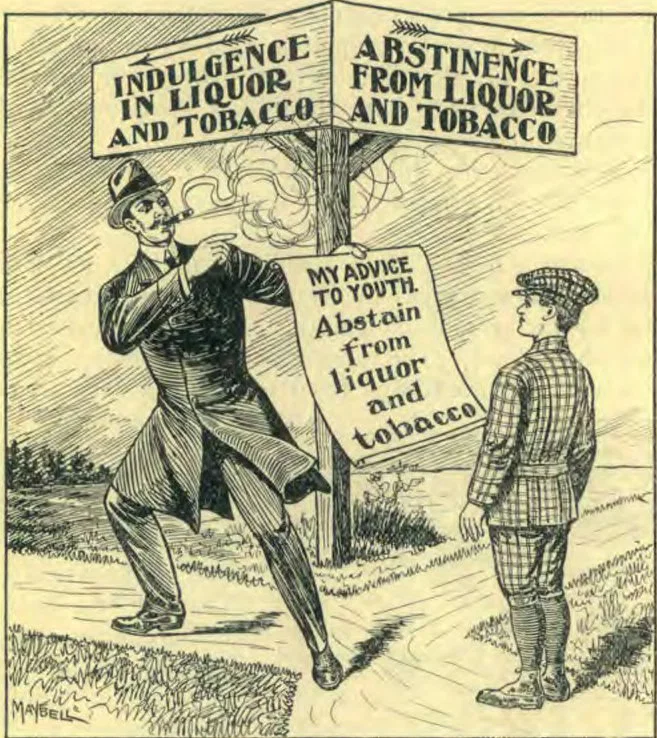
The inconsistency of teaching the right and pursuing the wrong.
Smokers
Nonsmokers
Poor memory
26
0
Poor reasoning powers
29
1
MORAL CHARACTERISTICS
Weak of will
32
1
Coward
15
0
Liar
16
0
Degenerate
7
0
Vulgar
12
0
Influence bad
15
0
Disobedient
18
1
Disrespectful
11
0
Truant
16
0
We quote as follows from Mr. Hervey’s conclusion: “Boys may use tobacco because they are physically and mentally weak and morally unsound, or they may become physically, mentally, and morally impaired because they use tobacco, or each factor may be partly cause and partly effect. In any event, the results of this study would seem to indicate that a close connection exists between low mentality, physical weakness, moral delinquency, and cigarette smoking. If this be true, the cigarette, far from being the sign of manliness and of superior intelligence, should be regarded as the badge of the physical weakling, the mentally incompetent, and the morally unsound.”
Superintendent Hervey also gives the following data regarding forty smoking and forty nonsmoking pupils, chosen by lot from the grades and the high school. The statement involves items not in the table above: “The average age of the smokers was 13 years 2.9 months, and of the nonsmokers 11 years 9.37 months. From this it would appear that those who use tobacco are 1 year 5.5 months older for their grades than are those who do not use tobacco. The cause for this will appear more evident later on. The average height of the smokers was 55.87 inches, while for the nonsmokers it was 56.1 inches. That is, notwithstanding the fact that those who do not use tobacco are almost a year and a half younger, they actually average .23 of an inch taller. From a table prepared by Dr. Franz Boos, showing the average height of 45,151 boys in Boston, St. Louis, Milwaukee, Worcester, Toronto, and Oakland, the 40 smokers were 1.13 inches shorter than they should be for their age, while the nonsmokers were about 2 inches taller than the average. The average weight of the smokers was 85.45 pounds, and of the nonsmokers it was 81.92 pounds. According to the table of Dr. Boos, boys of the age of the smokers should weigh 82.8 pounds, and boys of the age of the nonsmokers should weigh 72.2 pounds. From this it would appear that, while the smokers weigh 2.62 pounds more than the average, the nonsmokers weigh 9.72 pounds more than the average, a difference of 7.1 pounds in favor of the nonsmokers. Of the smokers, 33 had normal vision and six had poor vision, while of the nonsmokers all had normal vision. Of the smokers, none stood excellent in his studies, 2 ranked as good, 12 as fair, 26 as poor. Of the nonsmokers, 15 ranked as excellent, 14 as good, 11 as fair, and not one as poor. Of the smokers, 8 had failed of promotion once, 14 had failed twice, 8 had failed three times, and 1 four times, making a total of 64 failures. In other words, 31 boys out of the 40 had failed of promotion one or more times.”
Hundreds of statements regarding the injurious effects of tobacco on boys could be quoted, but nothing could be added to the evidence contained in the data from the various studies given above. The facts stated should be sufficient to keep any boy who cares for a good, strong character from entering the ranks of smokers.—Bruce Fink, Ph. D., in “The Tobacco Habit.”