THE new covenant plan is simply the "plan of salvation." This plan was formed in the council chambers of heaven by the Father and the Son. The counsel of peace was between them both. Zech. 6:13. God gave his Son (John 3:16), and his Son gave himself (Titus 2:14). The very first provision of the new covenant is, "I will put my law in their inward parts, and write it in their hearts." This implies conversion. The law may be written on stone, but that does not affect the life or the heart. By conversion we are brought in harmony with God's law, for it is a part of us. The children of the new covenant are all born after the Spirit. Gal. 4:29. They all "know the Lord."
In the formation of this plan God knew that it would be impossible for man to save himself by works that he might do, so he sent Christ to prepare a "robe of righteousness" for us to put on by faith. His life is a spotless robe. It was prepared by faith, the "faith of Jesus." The righteousness of Christ is the righteousness required by the law. The law bears witness that it is righteousness. Rom. 3:21. The robe of Christ's righteousness has Sabbath-keeping in it. This "robe" is unto all, and "upon all" them that believe. Rom. 3:22. We do not make our own garment of righteousness, under the new covenant, but we get a garment ready made. We do not need to go dressed in "filthy rags" (Isa. 64:6; Zech. 3:3, 4), but can put on the "fine linen" (Rev. 19:8), by faith in Christ. This change takes place at conversion. Rom. 3:26. After putting on this righteousness, shall we then transgress the law? God then desires that the "righteousness of the law" be fulfilled in us (Rom. 8:3, 4), and this is done by the power of a risen Saviour, who dwells in us and works through us (Phil. 2:13; Eph. 3:17).
This is the plan of the new covenant. What a wise plan it is! It only could be devised by infinite wisdom, and executed through infinite love. The law of God is the standard of righteousness in the new covenant, which standard we reach by faith in Christ.
The "First Covenant" and the Decalog.
It is claimed by many that the Decalog is the "first," or "old" covenant. Finding that the first covenant has "vanished away," they conclude that the Decalog is abolished. While it is true that the Ten Commandments are called "the covenant of the Lord," and the tables of stone called "the tables of the covenant," yet they are not the "first covenant," and never so called in the Bible. What is the first covenant? Is there a distinction between the "first covenant" and the "covenant of the Lord"?
The old covenant was a compact formed between God and Israel at Sinai, and then ratified by the blood of a sacrifice.
The old covenant dates from Sinai, as several expressions of the Bible indicate. It was made with Israel when the Lord "took them by the hand to bring them out of Egypt."
"It is written, that Abraham had two sons, the one by a bondmaid, the other by a freewoman. But he who was of the bondwoman was born after the flesh; but he of the freewoman was by promise. Which things are an allegory; for these are the two covenants; the one from the Mount Sinai, which gendereth to bondage, which is Agar [Hagar]. For this Agar is Mount Sinai in Arabia, and answereth to Jerusalem which now is, and is in bondage with her children. But Jerusalem which is above is free, which is the mother of us all." Gal. 4:22-26.
In this allegory, Agar, a bondwoman, is made to represent the old covenant, and it is expressly stated that the Hagar-covenant dates from "the Mount Sinai." It was not made until the children of Israel came to Mount Sinai. If the law of God and the Sabbath existed before the children of Israel came to Mount Sinai, then it can not be the Hagar-covenant which dates from Sinai.
The Sabbath is an institution as old as creation. Gen. 2:1-4. We have record where it was kept thirty-three days before the Hagar-covenant was made. Ex. 16:4, 5, 22-26. The law of which the Sabbath is a part existed at the same time, and "the Lord said unto Moses, How long refuse ye to keep my commandments and my laws?" The moral law must antedate sin (1 John 3:4; Rom. 5:12, 13); and as sin existed before the Hagar-covenant was made, so the law must antedate that covenant. In the beginning the law was written in man's very nature. Rom. 2:14, 15. It has been almost obliterated by sin. At Mount Sinai God rehearsed his law, and wrote it with his own finger upon stone (Ex. 20:1-17; 31:18), but he gave to them that which had existed before. The Hagar-covenant had not existed before Sinai, and therefore the law of God, including the Sabbath, can not be the "first," or Hagar, or "old" covenant.
Sarai was Abraham's wife, and, in the allegory, represents the new covenant. God promised to them a son. Gen. 15:1-4. Sarai became weary in waiting for God to fulfil his promise, and at last formulated a plan by which she thought to fulfil the promise of God. She had an handmaid, an Egyptian, whose name was Hagar. In order to fulfil the promise of God, Sarai gave Hagar to Abraham and she became his wife. Gen. 16:1-3. Hagar bare a son, and his name was called Ishmael. Gen. 16:11. Sarai also bare a son, and his name is called Isaac. Ishmael is born after the flesh, and Isaac is born by promise. Hagar represents the "old" covenant, and Ishmael represents the children of that covenant. With these facts before us, we can very easily determine what the Hagar-covenant is.
"Now when I passed by thee, and looked upon thee, behold, thy time was the time of love; and I spread my skirt over thee, and covered thy nakedness; yea, I sware unto thee, and entered into covenant with thee, saith the Lord God, and thou becamest mine." Eze. 16:8.
Hagar was a bondwoman and an Egyptian, yet she became Abraham's wife. The Jewish nation were in bondage in Egypt, yet the Lord led them out, and when they came to Mount Sinai, he "entered into covenant" with them, and they became married to him.
"Turn, O backsliding children, saith the Lord; for I am married unto you." Jer. 3:14.
The Jews, after the flesh, were once God's chosen people, and they became such by a covenant "entered into" at Mount Sinai. This is the "first," or "old" covenant. Ishmael was born after the flesh, and as he represents the children of the old covenant, the Jews after the flesh are the children of that covenant. Before calling attention to the marriage vows, or covenant "entered into" at Sinai by God and the Jews, we call attention to the character of Israel after the flesh. Of her the Lord says, "Thou becamest mine."
She was born after the flesh. Gal. 4:23, 29. She was a bondwoman because she was born after the flesh. All who are born "after the Spirit" are free. John 8:36.
6. She committed fornication and adultery. Eze. 16:26, 32.
7. She was a murderer, and murdered her Lord. Acts 7:52.
Is it any wonder that the Lord should find fault with her?
"For finding fault with them, he saith, Behold, the days come, saith the Lord, when I will make a new covenant with the house of Israel and with the house of Judah." Heb. 8:8.
Patience
By Bowman
PATIENCE is the pure gold of character, smelted from the ore of humanity in the furnace of affliction and cast in the mold of obedience. —Bowman.
Making of the Covenant.
By W. L. Iles
After Israel had encamped at the base of Mt. Sinai, Moses went up into the mount, and the Lord said unto him: "Thus shalt thou say to the house of Jacob, and tell the children of Israel: Ye have seen what I did unto the Egyptians, and how I bare you on eagles' wings, and brought you unto myself. Now therefore, if ye will obey my voice indeed, and keep my covenant, then ye shall be a peculiar treasure unto me above all people [''thou becamest mine'']; for all the earth is mine; and ye shall be unto me a kingdom of priests, and an holy nation. These are the words which thou shalt speak unto the children of Israel." Ex. 19: 3-6.
The foregoing text presents the following important facts:—
1. God set forth a proposition for the Jews to accept or reject.
2. In this proposition the Lord requires them to obey his voice and keep his covenant.
3. If they agree to the terms of the proposition, they become a "peculiar treasure" unto the Lord. "Thou becamest mine." In this proposition the Lord has in mind the Levitical priesthood and the Jewish theocracy.
This proposition must be presented to the Jewish nation, and so "Moses came and called for the elders of the people, and laid before their faces all these words which the Lord commanded him. And all the people answered together, and said, All that the Lord hath spoken we will do. And Moses returned the words of the people unto the Lord." Ex. 19: 7, 8.
This is the covenant "entered into" by which Israel became the Lord's. God would not take advantage of his people, and so before the covenant is ratified by blood, God speaks to them his holy law, which is the embodiment of all morality, and which was the constitution of the Jewish theocracy, and then gives them other precepts through Moses, which "were only the principles of the Ten Commandments amplified and given in a specific manner, that none need err."
"And Moses came and told the people all the words of the Lord, and all the judgments; and all the people answered with one voice, and said, All the words which the Lord hath said will we do." Ex. 24: 3. This is now the second time they make this important declaration.
In this transaction we have a mutual agreement between two parties, namely, God and the Jews. The Jews have agreed to obey all the words of the Lord. Upon these conditions the Lord promises to make them a "peculiar treasure" unto himself, and to make them a kingdom of priests, and an holy nation. This form of agreement is recognized as a covenant in the Word of God. Ex. 23: 32; 34: 12, 15; Deut. 7: 2.
The Covenant Ratified.
"And Moses wrote all the words of the Lord, and rose up early in the morning, and builded an altar under the hill, and twelve pillars, according to the twelve tribes of Israel. And he sent young men of the children of Israel, which offered burnt-offerings, and sacrificed peace-offerings of oxen unto the Lord. And Moses took half of the blood, and put it in basins; and half of the blood he sprinkled on the altar. And he took the book of the covenant, and read in the audience of the people; and they said, All that the Lord hath said will we do, and be obedient. And Moses took the blood, and sprinkled it on the people, and said, Behold the blood of the covenant, which the Lord hath made with you concerning all these words." Ex. 24: 4-8.
Note the following facts in the above text:—
1. Moses wrote in a book "all the words of the Lord," and then read them "in the audience of the people." This is called the "book of the covenant," for it contained the "covenant" and the laws which the Jews agreed to perform in the covenant. The Hagar-covenant was made at Sinai, but in the formation of this covenant the Jews agreed to keep God's law, which existed before the covenant was made, and still exists, altho that covenant has ended.
2. Just before the ratification of the covenant, the Jews the third time promise to obey all the words of the Lord.
3. Moses took blood and sprinkled it on the people, and said, "Behold, the blood of the covenant," which the Lord hath made with you.
4. The statutes and laws written in the book were not the covenant, but the covenant, or agreement, was "concerning those words." The "book" contained laws of a moral, civil, and ceremonial nature (Joshua 8: 34, 35; Exodus 21; 22; 23), and were given to regulate the Jewish theocracy.
All can plainly see that the above scripture is a description of the ratification of a covenant. Have we positive evidence that this is the "first," or "old" covenant?
"For where a testament is, there must also of necessity be the death of the testator. For a testament is of force after men are dead; otherwise it is of no strength at all while the testator liveth. Whereupon neither the first testament [covenant] was dedicated without blood. For when Moses had spoken every precept to all the people according to the law, he took the blood of calves and of goats, with water, and scarlet wool, and hyssop, and sprinkled both the book, and all the people, saying, This is the blood of the testament [covenant] which God hath enjoined unto you." Heb. 9: 16-20.
Paul is here describing the ratification of the "first testament," and gives the same facts as are given in Ex. 24: 4-8. Therefore the compact formed at Sinai between God and Israel, and ratified by the blood of a sacrifice, is the "first" covenant. Many consider this covenant a small affair, and fail to see that it was the foundation of the Jewish theocracy and the Levitical priesthood. The "new covenant" plan is the plan of salvation. The "old covenant" plan is the plan of the Jewish theocracy.
All that God can require of his creatures in any age is perfect obedience to his requirements. There is only one way that man since the fall can render obedience, and that is by faith in Jesus Christ. Faith brings Christ to our aid, enthrones him in the heart (Eph. 3: 17), and he then works in us that which is well pleasing in his sight (Heb. 13: 21; Phil. 2: 13). As the Jewish nation enter into this covenant, they do "not realize the sinfulness of their own hearts, and without Christ it is impossible for them to obey God's law." "Feeling that they were able to establish their own righteousness, they declared, All that the Lord hath said will we do, and be obedient."
The object and purpose of this covenant is to lead the Jewish nation to the blessings and privileges of the new covenant. The promises God made to them could not be fulfilled until they had faith in Jesus Christ. A self-righteous nation can not be "an holy nation." A self-righteous people are not "a peculiar treasure" unto the Lord. The Christian church is "a chosen generation, a royal priesthood, an holy nation, a peculiar people." 1 Peter 2: 9. As God requires obedience in both the old and new covenants, and as the promises of God set forth in the old covenant can only be realized when Israel comply with the Gospel or new covenant, therefore, if the Jewish nation had accepted of Christ and the Gospel, it would have established the "first covenant."
Duration of the Covenant.
"I entered into a covenant with thee, and thou becamest mine." The covenant entered into must last as long as the union formed or resulting by the covenant. Marriage vows are made binding until death. Altho one party may break their marriage vow, that does not divorce the parties. The Jews soon broke their agreement, and worshiped the golden calf. Through the prayer of Moses God still retained them as his chosen people. Had he consumed them (Ex. 32: 10), the old covenant would have ended. After this event, God still recognized the covenant as binding.
"And yet for all that, when they be in the land of their enemies, I will not cast them away, neither will I abhor them, to destroy them utterly, and to break my covenant with them; for I am the Lord their God. But I will, for their sakes remember the covenant of their ancestors, whom I brought forth out of the land of Egypt in the sight of the heathen, that I might be their God." Lev. 26: 44, 45.
"My people are bent to backsliding from me, tho they called them to the Most High, none at all would exalt him. How shall I give thee up, Ephraim? how shall I deliver thee, Israel?" Hosea 11: 7, 8.
"He came unto his own [thou becamest mine], and his own received him not." John 1: 11.
All through the old dispensation, or from the time when the old covenant was made until the cross, God recognized the Jews after the flesh as his people. The marriage covenant made at Sinai ended when Christ died upon the cross.
"For the woman which hath a husband is bound by the law to her husband so long as he liveth; but if the husband be dead, she is loosed from the law of her husband." Rom. 7: 2.
Christ was Israel's husband. Jer. 31: 32; Hosea 2: 7, 19, 20. With cruel and wicked hands she murdered her own husband (Acts 7: 52), and thus the covenant "entered into" at Sinai forever ended, and the Jews as a nation were no longer God's chosen people.
EFFECTUAL PRAYERS.
A GOOD example of joining works to faith and "answering one's own prayers," is given in an incident told by The Argonaut:—
“One hard winter, when sickness came to the poorly-paid pastor of a certain New England church, his flock determined to meet at his house and offer prayers for the speedy recovery of the sick ones and for material blessings upon the pastor’s family. While one of the deacons was offering a fervent prayer for blessings upon the pastor’s household, there was a loud knock at the door. When the door was opened, a stout farmer-boy was seen. ‘What do you want, boy?’ asked one of the elders. ‘I’ve brought pa’s prayers,’ replied the boy. ‘Brought pa’s prayers? What do you mean?’ ‘Yep, brought his prayers an’ they’re out in the wagon. Just help me, an’ we’ll get ‘em in.’ Investigation disclosed the fact that pa’s ‘prayers’ consisted of potatoes, flour, bacon, corn-meal, turnips, apples, warm clothing, and a lot of jellies for the sick ones. The prayer-meeting adjourned in short order.”
"THE MOST HIGH RULETH." NO. 8.
By W. N. Glenn
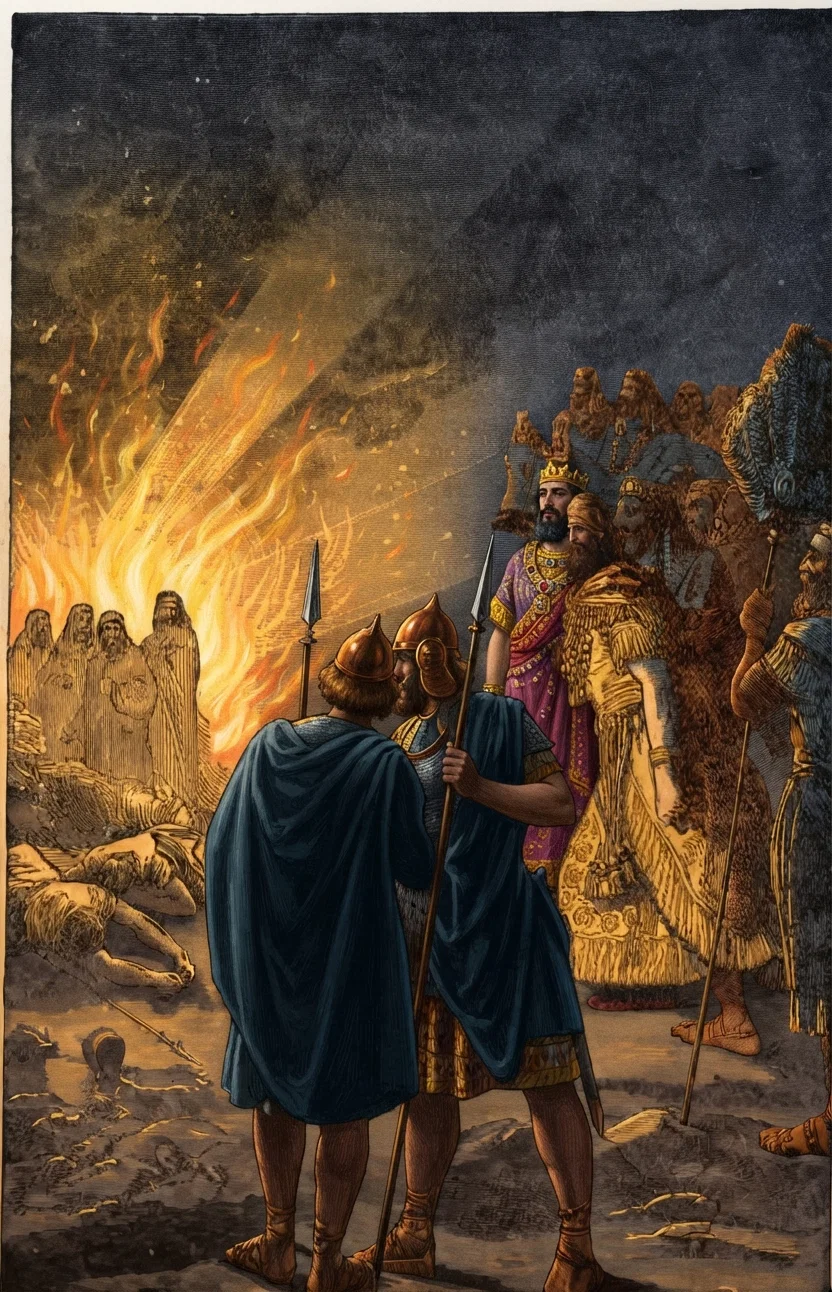
WHEN Daniel told King Nebuchadnezzar his dream and showed him the interpretation, the king acknowledged that Daniel's God was "a God of gods, and a Lord of kings." He made Daniel ruler over the whole province of Babylon, and chief of the governors over all the wise men of Babylon. Daniel's three friends, Shadrach, Meshach, and Abed-nego, were also given prominent positions. But, notwithstanding his acknowledgment of the superiority of the God of heaven, the king was not satisfied with the prophecy that his dynasty was to be overthrown. So he thought to thwart the purpose of the Almighty as foreshadowed in the great image.
With this purpose in mind, Nebuchadnezzar made a material image, and set it up on a high pedestal. Remembering that his kingdom was represented by the head of gold in the dream-image, he made his image all gold. Then he "sent to gather together the princes, the governors, and the captains, the judges, the treasures, the counselors, the sheriffs, and all the rulers of the provinces, to come to the dedication of the image." Dan. 3:2.
"Then an herald cried aloud, To you it is commanded, O people, nations, and languages, that at what time ye hear the sound of the cornet, flute, harp, sackbut, psaltery, dulcimer, and all kinds of music, ye fall down and worship the golden image that Nebuchadnezzar the king hath set up; and whoso falleth not down and worshipeth shall the same hour be cast into the midst of a burning fiery furnace." Verses 4-6. Now that the king had set up an image all gold, indicating the continued supremacy of his dynasty until the end of time, he proposed to add to its security by having the image dedicated as a universal deity.
But when the signal was given for all to bow down and worship the image, three men remained standing, in defiance of the king's command. These were Shadrach, Meshach, and Abed-nego, the three captive companions of Daniel. As Daniel is not mentioned in this connection, it is supposed that he was absent from the city. Then some of those Chaldean wise men, who were no doubt jealous of these Hebrews who had proved to be so superior to them in every qualification for preëminence, were quick to tell the king of this disregard of his command. Of course Nebuchadnezzar was furious, and immediately called the dissenting officers before him. He then repeated the order, and the penalty of disobedience, adding, "And who is that God that shall deliver you out of my hands?" He evidently thought that the God who had placed the Hebrews in his hand would not take them from him, and that no other god could do so.
But Shadrach, Meshach, and Abed-nego could neither be swayed by the multitude nor coerced by the wrath of the king. Knowing Him in whom they trusted, they answered: "O Nebuchadnezzar, we are not careful to answer thee in this matter. If it be so, our God whom
we serve is able to deliver us from the burning fiery furnace, and he will deliver us out of thine hand, O king. But if not, be it known unto thee, O king, that we will not serve thy gods, nor worship the golden image which thou hast set up." This was very plain speech to be addressed to one who was monarch of the world, and already angry because of wounded dignity. But the speakers were full of faith in Him who is able to remove and to set up kings. With such the commandment of God is always held above any civil law, no matter what the penalty may be.
Then the king was "full of fury;" his wrath knew no bounds. He commanded strong men to cast Shadrach, Meshach, and Abed-nego into the fiery furnace, which was heated seven times hotter than ever before. They were cast into the fire bound in all their clothing. The fire was so hot that it immediately slew the strong men who cast the condemned ones into it. Then, to all human expectation, the doomed men would be instantly killed by the heat, and quickly consumed. Soon, however, the king "rose up in haste, and spake, and said unto his counselors, Did not we cast three men bound into the midst of the fire? They answered and said unto the king, True, O king. He answered and said, Lo, I see four men loose, walking in the midst of the fire, and they have no hurt; and the form of the fourth is like the Son of God." The Revised Version reads, "a son of the gods," and as the king knew nothing of the Son of God as Christians know him, the latter rendering is no doubt the true one.
THREE HEBREW WORTHIES AND FIERY FURNACE.
However, the fourth person walking in the midst of the fire was the Son of God.
Then the king called to Shadrach, Meshach, and Abed-nego to come out to him, and they came forth from the fire. And all the king's officers "saw these men, upon whose bodies the fire had no power, nor was an hair of their head singed, neither were their coats changed, nor the smell of fire had passed on them." This remarkable deliverance drew from King Nebuchadnezzar another acknowledgment of the true God, and of the faithfulness of his servants: "Blessed be the God of Shadrach, Meshach, and Abed-nego, who hath sent his angel, and delivered his servants that trusted in him, and have changed the king's word, and yielded their bodies, that they might not serve nor worship any god, except their own God."
Thus easily and ingloriously came to naught the great Nebuchadnezzar's pompous effort to override the purpose of the Most High, who "ruleth in the kingdom of men." All that was necessary to do this was for the Lord to send his angel at the critical moment when the greatest power on earth had thought to overrule the commandment, "Thou shalt have no other gods before me." And God is just as jealous of any other commandment of his when antichrist in any form shall think to change it. The time will come when his Sabbath commandment, just as he gave it, will find as signal vindication as has any other.
But almost in the same breath with which Nebuchadnezzar acknowledged the supremacy of the "Most High God," he went to the other extreme, and issued the following edict: "Therefore I make a decree, That every people, nation, and language, which speak anything amiss against the God of Shadrach, Meshach, and Abed-nego, shall be cut in pieces, and their houses shall be made a dunghill; because there is no other god that can deliver after this sort." Verse 29.
This was a characteristic National Reform (or Church-and-State) decree, inasmuch as it was designed to annihilate as far as possible the memory of the offender. See also chapter 2:5. Under the rule of Papal Rome, under whose sway the Church-and-State principle reached the climax of cruel penalty, the remains of
John Wycliffe were disinterred forty years after his death, and burned, and the ashes cast into the river Swift, to be carried to the sea. Under this régime, for hundreds of years, burning and other modes designed to effect as far as possible utter obliteration from the minds of men, were in vogue. And in our day, in our own United States, certain National Reformers, in their advocacy of Sunday laws and other forms of State religion, have held up the same principle. One prominent leader openly suggests banishment for opponents of national religion. He classes all such opponents, Christian or unchristian, as atheists, and emphasizes the statement that "atheism and Christianity are contradictory terms. They are incompatible systems. They can not dwell on the same continent." Other expressions from the same8source indicate in very positive terms which party would have to go or be coerced were the State religion party in power. In this mania of human nature to rule or ruin, not only in secular but in religious matters, is made clear the ground of the oft interposition of the providence of God in removing kings and setting up kings. In 'man's inhumanity to man' we find the necessity to 'overturn, overturn, overturn' (Eze. 21:27), in the empire of the world, till the God of heaven shall set up a kingdom that will 'fill the whole earth,' and that 'will never be destroyed' (Dan. 2:35, 44).
"He which testifieth these things saith, Surely I come quickly. Amen. Even so, come, Lord Jesus." Rev. 22:20.
Question Corner
By Editor
"Enquire, and make search, and ask diligently."
No. 679. Against the Holy Ghost.
PLEASE explain Matt. 12:32: "And whosoever speaketh a word against the Son of man, it shall be forgiven him; but whosoever speaketh against the Holy Ghost, it shall not be forgiven him, neither in this world, neither in the world to come." J. Y.
The Holy Ghost, or Holy Spirit, is the manifestation of the Deity in operation. It is the life-force of God operating for the salvation of men. To save man it must be received by faith. Gal. 3:14. If so received it sanctifies and regenerates, and it is the only power that can. 1 Peter 1:2; 2 Thess. 2:13. If man rejects this manifest power of God, there is no other means by which God can reach him. That Spirit was manifest in Jesus Christ, even to the casting out of devils. The Jews said that the power was of Beelzebub. So when they thus rejected the only power that could save them, there was no more hope, nor forgiveness. There could be none. Compare with Mark 3:28-30.
No. 680. Ministration of Death.
THE expression "ministration of death written, and engraven in stones" (2 Cor. 3:7), is considered a figure of speech, I understand, meaning "ministration of death concerning things written, etc." Can you give a parallel figure of speech having a similar grammatical construction? W. H. S.
The only figure of speech claimed for it so far as we know is metonymy, in which the effect is put for the cause,—the ministration of that which caused death, because man sinned, as, "There is death [that which causes death] in the pot." "Man shall live by the sweat of his brow," that is, by the labor which causes sweat. But the transgression of God's law is sin, and the holding of that law simply in tables of stone, outside of the heart, is condemnation and death. See Bible Students' Library, No. 149, "From Glory to Glory," for a discussion of 2 Corinthians 3; 24 pp.; price, 1½ cents.
No. 681. The Passing of Paganism.
IS THERE any history to show A.D. 508 as the exact date for the taking away of the "daily" (paganism)? W. H. S.
See "Thoughts on Daniel," chapter 11:31; and chapters 21 and 22 of "Two Republics."
No. 682. What Sanctuary?
IS THE "sanctuary" in verse 11 of Daniel 8 the same as that in verse 14? W. H. S.
Both words come from the same root, and we see no reason why they may not refer to the same thing.
WILL you please explain 1 Tim. 4:1-5. The text reads: "Now the Spirit speaketh expressly, that in the latter times some shall depart from the faith, giving heed to seducing spirits, and doctrines of devils; speaking lies in hypocrisy; having their conscience seared with a hot iron; forbidding to marry, and commanding to abstain from meats, which God hath created to be received with thanksgiving of them which believe and know the truth. For every creature of God is good, and nothing to be refused, if it be received with thanksgiving; for it is sanctified by the Word of God and prayer." G. G. M.
The Lord here pictures a class of people that shall arise. It is the duty of each to see that he is not one of the class, by avoiding all teaching which would make him one. The text clearly teaches: (1) That the Spirit expressly gives this warning. (2) That it is applicable to the latter times. It certainly, then, has its application in our day. (3) Some shall depart from the faith. The true faith, the only faith, is the faith of Jesus, that which led him to obey God, and which, if we possess, will enable us to live his life. (4) Those who depart from the faith are led away by some form or forms of Spiritualism, and follow the teachings of demons. That is, they do not follow God's Word. (5) They do not do all that they do honestly, but "speak lies in hypocrisy." In doing this their conscience becomes hardened, seared, benumbed. (6) They forbid marriage, thus opposing an ordinance of God. Whether this is in respect to the celibacy of a class, or is general, matters not. (7) They will enjoin or command fasting, "commanding to abstain from meats," better from foods. The Greek word is broma, food. See its use in John 10:34; 1 Cor. 10:3 (the manna); Matt. 14:15; Luke 9:12. (8) This food is that which would and should be received with thanksgiving. (9) The reason is given in verse 5, "for it is sanctified [set apart, appointed] by the Word of God and prayer." The abstaining from foods must have reference to commanded fasts. The creatures which God has given for food may be eaten always by his people, and no one has a right to forbid them. In God's true church there are no enforced fasts; all fasting is voluntary. And he who eats will eat for strength not drunkenness, having regard for all that the Lord has said on the subject. He will not be longing for such a corrupt, unhealthy product as pork, nor lusting for the flesh pots of Egypt. But if so be that he can get no other food, he may believe that the life of God can make wholesome that which is unwholesome, even as he made the bitter water sweet. But he will not do this for him who eats to lust and not to God's glory. The only right rule is 1 Cor. 10:31.
The Outlook
By W. N. G.
THE W. C. T. U. AND NATIONAL REFORM.
AT the late W. C. T. U. Convention for the State of Pennsylvania, held at Williamsport, the National Reform cause was given considerable attention. Mrs. H. H. George reports the matter to the Christian Statesman, and says:—
“The convention gave support to the work by making the National Reform a separate department and appointing a superintendent. Heretofore the departments of Sabbath Observance and National Reform were united under one superintendent, Mrs. R. J. George, who sent in a request asking that National Reform be made a separate department. Already a letter has been sent to each county president asking that a superintendent be appointed in each county of our State.”
In mentioning the fact of her addressing the convention on the subject of National Reform, Mrs. George's report says:—
“At the close of the remarks, one woman arose and asked that those present join in singing, ‘All hail the power of Jesus’ name.’ We hope that the time is not far distant when all who join enthusiastically in singing, ‘Crown Him Lord of all,’ may put forth every effort to have the crown of this nation’s honors put on his head.”
It is strange how well-meaning men and women will persist in tempting the Lord with the empty honors which this world affords. They will “enthusiastically” sing, “Crown Him Lord of all,” and then offer him the crown of a very small portion of this little sin-cursed earth, which he has long ago declared must be melted with fervent heat, and the works that are therein burned up, before it will be a fit dwelling-place for righteousness. See 2 Peter 3.
The Saviour King was once offered “all the kingdoms of this world, and the glory of them,” if he would worship the power that offered it to him, but he spurned the offer as a blasphemous temptation. But by a species of adherence, little if any short of worship of the power that places him there, is the only means any one has of obtaining a high position in this nation.
The rulership of this nation is a political position, and the W. C. T. U. has long been working on the theory that “the kingdom of Christ must enter the realm of law through the gateway of politics.” So that if Christ were to stoop to accept the “crown of this nation’s honors,” he would place himself under obligation to some political party or power. And if he should attempt to carry out in his official position the principles of the Golden Rule, or the Christian principle of forgiving offenders who say, “I repent,” even to “seventy times seven,” it would not be long before his administration would be denounced as a failure. The people who clamor for government interference in the affairs of Turkey, or Cuba, or for the maintenance of a large army or navy in order to combat for prestige, would not long endure such a passive administration as Christianity would give. In fact, no earthly government would long stand the test of such an administration.
Christ wore this world’s crown once, and it was a crown of thorns. And if he were to come again to endeavor to inculcate the same principles that he then advocated, the world would give him just as cool a reception as it did on that occasion. “Yea, and all that will live godly in Christ Jesus shall suffer persecution.” 2 Tim. 3:12. This world never will endure Christ as a ruler, in this or any other nation. No one knows this better than he himself. He not only refused its crown when offered it by “the prince of this world,” but he declined it when the people would make him king. There is but one throne in9
this world of sin that is acceptable to him, and that is in the heart of the penitent sinner. “If a man love me, he will keep my words; and my Father will love him, and we will come unto him, and make our abode with him.” John 14:23.
Bible Readings.
By G. A. I.
"Seek ye out of the Book of the Lord, and read."—Isaiah.
"Whoso readeth, let him understand."—Jesus.
SPIRITUAL GROWTH.
Where There Is Life There Must Be Growth.
1. WHAT does the Lord promise to his people?
"I will be as the dew unto Israel; he shall grow as the lily, and cast forth his roots as Lebanon. His branches shall spread, and his beauty shall be as the olive tree; and his smell as Lebanon. They that dwell under his shadow shall return; they shall revive as the corn, and grow as the vine." Hosea 14: 5-7.
2. How do the flowers grow?
By receiving the blessings of the Lord. "For as the rain cometh down, and the snow from heaven, and returneth not thither, but watereth the earth, and maketh it bring forth and bud, that it may give seed to the sower, and bread to the eater; so shall my word be that goeth forth out of my mouth." Isa. 55 : 10, 11.
3. What should be our first desire when we are born again?
"As new-born babes, desire the sincere milk of the Word, that ye may grow thereby." 1 Peter 2 : 2.
4. In what are we to grow?
"But grow in grace, and in the knowledge of our Lord and Saviour Jesus Christ." 2 Peter 3 : 18.
5. What does the Saviour declare his words to be?
"The words that I speak unto you, they are spirit, and they are life." John 6 : 63.
6. What does the psalmist say the Word had done for him?
"If any man thirst, let him come unto me, and drink." John 7 : 37.
9. Until what time are we to grow?
"Till we all come in the unity of the faith, and of the knowledge of the Son of God, unto a perfect man, unto the measure of the stature of the fulness of Christ." Eph. 4 : 13.