IT had ben nigh onto eighteen years sence I had seen Hester Rogers (she wus a Brown), an' so as I wus comin' home from sister Melisse's, in Kansas, I stopped off an' made her a visit. She wus powerful glad to see me, an' I had a real good time; fur she hadn't changed much sence we went to school together, if she did show her age right smart, an' her man wus real clever. He didn't talk much, but I've thought sence 'twas because we kep' it a-goin' all the time—Hester an' me.
While I wus there Christmas come, an' they had a powerful sight of goin's on. I got there nigh onto a week before, an' Hester kep' speakin' about it all along, an' sayin' 'twus to be hel' in their church. I'd never ben to no sech doin's to Bean Blossom an' Nubbin Ridge, nur they didn't hev 'em to Bolton where I wus brung up, but then everything changes but truth, an' some folks try to change that. I'd always heerd about Cath'lics an' 'Piscopalians keepin' Christmas an' Easter an' Good Friday an' Lent an' St. Patrick's day, but I never thought Hester did, till I wus there. I never let on to her but what I knowed all about how they wus carried on, tho; but I didn't. She tol' me about 'em buildin' their new church that summer, an' jest dedicatin' it the Sunday before, so I s'posed it wus some kind of a sacred service or other.
We dedicate churches in Bean Blossom; but as Hester had one of Noah Webster's dictionaries, an' I didn't have much to do but jest knit, I looked up "dedicate," an' it means "to consecrate; to devote;" an' "consecrate" means "to declare to be sacred," an' "sacred" means "holy." So I knowed that in that new church that they had declared to be holy to God, they wouldn't think of havin' anything but a sacred service, for you know how Jesus drove the merchants out of the temple an' stopped its desecration, not even allowin' them to carry10any vessel through it. If it hadn't ben I thought of that, I'd have ben sure they wus startin' a store in the lobby or somewheres, the way the folks went in an' out of the church a couple of days beforehand, carryin' boxes an' bundles, only they took 'em in instead of out. It wus right close to Hester's, so I could watch 'em.
I didn't say nothin', tho, an' when the night (eve they call it) come, we got fixed an' went. When we got into the lobby, Hester's man went over to a man that wus behind a table that had a basket onto it (jest like the ones the deacons take up collections in to our church), an' handed him some money, an' he dropped it into that basket. I jest thought that wus their way of castin' into the Lord's treasury, till I saw him take two or three little silver pieces out of the basket, an' give 'em an' some cards to Hester's man, an' him give 'em (the cards jest) to a man at the door where we went in, jest like Baker an' me do when we go to the Brush County Fair. My, but I felt queer! Christ an' the tables of money-changers come to my mind like a flash. I didn't have long to think, tho, fur we went in an' got a seat. When we got settled down, like, I looked up to the pulpit, an', sir, up there, right under a arch, in the end of the church that had "Holiness to the Lord" painted on it in queer-shaped gilt letters, wus a white tent with toys an' clothes an' sech things hangin' all over it. There wus a evergreen tree, too, a little to one side, with 'em on, an' little candles burnin' onto the ends of the limbs. Well, I jest set and looked.
After a spell, when the house wus so full that men an' boys wus perchin' onto the pulpit steps an' standin' in the aisles, the minister got up an' said they would begin. He prayed, an' then spoke about Jesus bein' born in Bethlehem, an' the herald angels an' everything so nice, an' said that wus why they wus havin' the meetin'. I wondered why Parson Jones had never had 'em to Bean Blossom, an' thought to myself I'd speak to him about it when I got home. Jest as I thought that the minister said that he didn't know fur sure whether it wus Christ's birthday or not, so I reckon they jest played it wus, as the children say. I thought that would spile it fur me, unless 'twas certain, an' I could read it in the Testament jest what day he wus born, an' how it should be celebrated, if celebrated at all. Well, pretty soon they begun to sing, an' make speeches up there. Some of the little children spoke, an' real nice, too. I liked the music first rate, but I wus surprised that they sung songs, fur Hester had tol' me how they didn't think it wus right to sing anything but psalms in her church, an' I'd had a time of it all week chokin' 'em down, fur I'm always singin' 'round home. Hester an' the rest settin' back didn't sing with 'em, but I don't know whether 'twas because they wus agin' it or not; they didn't look mad nur nothin'.
They quit that, an' then the minister said something about presents, an' some men an' women went to takin' the toys an' things offen that tent an' evergreen an' handin' 'em to a man that roared out somebody's name as he hel' each one up, an' some young folks kep' takin' the things from him, an' carryin' them back to the folks they wus fur. This went on a spell, when, all to onct, all the folks begun to laugh right out in meetin'. When I looked, he wus holdin' up a white cotton nightcap. I watched the girl that took it, an' she give it to a man about forty-five years old, with a sleek bald head; an' he jest put it on, an' they all laughed agin. I did, too; fur I furgot about bein' to church, an' he looked so queer with that cap on, an' his face all over red whiskers an' grins.
Some got nice presents, too. They give Hester the nicest kind of a work-box, with spools an' needles an' a cushion in it all ready, an' I jest thought to myself I'd have one like it when I got butter an' eggs enough ahead at the store.
The first thing I knowed they wus callin' out "Mrs. Priscilla Baker," an' Hester's man got up an' motioned, an' they brought me one jest like hers exactly. It's awful nice an' handy, an' I keep it on a shelf Baker made me to one side the bay-winder.
Every onct in a while they'd laugh an' clap their han's an' stomp the floor like the boys used to to lyceum when I wus a girl. I didn't always know what wus the matter, tho. Onct it wus at a box of collars an' a bar of soap they give a man that Hester said needed 'em mighty bad. One young man got a old parasol an' a mince pie, an' another a emp'y beer bottle, an' the minister got a fine comb.
"Santa Claus, Santa Claus!" the little boys hollered, as a man all rigged out in a buffalo robe came out of that tent an' down the aisle, throwin' nuts and candy to the children in every seat. But I didn't enjoy it much more, an' wus glad when we got outdoors, where we could have a good breath agin. Hester an' me didn't talk much about the goin's on that night, fur it wus past bedtime when we got to her house, an' I started home early next mornin'. But it wus on my mind constant while I wus sailin' along on the railroad cars that day. After we'd past a few little towns, we come to a big one, an' a man got on, an' set down in front of me, an' 'twa'n't long till he tuck out a paper jest like the ones Hester showed me that her church prints, an' begun to read. I 'lowed from that he wus a gentleman, an' would know all about that service, so I jest tol' him all about bein' there, an' asked him where in the Bible it tells us how to do at 'em. He jest laughed kind of quiet like, an' said he didn't know unless it wus in some of the new version Bibles. When I got home I tol' Baker about it, an' he said, "Why, that hain't nothin' very new, mother, I've ben readin' fur some time that they're hol'in' 'em into most all the churches, back east, anyways." He wa'n't much tuck up with it, but I tol' him if we'd ben neglectin' something in the Lord's worship, we'd best fin' it out, an' commence.
Well, we read the Testament clean through, an' couldn't fin' one place where it says to keep Christmas, nur to have tents and gifts fur everybody, an' laugh an' stomp into churches. We can't even find out what day or month Christ come into the worl'. If anybody's got one of them new version Bibles with it in, I'd like to get it. The Lord killed Nadab and Abihu fur having strange fire 'round the tabernacle "that he had not commanded." So I want to see it in the Bible, an' be shore to get everything exactly like it's commanded, when we go to have 'em to Bean Blossom, an' so does Baker, an' I think Parson Jones.
PRISCILLA ANN BAKER.
REASON FOR REMOVAL OF ARCHBISHOP KEANE.
By M. E. Kellogg
THE removal of the Catholic Archbishop Keane from the head of the Catholic university at Washington, D. C., has quite generally been believed to have been because of his liberal principles, which the reactionary, or ultramontane, party in the Catholic Church could not bear. This view of the case is now confirmed by the words of Archbishop Keane himself. At a late banquet tendered him in Washington by very many distinguished statesmen and ecclesiastics, in anticipation of his immediate departure to Rome, the archbishop, in his response to the eulogies upon him and his work, had this to say:—
"For the realization of so vast and noble a purpose (the welfare of America), I have been not only anxious to do conscientiously my own humble part, but ready to give just recognition to whatever any believer in Christ, or even any believer in God, might be striving to do toward the same great end. Carping critics have asserted that in this I minimized Catholic truth, and dragged it down to the level of man-made and imperfect Christian systems, or even of heathen unbelief. In so saying they have totally and, I can not but fear, wilfully misrepresented me. I have always been glad, and even proud, to utter the fulness of the truth in any assemblage of human beings who care for the truth; for I hold with St. Paul that to believers and unbelievers, to Gentiles and to Jews, the church of Christ is still a debtor; but I have never forgotten that the power of the truth consists in its presentation in all its symmetry and beauty and fulness; I have never sacrificed or compromised one tittle or iota of it; and they who assert that I have, assert what is false. May God forgive them; I have no controversy with them."
Ordinarily the removal of a Catholic archbishop would be of no particular interest to us; but this is of interest to us, since it shows that the head of the Catholic Church at Rome is afraid that the American Catholic Church is in danger of casting off some of its medieval trappings, and coming more into harmony with the spirit of the age. It also shows that the Catholic Church of America to-day is under the control of that element in the church that looks to the times of Gregory VII. and Innocent III. as the best and brightest illustrations of what the Catholic Church should teach and do. Surely this bodes no good to American freedom.
As for Archbishop Keane, he has been promoted(?) to an office in Rome, where he can be carefully watched, used to good advantage, and prevented from doing any mischief. M. E. K.
Closing the Post Office on Sunday
The Tribune of this city says that "the local union of Christian Endeavor Societies has taken up the movement which is becoming general in regard to the closing of the post-office on Sunday. The pastors will be requested to preach on the subject December 12, when the Endeavorers will also take it up. January 2 it will again be the subject in local pulpits, and a petition will be circulated to be signed by those who are in favor of the movement. The petitions to have the office closed on Sunday will then be forwarded to Washington, D. C. Mass-meetings will also be held to advance the cause."
Investigating the Armenian Question
By Editor
The New York Herald has sent George Hughes Hepworth, D.D., one of its staff, to Armenia, to learn all about the Armenian question from A to Z, and report the same through the Herald. One writer in the Herald says that "he will write as a Christian man, the representative of a Christian nation." The first he can do if he is truly a Christian: but the second he can not do; for no nation as such sends him, and there is no recognized nation on this earth that is Christian. However, it will be of interest to read the results of Dr. Hepworth's investigations.
SOMETIME.
By Lillian Gray
SOMETIME, we shall know why
Our sunniest mornings change to noons of rain;
And why our steps are shadowed so by pain;
And why we often lie
On couches sown with thorns of care and doubt;
And why our lives are thickly hedged about
With bars that put our loftiest plans to rout.
Sometime, we shall know why
Our dearest hopes are swept so swift away,
And why our brightest flowers first decay;
Why song is lost in sigh;
Why clasping fingers slip so soon apart—
Estrangement, space, and death rend heart from heart,
Until from deepest depths the tear-drops start.
Sometime, we all shall know
Each other, aye, as we ourselves are known;
And see how out of darkness light has grown.
And He—who loves us so
Despite our wilfulness and blind complaint—
Will show us how his kind and calm restraint
Can mold a human soul into a saint.
Sometime, our eyes shall see
The silver lining to the darkest cloud,
While silvery echoes follow thunders loud.
Sometime, our hearts shall be
Content, forgetting all our restless mood,
And knowing everything has worked for good—
The how, and when, and why, be understood.
—Lillian Gray.
Alcoholic Insanity
By John Harvey Kellogg
ALCOHOLISM.
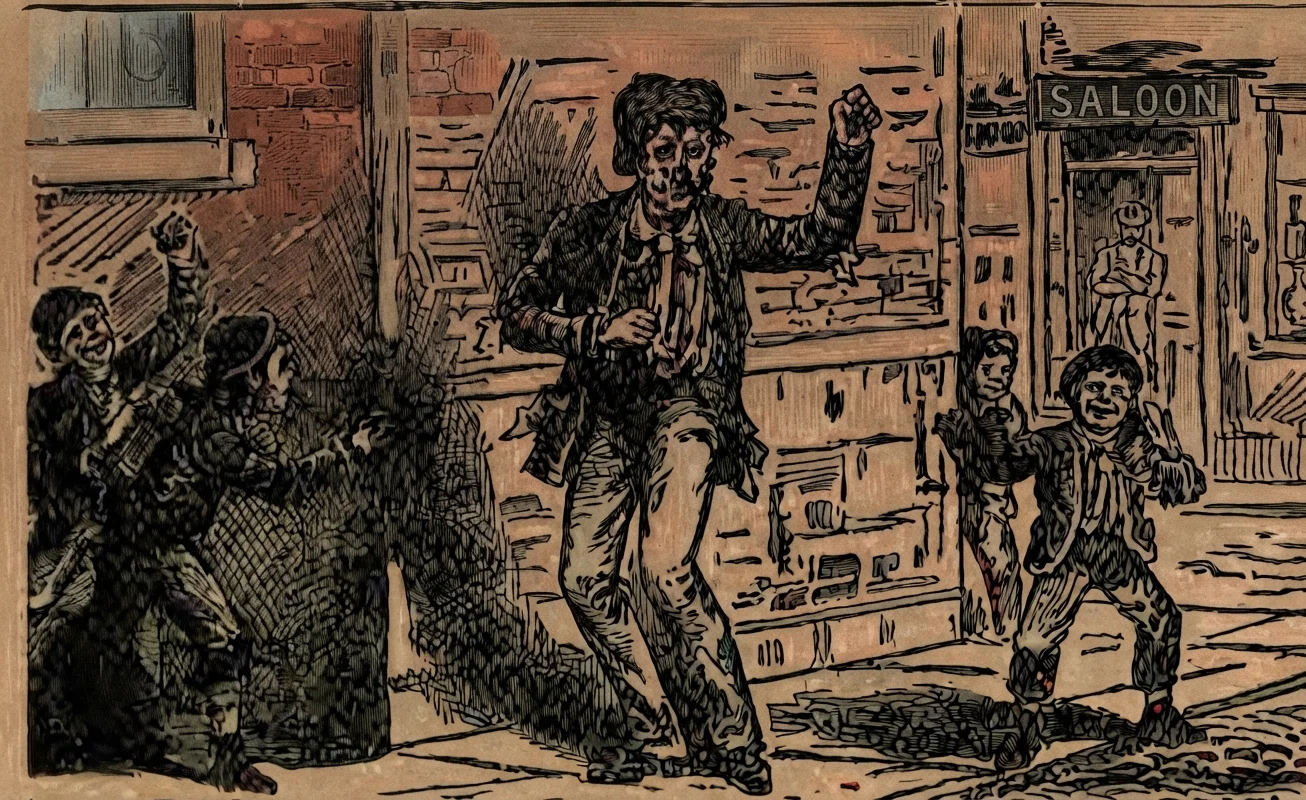
It is not necessary to tell the reader that the above picture is a representation of a drunkard. Such a man is recognized at once as a victim of alcoholism or inebriety, a vice-disease which is scarcely known outside of civilized countries, but which is recognized as a real malady, with symptoms as distinct and characteristic as those of smallpox or cholera.
We recognize the man who is afflicted with this disease by his trembling hand, his tottering gait, his bleared eyes, his haggard or bloated and repulsive visage, and his generally debased and besotted appearance. His muscles are soft, relaxed, feeble, and the subject of fatty degeneration. His stomach, liver, kidneys, heart, lungs, and other "internal arrangements," are all degenerated and demoralized as the result of his long indulgence in the poison of the cup. When he awakes in the morning, he seems to have scarcely power to raise his head from the pillow until he has had an "eye-opener" to whip up his flagging energies and goad them on to the complete exhaustion of his vital stamina. Another glass is needed to wake up his benumbed and crippled stomach sufficiently to produce a suggestion of an appetite. After breakfast, another glass is needed to digest the meal and steady the nerves for work.
So the poor fellow goes on. He may have no liking for the taste of liquor, perhaps he even loathes it; but his long use of the poison has created a diseased condition which nothing but liquor will remove, and to which the accustomed dram gives immediate and complete relief, altho each time the malady is "cured" in this way the disease strikes its roots down deeper into the constitution, and the necessity for the repetition of the remedy becomes more urgent and more frequent.
Thus the malady progresses until the victim of this disease becomes a total physical and moral wreck, and ends his wretched existence with apoplexy or delirium tremens, and is buried in a drunkard's grave.
The effects of alcoholism are mental and moral as well as physical. As the physical tone is lowered, the mental tone goes down also. The will is gradually weakened, until the victim of the disease becomes wholly a prey to the wild caprices of his depraved appetite.
A lowered nerve and mental tone implies a lowered moral tone as well. A benumbed conscience and a paralyzed will are the best possible preparation for all sorts of lapses from morality. Undoubtedly, alcoholism is responsible for a much larger share of the crimes annually committed in enlightened and civilized lands, than the majority of people suspect. A man whose instincts are naturally pure, and who has been previously a law-abiding citizen, under the baneful influence of alcohol gradually loses his respect for morality and his sense of obligation to his fellow-men. His own self-respect is lost, and he becomes an easy prey to temptations and to evil deeds of all sorts.
Alcoholic Insanity.
That inebriates are, of all classes of men, the most subject to diseases of the mind, is a fact which has been long established as a medical and scientific fact. The effect of alcohol is to produce a temporary insanity which does not differ essentially from the condition which constantly exists in the insane person. The different degrees of alcoholic intoxication exhibit in the most perfect manner all the different phases of real insanity. The man who "is fighting drunk" is the maniac. The man who is silly drunk or stupidly drunk, is the pathological analog of that stage of insanity known as dementia. A similar analogy exists between the other phases of insanity and intoxication. It is easy to see how the inebriate becomes insane. The frequent repetition of the temporary insanity of alcoholic intoxication after a time establishes the chronic condition, through impairment of the nutrition of the brain and its functions. The marvel is that a larger number of intemperate men do not become insane. It is highly probable that the forms of insanity produced by drink are far more common than is generally supposed, even by physicians. Many of these persons pass as cranks and eccentric individuals, and are not adjudged insane, simply because their insanity happens to assume some comparatively harmless form, altho they are always just upon the border line of complete mental derangement, and liable to develop the most dangerous forms of lunacy at any moment.
Hereditary Insanity.
Strange as it may appear, the worst injuries inflicted upon the mind by alcohol are not suffered by the intemperate man himself, but fall upon his children. We have in the hereditary effects of alcoholic intoxication the best possible illustration of the truth of the ancient proverb, "The fathers eat sour grapes and the children's teeth are set on edge." The statistics of insanity show beyond the possibility of controversy that the greatest number of recruits for our insane asylums come from the families of drunkards. The temporary physical condition resulting from the use of alcohol and causing temporary insanity in the parent, becomes a fixed and often hopeless condition in the child. Here is the undoubted source of a great share of the notable increase in the number of the insane which has of late attracted the serious attention of many eminent physicians and philanthropists.
The two greatest difficulties which stand in the way of the reformation of confirmed inebriates are the weakened will and the physical suffering11which is occasioned by the withdrawal of the narcotic poison which has benumbed the nerves and which is capable of producing a delusive freedom from pain and a seductive comfort for which nothing else is a perfect substitute. Every confirmed drunkard ought to be regarded and treated as a diseased man, a man who is infirm in body and in mind. A cure of the drink habit can not be effected without a cure of the alcoholic disease first, as in all old drinkers the disease is the real foundation of the habit and the chief obstacle to the cure.
Let every young man who has not yet become a victim of the terrible soul-and-body destroying disease, alcoholism, consider well before he exposes himself to the risk of becoming another on the list of so many thousands of victims whom it annually carries into poor-houses, prison-houses, mad-houses, and then at last to that narrow house which bears the ignominious epitaph, "A Drunkard's Grave."
J. H. KELLOGG, M. D.
AN EXPERIENCE WITH TOBACCO.
By Geo. Vanderpile
I LEFT my native country (Holland) when I was twenty-five years old, and, like very nearly all of my countrymen, I smoked a great deal of tobacco. It seriously affected my nervous system, but I did not know it. Well did I know that my arm was unsteady and my hand trembling, but the cause of it I did not understand. About two or three years after coming to this country, and while I was engaged as janitor in the public schoolhouse in Montague, Mich., I chanced to pick out of a waste-box a piece of the SIGNS OF THE TIMES. The main article in it was an exposition of the effects of tobacco on the human system. I was told my nervousness was caused by the use of tobacco, and that unless I gave it up at once I would soon be a physical wreck. I at once saw the force of the argument and realized the danger I was in. At once I resolved to give the matter a trial, and see whether the writer knew whereof he was affirming.
I smashed my pipe, and threw my idol in the furnace. Results: I am now almost fifty years old, my arm is steady, my hand is firm, my nerves are restored to their normal condition. And, altho I threw away the filthy weed in my own strength, without ever praying God to deliver me from the power and influence of the stuff which is most esteemed among men, and is an abomination to the Lord, I feel grateful to him for the strength to keep it from me all these years. And I also feel grateful to our Adventist brethren for publishing said article, through which, and by which, I was made a man once more.
GEO. VANDERPILE.
Harriman, Tenn.
OUR WORK AND WORKERS.
By Editor
Six new members were added to the church at Moravia, Iowa, on the 20th ult.
As a partial result of tent-meetings held at South Webster, Ohio, fourteen persons have taken their stand on the truths presented.
ON Monday, the 22d ult., a German church of eight members was organized at Sherwood, Defiance County, Ohio, by Elder S. S. Shrock.
FOUR persons have recently begun to observe the Sabbath of the Lord as a result of labor on the part of members of the church at Saginaw, Mich.
ELDER C. N. SANDERS reports the baptism of four persons at Mancelona, Mich., who have been keeping the commandments of God for three years as the result of Bible readings.
THE laborers in the work with the Signs of the Times in Toronto, Ont., report excellent success. They had about three hundred short-term subscriptions at last account, and the list was still increasing.
OUR Spanish paper, El Amigo de la Verdad, published at Guadalajara, Mexico, has entered upon its second volume. Monthly, 50 cents a year. It is a good missionary document to send to Spanish people, and ought to be well patronized by our people.
AT Macksburg, Iowa, November 19, Elder H. M. Richards baptized nine candidates, having the use of the Baptist Church baptistry for the occasion, and a large audience to witness the administration of the ordinance. A new church building is now under way.
ON Thanksgiving day the church in this city sent out seventy-five baskets of provisions and about two tons of coal to needy families. The blessings of such work are always mutual; yet the giver has somewhat the advantage, for "it is more blessed to give than to receive."
A SPECIAL course of ten weeks, commencing January 5, has been prepared at Union College, Nebraska, for workers in the field who feel the need of better preparation for their work, and for others who desire the privilege of such a course, in order to enter some department of the work.
MRS. M. C. KENYON, of Lansing, Mich., writes to Field Echoes: "We report for the Earnest Workers' Band at this place, twenty-seven members. Thirteen of these are working with the Signs of the Times. . . . We are hopeful that the effort will result in much good, not only to those outside of our circle, but to the spiritual good of the church."
BROTHER WARREN LATHAM, of Spokane, Wash., has "demonstrated that the papers [Signs of the Times] can be sold successfully, and a good living can be made from the papers, thus making one independent." But he has been called from this work to take charge of the Workingmen's Home in that city, and must needs give up the paper work as a specialty. Of the work to which he has been called, he writes, under date of November 24: "We had nearly 100 men sleeping on the floor of our reading-room Thursday night, and thirty-one to our five-cent dinner to-day."
A CONVENTION of conference presidents and physicians is held in Chicago, December 7 to 17, in the interests of city mission and Christian help work. Elder W. T. Knox and A. J. Sanderson, M.D., respectively president of California Conference, and physician-in-chief of the St. Helena Medical and Surgical Sanitarium, are in attendance from California.
THERE is a Christian Help Band at Marshalltown, Iowa, "only a few," so the report in the Workers' Bulletin says. They are evidently helpers indeed. In the past year they have sent two boxes to Chicago and one to the South, and have now sent one to the Haskell Home, at Battle Creek, Mich. This last box contains 35 new garments, 7 new quilts, and 15 partly-worn garments.
THIS, among other instances of rescue work in Cleveland, Ohio, is told in the Welcome Visitor: "One poor fellow was on his way to Lake Erie to end his miserable existence. He felt as tho he were forsaken of all. Passing by the mission and seeing a cheerful fire within, he came to the door, was welcomed as a brother, and saved. He testified in one of the meetings, with tears running down his cheeks, of the kindness and love shown him, and this had saved him from a watery grave."
THE "Special School Number" of the Christian Educator, published at Battle Creek, Mich., is replete with matter pertaining to our educational work. It contains forty pages, eight of which are of illustrations of our various denominational institutions, mostly educational. The Educator is filling an important place in our literature, not the least of which are the departments pertaining to home teaching. Its low price of forty cents a year is not to be compared with its true value in the family.
ELDER I. H. EVANS, president of the General Conference Association (the business arm of the General Conference), arrived in California on the 3d inst., and left for Texas on the evening of the 7th. He visited the sanitarium at St. Helena, the college at Healdsburg, and the publishing house here in Oakland. It was his first visit to the coast, and, altho he was on a flying tour, those who had the privilege of a personal meeting were glad to see him, and hope he will come again, and stay longer.
IN reporting to the Review his labors in the Caucasus, Elder H. P. Holser says: "It is in this field that in one of our companies both men and women were imprisoned two days for every time they attended Sabbath meeting. They were a large majority of the village, and among their men were all the strong ones physically; yet a small, weak minority could bring all this hardship upon them for more than a year. This illustrates the injustice that may be wrought by a few unprincipled men when the State makes laws concerning religion. Such laws discriminate against the righteous in favor of the wicked. But for some time these brethren have been left to meet undisturbed; and in general there is less persecution than formerly in the Caucasus; the enemy, having experienced that the truth has come to stay, has abated his fury. It was in this vicinity that the truth first entered among the Russians; and, tho the first man to embrace it was soon banished, the seed sown by him has continued to grow and multiply until there are now over a hundred Sabbath-keepers in this vicinity."
Story of Pitcairn Island
By Rosalind Amelia Young
Written by a Native Daughter
ROSALIND AMELIA YOUNG
“Na
"No better romance can be found in the annals of truth."—Christian Cynosure.
An account of the Mutiny of the English Sloop of War Bounty, and the adventures of the Mutineers among the Islands of the Pacific.
39 Bond St. OAKLAND, CAL. 14-18 W. 5th St.
New York City Kansas City, Mo.
GOD'S ENGINEERING.
By Louis Albert Banks
WHAT is believed to be one of the greatest engineering feats on record was accomplished recently in Philadelphia. The old iron span in the Pennsylvania railroad bridge, crossing the Schuylkill River, in Fairmount Park, was replaced by a new structure of steel in the space of two minutes and twenty-eight seconds, accurately timed. The substitution of the new bridge for the old was effected between the passage of two way trains over the bridge only nine minutes apart, that is, one train went over the old bridge, and nine minutes later the train that followed ran over the new bridge. Seventeen hundred tons was lifted out and into place by adequate machinery without delaying a train. That is surely a wonderful piece of engineering for a man to perform, but how slight compared to the engineering of Him who takes care of all the worlds, and never misses track of one! Even in our own little world how marvelous is the engineering skill that brings the sunrise always on time, and never permits the restful night to be delayed a moment overdue. The seasons come and go in orderly precision; seed-time and harvest do not fail. Surely we may trust the affairs of our little lives with perfect confidence in the hand of the Great Engineer.
—L. A. Banks, D.D.
THE PEANUT IS THE FRUIT.
THE peanut, says the Farm News, is coming into greater prominence every year as a factor in the world's supply of things needful, and there is hardly any limit to the predictions of the uses to which it may be put. At the same time, the territory in which it may be grown is rapidly extending and it is not too much to hope that it soon may become a really important crop in this country. Peanut oil is now highly valued in Europe, and peanut flour, said to be extremely nutritious, is used extensively in Europe, especially in hospitals. An oil factory, with a capacity sufficient to use five tons of peanuts daily, has been established at Norfolk, Va. In a prospectus issued by the company it is calculated that the receipt from five tons of peanuts will amount to 235 gallons of refined oil, at $1.00 per gallon; 175 gallons of crude oil, at 50 cents; 3,680 pounds of flour and meal, at 2 cents, and 3,300 pounds of stock feed, at 60 cents per 100 pounds, making the total gross receipts $415.90 per day, which, it is estimated, would give a yearly profit on a five-ton factory of $19,725.
P R O M I S E S.
By Flora Warren
SINFUL soul, why longer wander
As an exile on life's sea,
Burdened with thy sins so many?
Hear what Jesus says to thee:
"Come to Me, ye heavy-laden,
Come, ye weary and distressed;
I will welcome, I'll forgive thee;
Come, My child, I'll give thee rest."
Let not grief thy soul o'erburden,
Or thy sorrows heavy weigh;
There is comfort near thee ever,
Hear, O hear, thy Saviour say:
"I have borne thy griefs and sorrows,
Then be joyful, O ye sad!
I'll have mercy on My people,
I have comforted, be glad!"
FLORA WARREN.
Niles, Mich.
THANKS.
By L. A. Holobaugh
EDITOR SIGNS: I wish to thank, through the SIGNS, all who have so kindly and promptly sent me the paper for use in the canvassing work.
L. A. HOLOBAUGH.
Jackson, Ohio, Dec. 1, 1897.
The Sunday School
International Series.
LESSON I.—SUNDAY, JANUARY 2, 1898.
JESUS AND JOHN.
NOTE.—"In studying the life of Christ as reported by Matthew, we need first of all to put in our minds the whole scheme of his life, and keep it there while we are studying the details. See that each lesson finds its place and meaning in the life and work of our Redeemer. . . . The Word, who became Jesus on earth, was the eternal Son of God. By him the worlds were created. From his glorious home he came to this world to reveal to us our Father in heaven, to express his infinite love, to bring us messages of forgiveness and hope, to give his life in atonement for our sins, to redeem the world from sin to holiness and heaven."—Peloubet. Jesus was born in the latter part of the Jewish year B.C. 5, a little over four years before the beginning of the era marked by his name. Study in connection with the lesson scripture Isa. 40: 1-5; Matt. 1 and 2; Mark 1: 1-11; Luke 1-3; John 1: 1-18. For prophecies concerning Jesus, see Isa. 7: 14; 9: 6; 11: 1; Micah 5: 2.
7 "But when he saw many of the Pharisees and Sadducees coming to his baptism, he said unto them, Ye offspring of vipers, 8 who warned you to flee from the wrath to come? Bring forth 9 therefore fruit worthy of repentance; and think not to say within yourselves, We have Abraham to our Father; for I say unto you, that God is able of these stones to raise up children 10 unto Abraham. And even now is the ax laid unto the root of the trees; every tree therefore that bringeth not forth good 11 fruit is hewn down, and cast into the fire. I indeed baptize you with water unto repentance; but he that cometh after me is mightier than I, whose shoes I am not worthy to bear; he shall 12 baptize you with the Holy Ghost and with fire; whose fan is in his hand, and he will thoroughly cleanse his threshing-floor; and he will gather his wheat into the garner, but the chaff he will burn up with unquenchable fire.
13 "Then cometh Jesus from Galilee to the Jordan unto John, 14 to be baptized of him. But John would have hindered him, saying, I have need to be baptized of thee, and comest thou 15 to me? But Jesus answering said unto him, Suffer it now; for thus it becometh us to fulfil all righteousness. Then he suffereth him. And Jesus, when he was baptized, went up straightway from the water; and lo, the heavens were opened 16 unto him, and he saw the Spirit of God descending as a dove, 17 and coming upon him; and lo, a voice out of the heavens, saying, This is my beloved Son, in whom I am well pleased."
Golden Text: "This is my beloved Son, in whom I am well pleased." Matt. 3: 17.
SUGGESTIVE QUESTIONS.
(1) Who among others appeared at the place where John was baptizing? Verse 7. (2) What question did he ask of them? Same verse. Note 1. (3) What test did he give by which they might show their sincerity? Verse 8. (4) In what were they evidently placing their trust? Verse 9. (5) How did John show that God was not dependent upon them for the fulfilment of his promise to Abraham? Same verse. (6) What warning did he give them in regard to the work which was now being done? Verse 10. Note 2. (7) What might those expect who did not heed what is quoted in verse 8? Same verse. (8) With what and unto what was his baptism? Verse 11. (9) What did he say of the One for whom he was preparing the way? Same verse. (10) With what would he baptize? Same verse. Note 3. (11) What would he do with his threshing-floor? Verse 12. (12) How would the wheat and chaff be disposed of? Same verse. (13) Who else came to be baptized by John? Verse 13. (14) What did John seek to do? Why? Verse 14. (15) What reply did Jesus make? Verse 15. (16) What occurred after Jesus had been baptized by John? Verse 16. (17) What accompanied the opening of the heavens and the descent of the Holy Spirit? Verse 17. Note 4.
NOTES.
1. Offspring of vipers.—It was a strong comparison. The viper was the most dangerous of the poisonous snakes of Syria. The Pharisees and Sadducees were in a position to do great harm, and were doing it constantly. They had come (or some of them at least) to be baptized, to go through the form, not that they were repentant or had a desire to change their nature. Compare with this expression of John what the Saviour says in John 8: 44.
2. Ax laid unto the root of the trees.—Ready to cut down the tree if it continued to bear unprofitable fruit. The last special work was now being done for the Jewish nation as a nation. "The forces were already in operation which led to the destruction of the Jewish nation forty-four years later."
3. With the Holy Ghost, and with fire.—The baptism of the Holy Ghost began to be experienced on the day of Pentecost, and its reception is elsewhere mentioned in the records of the early church; but the baptism with fire will be experienced by those who have rejected every ray of light and thereby become cumberers of the ground, or, as in the other figure, the chaff of the threshing-floor. This seems evident from the verse which follows.
4. This is my beloved Son.—Three times did the voice from heaven bear witness to Christ and his work on earth: at his baptism, at his transfiguration (Mark 9: 7), and during his prayer to the Father recorded in John 12. See verse 28. As many times as Peter denied him the Lord indorsed his mission.