Your ShelfYour Projects

Review and Herald, Vol. 80, No. 13.

Transcendent Love
Earlier text: Bribery in Rhode Island Elections

Dispossessing Life’s Strongholds

Every Caleb will find life's strongholds filled with Anakims. They dwell in the heights of every noble ambition, and victory lies in their dispossession.

Deference Between Husband and Wife

THE man who, after a rude remark to a lady, begged her pardon, saying he had thought it was his wife, was of the kind very apt to be agreeable when outdoors, and disagreeable when at home, the man who not only has never profited by the old fable of the sun and the north wind, who has failed to perceive that courtesy is the flower of civilization and the essence of Christianity, but who has never learned that in the long run it is a good-paying investment. No man can hope to retain his wife’s affection, if she is much of a woman, who constantly offends her sense of propriety and outrages her feelings by his rudeness. She looks with envy at the woman whose husband listens with the appearance of pleasant interest when she speaks, sees always that she is well served, taps on her bedroom door before he enters, by his own deference obliges that of others; and in the absence of courtesy, and its visible evidence of appreciation, she ends by dethroning the demigod that every woman’s husband is to her in the beginning, holding in his place an ideal with small resemblance to himself as the thing she would have liked for the guardian of her home, always a little saddened by realization of the impossibility of its actual existence, and inevitably regarding her husband from a plane of personal superiority.
A corresponding disregard for her best happiness is shown by the woman who allows herself to treat her husband with disrespect, who breaks in upon his remarks, directs upon him her ridicule, points out his deficiencies, and complains of him to others. That woman’s husband, after a while, must feel a deadening of sensibility so far as she is concerned; she may have a partner, she no longer has a lover. And, meanwhile, she has lowered her own standard; for, after all, it is her husband; and if it is not true that as the husband is, the wife is, nevertheless the wife takes her rank from and through him; and if he is so poor a thing, moreover, it is supposedly the most in the way of husbands that she could attain.
Manners, said Aristotle, are the lesser morals; and to one who searches there is a moral and a reason behind every principle of their code. The offender against their code is considered a boor because he breaks down that which refines and sweetens life, and nowhere is this code so vital as in the intimate relations of the married, where it stands forever in the way of that rough familiarity which breeds contempt.
There are individuals who have the singular notion that attention to the minute matters of politeness in general is a confession of inferiority, and that, as between husband and wife, it is a silly superfluity. A man is afraid of being thought uxorious; a wife is afraid of seeming afraid; each thinks a certain carelessness, a certain roughness and brusquerie, the desirable method in public, leaving one to infer how much worse the want of courtesy may be in private.
Why it should discredit a man to show, so far as a sufficiently gentle and deferential manner does it, that his wife is of more importance to him than all the rest of the world is, or why a woman should think her acquaintances would esteem her less on seeing that she looks up to her husband, regards him as the last and greatest work of creation should be regarded,—as they every one of them either regard their own, or wish they did,—will always be a mystery. For, in point of fact, the more either asserts the other’s dignity, gracefully and naturally, and as without effort, the greater proportions that dignity assumes, while really each is honored in honoring the other, and each is happier.
For the rest, the home where delicate manners between the husband and wife are neglected is almost always a scene of strife and vulgar bickering, with partisan feeling. This child resents the careless or flippant indifference on one side; that child resents the bullying on the other; and union and harmony become unknown quantities. But the home where a fine courtesy prevails, where the husband entreats the wife as he would the first lady in the land, and compasses her with sweet observances and sympathetic care, where the wife never fails with the gentle word, the answering smile, the foreseeing thoughtfulness, the compelling respect, is a home where, if love did not exist beforehand, he would come to make his nest and abide continually.—Harriet P. Spofford.

Uncooked Foods

We have recently been requested to give our opinion regarding uncooked wheat bread. We have no acquaintance with this food personally, and can only consider the matter in the light of the principles involved. The statement is made in a circular issued by a manufacturer of uncooked wheat bread that “cooking not only destroys the vitality of the food, but makes it a poison.” “Eat uncooked, healthy, live food, and live; or unhealthy, cooked, dead food, and die. ‘There is no life without life,’ and no continuation of life without other life.”
This is all assumption, and gives evidence of ignorance of the real nature of foods and digestion. Many foods can be eaten raw with advantage, and no doubt the cook-stove is used too much; but that cooking converts foods into poisons remains to be proved.
The greater part of animate creation—the vegetable kingdom—gets all its nourishment from non-living matter. The air and soil provide oxygen, carbon, hydrogen, and nitrogen; and from these elements and a few others the plant builds up its complicated structure. From the non-living only, the plant gets all the material with which it makes up its living tissues. This fact itself is a refutation of the statement that “there is no continuation of life without other life.”
Again: is it supposed that wheat which has been masticated and subjected to the action of the gastric juice is still “alive”? Would it grow if planted? All physiologists know that in whatever form carbohydrates are eaten, they enter the blood current in the form of grape-sugar. Whether the food was some wheat eaten raw, or a baked potato, or a granose biscuit, or an apple, the result is the same so far as the final product is concerned: it all turns into grape-sugar, that is if it is taken into the blood at all. Quite often raw starch is not digested at all, and as a rule it is much harder to digest than cooked starch.
Again: whether an egg be eaten raw, or soft boiled, or hard boiled, the proteid material goes into the blood in the form of peptone. Whether the food be cooked or uncooked, the process of digestion destroys any life that may be present. So far as the final product is concerned, it matters little whether a food is cooked or raw; the only difference is that with cooked foods less digestive effort is required by the system, as cooking is a process of partial digestion. Starch granules, which are very difficult of digestion in the raw state, are by the process of boiling broken open, so that digestion becomes a comparatively easy matter. Any one can try the experiment for himself.
First secure a solution of iodine containing one grain of iodine, two grains of potassium iodide to one ounce of water. When this solution comes in contact with undigested starch, it becomes blue. Fully digested starch gives no reaction to this solution; that is, it remains colorless.
If a bit of raw starch, wheat, for instance, be masticated for, say, one minute, it will yield a blue color when treated with the iodine solution, showing the presence of undigested starch. If, on the other hand, a little starch paste be masticated for awhile, it will yield no test for starch, and Fehling’s solution will show the presence of an appreciable amount of sugar. Nearly every one knows something of how a raw potato would go as a food. It is practically indigestible by the saliva, whereas cooked potato is very readily digestible.
If one understands that the living plant structures use no living food in their growth, and that the gastric juice cuts and corrodes the food until it is changed much more than cooking changes it, it will not be difficult to detect the fallacy of the raw food theory.
But we have nothing to say against the use of raw foods—foods in their natural state—much more than is usually practiced. Fruits and nuts especially (excepting the peanut), having little or no starch, are excellent raw, and are so eaten by many. The cereals, for most people, are much better cooked—and well cooked. The legumes, especially beans, require thorough cooking. Pacific Health Journal.

When We Get Home

WHEN we get home, there’ll be no heartache, No weary days of toil and care, There’ll be no trembling, halting footstep, No wrinkled cheek, nor whitened hair.
There’ll be no lonely nights of watching, No fever flush, nor failing breath, No pulseless heart, nor awful stillness, In that blest land that knows no death.
There’ll be no sinning, and repenting, No broken vow, nor vain regret; For in that home-land bides no sorrow, No eyes with bitter tears are wet.
There’ll be no storm-cloud to appall us, No desolating wind to blow, No blasting, burning heat of summer, No cruel cold, nor drifting snow.
But safe within our Father’s dwelling, Beyond the reach of all that mars, We’ll live for aye, and sing his mercy, Beyond the sun, beyond the stars.
We’ll clasp our loved ones’ hands in greeting, We’ll join the throng about the throne, And praise the God of our salvation For all his love, when we get home.
—Anna M. Hicks, in Pittsburg Christian Advocate.

A Whole Man

E. J. WAGGONER
Let us bear in mind that we are studying “the gospel of health.” This phrase, like many others in common use, is very faintly understood by most people, and fully comprehended by none. It is our business to study the thing itself so thoroughly that the name will have a vital meaning to us.
A healthy man is a whole man. It is an easy matter, when one’s attention is called to it, to see the connection between the words “heal,” “hale,” and “whole.” All are from a single Saxon root, hel, meaning “whole.” This is still the word for “whole” in the Scandinavian languages, and from it comes the word “holy.” In the Danish the identity is very apparent, for hel, whole, by a little addition becomes hellig, holy. A holy man is simply a whole man, a man as complete and perfect as Adam was when “God saw everything that he had made, and, behold, it was very good.”
The fact that holiness has any connection with the body has been almost lost sight of, the popular idea being generally that “saints” were always men with feeble bodies. This false idea is a legacy from the Middle Ages, when most of the so-called saints were characterized by repugnance to cleanliness, and ill-treatment of the body. No charge is brought against the piety of those misguided men, and it is not denied that many most devoted Christian men and women have been physical wrecks; but it should nevertheless be understood that this is not the Scriptural presentation of holiness; for we read, “Beloved, I wish above all things that thou mayest prosper and be in health, even as thy soul prospereth;” and, “The very God of peace sanctify you wholly; and I pray God your whole spirit and soul and body be preserved blameless unto the coming of our Lord Jesus Christ.”
With the popular conception of the holy man as a pale-faced, stoop-shouldered, weak-limbed, hollow-chested person, contrast such Bible heroes as Abraham, at the age of a hundred years, running nimbly to wait upon his unexpected guests; Moses, beginning his life-work at the age of eighty, when most men consider theirs finished, if they chance even to be alive, and after forty years of such wearing labor as no modern statesman ever knew, laying it down with undimmed eye and unabated vigor.
That wholeness and holiness are in the highest sense identical, is evident from the life-work of Jesus of Nazareth. His name means “Saviour,” and he was so named because his work was, as it still is, to “save his people from their sins.” He himself declared that his mission was “that the world through him might be saved;” yet at the very outset of his career he “went about all Galilee, teaching in their synagogues, and preaching the gospel of the kingdom, and healing all manner of sickness and all manner of disease among the people;” and as he began, so he continued. He “went about doing good, and healing all that were oppressed of the devil; for God was with him.” Jesus was pre-eminently a physician; his first work seems nearly always to have been to heal men’s bodies; and the record of his miracles of healing is the most prominent feature of the Gospels.
These things should teach us that true holiness includes health of body. In this connection it should be noted that the words of Jesus, “Thy faith hath saved thee; go in peace,” spoken to the woman who was notorious as a sinner, and to whom he had just said, “Thy sins are forgiven,” are identical with the words which he addressed to the poor woman who “had spent all her living upon physicians, neither could be healed of any.” To this one, who, like the other, touched him, he said, “Thy faith hath made thee whole; go in peace.” The words “made whole” and “saved” are from a single word in the Greek.
How little Christ’s mission to earth, and the full meaning of his gospel, is comprehended even to-day! Yet how obvious it is from the Scripture record, that the forgiveness of sins involves the healing of the body, and is accomplished by the same power. This is vividly presented in the case of the palsied man, to whom Jesus first said, “Thy sins be forgiven thee;” and then, to make it evident that he had power on earth to forgive sins, he caused him to rise and walk. The rising and walking by the palsied man was a visible evidence of the forgiveness of his sins.
Lastly, for the present, we have the promise of God to ancient Israel, that if they hearkened diligently to the voice of the Lord, to do that which was right, he would take disease away from them (Ex. 15:26; 23:25), proclaiming himself their leader, and giving this exhortation and promise, which all would do well to heed: “My son, attend to my words; incline thine ear unto my sayings. Let them not depart from thine eyes; keep them in the midst of thine heart. For they are life unto those that find them, and health [medicine] to all their flesh.”

Old People

We wish to say a few words to old people. We see you wherever we go. We see you in the street cars. The conductor gives the car an extra rest when you get on or off, out of courtesy to your slow step. We see you at church. You nod sometimes, but the sermon is not complete without your smiles of approval. We see you around the stove, reading the papers.
You have one great temptation; it is to think that your days of usefulness are over, that you are only in the way. So you feel that it would be better to be out of the world. This is a great mistake. If the Lord thought that old people were useless, he would have devised some way suddenly to get rid of them.
But what makes a man useful?—Evidently not his ability to work. A baby can not earn a dime, can not do a stroke of work, yet it is often the most important personage in the household. Baby’s coming, often makes father straighten up, often brings sunshine into the home. The old man sitting in the arm-chair may be the most useful member of the household.
Let me say a few words to you: Old people are a blessing because of their wisdom. You have made the journey of life. You have a rich experience. That boy is a bright boy who is a warm friend to some aged person.
Old people supply a necessary conservative force. They give solidity to society; they make society more firm, and throw around much in life the mantle of reverence.
Old people make us think of the future world. We put them and the future life together. They bind us to the throne of God. We could not get along without the old folks. Positively, they are the most useful members of society.—Selected.

Spain, the Land of the Inquisition

B. G. WILKINSON
AFTER a careful investigation of the present conditions of Spain, which our visit to this land has permitted us to make, we wonder why the messengers who carry the truths of the third angel's message have not entered this country before. Surely God has gone before us, and doors are standing wide open in Spain for the entrance of present truth.
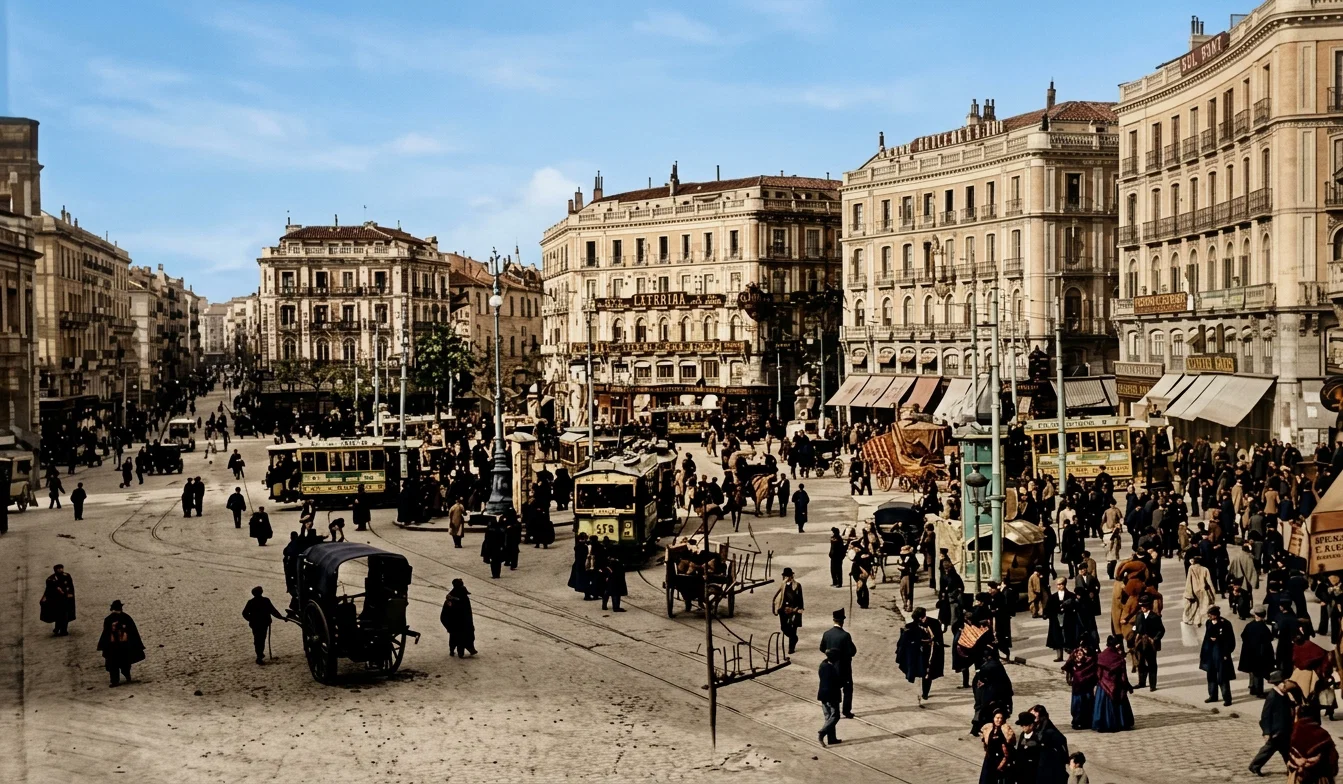
CENTRAL POINT, CITY OF MADRID
February 9 I left Paris, France, for Italy. After rejoining, at Torre Pellice, Brother Chas. T. Everson, who has just come from California to labor in Italy, we went on together to Rome. The city was filling up with visitors who were coming for the pope's jubilee and for the Easter services. Fifty thousand visitors were already in the city, and two hundred thousand were expected before Easter. As Rome is a city of about five hundred thousand inhabitants, it can be seen at once that we had much difficulty in securing an apartment for Brother Everson, his wife, and his sister-in-law, Mrs. Schell. After seven days of hard search from early morning till late at night, we finally found a good apartment, suitably located. I then left for Spain, praying that God's blessing might attend the work in Rome and Italy.
My immediate arrival in Spain gave me favorable opportunity to compare the conditions of this country with those of France and Italy. Upon my arrival at Barcelona, I found Brother J. Robert, of Basel, and Brother J. Vuilleumier, also of Switzerland. Barcelona is situated on the Mediterranean Sea, in the province of Catalonia, which is the northeastern province of Spain. Barcelona is the largest city in Spain, if the suburbs are counted. If not, it ranks second, next to Madrid. Here we found several Protestant churches already established; and an investigation of the religious condition led us to believe that if any opposition should arise to our work, it would come rather from the Protestants than from the Catholics. One minister implored us not to come, but we made the acquaintance of another, who had preached for twelve years, but who felt that he could no longer do so, as he could see no light in some of the doctrines now taught by Protestants. He was much interested in present truth, and asked us many questions ; and as long as we remained in Barcelona, he kindly aided us in obtaining what information we desired, and, as we afterward learned, defended us against the objections of other Protestant ministers.
But to show how God has wrought to make us see his great desire that Spain should be evangelized, I will relate the story of Dr. Fleidner, how he was led to build at Madrid the large Protestant school which we had the pleasure of visiting. These facts were related to us by his son.
Dr. Fleidner had his apartment in a house whose concierge (doorkeeper) frowned upon him savagely as a heretic. But the doctor determined to maintain a Christian pleasantness, and see who would win the day. After four years, one day the concierge addressed the doctor very quietly as he was going out, and asked him if he would not like to buy a fine piece of land at a bargain. "O," thought the doctor, "here is just what I am searching for, and what has been so hard to secure in this Catholic city. The hand of God must be in this." "The heir of the land is in the house at this moment," said the concierge, "and this is how I learned that he is pressed for money and wishes to sell." The doctor saw the man, and went to see the land. He found it to be superb land, the most elevated in Madrid, having one hundred and eighty thousand square feet, and offered for nine thousand dollars. But the doctor had only five thousand dollars. He offered this, but the owners laughed at him. "Remember," said Fleidner, "my offer is good only till March 31; this gives you two months to accept." For two months the owners searched all Madrid, and could find no one to buy. March 31 they were on hand, and Dr. Fleidner secured the land for five thousand dollars. But fourteen days after the bargain had been closed, a buyer appeared, and offered the former owners nine thousand two hundred dollars, two hundred dollars more than they asked. "Well," replied they, "had we known this, we would never have sold it for five thousand dollars."
But the land was at some distance from the principal street, and the doctor failed in all his efforts to buy the intervening piece; so he purchased a piece abutting on a side street, for twelve hundred and fifty dollars. At the end of a year, however, he was informed that the city had sold the piece he wanted to an individual who could not pay all, and that the state now offered that piece for sale. The price was seven thousand five hundred dollars, but the doctor had only two thousand eight hundred dollars. He went to his Madrid banker, and told him that that week he was in need of much money. "You may have all you wish," said the banker. So the land was bought. This was the providence of God, as will be seen later.
THE FLEIDNER SCHOOL
THE FLEIDNER SCHOOL
Now comes the wonderful part. If he could at first have bought the third piece of land, he would never have bought the second. But God would make use of the second piece to pay for all the rest, and give money to put into the building. In fact, two years later the city, having need of that piece of land for a reservoir of water, forced a sale upon him, and paid him fifteen thousand dollars. Thus God gave him the land, and twelve hundred and fifty dollars besides, and fulfilled his promise that in giving he would give liberally.
But now came the problem of how to put up the building. No architect in Madrid was willing to accept the job. The power of the clergy was too strong. "Well," said the doctor, "God has given us the land; he will surely give us an architect." He must have the plans of building to submit before he could ask permission to build from the city of Madrid. It was necessary to seek an architect in Alsace, Germany.
After the plans were ready, two long years passed before permission was obtained from the city to build, and scarcely had he begun to build when the order came to cease. What had happened? The archbishop had passed in his carriage before the building; he had seen the large foundation lines marked out; he had inquired into the project, and learning that it was to be a Protestant school, he sought and obtained from the minister of the interior the command to cease building. The doctor went to the mayor of Madrid, and asked why the command to stop had been given. 'Why,' said the mayor, 'it is a church you are building, and not a school.' He then pointed out to the doctor that his plan indicated a tower and a bell. 'Very well,' said the doctor, 'if that will please you, I will cut off the bell, and make the tower smaller, so you can not confound it with the bell of a church.' The mayor seemed contented, but pointed out a number of other small matters which must be changed. For months the doctor was compelled to go from the architect to one authority and then to another, and back to the architect; but all in vain. At last God threw down the Liberal party, which lent itself to the pope, and put in the Clerical party. Now all hope seemed gone, but still he trusted in God.
He found grace in the eyes of the new prime minister. Consent was given to resume the work of building if the bell, and also the clock, were taken out. But, behold again, he had hardly begun work when the chief of police ordered him to stop. But the doctor told his workers to go on. The chief of police went to the archbishop and to the legate of the pope. The doctor went to them also, and they were astonished to learn that permission to build had been granted by Canovas, prime minister of Spain.
A new effort was made. Cardinal Rampolla, the papal secretary of state, wrote from Rome to the queen of Spain, asking her to stop the building of that Protestant school. Dr. Fleidner had just left for Lisbon, to go to the May meetings at London. At Lisbon he could find no ship, so he came back to Madrid. At the depot a messenger awaited him with the message that the first minister wished to see him immediately. Canovas said to him, 'I find a new difficulty with regard to your school. I know you have made all concessions reasonable. But I beg of you, kindly remove from the facade of your school that Gothic pointed window. The papal legate demands it.' The doctor consented. Canovas continued, 'In the rear of your building you have a semicircular altar; I know it is not an altar, but it is semicircular.' Annoyed and vexed, the doctor replied, 'Then I will make it square.' But instantly he understood that he had made a mistake; for to make it square would spoil the whole building. God gave him the answer: 'Can we not make it an octagon in form?' The minister consented, and the scheme of the papal legate had failed. The building was continued, and in 1897 the school was opened.
Each year brings new openings in Spain for evangelical work. The canvassers of other denominations are now going from village to village. Living is as cheap as in any other country. May God hasten the day when a man of deep faith and proper qualifications shall be chosen of him to enter Spain and carry to it the truths for the last days.

Dialects of China

J. N. ANDERSON
In many particulars China and the Chinese are unknown and misunderstood. This I am confident is especially true of the speech, or language, in use by the four hundred million of the Middle Kingdom. The statement that China’s dialects are well nigh as numerous and as different as are the languages of Europe would be received by most people as erroneous or grossly exaggerated; yet such is the case so far as the spoken language is concerned. The one redeeming feature is that the written language, with its arbitrary characters, is one throughout the empire, being used in city, the same way that all Europe employs only one system of numerical notation,—the Arabic,—which is pronounced differently in each nation, but everywhere conveys the same meaning and possesses the same value. A native of Peking could as little understand one of Canton as a native of Berlin could one of London, or a Spaniard an Italian; but were they to pick up the same book, both could read and get the same meaning with different pronunciation, just as a Frenchman and an Englishman could read the same multiplication table, with the same understanding, but, of course, with different pronunciation.
These so-called dialects are, in truth, not dialects as we use the term, spoken by a few thousand, in a small section of country, but rather full-grown, distinct languages, spoken by millions both high and low. They are, to be sure, cognate languages bearing to one another a relation similar to that which exists between the Arabic, the Hebrew, the Syriac, the Ethiopic, and the other members of the Semitic family; or, again, between English, German, Dutch, Danish, Swedish, etc.
Broadly speaking, then, there are throughout China no less than eight main divisions of speech, or language, generally called dialects; which are here named according to their supposed relative age: Cantonese, Hakka, Amoy, Swatow, Hainanese, Shanghai, Ningpo, and Mandarin. All these differ so radically that only the term language can properly define them.
It will be seen from this classification that instead of the Mandarin being the oldest, and hence the parent language of China, it is, together with its many cognate branches, the youngest. The Cantonese, instead, is generally regarded as being the oldest and most nearly akin to the ancient language of China (spoken three thousand years ago), while the Hakka also gives evidence of being of a much greater antiquity than the Mandarin. The same may also be said of the Swatow, Amoy, Shanghai, and no doubt of the others. Hence it is generally held that the languages spoken in the southeast of China are more nearly allied to the ancient speech, whereas the Mandarin is a comparatively modern language.
So much for the main divisions of the spoken language of China. It remains now to be said that each of these languages is in turn subdivided into what may more properly be called dialects. Some of these are spoken by tens and even hundreds of thousands of natives, and in other parts of the world would be dignified as languages. Of the province of Kwangtung (which is a fair sample of China) it is said that the speech differs for every one hundred miles to such an extent that even the natives experience considerable difficulty in understanding one another. Nor is this all; for it is well known that these dialects break up into lesser divisions of subdialects. This is often seen in a single city, as is the case in Canton.
In regard to the range of the different languages, we find that the Mandarin is by far the most widespread. In one form or another it is the speech of fourteen or fifteen out of the eighteen provinces which compose China proper. This language is divided into three main branches, known as the northern, southern, and western, having for their respective centers Peking, Nanking, and Chingtu. These divisions of the Mandarin present less variations than similar divisions of other languages, so that a good knowledge of Mandarin gives a person access to the great majority of China’s millions. As this is the language employed by the officials throughout the empire, it is given the name Mandarin.
The other languages of China represent much smaller sections of country, and are employed by much smaller populations. Yet they are of sufficient importance to command respect. For example, the Cantonese, so called from Canton, the metropolis of South China, is spoken by about twenty millions in the Kwangtung and Kwangsi provinces. Like all the other languages, the Cantonese has an almost endless number of dialects and groups of dialects. One group consists of the San-wui, San-ning, Yan-ping, and the Hoi-ping; another consists of the Tung-Kwuse, San-on, Pok-lo, and Tsang-sheng dialects. All these are again subdivided, as, for instance, the San-wui dialect can be divided into three, and this threefold division is still further broken into smaller subdivisions, all of which present many but not insuperable difficulties to an individual of a different dialect. Nor does the matter end with these dialectic differences, since the speech of people on the boats differs from that of people on land, and there are, even, certain words used by women which the men are never supposed to use.
Several futile attempts have been made by the Chinese themselves to unify this babel of languages, but nothing of permanent value has resulted. This is still a vexed problem, which, if ever solved, will no doubt be solved by Europeans; and in the race for the supremacy, it must be admitted that the Mandarin dialect has by far the best prospect of winning.
Hongkong, China.
Continue reading: French-Latin and the East German Meetings