It was on the chilly shores of the Baltic, in Danzig, a city of about one hundred and forty thousand inhabitants, that the East German Conference was held, Jan. 7-11, 1903. Elders H. F. Schuberth and J. Erzenberger were present at the beginning of the meeting; as Elder Conradi had been obliged to meet with the French-Latin Committee at the close of the Carlsruhe meeting, his arrival was delayed a day or so. The French-Latin Committee met in Chaux-de-Fonds, did their auditing, and planned for their work the coming season. They enjoyed a profitable season together.
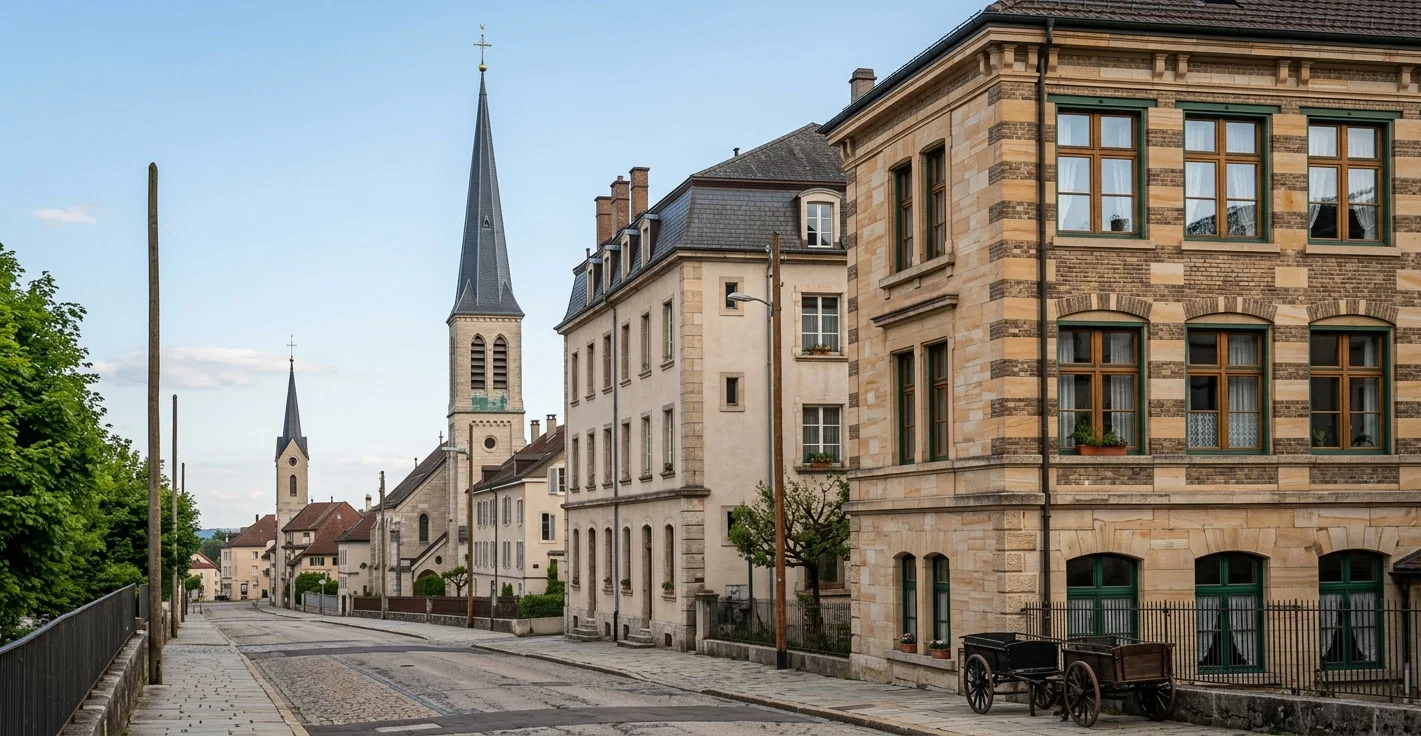
S. D. A. CHURCH BUILDING, CHAUX-DE-FONDS
During the year ending Dec. 31, 1902, there were sixty-five baptisms in the French-Latin field, and twenty-eight persons were received by vote. Of these, twenty-seven were baptized, and eighteen received by vote, during the first half of the year. I do not have the data to show in what countries the additions occurred, as the numbers were reported for the whole field during that time; but after the more perfect organization and division of the field at the Geneva meeting last July, we have these figures: in the original Central European (or what is now known as the French-Swiss) Conference, 34 baptisms, and 7 received by vote; tithe, $1,553; Sabbath-school offerings, $137; First-day offerings, $33; general gifts, $408; present membership, 405. In the French Mission: 3 baptisms, 3 received by vote; membership, 132; tithe, $419; Sabbath-school offerings, $47; First-day offerings, $9; general offerings, $19. In the Italian Mission we have 38 members, whose tithe for the last half-year amounted to $42, and their Sabbath-school offerings to $3. The receipts of the French-Latin field before the division effected in July were: tithe, $3,170; Sabbath-school donations, $357; First-day offerings, $82; annual offerings, $640; general gifts, $91. It may not be amiss to give the exact figures, as they occur in the yearly report of the European General Conference, which we are preparing for the year 1902. For the French-Latin Union: ministers, 4; licentiates, 5; Bible workers, 6; number of churches and companies, 22; total membership of field, 575; baptisms, 65; received by vote, 28; tithe, $5,186.18; Sabbath-school offerings, $545.34; First-day offerings, $125.03; annual offerings, $640.64; general gifts, $519.71.
The outlook in this field is very encouraging. There is much hard work to be done; but the power of God will be revealed here, as in other parts of the great vineyard. We should not forget the laborers who have many a hard battle to fight, but must uphold them by our united prayers, and heartfelt sympathy.
But to return to the East German Conference: the forty-two churches in this conference, whose membership had increased from 913 to 1,037 during the year, were represented by fifty-six delegates. To accelerate the transaction of the business to be done, a general committee of twenty-one members was chosen, and this appointed the Auditing Committee, the Committee on Resolutions, the Committee on Credentials, and the Nominating Committee.
The following formal actions were passed by the conference in session:—
1. We hereby express our thankfulness to our Heavenly Father for his rich blessings during the past year, as seen in the increase of our membership and tithe, and in the revival of our canvassing work, notwithstanding our faulty efforts.
2. We would urge our brethren to take part in the sale of "Christ's Object Lessons," as recommended by the German Union Conference.
3. We hereby express our determination to give our part toward the material fund for "Christ's Object Lessons."
4. In looking over the ripe harvest field and seeing the lack of all-round workers, we recommend that promising, trustworthy young people be encouraged to attend the school in Friedensau.
Whereas, The third angel's message is to go to all peoples, therefore,—
5. We recommend, That our First-day offerings (strengthened by free-will gifts) be devoted to opening the work in German East Africa.
Inasmuch as God is a God of order, therefore,—
6. We recommend, That each colporteur remain in and thoroughly work the territory given him, until he is assigned another field by the general agent.
7. Voted, that, beginning with Jan. 1, 1903, the East German, following the example of the West German, Conference, pay a second tithe to assist in forwarding the work in our mission territory.
Four offered themselves as prospective students for the Friedensau Industrial School; $57 was raised for the material fund; and $500 was voted from the conference funds toward the East African Mission. Two new churches were received, one at Görlitz, Silesia, with fifteen members; and the other in Plauen, Saxony, with eleven members.
These figures give an idea of the work of the past year: received by baptism, 189; by vote, 34; tithe, $7,209.52; Sabbath-school offerings, $807.70; First-day offerings, $167.74; annual offerings, $266.33; there are 75 canvassers in the field, and the sales amounted to $14,453.04 during 1902; the 45 Sabbath-schools contain 935 members; and at the meeting, ministerial credentials were given to E. Frauchiger, G. Oblaender, and G. Wagner; three were granted license to preach, and ten were given missionary credentials; three general canvassing agents were chosen; three were baptized at this meeting.
The officers chosen are: President, E. Frauchiger; Secretary, C. Reihlen; Treasurer, F. Rockel; Supt. Tract and Missionary Department, K. Laubhan.
The average attendance of our people was eighty; during the lectures for the public, about two hundred were present. Elder Frauchiger remained in the city another week, to follow up the interest, and the Lord came very near, and every honest heart experienced the blessedness of yielding more fully to God. Our brethren here have only courage for the work in the future. They look forward to a prosperous year, and expect that God will do still more for them than in the past.
Hamburg.
Missionary Interest Among Pitcairn Islanders
LETTERS received from Brethren J. R. McCoy and G. F. Jones report an increasing interest in missionary work among the Pitcairn Islanders. There are now one hundred and fifty-six Sabbath-keepers on the island. Brother Jones had spent the month of December with them. Since they have their little cutter, mail addressed to them at Mangareva, Gambier Islands, via Tahiti, will reach them in from three to six days after leaving Mangareva. Speaking of their isolation, Brother McCoy says: “When our papers occasionally come in on passing ships, they are like water to thirsty souls. The copies of the REVIEW AND HERALD sent me by way of Tahiti came up on the man-of-war three weeks ago (February 18). They are very old ones, but have been read over and over again. I am glad to see the interest taken in the work. I hope many souls will be brought to the light.”
Waiting
By S. G. Stock
THEY are waiting everywhere— Where the fields of earth are fair, Where the rivers nobly run, Where the blossoms seek the sun, Where the hills rise high and grand, Looking proudly o’er the land— Waiting! Waiting!
They are waiting in the wild, Sick and weary and defiled, And the Saviour’s healing word They have never, never heard; Ever hungry and unfed, Left without the living bread— Waiting! Waiting!
For the happy beam of day That shall chase their gloom away, For the news, so glad and blest, That shall set their hearts at rest, For the peace we know and prize, And the hope beyond the skies— Waiting! Waiting!
Yet not voiceless nor alone, For their cry to heaven hath flown, And the Master waiteth too, Waiteth, ransomed souls, for you, Till the life devotion sweet Be outpoured at his feet— Waiting! Waiting!
—S. G. Stock.
Barbados
By W. A. Sweany
BRIDGETOWN.—We are still under the lash of the quarantine, but hope it is rising again. We expect to be released ere-long, as the disease has almost entirely disappeared. Because of the quarantine, Brother Spicer could not visit us, and we could not attend the meetings. We are all well, and busy, and the Lord gives an encouraging measure of success and victory. Several will be baptized at the approaching quarterly meeting. The Spirit of the Lord is interesting, impressing, and convicting many souls, and we are kept busy instructing and encouraging them.
I am so glad to report that after long, careful, and prayerful effort, I have succeeded in starting into the work two native brethren, whom I fully believe will prove faithful and successful laborers. They are devoting their whole time to the work of preaching outdoors and in private houses, and of selling and otherwise distributing literature. There are yet others whom we hope to see enter this or other departments of the work. We must have more—many more—laborers, and we should be able to develop them right here.
The school is doing good work, despite the meager equipment and the utmost efforts of the enemy to hinder it. How we do need a thoroughly equipped training school, where we could train teachers, Bible workers, nurses, etc. We will gladly give our all to such an enterprise, and assist a number of our dear young people through it. We so much need a manager, to start a health food store, bakery, restaurant, treatment rooms, etc. These, of course, should be connected with the school. The demand for health foods continues, and we must handle them, although we have little time to devote to this work. However, the little we do in this line brings us in contact with many of the very best people in the island. The editor of the leading daily uses the foods, and highly recommends them in his paper. W. A. SWEANY.
The East Caribbean Conference
By W. A. Spicer
This is the name chosen by our brethren for the second conference organized in the West Indies. Our general meeting for the East Caribbean field was held in a tent in Port of Spain, Trinidad. The brethren are holding a series of tent meetings in this important center, having their tent pitched on a plat of ground just purchased for a church building.
In these island fields of the Caribbean, intercommunication is somewhat difficult, and the Lesser Antilles Islands were represented only by the workers from that group.
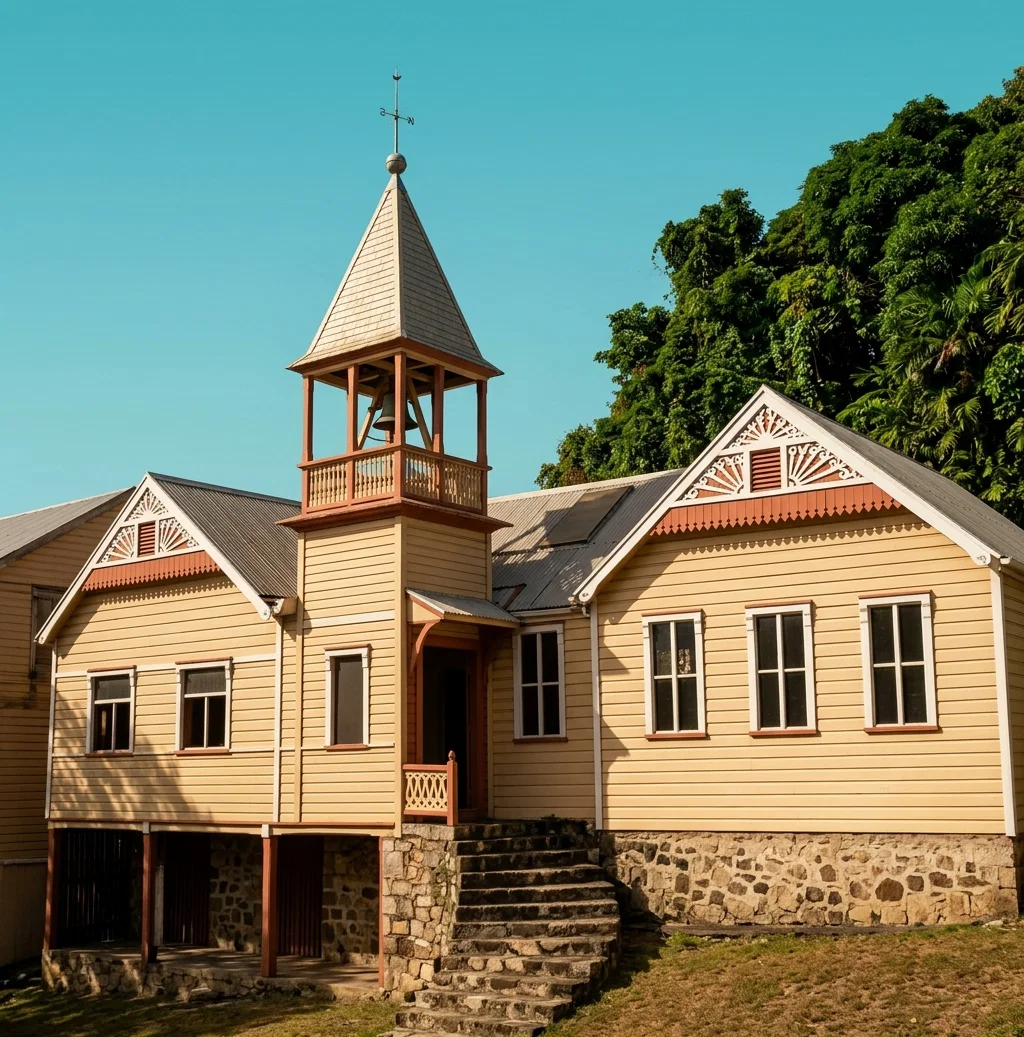
CHURCH AT ST. JOHNS, ANTIGUA
Members were present from the seven organized churches and other companies in Trinidad. These formed the nucleus for the conference organization. The three churches in Barbados, Antigua, and St. Thomas, and the eight churches in British Guiana were received into the conference, which thus has eighteen churches, with a total membership of about seven hundred and fifty.
Good reports were made of the work in the northern islands. In St. Thomas the people are preparing to erect a church building soon. Brother D. E. Wellman was able to report a very neat and commodious church building in St. Johns, Antigua. It had been quite a struggle to get a substantial work built up in Antigua, where I believe our work had its first beginning in these islands. But God has given the victory, and now that a live company holds the fort in St. Johns, the ministerial effort can soon be directed more generally toward other parts of the island, and even to other islands.
The workers in the new conference heartily join in the rallying call to push out into new fields, while the companies of believers are left with the responsibility of holding up the standard in the places already entered.
Brother E. Van Deusen, who has been working under the shadow of the volcano of La Soufriere, in the island of St. Vincent, reports a little company obedient to the faith. Before leaving them, he expects to have a small meeting-house erected, so that they shall be prepared to keep the light glowing.
The terrible scenes of the volcanic eruptions have seemed only to harden the hearts of the unbelieving. In fact, the preachers in the West Indies have very often led in scoffing at the idea that the judgments of the latter days are breaking over the earth. But in many minds these great calamities have served to emphasize the message that we bear.
Barbados is still under strict quarantine, on account of smallpox, and hence Brother W. A. Sweany and others from that island could not meet with us. The canvassers shut in by the quarantine have, however, done remarkably well in Barbados, we are told. This island is a sort of West Indian beehive, whose inhabitants are continually swarming over into other portions of the Caribbean. One meets the Barbadian on the South American mainland and in all the islands. Two of our preachers in Trinidad, formerly with the Methodists, are natives of Barbados.
The last year has been one of distinct progress in Trinidad. The canvassing work has been one of the most aggressive features here. The canvassers a year ago decided in council to put this work upon a good business basis, and have loyally co-operated with the directors in the effort to lift the book depository out of the difficulties which the former credit system had brought upon it. The Trinidad brethren have for some time been awaiting an opportunity to enter Venezuela, whose coasts lie just beyond the Gulf of Paria, which washes Trinidad's western shore. In normal times the island does much trade with the mainland. There are many English-speaking West Indians in Venezuela. Thus we have an open door into a country as yet absolutely unentered by us.
While our meetings were in progress, the powers raised the blockade of the Venezuelan ports, and the war-ships that had been patrolling the coast were gathering in the harbor of Port of Spain and other harbors, so that it may be hoped that one or two of our faithful Trinidad canvassers will soon be pioneering a new field with our literature. It is said that all the Venezuelan revolutions have been hatched in a certain hotel in Port of Spain, the rendezvous of political conspirators. Now our Trinidad friends will plan for a campaign of peace and good will into that distressful country. The brethren of the East Caribbean Conference are heartily with us in this campaign18to plant the standard in new fields, and they propose to do more work with less help from America than in times past, if necessary, in the planning of the world-wide missionary campaign.
Brother W. G. Kneeland, who has been director of the Trinidad work, now goes to the island of Tobago, with one of the native ministerial laborers, to open public work in that island.
Port of Spain is the headquarters of the conference. Brother A. J. Haysmer was chosen as president, with an executive committee representing the various districts comprising the conference. Instead of having three offices and book depositories in this region, we shall now have one. Workers in the Antilles and British Guiana may be settled with by the Trinidad office without difficulty, and the brethren feel that the organization of the whole field as one conference will facilitate the interchange of laborers when needful.
As in Guiana, so also in Trinidad, there are thousands of people from India, originally imported as laborers on the estates. The East Indian community in Trinidad has prospered, and many of this people are successfully engaged in trade and business on their own account. At San Fernando and Couva I met East Indian gentlemen of this class who are much interested in our work. One Indian brother, for years a Christian worker in another society, has joined us as a worker. Thus all classes are being reached.
It was decided to publish a paper for the West Indian field, called the Caribbean Watchman. With the two thousand believers in the two conferences, a circulation of several thousand should readily be secured. The printing will be done by outside firms, and the brethren propose to fix the price so that the paper shall be self-supporting. This is a medium for reaching the reading class of people that our workers have long desired. The paper will be published in Port of Spain.
Port of Spain is a beautiful and thriving city. Among West Indian cities, it stands next to Havana, Cuba, in size and importance, I believe. Midway between the Guianas and the Antilles, it is naturally a center for our work. One great need now is a church building in this city.
The brethren have been manfully working to secure this. A lot has been purchased in a good location. Land is very high in the respectable districts of the leading West Indian cities, and the purchase price, one thousand dollars, is regarded as a very fair bargain. It has, however, strained the local resources to secure the land. But our brethren mean to struggle on. Our work has sometimes lost much in this field by the necessity of carrying it on in out-of-the-way and even unsavory localities. The land for the Port of Spain headquarters is near the business quarter and on the edge of a respectable residential quarter. I believe the situation is such that outside help might well be given the brethren to assist in erecting a house of worship and depository combined.
I have been rejoiced continually in this trip to see what the truth is doing for the believers in these regions. Here was the battle ground, a few centuries ago, in the struggle of the European nations for the possession of the New World. If speech were given it, every league of this Golden Caribbean could tell tales of those times when adventurers braved perils and sufferings in the search for golden cities and treasures of pearl, and when pirate and buccaneer swept every coast and sea for spoil. Our workers have now the joyous task of searching for souls, the jewels of God's grace and love, scattered afar on island and continent. It has been worth while to send the missionaries and to spend our offerings for this purpose. Our brethren and sisters in the West Indies love the truth, and thank God for the blessed hope. They desire to stand loyally by us in hastening on this work to a speedy and glorious triumph.
W. A. Spicer.
Society Islands
By G. T. Beckner
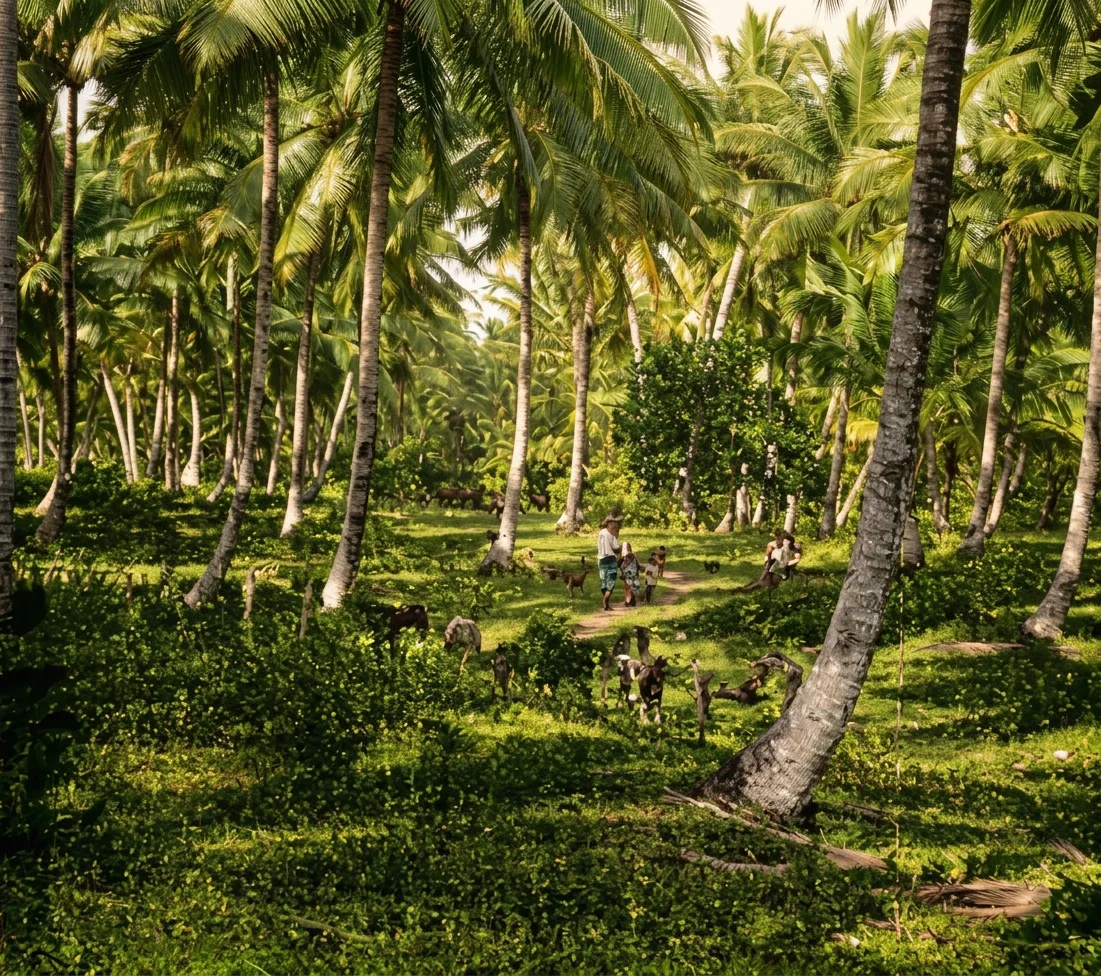
RAIATEA.—We have now been on the island fourteen months. Our work is moving along nicely, and we enjoy many tokens of God's favor. The Lord has blessed the work in taking the disease from the cocoanut-trees, which was very bad on many of the plantations. Since we came here, the place has yielded sixty thousand cocoanuts, which have been made into copra, amounting to thirteen tons, marketed at forty-four dollars, American money, per ton.
COCOANUT GROVE, RAIATEA
At present we have twenty head of cattle and four horses. We do not use cow's milk. The cattle are wild, and hard to manage, and the cocoanut milk is much more healthful, and better in every way. We use it for seasoning almost all kinds of food, and when used rich, it makes the most delicious pie-crust and sticks. At first, we did not like the flavor, but now we are fond of the milk when used in almost any way.
We have several acres of vanilla, which is just beginning to bear, and more that has just been put out. This needs but little attention in the way of cultivation, as it is put out beside a small tree, and left till it bears, which is two or three years. We have almost all kinds of tropical fruits on the place,—breadfruit, oranges, bananas, pineapples, limes, mangoes, guavas,—more than enough to supply all on the place. We have fresh fruit the year round, as all do not ripen in the same month. Our boys go to the mountains for plantain once a week. This they carry on bamboo poles over their shoulders. No one need go hungry in this fruitful land. Many of the people here think they must live on meats; and as fresh meat will not keep long, they use canned and preserved meat, and this we know is the worst kind. A favorite dish is raw fish with lime juice. Fish are plentiful, as the natives do not work, and have plenty of time for fishing.
Brother Smouse, of Mt. Pleasant, Iowa, has donated to the school part of a mill for making syrup and sugar from the sugar-cane, which is now grown here in small patches for chewing, just for the juice. The natives are very fond of anything sweet, and we hope to be able to help our school along. As there is nothing of the kind on the island, we feel sure of success, and in this way hope to be able to take more boys and girls, who so much need help, that they may be fitted to act a part in spreading the light of the truth to the world.
The spiritual interest among the students is good. One boy came to us who could use only the Tahitian language, and had never heard the Bible stories read. When he began to hear them in school and at worship, he of course wanted to know them all. So he bought a large Tahitian Bible, and began to read for himself. He takes his Bible and goes off alone and reads a long time. Two of the other boys who came last March could neither speak nor read English. They can now understand almost everything and can read and write well. As we try to help these young people, it does us good to see them take so much interest and seem to desire to know more, and our hearts go out to God in thankfulness that he has given us a place to work in his vineyard.
As we read the reports of the work in the earth, we can see that the message is indeed going with power. We want to do all we can to warn the people in this place of the soon coming of Christ. Let us be faithful a little longer, and soon the work will be closed up, and we shall be at home with Jesus.
G. T. BECKNER.
Upper Columbia
By W. F. Martin
WHEN our conference was divided into districts for the sale of “Christ’s Object Lessons,” the Milton (Ore.) district was assigned to me. Our share consisted of nearly six hundred books, six for each church-member in our district. Quite a number of the brethren and sisters loyally took hold of the work, and became responsible for the sale of their quotas. There was left on my hands, however, about two hundred and fifty books. With the Lord’s blessing, I succeeded in selling these so as to close up the work in our district soon after January 1.
January 20 I went to Weiser, Idaho, in answer to an urgent call for meetings near that place. Elder Wilson, a First-day Adventist, had been challenging our people for a debate. It was not my desire to enter into a discussion with him, but taking all things into account, it seemed the best thing to do. He affirmed that the ten commandments are abolished, which I denied. I affirmed that Christians are under obligation to observe the Sabbath of the fourth commandment;19this he denied. The discussion lasted four evenings. Before the hour of meeting, I met with the little company of our people there, and we earnestly sought God’s blessing. As a result, the Lord greatly blessed the presentation of his truth. Before the discussion closed, it was manifest to the people that the First-day Adventist minister had completely failed to establish his proposition, and an excellent impression was made for the truth. About two hundred and fifty voted requesting a series of meetings in the near future. Circumstances were such that it was not possible for me to remain longer; but that is an excellent field, and I would be glad to return at an early date to follow up the interest.
I next visited the church at Blackfoot, Idaho, which I was the instrument in God’s hand of raising up about two years ago. Since then they have had no ministerial help, yet have been faithful. I found them all of good courage, and working diligently to bring the truth to others. Nearly every member of the church is engaged in distributing tracts and papers, and some are holding Bible readings with their neighbors. As a result, there is quite an interest, and an urgent call for meetings. Truly, the harvest is great. Sabbath, March 14, was a good day for this church. One brother, an influential physician, was added to the church. So far their meetings have been held in a private house. My courage in God and in his truth is good.