The Youth’s Instructor, Vol. 32, No. 2.

The Catacombs of Rome

The Youth’s Instructor

Jan 9, 1884

S. D. A. Publishing Association · Battle Creek, Mich. · Jan 9, 1884

The Catacombs of Rome.

Who has not heard of the old Roman catacombs,—those interesting vaults of the earth to which the early Christians fled for refuge in times of persecution? These catacombs are underground rooms, dug in a soft, volcanic stone called in Italian, tufa. The word catacomb is derived from the Greek words, katà, down, and kumbos, a hollow, as if descriptive of an underground excavation. It is supposed by many modern writers that these sepulchers date back nearly to the times of the apostles.
There are forty-two of the catacombs, and they are situated mostly near the great roads leading out from Rome. The rocky ground in every direction is completely honeycombed by these vast cemeteries. Here, for centuries, the Christians were buried. During times of persecution they held meetings in the tombs, and even lived in them. The existence of baptisteries also prove that the rite of immersion was practiced there.
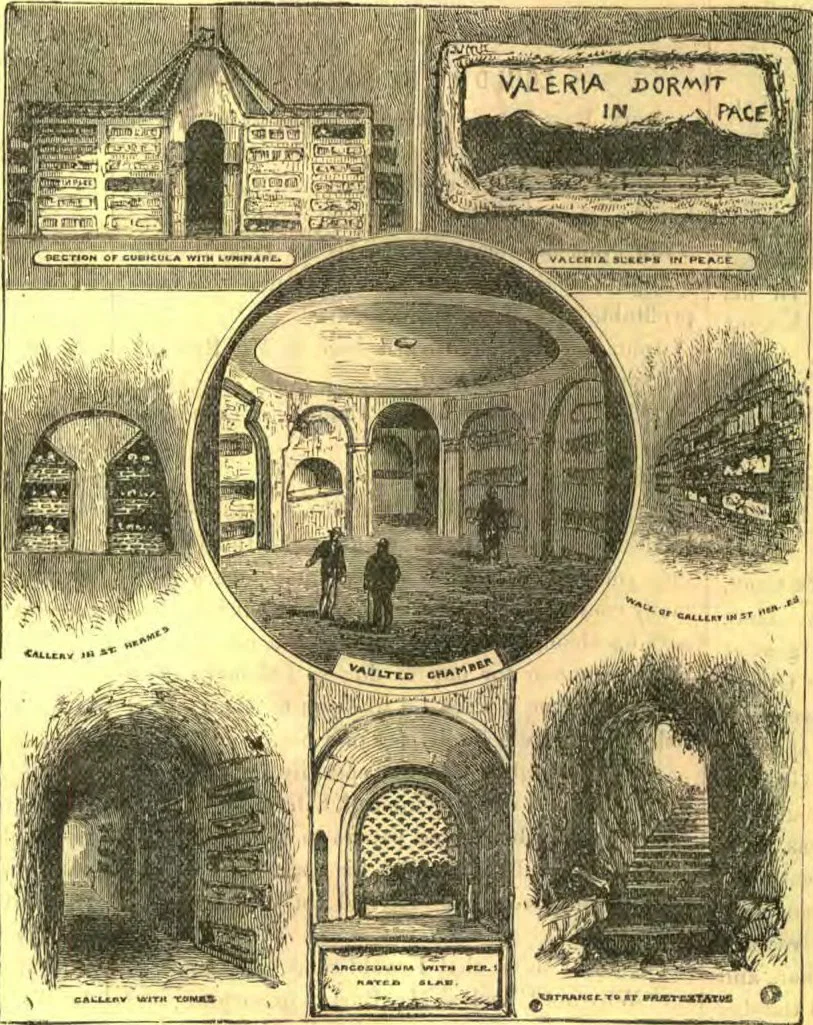
The catacombs consist mainly of two parts,—corridors and chambers. The corridors are long, narrow passages, forming a complete net-work of underground paths. The main corridors are from three to five feet wide, and average eight feet in height; but the side passages are often narrower, affording room for only one person to pass. The chambers are little rooms, often not more than eight or ten feet square. A view of one of these is given in the central part of the picture. Here the early Christians assembled in small groups, partook of the Lord’s supper, and comforted each other in their trials.
The sides of all the passages, galleries, and chambers are lined with stone graves, cut in the walls. These are also clearly shown in the picture. Here they are, as closely as they can be arranged, one tomb above another, like the berths of a ship. It is difficult to compute the number of graves in these great cemeteries. Some seventy thousand have been counted, but they are only a small part of the entire number. Father Marchi estimates the average to be ten graves for every seven feet of gallery. Upon this basis he reckoned the entire number buried in the catacombs to be seven millions!
These graves were at first all made air-tight by slabs of marble, or terra cotta tiles and plaster and cement. The name of the sleeper was generally scratched in the soft stone, or plaster. These inscriptions are exceedingly interesting, as they show the faith of the sleeping Christian. The symbols and inscriptions are those of peace and joy, and are even now found on many of the graves. The well-known symbols of the dove, lamb, olive branch, anchor, bread and wine, fish, lamp, good shepherd, and numerous others, point to the hope of the silent sleeper. While such inscriptions as “Resting in peace,” “Laid to sleep,” “In Christ,” “Waiting for the resurrection,” etc., show how the early Christians looked for the sounding of the last trump as the fulfillment of their hope.
In the silent chambers of the catacombs are the remains of men, women, and children. If the graves are opened, the lifeless forms, though frequently perfect at first, dissolve into a white, flaky powder on being touched or exposed to the air.
The length of all the galleries, corridors, and passages, put together, has been computed at from six to nine hundred miles! But it is difficult to give the precise extent of this vast city of the dead, on account of the tangled intricacy of its passages. Some of the catacombs also are almost wholly inaccessible on account of water.
The entrance to these sepulchers is sometimes like a fox’s burrow, often nearly concealed by the long grass or the melancholy cypress or ilex. Frequently an arch is formed at the catacomb’s mouth, or a little chamber. But in all cases there is a stairway leading down to the silent crypt beneath, as is shown in the lower right-hand corner of the picture. In the gloomy halls below reposes the precious dust of the martyrs, who may have heard the words of life even from the very lips of the apostles.
The walls are sometimes plastered, and where they have given way, are supported by masonry. At the corners of the passages are little niches in which lamps were placed; without these the halls would have been an impenetrable labyrinth.
The chambers of the catacombs generally have vaulted roofs, and are sometimes plastered, or cased with marble, and paved, occasionally with mosaic. The walls and ceiling are often covered with fresco work, frequently of elegant design.
To secure freedom from dampness, which would hasten decomposition and corrupt the atmosphere, the catacombs were always excavated in high ground, in the undulating hills about the city, but never in the valleys. They were made several stories deep. The awful silence and dense darkness of the lowest depths is absolutely frightful. It is the realm of eternal gloom—a place destitute of all light. Not so much as a lizard or bat has penetrated its obscure recesses. Nothing but skeletons, and dust, and ashes, on every side!
The catacombs were ventilated by numerous openings to the world above, called spiragli, or breathing-holes. There were also openings to admit some light to the various chambers, called luminari, or light-holes. These are shown in the upper left-hand corner of the engraving. Sometimes several chambers are partially lighted and ventilated by the same shaft. This is true of the upper stories, but not even the faintest ray ever reaches the lowest passages.
The catacombs are now somewhat mutilated by earthquakes and floods. Sometimes the stairways are broken, the corridors blocked up, and the roofs fallen. The rains of a thousand Italian winters have washed tons of earth down the light-holes; and the smoke of the lamps of early worshipers, and the torches of recent visitors, have impaired the beauty of many of the paintings. The hand of the spoiler, too, has rifled the graves and broken the tablets. Many fortunes have been expended by interested investigators in removing the collection of earth and debris so that the catacombs could be explored.
During the darkness of the Middle Ages, the catacombs almost passed out of the knowledge of the human mind. But in the year 1578, they were re-discovered by some workmen who were digging building material in a vineyard on the Salarian Way. Since then, they have ever been invested with a new interest to the Christian world.
The exploration of the catacombs is always attended with danger. M. Bosnio was several times well-nigh lost in those mysterious depths. And Mons. Roberts, a French savant, nearly lost his life the same way. As he wandered through gallery and chamber, absorbed in interest, the thread imperceptibly slipped from his hand! In his excited attempt to find the clew, the torch went out, leaving him in total darkness, a living prisoner among the dead. He shouted, but the hollow echoes only mocked his voice. Wearied and in despair, he threw himself on the ground, when—could he believe it?—his hand touched the cord by which he was enabled to retrace his way back to the mouth of the catacombs.
In 1798, some French officers of Berthier’s army, infidel in principle, visited the catacombs. Here they sang their wicked songs, rifled the graves, and said death was “an eternal sleep.” One of their number, more daring than the others, resolved to explore some remote galleries. He was speedily lost, and abandoned by his companions. Groping through the dark, he touched nothing but cold walls and moldering bones. His soul was filled with awe as he thought of his sins, of death and the Judgment. His physical powers soon gave way, and he sank in exhaustion. When rescued the next day, he was ill, but a converted man, and one who honored the Saviour’s cause till the day of his death, years after on the field of battle.
Even as late as 1837, a professor with his class, numbering nearly thirty persons, were lost in these underground labyrinths, and never discovered, though repeated and diligent search was made for their recovery. G. W. A.

WINTER

There's silence in the harvest field, And blackness in the mountain glen, And clouds that will not pass away From the hill-tops for many a day, And stillness around the homes of men.
The old tree hath an older look, The lonesome place is yet more dreary; They go not now, the young and old, Slow wandering by on wood and wold. The air is damp, the winds are cold, And summer paths are wet and weary.
The drooping year is in the wane, No longer floats the thistle-down; The crimson heath is wan and sear, The sedge hangs withering by the mere, And the broad fern is rent and brown.
The owl sits huddling by himself, The cold has pierced his body through; The patient cattle hang their head, The deer are 'neath their winter shed, The ruddy squirrel's in his bed, And each small thing within its burrow.
One silent night hath passed, and lo! How beautiful the earth is now; All aspect of decay is gone, The hills have put their vesture on, And clothed is the forest bough.
Silent, not sad, the scene appeareth, And Fancy, like a vagrant breeze, Ready a-wing for flight doth go To the cold northern land of snow, Beyond the icy Orcades. —Mary Howitt.

COULDN'T BE BOUGHT.

John Bailey was hurrying home from school when Mr. Burton hailed him. Mr. Burton was the proprietor of a sort of a store and saloon combined. He kept a stock of groceries and flour and a few other articles, and besides he kept beer on draught; and this last was of course the most profitable part of his business.
John stopped and turned back at Mr. Burton's call, and stood waiting.
“How would you like a chance to earn some money nights and mornings?”
“First rate.”
“I thought so. Well, I need a boy to help me in the store, especially evenings, and I thought I'd give you the chance. You see, there are a good many coming in after work-hours for their beer, and serving them, with weighing up the groceries, is most too much for one to do; so I thought if we could agree on a price I'd like you to come in and help. You are a likely sort of a boy, I guess.”
John's thoughts had gone speedily forward, and taken in a new coat for himself, a dress for mother, and no end of books and papers to be bought with money he should earn; but his hopes sank as rapidly as they had risen. He had not thought of the beer.
“I don't think that I could come,” he said.
“Why not?” asked Mr. Burton in surprise. “I thought you would jump at the chance.”
“So I did, at first; but come to think of it, I couldn't.”
“But why?” and as Mr. Burton insisted upon an answer, John said: “I can't help you because I don't want to betray the cause which I am pledged to fight for.”
“Cause! Pledged to fight for? What do you mean?”
“I mean the temperance cause. I can't sell beer, Mr. Burton.”
“Oh, that is it. Well, John, I won't ask you to sell beer; you may confine your work to the grocery department.”
“I don't think that would do either,” replied John. “It would look bad, anyway, and hurt the cause. I guess I can't come at all.”
But Mr. Burton persisted. “I will pay you well,” he said; and finally, as John became more decided in his refusal to entertain his proposal, he offered him large wages, and John, growing desperate, said, “Mr. Burton, I am not worth much, but I am not for sale, what there is of me,” and with that he said good afternoon, and hurried home to tell his mother the story of his interview, and get her approval; for he was sure she would approve.
When he had told her, she said, “John, you make me think of General Reed.”
“Who was General Reed?” asked John, who was not very well up in history.
“He was an officer in the American army during the Revolutionary War. It was during the winter of 1777-78, the very gloomiest period of the war. The soldiers were suffering greatly from privations, and many were getting discouraged. The English people were proposing measures of settlement of the difficulties; but the brave general who was at the head of the army had faith in the success of the cause, and would listen to no terms of peace which did not include an acknowledgment of the independence of the colonies. Then bribery was tried, and General Reed was offered a large sum of money if he would use his influence to bring about an adjustment of matters between the two countries. His reply to the proposition was, ‘I am not worth purchasing; but such as I am, the king of England has not money enough to buy me.’ And Mrs. Bailey smiled encouragingly upon her earnest-faced boy, whose dark eyes kindled with true patriot fervor, as she added: ‘I hope, John, you will always be loyal to the cause, and that there will never be money enough in all the world to buy you. Your name may not go into history alongside the patriot of 1777, but truth and loyalty are worth more than a name in history.’”—Faye Huntington.

TO THE BOYS.

WE are looking to you, boys, for our future teachers, deacons, elders, and ministers. As a general rule, I find that the best working Christians were converted when they were young. A tree which has been long planted is the more likely to bring forth much fruit. Our great Captain has found some of his bravest marshals among those soldiers who began as drummer-boys in the army. It is not possible to begin serving the Lord too soon. If we would be eminently useful, the earliest moment is, upon all accounts, the best. To whom are we to look for successors to ourselves and our fathers, but to the uprising race of our sons? The grand old banner of the gospel has been carried by our sires unto this day; will you not uphold it as they have done? Soon must we pass away, for our hair is turning white; it will be our greatest joy if we shall know that our sons will take care that the Lord’s work goes on. It will make our hearts leap within us, if we see you enlisted in the army of the bleeding Saviour; but if you prove false to your father’s God, it were better for you and for us that you had never been born.
Do you imagine that you cannot now be Christians? The gifts of our Heavenly Father’s love are not reserved for a certain age; boys may be saved; boys may be great workers for Christ; boys may bring great glory to God. Hence it is that just now, at this particular turning point in your lives, we are anxious to see you resolute for the right way. May the Holy Spirit incline you to resolve to be the Lord’s. Others may despise your conscientious choice, and make mirth of your holy carefulness, but what matters it? Some of us have been laughed at for these twenty years, and are none the worse for it; we have had all manner of evil spoken falsely of us for Christ’s name’s sake, but we are all the happier for it. O boys, if you are renewed in heart, and become for life and death the Redeemer’s, none can really harm you; all must be right with him who is right with God.
Hold on, then, to the school; and when you cease to be taught, become teachers. Hold on to the Sabbath services and all the ordinances of the house of the Lord, and say, like Ruth to Naomi, “Thy people shall be my people, and thy God my God.”—C. H. Spurgeon.

Rising Above the Morning Mist

Do what we will, we cannot drive away the mist that hangs low in the morning. But it is possible for us to get above it. By ascending the hill we see the blue sky serenely above. It is often the same with our troubles. They may hang about us like mist, and we may not see the way clearly; but if we ascend the mount of prayer, these things will be left behind, and God's face will shine upon us.

THE STRANGE PAINTER.

HAVE you heard of the marvelous painter, Who wanders at will through the land? Most dainty the delicate sketching That's wrought by his magical hand; Lofty the mountains and rocks stand; And his forests, in silvery sheen, With their glory of clear graven branches, Are fit haunts for gay fairy queen.
Ah, wondrous the work of the painter! Proud castles, with parapet bold, Grim ruins, o'ergrown with the ivy, His deft fingers quickly unfold, And at midnight, this lover of cold Cuts, glittering, icy, and white, His exquisite carvings in hoar frost, Which glisten at dawning of light.
Beware the chill breath of the painter! For fatal his nearness, and dread; He kisses our flowers in the autumn, And back from his touch they fall dead. He brings the trees gold robes and red, And gaily his coming they greet, But from gentle approach of the spring-time He hastens with swift-flying feet.
Can you tell now the name of the painter, This prince of the winter months drear? Soft over the panes, while we slumber, Glides his pencil in lines crystal clear; And yet, as the mid-day draws near, Though fair are his pictures, and fine, They vanish, like mist of the morning, Before the sun's conquering shine.
—Florence Brown.

A DISAPPOINTMENT.

Rob stood by the window, in the moonlight. “I hope that it will not rain to-morrow,” he cried.
“Does it look like rain? Are there clouds in the west?” asked Harry.
“Oh, I hope not!” exclaimed Alice. “I would cry my eyes out if it should rain.”
“And go without eyes the rest of your life?” asked nurse. “Why, Miss Alice, who sends the rain?”
“But just think how rain would spoil our picnic,” muttered Rob. “I wish that I could hold the clouds in my hands.”
He turned quickly from the window just then, and saw his mother standing in the door-way. There was such a look of surprise on her face, that Rob was sure she heard his speech.
“I came to say good-night to my darlings,” she said, “and—”
“To tell us a story,” interrupted Alice.
“Yes, a little story that I read in poetry. I will put it into prose for you:—”
“A long while ago, far from here, in a beautiful home by the sea-side, lived four little sisters. They were as merry as the day was long, and as happy as any other little girls in the land, perhaps.
“One sweet morning in June, they sat together under the trees, and made plans to spend a day in the woods. They were to fill their baskets with all kinds of nice things, and they were to carry games, and books, and whatever else they liked for entertainment. Father and mother and Uncle George would go with them; ‘Uncle George who had his head just brimful of funny stories,’ Laura said.
“‘If brother Maurice could only be here to go!’ exclaimed Cecelia.
“But Maurice was a young midshipman, away at sea; they could not hope to have him at their picnic. How long it seemed before the day would come! Many were the anxious thoughts about the weather! It did not seem possible that it could rain, when they wanted to go so very much!
“The baskets were filled the night before. Ring-toss and lawn-tennis were in the hall, waiting to be carried to the mountain. Five o’clock came. Minnie was up to catch the first glimpse of sunrise! There were thick clouds in the east, though, and no prospect of a clear sunrise.
“‘Maybe it will be bright by ten o’clock,’ said Cecelia, hopefully.
“Laura shook her head, declaring, ‘Father thinks that it is almost sure to rain.’”
“They counted the hours to breakfast-time. ‘We will know then,’ Cecelia said. Minnie fell asleep, meanwhile. She dreamed that the clouds had all passed away, and that the merry party was far up the mountain, with baskets and games. She woke up soon, to hear the great drops of rain pattering against the window-panes!”
“There were four sorrowful faces at the breakfast table that morning; for, of course, the kind mother and father were troubled by their children’s disappointment, though they were sure that it was for the best. I am sorry to say that the children fretted about the rain all day, so that no one fell asleep that night feeling very happy.
“A week passed. The rainy day was forgotten, when, one evening, just before tea, there was a knock at the hall door, and then a cry of delight! Elsie peeped over the baluster, and saw her brother Maurice, with his arms around his mother’s neck, crying and laughing at the same time! A moment more and every one was in the hall to welcome him, and to hear how such a delightful event as this home-coming had happened!”
“The story was soon told. His ship had been wrecked ten days before. He, with two or three sailors, had escaped. They were at sea three days, in a small open boat, with no fresh water, and with the sun pouring its hot rays upon their uncovered heads!”
“‘O dear mother, how hard we prayed for rain! just for one little shower, even!’ said Maurice.
“‘Did it rain?’ asked Cecelia, eagerly.
“‘Yes, it rained for a whole day—Wednesday, just a week ago. We should all have died if it had not been for that rainy day!’”
“The sisters looked at one another. Their mother exclaimed, ‘O my dears, do you hear that? Do you remember, it was the very same rain that made you all so unhappy?’”
“‘Tell me all about it,’ said Maurice. ‘How could the rain that saved me make you miserable?’”
“‘But we didn’t know that it was going to save you, Maurice,’ they said.”},{

WHAT A PLANT DID.

A little plant was given to a sick girl. In trying to take care of it the family made changes in their way of living. First they cleaned the window that more light might come to its leaves; then, when not too cold, they would open the window that fresh air might help the plant to grow. Next, the clean window made the rest of the room look so untidy that they used to wash the floor and walls and arrange the furniture more neatly. This led the father of the family to mend a broken chair or two, which kept him at home several evenings. After the work was done, he staid at home, instead of spending his evenings at the tavern; and the money thus saved went to buy comforts for them all. And then as the home grew attractive the whole family loved it more than ever before, and grew healthier and happier with their flower. Thus the little plant brought a moral as well as a physical blessing.

NEW-TESTAMENT HISTORY.

LESSON 169.—REVIEW, CONTINUED.
1. What enabled the apostles to speak with boldness? 2 Cor. 4:13.
2. For what did this faith lead them to hope? Verse 14.
3. How were they enabled to bear up under affliction? Verses 17, 18.
4. What took away the terrors of death? Chap. 5:1.
5. What assurance had they of the resurrection of the body, and the gift of eternal life? Verse 5.
6. Which does Paul regard as preferable,—the present state, or the immortal state which is promised to the faithful? Verse 8.
7. Does Paul desire to be disembodied, or does he wish to exchange this perishable body for a more glorious one? Verse 4.
8. What was the chief care of the apostles with reference to themselves? Verse 9.
9. What made them press the claims of the gospel so ardently? Verses 10, 11.
10. Why were they so willing to suffer hardships and persecutions? Verses 14, 15.
11. What change is produced by thorough conversion? Verse 17.
12. How does God bring men into harmony with himself and his law? Verses 18-21.
13. In view of this, what earnest exhortation does Paul give? Chap. 6:1.
14. How does he describe the experience through which he and his fellow-laborers have to pass? Verses 4-10.
15. What warning does Paul give against too close a union with the world? Verses 14-16.
16. What encouraging promise is given? Verses 17, 18.
17. To what should we be prompted by this promise? Chap. 7:1.
18. How does Paul describe the anxiety and trouble which he had suffered? Verse 5.
19. What change had been wrought by his learning that the Corinthians had heeded his former letter? Verse 4.
20. How had this intelligence been brought to him? Verses 6, 7.
21. What does Paul say about the effect of his letter? Verses 8-11.
22. How does he commend the liberality of the Macedonian brethren? Chap. 8:1-5.
23. How does he urge the Corinthians to practice the same? Verses 7, 9.
24. How does Paul commend Titus and the other brethren whom he sends to help the Corinthians? Verses 16-24.
25. What special work did he wish to have these brethren accomplish? Chap. 9:3-5.
26. How does he encourage cheerful giving? Verses 6-8.
27. What does Paul say about the weapons of the Christian warfare? Chap. 10:4, 5.
28. What fears had Paul? Chap. 11:3.
29. How did he express his tender interest in them? Verse 2.
30. How does he warn them against false apostles? Verses 13-15.
31. How does Paul urge his claims to apostleship? Verses 22, 23.
32. How had he proved his faithfulness? Verses 24-28.
33. What does he say about visions and revelations? Chap. 12:2-4.
34. How does he speak of his coming visit to them? Verses 14, 15.
35. What anxieties and fears does he express? Verses 20, 21.
36. What warning does he give? Chap. 13:1, 2.
37. How does he exhort them? Verses 5, 7, 11.

Building Better Than We Know: A Verse on Labor and Faith

’Tis said of some—a noble few— “ They builded better than they knew,” While many have the care and cost, To find at last their labor lost. God grant that we such skill attain, That what we build be not in vain.

THE LAPWING

Written for the INSTRUCTOR.

THE LAPWING.

The Lapwing belongs to the Plover family, a list of birds known as Waders, from their manner of wading in the water and taking food from the surface. Some species have very long legs, as the stork, and are called stilt-birds. Most kinds have long bills. The name Lapwing was given to this branch of the family from its manner of stretching out its long wings and flapping them very quickly.
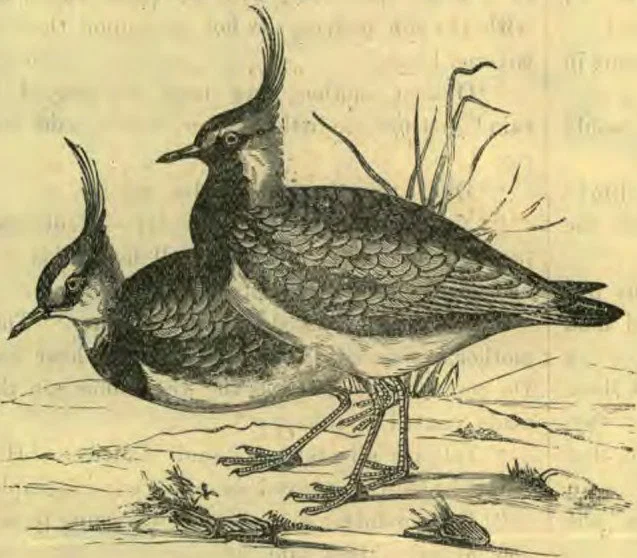
As you will see in the picture, this bird has a long, pointed crest, or tuft, attached to the back of its head, which it can carry horizontally, or raise in the air, as best suits itself. Its colors are very beautiful. Its chin, throat, and breast are jetty black in the summer, and change to white in the winter months; and it has a black streak which extends from the chin under the eye. The upper part of the body is a “rich coppery green, glazed with purple, the whole having a brilliant metallic appearance.” The upper part of the tail is white, tipped with black, while the wings are black, tipped with white.
As nearly as we can learn, England is its native country, where it lives upon the rivers, lakes, and marshes, and feeds mostly upon insects, worms, and grubs. The latter it has a way of forcing from the ground by stamping upon it.
These birds are so useful in destroying insects that they are often kept in gardens for that purpose. One man used one in this way for a number of years.
For their nests, they select, or make a little hollow spot in the earth into which they place a few straws or grasses, and lay their eggs, four in number. The eggs are very large at one end, sharply pointed at the other, and the bird is careful always to arrange them with their points together, so that they somewhat resemble a cross.
The eggs, under the name of “Plover’s eggs,” are much prized as an article of food; but they look so much like the ground in color that none but those used to hunting them often succeed in finding them.
These birds use great caution, and display almost human skill, in their care for their eggs and young. “If disturbed while tending them, the male bird rises in the air, and wheels round and round with a flapping flight, piercing the air with continued cries of ‘wee-wit, wee-e-wit,’ uttered very distinctly. This cry has given the bird the name of Peewit in some places, and has also caused the French to call it ‘Dix-huit,’ which, in their language, has much the same sound.”
The male bird takes this course to turn the attention of the enemy from the nest. The female bird, if disturbed, plays another trick, for the same purpose. “Rising from the nest, she limps away slowly, flapping her wings awkwardly, so as to give the impression that she has injured a wing or a leg, thus trying to tempt the intruder to overlook the nest and pursue her.”
What an instance of God’s wisdom and love is shown in his manner of providing for the wants of the lower order of animals; and if he has such care for them, how much more may we expect he will do for men. “He is great in little things as well as in great ones.”
“O Lord! how manifold are thy works; in wisdom hast thou made them all.” M. J. C.

TO OUR LITTLE CANVASSERS.

Boys and girls, you ought to have been here at the time of our last General Conference. Why, it did seem as if all the plans were made for doing a great work that any one could ever invent. One could not help but catch the missionary spirit to be here; and we feel sure that if you had been here, you would have gone home to work with a will to get subscribers for the INSTRUCTOR.
You should have heard them talk about canvassing, and about what would be best for beginners to use in learning to do this sort of work. You see, we all have to learn how to do the little things before we can do the greater ones, and canvassing for the INSTRUCTOR is light work because it is so easy to get subscribers for so nice a paper.
There are several good reasons why you should take hold of this work. You will be doing good to others by furnishing them with useful reading, and will be gaining an experience which will fit you for greater usefulness by and by. By persevering effort you can greatly increase our subscription list, which will enable us to furnish you with a better paper; and, too, you can get some valuable books for your library, as you will see by referring to our Prize List in last week's INSTRUCTOR.
We would call your attention particularly to the Prize List, which has been carefully revised, and has had several additions made to it of choice books and beautiful cards. Don't fail to examine it.
Now, how many will try real hard to see what they can do in canvassing for the INSTRUCTOR, and then write a letter to the Budget, telling us what success they have had? Postage is cheap now, so we shall expect to hear from many.
M. J. C.

OUT IN THE STORM.

SHRILL shriek the winter winds, And through the hemlocks sigh; Swift, in a wild and merry dance, The snow-flakes whirl across the sky. The trees with icy boughs Stand crackling in the gale; Low from his kennel, snug and warm, Echoes old Carlo's mournful wail.
Heap high the blazing grate, And fill the house with cheer; In cozy circle clustered round, No storms we happy children fear; Though the loud, whistling blasts O'er land and ocean roam, We laugh and sing without a care, Safe in our own dear sheltering home.
But listen! “Tap, tap, tap,” Upon the window-pane. You roguish wind, we love you not; Pray fly away, nor come again! Ah, look! A tiny beak! A shrewd and sparkling eye! 'Tis Master Snow-bird's plaintive chirp: “Feed me, kind friends, nor let me die!”
Hasten! the choicest crumbs Pour on the window-sill. Welcome, lone wanderers in the gale; Come, snow-birds all, and take your fill. He darts away in fright; Quick, close the sash, and wait! See, he returns on fluttering wing, And, joyful, calls his mate.
How sweet amid the storm Their twitters of delight! And, while we watch their eager joy, How our own hearts grow warm and light! Only two mites of birds, Two specks on the gray sky; Yet not one pang nor joy they feel Escapes the heavenly Father's eye.
—Our Little Ones.
Continue reading: ROCKS