The Youth’s Instructor, Vol. 33, No. 33.

CHRIST FEEDING THE FIVE THOUSAND
Earlier text: CHRIST FEEDING THE FIVE THOUSAND

FISH-HOOKS

The cost of fish-hooks is so trifling that perhaps you have never thought that it requires time, labor, and even skill to manufacture them. A writer in the Sunday-School Advocate says:—
“Combined with the manufacture of needles, there is one town in England, of considerable size and importance, that depends almost entirely on needles and fish-hooks for its well doing.
“If you could visit its factory, you would soon see that the variety of fish-hooks made is surprising, and the number in demand enormous. The cod-fishery alone draws on the manufacture for millions of hooks year after year. One of the heads of the Milwood firm at Redditch says that a few years ago, it being a comparatively slack time, they set some of their hands on the work of making these hooks for the cod-fish, and accumulated a couple of million, which one would reasonably suppose would be regarded as sufficient stock on hand, but exactly at this time, came from a foreign house an order for three million hooks of the exact pattern, and in a month or so the full commission was executed.
“There are two kinds in the market, the English and the Irish, or Limerick fish-hook. The latter were long in repute among anglers, but now it is said the largest number are made at Redditch, in Worcestershire.
“The process of making them is thus described: Steel wire is cut into the required lengths, and softened; then the ends of these bits of wire are inserted into shallow holes, in a sort of rest, or standard, and thus supported, the barbs of all three together are cut up by the skillful pressure of a stout knife. They are then pointed and turned by pressing them against a little ridge of sheet brass let into a block of wood having the requisite curvature. The other end is next flattened out by laying it on a small anvil, and striking a blow with a hammer. This is done to prevent the silk ligature from slipping over the end. The finer worm hooks have the shanks filed in order that the silk dressing may not enlarge the shank so much as to prevent the slipping of a small worm over it. They are then hardened, tempered, and blued.
“The Limerick hooks are made by cutting the steel, which is made from the best malleable iron, into lengths for two hooks. The ends are then forged out to the shape of barb and point, and the barb is undercut with a file for the solid forged end, instead of being cut and turned up with a knife. On this the reputation of the Limerick hook depended. They are shaped in the required curve by grasping them in circular pliers, and bending the wire with a turn of the wrist.
“There are many curious hooks made, and of all sizes, from that required to catch a shark, or even a still larger hook, strong enough to serve as a meat-hook to roast an animal whole, to such tiny ones that a dozen of them can be taken up on the finger tip. These latter go to the remote parts of India, though it is not known for what kind of fishing they are required.”

ANECDOTES OF TWO FAMOUS PAINTERS.

Xeusis, a famous Greek artist of ancient times, painted so naturally a dish of grapes held by a boy, that birds flew down to the canvas and pecked the fruit. But while his friends regarded the act as the best compliment ever paid to an artist, Xeusis sighed, exclaiming: “Had I painted the boy as true to nature as the grapes, the birds would have been afraid to touch them!”
It is of Xeusis and a rival Greek that a more familiar anecdote is handed down. The rival was Parrhasius. In the contest between them, Xeusis painted his favorite subject, grapes. At the exhibition of the pictures, down came the birds again, and flew at the grapes as if to eat them. “Now,” said Xeusis, triumphantly, “draw aside that curtain, and show your picture.” His rival smiled, for the curtain itself was the picture, painted upon a board to represent real drapery. The generous Xeusis yielded the palm at once, saying, “I deceive birds; you, an artist.”—Selected.

Glass Plates Proposed as Ship Hull Sheathing

It would be strange if glass should supersede copper for sheathing ships; but the hull of an Italian ship has been covered with glass plates cast like iron, which it is claimed will not rust or crust over.

The Quiet Clock Keeps the Best Time

It is not the clock with the loudest tick that goes the best.

TWO FOOLISH BOYS.

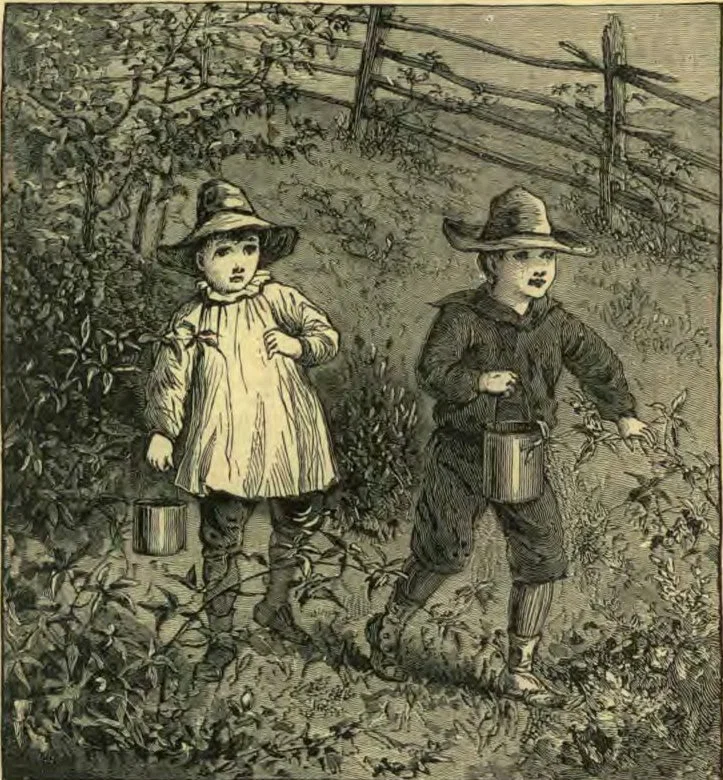
Rob and Kit Wood lived in a little log house among the pine forests of Northern Michigan. On every side rose the tall trees, forever singing and sighing, as the breeze passed through them. At their roots nestled the wild flowers, their sweet pink blossoms filling the air with fragrance in the early days of spring. Running through the forest was a narrow footpath, and an uneven wagon track, now almost lost, and again sinking deeply into the ground. This was the road that led to their nearest neighbors, about four miles off.
Farther away, in an opposite direction from the neighbors, a little path ran down to the road. You would hardly think of finding a path here; for scrub oaks and tangled briers had grown up all along the road, forming a thick undergrowth. Pushing your way through, you soon came to a clearing, in the midst of which stood an old, tumbled-down house. Once this had been a good farm, tilled by a happy family; but now it was all deserted, and on the tall briers that had grown up, great clusters of blackberries hung ripening in the sun.
“Kit! Kit! wake up!” called Rob, one bright August morning, as he sat upright in bed, and looked down at his younger brother beside him. “Christopher Wood! I say,” giving Kit a hard shake, “let’s ask mother if we may go blackberrying.” At this, Kit’s eyes flew wide open, and he bounded out onto the floor. The chores were done with surprising swiftness this morning; the wood-box was filled to the top with good wood, and the kindlings piled up in the corner. The water-pails were filled, and Rob fed the chickens, a task which he usually left for Kit. Then they went to ask mother. She stopped in the ironing long enough to put up a luncheon, and giving them a good-by kiss, told them to be home before dark.
The sun shone, oh, so hot! and the walk was long; but they trudged on. By and by they reached the clearing. “How thick and ripe the berries are,” called out Kit, as they entered the patch.
“My! won’t mother be glad to get these,” said Rob, picking as fast as he could. “Hope she’ll make us a pie.” Then there was silence, unbroken except by the snapping of dry twigs as the boys stepped on them.
By and by they grew tired of this steady work; then they sat down under a shady tree to eat their dinner, and wait till it was a little cooler. Overcome by the heat, the little heads sank lower and lower, and the long lashes drooped over the bright eyes. Soon they were fast asleep. Lower sank the sun, yet they slept on, and were only awakened when the long afternoon rays shone full in their faces.
“O Kit!” exclaimed Rob, “see how low the sun is, and our pails are only half full. What shall we do?”
“Let’s hurry and fill them,” said Kit, rousing up from his nap; “guess we can get ’em full before night,” and they went to work to make up lost time. Neither of them noticed how late it was growing; and when they had the pails full, the sun was out of sight.
“O Rob,” cried Kit, “do let’s hurry; it’s getting dark.”
“Don’t be a goose,” said Rob, who was himself trembling from fear; “what’s going to hurt us, anyhow? Guess we’re big enough to be out a little after dark;” and he walked reassuringly down the path, whistling as he went.
As they entered the road, darker still from the overhanging trees, the whistling ceased, and both boys walked rapidly down toward home. Once Kit looked behind him, and stood rooted to the ground with fear. Up the road was a white object coming slowly toward them, and waving its arms, so they thought. All the ghost stories they had ever heard flashed through their minds, and they turned and ran with all their might toward home. Every time they looked round, the white object was still following them.
Mother was at the door anxiously looking for them. It was two very scared, white faces that were upturned to hers a moment after, and two breathless little voices gasped out, “O mamma!”
“Why, what is the matter?” said Mrs. Wood, when she had succeeded in quieting them. “What has frightened you so?” And Rob managed to tell her how they had seen a ghost following them down the road home.
Mr. Wood came in in time to hear the last of Rob’s story; and bursting into a laugh, said, “Come out into the yard, and I will show you the ghost.” With one hand in mamma’s, they timidly obeyed, and saw old Dobbin standing in the moonlight, whisking his sides with his tail. Rob and Kit looked foolishly at each other, and said nothing. Mamma told them that there were no such things as ghosts, and that it was silly to be afraid to go into the other room or down cellar after dark. Then she gave them a little verse to learn, that would help them when they got frightened again. It was this: “What time I am afraid, I will trust in Thee.” She talked to them a little while about trusting the Lord, and told them some of the promises he has made us. I think they never believed in ghost stories again, and they learned not to be afraid in the dark.
W. E. L.

THE DOVES OF VENICE.

If any of our little readers should ever go to Venice, Italy, they must not fail to visit the great square of San Marco, so called after a magnificent cathedral built there many centuries ago. But, although they will like to see the cathedral, it is not that I am going to speak of now. Our little friends must be sure to be on the square a few minutes before twelve at midday. They will then see clouds of beautiful doves flying from all quarters of the city, and lighting on the eaves of the houses, on the domes of the old church, and indeed on every spot where a resting place can be found. They seem to be waiting for something, and so they are, for long habit and instinct teach them to be there at that time. As the great clock tells the hour, a window opens, and a hand is stretched out, scattering grain on the pavement beneath. In a second almost down sweep all the doves, each one trying to get more than his share. The air seems darkened with them, and there is such a fluttering and haste as never was. But they need not be in such a hurry, for the grain is thrown out again and again, till all are satisfied.
These doves are great favorites with the Venetians, and they never allow them to be killed. Some years ago, a rich lady of the city died, and left a piece of ground to be cultivated for the birds. So they have their own farm, which cannot be taken from them.

A Boy's Duty to Be Faithful and Kind

A boy’s temptations are no harder for a boy than a man’s temptations are for a man. It is just as much a boy’s duty to be faithful and just and kind on the playground or at school or at home, as it is a man’s duty to be just and honest and true in the counting-room or in the senate-hall. It is just as much a boy’s duty to imitate the boy Jesus, as it is a man’s duty to imitate the man Jesus.—The National Baptist.

Letter Budget.

HIRAM SHAFFER, of Polk Co., Mo., writes: “I am a little boy, eleven years old. I have one sister. We are trying to be good children and keep all God’s commandments. We keep the Sabbath with our papa, mamma, and Uncle Ed. We were all baptized last winter. We don’t live in houses, but we dwell in tents. We can be as transient as the Arabs of old,—when necessary, we can fold our tents and journey onward. We like the INSTRUCTOR very much, and would not like to be without it. We also like our Sabbath-school. I want the INSTRUCTOR family to pray that we may prove faithful, and be able to stand when Christ shall come.”
What Hiram has written about dwelling in tents makes us all want to know more of his home. That manner of life in warm weather seems very like old Bible times; but what can one do in real cold weather? Fortunately he does not live in a very cold climate. We should like to visit you, Hiram.
HETTIE ADAMS writes from Washington Co., Iowa. She says: “I take the INSTRUCTOR, and like it much. I live thirteen miles from church, so that I do not get to Sabbath-school very often; still I do not belong to the ‘Late to Sabbath-school’ family when I do go. Ma gave me half the chickens this year for feeding them and hunting the eggs. We have raised two hundred and fifteen little chickens, and I have found two thousand and fifty eggs this year. I have two sisters and one brother living. One sister died last fall of consumption. I hope to be faithful, so I can meet all the INSTRUCTOR family in heaven.”
If Hettie has one half of the chickens raised, can the little people tell how many belong to her? After taking out the one-tenth, how many will she have? How many dozen eggs did she find?
DAISY A. GRANT, of Clarke Co., Ohio, writes: “I am a little girl nine years old. I have been keeping the Sabbath with my mother almost a year. I attend Sabbath-school and church, and enjoy them much. I read a story in the INSTRUCTOR about the Sphinx. I was greatly interested in it. I heard it was one of the seven wonders of the world. I would be very glad to have the INSTRUCTOR contain a story about them all. Yours in the hope of a coming Saviour.”
The writer of the “Sphinx” article may grant your favor at some future time. The sphinx, however, is not counted as one of the Seven Wonders.
ARTHUR A. CULVER, of Guthrie Co., Iowa, says: “I have taken the INSTRUCTOR five years, and do not wish to be without it. I am eleven years old, and with my brother, who is thirteen years old, learn lessons in Book No. 4. My sister Annie, eight years old, studies Book No. 3, and brother Frank, who is six years old, gets lessons in No. 1. Ma gets lessons in the INSTRUCTOR. We all like to read the nice pieces so carefully prepared for our instruction. We all go to day school, and have a Sabbath-school at home. We go to Sunday-school, and pa is the superintendent. Ma has a class of seventeen scholars, who recite their lessons from Book No. 1. We had a Sabbath-school last summer, five miles from home. With parents and children, there were thirty-eight members. We haven’t met this summer. I am taking music lessons. With much love to the editors, I will close.”
It seems a pity that you could not continue so large a Sabbath-school as yours was last summer.
BIRDIE E. PARDEE, of Boone Co., Neb., writes: “I wanted to write for the Budget a long time ago, but mamma wanted me to wait until I could write myself. We live near a little town. I went to school until a dog ran mad and bit several dogs, some stock, and a man, when mamma was afraid to let me go. We had a nice teacher. There are no Sabbath-keepers nearer than the Albion church. There were five baptized at the last quarterly meeting, and I was one of the number. I tried to get subscribers for the INSTRUCTOR, but did not succeed. I like the Budget, and I like to read the letters just as they write them. I enjoyed reading Uncle Ide’s travels because papa and mamma were brought into the truth by his preaching. I am reading the New Testament through. I am now in Galatians. I am ten years old, and am trying to overcome. Pray that I may.”
Birdie waited until she could write quite an interesting letter. We shall all want to hear from her again.
EDITH BOYER, of Pierce Co., Wis., writes: “I thought I would write and tell you about our Sabbath-school. We have a splendid school; there are thirty-five members besides the children. I go as often as I can, and try to learn my lessons well. I am fourteen years old, and I am in the INSTRUCTOR class. My mother is a Sabbath-keeper, but my father is not. I hope he may soon become one, for it will be so nice for my father and mother both to keep the Sabbath. I am trying to be a good girl so I can meet you all in the new earth. Pray for me that I may ever be found faithful, doing my duty.”
If you are always faithful and kind, Edith, perhaps you will some time have the satisfaction of keeping the Sabbath with your father.

THE RAIN.

Up in the ancient roof-tree, Hiding among the leaves, Toying with swaying branches, Dancing in mossy eaves— Making the softest music, Kissing the window-pane— These are some of the frolics Of the gentle-falling rain.
Rushing down in a torrent, Wetting the farmer’s hay, Just as the boys are trying To save and stow it away; Tearing to earth the vinelets Climbing the cottage wall,— These are some of the mischiefs When the heavy raindrops fall.
Filling up the cisterns, Making the rivers flow, Blessing the drooping corn-field, And the patch where the melons grow; Waking a bud of beauty Where a withered leaf had been,— Doing each little duty With no thought of murmuring;
Raindrops, blessed raindrops! Come ye fast or slow, Bringing to our vision Oft the promised bow. Gift of the great All-Father, Sent the world to cheer, Hearts were sad without you, Earth were dry and sear. —Mrs. E. A. Harriman.

You have reached the end of this edition.

The Youth’s Instructor · Sep 2, 1885