The Youth’s Instructor, Vol. 33, No. 33.

CHRIST FEEDING THE FIVE THOUSAND

The Youth’s Instructor

Sep 2, 1885

S. D. A. Publishing Association · Battle Creek, Mich. · Sep 2, 1885

CHRIST FEEDING THE FIVE THOUSAND.
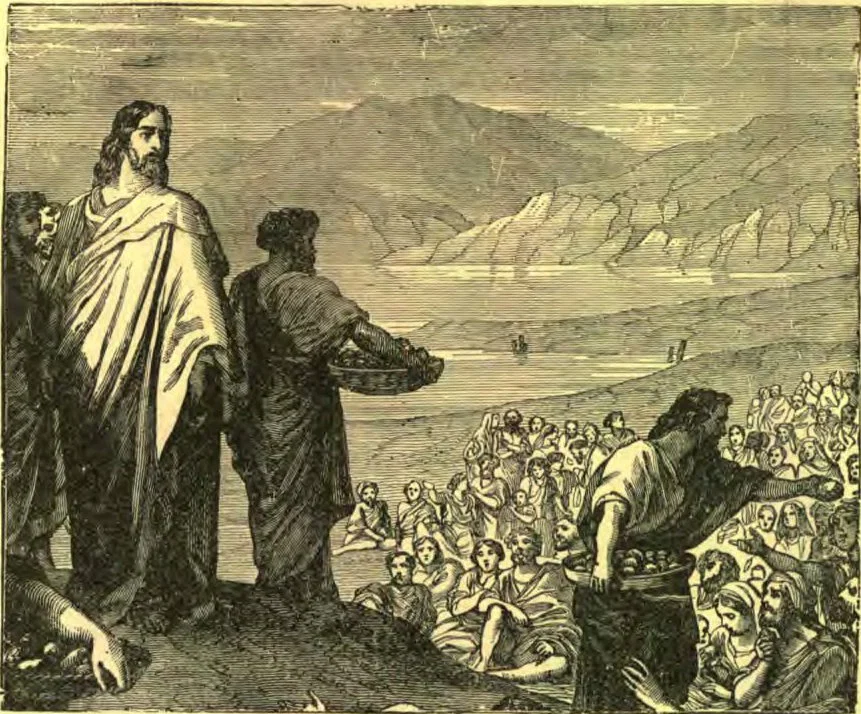
IN the picture we have a view of one of the most notable miracles that our Saviour performed while he remained here on earth. It is mentioned in all four of the evangelists, by Matthew, Mark, Luke, and John, which is remarkable of itself. The twelve apostles had just returned from their first missionary tour, where they had been sent by Jesus to teach and preach in the cities of their own country. See Matt. 11:1. Our Saviour knew that they now needed rest, and so he said to them, “Come ye yourselves apart in a desert place and rest awhile.”
There were many places suited for such retirement, but the Master told his disciples to take the boat and cross the head of Lake Tiberias to a retired spot which was some six miles away, not far from the city of Bethsaida. Luke 9:11. Anxious eyes were watching the movements of the wonderful Prophet; and as the great Teacher and his disciples sailed away from the wharf at Capernaum, the people anticipated his place of landing, and multitudes followed along the shore on foot, and outwent the boat.
Then as Jesus and his disciples came to disembark, instead of being alone, where he could instruct them privately about the gospel work, lo! a great multitude of people were ready to claim the attention of the mighty Healer. Hundreds of sick and maimed had been brought for Jesus to relieve, and were placed on the ground in positions to attract his attention. The Saviour could not obtain the retirement which he and his disciples desired. Stream after stream of people poured in, until many thousands were assembled. It was at the time of the Passover (John 6:4), and these Passover pilgrims were all anxious to listen to the wonderful Prophet.
From the account, it seems that in this manner the blessed Redeemer spent almost the entire day. He taught, and healed, and comforted, and instructed as the anxious multitude had need. The narrative says, “He was moved with compassion toward them, because they were as sheep not having a shepherd.” At last the day wanes, and the shadows lengthen and deepen, but yet the people show no signs of weariness nor any intention to depart. They have listened to the precious words of life as they fell from the lips of the great Teacher, and they have seen his almighty touch, as the sick were healed, the insane restored, and the maimed made sound again.
But the setting sun warns them that night is approaching, and the anxious disciples come to Jesus and say, “This is a desert place, and the time is now past; send the multitude away, that they may go into the country round about, and into the villages, and lodge and buy bread for themselves, for they have nothing to eat.” The Saviour quietly replies, “Give ye them to eat.” Then turning to Philip, a native of Bethsaida, and therefore well acquainted with the surrounding country, Jesus said to him: “Where shall we buy bread, that they may eat?” This he said to prove Philip, for Jesus himself knew what he would do. John 6:6.
Philip’s eye ran over the large company, and making a rough estimate he answers, “Two hundred pennyworth of bread (about forty-six dollars’ worth) would not be sufficient for them, that every one might get a little.” Andrew, the brother of Simon Peter, another native of Bethsaida, said, “There is a lad here who has five barley loaves and two small fishes, but what are they among so many?” This was probably some Jewish lad who had barley cakes and dried fishes to sell.
Jesus now directs that the meager supply be brought to him, and then he says to the disciples, “Command the people that they sit down upon the grass in ranks by hundreds and by fifties.” This was to prevent confusion and oversight in distributing the food he was about to miraculously prepare, and also to secure easy passage-ways among that vast multitude.
The arranging and seating some ten thousand people into orderly groups of fifty and one hundred persons each consumed some little time; but it is satisfactorily accomplished, and all are arranged in the presence of the Saviour. Everything in nature now seemed in harmony with the occasion. It is spring, for the Passover is at hand, and the air is doubtless filled with the fragrance of flowers and blossoms; the heat of the sun has abated, and the still waters of Galilee are peacefully sleeping at their feet, while the eyes of ten thousand persons are wonderingly directed toward Jesus, in vague anticipation of what he is about to do.
Jesus, now in the quiet of that still hour, while all eyes were fastened upon him, looked toward heaven and gave thanks for the food. He blessed the repast which he was about to supply in the wilderness. The account says, “He blessed and brake.” The Jews did not cut their bread, but baked it in loaves of a cake-like thinness, suitable for breaking.
Having given thanks to God for the food, the Saviour took the loaves and fishes, and dividing them into suitable portions, passed them to the twelve, and directed them to distribute the same to the people. And now began that mysterious and wonderful repast! Whether the food multiplied in the hands of the Saviour as he passed it to the disciples, or in the hands of the apostles as they handed it to the people, the record does not say, but it is more reasonable to suppose that the miracle was wrought in the Saviour’s hands. One thing is certain: all partook of the meal; all ate until they were satisfied; and there was more than could be used. The account says, “They took up of the fragments that remained twelve baskets full.”
Our Saviour, in order to teach all a lesson of economy, said, “Gather up the fragments that remain, that nothing be lost.” The “baskets” here mentioned were a kind of satchel or traveling basket, holding about a peck, which the disciples generally carried about with them.
This mighty miracle of the Saviour’s convinced the people for the time that he was the true Messiah. But probably they had more enthusiasm than true faith. The crowd speedily decide that Jesus shall not remain in obscurity any longer, and they are about ready to bear him upon their shoulders and proclaim him king.
Doubtless the disciples partook of the same spirit. But the Saviour anticipates their unwise scheme, and at once directs the apostles to take the boat, and return immediately to Capernaum. He then turns to that company of five thousand men, who are about to take him by force and make him king, and dismisses them with an authority that none dare disobey.
There is but one more miracle like the foregoing in the New Testament. It is the feeding of the four thousand men, besides the women and children, and is found only in the Gospels of Matthew and Mark. At this time, also, there were taken up seven baskets full of the broken fragments which remained after the multitude had eaten a full meal.
Let us all more fully trust and love this mighty Saviour, who can provide a table in the wilderness, and who is ever ready to forgive the sins of all who humbly call on him.
G. W. A.

A ROLLING STONE.

There is an old maxim—“A rolling stone gathers no moss”—which is applied to men who often change their business, going from one pursuit to another, successful in none. But the truth of the maxim depends on the qualities of the man. Sagacity, decision, and perseverance may turn the maxim into a lie, as it did in the life of the late Peter Cooper. His father was a hatter in New York, with nine children, Peter being the fifth child. With so many mouths to feed and bodies to clothe, Peter was obliged to pull, pick, and clean wool used in hat-bodies when he was a mere child.
He was kept at this work during his boyhood, except one year, when he attended a poor-school and learned something of arithmetic, reading, and writing. When he was fifteen years of age, he was a good hatter. Then his father relinquished his business, and removed to Peekskill, where he ran a brewery, and Peter mastered the art of beer-making in two years. But he disliked the business; it was too low and mean for a boy of his aspirations.
With his father's consent, he went to New York for employment of some kind. Entering a carriage factory, he inquired, “Have you room for an apprentice?”
“Do you know anything about the business?” the proprietor asked.
“No, sir; nothing,” was Peter's frank reply.
“Have you been brought up to work?”
Peter's answer was a brief history of his life.
“Is your father willing that you should learn this business?” continued the man.
“He has given me my choice of trades,” answered Peter.
“If I take you, will you stay with me, and work out your time?”
“I will, certainly,” was the youth's assuring answer. So a bargain was struck,—twenty-five dollars a year and board,—and Peter learned the coach-making business. Four years he spent at this shop, when, at twenty-one years of age, his employers offered to build him a shop, and set him up in business, which offer he declined because “he had a horror of being burdened with debt.” It was during his apprenticeship to the carriage-maker that Peter began to feel his great need of more education. He procured books, and spent his evenings and leisure moments at other times in mental improvement. He looked about for an evening school which he might attend, but there was no such school in the city. Disappointed and somewhat discouraged, Peter resolved, then and there, that if ever he made money enough, he would establish an institution where intelligent and aspiring youths like himself might have an opportunity to learn,—a resolve which he carried out forty-five years afterward in the erection of Cooper Institute in New York.
The war of 1812 began about the time Peter reached his majority, and it ruined the carriage-making business. At the same time, the war created a demand for clothing; and Peter Cooper invented a machine for cutting away the nap on the surface of cloth, for which the demand became so great, within a short time, that he found himself unexpectedly in a thriving, money-making business. The return of peace, however, in 1815, destroyed that business as suddenly as it was created; for American manufacture could not compete with the English in the absence of a tariff, and the market overflowed with English goods.
Next he bought out a grocer, doing business on the spot where Cooper Institute now stands. He prospered in this venture, but at the end of a year sold out, and engaged in the manufacture of glue, a business to which he could stick, for in it he saw a fortune. The latter business proved so lucrative that, in a few years, it yielded him an income of thirty thousand dollars annually. His fortune was made!
Hatter, brewer, coachmaker, inventor, grocer, glue manufacturer! “A rolling stone gathers no moss.” It gathered a pile of moss in this case. Cooper upset the maxim. While in nine cases in ten the maxim proves true, in this case Cooper proved it false. His sagacity, decision, application, and perseverance enabled him to swap a good chance for a better one successfully. His “rolling” was not indiscriminate and aimless. There was method in it. He was forewarned and forearmed by his observation, circumspection, and self-reliance. No inefficient, shiftless youth could have accomplished so much by any amount of “rolling.” Changing from one pursuit to another without reason or judgment,—changing for the mere sake of changing; a jack-at-all-trades, and good at none,—that is “the rolling stone that gathers no moss.”—WM. M. THAYER, in The American Teacher.

HOUR BY HOUR.

One single day Is not so much to look upon. There is some way Of passing hours of such a limit. We can face A single day; but place Too many days before sad eyes— Too many days for smothered sighs— And we lose heart, Just at the start. Years really are not long, nor lives— The longest that survives; And yet, to look across A future we must tread, bowed by a sense of loss, Bearing some burden weighing down so low That we can scarcely go One step ahead, this is so hard, A view so stern to face; unstarred, Untouched by light, so masked with dread, If we would take a step ahead, Be brave and keep The feet quite steady, feel the breath of life sweep Ever on our face again, We must not look across, looking in vain, But downward to the next close step, And up. Eyes which have wept Must look a little way, not far. God broke our years to hours and days, that hour by hour And day by day, Just going on a little way, We might be able all along To keep quite strong. Should all the weight of life Be laid across our shoulders, and the future, rife With woe and struggle, meet us face to face At just one place, We could not go; Our feet would stop; and so God lays a little on us every day, And never, I believe, on all the way Will burdens bear so deep, Or pathways lie so threatening and so steep, But we can go, if by God's power We only bear the burden of the hour.

BALE, SWITZERLAND.

As the S. D. A. General Conference has established a mission in this city, perhaps some of our readers may like to know something of the place and people. Bale, the capital of the canton of the same name, is situated in the northern part of Switzerland, near both Germany and France. The first mention made in history of the city was in the year 374, at which time it was called Basilea, and many Germans still use that name in speaking of it. It is one of the principal cities of Switzerland. During the middle ages it was an independent city of the empire; but in the year 1501 it united with the Helvetic Confederation, the proper documents being signed, and publicly proclaimed in the market place on the 13th of July, and Bale took its place as the ninth canton in the Confederacy.
On the 18th of October, 1356, at ten o’clock at night, the city was visited by a severe earthquake, followed by a devastating fire, which spread for several days among the ruins. Three hundred persons perished, and a great number of castles and other buildings were thrown down. So nearly complete was the ruin, that many of the survivors were in favor of building a new city on a different site; but the majority desired to remain upon the spot where their forefathers had lived so many generations. In a few years the walls and many of the principal edifices had been rebuilt. At the present time it contains a population of 65,000.
For a long time it was a “walled” city, but the constant growth forced itself beyond the walls, and these barriers have very nearly disappeared. The gateways and watchtowers, however, still remain perfect, the huge gates being always open. The towers over the gates are massive structures, and look as though they might be safe resorts for the defenders of the place. Each tower has its clock, which strikes the hours, half hours, and quarter hours. The streets of the ancient portion of the city are very narrow and crooked, but those of modern construction are wider, and well laid out.
The beautiful Rhine flows through the place, and is spanned by several bridges. Its waters are of a deep blue, and it runs quite rapidly, although smoothly. There are many beautiful and picturesque spots along its banks, the latter being steep and high, from which a fine view of the river can be obtained. The terminus of the Jura mountain range, between Switzerland and France, is but a short distance from here; and from elevations about the city, the “Black Forests” of Germany are plainly seen.
The country immediately surrounding the city is level and highly cultivated. Within the city limits there are a great many beautiful gardens and walks, much pride being displayed in their arrangement. More attention is given to holidays and festivals here than in America; and on all such days, as well as on Sundays, the people turn out en masse, children and all, and spend much of the day in the fields and gardens. They seem to have a high appreciation of the benefit of fresh air and exercise in the proper development of the little ones.
The buildings are all of stone and brick, among them being some fine churches and public edifices. Some partially destroyed by the earthquake of 1356 were repaired, and are still standing. Some it is calculated have been built nearly 1000 years. Such care is now taken in the construction of buildings, in order to guard against fire or other disaster, that a raging fire would be an impossibility. The alarm of fire is almost unknown. The city is supplied with water from a location among the high hills, which, on account of the height, acquires a great pressure, and would thus be very serviceable in case of fire.
A large proportion of the hillsides and mountain slopes within sight of the city are covered with vineyards, from the products of which a great amount of wine is made. The city itself abounds in beer and wine gardens, and beer-drinking is almost universal among all classes. In passing through the place, it would seem as if a person could hardly get out of sight of the signs displayed over the gates and doorways of drinking places. It hangs like a cloud over the entire country.
The people are slow, and cling with tenacity to old, established habits and customs. The public market places are thronged early in the morning by the country women, displaying their butter, eggs, fruit, and vegetables for sale. Hardly a man is to be seen among them. Each woman has a small wagon, with which she conveys her stock to market without the assistance of man or beast. The roads leading into the city are macadamized, and very hard and smooth, thus enabling one to draw quite a heavy load. The streets throughout the entire city are kept very neat and clean.
Occasionally a stork’s nest is seen perched on the peak of some building. The nest is about the size and shape of an ordinary bushel basket, and is composed of twigs. Although not adding to the beauty of a gentleman’s residence, they are allowed to remain without being molested.
It would, no doubt, be a strange sight to many of the INSTRUCTOR family to see a funeral procession passing along, the coffin borne upon the head of a woman; but such is the custom here among the poorer classes, when the burden is not too heavy to be carried in that way. Only a few days ago I witnessed such a sight. There was only one woman in the procession, and she carried the coffin safely poised on her head; and although she carried it fully a mile, not a misstep was made. Behind her were several men, walking in line, and two small girls carrying a basket of flowers. Judging from the size of the coffin, it must have contained the remains of a child ten or twelve years of age. The women seldom accompany the procession to the grave, unless the deceased be some very prominent person or dignitary.
The mind is now carried forward to another city which will soon be the abode of the faithful, both old and young, children as well as parents. It also has walls and gates, and a beautiful river flowing through it; and the streets are of pure gold. But it is not made with hands. Its builder and maker is God. It far surpasses in beauty anything ever beheld by mortal eyes. What a privilege it will be to behold that city, and to share its beauties through eternity! No funeral processions there, no destructive earthquakes nor consuming fires. We must also remember that none but the pure in heart will enter the gates of that beautiful city. Let us all try to live so that we may be prepared for a home in it. We hope none of the INSTRUCTOR family will be left out.
R. H. COGGESHALL.

WHAT THE BIRDS ACCOMPLISH.

The swallow, swift, and nighthawk are the guardians of the atmosphere. They check the increase of insects that otherwise would overload it. Woodpeckers, creepers and chickadees are the guardians of the trunks of trees. Warblers and flycatchers protect the foliage. Blackbirds, crows, thrushes, and larks protect the surface of the soil. Snipe and woodcock protect the soil under the surface.
Each tribe has its respective duties to perform in the economy of nature, and it is an undoubted fact that if the birds were all swept off the face of the earth, man could not live upon it. Vegetation would wither and die. Insects would become so numerous that no living thing could withstand their attacks. The wholesale destruction occasioned by grasshoppers, which have lately devastated the West, is undoubtedly caused by the thinning of the birds, such as grouse, prairie-hens, and the like, which feed upon them.
The great and inestimable service done to the farmer, gardener, and florist by the birds is only becoming known by sad experience. Spare the birds and save your fruit. The little corn and fruit taken by them is more than compensated for by the quantities of noxious insects they destroy. The long-persecuted crow has been found, by actual experience, to do more good by the vast quantities of grubs and insects he devours than the harm he does in the few grains of corn he pulls up. He is one of the farmer’s best friends. —Selected.

THE TWO PURSES.

ONE for the Lord and one for yourself. Be sure to have two places for money, one of which shall be consecrated to the Lord and the other for personal and business purposes.
A young lady said to her father, “I would like to put something into the box, as it is passed around on the Sabbath.”
Her father willingly gave her part of his donation, and thus she added the influence of her example to the custom, but nothing to the increase of the collection. She wanted to give something of her own. She had about six or eight dollars yearly of interest money on a small invested capital. This she had been accustomed to use for Christmas and birthday gifts among her friends. She resolved to have two purses, and put into one, for the Lord, at least one-tenth of her income. Although it made but a small sum, she had more satisfaction in giving than ever before. But the delightful part came when, from one cause and another, wholly unexpected, she received the next year a far greater sum for her own disposal than she had ever had before, and a good portion of it went into the Lord’s purse.
“I never think of touching what is in the Lord’s purse for any but religious purposes,” said she, “and never borrow from it for my own use. It is sacred to the Lord. It is in his purse, and I never enjoyed my money before as I do now. It is not much, but I am glad to do it, and in consequence always have a little money ready for every good cause.”
Ah! it is a good way—it is a right way. If you have not tried it, begin now, and learn its blessedness by your own experience.—Christian Giver.

FIDELITY AS AN APPRENTICE.

The late Dea. Daniel Safford, of Boston, was a successful mechanic. Beginning life as a blacksmith, he conferred honor on his trade by his high character, his thorough work, and his large business enterprises. He built up an extensive business, and accumulated a fortune, which was liberally used for benevolent objects. One secret of his success was his uniform fidelity, never slighting any work, but finishing everything that passed through his hands in the best manner possible.
When he was an apprentice, he made this record in his journal: “Resolved to do work for my employer as faithfully as if I were doing everything for myself.” Many clerks and apprentices make a great mistake in slighting their work when it is not subject to careful inspection. They draw a broad distinction between their own interests and the interests of their employers, and try to go on as easily as possible for themselves. Such young men rarely ever succeed in life, and they do not deserve to succeed.

The Abbot's Oaks: Planting Hearts Early

A story is told of an abbot who wanted to buy a field near his monastery. The owner would not sell it; but at last he consented to lease it for the growth of one crop. The abbot planted it with acorns. With oaks growing on it, he was sure of it as long as he and his fraternity might want it. Satan outwits good people sometimes in similar style. He gets the first planting of children's hearts, and he has them for life.

A BUILDER’S LESSON.

“How shall I a habit break?” As you did that habit make. As you gathered, you must lose; As you yielded, now refuse. Thread by thread the strands we twist Till they bind us, neck and wrist; Thread by thread the patient hand Must untwine, ere free we stand. As we builded, stone by stone, We must toil, unhelped, alone, Till the wall is overthrown.
But remember, as we try, Lighter every test goes by; Wading in, the stream grows deep Toward the center’s downward sweep; Backward turn, each step ashore Shallower is than that before.
Ah, the precious years we waste Leveling what we raised in haste: Doing what must be undone Ere content or love be won! First across the gulf we cast Kite-borne threads, till lines are passed, And habit builds the bridge at last! —Wide-Awake.

SECURING ATTENTION.

To secure attention, the teacher must not only bear in mind those things which help prepare him for his work, but he must consider the wants of his pupils. His treatment of them affects his measure of success. There are three things to which the teacher should appeal:—
The Scholar's Curiosity.—The inquisitiveness of a child should be regarded by the parent and teacher as a hopeful feature. These little inquiries are like so many rootlets reaching out for new ideas, grasping new trains of knowledge that are to build up the mind, give it life, vigor, and expansion. The love for the new and strange are legitimate and wholesome aspirations, of which the teacher must avail himself in securing the attention of his pupils. The human mind is constructed so as to relish, and, indeed, to require variety, if it is to be directed or its attention gained. Adults are no less fond of what is new and interesting than are children.
Nature appeals to our curiosity in its endless beauty and variety. There is variety in the landscape we enjoy; hills, valleys, rivers, and lakes, to say nothing of the charms in the vegetable and floral kingdoms, spread themselves in rich profusion for our attention and admiration. God has, in his realm of grace, equally consulted our nature, and spreads truth at our feet, not gathered en masse and classified abstractly, but in bountiful profusion, scattered and diversified through his revealed word, clothed in freshness and beauty.
Praise God, Christian teacher, for his rich grace, in giving us the visible, that thereby we may grasp the invisible; that by the known we may be made acquainted with the unknown.
The Scholar's Confidence.—This is a plant of slow growth, and needs careful culture. Guard it with great care. Nurse it tenderly, and allow nothing to hinder its steady growth. Every teacher will know how to value it. Without it, little can be done in teaching; and certainly attention will be wanting if confidence is absent.
The teacher needs the scholar's confidence in his personal piety. His daily walk will strengthen or weaken the scholar's respect for him. How can the teacher plead with his pupils successfully, if they doubt his sincerity, his character, or his Christian fidelity? His tears are vain, and his words fall lifeless on their ears.
So live, teacher, that you may win the love and unwavering confidence of the precious souls placed in your charge. It will help to secure attention.
The Scholar's Conscience.—As it may be developed, lay hold of it, and appeal to it appropriately. As the moral sensibilities become manifest, the teacher should, by well-directed efforts, secure for the truth not only a patient and attentive hearing, but a prompt and hearty obedience. The teacher cannot afford to omit the cultivation of his pupil's conscience. Keen sensitiveness must be encouraged. The higher the sense of right and wrong, the more pliable will be the attention of the scholar.—Aids to S. S. Workers.

FOREIGN POSTAL SERVICE.

C. F. GORDON CUMMING, in an article in Cassell's Family Magazine entitled “The Postmen of the World,” says of the foreign Post:—
“In my farthest wanderings I have never reached any point so isolated as to be beyond the ministrations of the Post-office, but strangely varied have been its emissaries.
“In my travels in the Himalayas we found a truly useful friend in the native post-master at Kotghur, which was the farthest limit of the great postal network. Thenceforward, as we journeyed in the wilds, he forwarded all our letters by a very lightly-garbed special runner, who carried them as English village children carry sweet violets, in the end of a cleft stick. Thus the letter was perhaps carried for several days, and was at length delivered as clean as when it started.
“The commonest type of Indian post runner, or ‘Tappal wallah,’ wears a long white coat, very tight trousers inclose his lean legs, and his head-dress is a huge, light blue turban. His letter bag is slung on his side, and it is necessary that he should be a good linguist, and be able to read a great variety of strange, crabbed characters, for several of the multitudinous languages of Hindostan are written in quite distinct characters, all of which are alike incomprehensible to our untutored eyes. The rural letter-carrier of Hindostan carries a long stick with a sharp point, which can be used as a weapon in case of need. The stick is adorned with six little brass bells, which serve to frighten away reptiles and dangerous animals, and also to give notice of the approach of the post. The danger from wild beasts is, in some districts, a very real one, the ‘tappal’ runners through the forest districts in the south of Ceylon, having occasionally had very narrow escapes from the attacks of ‘rogue’ elephants and other wild beasts.
“Of all varieties of Indian letter-carriers, clothed or unclothed, none are so picturesque as the Camel Express Messengers. The men wear a serviceable red uniform, and a large green turban embroidered with gold thread. From their girdle hangs a curved saber in a red sheath. The camels are adorned with trappings of gay cloth and tassels, ornamented with blue beads and cowrie shells, and small brass bells round the neck to give notice of their swift approach. It is said that their rough and rapid trotting, sometimes at the rate of eighty miles a day, is so trying to the riders as to shorten their days. Two heavy mail-bags hang to right and left on each side of the camel, and the saddle is so arranged that a passenger can take a seat behind the postman.
“In no country of the world is the postal organization more wonderful than in Japan; the chief marvel being that, till about a dozen years ago, there was no regular government institution of posts in the country. In 1871, when Japan awakened like a giant from her long sleep of exclusiveness, and set to work to accomplish changes of every sort, she resolved to establish the European postal system; and with such astonishing zeal has she done her work, that within ten years the British, American, and French post-offices, which had been established at all the open ports, were closed, foreign nations being satisfied with the thoroughness of the Japanese postal service. In that short period mail routes had been organized over 36,000 miles; mail-trains and steamers, post-vans, and runners were all enlisted; 3,927 post-offices and 7,439 letter-boxes had been established; money order offices and post-office saving-banks were in full operation; 7,500 persons were employed on the regular staff; stamps, stamped envelopes, post-cards, and newspaper wrappers were issued at the same rate as our own; letter postage to any part of the empire being at the rate of 1 d., and post-cards ½ d.; while within the limits of the city of Tokio these postages are respectively only half-price.
“Where the post-office had thus been started in full operation, it is needless to say that the telegraph was not forgotten; and by 1880 it was in full working order over a distance of about 10,000 miles, and giving employment to about 15,000 persons.”

IMPORTANT BIBLE SUBJECTS.

LESSON 60.—INHERITANCE OF THE SAINTS.

(Concluded.)

THE PROMISE FULFILLED.

[NOTE TO THE STUDENT.—Do not consider the lesson learned until you can give at least the substance of every text, with the correct reference for each. The references in black letters indicate those texts that should be committed to memory. A little diligent application each day will enable you to do this.]
1. By what means is the “gathering” of Israel effected?
2. After the coming of the Lord, what must take place before they can be planted in their own land? Give Bible proof on both these points.
3. When the earth is given to Christ for a possession, what will he do? Ps. 2:8, 9.
4. Where have we a vivid prophetic description of this event? Rev. 19:11, 15, 16, 21. Read also the intervening verses.
5. What Old Testament prophecy mentions the same thing? Isa. 11:1-4.
6. When the wicked are thus destroyed, what is done to the earth? 2 Pet. 3:7, 10, 11.
7. What is promised after the dissolving of the earth? 2 Pet. 3:13.
8. Where is this promise found? Isa. 65:17-19.
9. What can you say of the happiness of the people who inhabit that land? Isa. 65:18, 19; Rev. 21:4, 5; Isa. 35:10.
10. What of the employment of the people? Isa. 65:21, 22.
11. How do we know that this is to be fulfilled when Israel are gathered and placed in their own land? Amos 9:13-15.
12. What will be the character of the people at that time? Isa. 54:13, 14; 11:9.
13. What persons to whom special promises have been made, will then realize their fulfillment? Matt. 8:11.
14. Why has the fulfillment of this promise been so long delayed? 2 Pet. 3:9.
15. From the Lord’s standpoint, has it really been long since the promise was first made? 2 Pet. 3:8.
16. When the promise is fulfilled, how will all creation stand related to God? Rev. 5:13.
17. In view of the blessed promises held out to us, what exhortation should we constantly bear in mind? Heb. 2:1-3.

ENDEAVOR

STRIVE, endeavor; it profits more To fight and fail, than on Time’s dull shore To sit an idler ever; For to him who bares his arm to the strife, Firm at his post in the battle of life, The victory faileth never.

NAMING STEAMSHIPS.

A CURIOUS method is adopted in the naming of steamships, which is of interest to the inquiring mind. With little care, one need but know the name of a vessel to tell nearly always to what line of steamers it belongs; and circumstances might happen where such knowledge would be very serviceable. An exchange says of this custom:—
“In naming steamships, some companies select the names of cities, others, American States, and others begin the name with a certain letter or syllable. Vessels have been renamed to conform to a rule. The Guion Line names its vessels after the States and Territories of the Northwest; as the Wisconsin, Nevada, Arizona, Alaska, and Oregon. The White Star Line selects names for its vessels ending in ‘ic’; as the Baltic, Adriatic, Germanic, etc. The Cunard Line chooses names ending in ‘ia’; as the Gallia, Servia. The National Line began naming its vessels after American States, but afterward adopted the names of countries. The present Holland was formerly the Louisiana; there also are the Canada and Greece. The Inman Line names its vessels after cities; as the City of Chicago, City of Berlin, etc. The State Line adheres to the names of American States for its vessels; as the State of Pennsylvania, State of Nebraska. The New York and Bordeaux Line names its vessels after well-known wine châteaux, and the wines furnished on board are bottled at the château after which the ship is named. The two vessels now running are the Château Leoville and Château Lafite. The Hamburg-American vessels bear the names of German poets. The North German Lloyd has a vast fleet of steamers. Some of them are named after the rivers; a few, like the General Werder, after prominent persons; others after old estates and leading cities. The Bremen and Hull vessels are named after birds. Of the American Lines, the Alexandres' Mexican and Havana steamers are named after cities; as, the City of Puebla, City of Alexandria, etc. The Savannah Line selects Indian names. The United States and Brazil Line selects names ending with ‘ance’; as Finance, Advance, and Reliance. Of the outside British lines the Glen Line names its steamers beginning with ‘Glen’; the Japan Line, ending with ‘shire’; the Ben Line, beginning with ‘Ben’; the Hall Line, ending with ‘Hall’; and the Calcutta Line after the stars.”

THE PEACOCK THRONE.

In a late number of the INSTRUCTOR you were given a description of what is supposed to be the “most beautiful building in the world,” which was built by the emperor, Shah Jehan, at an expense of $15,000,000, as a memorial to his deceased wife. This same emperor ruled, seated upon a throne which cost $30,000,000. It was easy for him to pay these immense sums, for his wealth was enormous. But this ruler’s glory, like that of all earthly potentates, is departed, and the Shah now sleeps by the side of his wife, two hundred feet beneath the dome which covers their resting-place. But of the magnificence of his throne, a writer in Golden Days says:—
“This throne stood on a pavilion of marble at Delhi. It was six feet long and four feet broad, and was composed of solid gold, inlaid with rare gems. It received its name from the jeweled images of peacocks which adorned its canopy. This canopy was also of gold, supported on twelve golden pillars, and hung all round with a fringe of pearls.
“On each side of the throne stood two umbrellas. These symbols of royalty were made of crimson velvet, embroidered with gold thread and pearls, while to each was a solid gold handle, eight feet long, studded with diamonds.
“The cost of the peacock throne was about $30,000,000. It was the work of a Frenchman named Austin de Bordeaux, and was made for Shah Jehan, the emperor.
“In a war that followed, the throne was carried off into Persia, and afterward the gold was melted and turned into money.”
Continue reading: FISH-HOOKS