THE limits of a brief article are quite inadequate for the discussion of an ancient civilization. And the attempt to describe the conditions in Japan to-day is further complicated by the commingling of the old and the new; for Japan has not yet passed the transition stage between the mediæval and the modern. To point out some of the most striking differences between eastern and western ways and ideas, and to note the effects of these differences, is the most that can be attempted here.
One of the first things to attract the attention of the newcomer in Japan, is the amount of hand labor performed. This is noticed first in the traffic of the streets. In all the large towns there are wagons drawn by horses; but these are the exception, the great majority of the vehicles being carts drawn by hand. Everybody has heard of the jinrikisha, the carriage of the Orient. And just as this somewhat exaggerated baby-cab takes the place of our 'busses and hacks, so do small two-wheeled carts do the work of our drays and delivery wagons. This may seem a hard way of doing things, but it has its compensations. Horse and driver are united in one, and the horse never becomes frightened nor runs away.
If we extend our observations by a visit to the country, we observe that this way of doing almost all kinds of work by hand applies also to the cultivation of the soil, and the harvesting of the crops. Occasionally one sees a horse or a bull wallowing through the mud of a rice field, drawing a plow or some other implement for preparing the soil for the seed; but very much oftener this sort of labor is being done by long-bladed hoes in the hands of men and women.
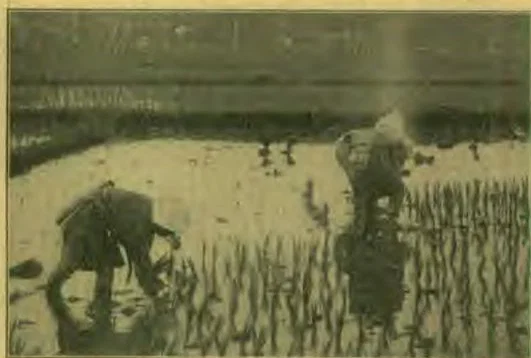
Rice is the principal crop, and its cultivation will serve to illustrate the farmer's work. The seed is thickly sown in a small tract of land, and grows there till some time in June, when the young plants are transplanted, all by hand. The plants are set in rows a few inches apart, and are fertilized and kept free from weeds by painstaking hand labor. The ripe grain is cut with a small sickle such as the reapers of Boaz might have used, the grain is separated from the straw by pulling a handful of heads between a number of close-set teeth or prongs; and all the implements for hulling, winnowing, and scouring the grain, are also commonly worked by hand.
Transplanting Rice.
In manufacturing lines the same rule holds, tho with exceptions; for foreign methods and appliances are being introduced, especially in the production of articles of foreign origin. But from ancient times the exquisite lacquer china, and porcelain wares, have largely been produced in the homes of the people. The same is true of the rich fabrics and needlework that are so highly prized.
The enterprising Westerner is inclined to look with pity, if not contempt, upon these slow, out-of-date methods; but here, too, there are compensations well worth considering. The invention and use of labor-saving machines seem to be not altogether an unmixed blessing. Every new invention throws many workmen out of employment, while the profits of the capitalist and manufacturer are proportionately increased. The net result is the massing of property into the hands of a few, while the common people grow poorer. The Japanese artisan may be poor; but he is more independent than many of like craft in Western lands.
The domestic life of the Japanese presents many features that are strange to Western people. The standard of living is on a cheaper scale, else the people would not be able to subsist. A foreigner would not take kindly to living "Japanese style," and might be inclined to recommend that they adopt Western ways. Let us notice what this would mean to them.
In the first place, such a change would quite revolutionize their dwellings. The use of chairs, tables, bedsteads, and other Western furniture would require that the rooms in the house be larger and more in number. The straw mats on the floors would have to go; for chairs and table legs ruin them, and with chairs and bedsteads they would not be needed. A Japanese house has no chimney except an opening in the roof over the kitchen. The handful of charcoal in the fire-box serves only to warm your fingers while you sit close by, and does not appreciably warm the air in the room. "Cold as a barn"
exactly describes a Japanese house in winter. The inmates keep comfortable, or as nearly so as possible, by donning extra garments, sitting on their feet, and warming their fingers over the charcoal fire. In the colder parts of the country, a box-like frame is set over the fire-box, and a heavy quilt is thrown over this. The family gather about this kotatsu, draw the edges of the quilt over their laps, and so keep quite comfortable. And at night the beds are made up on the floor around this queer stove, and the heat from the fire makes each bed very comfortable; but one is apt to wake in the morning with a headache, due to the charcoal fumes. The introduction of foreign stoves would call for chimneys and stovepipes, and would greatly increase the expense for fuel.
Contrasts in Cost of Living.
13All these considerations help to explain how the people can live so economically. Their houses contain very little furniture, and the same small room may serve as sitting-room and dining-room by day, and sleeping-room at night. But little fuel is consumed. The food is generally very plain and simply prepared, mostly by boiling in water; but preparations boiled in oil are not uncommon. There are no ovens, the broiling of fish and the baking of small cakes being done over a charcoal fire. It is said that six students can be educated in Japan for what it costs to educate one in an American college. A common price for board and lodging at an ordinary boarding-house is four dollars a month. And yet if a person wishes to live "foreign style," he must pay from thirty to thirty-five dollars a month at a private boarding-house; and hotel rates are in proportion.
Social and Family Relationships.
The social life of the Japanese also presents contrasts with the West. The social scale is perpendicular rather than horizontal, as with us. The parents, of course, stand at the head of the family; then the children rank according to age. The eldest son, as the family heir, is accorded a degree of respect and authority unknown in a Western family. The language contains no simple words for brother and sister; but there is one word for elder brother, and another for younger brother; likewise distinct words for elder and younger sister. Thus the distinction of rank according to age is daily recognized and impressed by the language used.
The position of wife and mother is one of meek submission to her husband. When a son of the family marries, he commonly brings his bride to the home of his parents, where she becomes subject to her mother-in-law. Under this plan the young people have the advantage of the long experience of the parents in matters of domestic economy; but such an arrangement is often the cause or occasion of much unhappiness.
The virtue of filial piety is highly prized by the Japanese. The duty of the child to the parent is one of the five relations recognized in the moral system of Confucius; namely, of subject to sovereign, of parent to child, of brother to brother, of child to parent, of friend to friend. Perhaps I can not better illustrate the Japanese ideal of obedience to parents than by relating the following story, said to be strictly true. A Japanese father one day ordered his son to go to the village on some errand; and as the roads were muddy, he told him to wear his straw sandals. As the boy was about to start, his mother saw him, and, not knowing what his father had ordered, told him to wear his high wooden clogs, as the mud was not deep. It required a few minutes to make the change from sandals to clogs, and, as he was about to start again, his father saw him, and, noticing that he was wearing clogs, repeated his order that he wear sandals. The boy without controversy made the change, and again essayed to start. But this time his mother saw him again, and repeated her command to wear the clogs. What should he do? How could he obey both parents? When next seen he had answered these questions to the best of his ability; for when met by a friend, he was hobbling along, with a sandal on one foot, and a clog on the other.
This may seem like a high standard of morality for a people regarded as heathen. But it will be noticed that the Confucian system of morality fails to recognize man's obligations to a Power higher than parent or earthly ruler. And so the Christian teacher often finds that these ideas of loyalty to the civil ruler and obedience to parents often stand in the way when the obligation to obey the law of God is presented. And it requires much care to impress these people with a proper sense of their obligations to God, without appearing to teach disloyalty and disobedience to rulers and parents, when laws and commands conflict with the Lord's requirements. The lessons learned in childhood exercise a strong influence upon the life, and it is very difficult to unlearn these lessons, or to weaken their influence. This illustrates the great importance of early education.
But the truth of God, like a hammer, is breaking hard hearts in Japan; like the sun, it is bringing light into darkened minds. The strongholds of error are being cast down, and souls are building for eternity upon the sure foundation. F. W. FIELD.
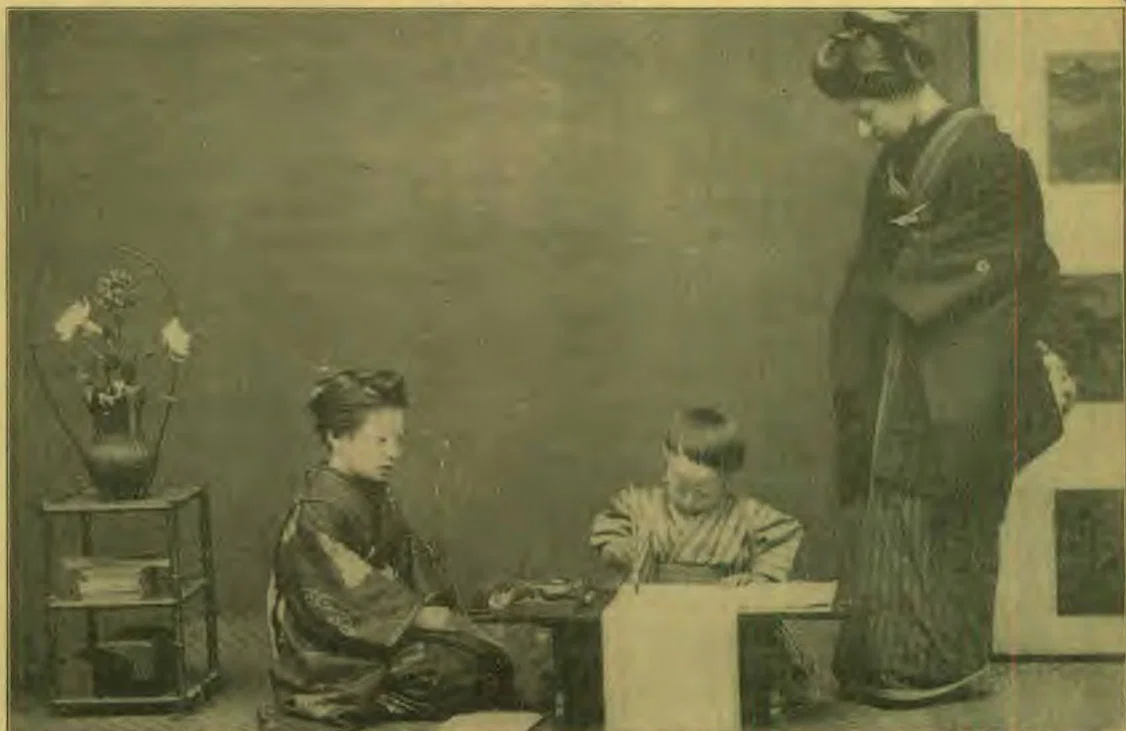
First Lesson with Writing Brush.
A SUCCESSFUL SERIES OF MEETINGS.
A DECIDEDLY interesting series of meetings is now being held in Oakland, Cal., by Elder William Ward Simpson, assisted by Elder E. J. Hibbard, and others.
The place of these meetings is in a large pavilion, on Broadway, near the center of town. The tent is nicely seated, and warmed by two stoves.
The first meeting was held in the First Congregational Church, the largest in the city, and the next in the tent. At the large meeting given in the church was a good opportunity to advertise the meetings to follow at the tent.
The attendance has been excellent, and has not diminished at all, tho the great testing truths of the message have been reached.
There are three features connected with these meetings which those holding such services would do well to study.
1. The meetings are advertised. Signs, bill-boards, striking hand-bills, and dodgers in colors, prophetic symbols placed in store windows, notices in the papers, personal invitations by workers, everything, in fact, which will arouse attention and awaken interest to hear and see. Sensational? It seems so measured by present-day religious apathy; but, after all, can we do too much to induce men to hear and study the Word of life?
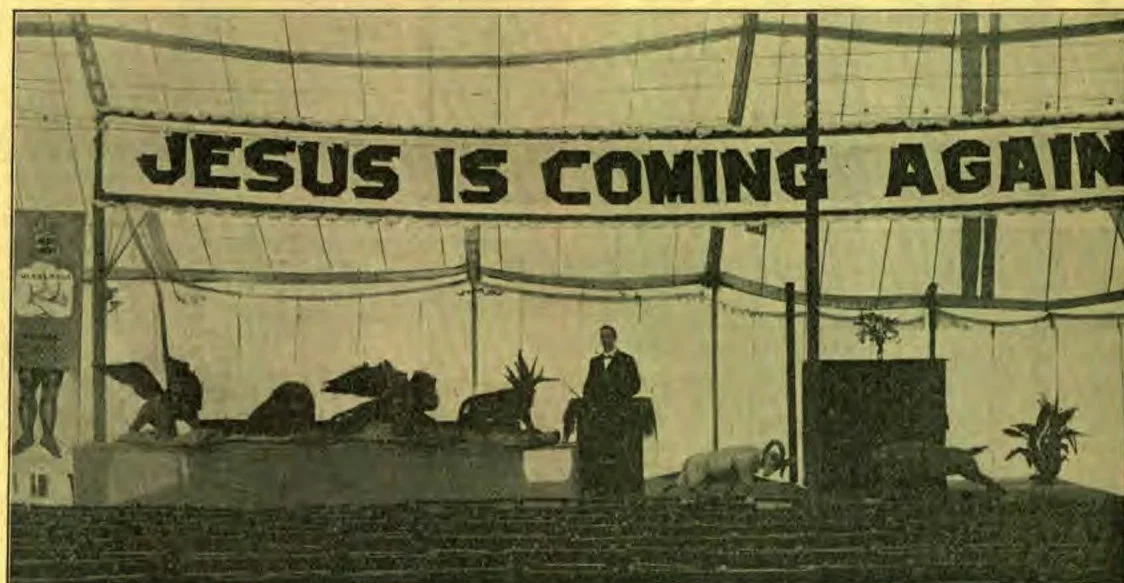
2. The use of charts, blackboard, and objects in making plain the prophecies and other parts of the scripture. The chart apparatus will show at once a dozen charts, more or less, covering the entire field of prophecy. These charts are each and all under the easy control of the speaker by means of a compressed-air apparatus. They can be raised or lowered, swift or slow. The symbolic images are of sufficient size to be seen anywhere in the large tent.
Besides the charts, Elder Simpson has papier mache images, about two-thirds life-size, as shown in the accompanying picture. In these symbols the parts which mean anything are detachable. The notable horn of the fierce goat of Daniel 8, for instance, breaks, and four notable ones spring up. Of the ten horns, three are plucked up, and the little horn takes their place. It is very realistic, and of wonderful interest.
The blackboard is used constantly for diagram and text, and texts in large letters are hung in sight of the audience. Over the rostrum is the great fact
“JESUS IS COMING AGAIN.”
3. The word of God is preached in its simplicity, and over and over in a score of striking emphatic ways, the same truth is emphasized. The Bible is a new book to many who have been church-goers for years.
The writer was present Sabbath, November 17.
The fruits of the effort at that date he would place at fifty souls. Others who are attending constantly have estimated the number at from seventy-five to one hundred. Later developments may reach this.
Earnest prayer and wrestling with God is always the price of success in such an effort. It means much to the Oakland church. Is she prepared to carry these children, to lead them in the right way, to bring them up in the nurture and admonition of the Lord, to be workers for God.
May God bless richly him who is bearing the heavy human burden, as well as all his associates.
A Faithful Worker’s Death
By Editor
THE SIGNS OF THE TIMES is called upon to mourn a faithful worker, one who, the not in our office, has been intimately connected with us for a number of years. One of the most faithful agents of the paper was Brother George A. King, who passed away November 4, of pneumonia, in New York City. His whole life was wrapped up in the cause of the great Gospel message. Brother C. H. Edwards writes us that he always looked upon the SIGNS OF THE TIMES as a father might look upon his only child. Editors and proof-readers could not have scanned its pages more minutely than did he. He read it from cover to cover, and for many years, without a day's rest, he had given the Gospel message to the people from house to house. For nineteen years he has worked in New York, and souls have been converted as a result of his labors. During his lifetime he has sold above $25,000 in books and papers. But our brother rests in hope, and truly his works do follow.
OUR ROME LETTER
By C. E. Milton
From Our Own Correspondent.
THE JESUITS AND GERMANY.
The head of the Jesuitical order is commonly designated by the title "the black pope," on account of the tremendous influence that he wields in the Catholic Church. The reason for the word "black" is that the habit of the order is black. The pope himself wears white, and is therefore called "the white pope."
By the suppression of the Jesuits in 1773, the order suffered keenly, but since then it has re-acquired much of its lost power; and at present it is making wonderful strides. Under the administration of the late General Martin, the order increased from 11,000 to 16,000 members.
The Jesuits are the educators of the Catholic Church, and consequently are really the bone and sinew of Catholicism. For the church depends almost wholly on its educational forces for retaining its prestige in Catholic countries as well as in its endeavor to propagate its faith in other places.
The new general of the Jesuits, Father Wernz, is a German by birth, but has for many years held his residence at Rome. He is the rector of the Gregorian University at Rome, which is the leading Jesuit college, having been founded as early as 1582. He is councilor of the Inquisition, and is highly esteemed by the Roman Curia on account of his conservative views on education. He has no sympathy with the modern tendency in education. During his twenty-three years' residence as professor of the leading Jesuit college, we may be well persuaded that he has become a Jesuit of the Jesuits.
The nationality of the new general has been the subject of much comment by the European press. I was well persuaded that a German would be chosen before the result of the election was announced.
The German emperor was manifesting an intense interest in the election of the new general, as Germany had recently been opened to the Jesuits. The Catholic leaders knew that the election of a German to the position of general of the Jesuits would give that order a much freer hand in Germany, and would add another link to the chain that the Vatican is forging for the purpose of tying the German Empire to its chariot wheels. The election of a general of the Jesuits may be held in secret, and may be said to be by the consent of the members present, but, after all, the Vatican names the man.
As the Papacy is losing ground in Latin countries, she is working with a new zeal to acquire a foothold among the Teutonic nations. The sphere of operation, therefore, has been transferred from France to Germany. The Germans and the French have very little love for one another, and the Vatican is taking advantage of this national hatred to ingratiate herself into the good-will of Germany, now that France is making a fierce fight upon her.
The Papacy is allowing the Teutonic nations a large say in its affairs at present, but they will pay dearly for these favors when the Vatican's time comes to reap. Austria's word decided the election of the "white pope," and the influence of Germany predominated in the selection of the "black pope."
The German emperor has shown himself exceedingly friendly to the Vatican. He went to visit the late pope with a gorgeous display of pomp and ceremony; to a convent near Rome he made a magnificent gift; and the German Catholic church of Rome was presented a beautiful organ by the German monarch. His zeal for the German Catholic missions in Asia Minor has given great delight to the Papacy.
The Papacy in turn has counseled the Catholic party of the Reichstag to hold a favorable attitude toward the financial and military schemes of the emperor. The Catholic representatives, therefore, are among the warmest supporters of the emperor's policy. In the German church at Rome, to which the emperor donated an organ, mass is celebrated in his honor on special occasions.
With the present attitude of the Vatican toward France, and with a German as the general of the Jesuits, it is quite certain that the places previously dominated by the French missions will soon fall under German influence.
With a free hand in the affairs of Germany at home and abroad, the Jesuits will soon make their power felt in Germany. Germany is certainly in danger; for, with a Protestantism honeycombed with "higher criticism" and skepticism, where is the power to resist the inroads made by the present onslaughts of Jesuitism? C. E. MILTON.
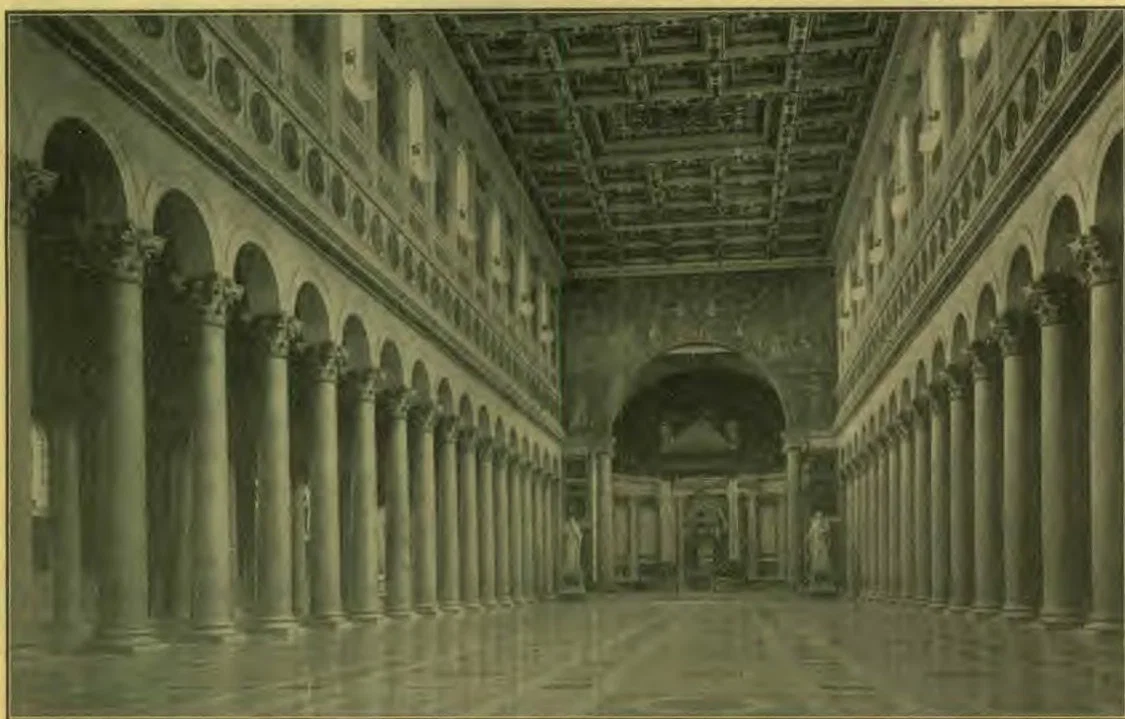
Interior of St. Paul’s Church, Rome.
ITALY AND THE JESUITS.
It is reported from Rome that the Italian minister of justice has issued a secret circular to all the public prosecutors of Italy "in which they are warned that the laws of Italy do not allow members of the Jesuit order to reside there," and stating that "since the expulsion of the Jesuits from France many of them have settled in Italy."
The circular is thought to have been "necessitated by the insistence of the Masonic order and the liberal societies in Italy that the law be enforced."
It seems that the government has ignored the violation of this law heretofore. A few years ago the general of the Jesuits transferred his official residence to Rome, and tho this is in violation of the law, the government has taken no action regarding the matter, notwithstanding the fact that this violation of the law has been recently emphasized and made conspicuous by the open purchase, at enormous cost, by the Jesuits of buildings within a stone's throw of the residence of the dowager queen, for the residence of the new general and the executive offices of the order.
This proceeding, it is said, was perfectly known to the government officials. In the law of guaranties, through which the pope was allowed to provide out of the government funds for the support and maintenance of all the generals of religious orders in Rome, the head of the Jesuits was specifically excluded from such provision.
ENGLISH EQUALITY.
THE English Government has declared equality of religious sects on the island of Malta, where hitherto religious services other than those of the Roman Catholic Church have been required to be of a private character. This action, which is in the form of a parliamentary paper ''dealing with the whole question of religious toleration on the island,'' issued by the secretary of state through the colonial office, is the outcome of objection made early last summer by the Roman Catholic Bishop of Malta to the preaching of a clergyman of the Church of England in the Theater Royal, and agitation and disturbances stirred up thereby.
The paper declares ''that the government is not aware of any pledge given to the Roman Catholics of Malta precluding the treatment of all religious bodies with equality,'' and orders the removal of the restrictions heretofore in force on the island with reference to public religious services by churches other than the Roman Catholic. The paper adds that it is earnestly hoped that this order will not call forth any further disturbances, and ''gives warning that if it should, the whole power of the government will be used to suppress the disorders.''
Thus the Roman Catholic Bishop of Malta finds that his protests against religious services other than his own, while for a time successful, have but ended in a loss of ground and the removal of the very restrictions under which he made his demands.
Against Fraternal Societies
Against Fraternal Societies.—The Supreme Court of the state of Washington has approved the action of the Seattle school board barring all students from all high-school privileges, except that of attending the classes, so long as they belong to the Greek-letter fraternities. The court says: “The evidence shows beyond doubt that these secret organizations foster a clannish spirit of insubordination which results in much evil to good order, harmony, discipline, and general welfare.”
Arrests for Sunday-Law Violations
In Brooklyn, N. Y., on a recent Sunday, seventeen persons were arrested by the police of the Ralph Avenue and Brownsville stations for violation of the Sunday law. The men were all found working in different parts of the precinct. Two Brownsville policemen raided four blacksmiths' shops and arrested eleven men. On being arraigned in the Gates Avenue police court the next morning, they all told Magistrate Higginbotham that they observed their own Sabbath, and were discharged. The National Horseshoers' Union, it is understood, complained about these men. two other men were arrested by the police of the same station while they were working on new buildings in course of construction on Bristol Street.
Papers Sent Without Payment
We send no papers from this office to individuals without pay in advance. When persons receive copies without ordering them, they are sent by other parties, and we can give no information in regard to them. Persons thus receiving copies of the "Signs" are not indebted to the office, and will not be called upon to pay for them. Please read the papers you may receive, and hand them to your friends to read.
Collision of Steamers on Puget Sound
The uncertainty of life, and the fact that no one knows what a day may bring forth, were sadly illustrated on Puget Sound, near Seattle, Wash., on the night of November 19, when two steamers collided, and forty-eight people were drowned.
The Coming Church-State Union
It would be a very easy matter to fill this paper from beginning to end on the ominous evidences of the coming church-and-state union, foretold in God's prophetic Word. Many striking things have been crowded out. It means the recrudescence of the Dark Ages. It means persecution for conscience' sake. It means destruction of all spirituality in the church which fosters such sentiment. It spells utter ruin to the state which yields to it.
The Sunday-Law Agitation
The Sunday-law agitation is spreading all over the world. To him who is watching events it is astonishing with what rapidity the question is going. The Sabbath agitation, like Banko's ghost, "will not down." Men may ignore it, ridicule it, angrily set it aside, and think it is gone, but it is God's time to agitate. The question will be kept before the world until men choose the right side or the wrong side. On the one side of the question are arrayed the forces of tradition, those who are seeking to confirm their position by civil law; on the other hand stands the naked truth of God backed by the thunder of Sinai, and the example of our Lord Jesus Christ. It is, and ever has been, a confession of a religion's weakness when appeal is made to civil law. It would seem as tho all true Christian Sunday-law keepers would see this.'
— ELI
Ominous Intimacy
Ominous Intimacy.—The Roman Catholic Archbishop Ireland, and Bishop O'Gorman, of Sioux City, Iowa, were luncheon and dinner guests of President Roosevelt at Oyster Bay on September 20. On this date the President had five guests at luncheon and the same number at dinner, but the two Roman Catholic ecclesiastics were the only two who were guests both at luncheon and dinner. Bishop O'Gorman is the ecclesiastic whom the President made a member of the "mission" which he sent to the Vatican in 1902, to negotiate with the late Pope Leo XIII. regarding matters in which this government and that church were concerned in the Philippines. Archbishop Ireland was the chief spirit in the sending of this "mission," in which the Vatican naturally took much pleasure and satisfaction. The archbishop has been on very intimate terms with federal administrations for several terms.
Ancient Dates
Ancient Dates.—Do not be troubled at the ancient dates given us by some of the learned men who are claiming to have discovered by various histories, written on stones or bricks, that Egyptian history goes back to more than forty centuries before Christ; that Aztec or Chinese history is older still, etc., etc. In the first place, it is often difficult to tell whether these ancients reckoned by months or years. This is especially true where there is no definition of measuring periods or parallel texts in known languages. Secondly, all nations are wont to boast of their great ancestors, and ancient heroes, deifying their chiefs and magnifying the time of their reign. Thirdly, sometimes kings given as reigning successively, reigned contemporaneously, their reigns lapping or paralleling each other. Fourthly, nations in question counted among their ancestors the long-lived race before the Deluge. It is certainly of enough importance to take these things into consideration before condemning the Bible.
Saving Others
Saving Others.—In the awful electric-train disaster at Atlantic City, N. J., October 28, in which three cars plunged into the bay and fifty-eight were drowned, there were some marvelous escapes. Two men stopped at Pleasantville, because something told them not to go on to Atlantic City. One woman, a Mrs. McDonald, tells the following experience:
“When the cars went overboard, I was looking out of the window. It was terrible. I saw that we were all doomed, and my first thought was of my husband. The cars plunged over, and the water began gurgling into the windows and doorways. Fortunately, I am a good swimmer. The Lord only knows how I broke my way through a window, but I did it. As I rose to the surface I thought of my husband and dived down with a faint hope that I could reach him. I went down and down, and finally grabbed hold of a body. I came up with it, but discovered that I had rescued some other man, and he got safely ashore. I dived twice more, and each time I brought up a strange man. The fourth time I went down I reached my husband, and succeeded in landing him safely ashore.”
If she had found her husband first, the three others would not have been saved. Had God nothing to do with this?
Elmira Sunday-Law Controversy
Elmira, N. Y., has been a storm-center for the last few weeks over Sunday laws, their benefits, and otherwise. The Sabbath (?) Association of New York State, on the one side, and the Religious Liberty Association on the other, have waged strenuous warfare through the press and from the pulpit and platform. Mass meetings have been held, and the Religious Liberty people seem to have the best of it. The importance of the question can not be overestimated. In it is involved Christian faith and human liberty. Read our report, 'A Great and Important Meeting,' and rouse to the times in which we live.
POLITICIANS SEEKING ROME'S AID.
In a recent sermon in his Baltimore cathedral, Cardinal Gibbons took occasion to air his intimacy with prominent statesmen. He is reported to have said: "One evening a few months ago, in Washington, I had the honor of conversing separately with six distinguished statesmen, all of whom are available for the Presidency," to which he added that he "found them all in a receptive mood."
This is pretty good testimony to the fact that the head of the Roman Catholic Church in the United States moves in high political circles at the capital of the nation, and is on intimate terms with its leading statesmen and politicians. The state and 'the church' are getting very close together, and the great church federation movement is greatly facilitating the soon-coming union. And the masses are oblivious to the meaning of it.
The Death of Sara Hansbrough Henton
We are sad to report the demise of one of our faithful correspondents, Mrs. Sara Hansbrough Henton, wife of Mr. Ambrose E. Henton, of Georgetown, Ky. She has from time to time contributed helpful little articles to our Home Department. We have always prized these, written, as they were, in neat style, and always practical and helpful. Mrs. Henton was sixty years of age, a contributor to some forty or fifty newspapers and magazines in different parts of the country, a very kind woman, given to good works. Our sympathies are with her friends and relatives. The Georgetown Times has an extended notice of her life.
Church Diplomacy
The failure of certain appointees of Pope Pius X. in diplomatic positions has decided the pontiff to demand a competitive examination among the members of the Curia, that he may find those who are fitted for diplomatic careers. Most of the church diplomats have obtained their experience at a special school called the “Roman Academy of Noble Ecclesiastics.� This the pope recently abolished. The true church of Jesus Christ needs no diplomacy. All of God’s representatives have the message of their Master to give to a dying world. Not by any compromise with states or individuals, but as glad tidings to lost souls.
A Striking Rendering
A Striking Rendering.—In 1 Kings 18:21 our Common Version makes Elijah say to the people of poor, half-hearted Israel, "How long halt ye between two opinions?" The American Standard Revised Version has it, "How long go ye limping between the two sides? if Jehovah be God, follow Him; but if Baal, follow him. And the people answered him not a word." How truly the American Revised Version expresses their attitude, "limping between the two sides." Sometimes having thoughts of the true God and a desire to follow Him; sometimes following the visible crowd and worshiping Baal, but not strong in doing either. What a picture it is of the multitude even of professed Christians to-day. Limping between God and the world. How long will they keep it up?