Your ShelfYour Projects

Signs of the Times, Vol. 26, No. 39.

FAITH AND REASON
Earlier text: THE MEAT-OFFERING

A PITIFUL CONDITION.

THE newspapers reported a few days since that the great Rogers Locomotive Works at Paterson, N. J., are about to be shut down. These works have on their pay-roll some fifteen hundred men. One machinist has been in that shop for fifty-two years working steadily. Another one has been there fifty years. Still another for forty-five years, and another for forty-two years. Many others have been there for long periods of time. Now the crisis has come, and there is danger that the shop will have to be closed because of a lack of work.
In the very nature of things, when the country was building up and a great many locomotives were needed, the shops would have to be run very strongly, but any one ought to see that there must come a time when the demand would be quite largely supplied with the needed locomotives. Then there are other firms springing into existence that do the same work, and hence the constant danger of being thrown out of employment.
Now why is it that men will be so short-sighted as to work right along year after year at a job that they can not hope to keep always, and cognizant of the fact all the time that if they were thrown out of that position they would not know which way to turn for a livelihood? The Lord created man with a great variety of faculties, so he might be able to turn his hand to a great many different things. The individual who cultivates these abilities God has given him will never be at the mercy of circumstances, nor of the employing class. Every individual should learn to employ himself, and no one who is continuously employed by others can develop into the strength and manhood that are developed by being his own employer. When we work for others it should be from the standpoint of an accommodation to them and not from that of necessity on our part.
A great deal of the labor troubles that are in the country would be swept away if men were not "hoodooed" by the idea that certain classes are born to be employers, while others can never employ themselves. Instances are numerous where men have been employed year after year and thought they could not do anything except the job they were set at by their foreman or superintendent, but a reversal of some kind has thrown them out of their position, and, while they thought at first they could not do anything, yet necessity drove them to the exercise of the faculties they had possessed all these years, and they have soon found that they were able to make a success of employing themselves, and thus be independent of the employing class. In these days men should very carefully consider these important principles. T.

A TERRIBLE VISITATION.

ONE of the most fearful calamities of modern times has just befallen the city of Galveston, Texas, and the wreck and ruin have reached out far toward the interior of the State. A hurricane which visited the West Indies on September 7 arrived in the Gulf of Mexico on the following day, driving before it a veritable tidal wave, which engulfed the entire island on which Galveston is situated. A strong wind from the north piled up the waters of the bay on the shoreward side of the island, and between the two contending forces the city of Galveston became a raging sea, the waves and the hurricane uniting to rack and beat to pieces every building that was not of the most substantial character. The storm continued from the evening of the 8th till the morning of the 10th, completely wrecking upwards of 4,000 buildings, and burying many of their occupants. The number of dead will never be accurately known, for hundreds of bodies have been carried out to sea. Many of these are being washed up on the beach along the coast, but others will never be found. Barge loads of the dead have been taken out into the gulf and thrown overboard, and many others have been cremated in piles of débris, as the number of dead is so great as to make ordinary burial impossible. It is estimated that as many as 5,000 persons lost their lives in Galveston alone, while scores, if not hundreds, were drowned or killed in towns on the mainland. The railroad bridges and wagon bridges connecting the city with the shore have been completely demolished, and all the wharves and docks and grain elevators have been destroyed. The property loss will amount to many millions of dollars. Soldiers have been sent to the scene, and the whole island has been placed under martial law. Human ghouls have busied themselves in stripping the dead of clothing and valuables, and have not hesitated to hack off the swollen fingers of the dead to secure the rings they wore. An urgent appeal for help has been sent out by the governor of the State, and liberal responses are being made from many quarters. The storm is spending its fury along a line from Texas to the Great Lakes.

Ancient Babylonian Library Discovered

PROF. H. V. HILPRECHT, president of the University of Pennsylvania expedition to the ancient site of Nippur, has returned to Constantinople, and reports the discovery of the library of the Great Temple, with over 17,000 tablets dealing with historical and literary matters, all believed to be at least 2,280 years older than the Christian era. It is stated that the unexplored remains of this ancient library will require five years for excavation. The explorers believe that if the unexplored parts prove as rich in results as the portion already uncovered, there will be no example in the world's history, not even in Egypt, of so complete a recovery of the records of an ancient civilization. Nippur, from whose ruins these tablets are taken, was situated about midway between Babylon and Erech, those cities which comprised the beginning of Nimrod's kingdom. These studious archaeologists are coming to believe, from their studies of the buried history of Babylon, that the Babylonian "civilization" was superior to that of Greece and Rome. Thus is seen another reason for the scriptural designation of Babylon as the "head of gold," in comparison with the baser kingdoms that were to follow.
THE report of the third vice-president of the Catholic Total Abstinence Union states that "at many afternoon teas intoxicating liquor has taken the place of tea to a noticeable extent." It does not seem to have occurred to the author of the statement, however, that this was a natural consequence. The continual tippling of tea is responsible for much of the appetite for strong drink in both men and women. Tea drunkards are becoming more and more common, but the vast majority fly to something stronger before the "tea-drunkard" stage is reached, and become alcoholic drunkards. The connection between tea-drinking and liquor-drinking is much closer than many are free to admit.
THE position of the Boers in the Lyndenburg Mountains was attacked by General Buller on September 7. The Boers were driven from their position, and, being compelled to retreat over a narrow road, lost heavily. The British occupation of the Lyndenburg Mountains is believed to mark one of the closing acts of the war. The Boers are now planning to trek into German territory in East Africa, which will mean an overland journey of over a thousand miles through the wildest portion of Africa. It is stated that many of the Boers will take this trip, leaving all their possessions in the Transvaal, rather than live under the authority of their conquerors.
THE Japanese consul at Amoy, China, reports that the riots against native Christians in the Amoy district are becoming serious, and that the city gates in six adjoining districts have been completely closed. The United States consul at Shanghai has been making a systematic effort to ascertain the number of American and English missionaries that have been murdered in China. He has found that 93 have been killed, while there are 170 others in the disturbed districts that are not yet accounted for, the majority of whom have doubtless lost their lives.
THE yearly expenses of the sultan have been estimated at no less a figure than $30,000,000. Of this $7,500,000 is spent on the clothing of the women in the sultan's harem, and $400,000 on his own wardrobe. Nearly $7,500,000 is swallowed up in presents, $5,000,000 goes for pocket money, and still another $5,000,000 for the table. It seems impossible that so much money can possibly be spent in a year by one man. However, some 1,500 persons live within the palace walls, live luxuriously and dress expensively, at the cost of the civil list.
THE most important scientific report brought before the British Association at its recent session at Bradford, England, was that dealing with Sir William Preece's discovery of wireless telephony. The wireless telephone system has been established across a lake, and between certain islands and the mainland. Parallel wires are stretched along the shore of the island and that of the mainland, the end of the wires terminating in metallic plates in the sea. These wires are then attached to ordinary telephones, and the service is complete.
THO little has been said of the recent Zionist congress in London, this meeting of the Zionists was one of the most important yet held. Jews were present from all quarters of the globe, and much enthusiasm was manifested in their deliberations. It is confidently expected by the leaders of this movement that Jerusalem will yet be the home of the Jews, notwithstanding that the laws of Turkey in reference to Jews in Palestine seem designed for the special purpose of thwarting such a movement.
THERE has been much uneasiness during the week over the threatened strike of the entire membership of the United Mine Workers of America, including 143,000 men, laborers in the coal mines of the Eastern States. The strike, had it been declared, would have been one of the most gigantic in the history of the country, and one in which, without doubt, many lives would have been lost.
A SERIOUS riot occurred at Sarajevo, Austria, on September 7. The Austrian authorities had forbidden the Mussulmans to celebrate the jubilee of the sultan. The latter persisted, and were only quelled by the united efforts of the police, fire brigade, and three regiments of soldiers. Many of the Turks were shot by the soldiers before they could be dispersed.
THE north polar expedition, under the Duke of Abruzzi, nephew of the late King Humbert, reported at Tromsoe, Norway, on September 6. The expedition reached a point in latitude 86.33 degrees north, thus penetrating farther north than Dr. Nansen's trip. The ship was frozen in the ice eleven months, and three members of the expedition perished.
A GREAT earthquake is reported to have occurred at Lituya, Alaska. On account of the few inhabitants of the country, only five are known to have lost their lives. Five of the immense glaciers which open into Lituya were destroyed by the earthquake and were sent crashing into the bay, partly filling it with great mountains of ice.
THE New Voice continues its publication of charges of official corruption in Manila. The reports brought by their special representative, who spent much time in the Philippines, brings to view a deplorable condition of things in the islands, where liquor and the social evil hold high carnival and receive equal protection.
A TERRIBLE disaster was narrowly averted off the coast of Massachusetts on September 9, when a large excursion steamer carrying 600 people crashed upon a submerged rock, tearing a hole in her side. The steamer was run ashore at full speed, and by the prompt use of life-boats the entire company was saved.
MISSIONARIES of the Presbyterian, Methodist, Congregational, and other denominations who have been working in China are appealing to their home boards to send aid to the suffering native Christians in Northern China. These boards are about to issue an appeal for money to be sent to that troubled field.
THE big freight steamer May Flint, while sailing to an anchorage in San Francisco Bay, on the night of September 9, became unmanageable, and crashed into the prow of the battle-ship Iowa. A great hole was stove in the side of the steamer, and she went down with her cargo of 5,000 tons of coal.
REPORTS from Colon, Colombia, state that the rebels have seized the city of Turbaco, near Cartagena, as well as the railway. The next day after the capture of Turbaco, government troops arrived, and a battle ensued, whose outcome has not been reported.
THE receipts of the American Board of Commissioners for foreign missions in the past eleven months of the fiscal year have been $589,935, as compared with $525,030 for the corresponding period of last year, an increase of $64,905.
THE Japanese Government is calling home its subjects in other countries who are able for military service, and seems to be preparing for a long campaign, either in China or against unfriendly powers who are now there.
THE War Department and the Red Cross Society are both taking measures to relieve the distress among the Indians of Alaska, who are suffering from disease, lack of food, fuel, and clothing.
THE officers of the National W. C. T. U. have expressed their disapproval of the prayer chain inaugurated in Indiana for the defeat of President McKinley, and will not take part in it.
THE mayor of Trinidad, province of Santa Clara, Cuba, has telegraphed the military governor for assistance, as a cyclone has destroyed all the crops in the district.

THE SITUATION IN CHINA.

THE latest advices from China indicate that the Chinese Government is desirous of securing peace. Prince Ching has been received at Peking by the allied forces there, and will assist in the negotiations, while Li Hung Chang has received his credentials from the emperor as a special peace envoy. These credentials have been presented to the powers; but there seems to be a disposition on the part of some of the nations to wait further developments before negotiating with the Chinese Government. Altho Russian troops continue to land in China, Russia continues her preparations for withdrawing her legation and troops from Peking. France has signified her willingness to follow Russia's lead in this matter, and it is reported that the American troops have also been ordered to withdraw. Germany has given no indication of willingness to withdraw, and her position is the same as that of England. There is little to indicate what the course of Japan will be, altho she has declared her intention of demanding territory in China as compensation for her services during the war. Owing to the fact that Japan furnished so much more than her proportionate share of the troops now in China, she is expected to remain there as long as any of the other powers remain.
Russia seems very desirous of having all the foreign troops leave the Chinese capital, and in this the Germans and English see a deep design. It is even charged that Russia will receive three Chinese provinces as compensation for inducing the other powers to leave Peking.

History of the Use of Alcohol

ALCOHOL; ITS HISTORY, AND ITS EFFECTS UPON SOCIETY.

By W. H. Riley, M.D., Superintendent of Colorado Sanitarium, Boulder, Colo. [All rights reserved.]

History of the Use of Alcohol.

INTOXICATING drinks, the basal principle of which is alcohol, have been known and used by almost every nation mentioned in history. From the remotest periods, in the most ancient records, we find allusions to its use, and it has a history exceedingly interesting. “There is nothing new under the sun,” and we accordingly find the spirituous beverage of to-day not among the inventions and discoveries of this great century of increased knowledge. Early discovered, the human family have tenaciously clung to it, seemingly finding in it the great antidote for dull care, sorrow, and the multitude of human woes. Generally considered a blessing, it has nevertheless been a viper nourished in the bosom.
We find reference made to intoxicants in the earliest historical records—the sacred classics—of the most ancient nations. The Rig-Veda, the sacred books of the ancient Brahmans of India, have references to two drinks of this character. A variety of beer, called sura, was made from rice, barley, and honey, with but little expense, and was popular among the common people. This was very intoxicating, and was in disrepute among the priesthood, by whom, however, the sacred wine, soma, was highly praised. This soma was offered as a libation to Indra, Vishnu, and other favorite gods, by whom it was also drunk. In order to make an acceptable offering, it was not necessary that the libation be entirely poured out, but the larger portion might be drunk, the pleasant after effects being a token of divine favor, and in nowise due to any ingredient common to the vulgar sura. The Chinese have for ages used these beverages, the early records mentioning wine made from grapes, and beer from rice.
The Bible gives an instance of intoxication from wine as far back as twenty-three centuries before the Christian era, and in the history of Judea the use of wine, both temperately and intemperately, was always known. Many allusions are made in the Scriptures to both the good and evil effects of wine. It is thought that two different kinds of wine are alluded to, the good results coming from the pure juice of the grape, the ill effects arising from that which had undergone fermentation. The effects of “strong drink” are portrayed to be the same as to-day. Drunkards are described as reeling “to and fro.” Besides mistakes in walk, stumbling, and losing their way, their sight was imperfect, and the judgment impaired as a result of the use of intoxicants. “They also have erred through wine, and through strong drink are out of the way; the priest and the prophet have erred through strong drink, they are swallowed up of wine, they are out of the way through strong drink; they err in vision, they stumble in judgment.”
The effect upon the stomach is also mentioned: “For all tables are full of vomit and filthiness, so that there is no place clean.” The question is asked, Who hath woe, sorrow, contentions, babbling, redness of eyes, and wounds without cause? The answer is, “They that tarry long at the wine; they that go to seek mixed wine.” And the wine at first enticing and attractive, at the last “biteth like a serpent, and stingeth like an adder.” The drunkard was assured that he would “come to poverty,” the same wretched condition witnessed to-day.
In the early history of Israel, drunkenness was severely punished. If a youth was addicted to gluttony and drunkenness, rebelling against the admonitions of his parents, he was to be stoned. Two priests, whose minds had become confused with liquor, burned common fire in their service instead of sacred, and for this were smitten with death. A woe was pronounced upon him who gave his neighbor intoxicating drink, and in later times all drunkards were declared to have no part in the kingdom of God.
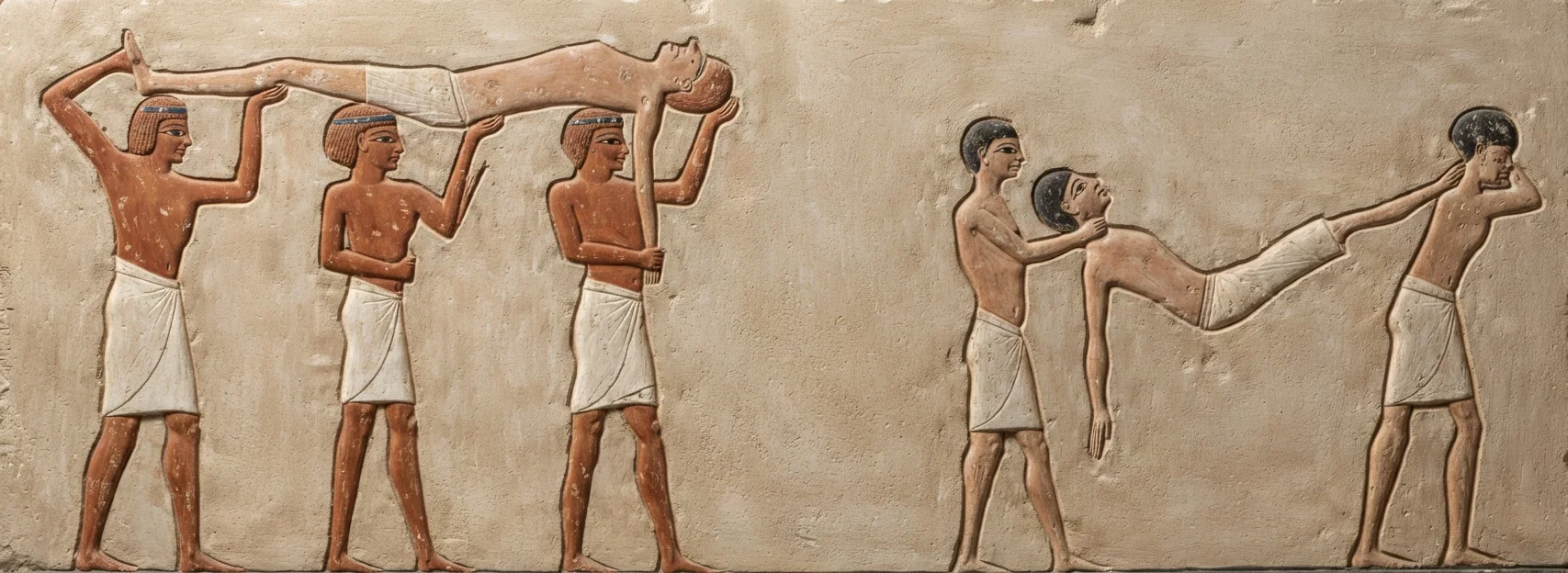
The Egyptians early discovered the art of making intoxicating drinks from barley and grapes. We have the testimony of Herodotus and other historians, and find similar records in the mural paintings on the ancient monuments. On the tombs of Beni-Hassan, by some thought to be 5,000 years old, is still to be seen the work of the artists of that day, who seem to have delighted in portraying the scenes of their every-day life. Among these pictures are to be seen vineyards, and a system of irrigation. We get an idea of their processes of making wine, which was either trodden out or squeezed in a bag by twisting. The storage and fermentation are also represented. There are seen genteel people drinking in their houses, and also those drinking immoderately, who act like beasts under its influence. The accompanying cut shows one of their portrayals of a man carried home drunk by his slaves. Women also are represented as indecently intoxicated.

Starch the Chief Food Element

SOME POINTS REGARDING FOOD. No. 2.

Starch the Chief Food Element.

GRAINS are the most universal of all foods; and it is fortunate that it is so, for they contain practically the proper proportion of food elements to nourish the human system. The most abundant of these is starch, and that fills exactly the same place in the body that coal does in the furnace,—it supplies heat and force. Another important food element is the proteids, or albumen. Foods of this class can be represented by the furnace itself, for they build up the tissues. So if one should attempt to live wholly upon starch, he would have plenty of heat and energy; but the structure of the body itself would crumble away, and he would gradually grow weaker. Altogether too many, in taking up diet reform, do not take pains to learn how properly to substitute foods for those which they leave off. We require from fourteen to sixteen ounces of starch a day, while we only require from two to four ounces of proteids and one to two ounces of fat. So starch is the most abundant food element we take in, and much of the subject of proper cookery must cluster around the starch question.
The human system can digest raw albumen and raw fat; but it can do nothing with raw starch, at least not until it has passed on into the small intestines. So the cook-stove lifts a great load off the digestive organs, and cook-stove energy is a great deal cheaper than nerve energy. Raw green fruits contain an abundance of starch, just the same as the potato does; but as the fruit ripens, nature goes on, and not only brings it through the cooked stage of starch, but actually changes it into sugar, so the work of digestion is practically done for the starch. That is why fruit is such a valuable food in fever; it really needs no further digestion. No such change takes place in the potato; therefore it positively needs cooking, while the fruit does not, except in some of the coarser varieties to soften up the cellulose or woody matter.
DAVID PAULSON, M.D.

ON THE OTHER SIDE.

We go our ways in life too much alone; We hold ourselves too far from all our kind; Too often we are dead to sigh and moan, Too often to the weak and helpless blind; Too often where distress and want abide We turn and pass upon the other side.
The other side is trodden smooth and worn By footsteps passing idly all the day; Where lie the bruised ones that faint and mourn Is seldom more than an untrodden way. Our selfish hearts are for our feet the guide— They lead us by upon the other side.
It should be ours the oil and wine to pour Into the bleeding wounds of stricken ones, To take the smitten and the sick and sore And bear them where a stream of blessing runs. Instead we look about—the way is wide— And so we pass upon the other side,
O friends and brothers, gliding down the years, Humanity is calling, and all In tender accents, born of grief and tears! I pray you, listen to the thrilling call. You can not, in your cold and selfish pride, Pass guiltlessly upon the other side.
—Selected.

“I MUST GO TO WILLIE.”

DURING our Civil War there was a woman in Maine who received a letter which ran thus: “Willie is sick; he is dying.” The mother read the letter, and looking up to her husband, said:—
“Father, I must go to Willie.”
“No, wife, you can not go,” he replied. “You know there is a line of bayonets between you and Willie.”
She did what the Christian mother always does when her boy is in peril. She spread that letter before the Lord, and prayed all night. Next morning she said:—
“Father, I must go to Willie. I must.”
“Well, wife,” he said, “I do not know what will come of this, but of course if you will go there is the money.”
She came down here to Washington, and the President—Abraham Lincoln—who had to brush away a tear as he wrote, handed her a paper and said:—
“Madam, that will take you to the enemy’s line, but what will become of you after you get there I can not tell.”
She took the paper and came down to the line and the picket; she handed him the pass, and he looked at it and at her, and said:—
“We don’t take that thing here.”
“I know it,” she said; “but Willie, my boy, is dying in Richmond, and I am going to him. Now shoot!”
He did not shoot, but stood awed and hushed in the presence of a love that is more like God’s than any other that surges in the human soul in its deathless unselfishness.
All that mother thought of was her boy. Smuggled through the lines, she went down to the hospital. The surgeon said to her:—
“Madam, you must be very careful; your boy will survive no excitement.”
She crept past cot after cot, and knelt at the foot of the one where her boy lay, and putting up her hands prayed in smothered tones, “O God, spare my boy!”
The sick man raised his white hands from under the sheet; the sound of his mother’s voice had gone clear down to the brink of the valley and shadow of death, where the life of the young man was going out in its ebbing tide. Raising his hand, he said:—
“Mother, I knew you would come.”
That boy is a man to-day, saved by a mother’s love.—The Progressive Age.

TEACHING POLITENESS.

A MOTHER noticed a remarkable change in the deportment of her six-year-old son. From being rough, noisy, and discourteous, he had suddenly become one of the gentlest and most considerate little fellows in the world. He was attending the kindergarten, and his mother naturally inferred that the change was somehow due to his teacher's instruction.
"Miss Smith teaches you to be polite?" she remarked in a tone of interrogation.
"No," said the boy, "she never says a word about it."
The mother was puzzled, and all the more when further questioning brought out more emphatic denials that the teacher had ever given her pupils lessons in good breeding.
"Well, then," the mother asked finally, "if Miss Smith doesn't say anything, what does she do?"
"She doesn't do anything," persisted the boy. "She just walks around, and we feel polite. We feel just as polite as anything."
That was all he could tell about it, and his mother began to see through the mystery. —Educational News.

THE CIGARET POISON.

THE teacher of a public school in Chicago found that eighty of her scholars smoked from two to twenty cigarets a day. Only six of these boys were able to do good work in their classes. The victims of the cigaret habit confessed that they were suffering constantly from headache, drowsiness, and dizziness.
Many declared they could not write well because their hands trembled. A number were "shaky" when they walked, and unable to run for any distance. They could not rouse themselves to meet the examination test. The teacher reported that they were sure to fail if asked to memorize anything. Several of the smokers were from four to five years too old for their grade, and it was found that after they began to smoke their progress ceased. Except in three instances, the scholars hardest to discipline were smokers. Truancy and theft were directly traced to indulgence in the habit. Boys who had reformed and joined the Anti-Cigaret Society said they "felt like different boys."—Youth's Companion.

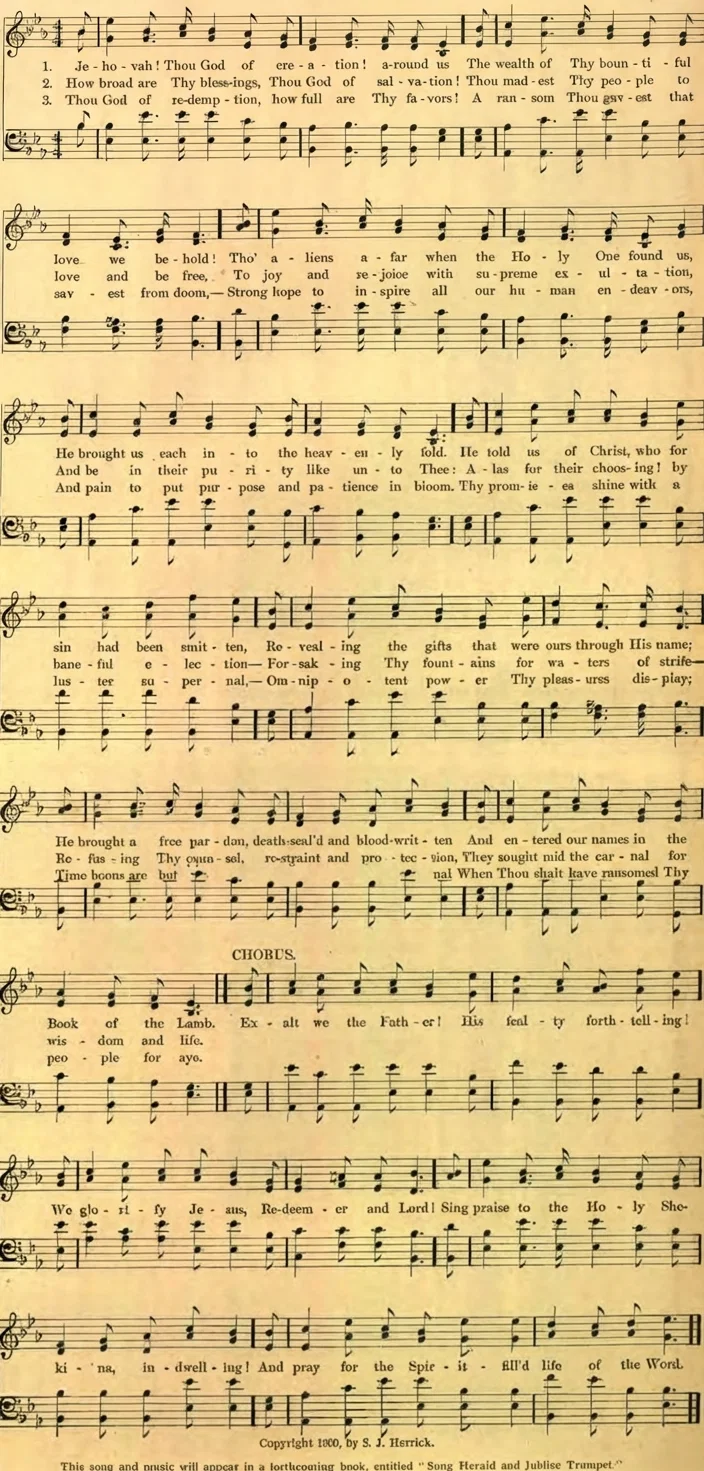
The Spirit-Filled Life.

LLEWELLYN A. MORRISON. S. J. HERRICK.
This song and music will appear in a forthcoming book, entitled "Song Herald and Jubilee Trumpet."

THE NEED OF REFORMATION IN INDIA.

IN the statistics quoted in a former note, showing the seven-tenths per cent. of nominally Christian population in India, we have included the widespread Roman Catholic population. The Roman Church is the most numerous in India, and one finds her institutions everywhere. She has the best schools, it is said, so far as secular education is concerned, and they are multiplying continually. Their work is done very quietly, and there is little evangelistic effort among them, as village preaching. Francis Xavier, who came out in the sixteenth century to turn the people to the faith of Rome, had political influence behind him, so that it was hardly safe for the people within the Portuguese sphere of influence to resist his arguments too strenuously. Thus Rome began in India.
Now, shorn of secular power, the agents of the Roman Church still have a system which gives them the advantage. The mystery, the human authority, and the ease with which Catholicism is adapted to the minds of the people, bear ready fruit, and they seem to have more hold on their people than most Protestant missions. Protestant converts wander from one communion to another with an astonishing ease, and very often they try the Catholic fold, but apparently not as many get out of that as fall into it. A writer in the Harvest Field, a missionary journal in southern India, says of the Catholic converts:—
“The more respectable native Catholics observe caste. Pudupett, a district of Madras City, is almost entirely inhabited by this class, and in a stroll through it you may see Sivites and Vishnuvites wearing the distinguishing marks of their caste. The Sivite who follows the ‘way of works,’ has on his sacred ashes and the pottu, or circular dot, in the center of his forehead. The Vishnuvite who practises the ‘way of faith,’ has his namum, the trident-shaped mark of Vishnu, painted on his forehead. Round his shoulders is suspended the sacred thread. Outwardly you suppose these men to be respectable caste Hindus, but round the neck of some you see small pictures of patron saints, and then you know that the people are Roman Catholic, and, more than this, you ascertain that, after joining the Catholic Church, the converts are allowed to observe all the usages of the particular caste in which they were born. The blend is a curious mixture of Christianity and Hinduism. Thus in their marriages the Christian part of the ceremony is celebrated in the church by the priest; the Hindu part is performed in the house of the contracting parties. The Hindu ceremonies last three days, and on the last day is the crowning ceremony of Sheshai, in which a Brahman priest pronounces Hindu prayers and scatters rice upon the bride and bridegroom. They have marriage processions through the streets with music and tom-toms. Another matter in which they closely resemble the Hindus is in their car festivals. Images of Christ, the Virgin Mary, and other saints are placed in the car, precisely as Hindu gods are placed, and the cars are dragged through the streets to the accompaniment of native and sometimes English music. The festival ends in a grand display of fireworks.”
But this caste survival is not altogether peculiar to Roman missions. One finds it everywhere among Protestant converts more or less, and it is a thing that requires constant dealing with. This, together with the heathen or Moslem idea of woman, which has fastened itself more or less upon the Christian community, stirs one’s soul continually. And in my opinion, it is one thing at the root of the confessed failure of self-supporting churches in India. Doubtless one reason why Protestant missionaries have not grappled with the question more energetically is the fact that in all likelihood the society that tried to put things on a living basis would lose a good proportion of its converts. But it would be a blessed loss to all the societies if they could but see it, and they might get down to a basis where they could build up. Frequently we hear of converts transferring themselves from one society to another over some question of discipline or of support. The necessity of coddling and helping communities to hold them seems to paralyze many missionaries. The practical situation that confronts the old and large societies, who might be supposed to have solved some of the problems, is shown by the following recent report from a Protestant missionary in one of the southern districts:—
“So far from caste feelings abating with the advance of Christianity, I grieve to say that they seem to increase as time goes on. We have had the oldest and best congregation in the whole district refuse to receive a trained Christian master of Chuckler origin, simply on caste grounds, tho the master’s house is far from the village, and does not touch their own in any way. Christians refused to receive him, because he was born a Chuckler—a lower caste than their own—and when pressed to do so, they threatened secession to Rome if this master was forced upon them. “As a counterblast, the nearest Chuckler congregation has withdrawn from divine services with Christians of Pariah origin, and threaten to secede altogether if not provided with a master of their own.”
Everybody knows that the trouble is that these poor people were taken into the church unconverted, supposing that they were Christians. And now after a generation of such things the little light has become gross darkness. The place to meet heathenism is at the gate. This thing is so widespread among the missions, specially in South India, that the missionaries have organized a society to fight it. One can hardly understand the necessity of any different kind of society than the Christian church itself to fight caste and heathenism within the church. But unless there is cooperation the old, old trouble in India would be seen when pressure was brought to bear,—converts would transfer their allegiance to other societies. The situation is the most difficult imaginable on these grounds, and only by utterly separating one’s self from all that is of the proselytizing spirit can any advance be made. Not converts to any mission nor to anybody, but only to the Lord Jesus Christ, are wanted. And on this principle one finds perfect freedom to work for any or all, regardless of the great cry that is raised in certain circles whenever one attempts to give the Word to one who is already a “convert.”
The object of this anti-caste society is thus stated by the secretary:—
“The object of this society is to do something—to work and not merely to talk. Many missionaries say, ‘O, yes, we disapprove of caste, but we do not believe in drastic measures!’ and so on. But when we ask what their methods and measures are, they are silent. They use caste titles when addressing members of their congregations, as they are afraid of offending them—regardless of the fact that caste is offensive to God. Their reports attach caste titles to all names. They have their ‘caste’ schools, whereby the mission puts its imprimatur on caste. They allow communicants to approach the Lord’s table in the order of caste. They marry with a tali that indicates caste. In God’s acre the different castes are kept carefully apart from one another.”
Does anybody that knows the message for these days wonder that Seventh-day Adventists in India do not recognize any boundary lines within which they must give the Word, and are ready to teach converts or Hindus that the times of ignorance God has winked at, but now He commandeth all men everywhere to repent, because the kingdom of heaven is at hand? Whether from among the heathen or the convert communities will come a larger proportion of believers in the message, no one can tell. But we know that the third angel’s message of Revelation 14 is for every creature, and we thank God that we are free to give it to all who come within the sound of our voices or within reach of our literature. Many talk of the conversion of India as the Roman Empire was converted. And some Protestant missionaries draw lessons as to the methods and policy from the fathers of the early church. They fail to see that what they are studying as the development of the church of Christ, sweeping on to the triumphant conquering of the great empire in the early centuries, so far from being what they suppose, was really the growth of apostasy and the development of that awful man of sin.
It is a solemn fact that in modern missionary methods there is a tendency in the same direction. God grant that the multitudes of honest godly and heroic missionaries who may not now see the message for these closing days, may see it, and find it the help that it is. As for many ecclesiastically-minded managers of missions, some will of necessity stumble. Some are already teaching their converts, who first of all learned the Ten Commandments, that these are now of “low tone,” and that as Christ kept them, we mustn’t. And the doctrine is practised to an alarming extent.
Continue reading: THE HEAVENWARD CALL