WHAT shall I do, my Lord, my God,
To make my life worth more to Thee?
Within my heart, through earth abroad,
Deep voices stir and beckon me.
Through strange confusion of the time
I hear Thy beckoning call resound;
There is a pathway more sublime
Than yet my lagging feet have found.
My coward heart, my flagging feet,
They hold me in bewildering gloom;
Come Thou my stumbling steps to meet
And lift me into larger room.
The dearest voice may lead astray;
Speak Thou; Thy word my guide shall be,
O, not from life and men away,
But through them, with them, up to Thee!
It is not much these hands can do;
Keep Thou my spirit close to Thine,
Till every thought Thy love shines through,
And all my words breathe truth divine.
With souls that seek Thy pure abode,
Let my unfaltering soul aspire.
Make me a radiance on the road,
A bearer of Thy sacred fire.
—Selected.
Bearing With Others
"If thou wilt thyself be borne with, bear also with another."
THE BONZE MONKS OF CHINA.
By Ruth Everett
FORMERLY when Chinese parents had a little baby girl that they did not want, they took it to the nearest river and pitched it in. Of comparatively recent years a Catholic institution called the Holy Childhood Society has been formed for the purpose of rescuing these innocent little ones from death and teaching them to lead good, useful lives. So now the girl babies, instead of being thrown into the rivers as formerly, are carried to this society by the mothers, who get two hundred capeques (about ten cents) for the baby, then turn themselves about without a seeming thought or care of what is to become of the baby. When it is a boy baby that the parents want to get rid of, they sell it to the bonze monks. Occasionally also the ranks of these monks are recruited by receiving children whose parents, for some favor received or desired, have vowed the unborn infant, if it should be a male, to Buddha. It should be consecrated from the hour of its birth. In such a case, when the little fellow is about three years old he is taken to a bonzery and put down in front of a big idol. From that moment he is in the care of the monks, and no possible opportunity is allowed him to escape. Recruits are also got from notable criminals, fleeing from justice, and from indigents who are willing to undergo the fiery initiation for the sake of a lifelong guarantee of boiled rice without much work or worry about getting it.
It is not likely that the earth's surface supports another religious organization that has as many queer, austere, cruel, revolting rites as these same bonze monks of China. Their monasteries are to be found in a number of different places throughout the empire. They are religious monks of Buddha, are called bonzes, and their monasteries are called bonzaries. The Caushan bonzery buildings, which shelter some four hundred of the monks, are situated in a beautiful green nook several leagues from the city of Caushan, which is in the province of Fo-Kien, and are backed by the Foo-Chow Mountains.
A Chinese Farmhouse.
The bonzes are the most illiterate men in China. Very few of them can read, and most of the better class of the Chinese hold them in great contempt. While a certain portion of their number are from time to time detached and sent to the various chapels and pagodas in the neighborhood to care for the devotees, the greater number of them never leave their monasteries from the day of their consecration to death, but serve there their community as shoemakers, carpenters, gardeners.
A supreme torture awaits the poor bonze at the very gates of death. As his hour approaches, whether conscious or unconscious, his fellow-monks lift him up and toss him upon a huge fire, which they have prepared for that purpose. In the tortures of the flames that are built to consume his flesh, he gasps his last breath.—Ruth Everett.
ANGLO-EDUCATION IN INDIA.
By John McLauren, D.D.
THERE are reckoned to be 3,000,000 of these Anglo-educated Hindus in India at present holding positions of trust, from the clerk in a bank to the judge on the bench, or the prime minister of the raja of an estate as large as many a kingdom. It is impossible for a man to go through such a course all in English, and remain an idolator as before. He may become a Theosophist, a Spiritualist, or a Brahmoist, but not a worshiper of sticks and stones. In nine cases out of ten he will also get sick of the social and family habits and customs of his fathers, and he will long for the pure and holy home ties which he sees exemplified in mission families all about. Many of these are professing Christianity, and we must see to it that the Gospel is lovingly and intelligently brought to the attention of such an interesting and influential section of the Hindu people.—John McLauren, D.D.
IN AN EVER-WIDENING CIRCLE.
WHO can tell where the effects of a good deed will end. Oftimes it spreads in an ever-widening circle, till the little action scarcely noticed at the first has become the fruitful cause of immense good.
It is related that some years since a boy in the State of Pennsylvania gave some money to buy Bibles for people who could not buy them for themselves. It was not a large sum, but in the end it did a great deal of good. The man to whom he gave it (Rev. G. F. Dale) went as a missionary to Syria.
One day a lad came down from one of the little villages among the mountains, and asked for a Bible. He had an old silver coin that he had plowed up on the plain of Cœle-Syria. This he offered for the Bible. It had no intrinsic value, but the missionary took it and gave him a Bible bought with the Pennsylvania boy's money.
Some time after the Bible had been given, the lad appeared again, and told the missionary that his people had tried to get his book away from him in order to destroy it. But he had made a chest for it, with a lock and key.
The missionary had to return to the United States for rest and to renew his strength. On his return he was told that two young men were to be received into the church the next Sunday. What was his surprise and joy to find that the boy who gave the coin for the Bible was one of them! He had studied the Bible, and it led to his conversion. The boy in Pennsylvania heard of it and rejoiced. He had helped to convert a heathen. The boy in Syria became a Christian worker.
It is for us to do right. In the providence of God lies the result. He alone knows the intricate relation of all things.—Christian Work.
PERIODICALS WANTED.
LATE, clean copies of our papers for missionary work. Address, post-paid, W. J. Read, Girard, O.
SIGNS, Reviews, Instructors, and other denominational matter for missionary work. Address, post-paid, C. G. Allen, 432 Indiana Avenue, Butte, Montana.
OUR WORK AND WORKERS.
By Editor
THE brethren at Everett, Wash., are erecting a new house of worship.
BROTHER C. NELSON mentions the baptism of two candidates at Lamberton, Minn.
THE baptism of nine candidates at Smith River, Cal., is reported by Brethren F. M. Burg and C. T. Everson.
THREE converts are reported at Redfield, S. D., where Brother W. G. Kneeland and others are laboring.
AUGUST 19 thirteen candidates were baptized at Omaha, Neb., making seventy-three who have united with that church within a few months.
FROM the Missionary Visitor we learn that fifteen persons have taken a stand for the truth at Pe Ell, Wash., where meetings have been held by Brethren S. W. Nellis and J. H. Hanson.
FOLLOWING the tent-meetings at Boulder Creek, Santa Cruz Co., Cal., ten persons were baptized, and at last report ten others had begun the observance of the Sabbath of the Lord.
A REPORT from St. Paul, Minn., by Brethren A. J. Stone and J. F. Anderson, notes the baptism of three persons, with four others who have decided to obey the truth. Still another who had been previously baptized had united with the church.
IT may seem insignificant to note that attendance at meetings held in a certain place was hindered by the mosquito pest. But mosquitoes are an agency of the enemy. They are bred from stagnation, and stagnation is a result of sin, which is the "transgression of the law" of God.
SEVERAL years ago an attempt was made to stamp out the Sabbath of the Lord in the vicinity of Springdale, Ark., by means of Sunday-law persecution. However, the effort signally failed, and we learn from the Reporter of August 29 that "the church school will begin Monday, October 1. The building is nearing completion, and will soon be ready for occupation."
THOSE who desire to attend, or ought to patronize, Graysville (Tenn.) Industrial School should know that the institution has natural advantages of climate and scenery, in a quiet, fertile valley, that are wanting in many college locations. Students who attend school surrounded by such influences will come out purer and better than if educated under the contaminating influences of city life.
AT the recent meeting of the Arkansas Conference officers were elected as follows: President, A. E. Field; vice-president, E. B. Hopkins; secretary and treasurer, Etta Hardesty. The president and secretary were each chosen to like positions in the tract society. Several new canvassers have been added to the list of workers. Four new churches were added to the conference, and marked prosperity was shown by the annual reports.
THE following note is a specimen of such as are frequently received at this office: "Some one has been kind enough to send me the SIGNS OF THE TIMES till November 1, and, becoming interested in keeping the seventh day, I send you $1.00 to pay for one year's subscription, which I see you offer it for if sent before October 1. Please send two pamphlets on 'Marshaling of the Nations,' one 'The Seven Trumpets,' two 'An Astronomer's View of our Father's House,' and one 'The Great Day of the Lord.'"
CONCERNING the Missouri Conference and camp-meeting Brother R. M. Kilgore, superintendent of General Conference District No. 5, writes: "About five hundred persons were camped in Burge Park, Kansas City. During the meeting eighty persons went forward for prayers. Nineteen were baptized. The laborers present were Prof. B. G. Wilkinson, Brethren S. H. Lane, J. E. Jayne, J. M. Rees, H. Shultz, and Prof. P. T. Magan. The plan for the relief of our schools was presented by Professor Magan. Brethren D. T. Jones, R. C. Porter, and J. O. Beard were also present, and S. C. Osborne, district canvassing agent, labored in the interest of his line of work. About twenty-five canvassers engaged to enter the field. Brother J. M. Rees was elected president of the conference and also of the tract society. Brother R. C. Porter was elected to a place on the executive committee and president of the Sabbath-school association. Five tents will enter new fields immediately, each manned with a good corps of workers."
5 "He therefore that supplieth to you the Spirit, and worketh miracles among you, doeth he it by the works of the law, or by the hearing of faith? Even as Abraham believed God, and 6 it was reckoned unto him for righteousness. Know therefore that they which be of faith, the same are the sons of Abraham. 8 And the scripture, foreseeing that God would justify the Gentiles by faith, preached the Gospel beforehand unto Abraham, saying, In thee shall all the nations be blessed. 9 So then they which be of faith are blessed with the faithful Abraham. 10 For as many as are of the works of the law are under a curse; for it is written, Cursed is every one which continueth not in all things that are written in the book of the law, to do them."
NOTE.—For the sake of the connection, this lesson includes three verses of the preceding lesson, taking only three in advance. The earnest student will be glad of this opportunity to get the verses already passed over more firmly fixed in mind, and will find the lesson sufficiently long to occupy all the time and thought he can bestow upon it. Let us put a few questions to it; examine the text closely, and see how it answers them.
SUGGESTIVE QUESTIONS.
(1) How is the Spirit ministered, and by what means are miracles worked? (2) Is it by the works of the law, or by the hearing of faith? (3) What is the obvious answer? (4) With whose experience is the ministering of the Spirit and the working of miracles identical? (5) How did Abraham get righteousness? (6) Who, then, are the children of Abraham? (7) What was foreseen in the Scriptures? (8) What, therefore, was done? (9) In what words was the Gospel preached to Abraham? (10) Of what was the preaching of the Gospel to Abraham a proof? (11) Who, then, are blessed? (12) With whom are they blessed? (13) Who are cursed? (14) Why are they cursed who are of the works of the law? (15) What, then, would be their condition if they should do, and continue to do, all things written in the law?
NOTES.
1. "THEY which are of faith, the same are the children of Abraham." Abraham is the father of all them that believe, whether they be circumcised or uncircumcised. Rom. 4:11. No one, no matter of what nation or people, will enter heaven except as the child of Abraham. The faithful followers of Christ are the real seed of Abraham.
2. FROM the very beginning, long before the days of Abraham, it was foreseen that God would justify the heathen through faith. Faith is the only possible means of salvation; and unless it was the heathen who were justified by it, no one on earth could be justified, since all were heathen. In the fall of Adam, all men became heathen,—wanderers from the one true God.
3. THE preaching of the Gospel to Abraham was the proof that God would justify the heathen through faith; for Abraham was born a heathen. "The father of Abraham and the father of Nachor" "served other gods." Joshua 24:2. The very existence of the Jewish nation, therefore, and their separation from the nations of earth, was a standing witness to the fact that it was God's plan to save as many heathen as would believe.
4. THE Gospel was preached to Abraham in the words, "In thee shall all nations be blessed." If you wish to know what this blessing is, read Rom. 4:1-9. It is the blessing of forgiveness of sin. It is the blessing of the righteousness of God through the faith of Jesus Christ. This blessing has come upon all men, for "as by the offense of one judgment came upon all men to condemnation; even so by the righteousness of One the free gift came upon all men unto justification of life." Rom. 5:18. What a pity that all will not take the gift thus freely bestowed!
5. ALL, however, who believe, who "are of faith," that is, of faith alone—not faith and works, but faith which works,—are blessed with faithful Abraham. Righteousness—right-doing, obedience to the law—comes by faith alone, and not by any works of law done by man. Christ is not dead in vain. See Gal. 2:21. Whoever would be justified by his own obedience is seeking to frustrate the grace of God, and to prove that it was not necessary for Christ to die. Every such attempt will fail.
6. SINCE they who are of faith are blessed, it follows that they who are of works are cursed, else God would be denying Himself. What is the matter with the law? Is it not good?—O, yes; it is all right! "The law is holy, and the commandment holy, and just, and good." Rom. 7:12. Then why is the one who does it under the curse?—He is not. Here is where so many stumble in their reading. It is written, "Cursed is every one that continueth not in all things which are written in the book of the law to do them." This is of itself proof that the law is good, and that "blessed are they that do His commandments." If men did, and continued to do, all things that are written in the law, they would be blessed.
7. BUT "all have sinned, and come short of the glory of God." Rom. 3:23. "The carnal mind is enmity against God; for it is not subject to the law of God, neither indeed can be." Rom. 8:7. Therefore it is that "by the works of the law there shall no flesh be justified" (Rom. 3:20); and as many as seek justification by it are under the curse. Note that not only the willful transgressors, but even the seekers after righteousness, if they seek it by their own works, are under the curse. Yet some will be blessed. Yes: "they which be of faith are blessed with faithful Abraham," because faith works by love, and love is the fulfilling of the law. We are made righteous by faith, and by faith are we kept righteous. "The just shall live by faith."
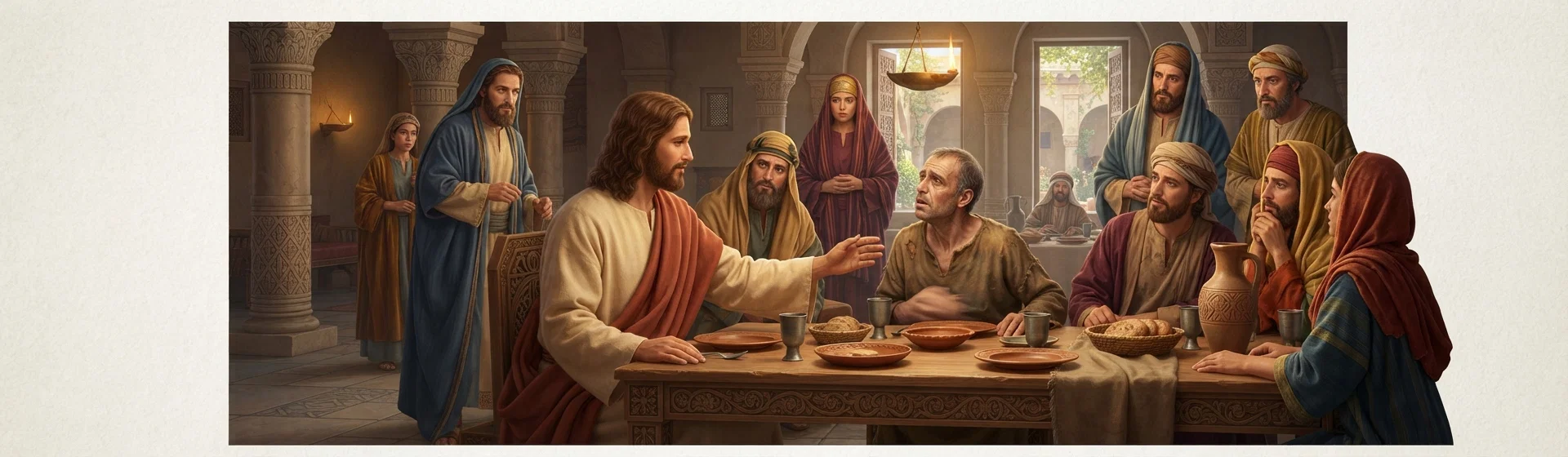
1 "And it came to pass, when He went into the house of one of the rulers of the Pharisees on a Sabbath to eat bread, that 2 they were watching Him. And behold, there was before Him 3 a certain man which had the dropsy. And Jesus answering spake unto the lawyers and Pharisees, saying, Is it lawful to 4 heal on the Sabbath, or not? But they held their peace. And 5 He took him, and healed him, and let him go. And He said unto them, Which of you shall have an ass or an ox fallen into a well, and will not straightway draw him up on a Sabbath 6 day? And they could not answer again unto these things.
7 "And He spake a parable unto those which were bidden, when He marked how they chose out the chief seats; saying 8 unto them, When thou art bidden of any man to a marriage feast, sit not down in the chief seat; lest haply a more honor9 able man than thou be bidden of him, and he that bade thee 10 and him shall come and say to thee, Give this man place; and then thou shalt begin with shame to take the lowest place. 11 But when thou art bidden, go and sit down in the lowest place; that when he that hath bidden thee cometh, he may say to thee, Friend, go up higher; then shalt thou have glory in the presence of all that sit at meat with thee. For every one that exalteth himself shall be humbled; and he that humbleth himself shall be exalted.
12 "And He said to him also that had bidden him, When thou makest a dinner or a supper, call not thy friends, nor thy 13 brethren, nor thy kinsmen, nor rich neighbors; lest haply they also bid thee again, and a recompense be made thee. 14 But when thou makest a feast, bid the poor, the maimed, the lame, the blind; and thou shalt be blessed; because they have not wherewith to recompense thee; for thou shalt be recompensed in the resurrection of the just."
NOTE.—At the time of this lesson Jesus was at Bethabara, beyond Jordan, near the fords, and this was in A.D. 30. In connection with this lesson, let both teacher and student learn the fourth commandment, not merely the words, "Remember the Sabbath day, to keep it holy," but the whole commandment. See Ex. 20:8-11. Study also Gen. 2:2, 3, and notice what entered into the Sabbath, what it took to make a Sabbath, and the particular day, and the one day only which has ever received what is enumerated therein. See also Isa. 58:13, 14; 56:2, 6, 7. It will be noted by reference to Acts 13:27, 42, 44 that the same Sabbath which the Jews had recognized, the same Sabbath referred to in the fourth commandment and in the references in Isaiah, was recognized as "the Sabbath day" long after the crucifixion of Christ.
Golden Text: "Whosoever exalteth himself shall be abased; and he that humbleth himself shall be exalted;" Luke 14:11.
SUGGESTIVE QUESTIONS.
(1) Into whose house did Jesus on this occasion enter? For what purpose? Upon what day was this? What were some of them doing? V. 1. Note 1. (2) Who is particularly mentioned as being present? V. 2. (3) What did Jesus say to the lawyers and Pharisees present? What in this verse shows that they had been questioning among themselves as to what Jesus would do with the diseased man? V. 3. (4) What reply did they make? What did Jesus do? V. 4. Note 2. (5) With what illustration did Jesus show them the reasonableness of healing disease on the Sabbath day? V. 5. (6) How did Jesus' illustration leave the Pharisees and lawyers? V. 6. (7) What action of those who were bidden led Jesus to speak a parable at this time? V. 7. (8) What instruction did He give them? Who might be present that would make it uncomfortable for those who chose the highest seats? V. 8. (9) In that case, what would the self-exalted man be asked to do? How would one naturally feel at such a time? V. 9. (10) What would be a better thing for them to do when invited to such a gathering? What would quite likely result when one had done this? How would the one be regarded who was thus given distinction? V. 10. Note 3. (11) What truth does Jesus draw from this parable? V. 11. (12) To whom does Jesus next address His teaching? What instruction did He give to this Pharisee? Where would one receive his reward if only his friends were benefited by his action? V. 12. (13) Among whom should one's liberality be dispensed? V. 13. Note 4. (14) What would be the result to one who did this? Why does Heaven recognize such deeds? When will the one who does such good acts receive his recompense? V. 14. Note 5.
NOTES.
1. They were watching Him.—As upon many other occasions the scribes, lawyers, and Pharisees were watching for an opportunity to accuse Jesus. The diseased man may have been brought there for the purpose of testing Jesus whether he would heal him on the Sabbath day. Jesus disarmed their accusation before healing the man, that they might see the righteousness of His course. Having read their thoughts, He asked them a question upon whose answer they expected to catch Him. They dared not permit themselves to reply. He replied to His own question by healing the man.
2. Took him, and healed him.—"Jesus neither here nor elsewhere abolishes or lessens the force of the fourth commandment. It is still in force as a day of rest and of worship. It is absurd to think that God would abolish from His Word what He has written on the nature of man and still keeps in force there. The Pharisees had covered up the Sabbath law by writing over it their human traditions. Jesus erased their writings and restored the original commandment. Jesus swept away the cobwebs; He did not tear down the house. He only removed the rubbish with which the Pharisees had encumbered the Sabbath. Jesus restored the Sabbath law by restoring its spirit."—Peloubet. It was prophesied of Jesus that when He should come, He would magnify the law and make it honorable. Isa. 42:21. He was doing it by just such teachings as recorded in to-day's lesson. Matt. 5:17-19. It is also absurd to hold that God would abolish the Sabbath which He created in Eden, blessed and sanctified, and then institute another sabbath, and all without giving a word of instruction in reference to the matter. He has told us which day His Sabbath is, and He has never taken it back.
3. Sit down in the lowest place.—Not out of feigned humility; not for the purpose of being exalted above men. Such a spirit is as unchristian as that of him who rushes into the highest place. If God exalts men, it is because they have been humble in spirit. The exaltation comes as a natural consequence of genuine humility. There is also true courtesy taught in this lesson of the Saviour's. The Christian and the true gentleman will prefer another before himself. Those who seek to exalt themselves have little of heaven's spirit. They would be out of place there.
4. Bid the poor.—Jesus had set the grandest example of the carrying out of this instruction. He had come to bid the poor of earth, the blind, the lame, the oppressed, to the banquet of heaven, and they have nothing with which to recompense Him. He, like those who follow His instruction in this thing, will receive a reward at the resurrection of the just, when His people, those for whom He died, are gathered around Him.
5. At the resurrection of the just.—This is the first resurrection, spoken of in Rev. 20:4-6. There are to be two resurrections, one of the just, and one of the unjust. Acts 24:15. Those to whom heaven will be opened will be those who arise in the first resurrection. 1 Thess. 4:16.
Jesus and the Resurrection
Important thoughts upon immortality and the resurrection are clearly presented in this tract, showing our dependence on the Saviour for both. A. G. L. No. 42. 50 cents per 100.
PACIFIC PRESS PUBLISHING CO.
New York City Oakland, Cal. Kansas City, Mo.
THE GREAT DAY OF THE LORD. By M. C. Wilcox. This tract of 40 pages sets forth in brief some of the more important events of the Great Day of God Almighty. It discusses the character of that day, shows when it begins, the coming of the Lord, the events in connection with that coming, the Millennium, the Saints in Judgment, when the Day of the Lord Ends, and the Eternal Home of the Redeemed. Bible Students' Library No. 65. Price, 5 cents.
INTERNATIONAL SERIES THE SUNDAY SCHOOL
2,500 IN USE
Lambert's Nut Butter Mills
Are the original and only perfect nut grinders on the market, having stood the test of five years' general use. Ball Bearing, easily operated, make the finest kind of butter, warranted to give satisfaction.
Nut Butter is a valuable substitute for lard, cow's butter, and all animal fats, which are recognized to be injurious to the human system.
Guide for Nut Cookery, a most valuable book of 450 pages, given with each mill. We make roasters and blanchers too. Write to-day for special prices on all kinds of health foods, nuts, and machinery. Specialties: Spanish and Virginia varieties of shelled peanuts.
All orders promptly filled. Send to-day.
# JOSEPH LAMBERT
336 W. Main Street
Battle Creek, Mich.
VIRGINIA HOMES.
You learn all about Virginia lands, soil, water, climate, resources, products, fruits, berries, mode of cultivation, prices, etc., by reading the Virginia Farmer. Send 10 cents, for three months' subscription, to FARMER CO., Emporia, Va.
WORLD'S OUTLOOK.
By Editor
The world's outlook will be the special feature that will characterize the next special number of the SIGNS OF THE TIMES. It will be dated November 28, and will be ready for circulation November 1. The events in the world's history during the past year, that so strikingly fulfil prophecy, make it highly necessary that such a number of the SIGNS should be issued, and we believe that all will see the importance of giving it a wide circulation.
This World's Outlook number of the SIGNS will contain thirty-two pages of the most intensely interesting and valuable matter. It will be beautifully and forcibly illustrated, and a striking cover design will be specially prepared for it. Send in your advance orders so as to be sure to get some of the first numbers that come from the press.
One brother has already said that he wants 3,000 copies. Are there not hundreds like him who design to assist thus heroically in extending the circulation of this paper?
Wonders OF THE 19TH CENTURY
Is a 32-page tract. Its object is to recount and describe some of the principal inventions of this closing century, and to show their significance.
It contains fifteen illustrations. Is an easy seller.
Price; 5c each or $2.00 per 100.
PACIFIC PRESS PUBLISHING CO., Oakland, Cal.
New York City Kansas City, Mo.
The Winning of Margaret
How Margaret and her skeptical friend Ralph were converted. A well-told story. Price, $1.00 per 100.
PACIFIC PRESS PUBLISHING CO.
New York City Oakland, Cal. Kansas City, Mo.
THE ATONEMENT.
By Ellet Joseph Waggoner
AN EXAMINATION OF
A REMEDIAL SYSTEM, IN THE LIGHT OF
NATURE AND OF REVELATION.
BY ELD. J. H. WAGGONER.
THIRD EDITION, REVISED AND GREATLY ENLARGED.
THIS work is a critical and exhaustive treatise on the plan of salvation as revealed in the Scriptures, showing its harmony with the principles of justice and mercy, its consistency with reason, and its final results as affecting the destiny of the human race 368 pp.; cloth, $1.00.
Address.
PACIFIC PRESS, Oakland, Cal.
Instructions for Ordering.
By Editor
1. REMIT by P. O. Money Order, Express Order, or Bank Draft on New York, Chicago, or San Francisco.
2. If paper money or silver is sent, register the letter.
3. Orders and Drafts should be made payable to the PACIFIC PRESS PUBLISHING CO., or to SIGNS OF THE TIMES.
Postage-stamps.—Please do not send postage-stamps, as they are liable to stick together, and are useless in this condition.
Foreign Money.—Do not send any.
Receipt.—No formal receipt is sent unless by special request. The address label on your paper will indicate the time to which your subscription is paid. In case of non-receipt of papers, or any other irregularity, please notify us immediately.
Expiration of Subscription.—All papers are discontinued at the expiration of the time paid for. Notification will be sent several weeks before date of expiration, thus enabling you to renew in ample time to secure unbroken files. Please be prompt, as we can not always furnish back numbers.
Change of Address.—When ordering change of address, please give both the old and the new address.
Important.—Use a separate sheet for SIGNS orders, separate for other papers, separate for books, for tracts, etc., and if you address the editor, use a separate sheet. All can be sent in one envelope, and the money all sent in one order, but write each kind of business on a separate sheet. In this way each order can be handed to the proper clerk and filled at once.
Articles Desired.—Those which set forth in the Spirit of Christ the great saving truths of God, short and to the point. It is better to treat one important truth clearly, in a short article, than many points vaguely in a long one. We desire no caustic, critical productions, which might minister to personal pride or pleasure, but can not save souls.
TO CONTRIBUTORS.
By Editor
THE SIGNS OF THE TIMES is a purely missionary enterprise. For this reason it has felt free to ask for contributions from its friends. It pays nothing for contributions, either prose or poetry, unless solicited by the editor, and then the fact is stated when the articles are asked for. This is a plan rarely followed, but sometimes deemed expedient.
How Prepared.—Write plainly, with typewriter or ink, with wide space between the lines, to freely admit of editing, writing of subheads, etc. Write on one side of the sheet only. Sign the name to the manuscript, as it becomes sometimes separated from accompanying letter. Anonymous contributions are not used, whatever their merit. If the writer does not wish his name to appear, let him furnish a pseudonym for the public. But we wish the name.
Manuscript Returned.—We will return all unused manuscript desired if stamp and directions are inclosed. We are forced sometimes to return good manuscript mainly for three reasons: (a) Sometimes the articles are too long; (b) sometimes we have a number on the same subject; (c) sometimes our plans are such that an article can not be used till it is out of date. We therefore hope that no offense will be taken by those who have freely contributed their best thought if their productions are returned. When we receive so much matter, we can not use all.
NOTE.—We wish those who ask questions to take particular notice: (1) Only such questions will be answered here as we believe to be of general interest and information. (2) We can not undertake to explain from four to a dozen scriptures, as in one sentence we are often requested to do. (3) Do not ask to "explain" a certain text or passage. State clearly the point in question. (4) Give full name and address, not for publication unless desired, but as evidence of good faith, and to give us the privilege of replying by letter if deemed best. (5) Unsigned communications of any kind find the quickest way to the waste-basket. (6) It is always well to inclose stamp. (7) "Foolish and unlearned questions avoid," also those that minister to mere curiosity. (8) Study the Scriptures yourselves.
Do Not Forget
By Editor
That on and after October 1, 1900, the subscription price of the Signs of the Times will be $1.50 a year instead of $1.00 as heretofore. The unavoidable necessity for making this change in price has already been fully set before our readers.
Until October 1, subscriptions will be received at the old price of $1.00 a year
Many of the old subscribers to the paper are sending in their subscriptions for two or three years in advance. There are advantages in receiving these long-term subscriptions that make it profitable to the Signs, and we would encourage as many as are situated so they can do so, to place their subscriptions ahead several years between now and the first of October. We have tried to advertise this change in price as extensively as possible and we hope that all of our readers are made fully aware of it, so that no one can say that due notice of the change has not been fully given. The striking events which are so remarkably fulfilling prophecy in these times, and which are commented on from week to week in the Signs, will make it all the more indispensable as the days go by. Every subscriber should continue to take it, and should do all in his power to extend it to others.