“The Catholic News voices its Romish spirit in these words: ‘So great an honor has never been conferred on that historic pile, as will be conferred when there is a “Catholic altar” erected there—and there it is surely destined to be erected, and by the will, consent, and hands of the American people. The Catholic Church is to-day the balance wheel of this republic, and the day is not far distant when she will become the entire machinery of this government and perpetuate it as God’s most favorable nation.’ In the face of all the past history of Romish persecution and intolerance, the American people will surely hesitate before they intrust the entire machinery of our government into the hands of the Romish Church.”—Christian Cynosure.
Yet the editor of the Cynosure is a prominent factor in the great National Reform movement which is now seeking to attach a religious amendment to the Constitution of the United States, which will practically exclude from office all excepting professed Christians, and even such of them as do not observe Sunday. And this Reform Association has expressed a willingness to “gladly join hands” with9the Catholics in the wicked scheme, “whenever they are ready to co-operate.” These reformers fairly danced with joy when Cardinal Gibbons attached his name to a petition for a national Sunday law, and immediately heralded abroad the news that 7,200,000 signatures had been secured by virtue of this one name. They also went into ecstasies when the United States Supreme Court issued its dictum that “this is a Christian nation;” yet the first stone laid in the foundation of that opinion was the fact that Christopher Columbus received his commission, under which he discovered America, from “Ferdinand and Isabella, by the grace of God King and Queen of Castile.”
If this fact were in any sense relevant to the subject, if it in any manner could be counted as a factor in the establishment of the religious character of this nation, it would to that extent indicate that this is a Roman Catholic nation. This would be the logical conclusion, from the fact that Ferdinand and Isabella were intensely Catholic; so prominently and preëminently Catholic that they were entitled by the pope “The Catholics.” So zealous were they for the preëminence of the church, that by them the notorious Inquisition was established for torturing confessions from “heretics,” and by means of which many thousands of victims were put to death. Not only was the Inquisition established by Ferdinand and Isabella, but it was by their government sustained.
Those who recognize the Christian nation theory, as promulgated by the Supreme Court, and on the strength of it advocate the proposed religious amendment and contingent religious legislation, can not consistently deny to the Roman Catholics all the prestige they may be disposed to claim in the “machinery of our government.”
The Catholic Church may not be the “balance wheel of this republic,” but it exercises more influence in public affairs—national, state, and municipal—than any other religious organization, and has power to secure more material aid for its various enterprises than all others combined. It is also true that no influence is doing so much to place the Catholic Church in control of the “entire machinery of this government,” as the National Reform combination. Every effort that it puts forth for religious domination in civil affairs is just so much effort to establish conditions in the land which are distinctively Roman Catholic in principle. And when the time comes, as it surely will, that these conditions prevail; it will be found that experienced Rome will be far ahead of all others in the ability to take advantage of the situation. Rome is cunningly and quietly looking on, while professed Protestantism is preparing a platform upon which she may victoriously stand.
The principle of church and state union, with the church in control, is Rome’s strong citadel; and this is the real ground of all the religious legislation which a professed Protestantism is so strenuously urging in the United States to-day, through the plea of “national reform,” and by the means of the much-lauded “Christian citizenship” movement. True Protestantism stands only in the absolute equality of all men, without respect to race, political opinion, or religious belief, and the absolute separation of church and state. When any Protestant, or combination of Protestants, in the name of Christianity, step off from this stand, they step onto Roman ground. W. N. G.
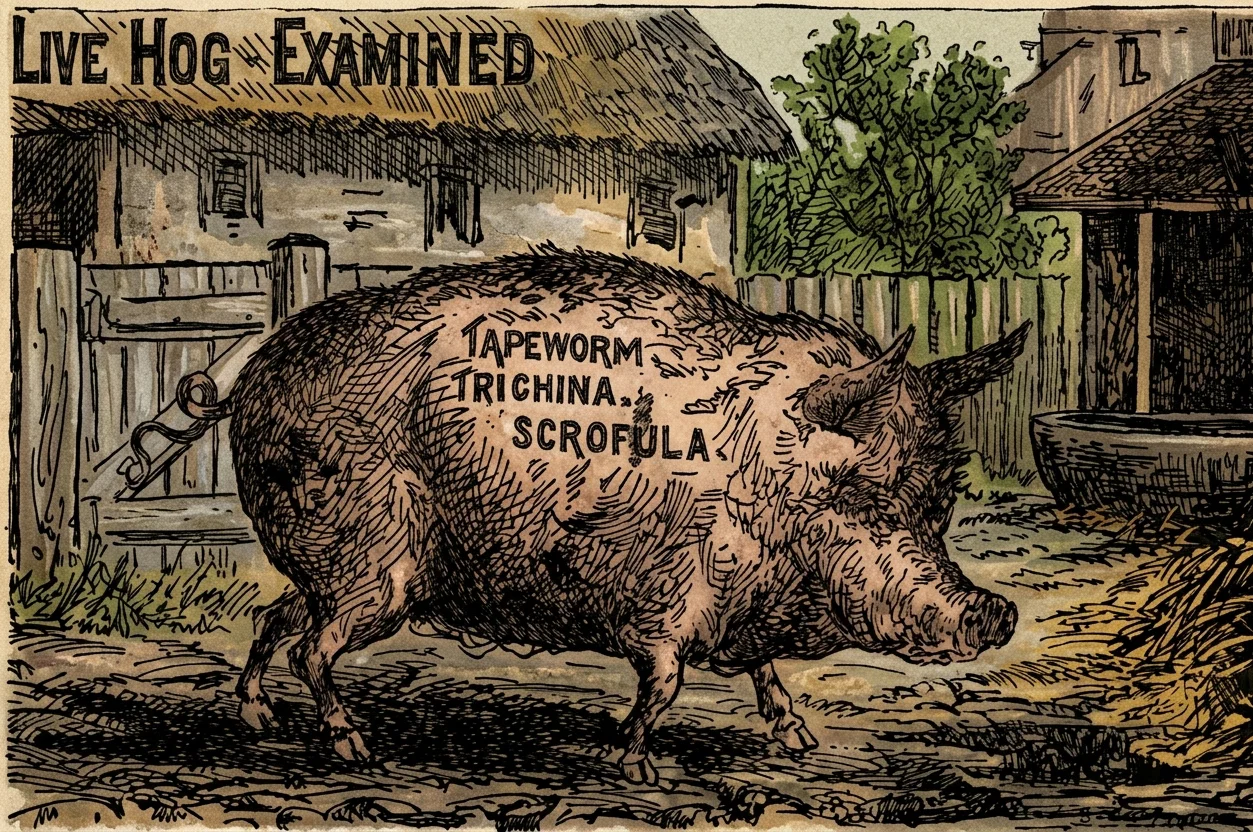
LIVE HOG EXAMINED
By John Harvey Kellogg
LIVE HOG EXAMINED
BY J. H. KELLOGG, M.D.
Look at that object in a filthy mud hole by the road-side. At first you distinguish nothing but a pile of black, slimy mud. The dirty mass moves. You think of a reptile, a turtle, some uncouth monster reveling in his Stygian filth. A grunt! The mystery is solved. The sound betrays a hog. You hasten by, avert your face, and sicken with disgust. Stop, friend, admire your savory ham, your souse, your tripe, your toothsome sausage, in its native element. A dainty beast, isn't he?
Gaze over into that sty, our pork-eating friend. Have you done so before? and would you prefer to be excused? Quite likely; but we will show you a dozen things you did not observe before. See that contented brute quietly reposing in the augmented filth of his own ordure. He seems to feel quite at home, doesn't he? Look a little sharper and scrutinize his skin. Is it smooth and healthy?—Not exactly so. So covered is it with tetter, and scurf, and mange, that you almost expect to see the rotten mass drop off, as the grunting creature rubs it against any projecting corner which may furnish him a convenient scratching place. As you glance around the pen, you observe that all such conveniences have been utilized until they are worn so smooth as to be almost inefficient.
Stir up the beast and make him show his gait. See how he rolls along, a mountain of fat. If he were human, he would be advised to chew tobacco for his obesity, and would be expected to drop off any day of heart disease. And so he will do, unless the butcher forestalls nature by a day or two. Indeed, only a few days ago a stout neighbor of his was quietly taking his breakfast from his trough, and grunting his infinite satisfaction, when, without a moment's warning, or a single premonitory symptom, his swinish heart ceased to beat, and he instantly expired, without finishing his meal, much to the disappointment of the butcher, who was anticipating the pleasure of quietly executing him a few hours later, and serving him up to his pork-loving patrons. Suppose his death had been delayed a few hours, as is the case with the majority of hogs? or, rather, suppose the butcher had got the start of nature a little, as he generally contrives to do?
But we have not half examined our hog yet. If you can possibly prevail upon yourself to sacrifice your feelings, in the cause of science, pork-loving friend, just clamber over into the reeking sty, and take a nearer view of the animal that is destined to delight the palates of some of your friends, perhaps your own. Make him straighten out his foreleg. Now observe closely. Do you see an open sore, or issue, a few inches above his foot, on the inner side? and do you say it is a mere accidental abrasion? Find the same on the other leg; it is a wise and wonderful provision of nature. But what are they? Grasp the leg high up, and press downward. Now you see, as a mass of corruption pours out. That opening is the outlet of a sewer. Yes, a scrofulous sewer; and hence the offensive, scrofulous matter which discharges from it. Should you fill a syringe with mercury, or some colored injecting fluid, and drive the contents into the same opening, you will be able to trace, all through the body of the animal, little pipes communicating with it.
What must be the condition of the body of an animal so foul as to require a regular system of drainage to convey away its teeming filth? Sometimes the outlets get closed by the accumulation of external filth. Then the scrofulous, ichorous stream ceases to flow, and the animal quickly sickens and dies, unless the owner speedily cleanses the parts, and so opens anew the feculent fountain, and allows the festering poison to escape.
What dainty morsels those same feet and legs make! What a delicate flavor they have, as every epicure asserts! Do you suppose the corruption with which they are saturated has any influence upon their taste and healthfulness?
The hog is a scavenger by nature, and it is probably for this reason he has been furnished with special means for removing impurities from his gross body.
The process of fattening hogs is one productive of disease. A fat hog is one which is grossly diseased. The process of fattening is one of disease producing. The livers of fat hogs are often masses of disease. Butchers will tell you that they often find the liver in fat hogs crowded with abscesses.
Tapeworm.—This loathsome creature, which often gets into the human stomach and intestines, and sometimes grows there to the enormous length of several rods, is often communicated to man by eating pork. The occurrence of tapeworm is becoming much more frequent in this country than formerly.
Trichinae.—Still more to be dreaded by pork eaters are the terrible trichinae, which10are also communicated by the eating of pork. Each worm is so small that several hundred thousand of them may occupy a single cubic inch of pork. When taken into the body, a single worm produces a thousand young, which at once commence boring into the body in every direction, lodging at last in the muscles. The pain and general disturbance of the system are so great that few constitutions can survive the terrible ordeal. If life is not destroyed at once, the individual lingers along, a sufferer for life, his body filled with disgusting worms, for which there is no remedy. No cure for the disease has been discovered. Probably about one hog in ten is affected by the disease. No more than one in ten of the deaths from this cause are attributed to it, as the disease may appear like many others. It especially resembles cholera, dysentery, typhoid fever, cerebro-spinal meningitis, and rheumatism.
The ancient Jewish law forbade the use of swine's flesh, and the orthodox Jew of to-day would as soon think of eating a cat or dog as a hog. The Jews are noted for their health and longevity, and their abhorrence of the hog may be one reason for this remarkable national peculiarity. It is a question well worth considering, whether, if pork is not good for a Jew, is it good for a Christian?
Why Not Preach the Gospel?
—It would be truly refreshing to see some of our great religious contemporaries of the east as much enthused over the Gospel as over politics. Some of them are greatly perturbed over “the silver craze” and “the dishonesty” there is in it, questions concerning which many honest men differ, and which, to some extent, are a matter of theory, to be tested by practice, while the Gospel is given second place, and yet multitudes are dying for need of it. It would be a good thing if these religious, Christian, denominational papers would preach a great deal more Gospel, and a great deal less politics. In fact, we do not believe that it would do any harm if they gave themselves wholly to the Gospel, and left politics where it belongs.
A LESSON OF CONTENT.
By Educator
Because you can not hold
The firmament's huge weight,
Like Atlas in the legend old,
Why so disconsolate?
You surely can lift up a little cup,
And some poor thirsty one shall drink it up.
Because you can not tell
The truth to distant lands,
Till all the world shall know it well,
Why fold your idle hands?
Can not your loving lip be reconciled
To tell the story to a little child?
Because you can not gain
A wondrous Waterloo
In life's great battle, why remain
Unarmed with foes in view?
Be not afraid. Like David, take your sling,
And do some humble part in conquering.
Because you can not wear
The costly pearl, and gem
To sparkle in your shining hair,
Where all can look at them,
Why do you grieve? That rose-bush by the way
Gives you fresh blossoms for your breast to-day.
Not riches, but content;
Not greatness, it may be;
Not glory, but the footstep bent
Where duty calleth thee.
He asketh not, O sad, discouraged one,
How great? how strong? how sweet? but, "Hast thou done?"
—Educator.
PROVING IT FROM THE BIBLE.
While a naval officer was inspecting one of the schools in the island of Barbadoes, containing two hundred negro boys and girls, a sign was made by one of the children, by holding up his hand, intimating that he wished to speak to the master. On going up to the child, who was somewhat more than eight years old, the master inquired what was the matter.
“Massa,” he replied, with a look of horror and indignation which the officer said he should never forget, and pointing to a little boy of the same age, who sat beside him,—“Massa, this boy says he does not believe in the resurrection.”
“That is very bad,” said the master; “but do you, my little fellow,” addressing the young informer, “believe in the resurrection yourself?”
“Yes, massa, I do.”
“But can you prove it from the Bible?”
“Yes, massa; Jesus says, ‘I am the resurrection and the life; he that believeth in me, tho he were dead, yet shall he live,’ and in another place, ‘Because I live, ye shall live also.’”
The master added, “Can you prove it from the Old Testament also?”
“Yes; for Job says, ‘I know that my Redeemer liveth, and that he shall stand at the latter day upon the earth; and tho after my skin worms destroy this body, yet in my flesh shall I see God.’ And David says, in one of his psalms, ‘I shall be satisfied when I awake with Thy likeness.’”
“But are you sure these passages are in the Bible? Here is a Bible; point them out to us.”
The little lad found all the passages, and read them aloud, to the surprise and delight of the visitors.—Christian Herald.
POOR JACK.
Years ago a sailor before the mast, coming into port, was regarded as a dangerous outcast. After the long confinement on shipboard, he was turned loose in a strange city, his pockets full of money, not a friend to welcome him save fiends in human shape, who tempted him in every possible fashion to spend his hard-earned wages. Too often a fixed habit of drink renders him an easy prey.
Late years, Christians are waking to the fact that they owe a duty to Jack, as their brother, and are trying to save and help him.
This story was told by the sailor to a friend:
“I am a man who would like to have a home and folks of my own, but I’ve been ten years on the water. I never married, and my old father and mother have been long dead. So when I came to a port, the only fun I knew was to get drunker than usual, and act like a beast, and be treated like a beast.
“On one long voyage we was bound to the port of New York. The only soul I knowed in that big town was an old hag that kept a filthy house for sailors. I knowed she’d drug me and take my last cent, an’ then turn me out. But I kep’ goin’ to her ’cause she called me by name. It was sort of homelike, you see.
“But on this voyage one or two of the men kep’ passin’ a card around that came from New York. At last I got it. On it was a ship, an’ a man at the wheel.
“‘That’s me,’ says I.
“Underneath was some texts hard on drunkards. That made me mad. ‘I don’t want no preachin’,’ says I, ‘because I’m that wicked I’m past savin’. Nobody don’t care for me.’
“But I turned the card over, an’ on the other side was a man’s open hand stretched out, an’ the word ‘Come.’
“That struck me hard. It was the first friendly hand held out to me since I took to sea. ‘I ain’t fit, but I’ll go,’ I says.
“When I got to port, I did go. I found a clean, comfortable house, and friends who tried to save me. They told me of Him who spent most of His time with sailors, an’ loved them. I was ashamed to ask Him to save me, I was that vile an’ wicked. But as soon as ever I asked, He answered. I think maybe it was His hand held out to me.”
Thus does God answer every cry, “Be merciful to me a sinner.”—Exchange.
EXCELLENT RULES.
The following rules are so excellent that they will bear reading at least once a month. They will supply enough “honeyed sweetness” to make any life pleasant and respected.
Be faithful to your sense of right and wrong.
Be reserved in disputes; you don’t know everything, so do not talk as if you were infallible.
Be brave in the battle for right.
Be just to yourself and others.
Be discreet and circumspect in public.
Be hearty in your recognitions and salutations.
Be gentle and affectionate at home.
Be willing to listen as well as to talk.
Be a teacher of noble truths to your household.
Be not a fop nor a fripper.
Be a hero of integrity to friends and servants.
Be willing to do your share of the work of life.
Be willing that others should obtain a share of honors and attentions.
Be a wise counselor in your circle.
Be broad and tolerant; all wisdom is not in your brain; exploded errors have not their dogmatists.
Be not quick to take offense; often none is intended; people are not always thinking of you.
Be a follower of the Golden Rule; it is not only the highest morality, but is a fruitful source of genuine etiquet, and is, withal, but simple justice you owe as much to others as they owe to you.—Cleveland Leader.
Facing Evil and Conquering It
A MAN can no more be a Christian without facing evil and conquering it than he can be a soldier without going to battle, facing the cannon’s mouth, and encountering the enemy in the field.—Chapin.
The Condor, the Largest Bird
The largest bird in the world is the condor. Condors with a spread of wing of eighteen to twenty feet have been shot in the Andes.
THE POWER OF THE BIBLE IN INDIA.
[An extract from an address by Rev. Henry Haigh, of India, delivered at the annual meeting of the British and Foreign Bible Society, in London, May 7, 1896.]
Some years ago a man came into my study in India, bringing a letter of introduction from a brother missionary 200 miles away. He was a thin, gaunt-looking man, one who evidently had in him a large capacity for mysticism and devotion. Two years before he had begun to read a Bible in Sanskrit at the place where my brother missionary lived. He was a great Sanskrit scholar, and the teaching which he had, very soon began to find a new explanation and a strange fulfilment in the Book which was now placed in his hands. He became an enthusiastic student, and, after he had studied for about six months, he proposed, on his own account, to become an expounder of the Bible. He did not profess to be a Christian, and he had no desire to be baptized.
He took the Bible about with him wherever he went, and read it to the people. For a long time he did work of this kind. He would start out without giving him any warning, and stay away for two or three months, and then suddenly return. He said—
“I have been all through the south of India on this journey, and I have stopped at about a dozen different places. I did this in one place. As soon as I got there I asked for the chief pundit of the place, and was introduced to him. I asked him if he had any people to call together that I might talk, and he called these together—sixty of them; and when they came, I sat down, and I opened the Bible, and I began to chant from the Bible as we chant from our own Vedas. And the chief pundit and the bystanders listened. I chanted from the Psalms, and they said, ‘What Veda is that? It is beautiful. We have never heard that Veda before. Where did you get it?’ I went on, and then, after I chanted some of the Psalms, I began to chant some of the stories of the life of Christ, and they listened to me and wondered, and at last they said, ‘We must have that Veda,’ and I have brought home sixty rupees from the people of that place in order that we may send them at once sixty Sanskrit Bibles.”
But he did more than that. There was in Mysore a Guru who was perhaps the most powerful ecclesiastical potentate in the whole of India. This man went to him—he had nothing on but just one cloth thrown around him—and when he came up to the place where this Guru lived, he asked to be introduced to him. “Why do you want to see his holiness?” “I want to speak to him. I am a Sanskrit scholar, and I hear that his holiness is the greatest Sanskrit scholar living, and I should like to converse with him and sit at his feet.” He prostrated himself, and talked in Sanskrit with the Guru for a while. At last he said: “Your holiness, I have a book, a Veda. I do not know whether you have seen it, but, if you will permit me, I will chant a portion from it,” and his holiness granted permission, and so he began to chant a portion of the sermon on the mount, and the Guru listened to it as one would listen to new and ravishing music, and when he had done, he said: “Can you get me a copy of this Veda? I should like to have it, and to turn to it again and again,” and the man said, “I will get you one if you will,” and then he said, “I left him, and I have come back to get a special copy for the Guru.”
Two or three days afterward there came a letter from the Guru to the man himself, and he brought the letter with him and showed it to him, and the letter said:—
“I have been thinking about that chant of yours which said, ‘Ye must be born again,’ and I should like to know exactly what the Christian people mean by that, and how they would have people born again. Will you speak to some Christian Guru and get the information I want?”
And so they sat down together, and spent the better part of one day in inditing a long and respectful, but plain and evangelical, letter to the highest priest of the Hindus.
Just before I left India, a native teacher brought a man to me who told me this story, that some three years before a copy of the Gospel had come into his hands. He began to read it, and he found in this Gospel the portrayal of such a Guru as he had never heard of before. His Gurus never came to him without trying to take the money out of his hands. He said:—
“Sir, I read and read, until I felt that this was the Guru that I needed, and so I took the idol which I and my wife had been worshipping for a long time, I put it out of the house, and then I set up a shelf on the wall, and I have put that Book there, and I burn incense before that Book, and prostrate myself before it, and in that way try to worship the Guru of whom that Book tells me.”
There was another man living away across country, who had never seen a missionary; he had never seen a native teacher; but he had read the Bible; he had read it carefully and repeatedly, and he had adopted the Guru whom it portrayed. What was the consequence? That man, having seen how good the Guru was, had said to himself: “I must obey this Guru; what are his commands?” and, turning to the Gospel once more, he found the command that he must be baptized in the name of the Father, and of the Son, and of the Holy Ghost. What was he to do? He had never seen a Christian church; he had never seen the ordinance of baptism administered; but he had a way of obeying the command, and so, day by day, he went down to the tank, and, looking up toward heaven, he said, “I baptize myself in the name of the Father, and of the Son, and of the Holy Ghost,” and at each name he plunged into the water and came out again. And who should say that that man was not baptized from heaven? More than that, he saw a command that he was to remember Christ’s death till he came, that he was to eat and drink; and so, altho he had never been in a church, day by day he took a handful of rice, and, putting it in his mouth, said, “This I do in remembrance of Christ;” and, drinking a little water, he said, “I drink this because Christ died for me;” and that man, tho no priest had ever put his hands on his head, and no minister of any church had ever given the sacrament to him, that man had received the supper of the Lord.
BIGOTRY IN MEXICO.
By H. L. Morehouse
THE intense bigotry of the masses of the Roman Catholics in Mexico renders the work of their evangelization very difficult. They have been most sedulously taught by the venerated priesthood that outside of the Roman Catholic Church there is no salvation; that Protestantism is of the devil; they have heard Luther described as an earthly prince of his Satanic majesty, and have shivered as they came in contact with Protestants who were branded as Lutherans; they have been taught that it was a mortal sin to enter a Protestant place of worship; forbidden to accept the Bible; while priestly lies have been concocted to the effect that American missionaries were secret emissaries of the United States to bring about annexation and annihilate Mexican nationality; and even in some cases that they sought to abduct children to send to the United States to be manufactured into fine soaps for toilet purposes. These are but specimens of the diabolical methods employed to influence the lower classes especially, against missionaries of the Gospel.
The poor, ignorant, credulous people believe every word of it, and often become terribly excited over the matter. Inflammable as powder, they need but the application of a priestly spark to explode in deeds of violence and bloodshed. Hence, it is not surprising that there have been martyr missionaries in Mexico. Dr. William Butler, of the Methodist Episcopal Church, gives statistics of the numbers, the localities, and dates where these witnesses for Christ came to a violent death12at the hands of Romanists, showing that one American and fifty-eight Mexicans perished thus in the last twenty-five years. The American was Rev. J. L. Stephens, a Congregational missionary, who was assassinated by fanatics on Sunday night, March 1, 1874, at Ahualulco. Many others have narrowly escaped death.—Rev. H. L. Morehouse, D.D.
THE LOVE OF GOD.
Searching for strawberries ready to eat,
Finding them crimson, large, and sweet,
What do you think I found at my feet,
Deep in the green hillside?
Four brown sparrows, the cunning things,
Feathered on breast and back and wings,
Proud of the dignity plumage brings,
Opening their four mouths wide.
Stooping lower to scan my prize,
Watching their motions with curious eyes,
Dropping my berries in glad surprise,
A plaintive sound I heard.
And, looking up at the mournful call,
I spied on a branch near the old stone wall,
Tumbling and twittering, ready to fall,
The poor little mother bird.
With grief and terror her heart was wrung,
And while to slender bough she clung,
She felt that the lives of her birdlings hung
On a more slender thread.
Ah, birdie, I said, if you only knew
My heart was tender and warm and true!
But the thought that I loved her birdlings too,
Never entered her small brown head.
And so through this world of ours we go,
Bearing our burdens of needless wo,
Many a heart beating heavy and slow,
Under its load and care.
And, O, if we only knew
That God is tender and warm and true,
And that he loves us through and through,
Our hearts would be lighter than air!
—Selected.
IDOLATRY IN MEXICO.
By J. R. Mood
AMONG the many other reasons why we are at work in Roman Catholic Mexico may be mentioned the gross idolatry of the common people. Intelligent Romanists confess that the masses of the people worship the material images that abound in their churches and homes. We are not dependent upon their witness, however, for the facts are before our eyes every day. I doubt if you could find a country not semi-barbarous where idol worship is more common than in this priest-ridden land. This childish devotion to images has filled their highways, mountain tops, street corners, and homes with all manner of things to be worshiped, from the one-cent paper wood cut of the Virgin of Guadalupe to the life-size painting or sculpture dressed in the finest of fabrics and adorned with precious stones valued at millions. Every dam in the mountains, every bridge across a stream, every prominent hilltop, and almost every weather-beaten tree, has its rudely constructed cross, or “Christ,” as they sometimes call it, to be kissed or worshiped. Such sensuous devotion to stocks and stones must be witnessed to be realized.—Rev. J. R. Mood.
Our Work and Workers.
Elder C. McReynolds has returned to Texas, and has been elected president of the conference, a position he held several years ago.
At Hornellsville, N. Y., three converts are reported by Brother John S. Wightman, and a promising field is seen where but recently this way had not a single representative. A tent meeting is to follow this introduction.
Elder D. T. Sherman reports a very encouraging interest in tent meetings held in a country place in Wake County, N. C. The work was begun by holding meetings in private houses, but the attendance increased until it became necessary to erect a 50-foot tent.
Young people, and old people who have little or nothing to do, you can go out and make some money for yourselves and the cause between now and the holidays by selling those beautiful and useful books, “His Glorious Appearing,” “Christ Our Saviour,” “Mount of Blessing,” and “Gospel Primer.”
When a man is willing to be guided in the way of truth, he will discern light very readily. A brother is now doing missionary work in North Carolina who but recently was led to embrace the views of Seventh-day Adventists by reading a stray copy of the American Sentinel which some one had dropped by the wayside.
Recently a canvasser in Rosario, the second largest city in Argentina, found two families of Sabbath-keepers who hitherto had been unknown to any of our people. Thus we see that God is able to raise up standard-bearing witnesses to his truth in any quarter of the world, and we know not how many he may have in isolated places.
Elder A. E. Place, whose severe illness was noted some weeks ago, has so far recovered as to be able to resume his duties as president of the New York conference. During his convalescent state he made a journey westward as far as Boulder, Colorado, at which place our excellent sanitarium has become a noted Mecca for invalid pilgrims.
A report from Elder E. H. Gates announces that medical work has been commenced in Honolulu, H. I., by Dr. S. P. Kellogg, who recently went to the islands from Michigan, accompanied by Brother and Sister Lingel, experienced nurses. He says that prominent men have offered sanitarium sites out of the city, but it was thought best to begin work in the city, and thus take time to study more fully the matter of a sanitarium.
We have read an encouraging report concerning missionary work in Sioux City, Iowa. Of those who worked especially to earn money for the cause, it is stated that “one blind brother made hammocks, and a crippled sister made lace.” Also that the children sell the SIGNS. It is good to see the lame and the blind, the old and the young, interested in spreading the good news of the kingdom of God, which is soon to come.
The International Tract Society has eight numbers of the “Words of Truth Series” of leaflets. Each number contains four pages, size of Apples of Gold tracts. Price, 35 cents per hundred. The eight numbers are entitled as follows: No. 1, “Change of the Sabbath;” No. 2, “The Law of God;” No. 3, “Claims of Sunday Sacredness;” No. 4, “The Millennium;” No. 5, “The Sabbath;” No. 6, “The Nature of Man;” No. 7, “The Wages of Sin;” No. 8, “The Coming of the Lord.”
At Fredrikstad, Norway, where a general meeting was recently held, the brethren have purchased a meeting-house with a seating capacity of about three hundred. It is said that this house is “literally built upon a rock, which rises several feet above the ground.” During the meeting three brethren were ordained to the ministry. Some laborers were present from the far north Hammerfest and Vardö, and one from Iceland. This brother has translated some of our works into the Icelandic language for publication. The Norway conference now numbers twelve churches, and maintains three schools for children.
A brother in England says: “One of my subscribers to Present Truth has been sending out the papers to her son at St. Petersburg, Russia, who is doing some work at the czar’s palace. He received the paper for June 4, but part of the front page was cut out, and part of the last page was blacked over with ink. He has sent to his mother asking her to send him a copy of what was cut out. In looking it up I find that it is the article upon the ‘Coronation Scenes,’ and the article about those 5,000 Russian Christians having to leave their homes because they refuse to carry arms. Tho these little articles do not reach their destination, one good thing is the officials who blot these things out have the truth set before them. Let us pray that the seed will bring forth fruit.”
We have just received the “Third Annual Calendar of the Keene Industrial Academy,” for 1896–97. This institution is located at Keene (near Cleburne), Johnson County, Texas. The calendar is neatly printed, giving views of the three principal buildings—the Home, the Academy Hall, and the Assembly Hall. The courses of study have been outlined with special reference to the preparation of laborers for Christian work, and they have been made as short as seemed to be consistent with thoroughness. It is the purpose of the institution to do more for its students than merely to make them proficient in certain lines of study. The object sought is to develop and train every part of the being—physical, mental, and moral. The academy provides four courses of study: A Ministers’ Course of four years; an Academic Course of four years; a Christian Workers’ Course of two years; and a Preparatory Course of two years. It is designed to make the Ministers’ Course thoroughly helpful and practical. In all the departments eighteen hours a week of physical labor are required, for which a liberal compensation is allowed. Those who work by the hour will be paid according to their ability, the highest price being ten cents per hour. Young ladies are allowed an average of five cents per hour. Gentlemen will be paid sixty cents per tier for cutting sixteen-inch stove wood. For catalog, or special information, address, Keene Industrial Academy, Keene, Texas.
Interlinear Greek-English New Testament
With the Authorized Version conveniently printed in the margin for ready reference, together with the various readings of the Greek text of the editions of Elzevir 1624, Griesbach, Lachman, Tischendorf, Tregelles, Alford, and Wordsworth.
LOVE,
Bible scholars know should replace the word “charity” in 1st Corinthians XIII. There are thousands of similar instances. In all such instances that other word, “the word that illumines,” may be found at a moment’s notice, and on the instant in the INTERLINEAR NEW TESTAMENT.
The text is well printed, with a PROPERLY ACCENTED GREEK TEXT, and where the arrangement of the word-for-word rendering is likely to be mistaken by a person unacquainted with the Greek idiom, the words are numbered to assist the student. It will be of real help to any Bible student.
SPECIAL INSTALLMENT TERMS TO CLERGYMEN.
Neatly bound in dark olive green cloth, stamped in gold. 670 pages.
PRICE $3.00, POSTPAID.
Address,
PACIFIC PRESS PUBLISHING CO., Kansas City, Mo., and New York OAKLAND, CAL.