Of the Lord Jesus Christ in his youth the divine testimony is given, “And the child grew, and waxed strong in spirit, filled with wisdom; and the grace of God was upon him.” After the visit to Jerusalem in his boyhood, he returned with his parents, “and came to Nazareth, and was subject unto them. . . . And Jesus increased in wisdom and stature, and in favor with God and man.”
In the days of Christ the educators of the youth were formalists. During his ministry, Jesus declared to the rabbis, “Ye do err, not knowing the Scriptures, nor the power of God.” And he charged them with “teaching for doctrines the commandments of men.” Tradition was dwelt upon, amplified, and reverenced far above the Scriptures. The sayings of men, and an endless round of ceremonies, occupied so large a share of the student’s life, that the education which imparts a knowledge of God was neglected. The great teachers were continually enlarging upon little things, specifying every detail to be observed in the ceremonies of religion, and making its observance a matter of highest obligation. They paid “tithe of mint and anise and cummin,” while they “omitted the weightier matters of the law, judgment, mercy, and faith.” Thus there was brought in a mass of rubbish that hid from the view of the youth, the great essentials of the service of God.
In the educational system there was no place for that personal experience in which the soul learns for itself the power of a “Thus saith the Lord,” and gains that reliance upon the divine word which alone can bring peace and power with God. Busied with the round of forms, the students in these schools found no quiet hours in which to commune with God and hear his voice speaking to their hearts. That which the rabbis regarded as superior education was in reality the greatest hindrance to true education. It was opposed to all real development. Under their training, the powers of the youth were repressed, and their minds were cramped and narrowed.
The brothers and sisters of Jesus were taught the multitudinous traditions and ceremonies of the rabbis, but Christ could not be induced to interest himself in these matters. While hearing on every hand the reiterated “Thou shalt,” and “Thou shalt not,” he moved independently of these restrictions. The requirements of society and the requirements of God were ever in collision, and while in his youth he made no direct attack upon the customs or precepts of the learned teachers, he did not become a student in their schools.
Jesus would not follow any custom that would require him to depart from the will of God, nor would he place himself under the instruction of those who exalted the words of men above the word of God. He shut out of his mind all the sentiments and formalities that had not God for their foundation. He would give no place for these things to influence him. Thus he taught that it is better to prevent evil than to attempt to correct it after it has gained a foothold in the mind. And Jesus would not by his example lead others to place themselves where they would be corrupted. Nor would he needlessly place himself in a position where he would be brought into conflict with the rabbis that might in after years result in weakening his influence with the people. For the same reasons he could not be induced to observe the meaningless forms or rehearse the maxims that afterward in his ministry he so decidedly condemned.
Tho Jesus was subject to his parents, he began at a very early age to act for himself in the formation of his character. While his mother was his first human teacher, he was constantly receiving an education from his Father in heaven. Instead of poring over the learned lore handed down by the rabbis from century to century, Jesus, under the divine Teacher, studied the words of God, pure and uncorrupted, and studied also the great lesson book of nature. The words, “Thus saith the Lord,” were ever upon his lips, and, “It is written,” was his reason for every act that varied from the family customs. He brought a purer atmosphere into the home life. Tho he did not place himself under the instruction of the rabbis by becoming a student in their schools, yet he was often brought in contact with them, and the questions he asked, as if he were a learner, puzzled the wise men; for their practices did not harmonize with the Scriptures, and they had not the wisdom that comes from God. Even to those who were displeased at his non-compliance with popular customs, his education seemed of a higher type than their own.
The life of Jesus gave evidence that he expected much, and therefore he attempted much. From his very childhood he was the true light, shining amid the moral darkness of the world. He revealed himself as the truth, and the guide of men. His conceptions of truth and his power to resist temptation were proportionate to his conformity to that word which he himself had inspired holy men to write. Communion with God, a complete surrender of the soul to him in fulfilling his word irrespective of false education or the customs or traditions of his time, marked the life of Jesus.
To be ever in a bustle of activity, seeking by some outward performance to show their superior piety, was, in the estimation of the rabbis, the sum of religion, while at the same time, by their constant disobedience to God’s word, they were perverting the way of the Lord. But the education that has God back of it, will lead men to seek after God, “if haply they might feel after him and find him.” The Infinite is not, and never will be, restricted by human organizations or human plans. Every soul must have a personal experience in obtaining a knowledge of the will and ways of God. In all who are under the training of God is to be revealed a life that is not in harmony with the world, its customs, its practice, or its experiences. Through study of the Scriptures, through earnest prayer, they may hear his message to them, “Be still, and know that I am God.” When every other voice is hushed, when every earthly interest is turned aside, the silence of the soul makes more distinct the voice of God. Here rest is found in him. The peace, the joy, the life of the soul is God.
When the child seeks to get nearest to his father, above every other person, he shows his love, his faith, his perfect trust. And in the father’s wisdom and strength the child rests in safety. So with the children of God. The Lord bids us, “Look unto me, and be ye saved.” “Come unto me, . . . and I will give you rest.” “If any of you lack wisdom, let him ask of God, that giveth to all men liberally, and upbraideth not; and it shall be given him.”
“Thus saith the Lord: Cursed be the man that trusteth in man, and maketh flesh his arm, and whose heart departeth from the Lord. For he shall be like the heath in the desert, and shall not see when good cometh; but shall inhabit the parched places of the wilderness, in a salt land and not inhabited. Blessed is the man that trusteth in the Lord, and whose hope the Lord is. For he shall be as a tree planted by the waters, and that spreadeth out her roots by the river, and shall not see when heat cometh, but her leaf shall be green; and shall not be careful in the year of drought, neither shall cease from yielding fruit.”
Harmony of Paul and James on Faith and Works
By D. T. Bourdeau
SAVING FAITH, OR FAITH SEEN IN WORKS. NO. 4.
BY D. T. BOURDEAU.
Harmony of Paul and James on Faith and Works.
We see, then, that James does not contradict Paul. If he does, then he certainly contradicts himself; for he teaches that Abraham was justified by faith when he says (in the same passage), “Abraham believed God, and it was imputed to him for righteousness.” This involved the justification of Abraham, and occurred before Abraham was justified or approved for having offered Isaac upon the altar. If James contradicts Paul, does not Paul contradict himself when he says, “For not the hearers of the law are just before God, but the doers of the law shall be justified [in the day of judgment, as appears from the connection]”? Rom. 3:13. And does not the Saviour contradict Paul when he says, “But I say unto you, That every idle word that men shall speak, they shall give account thereof in the day of judgment. For by thy words thou shalt be justified, and by thy words thou shalt be condemned”6(Matt. 12:36, 37)? No contradiction will be seen in any of these cases if the principles we have laid down are regarded, and if all the circumstances that have called forth the sayings we have noticed are duly considered.
A man can no more be justified by a dead faith than he can be pardoned and saved by a dead faith. It is even by the faith by which we are justified that we repent unto salvation. No one has ever repented unto salvation without first taking in by faith the love of God through Jesus Christ, and what Christ has done to save man. No one was ever justified by a faith that does not lead men to repentance, and that is not seen in repentance. God never justified a man who had not been sorry for having done evil works, and who had not promised by God’s grace to do the works of righteousness. But some will say, “Was not the thief on the cross justified and saved by a faith disconnected from works?” To which we reply: Tho the thief on the cross did not, for want of time and opportunity, do all the works that God requires of man, yet he did all that he could do to show his faith by his works. He repented, and showed his repentance by laboring, before an immense throng of bitter opposers to Christianity, to persuade the malefactor, who, like him, was being punished for his evil deeds, to repent; and he offered to Jesus a prayer for final salvation, under the same trying circumstances. Luke 23:39, etc. Here was saving faith—faith seen in works, that cost more than they would have cost under ordinary circumstances. And as for the rest of the works that God required of man, God, in this case, accepted the will and good desires for the performance of them. But had this man lived on, God would have held him to the duty of performing those works. And if this man had had his life prolonged, and had persistently and permanently refused to do the works of God, he would have lost his pardon and justification, having disregarded his vows at conversion and blotted out his faith and repentance.
Did not the unmerciful servant, of which our Lord speaks in a parable (see Matthew 18), lose his pardon, when, having been forgiven a large debt, he refused to bestow an act of mercy upon—to forgive—one who owed him a comparatively small amount? And when a man loses his pardon, does he not lose his justification? See also Eze. 18:24, etc.
Is it not evident that even Christians are in danger of having limited and imperfect views of pardon and justification, and of cherishing the false idea that it suffices to have been pardoned and justified years ago, to be saved at last? The Christian must receive a new justification every time he sins through weakness, while aiming to overcome. If he then refuses to do this, if he refuses to repent, and to do the works that God enjoins upon him, and chooses to practice unrighteousness when the clear light from God’s word relative to his duty shines upon his pathway, will he not lose his first justification and his first pardon, and the assurance from heaven of being saved at last?
We are safe only as we, after exercising living faith in Jesus, at our conversion, press forward in doing, by faith, the works that God requires of us, and as we, after our conversion, repent and believe every time we perform evil works, or see defects in our good works. If we do this, cherishing a tender conscience, and keeping faith in constant exercise, our evil works and the defects in our good works will be made up by Christ’s imputed righteousness; our evil works will be fewer and fewer, and our good works will answer more and more to those of Jesus, our blessed Pattern, until we, by grace divine, shall be enabled to do perfectly and naturally what the Lord requires of us to do.
If we pursue this course, in the day of judgment, when men shall be justified or condemned by their works (Matt. 12:36, 37; Rom. 2:15), it shall be seen that we, through God’s grace, have wrought works which, considered in connection with Christ’s perfect works (that will then be counted as ours), will enable the righteous Judge—the Judge of all mankind—to pronounce us as just as angels and as the dear Redeemer.
In our probationary state faith is made prominent, because we need it to wash our robes of character in the blood of the Lamb (Rev. 7:13, 14), to secure pardon, put on Christ’s righteousness, and do the works of God. In the day of judgment, when the work of faith shall have been accomplished, works (first those of Christ, wrought for us, and received by faith, then ours wrought by faith) will be made prominent, and will be made the rule by which to determine whether men can be pronounced just, or in harmony with God’s holy law,—the perfect and unchangeable standard of justice or righteousness.
And as men will finally be justified or condemned by their works, so will they finally be judged and rewarded according to their works. Rev. 20:12, 13; 22:12, etc. Should not this consideration alone lead us to use every means that God has put within our reach to do those works that are well pleasing to him who has created us by his Son, and who has given his Son that we might be saved?
Two Dangerous Positions.
One thing that is indispensable to the safety and success of soldiers engaged in military operations, is that they occupy a proper position—a position that will shield them from the missiles of death that are aimed at them by the enemy. The same is true of us with regard to God, who, tho forbearing and merciful, will inflict upon us the just penalty of his law, unless we properly relate ourselves to him by taking a right position on faith and works. That position is the one which unites faith and works. The moment we separate faith and works, we occupy a very dangerous position, and have no scriptural reason to expect to be saved.
From the points that have already been established, it is evident that there are two most dangerous positions that should be avoided: First, that of those who exalt faith, and discard good works—especially such works as are not agreeable, because the performing of them involves self-denial—and yet expect to be saved by God’s grace, or unmerited favor. Such have not a saving faith, are not entitled to the benefits of God’s grace, and will finally receive the fearful, but just, penalty of God’s law, unless they change their position, and take the safe ground of faith and works.
The other position that is to be avoided is that of those who exalt good works and think they can be saved by them without exercising faith in Christ. Such have very limited and imperfect views of the holiness and exalted character of the law of God, do not have a true sense of the heinousness of sin, and place a higher estimate on their efforts and works than does He who searches the reins and the hearts, and weighs the motive of every action in the unerring balances of eternal rectitude.
Such think that if they lead lives that are usually termed moral, God, in his great love and mercy, will pass over the slight defects he may see in them. They forget that God is a God of justice, as well as a God of love and mercy. They place too low an estimate on God’s justice, and do not, therefore, see the need of a Saviour. And as their idea of God’s justice is narrow and limited, so their idea of morality is narrow and limited. It is moulded by worldly and selfish principles, and not by the principle of supreme love to God, and does not take in the great moral duties man owes to his Creator, unless it be as a matter of policy, and to please men and receive their honor. And what is that but selfishness?
As such do not feel the need of God’s grace, or unmerited favor, through Jesus Christ, they do not receive it, and will surely feel the heavy weight of God’s law at last, unless they heartily repent, believe on Christ, and, by grace divine, do works of righteousness.
An Important Testimony from the Saviour on This Subject.
In the following testimony, the Saviour exposes the folly of those who profess to believe in him and yet do not heed his sayings, nor do the works enjoined by his Father’s law, and shows that those are wise indeed who truly believe in him, and pursue an opposite course:—
“Not every one that saith unto me, Lord, Lord, shall enter into the kingdom of heaven; but he that doeth the will of my Father which is in heaven. [Here the will of God is synonymous with the law of God, as in Ps. 40:8: ‘I delight to do thy will, O my God; yea, thy law is within my heart.’ It is also Christ who speaks in this text. Compare Ps. 40:6–10 with Heb. 10:5, etc.] Many will say to me in that day, Lord, Lord, have we not prophesied in thy name? and in thy name have cast out devils? and in thy name done many wonderful works? And then will I profess unto them, I never knew you; depart from me, ye that work iniquity [or, ye who work or practice lawlessness, or, ye who work against the law. Either of these expressions would better convey the sense of the original]. Therefore whosoever heareth these sayings of mine, and doeth them, I will liken him unto a wise man, which built his house upon a rock; and the rain descended, and the floods came, and the winds blew, and beat upon that house; and it fell not, for it was founded upon a rock. And every one that heareth these sayings of mine, and doeth them not, shall be likened unto a foolish man, which built his house upon the sand; and the rain descended, and the floods came, and the winds blew, and beat upon that house; and it fell; and great was the fall of it.” Matt. 7:21–27.
Is It Consistent?
Is it consistent for one to avow principles and then demolish them while claiming that they are good? All say that it is not. Yet this is precisely what not a few do with regard to faith and grace. They boast of faith and grace, and flippantly quote such scriptures as the following: “All things are possible to him that believeth” (Mark 9:23); “Where sin abounded, grace did much more abound” (Rom. 5:20); yet, when they are invited to practice certain works which they admit to be good, and to be required of them by the Lord, they will excuse themselves by saying, “It is impossible for any one to do them.” “All things are possible to him that believeth,”7but it is impossible for them to do, even by grace divine, certain works that the Lord requires them to do.
Do those who take these conflicting positions have the faith and the grace that they pretend to have? What kind of grace or favor is that which leaves men in their sins, and can not enable them to overcome sin and do the works that God commands them to do? It is a misnomer, a false grace, that can save no one; and so of the faith that goes with it. The grace of God is as pure as his own character. It does not save men in their sins, but “from their sins.” Matt. 1:21. It does not reign through sin, but “through righteousness.” Rom. 5:21. God enjoins no work upon us that we can not by his grace perform. He would multiply his grace unto us (2 Peter 1:2, etc.); and those who possess the true grace of God, and improve upon it, will be “zealous of good works” (Titus 2:11–14). They will cheerfully perform the works that God enjoins upon them in Holy Writ.
(To be continued.)
TRUSTING
By A. D. Parker
BY MRS. A. D. PARKER.
Still will we trust, tho earth seem dark and dreary,
And the heart faint beneath the chastening rod;
Tho rough and steep our pathway, worn and weary,
Still will we trust in God.
Our eyes see dimly, till by faith anointed,
And our blind choice oft brings us grief and pain;
Through Him alone who hath our way appointed,
Can we find peace again.
Choose for us, Lord, nor let our weak preferring
Cheat our poor souls of good thou hast designed;
Choose for us, Lord; thy wisdom is unerring,
And we, like Israel, blind.
So from our sky may night unfurl her shadows,
And day pour gladness through the golden gates;
Our rough path leads to God's eternal meadows,
Where joy our coming waits.
Let us press on, in patient self-denial,
Accept the hardship, shrinking not from loss;
Our path will reach beyond the hour of trial,
Our crown, beyond the cross.
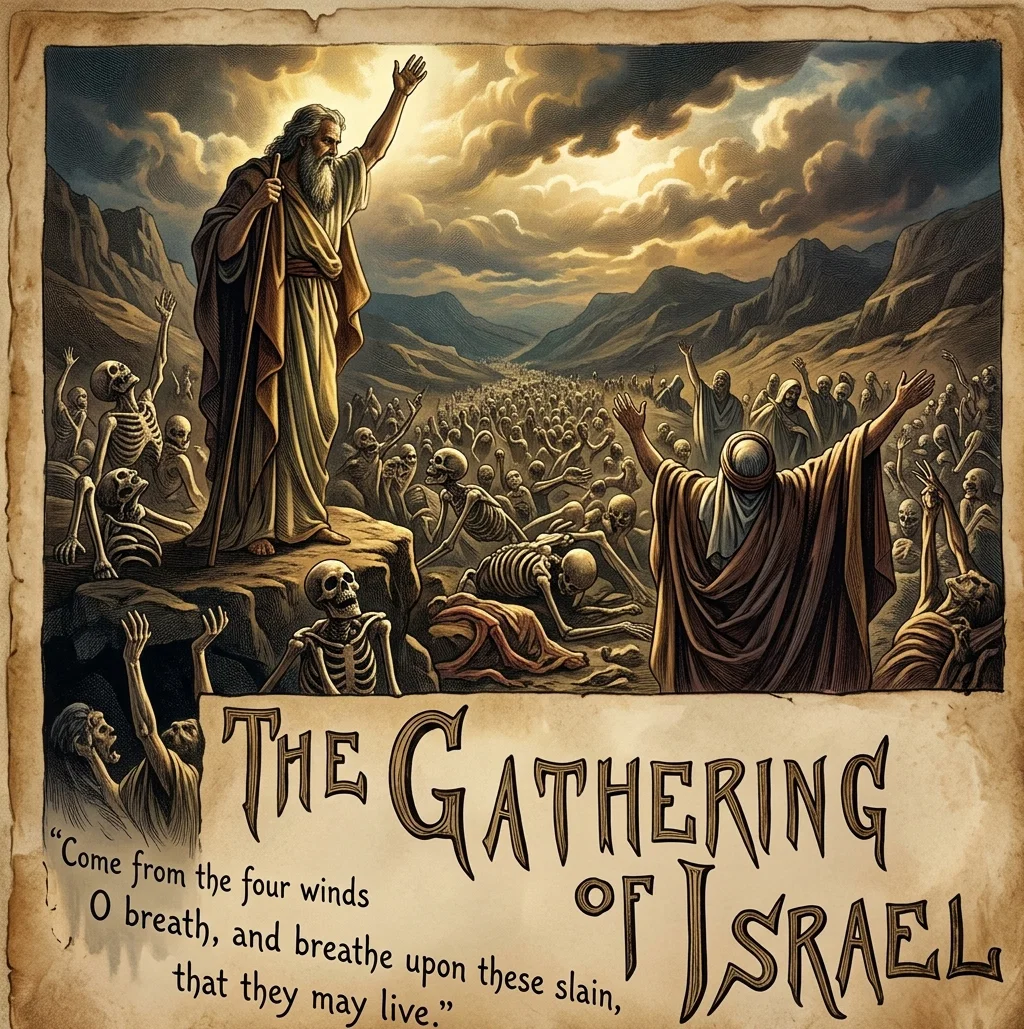
In a wild, lonely valley,
So death-like a valley
That no other valley
With it could compare,
Men's bones by the thousands,
And hundreds of thousands,
And thousands of thousands,
Lay bleaching and bare,
THE GATHERING OF ISRAEL
When, one day, a prophet
Came there as a prophet,
And LIFE had this prophet
Engraved on his brow.
He cried to those dry bones,
“Awaken, ye dry bones,
And cease to be dry bones;
The Lord calls you now!”
Then quickly those bony men,
Legions of bony men,
Armies of bony men,
Heard and obeyed.
And just as they were in life,
Long ago were in life—
Stalwart they were in life—
Was each one made.
And so to the righteous dead,
Great and small righteous dead,
All of the righteous dead,
Hope is secure.
And when the Lord shall speak,
Over their graves shall speak,
Life to the dead shall speak,
Endless and pure.
THE BIBLE.
This book contains the mind of God on the state of man, the way of salvation, the doom of sinners, and the happiness of believers. Its doctrines are holy, its precepts are binding, its histories are true, and its decisions are immutable. Read it to be wise, believe it to be saved, and practice it to be holy. It contains light to direct you, food to support you, and comfort to cheer you. It is the traveler's map, the pilgrim's staff, the pilot's compass, the soldier's sword, and the Christian's charter. Here Paradise is restored, heaven opened, and the gates of hell disclosed. Christ is its grand subject, our good its design, and the glory of God its end. It should fill the memory, rule the heart, and guide the feet. Read it, slowly, frequently, prayerfully. It is a mine of wealth, and a paradise of glory and pleasure. It is given you in life, will be open at judgment, and will be remembered forever. It involves the highest responsibility, rewards the greatest labor, and condemns all who trifle with its holy contents.—Selected.
JESUS RIGHT THERE.
A young Chinese woman, who recently became a Christian, was threatened, scolded, and persecuted in many ways by her family and friends. Finally her brother offered her anything he had or could get for her if she would give up the “Jesus doctrine.” She said: “You ask of me the only precious things I have, more precious than anything you can give me. I can not give them up for fields or jewels. My Bible says, ‘What shall it profit a man if he gain the whole world and lose his own soul?’”
She came back to the Christian school, where she had gained her “precious things,” and her heathen mother was heard to say: “It is no use to talk any more to that daughter of mine. She seems to think there is something very good in that foreign religion.”
And the young woman herself said: “I love the Lord Jesus as I never did before. All the time those people were coaxing and scolding and swearing at me, I forgot that I was just one lone woman against them all. It seemed as if Jesus was right beside me, answering and fighting for me. I kept remembering his words, ‘Be not afraid of them that kill the body, and after that have no more that they can do.’”
Is there not danger that we, too willing to be “carried to the skies on flowery beds of ease,” may lose the blessedness of the eighth beatitude, and fail to possess fully the kingdom of heaven?—Christian Advocate.
A DAMAGING ADMISSION.
By W. N. Glenn
BY W. N. GLENN.
The object of the National Reformers, the various elements engaged in the crusade for a religious amendment to the Federal Constitution, is that the government shall be controlled by men who adhere to the Christian religion. Time and again they have indorsed the Puritan idea of government. One of their leading workers, in the midst of an impassioned speech, once cried out: “O, for the breath of the Puritan! O, for a little of the Puritan Sabbath!”
The advocates of the proposed amendment, which is now pending in Congress, do not hesitate to say that under its provisions a Jew or an infidel could not consistently take the ordinary oath prescribed for legislators, and consequently could not hold such offices. It is also designed that courts shall decide moral questions, and that the Bible shall be the standard of legislation and of court decisions; thus Congress, state Legislatures, and the courts would decide as to the meaning of the Bible on all moral questions. All this is not only admitted but urged as the object of this now prominent “reform” measure. It is in keeping with the following declaration by the Puritan fathers, as given in “Clarke’s History of Intolerance”:—
No one shall be a freeman, or give a vote, unless he be converted, and a member in full communion of one of the churches, allowed in this dominion.
No man shall hold any office who is not sound in the faith and faithful to his dominion; and whoever shall give a vote to such a person shall pay a fine of one pound. For a second offense he shall be disfranchised.
One of the cardinal objects of this National Reform movement, as expressed in its leading organ, is to “enforce upon all that come among us the laws of Christian morality.” But the very thing which they would fain have brought about in the commonwealth consists already, to an eminent degree; to such a degree, according to their own admission, as to practically prove that their hope of reformation on the lines marked out is without foundation. They confess that the extensive evils of the present time exist in spite of the fact that “our legislators are largely church members.” The Christian Statesman, a leading organ of the National Reform combination, in a well-merited criticism of the saloon evil, makes this candid admission:—
The church is also responsible. Saloon-keepers are in her communion. The ecclesiastical courts hesitate about giving deliverances on the subject of temperance, and as a rule dare not enforce discipline even when their deliverances require it. Our legislators, the authors of license legislation, are largely church members. The two great parties, both of which are controlled by the liquor interests, are also largely composed of the same. Yes, the church must bear her share of responsibility for all the harm done by the drink traffic.
We say this is a candid admission, but it is more; it is a practical demonstration that the hope of national reform, based upon the prospect of having legislative chairs and court benches filled with professing Christians,8is a most blinding delusion. In addition to this practical illustration we have the fact that the justice of the Supreme Court who framed the “Christian nation” dictum, and is therefore hailed as a champion by the National-Reform-Religious-Amendment forces, is the same justice whose “original package” decision broke the force of the prohibition law in Kansas.
If the people, who are now being importuned to indorse the proposed amendment to the Constitution, will calmly note these facts, these admissions on the part of the advocates of the intolerant proposition, they will see the propriety of maintaining the degree of religious liberty now theoretically guaranteed by the Constitution. This degree is already limited to the minimum, through unwarranted congressional and state laws and Supreme Court decisions. Any further limitation, by eliminating even the semblance of a guarantee of religious liberty, would be simply a return to the conditions from which we emerged after the Revolution.
We note also the statement that “the two great parties, both of which are controlled by the liquor interests, are also largely composed of the same;” that is, of church members. Now it is well known that “the two great parties” control the destinies of the nation. No other party ever can come into power excepting by large accessions from one or both of these parties. And such large accessions never will be won over except on the selfish expectation that the party to which they go will gain the political ascendancy. So that the political control of the nation is almost sure to be in the hands of church members, just as it is to-day. No matter what party name they may assume, or what measures they may espouse, their political aims will be the same, namely, political power. If they should pass religious laws, their object would be the same as they now have in view when they sustain the liquor traffic, namely, retention of their political prestige.
So, from the admission contained in the foregoing quotation, we may logically expect that, no matter what changes may take place by turning the political kaleidoscope, it will be simply a shifting of the same elements that in the main control legislation and judicial decisions to-day. There is no prospect that the turning of the glass will improve the material of the shifting fragments. Their nature will be the same. Then does not the national aspect to-day, controlled, as it admittedly is, by church members, give us an indication of what it would be if the church were to exercise more power in the government? It is admitted on all hands that the affairs of our government have been more and more corrupted with every succeeding administration for many years. It is also known that politicians have for years been recognizing the expediency of religious profession as an aid to political preferment, just as business men recognize the policy of connecting with popular churches in order to increase their trade.
Then what is to be gained by placing more power in the hands of church-member politicians, in the face of their well-known corrupt practices. If they are corrupt in the civil matters intrusted to their care, will they be any the less so if we turn over to their hands the moulding of our religious scruples and practices? Has not all history shown that religious power in the hands of corrupt political officials has only added opportunity to their natural viciousness, and made them more and more tyrannical? None but tyrants at heart ever yet desired to compel by civil law the consciences of the people. The great Head of the Christian church himself did not compel obedience to his doctrine. He said: “If any man hear my words, and believe not, I judge him not; for I came not to judge the world, but to save the world.” The Gospel invitation is, “Whosoever will, let him take the water of life freely.”
Let us turn for a moment to the proceedings of a recent national convention of one of those “two great parties” that is “largely composed” of church members. We note the one that was mainly instrumental in opening the doors of congressional action to religious legislation in 1892, and declared that the first day of the week is the Sabbath of the fourth commandment, which expressly says that “the seventh day is the Sabbath of the Lord.” Well, this convention of church-member politicians was seriously divided in sentiment, altho professing to be Christian. The contention arose over the matter of opening the convention with prayer. One faction would not agree that a Protestant should officiate, and another faction would not consent to the prayers of a Catholic. Of course these two “Christian” factions were sufficiently strong to unitedly control the convention, so they compromised on a Jewish rabbi. These two “Christian” elements in the convention agreed to heal their differences by choosing presumably an enemy of Christ to pray for them. So it was on a former occasion, some centuries ago—Herod and Pilate were made friends, and Christ was crucified.
Such are some of the fallacies of church-member politics, yet there is a widespread effort now in progress, being energetically pushed during the interval between sessions of Congress, to fasten upon the Constitution a provision that will give exclusive power in the nation to those who will join the church, and support its claims on demand. What do we see in the current actions of professedly Christian politicians to warrant any such wholesale transfer to them of both our civil and religious destinies? Before we indorse such a movement, let us seriously count the cost, and decide whether we are prepared to launch out upon the flood of church and state union. The lesson to be learned from the quotation upon which we have been commenting, should be heeded by all. It is an admission extremely damaging to the cause of the proposed religious amendment to the Constitution.
The Resurrection of God's People
“Thus saith the Lord God: Behold, O my people, I will open your graves, and cause you to come up out of your graves, and bring you into the land of Israel.” Eze. 37:12.
BENEFITS OF THE CHRISTIAN LIFE.
By William T. Heald
BY WILLIAM T. HEALD.
CHRISTIANITY is a conduct of life according to a given standard, and that standard is Christ. It is profitable unto all things, having promise of the life that now is, and of that which is to come. Its attributes are love, joy, peace, long-suffering, gentleness, goodness, faith, meekness, and temperance; and we are told that against such there is no law.
Now let us expand upon the above statements. A life with the above attributes is said to be profitable unto all things. Is it? If there were no hatred (the opposite of love), there would be no war. Would the world be better off without war? There would be no murder. Would the world be better off without murder? “O, yes,” says one, “but that word ‘long-suffering,’ I don’t see the profit of that.” Yes, that is hard to see. But what is the proposition upon which these attributes are named?—Why, they are to be profitable both in this life, and in the life to come. Then what are the attributes of this life? Not the same as of the life to come, I am sure; for in this life we have to contend with cares, perplexities, obscurities, sickness, and sorrows without number. What are we going to have with which to combat these many grievances?—It is only long-suffering that can stand the pressure of the afflictions of this life.
We are not told that these attributes will produce a perfect state in this life, but only that they have promise both of this life and the life to come. But, says one, if it is to be only promise, then it is not worth my while to bother with all this conformity for the sake of promise. Ah, but that is where we become near-sighted again! Were the promise only for this life, it would, indeed, be a fleeting vanity. But the promise is twofold; and the promise of the life to come is conditional on our acceptance of the promise of the life that now is.
Here in this life we are not promised a perfect state, but in the life to come the state promised is perfect. “Well, then,” says our inquisitive friend, “I don’t see as the promise for this present life amounts to anything.” That is a wrong conclusion. That last little statement, “against such there is no law,” may seem to be of no consequence in this connection, but in reality it is of the greatest moment. The instant one embraces this life of Christ, he is a free man. He is free from the bondage of the law, because his life is in harmony with the law, and against him the law can not operate, or, in other words, against him there is no law.