The city of San Jose, like so many of its sister cities in California, was compelled to make obeisance to the perverted powers of nature on April 18.
San Jose is known throughout the country as the Garden City of California—beautifully situated, practically every residence a flower garden, well supplied with buildings artistically constructed, and seemingly strong to resist any ordinary manifestation of nature's forces.
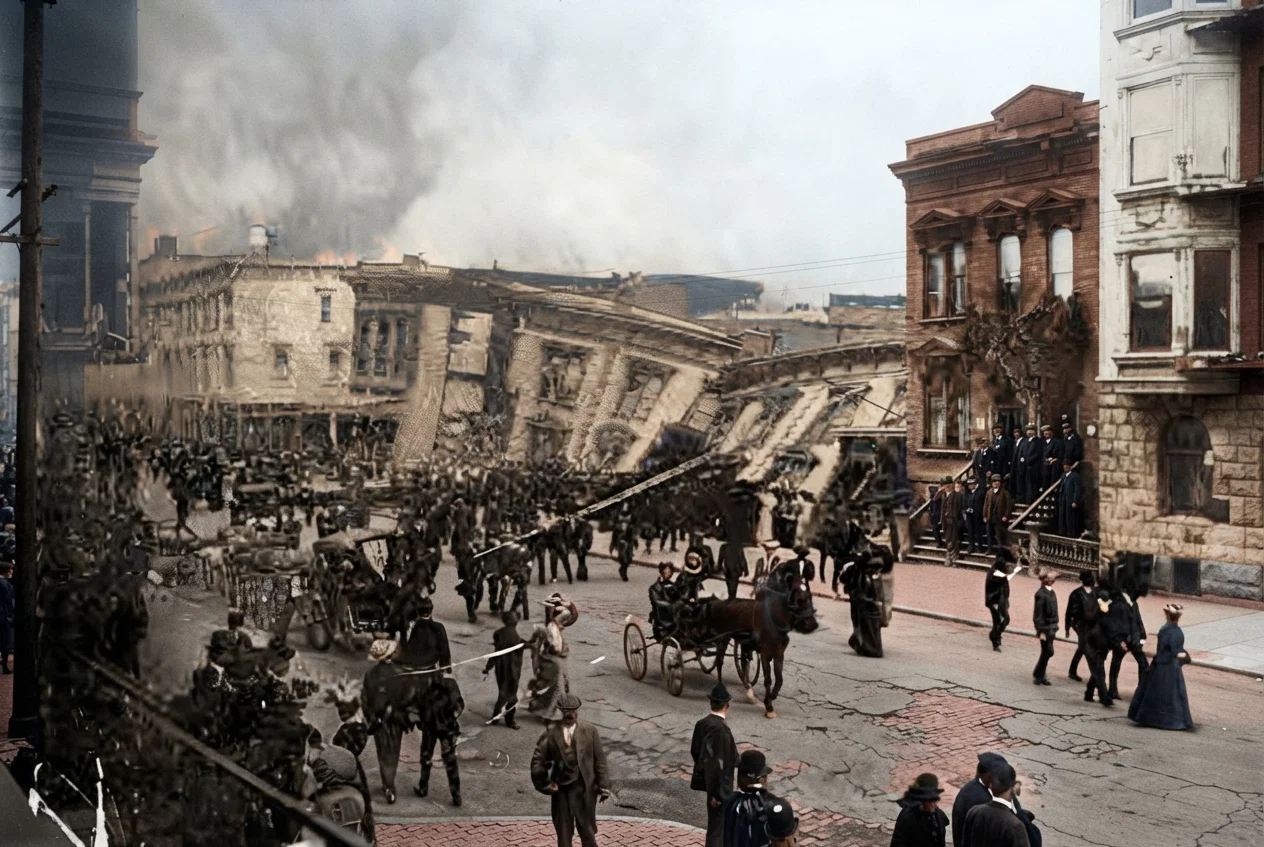
In twenty-eight seconds the best that men could do was leveled with the ground or stood tottering like reeling inebriates.
First Street, the finest street of San Jose, lined on both sides with substantial and wealthy business enterprises, was left a trembling wreck from end to end. No single structure in all that stretch of brick and steel and stone buildings was without its mark of devastation. Some that appeared to have weathered the upheaval in a fair degree, on closer inspection have been condemned to be torn down piece by piece. Massive stone-pillared fronts were shattered and seamed, their very seeming massiveness only accentuating their treacherous weakness, and making man's strength and man's ingenuity appear frailer and less dependable by comparison with the elements that were pitted against him.
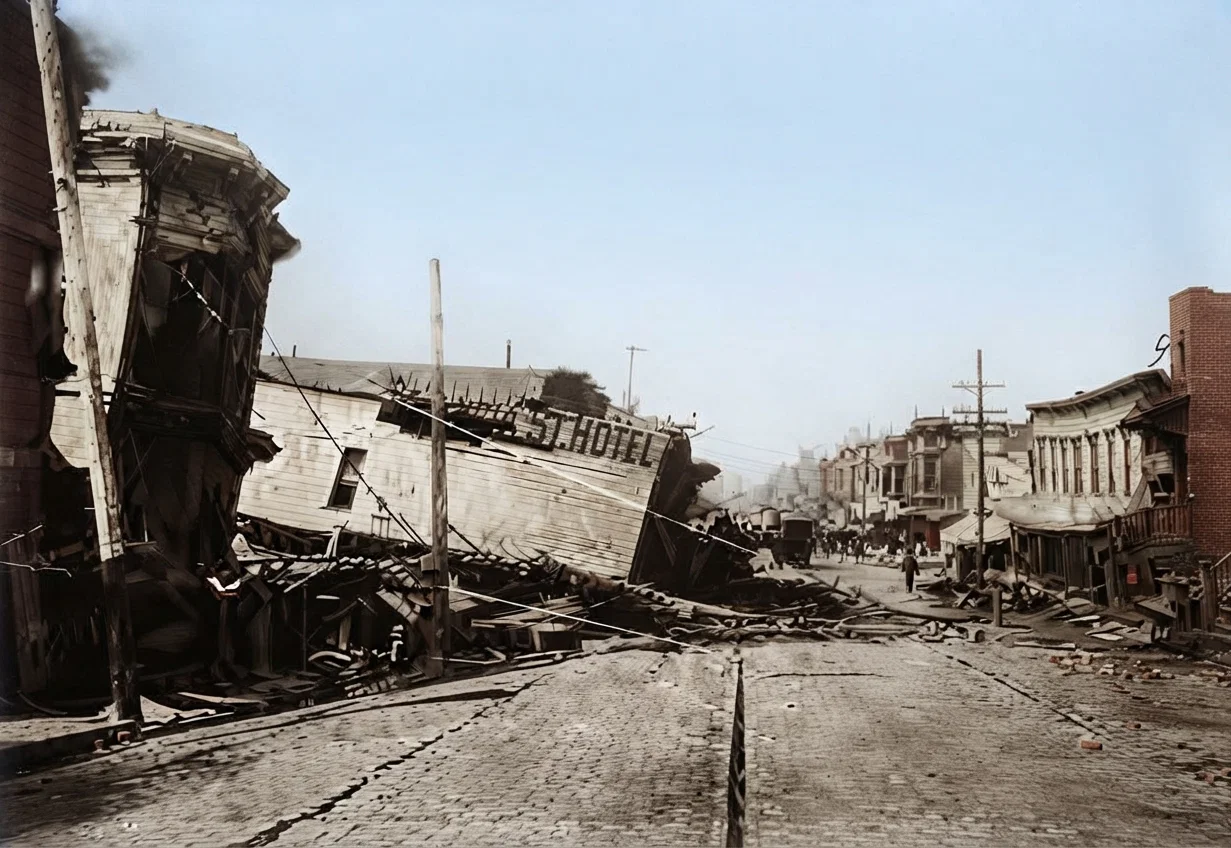
Another Scene of Earthquake Wreckage on Golden Gate Avenue, San Francisco.
Added to the enormous expense of building is the great expense of unbuilding what nature seemed content to leave standing. Practically the whole of the business portion of First Street comes down, or requires vast outlays of means to put the structures in their former condition.
But First Street did not suffer alone. Everywhere the writer found the striking evidences of the fearful temblor.
There is an effort on the part of many in this city to minify, rather than magnify, the results of the earthquake. It is firmly believed that there were many more lives lost than have been reported. Nineteen are admitted to have perished in this city. Some declare the number to be double that. We saw buildings whose whole tops were crushed in by bricks and stones from the tops of other buildings. The sidewalks were broken, dented, or shattered in front of many buildings by the great stones that were thrown down from the higher structures, in a veritable bombardment. Look where you would, it was but broken stones, shivered timbers, plaster, heaps of brick, twisted iron frames, and tangled wires.
San Jose also had her fire, but it is not to be compared with San Francisco's visitation. It seemed for some hours, however, to threaten the destruction of the business district. Two large buildings, covering about a third of a large block, were completely destroyed; but the fire was held within that block, as San Jose's water system was not injured by the earthquake.
In various parts of town, residences were set off from their foundations, some of them crushed or driven back upon their haunches, with porches torn off or tilted at dangerous angles, the buildings propped and braced to prevent serious accidents while they are being torn down.
Imagine a hale, strong man, smitten in death while still standing, and propped up that he might present an appearance of life. Such is but a weak representation of how San Jose impresses the one who once looked upon what it was and now sees it as it is.
The financial loss is now placed at $3,000,000. It is impossible to conceive how it could be rebuilt as it was for any smaller amount.
The work of clearing away the débris, strengthening the less seriously injured buildings, and rebuilding the structures that collapsed, is a task that will keep San Jose busy for months to come. She is busy now—very busy; and yet, in many places the task seems barely touched. The ruins of a few large buildings have been completely removed; many remain just as they were left when the quaking ceased; a large number are braced in at least two directions, and business continues to be transacted in them; while in all parts of town demolition and reconstruction are going on at the same time. In some of the buildings, like the Hall of Records, the great cracks are widening, and the small ones are more manifest than they were immediately after the earthquake. But San Jose is rebuilding with magnificent courage. s.
MOUNTAIN VIEW'S EXPERIENCE.
By G.
OUR home town is fortunate in having but few brick houses. Of these few, four are in heaps of ruins, and the others are seriously damaged.
One building with a general merchandise store and the post-office on the first floor, and a lodging-house upstairs, was thrown into a miscellaneous heap.
Another building, containing two stores below and a large hall above, was mostly tumbled into the street. A large two-story furniture establishment fell flat to the earth. A large fruit-drying and packing house was also totally wrecked.
Two two-story frame buildings were ruined, and others more or less damaged. Broken chimneys, windows, dishes, or furniture were the order common to all houses.
The two large tanks of the town water-works—100 feet high, and containing 70,000 gallons—fell to the ground. However, the pumping apparatus was not8injured, and water for the town is pumped directly into the mains.
The financial damage, estimating all losses, will reach approximately $175,000, to say nothing of loss of business for a time. There was no loss of life, altho a dozen persons were more or less injured.
Our own building, the Pacific Press Publishing Company's plant, was terribly shaken. All the wall except the front was wrecked or ruined.
Fortunately the roof was not injured, and enough wall stood with interior structure, to support it until the frame could be built under it.
With the exception of our two linotype machines, injured by falling walls to the extent of several hundred dollars, and a small quantity of type, our working material was practically uninjured. These machines were out of use for sometime, as there is no place on the Coast where they can be repaired at present. Operators had left their posts but half an hour before the crash came. Aside from these machines, work could proceed in all departments after clearing away the debris.
Had we been in some incorporated city the authorities would not have allowed us to go to work on the inside at all; but as it was, working or not working was voluntary only as individuals felt impressed to service because of the urgent need. The response was quite general, and the clearing out was done in a short time.
As the editors sought their offices they were confronted by a distressing sight. In two rooms large bookcases and their contents were piled in the middle of the floor. The books were mingled with broken plaster, broken glass, and splintered wood. In the hall, in front of our doors, lay an immense pile of miscellaneous engravings, the cabinets of drawers containing hundreds of these having fallen forward from the wall. The chapel in the second story was entirely open at one end, the wall being upon the ground, but right on the edge of the broken wall left standing still, hung a text motto: "Be still and know that I am God."
In the power-house but one steam-pipe was broken, which was quickly repaired. The main tankhouse, of frame, is uninjured.
Our new two-story boarding-house, frame and plaster, suffered no damage to speak of. It stands within a hundred feet of the brick publishing house. This emphasizes the impracticability of brick buildings where there is liability to earthquakes, and that is everywhere.
But, praise the Lord, "we are all here," and all alive, and we hope have profited by the experience.
G.
A Strong City
"In that day shall this song be sung in the land of Judah: We have a strong city; salvation will He appoint for walls and bulwarks. Open ye the gates, that the righteous nation which keepeth faith may enter in." Isa. 26:1, 2.
What Do These Things Mean?
By J. O. Corliss
To be an infallible guide, the Bible must be able to instruct in all things pertaining to life and godliness. Such instruction, to be competent, must reveal the eternal purpose of God concerning this earth and its inhabitants. This purpose being a fixed one, God's omniscience must foresee and declare those events which are to affect the destiny of His people. To believe otherwise would belittle the Creator, and make Him unworthy of confidence in time of dire need.
Taking this view of the Bible, we are compelled to believe that the terrible calamity just visited on the Pacific Slope is significant, as indicating something for which the people ought to be prepared. The havoc wrought in San Francisco, Santa Rosa, and other cities of California, was not wholly accomplished by the shaking of the earth; in San Francisco particularly, fire of the most persistent character followed, devouring buildings deemed indestructible by fire or earthquake—two elements of destruction associated together in God's Word. Isa. 29:6.
By the combination of these two elements the destruction of the world will be accomplished in due time. The prophet says:
Collapse of the large, four-story Valencia Street Hotel, in which four stories were telescoped into one. The street also sunk several inches here. Between thirty and forty were killed in this building, which caught fire soon after its collapse.
"And the seventh angel poured out his vial [of wrath] into the air; and there came a great voice out of the temple of heaven, from the throne, saying, It is done. And there were voices, and thunders, and lightnings; and there was a great earthquake, such as was not since men were upon the earth, so mighty an earthquake, and so great. . . . And the cities of the nations fell. . . . And every island fled away, and the mountains were not found." Rev. 16:17-20.
Those who passed through the recent earthquake will corroborate the statement that the scenes which followed it beggar description. Rich men lost their all, and were reduced from affluence to poverty. Poorer people were reduced to beggary, and cried like children. Confusion prevailed. But calamitous as was this recent occasion, the event predicted in the foregoing scripture will bring infinitely greater distress, so much so that "the mighty man will cry there bitterly," for that day will be "a day of wrath, a day of trouble and distress, a day of wasteness and desolation, a day of darkness and gloominess, a day of clouds and thick darkness." That day will be "the day of the Lord's wrath," in which "He shall make a speedy riddance of all them that dwell in the land." Zeph. 1:14-18.
At this time the ethereal arch of heaven will pass away as a scroll being rolled together, and every mountain and island will remove. Then all men—kings, rich men, chief captains, and earth's mighty men, with the bond and free—will hide together among the rocks of the hills, and in one mighty chorus of lamentation, cry to the rocks and mountains to fall on them, and to hide them from the face of Him whose wrath they have provoked by their glaring enormities in sin. Rev. 6:14-16. And again fire will follow.
That this is not a fancy sketch, we have only to refer again to Scripture. Speaking of the attitude of those who will make light of the evidences of Christ's near coming, the apostle Peter says such are willingly ignorant of the fact that by the word of God the world was once destroyed by water. He then adds: "The heavens and the earth, which are now, by the same word are kept in store, reserved unto fire against the day of judgment and perdition of ungodly men." 2 Peter 3:4-7.
Such a sure and terrible ending of all things sinful must be reserved for definite time in the purpose of God, who could not be true to His declared merciful character should He fail to give warning of its direct approach. When the Saviour was asked what signs would herald His second advent and the end of the world, among other things He said: "Nation shall rise against nation, and kingdom against kingdom, and great earthquakes shall be in divers places." Matt. 24:1-8; Luke 21:10, 11.
The ever-increasing number of earthquakes during the last few centuries is told in cold, tabular fact elsewhere in this paper.
Now there comes to us unheralded the sad catastrophe in California, breaking down and destroying important centers of industry. This also must be accepted as a premonition of the great and terrible earthquake before which all the cities of the nations will soon surely fall, and the accompanying fires of the last day which will complete the destruction of all sinful things.
He who pays heed to this warning and lets the Lord direct his ways, will certainly escape the general ruin, because he will have found shelter under the protecting wing of the Almighty. A thousand shall fall at his side, and ten thousand at his right hand, but it—the destruction—will not come nigh him, because he has made the Lord his refuge, even the Most High his habitation. The angel of the Lord shall keep him in all his ways. Ps. 91:5-11.
In that day every earthly thing will be removed by the terrible shaking it will receive. One thing alone will remain, the Word of God, because it can not be shaken, hence must stand forever. Fixed on this, one will be safe, even tho the earth be removed out of its place. Heb. 12:26-28.
Shall we not, then, learn the lesson God would have us study in what is occurring about us, and so yield our hearts to be controlled by Him that our lives may be moulded after the fashion of His own, and we be prepared to meet those things that are so rapidly coming upon the earth? God grant that we may. J. O. CORLISS.
SAN FRANCISCO.
By Wallace Irwin
[Wallace Irwin, in Collier's Weekly.]
She laughed upon her hills out there
Beside her bays of misty blue;
The gayest hearts, the sweetest air
That any city ever knew.
For I have whistled all the songs
That thrilled upon her care-free breath,
And I have mingled with her throngs—
But never in the thought of death.
Lady of Ventures, Joy of Earth,
How more the pity for your moans
With all the blossoms of your mirth
Crushed, like your youth, beneath the stones.
Santa Rosa's Sad Story
THE city of Santa Rosa, county seat of Sonoma County, Cal., with a population of 10,000, has a thrilling earthquake story which we barely noted in our first edition. In some respects this place fared worse than San Francisco in proportion to size. This is especially true of its death-roll, which reached 102. From Mr. Geo. E. Peery's graphic report to the Oakland Herald, we take the following:
The appalling immensity of San Francisco's catastrophe obscured Santa Rosa's sorrow from the world's attention. Tho less in extent, it was greater in degree than that of the metropolis. The loss of life was proportionately greater, and the business part of town was absolutely annihilated. Santa Rosa differed from most towns of similar size in being more compactly built. All its business houses were closely grouped about the center, where stood the county courthouse. So, when this group of business blocks was tumbled into blazing ruin, there were no suburban stores to supply the pressing needs of the moment.
There was neither bread nor meat for the living; there were no coffins for the dead. The breaking off of communication left the world in ignorance of Santa Rosa's destruction; and beyond mere surmises, this city's first intimation of San Francisco's disaster was the arrival of a train load of nearly a thousand refugees, wounded, sick, half-clad, and half-starved, seeking shelter where there were no houses, and begging help that none could give.
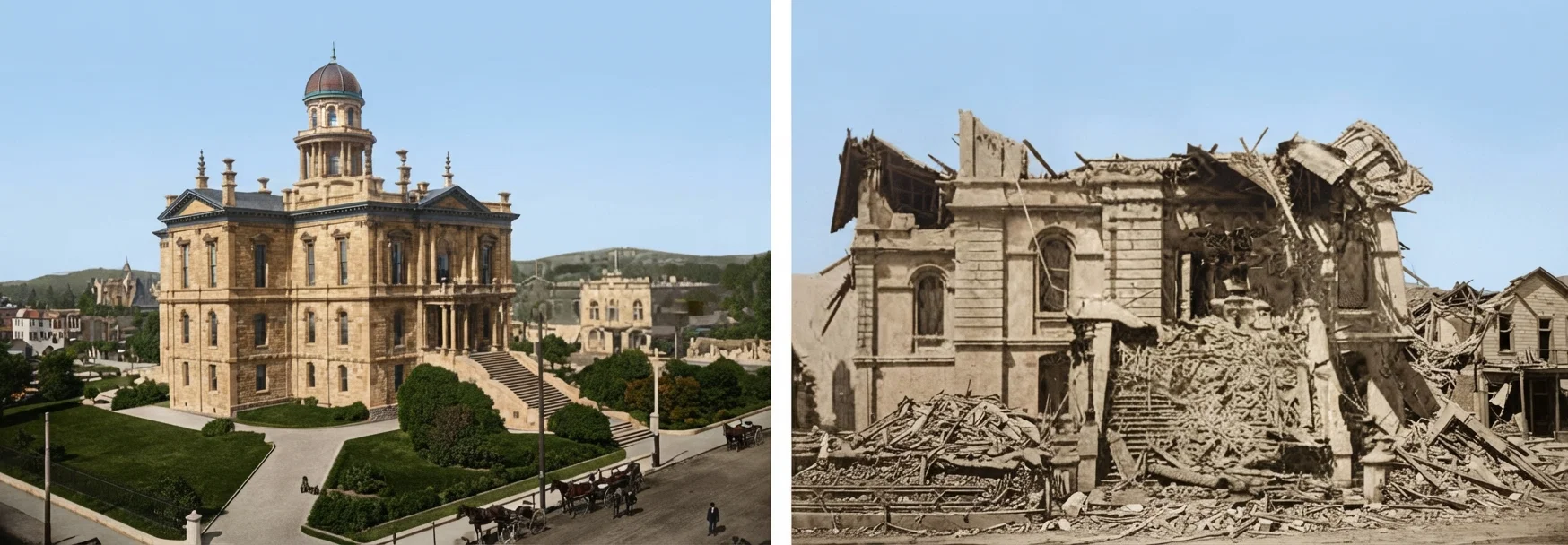
Ruins of Santa Clara Court House.
San Francisco's call for aid was heard far and wide, and spendthrift hands responded, but Santa Rosa's moaning reached only her own ears at first, and the suffering was intensified as it lengthened.
The earthquake shock buried firemen, horses, and engines under their own walls and roofs. Frantic efforts freed them, and valiantly they served. Santa Rosa had two engines; Sabastopol sent a third. The water system was unimpaired, and the supply sufficient, and within three hours the three engines had twenty scattered fires under control. Just how many lives those three hours cost can not be told. Many of the corpses found in the ruins had been crushed when the buildings fell; but many others had been living survivors of the earthquake until the fire reached them.
In the office of the Press-Democrat newspaper, four lives were lost. Three carriers, with the pressman, were crushed to a pulp when the three-story building slid backward with its thousand-ton weight upon the one-story pressroom.
The Hotel St. Rose was a new building, four stories high, and believed to be of modern scientific construction. It crumpled as a pasteboard box, imprisoning some of the hundred guests within its walls, and sliding others outward into the street unhurt. It required hours to free some of those shut in.
The courthouse lies a mighty heap of ruin, its massive dome sunk nearly out of sight, with its summit resting against the eastern wall, which bulges with the weight. The new Masonic Temple, in which the mortar on the topmost course of yellow stone was scarcely dry, now lies as tho battered by a month's bombardment. One block east is a heap of blue basalt, that a week ago was the public library. The earthquake's vibrant swing flung blocks of stone that weighed a quarter of a ton apiece across the street.
Five banks with deposits aggregating nearly nine million dollars, were in the earthquake's path. Now, five naked steel vaults, loom among a chaos of shattered walls, guarded by sentinels with rifles. Three brick hotels, three and four stories high, one hotel of stone, and two that were built of wood, are all laid low by earthquake shock and fire. The big brewery, five stories high, the shoe factory, a three-story building only a year old, a four-story brick flour mill, two theaters, five public halls, the Odd Fellows' Temple, and a score of office buildings, retail stores, and flats and lodgings—all are gone, and nothing left but rubbish.
Yet with magnificent courage Santa Rosa is rising from her wreck and ashes.
SOME DIRECT CAUSES OF EARTHQUAKES.
By Ellen G. White
A T this time [the time of the Deluge] immense forests were buried. These have since been changed to coal, forming the extensive coal-beds that now exist, and also yielding large quantities of oil. The coal and oil frequently ignite and burn beneath the surface of the earth. Thus rocks are heated, limestone is burned, and iron ore melted. The action of the water upon lime adds fury to the intense heat. As the fire and water come in contact with ledges of rock and ore, there are loud explosions, and volcanic eruptions follow. These often fail to give sufficient vent to the heated elements, and the earth itself is convulsed, the ground opens, and villages, cities, and burning mountains are swallowed up.
The depths of the earth are the Lord's arsenal, whence were drawn weapons to be employed in the destruction of the old world. Waters gushing from the earth united with the waters from heaven to accomplish the work of desolation. Since the Flood, fire as well as water has been God's agent to destroy very wicked cities. These judgments are sent that those who lightly regard God's law and trample upon His authority may be led to tremble before His power, and to confess His just sovereignty. As men have beheld burning mountains pouring forth fire and flames and torrents of melted ore, drying up rivers, overwhelming populous cities, and everywhere spreading ruin and desolation, the stoutest heart has been filled with terror, and infidels and blasphemers have been constrained to acknowledge the infinite power of God.
Said the prophet of old, referring to scenes like these and the more terrible manifestations to be witnessed at the second advent of Christ: "O that Thou wouldst rend the heavens, that Thou wouldst come down, that the mountains might flow down at Thy presence, as when the melting fire burneth, the fire causeth the waters to boil, to make Thy name known to Thine adversaries, that the nations may tremble at Thy presence! When Thou didst terrible things which we looked not for, Thou camest down, the mountains flowed down at Thy presence."
"The mountains quake at Him, and the hills melt, and the earth is burned at His presence, yea, the world, and all that dwell therein. Who can stand before His indignation? and who can abide in the fierceness of His anger?" "Bow Thy heavens, O Lord, and come down; touch the mountains, and they shall smoke. Cast forth lightning, and scatter them; shoot out Thine arrows, and destroy them."
As lightnings from heaven unite with the fire in the earth, the mountains will burn like a furnace, and will pour forth terrible streams of lava, overwhelming gardens and fields, villages and cities. Seething, molten masses thrown into the rivers will cause the waters to boil, sending forth massive rocks with indescribable violence, and scattering their broken fragments upon the land. Rivers will be dried; the earth, convulsed; everywhere there will be dreadful earthquakes and eruptions.
Thus God will destroy the wicked from off the earth. But the righteous will be preserved in the midst of these commotions, as Noah was preserved in the ark. God will be their refuge, and under His wings shall they trust. Says the psalmist: "Because thou hast made the Lord, which is my refuge, even the Most High, thy habitation, there shall no evil befall thee." "In the time of trouble He shall hide me in His pavilion; in the secret of His tabernacle shall He hide me." God's promise is, "Because he hath set his love upon Me, therefore will I deliver him; I will set him on high, because he hath known My name."—From "Patriarchs and Prophets."
A Mighty Ruin—A Sure Trust
I HAVE seen San Francisco in the heyday of her glory; I have seen her humbled in the ashes of her ruined homes. I have seen her people marching in pride and revelry through thronging thoroughfares; I have seen them hurrying out of the flames and smoke with the flotsam of their treasures in napkins and blankets. I have seen her people pandered to by liveried servants, or speeding in costly automobiles and luxurious palace cars for pleasure; and I have seen them tugging their earthly belongings in unwieldy trunks along the streets at the end of frayed ropes—not in pleasure, but in desperation, with blood-shot eyes and terror-stricken faces.
I have stood on Nob and Telegraph Hills, and looked over the thousands of acres of gilded wealth and tattered poverty, of princely palaces and hovels of misery, of massive churches and gilded palaces of lecherous sin; and now I have stood upon the great funeral pyre of all this conglomerate congestion of modern civilization, rubbed its whirling ashes from smarting eyes, and listened to the moaning of the winds through the wreck and ruin of it all. Other cities have passed from opulence to ash heaps in an age or a generation; but we are living rapidly today. San Francisco has become an acropolis, a parthenon, a Thebes, a stone henge, an Alhambra, altogether, in less than half a week. Here are the broken columns of ancient Grecian architecture; yonder are the crumbling ruins of the playhouses of some ancient Rome; there stand the trembling remains of some historic "Court of Lions," and we can almost see in the fleeing people some weeping Abbu Abdullah, sorrowing for a lost kingdom. What sorrows, what heart-breaks, what terrors, what separations, what terrible deaths, what serious lessons a great catastrophe like this can huddle into a few hours of time! and over it all we can see spread a deep mantle so like to Herculaneum and Pompeii.
We looked to the north, to the south, to the east, and to the west, and could see with the mind's eye in every one of those ten thousand acres of disaster the graves of thousands of cherished hopes. San Francisco had a number of populous cemeteries in her outskirts, and many funeral trains wended their ways to these every day of the week; but no such municipal cemetery as this one had ever before been beheld by this palsied world. The wealthy buried much; the poor in very many cases buried more—for they buried all.
Great buildings were not the only things the earthquake leveled; for the silk-clad and the rag-clad touched elbows in the doubling, winding bread-line, received milk from the same can, and waited hungrily for their slice of steak from the same round. The silk tile looked down on the grimy slouch hat while their wearers took bread from the same hand. The rich learned what it was to be hungry, and the poor learned that money can not shield its owner from sorrow and distress.
This earthquake was a great demolisher of false trusts and false hopes. Men and women had come to trust in their substantial residences, in the effectiveness of their fire-fighting apparatus, and gave little thought to the future, or to their eternal interests; but somewhere deep down in the earth arose the growl of an angry power that seemed to gather itself for an effort at ruin that would send the groan of dismay around the world. It gripped the whole gateway of this western empire in teeth stronger than iron or steel or stone, and shook the hills and the valleys, the cities and the waters of the sea—shook them as no living power can shake anything else that lives, and the fury seemed to grow with the very expenditure of its energy. Then it ceased, and flung down its victim; and O, what a ruin was there!
In no place in all this world, at no time in all its history, have human eyes ever looked upon such a scene as spreads itself out by the Golden Gate today. Go where you will, look in what direction you will, the eyes rest upon the splintered skeletons, the twisted ribs, and the staring, eyeless sockets of what were once creations of architectural beauty, and embodiments of wealth. Man spared nothing—not even truth and purity—to make it all it was; and the flames have spared nothing save that which they seemed to consider unworthy of their prowess.
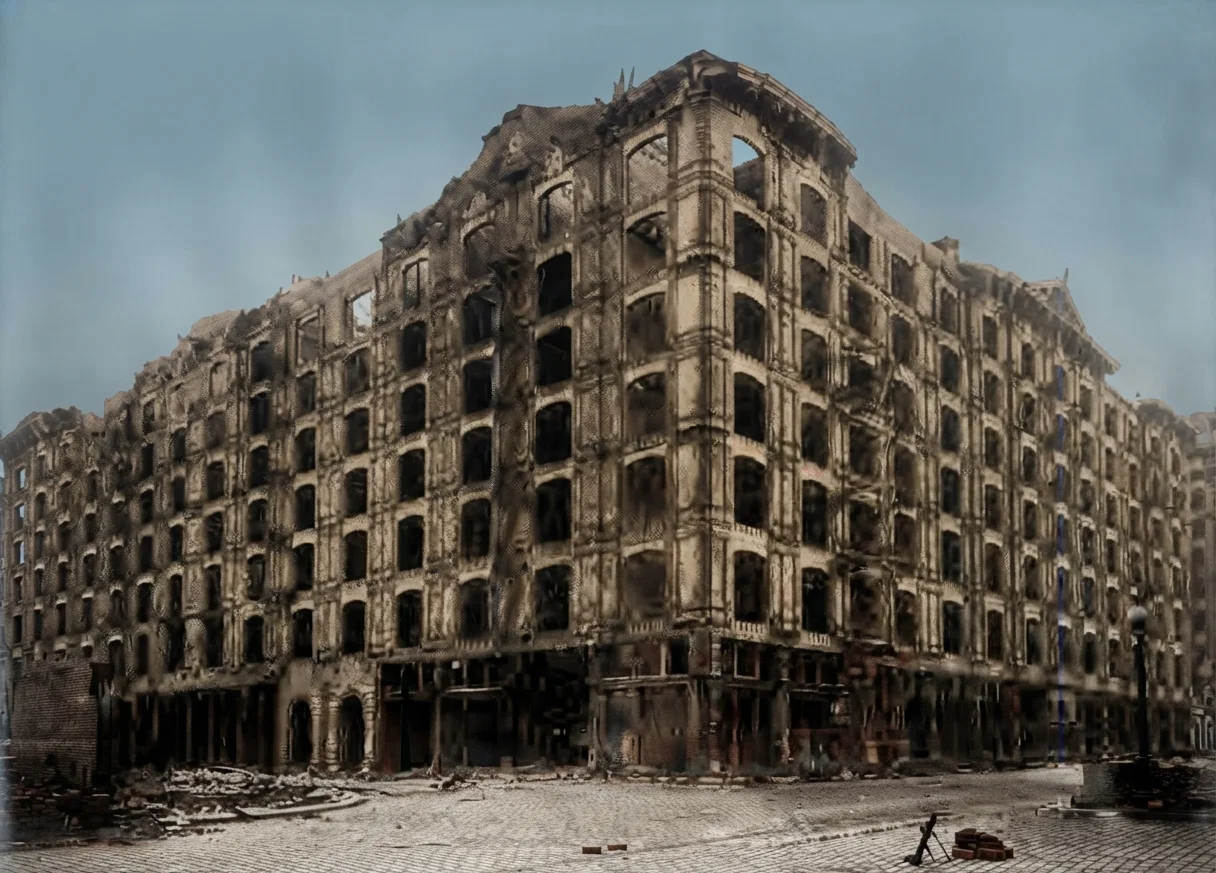
The Palace Hotel, one of the finest hotels in the world. Its register has carried the names of some of the greatest of earth's people who have passed through San Francisco. The building cost over $7,000,000, and over 30,000,000 bricks were used in its construction. Its massive walls, tied by strong bolts in every direction, withstood the earthquake shock and verified the words of the builder that "It could be shaken up, but could not be shaken down." But the fire destroyed its beauty, and left it a majestic ruin. It will be torn down, and a steel and cement structure built in its place. How uncertain are the grandest palaces of earth.
Year after year men piled block upon block, and column over keystone, riveted steel upon steel, and enfleshed the structures in stone and stucco; high as Babel's tower they builded; beautiful as the Alhambra they embellished; and then traveled to the ends of the earth to laud great San Francisco. But as quickly as a broom in the hands of a servant sweeps the cobwebs from a kitchen, so quickly did the besom of earthquake sweep San Francisco's beauty into her crumpled streets. In that instant the great arteries of her life were broken, and the water that would have saved her from the all-enveloping tongue of flame poured itself out in useless torrents upon the ground.
No one who has not seen it can ever realize what it is; no one who has yet seen it has been able to tell it to any one else so they can realize it. One who has known San Francisco in most of her stages of development said of it, " San Francisco is gone." Another says, " It was not a fire in San Francisco; it was a fire of San Francisco." This burning metropolis sent up a pillar of cloud by day, and a pillar of fire by night which could be seen for a hundred miles. One said, " I supposed, of course, that the matter was exaggerated." He looked upon the wreck and declared there were no words in the language by which an exaggeration could be produced. He had seen some of the ruins of ancient cities; but they could all be bundled into one corner of San Francisco's ruin and be lost. The areas covered by the great fires of Chicago, Boston, and Baltimore, would cover scarce one-half of the ash heaps of San Francisco.
In the calamity that has come to this fair country, man may learn, if he will, the utter worthlessness of human trust in the works of human hands. How many thousands have utterly forgotten God, and been putting their trust in their own powers. Souls are infinitely more valuable than dollars or buildings. I will not say that God sent the earthquake or the fire; but we do know He permitted them to come. Knowing that, it should be enough to show to every human being that there are lessons in them for him to take most seriously to heart. God does not willingly afflict, or permit to be afflicted, the children of men. He " is long-suffering to usward, not willing that any should perish."
Soul, have you learned the lesson? Have you allowed that earthquake to shake the tendrils of your heart free from the crumbling ruins of the false hopes to which they clung? Have you let those fires burn away every rootlet that has bound you to the world and the things of the world? If not, will it be necessary for a closer lesson to come? When God's " judgments are in the earth, the inhabitants of the world will learn righteousness." Are we learning it without the judgments? If so, well and good. If not, then let us not complain if God permits the judgments to come.
A day is coming wherein the " cities of the nations" shall fall; a day when not cities merely, but the very heavens, shall be on fire, and the elements " melt with fervent heat, the earth also, and the works that are therein shall be burned up." God has provided a refuge for His children in the days of these calamities. The child of God need not be fearful. Mountains may rise or fall; cities may shake down or burn up; all the elements may be at war; pestilence and famine may spread their devastating blight. But in it all, and through it all, the true child of God may rest and trust in the arms of the Almighty. Peace in the midst of turmoil; protection in the midst of calamity; trust in the midst of terrors—these are the portion of every soul that lives upon the Word of God, walks in His footsteps, and yields the heart and hand to His service.
S.
Good Tidings to Zion
"O THOU that tellest good tidings to Zion, get thee up on a high mountain; O thou that tellest good tidings to Jerusalem, lift up thy voice with strength; lift it up, be not afraid; say unto the cities of Judah, Behold, your God! Behold, the Lord Jehovah will come as a mighty one, and His arm will rule for Him. Behold, His reward is with Him, and His recompense before Him. He will feed His flock like a shepherd, He will gather the lambs in His arm, and carry them in His bosom, and will gently lead those that have their young." Isa. 40:9-11.