Your ShelfYour Projects

Signs of the Times, Vol. 32, No. 25.

EARTHQUAKE and FIRE SPECIAL
Earlier text: The Origin of the Earthquake

Awaiting the Committee's Report

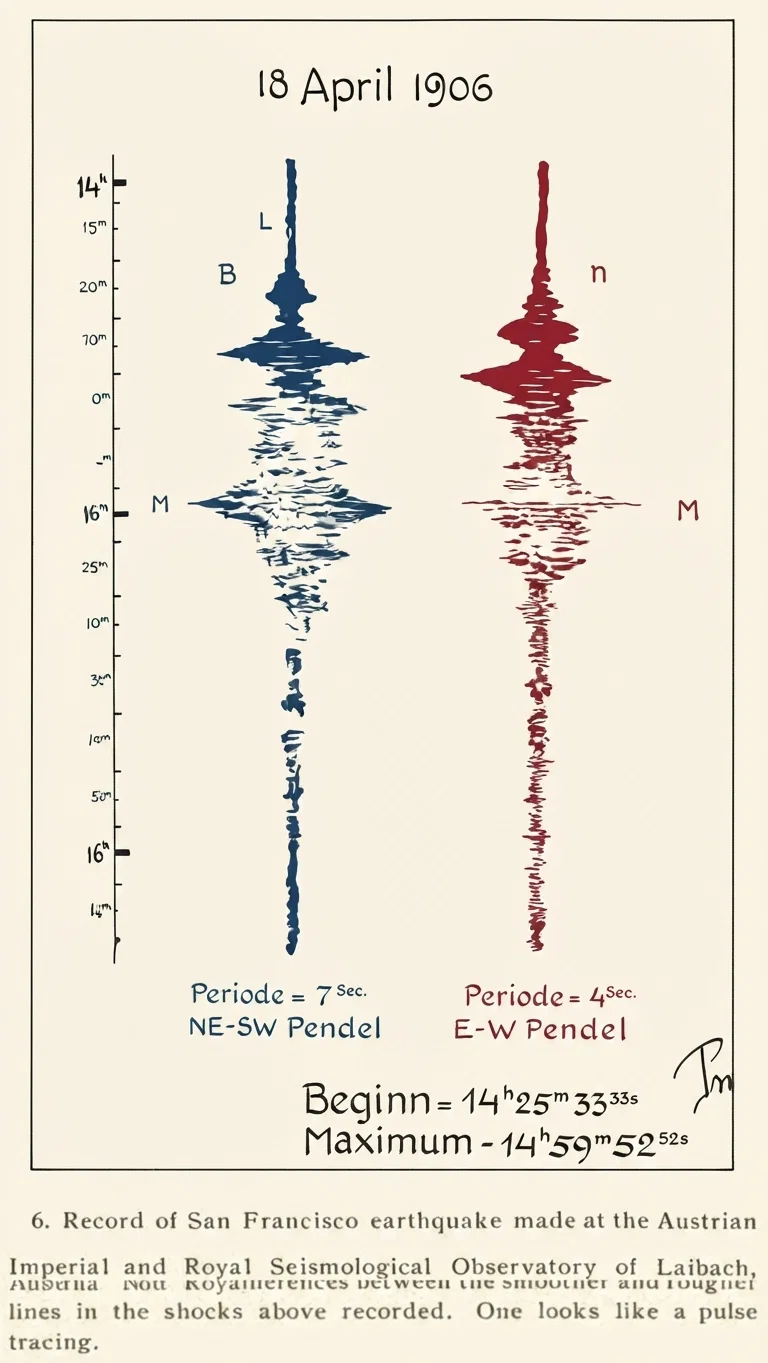
6. Record of San Francisco earthquake made at the Austrian Imperial and Royal Seismological Observatory of Laibach, Austria. Note the differences between the smoother and rougher lines in the shocks above recorded. One looks like a pulse tracing.
Branner, Stanford University; Prof. A. O. Leuschner and Prof. Geo. Davidson, of the University of California; Prof. Charles Burckhalter, of the Chabot Observatory, Oakland; William Wallace Campbell, director of the Lick Observatory, Mt. Hamilton.
No definite report has been received from the committee as yet. They have asked for salient facts from any cognizant of them.

"LET NOT YOUR HEART BE TROUBLED"

Heralds of the Morning

"Among the most expressive and beautiful words of the English language, is the noble, tender term, 'Home.' Among the sweetest songs ever sung by loving lips, is 'Home, Sweet Home,' given to a needy world by one who never had a home, yet whose heart ever cried out for what the world never gave him. His very homelessness voiced sweeter and deeper the longing of every true human heart."—Extract from Preface of "Heralds of the Morning."
This book is written with the "great home coming" in view. It shows the relation of current events to the "home over there." Necessarily it treats upon some of the discouraging things of this time, but it always does it in a way to show their significance. It teaches us to look upon them as signs of the better day—as heralds of the morning. The following is a partial list of its chapters:
  • The Social Vice
  • Ye Have Heaped Treasure for the Last Days
  • And the Nations Were Angry
  • The Voice of the Elements
  • The Testimony of the Earth
  • Our Refuge and Fortress
It contains nearly four hundred pages and is bound in substantial cloth. Price, post-paid, $1.75.

Great Controversy

This volume presents the most wonderful and intensely interesting history that has ever been written of the great conflict between Christianity and the Powers of Darkness, as illustrated in the lives of Christian martyrs and reformers on the one hand, and wicked men and persecuting powers on the other.
Beginning with our Lord's great prophecy given while viewing Jerusalem from the Mount of Olives, this book outlines the whole history of the dispensation down to the time spoken of in the closing paragraph when,—
"The great controversy is ended. Sin and sinners are no more. The entire universe is clean. One pulse of harmony and gladness beats through the vast creation. From Him who created all, flow life and light and gladness, throughout the realms of illimitable space. From the minutest atom to the greatest world, all things, animate and inanimate, in their unshadowed beauty and perfect joy, declare that God is Love."
In the Preface we read:
"In the great final conflict, Satan will employ the same policy, manifest the same spirit, and work for the same end, as in all preceding ages. That which has been will be, except that the coming struggle will be marked with a terrible intensity such as the world has never witnessed."
With these facts in mind, the author has selected such events in the history of the struggle of the church as foreshadow the conflict just before it, and has so treated them as to make their meaning clear to all. The chapters devoted entirely to the continuation and culmination of this conflict are as follows:
  • The Impending Conflict
  • The Final Warning
  • The Time of Trouble
  • God's People Delivered
  • The Desolation of the Earth
  • The Great Controversy Ended
These chapters particularly should be read by all interested in the final triumph of right principles. The work contains more than 700 pages, and is strongly bound in cloth at $2.50. Also published in Danish, Swedish, German, and French.
These and many other books treating upon the great questions of the day may be obtained from regularly authorized agents, or from— The PACIFIC PRESS PUBLISHING CO., Mountain View, California Kansas City, Mo., 1109 E. 12th St. Portland, Oregon, 285 Salmon St. REVIEW AND HERALD PUBLISHING CO., Takoma Park Station, Washington, D.C. Battle Creek, Michigan SOUTHERN PUBLISHING ASSOCIATION, 24th Avenue North, Nashville, Tennessee Fort Worth, Texas

Two Books with a Message of Comfort and Cheer

YOU have seen the increase of destructive storms, earthquakes, tidal waves, and fires, and wondered what it all means. Has it occurred to you that these things may be "Handwritings on the Wall,"—Messages from God to you; not messages of death and destruction, but messages which, if heeded, will bring comfort and cheer and never-ending life? The books described on this page will help you to recognize these messages and to interpret them as well. They will richly repay a careful reading.

San Francisco’s Great Fire and Earthquake
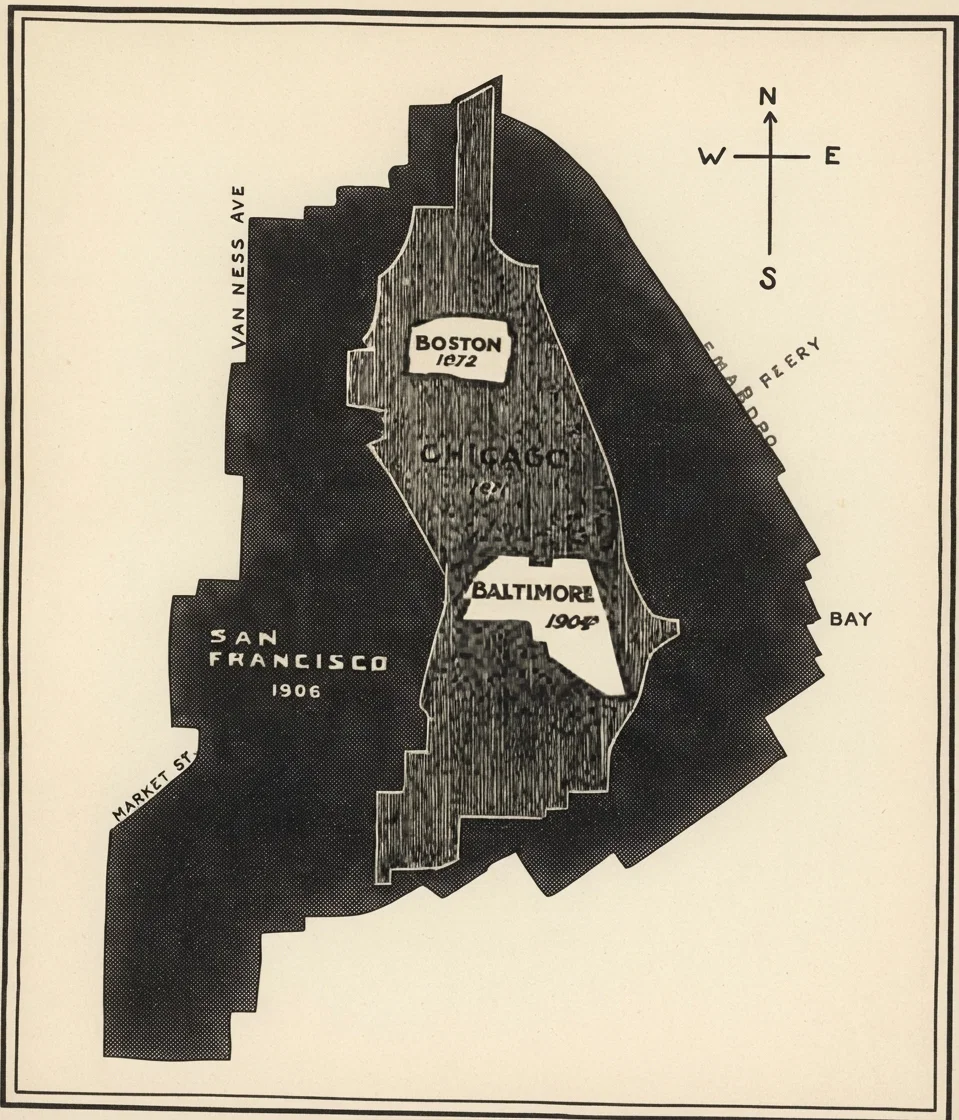
The comparative diagram shows most graphically how San Francisco's great fire overshadows the other great fires of the country. Its area is more than twice as great as Chicago's, Boston's, and Baltimore's combined. Only by an eye witness can its awful devastation be at all appreciated.
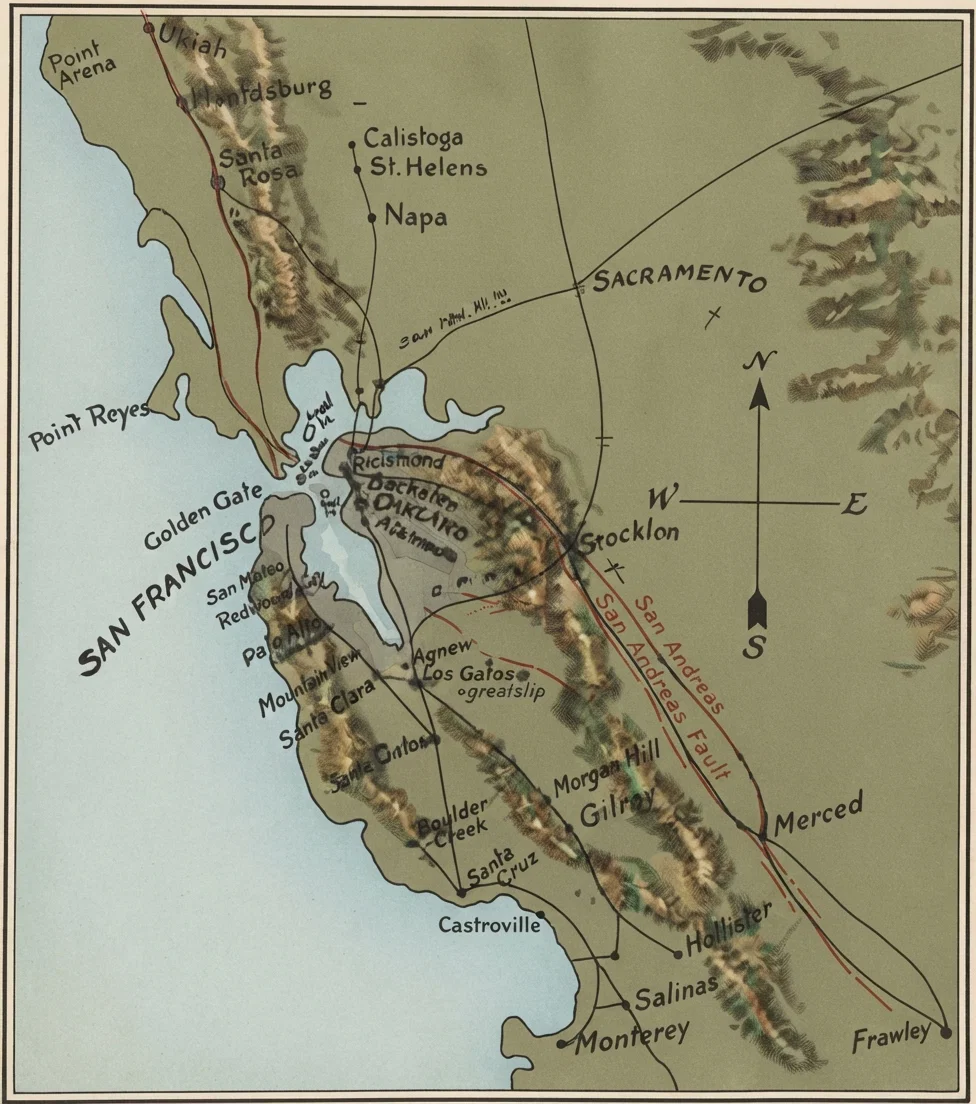
The map shows a strip of California about 200 miles from north to south. The "fault" in the earth's crust, where the great "slip" took place runs in almost a direct line from San Juan in the south, near Salinas, to Point Arena in the north. Along this line many breaks and sinks and elevations occurred. The great quake extended in its effects both north and south of this map, but not seriously. Los Angeles scarcely felt it, yet Frawley, a little town 100 miles south of Los Angeles, was greatly damaged.
COMPARATIVE AREAS OF AMERICA'S GREAT FIRES
EARTHQUAKE DISTRICT FROM UKIAH ON THE NORTH TO SALINAS ON THE SOUTH A DISTANCE OF 200 MILES
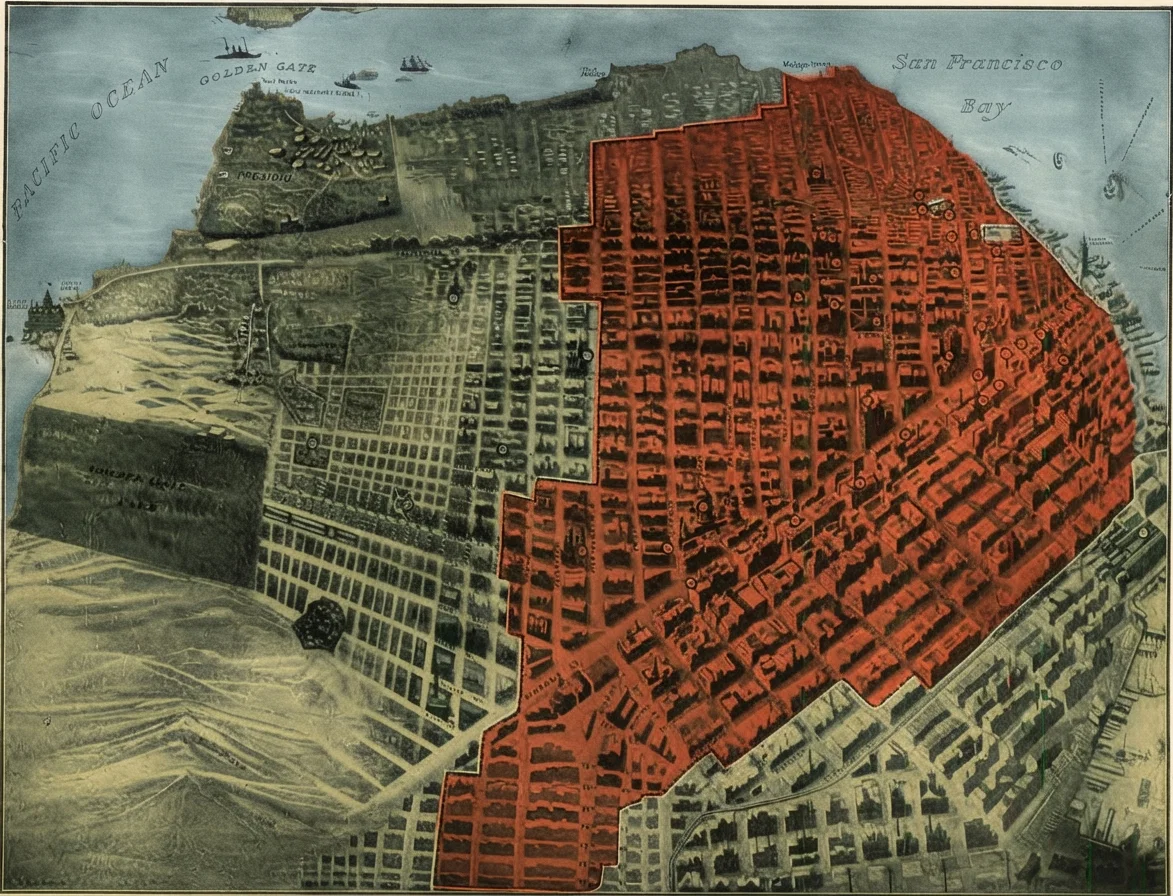
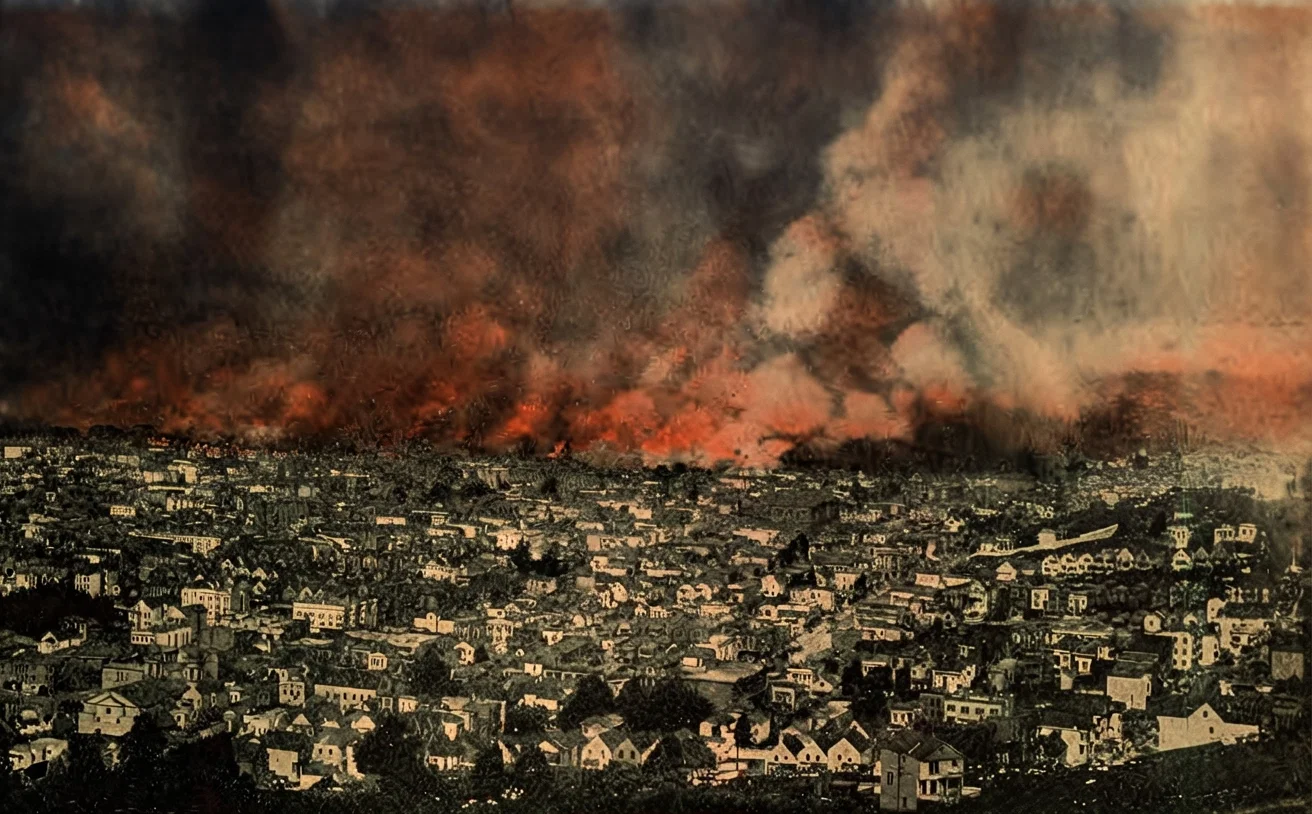
The tint indicates the portion of San Francisco that was destroyed by fire. In this district there are five little unburned oases in the midst of the general devastation. The ruined region includes practically all that was known as San Francisco,—all the business, financial, amusement, and most of the residence sections. There remains little outside of it but scattered dwellings, isolated manufacturing plants, and open spaces. The burned district is a solid bulk over four miles long and two miles wide. The value of the property destroyed within this district is now placed at $350,000,000. The insurance on this amounts to about $175,000,000. The principal buildings and landmarks of the city were: (1) City Hall; (2) Post-office; (3) U. S. Mint, saved; (4) Grand Opera House; (5) Call Building; (6) Mutual Savings Bank; (7) Chronicle Building; (8) Flood Building; (9) Examiner Building; (10) Palace Hotel; (11) Grand Hotel; (12) Merchants' Exchange; (13) Hall of Justice; (14) Portsmouth Square; (15) Chinatown; (16) Union Square; (17) St. Francis Hotel; (18) Bush Street Synagogue; (19) Mark Hopkins Institute; (20) Fairmont Hotel; (21) Southern Pacific R. R. Station; (22) St. Ignatius Church; (23) St. Mary's Cathedral; (24) Majestic Theater; (25) Mechanic's Pavilion; (26) Jefferson Square; (27) Masonic Cemetery; (28) Alamo Square; (29) St. Patrick's Cathedral; (30) Russian Church; (31) St. Dominick's Church; (32) Telegraph Hill; (33) Wells Fargo Building; (34) Unburned district around Telegraph Hill; (35) Olympic Club; (36) California Theater, where Fire Chief Sullivan was killed; (37) The Emporium, the largest department store in the city.
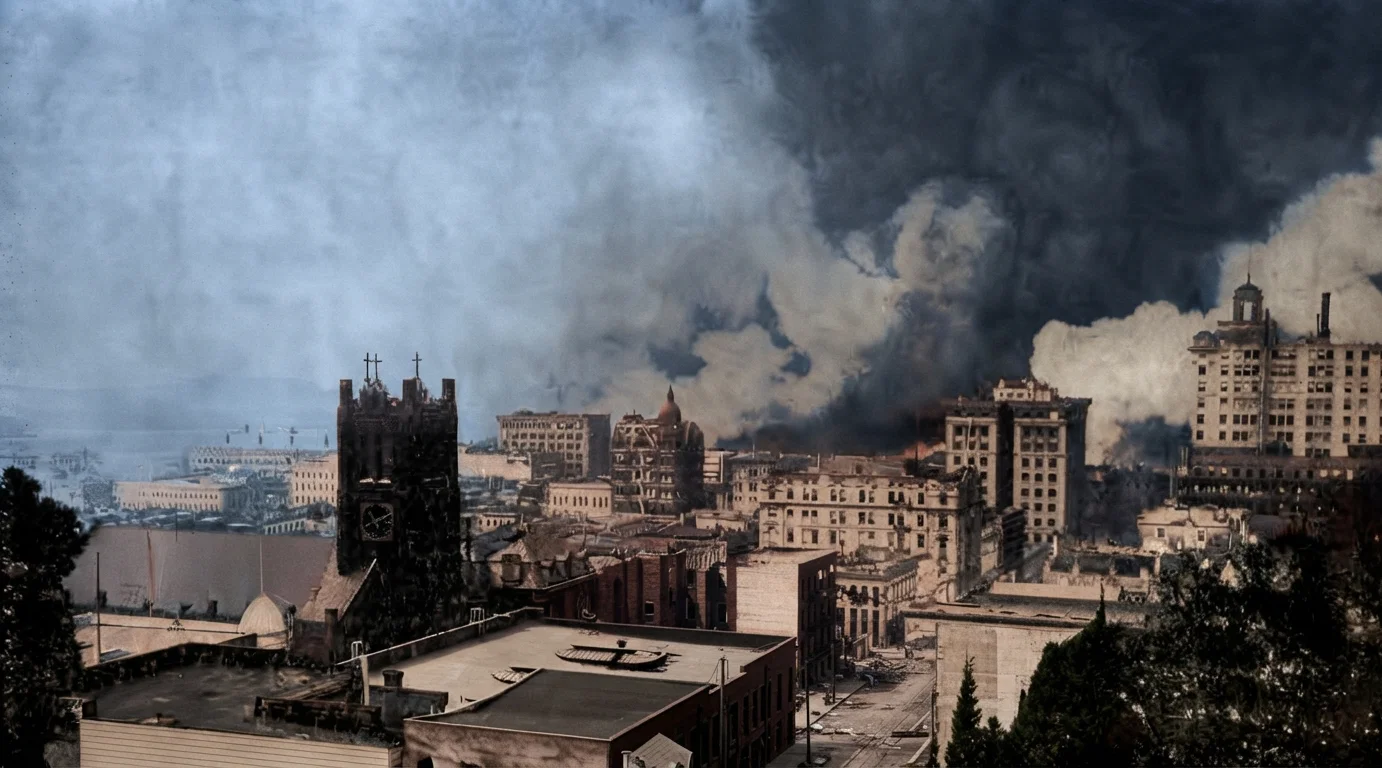
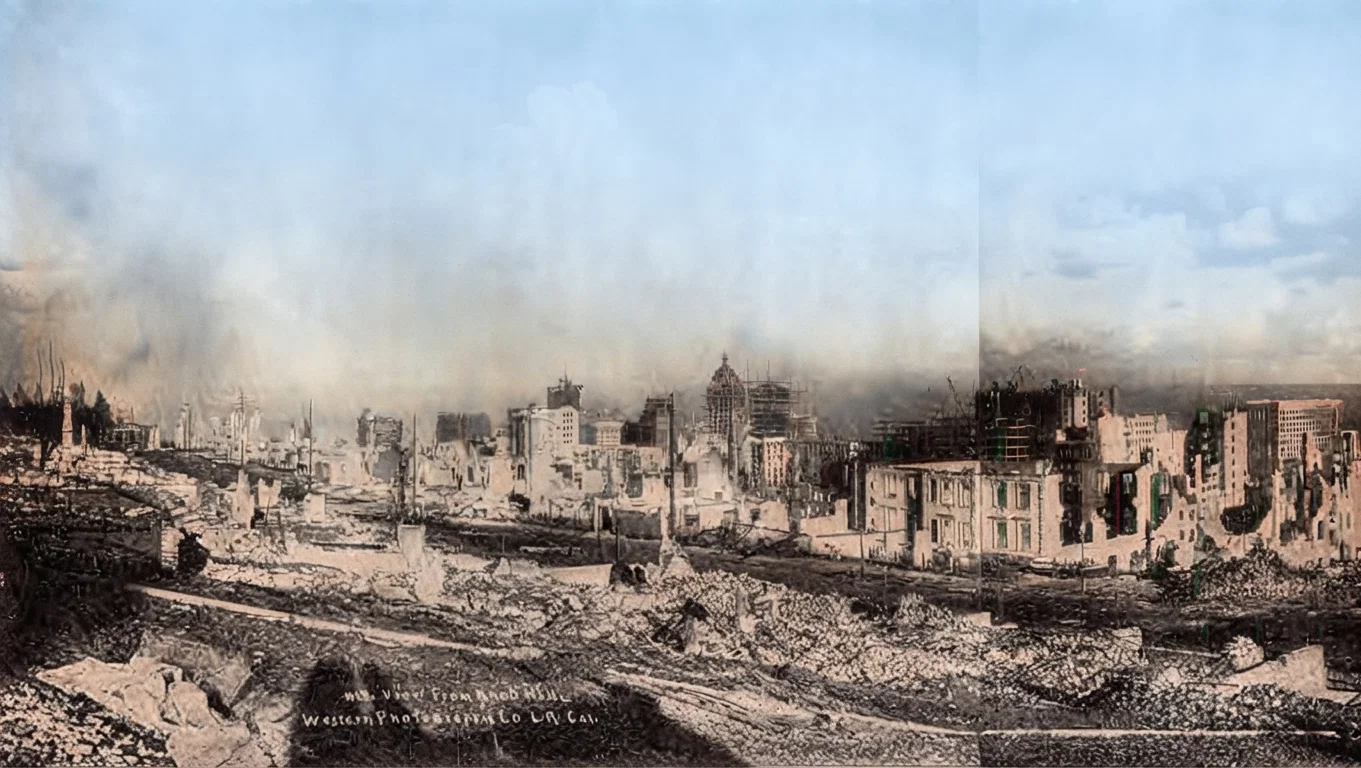
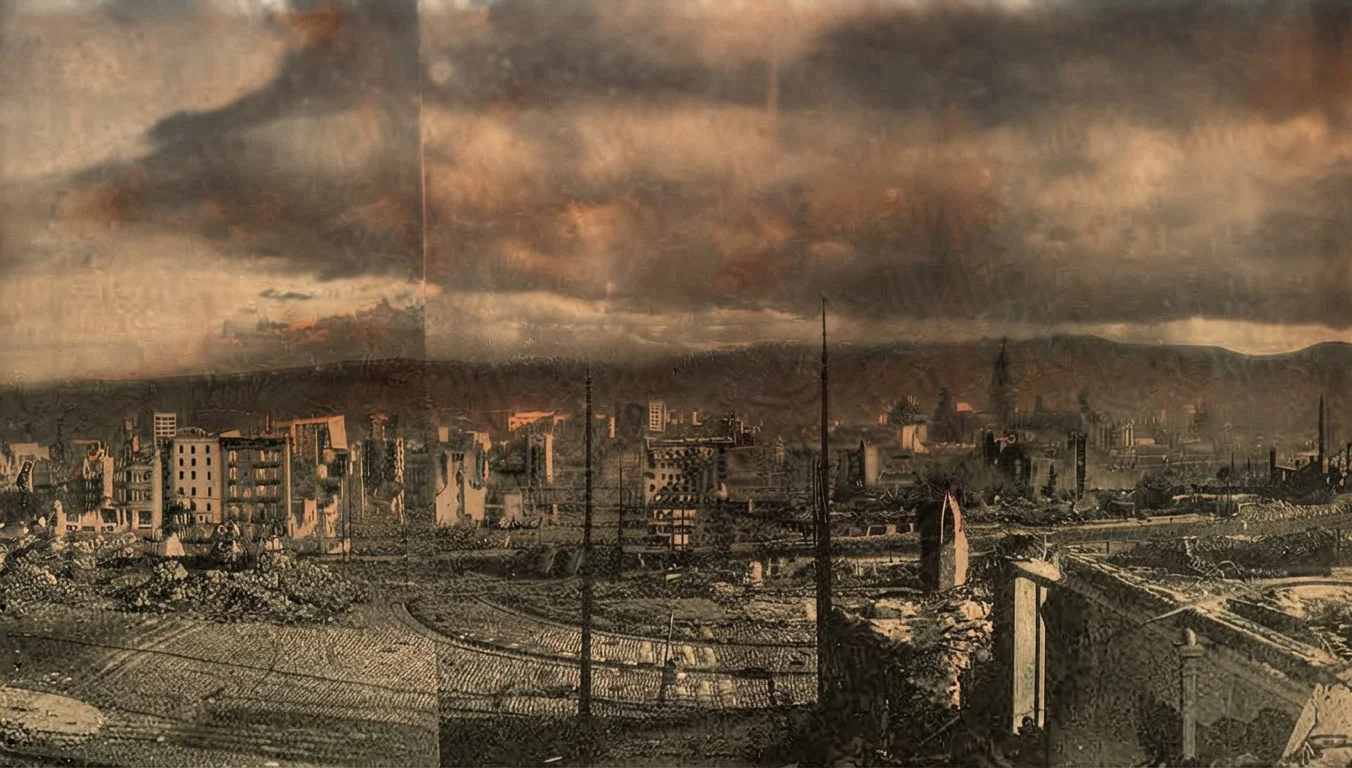
Looking down California Street toward the Ferries from Nob Hill, April 18. The dark clock tower in the foreground is that of St. Mary's Church. The clock was thrown down by the earthquake, but the inscription still remains, "Son, observe the time, and fly from evil." Ecclesiasticus 4:20. The square building beyond with the dome is the Pacific Mutual. The high double structure is the Kohl (Hayward) Building; the one at the right, the Merchants' Exchange.
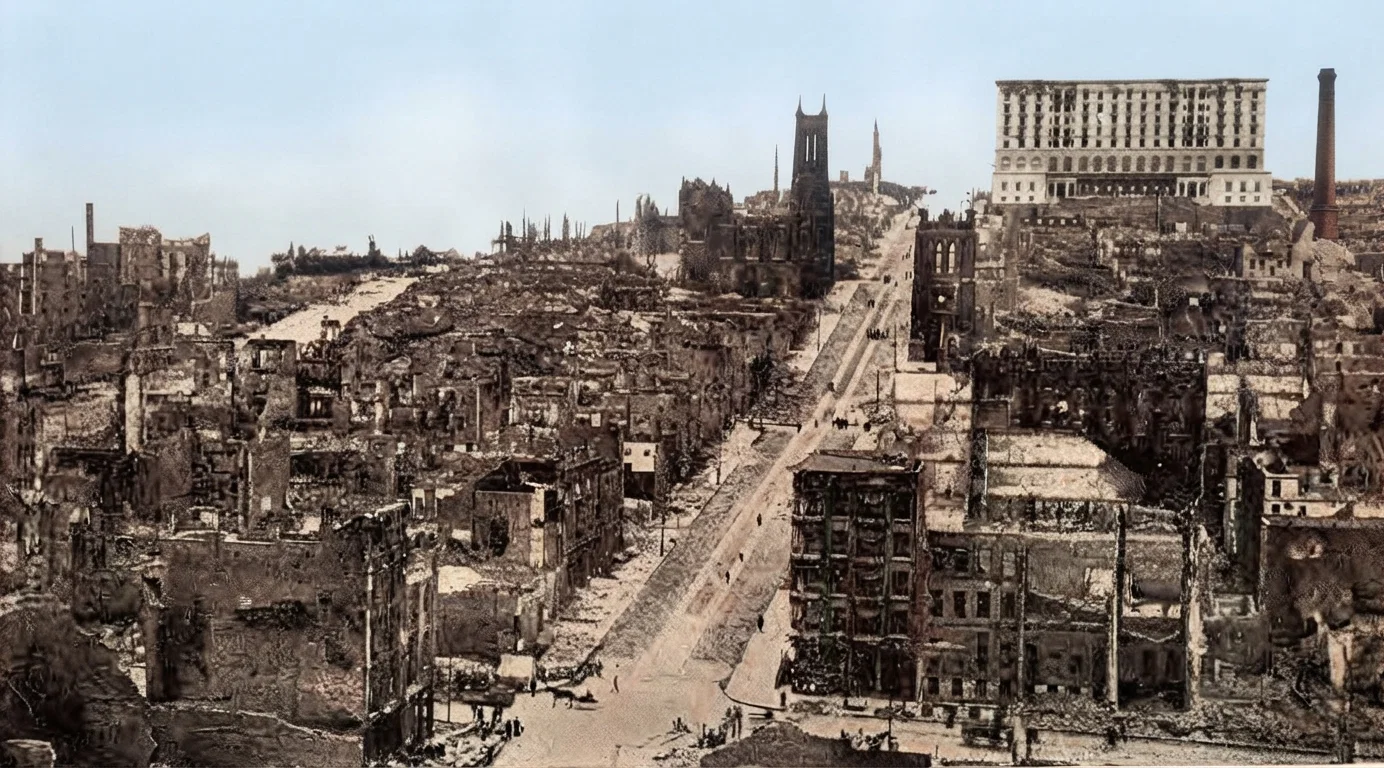
A fine view of the ruins looking from the Kohl Building up California Street to Nob Hill. The large square building on the top of the hill is the Fairmont Hotel. Injured little by the earthquake, but all the woodwork in it was consumed by the fire. On the other side of the street farther up the hill is the remains of a large Episcopal Church, while one tall chimney nearly opposite the Fairmont Hotel is all that is left of the Hopkins Art Institute, with many of its priceless treasures of art. Many were removed to the University at Berkeley, but a great many of them also perished.
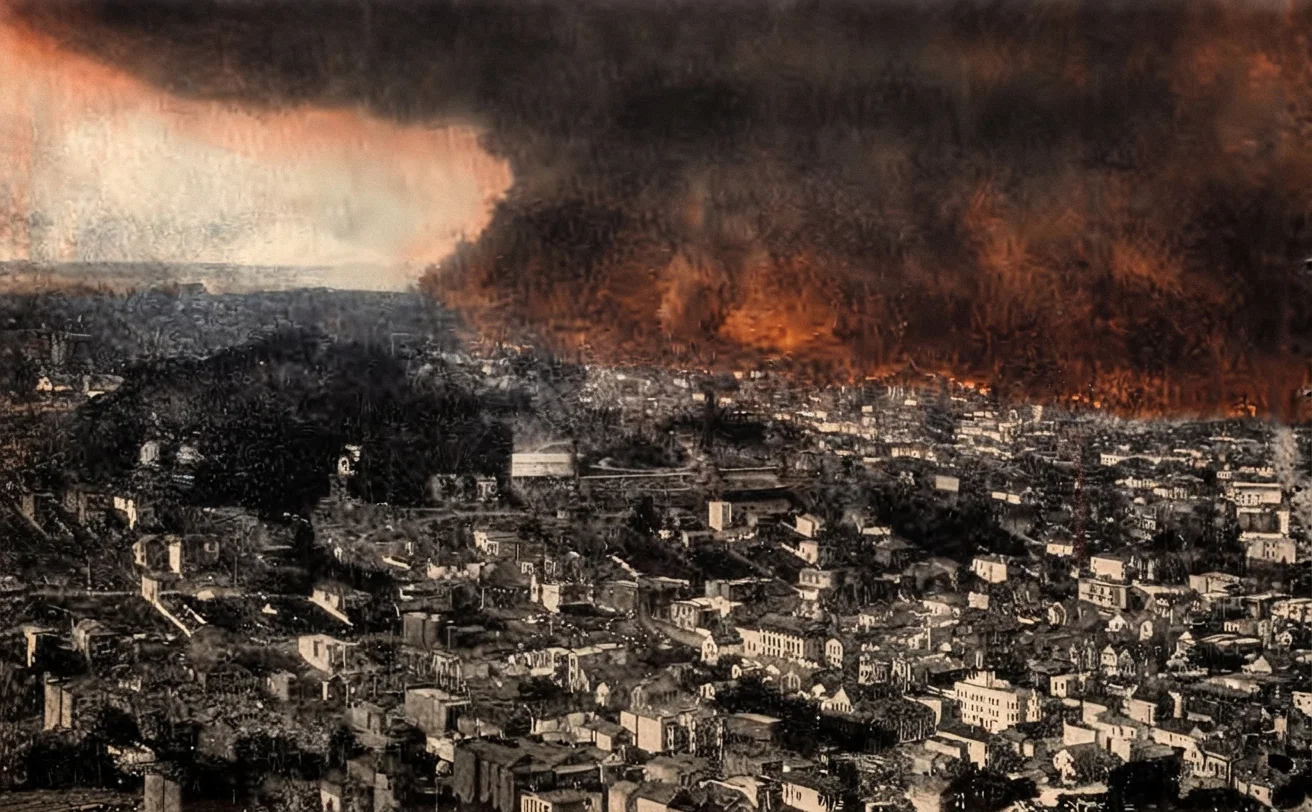
No 12. View From Knob Hill. Western Photographic Co L.A. Cal.
Copyright 1906 by H. S. Hooper, S. F. Used by Permission
tables, meats, etc., in the Economy way—Note the wide mouth—how easy it is to put your hand in and thoroughly clean the jar. No rough seams inside or out to catch lint, chip into food or

You have reached the end of this edition.

Signs of the Times · Jun 27, 1906