IN reply to your inquiry, I will give you an epitome of the view of many of God's faithful witnesses as to the signs of the times, in which I profoundly concur.
There are two great masterly causes for the present defection in the spiritual life of the church, and the decrease of the conversions:—
1. The destructive criticism which impairs and undermines faith, "the mother grace," in clergy and laity.
2. Our splendid, intellectual, materialistic, and secular civilization bewitches the people with a craze of money-making, worldly pleasure, and monumental egotism. Christ is crucified between two thieves, business and pleasure. God shows us the remedy: believe God, and come out from the world.
From these two roots crop out some seven off-shoots, or manifestations:—
1. The neglect of home religion and devotional meetings, to counteract the outside influence of worldliness and secular education.
2. The frenzy of pleasure in worldly amusements and the functions of hypocritical and hollow-hearted society. "Society" is now doing more to injure the spiritual life of our city churches than the saloons.
3. "The amusement heresy and cooking-stove apostasy" in the churches, opening a wide door for fellowship with the world in the merchandising, feasting, and fun. The less piety a church has, the more oysters, ice-cream, and fun it takes to run it, and the faster it runs from God.
4. The general and unprecedented prevalence of novel-reading among church-members and Sunday-school children, and the rehashing of them even in the pulpit.
5. The multiplication of special days which simply create and nourish the love of novelties outside of the Gospel, and which belong to a corrupted or a chromo Christianity.
6. The craze of organization in the church, added to outside lodges, which cumbers and confuses the church with the clatter of unblest machinery, promotes worldly formality and the clannishness of classes rather than the catholicity of Christianity.
7. Last, but not least, the secular, sensational, and cowardly preaching of the day, which changes the emphasis from eternity to time.
The near future will witness a separation. Christ will soon call His people out, either perpendicularly by His coming, or horizontally by secession.
Freight Train Wreck at Keswick
Two MEN were killed and three severely injured in a freight-train wreck at Keswick, Cal., November 4.
News of the World
PRESIDENT KRUGER arrived in Marseilles, France, on November 22, and was accorded a most enthusiastic reception. Thousands of persons had gathered to welcome the Boer chief. A cordial reception was also given Mr. Kruger on his arrival in Paris on November 24. President Loubet, of France, gave Mr. Kruger an official reception at the Hall of Embassadors, and later paid him an official visit at the latter's hotel. All along the route of the Boer president there was an uproarious demonstration. The authorities, fearing an anti-British demonstration and rioting, had taken every precaution to preserve order. Mr. Kruger will visit other European nations for the purpose of arousing sympathy for the Boer cause.
THE census returns show that the State of New York has the enormous population of 7,268,009, a little more than the entire nation had in 1810; that Pennsylvania has a population of 6,301,365; Illinois, 4,821,550; Ohio, 4,157,545; Missouri, 3,107,117, and Texas, 3,048,828. It will thus be seen that any of the States named has a larger population than the original thirteen States had when freed from the mother country. The population of New York is larger than that of Norway and Sweden combined, larger than the Netherlands and Belgium combined, larger than Ireland and Wales combined, and nearly twice as large as Scotland.
IN spite of repeated demands, Turkey has refused to authorize the establishment of an American consulate at Harpoot, altho such authorization has been given for an English consulate at that place. The demands on the Porte for the settlement of indemnity for the missionary outrages are still repeated by United States Charge d'Affairs at Constantinople, but no settlement has been effected.
MANY fierce and destructive storms have been reported during the week from different parts of the world. Disasters are reported from a number of States, in which many persons lost their lives. In the tornado which swept through portions of Tennessee and Mississippi sixty-four deaths are reported, and upwards of a hundred persons were injured.
NEGOTIATIONS are now in progress at Washington for a reciprocity treaty under the Dingley Tariff law between the United States and Russia.
NEAR Juneau, Alaska, recently, prospectors discovered the skeleton of what is believed to be the largest mastodon ever found. The find was made in the icy cañon of Murphy Creek.
THE czar of Russia has been suffering from a severe attack of typhoid fever, which it is believed came very near terminating fatally. Much anxiety was manifest throughout the world.
THE United States monitor Nevada was launched at Bath, Me., on November 24. This vessel, which has a powerful armament for a monitor, is one of four sister ships now being constructed in American yards.
THE Canadian coasting steamer St. Olaf was wrecked on one of the Seven Islands, in the Gulf of St. Lawrence, on November 21, and her crew and passengers, numbering twenty-six in all, were drowned.
THE Chicago corn market was "cornered" November 21 by one of Chicago's grain speculators, and the price in the pit was arbitrarily forced up, netting this one speculator a fortune of several hundred thousand dollars in a few hours.
A REPORT from Venezuela states that there has been heavy fighting in Colombia between the rebels and the government troops, with considerable loss of life. It is reported that the rebels have seized the principal seaports of Colombia, and hold other important places.
THE presidential campaign of 1864 cost $200,000; of 1872, $500,000; of 1884, $1,500,000; of 1892, $2,000,000; of 1896, $4,000,000; of 1900, $5,000,000. All of which means not only legitimate increased expense, but increased political debauchery. It is the rule of plutocracy in a nominal republic.
ABOUT 500 Indians from the White River Reservation are roaming over the hunting-grounds of Colorado, and it is expected that serious trouble will result from the attempt to drive them back to their reservation. The State cavalry has been ordered to hold itself in readiness should trouble occur.
THE Independent Home Rule party in Hawaii carried the election, having a considerable majority over either the Republican or Democratic party. Mr. R. W. Wilcox, a native of the islands, and a former supporter of the royalists, was the successful candidate for a seat in the United States Congress.
THE U. S. Fish Commission steamship Albatross has just returned from a fourteen months' cruise in the South Seas and in Japanese and Alaskan waters. Her officers report finding a great many islands mischarted, some of them being a dozen miles from the published location. This, of course, renders navigation by chart quite dangerous. An interesting scientific fact was determined, that the uniform temperature at the bottom of the ocean is a trifle above 35° Fahrenheit, a little more than 3° above the freezing point.
THERE is a growing disposition in Washington to view with suspicion the professions made by foreign nations regarding their intentions toward China. It is now estimated by correspondents who not long since were expressing the belief that everything was shaping itself in favor of the preservation of the integrity of the empire, that exactly the opposite is likely to occur as the result of the relief and punitive efforts of the powers. Every action of the interested powers since the Boxer outbreak has been leading up to the consummation which has been looked for ever since the time when statesmen and publicists in Europe busied themselves mapping out spheres of influence for their respective countries. That China will be dismembered we may be assured, if for no other reason than that the powers would find themselves unable to avert such a consummation, even tho they were really desirous of preventing it.
San Francisco Chronicle
A SETTLEMENT of the Chinese imbroglio is not yet in sight. Bands of Boxers and armies of the imperial troops are reported in different parts of the Chinese Empire, and the Boxers are said to be furnishing the necessaries of the imperial court. The empress dowager has informed Li Hung Chang and Prince Ching that she will hold them responsible for the establishment of peace with the foreigners. At the same time it is believed in nearly all quarters that the present demands of the powers are such as China can not accept. These demands, which follow closely the propositions outlined some time ago by France, have been agreed to by the representatives of all the powers at Peking, tho it is not known whether the United States will allow itself to be bound by the action of its minister in this matter. The approval of the different powers will be necessary before this preliminary treaty entered into by their representatives can go into effect. A German expedition marching north from Peking, repulsed a Chinese army, raised the German flag on the great Chinese wall, and disarmed a body of Chinese imperial troops. A despatch states that the French have had a severe battle with Boxers south of Pao Ting Fu.
THE DECADENCE OF FRANCE.
OCTOBER 23 the Huguenots of New York City celebrated the revocation of the Edict of Nantes, at the Marble Collegiate Reformed Church at Fifth Avenue and Twenty-ninth Street, and were addressed by Rev. Charles Merle d'Aubigne, who is here as delegate of the Evangelical churches of France to the churches of America. Mr. d'Aubigne pleads for the friendship of the United States for France, and American aid in lifting the French people out of their low conditions. . . . Mr. d'Aubigne spoke of his countrymen with deep discouragement, and a severer judgment could hardly be framed. He said, as reported:—
"The moral standard of France is very low. The people have abandoned the use of light wines, and now that deadly poison, absinthe, is what I might safely call the regular drink of the French people. France now stands next to Belgium in intemperance. There are more than 500,000 public houses, nearly one to every 76 persons. The spread of immorality is appalling. Immoral literature is circulated throughout the country and is obtainable by any one. There are also numerous immoral newspapers freely distributed. The criminality of France is now three times as great as it was 50 years ago, and the immoral influence upon the young is pathetic and astounding."
Speaking of the predominance of the Roman Catholic Church, which owns a tenth of the land property of France, he noted that the faith of the people was very low, and in many districts had no hold whatever. Yet, he said, the Roman Church, while establishing 20 convents a year, is doing little to raise the morals of the people, and the Protestants are the leaders of every movement against vice.
—Springfield Republican.
TRUE BIBLE STUDY.
BLESSED be all the Bible schools which will truly carry out what the Bible Teachers' College, of Mont Clair, N. J., sets forth as one of its distinguishing features:—
"The prominence given to the study of the English Bible. The object is not criticism of the Bible or the study of books about the Bible, but the study of the Bible itself without the restriction or limitation of theory or system of doctrine. The best available helps will be freely used, but only when necessary after work on the Biblical material."
The college has an array of great names with ponderous titles among its instructors. Will the students interpret the Scriptures by these men's opinions, or men's opinions by the Bible? Isa. 40 : 6-8; 1 Peter 1:24, and Jer. 23 : 28, 29 are worthy scriptures to consider in this connection. May God bless the school which teaches untrammeled the Bible.
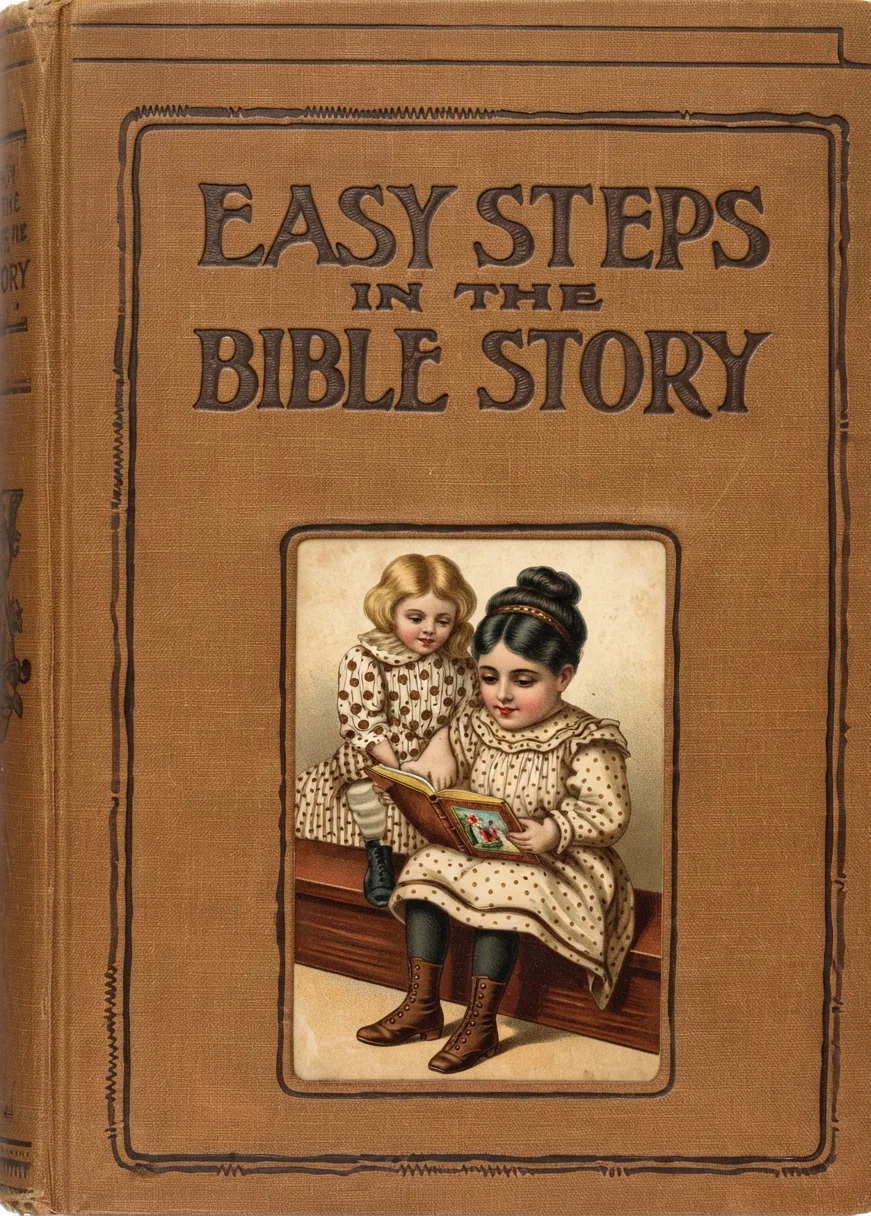
Easy Steps in the Bible Story
By Adelaide Bee Cooper
By ADELAIDE BEE COOPER
Introduction by Elder S. N. Haskell
The early Bible stories never lose their beauty or charm.
The book contains 160 pages, presentation card, frontispiece, table of contents, more than 150 pen drawings illustrating the text, also many full-page illustrations. Beautiful cover design.
AGENTS WANTED
PRICE, IN CLOTH, 50 CENTS
PRICE, IN BOARD, 25 CENTS
Bible Text-Book
By O. A. Johnson
By PROF. O. A. JOHNSON
Is a compendium of forty-nine tersely written Bible subjects.
The book contains 208 pages, table of contents, general index of subjects, five explanatory charts, and is bound in two styles of binding.
PRICE, IN CLOTH, 30 CENTS
PRICE, IN LEATHER, 50 CENTS
REVIEW AND HERALD
Publishing Company
BATTLE CREEK, MICHIGAN
243 S. Boulevard, Atlanta, Georgia
571 Yonge Street, Toronto, Ontario
FAITHFULNESS AND LOVE OF THE HUSBAND.
By Mrs. M. C. DuBois
Nature of True Marriage.
GOD is love; therefore love is born of God. Many, however, who enter into the marriage relation are ignorant of the love that is born of God. They mistake lust for love. True love is unselfish and enduring. It stands by through “better or worse,” in sickness as in health, and is faithful unto death.
Marriage is sacred. It was instituted by God Himself; and all who enter wedlock take upon themselves most solemn obligations, and assume the most tender relations one to the other. But too often husband and wife drift apart when the tests of married life come, and their vows at the marriage altar become a dead letter. Instead of faithfulness “until death doth us part,” a separation takes place on the merest pretense. Indeed, divorces are so frequent nowadays that it is no wonder many are asking, “Is marriage a failure?”
It is my purpose to study this important question from a Bible standpoint, and from God’s Word get a better idea of the true relation that God intended should exist between husband and wife.
Duties of the Husband.
Let us begin with the duties of the husband. When God presented the woman to Adam, He laid upon him obligations that reach every man who enters the marriage state, tho many who repeat these vows are ignorant of their true meaning, and therefore fail to realize the solemn responsibility they are assuming.
In the Bible the husband’s duty is clearly outlined, love being the starting-point. We read:—
“Husbands, love your wives, even as Christ also loved the church, and gave Himself for it. . . . So ought men to love their wives as their own bodies. He that loveth his wife loveth himself. For no man ever yet hated his own flesh; but nourisheth and cherisheth it, even as the Lord the church.” Eph. 5: 25–29.
How many there are who know nothing of the pure, true love here defined! Mark the degree of love,—as Christ “loved the church.” He gave up all, even life.
Men ought to love their wives how much?—“As their own bodies.” Bone of his bones, and flesh of his flesh, you see. Self-love is strong in a man’s heart, but his wife is to be loved as himself. How is it, husbands who may read this article, are you providing amply for your wife, nourishing her as your own body? Are you mindful of the needs, not only of the body, but those of the heart and mind? Are you “encouraging, comforting” her daily? Do you “cherish” with “tenderness and affection” the wife by your side? If not, you are failing in the duty God has enjoined upon you as a husband. Remember, “No man ever yet hated his own flesh, but nourisheth and cherisheth it, even as the Lord the church.”
Again we read, “Husbands, love your wives, and be not bitter against them.” Col. 3: 19. “Bitter” is a little word, but means much. A few of Webster’s definitions are, “sharp; causing pain; cruel; severe; reproachful; sarcastic.” Is it any wonder God warns you against so dark a list? Have you ever spoken sharp words to the wife, or been severe, sarcastic, cruel? Have you ever reproached, when she failed in any line of duty, the one who should be loved as yourself? Remember, “no man ever yet hated his own flesh, but nourisheth and cherisheth it, even as the Lord the church.” A man who would blush with shame to strike his wife with his hand, will often smite her with his tongue, which causes her deeper pain than would a blow from his strong right arm. O husbands, be careful of your words!
Perhaps you say, “God forbid that I should be such a monster.” Well, there is danger of failure on this point, or God would not have inspired such an admonition; for “all Scripture is given by inspiration of God.” Be careful that you study well this portion of His Word, and be sure you fail not in all the duty you owe your wife.
MRS. M. C. DUBOIS.
ALCOHOL; ITS HISTORY, AND ITS EFFECTS UPON SOCIETY.
By W. H. Riley
By W. H. Riley, M.D., Superintendent of Colorado Sanitarium, Boulder, Colo.
[All rights reserved.]
Economic Evils.
THE expenditure of such vast sums of money as go every year for alcoholic drinks is an important item for society to consider in connection with its own welfare and advancement. The investment of capital in useful industries, giving honorable and useful employment to the laboring classes, and increasing the wealth and civilization of the nation, is one of the greatest benefits of society. Plenty of useful, healthful employment brings the great mass of the people, those who form the strength of the nation, up to a higher plane, physically, mentally, and morally. In the absence of idleness, the temptations to crime are fewer, and poverty is not so prevalent. A feeling of harmony grows up between the various classes of society, and a step forward is taken to a better civilization.
The proper use of this capital brings material and permanent results. Not only are the wage-earners enabled to provide for the wants of their families and better their condition in life, but the results of this work remain in a substantial form. Conveniences and sources of pleasure are produced to satisfy the desires of society, and wealth increases. And as the desires of men are satisfied, new desires spring up, and the demand for labor increases.
If, however, a large amount of capital is invested in an enterprise which, altho it may give fair compensation to the employees and return the money invested, yet does not produce something, have some substantial result, society is a loser to the extent of what might have been gained. After all the labor of the workers, the employment of the money, and the use of time, nothing is to be seen as a fruit of this effort. Even tho the work has been honorable, and in no way detrimental to health or morals, yet there is a loss, and this loss affects the community. Such, in a measure, is the liquor traffic. Tho no money is lost, tho the country contains the same amount of gold and silver, yet no great public work or substantial private benefit stands as a product of the employment of this capital. So the money invested in the business is misapplied.
SPENT FOR BOOTS AND SHOES SPENT FOR LIQUOR SPENT FOR CLOTHING
But when we consider what a waste of means there is in the vast sum of one thousand million dollars spent yearly for drinks in our country, we see how society as a whole suffers from this habit. Society suffers to the extent of what this money might do if rightly used, and more. The education of the masses is not what it might be. The discontent of the laboring classes and the tendency toward socialism and anarchy, which at this very time portend much evil for the future, the prevalence of pauperism and crime, are all augmented by the waste of money for alcoholic drinks. True, this is by no means the one cause of these evils, but it augments the enemies of civilization and social progress.
The sober, industrious workman is affected by the drink habits of his fellow-workmen. Upon the wage-earners falls most of the expense for drink, and it affects them as a class. If intemperance were divided equally among them, the evil of which we speak would not be so great. A part of the wage-earners are sober and industrious, and another part are intemperate. Those who are intemperate are frequently incapacitated for work by their habits of dissipation, and when they are on duty their work is, on the average, of a lower grade than that of the sober man. The employer, looking over the general class of workmen, and estimating the value of their labor, will fix a wage which he thinks the poorer workmen will earn, and thus a sober workman’s wages are less than they would be were it not for the intemperate habits of his fellows.11
Again, $100 spent for distilled liquor pay in wages for the manufacture only $1.08, and for materials from other industries but $5.72, and give employment in manufacturing for but .61 day. On the other hand, if $100 be spent for boots and shoes, the sum gives employment for 14 days, pays in wages $22.50, and draws from other industries over $40 worth of materials. It is thus readily seen that if $100 be spent for boots and shoes instead of for liquor, employment is given to 28 men instead of 1, and other industries sell seven times as much material for the manufacture. Thus the money paid for boots and shoes helps the other industries far more than the same amount spent for whisky or beer.
The average of 27 representative industries, such as the manufacture of carpets, furniture, clothing, brick, iron, steel, lumber, leather, food, etc., shows that $100 spent for these commodities gives employment for 12 days, pays in wages $17, and draws upon other industries for $44 worth of material. Hence, if the $1,180,000,000 spent annually for liquor in the United States were spent instead for such staple articles as are mentioned above, it would give constant employment to 725,000 men in the manufacture alone, and would demand from other industries over $500,000,000 in materials, thus giving employment to 250,000 more workmen.
"Three workmen leave the shop Saturday night, each with a ten-dollar bill in his pocket to show for his week's labor. One spends his money to supply his family with boots and shoes; one buys a suit of clothes, and the third 'blows in' his money in a glorious drunk at the saloon. Besides the important difference that two men go home sober, and with their arms full of valuable goods, while one goes home a brute and empty-handed, there is the further difference that the spending of the money has upon other workingmen and the farmer whose labor produced the goods. What this difference is, is shown by the diagrams, each of which represents the value of a ten-dollar bill.
"Of the $10 that went for boots and shoes, tracing it back through the shoe factory and the tannery, it is found that $2.89 went to pay the farmer for his hides, and $2.91 went to the tanners and the shoemakers.
"So with the $10 that went for a suit of clothes, $2.28 paid the farmer for his cotton and his wool, and $2.77 went for wages to the spinner, the weaver, and the tailor. But of the $10 that was spent for beer and whisky, only 96 cents went to the farmer for his grain, and 38 cents to the men whose work produced the liquors.
"The farmer and the wage-earner received $5.80 from the man who spent his money for shoes, $5.05 from the man who spent his $10 for clothes, but only $1.34 from the $10 that went to the saloon. In each case the rest of the $10 went to pay transportation, rent, interest, taxes, profit, and cost of retailing.
"Every time a ten-dollar bill goes to the saloon instead of for shoes or clothing, the farmer and the wage-earner are losing about $4.00. There are about 100,000,000 of these ten-dollar bills squandered in the saloon every year, which means a loss to the farmer and the workingman of $400,000,000, to say nothing of the millions more that would go to the railroad men and the retail clerks, but which is now swallowed up in profits by the liquor men.
"The facts upon which these figures are based are from the census of 1890."—Prohibition Handbook.
(To be continued.)
THE HOME
UPHILL.
By Christina Rossetti
Does the road wind uphill all the way?
Yea, to the very end.
Will the day's journey take the whole long day?
From morn to night, my friend.
But is there for the night a resting-place?
A roof for when the slow, dark hours begin.
May not the darkness hide it from my face?
You can not miss that inn.
Shall I meet other wayfarers at night?
Those who have gone before.
Then must I knock, or call when just in sight?
They will not keep you standing at that door.
Shall I find comfort, travel-sore and weak?
Of labor you shall find the sum.
Will there be beds for me and all who seek?
Yea, beds for all who come.
—Christina Rossetti.
THE SABBATH SCHOOL
LESSON XII.—SABBATH, DECEMBER 22, 1900.
“THE SON ABIDETH EVER.”
Lesson Scripture, Gal. 4:25-31; 5:1, R.V.
25 “This Hagar is Mount Sinai in Arabia, and answereth to the Jerusalem that now is, for she is in bondage with her 26 children. But the Jerusalem that is above is free, which is 27 our mother. For it is written,
Rejoice, thou barren that bearest not;
Break forth and cry, thou that travailest not;
For more are the children of the desolate than of her which hath the husband.
28 “Now we, brethren, as Isaac was, are children of promise. 29 But as then he that was born after the flesh persecuted him 30 that was born after the Spirit, even so it is now. Howbeit what saith the Scripture? Cast out the handmaid and her son; for the son of the handmaid shall not inherit with the 31 son of the freewoman. Wherefore, brethren, we are not 1 children of a handmaid, but of the freewoman. With freedom did Christ set us free; stand fast therefore, and be not entangled again in a yoke of bondage.”
NOTE.—The word “handmaid,” which is used in the revision, is manifestly in contrast with “freewoman”—so that it is the same as “bondmaid” and “bondwoman” in the common text. The Greek word from which it is translated is defined as “a young female slave.”
SUGGESTIVE QUESTIONS.
(1) What does the history of Abraham, Sarah, Hagar, and their children contain? (2) What do the two women stand for? (3) Whence does the one covenant come? (4) To what does it bring forth? (5) Who represents this? (6) To what does it answer? (7) In what condition is the old Jerusalem? (8) What of Jerusalem which is above? (9) What relation does it sustain to true Christians? (10) What is written concerning it? (11) Where is it written? (12) How was Isaac born? (13) What are the “brethren” in Christ? (14) How do the children of the flesh regard the children of the Spirit? (15) Nevertheless, what saith the Scripture? (16) What is to be done to the bondwoman and her son? (17) How sure is this? (18) Why is it to be done? (19) Whose children are those who know God? (20) Since the bondwoman brings forth children to bondage, what must be the condition of the children of the freewoman? (21) What exhortation is therefore given us? (22) In what are we to stand fast? (23) Who has given us this freedom? (24) What are we to guard against?
NOTES.
1. Do NOT forget that Hagar was a slave, and as such could bear children only to bondage. Ishmael was not the heir of Abraham until Isaac was born, becoming a slave afterwards; he was always only a bond-servant. His mother could never bear any other than bond-servants, even tho Abraham himself were their father. Even so the covenant from Sinai which is Hagar and the old Jerusalem, could never bring forth free sons of God. There was never a time when the covenant of Sinai could do more than work condemnation and wrath. From its first moment it was an instrument of death, and all who held to it were in bondage—the slaves of death.
2. VERSE 27 is a quotation from Isa. 54:1. From it we have a key to much of the prophecy of the Old Testament, for we see that all the prophecies concerning the glorious restoration of Jerusalem, and the gathering of her scattered children, refer to the New Jerusalem which cometh down from God out of heaven. Rev. 3:12. Jerusalem is now desolate; none of her children are within her walls, for Christ has not yet come to take them there. Soon the Seed will come to whom the promise was made, and then it will be seen that Jerusalem has a host of children, for they will then come to their inheritance. Then the place which old Jerusalem occupies will be found altogether too small, and a much larger place will have to be prepared. Isa. 49:18-22. From among the Gentiles will her children be gathered. See also Acts 15:14-17.
3. ISAAC was the child of faith, the child of promise, born of the Spirit. If we truly believe, then we are born again, “born from above” (John 3:3, margin), and, like Isaac, are the children of promise, having the New Jerusalem for our mother. We may expect tribulation and persecution from the flesh, even from our own flesh; but that is only for our encouragement. “If ye were of the world, the world would love his own; but because ye are not of the world, but I have chosen you out of the world, therefore the world hateth you.” John 15:19.
4. “BRETHREN, we are not children of the bondwoman, but of the free.” No matter tho we have been bound hitherto, we are sons of the freewoman, because the proclamation of freedom has gone forth to all. The bonds are loosed, but we may not have known it. All we have to do is to arise, shake ourselves from the dust of the dungeon, and loose ourselves from the bands of our neck. Isa. 52:1, 2. Do not stay in slavery after the emancipation has been proclaimed. Liberty has been proclaimed to all the inhabitants of the land, to the sinners of the Jews as well as to the sinners of the Gentiles; to professed Christians, who find a yoke of bondage still on their necks, as well as to the reckless transgressor.
5. WITH freedom Christ did set us free, even with His own freedom. “The glorious liberty of the children of God” is a present reality. The inanimate creation yet groans under the bondage of corruption, and must until the time of restoration, at the coming of the Lord, but it will at that time only be delivered to share the glorious freedom which the sons of God now enjoy. If we are truly sons of God now—and we are if we truly believe—we are joint heirs with Christ, and as free as He is; that is, as free from sin and from all the power of the enemy. This being the case, why should we ever allow ourselves to be entangled in the yoke of bondage?
6. HERE is a serious personal matter for the consideration of each one. Christ said, “If ye continue in My word, then are ye My disciples indeed; and ye shall know the truth, and the truth shall make you free.” John 8:31, 32. He is the truth. John 14:6. “If the Son, therefore, shall make you free, ye shall be free indeed.” John 8:36. Are you free indeed? Do you know your freedom? Are you free from all bad habits and from every form of slavery? Are you master of the world, the flesh, and the devil? Does the devil flee from you at your command? Have you victory over the lust of the flesh, the lust of the eye, and the pride of life? If not, you do not yet know the truth, for the truth makes free, and the freedom is nothing less than that here spoken of. This and nothing less is the freedom that Christ, the Son, the Truth, gives us. Do not complacently rest in the correctness of the doctrine you hold. No one may be able to pick a flaw in it; yet if you have not this freedom, you do not know the truth, much less can you teach it to others. To be thus free is not a hard requirement, but a glorious gift offered freely to all. Take it, and stand fast in it.
Obedience and Safe Rule
"No man doth safely rule but he that hath learned to gladly obey."
Spencerian Steel Pens
Write Well
Once Tried
Wear Long
Always Used
Select a pen suited to your handwriting from 12 different patterns, which will be sent by mail on receipt of 6 cents in postage stamps.
SPENCERIAN PEN CO., 349 Broadway, New York
VIRGINIA HOMES.
Virginia Farmer Subscription
You learn all about Virginia lands, soil, water, climate, resources, products, fruits, berries, mode of cultivation, prices, etc., by reading the Virginia Farmer. Send 10 cents, for three months' subscription, to FARMER CO., Emporia, Va.
Jesus and the Resurrection
Important thoughts upon immortality and the resurrection are clearly presented in this tract, showing our dependence on the Saviour for both. A. G. L. No. 42. 50 cents per 100.