A tract that is calculated to be a help to those who are halting between two opinions. A. G. L. No. 33. 25 cents per 100.
PACIFIC PRESS PUBLISHING CO.
New York City Oakland, Cal. Kansas City, Mo.
FROM INDIA.
By W. A. Spicer
EDITOR OF THE "SIGNS"—Dear Brother: I have received from the Bombay Committee of the Americo-Indian Famine Fund a second remittance from you of $700, sent by you the last of July. I had already placed about $350 of this, from our own funds, with various missions, as I saw that you were still receiving money from your readers, and knew that it would shortly arrive. The balance of the amount will be placed as I see openings where it will be used to the best advantage. I think, however, that quite a proportion of it will go to the Church of England Bhil Mission, where they seem to be using more funds in the actual feeding of the hungry than anywhere else just now. The Bhils are an aboriginal tribe, inhabiting a hilly country, and have been heavy sufferers during the famine. Their nomadic instincts and the difficulty of securing their co-operation have made the task of saving them from starvation in this time exceedingly difficult; so I should judge from the missionary reports.
Orphaned, Deserted Children. They can be saved.
The famine is broken, evidently, over practically the whole famine area, tho the government continues to give relief to millions, and will continue to do so until crops are available again. Most of the missionary effort, as near as I can learn, aside from a few points, as the Bhil country, is now directed to feeding and clothing and caring for the orphaned and widowed, and providing for their future needs, or looking after the village cultivators connected with the missions or within mission spheres. Further contributions sent through your readers I shall endeavor to put in as wisely as I can.
The expression of sympathy in so practical a form as has been manifested in America and Europe in this time must certainly be a testimony to the non-Christian peoples of India. The suffering has been among the lower castes principally, and the outcastes, but they must know that somebody in the world has thought of them aside from the government, which in India is the ma-bap (the mother and father) of the people. If all this help could be widely separated, in the minds of the more intelligent Hindu population, from all idea of making proselytes, the influence would be far greater. But some things are unavoidable in this world. I have regretted to see that some missions are already busy baptizing and making "Christians" of children and widows gathered in from the famine areas. There have been many children gathered from the state poorhouses and camps, and also many widows. In many missions these are made "Christians" very easily. It misleads the intelligent heathen. But it is the way of the world, and I suppose we must not think it any more difficult for the waters of India to make little Hindus Christians than for the waters of America or England to make those upon whom it is sprinkled children of God and inheritors of the kingdom of heaven. The popular perversions of Christianity, however, mixed as they are with ideas borrowed from paganism, look worse in these lands where we find the unadulterated heathenism.
W. A. SPICER.
September 19, 1900.
CAUSES OF FAMINE IN INDIA.
THE causes of famine in India are chiefly these: (1) The lack of rain. Because of this crops fail. The pastures become dry. Man can get neither work nor wages. Want, misery, and starvation of man and beast are sure to follow.
(2) The improvident disposition of the people, common to tropical climates. More than this, the intolerable curse of caste existing renders all efforts of co-operation nugatory. In fact, it precludes all efforts.
(3) Another cause of the famine is the British Government, tho, strange to say, it is to the government's credit. Under the wholly native régime, bloody, intertribal wars and local famines prevented a great increase of population. The people by the thousands were slain by the sword, famine, and pestilence, and of it the world knew but little. But under the British rule the intertribal wars ceased more or less. Efficient measures have been adopted to check famine and pestilence. Life conditions have greatly improved, and the population has arisen under British control from 130,000,000 to nearly 300,000,000 people.
A Problem.
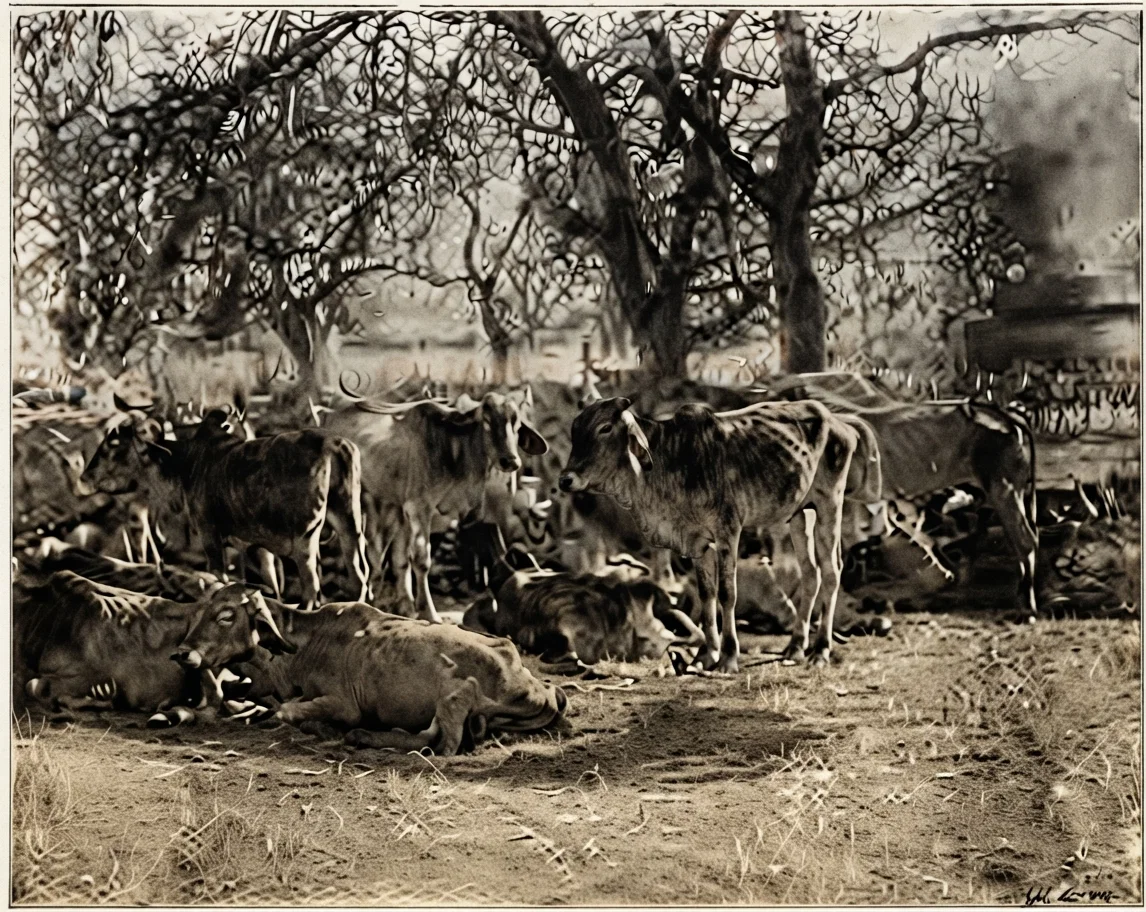
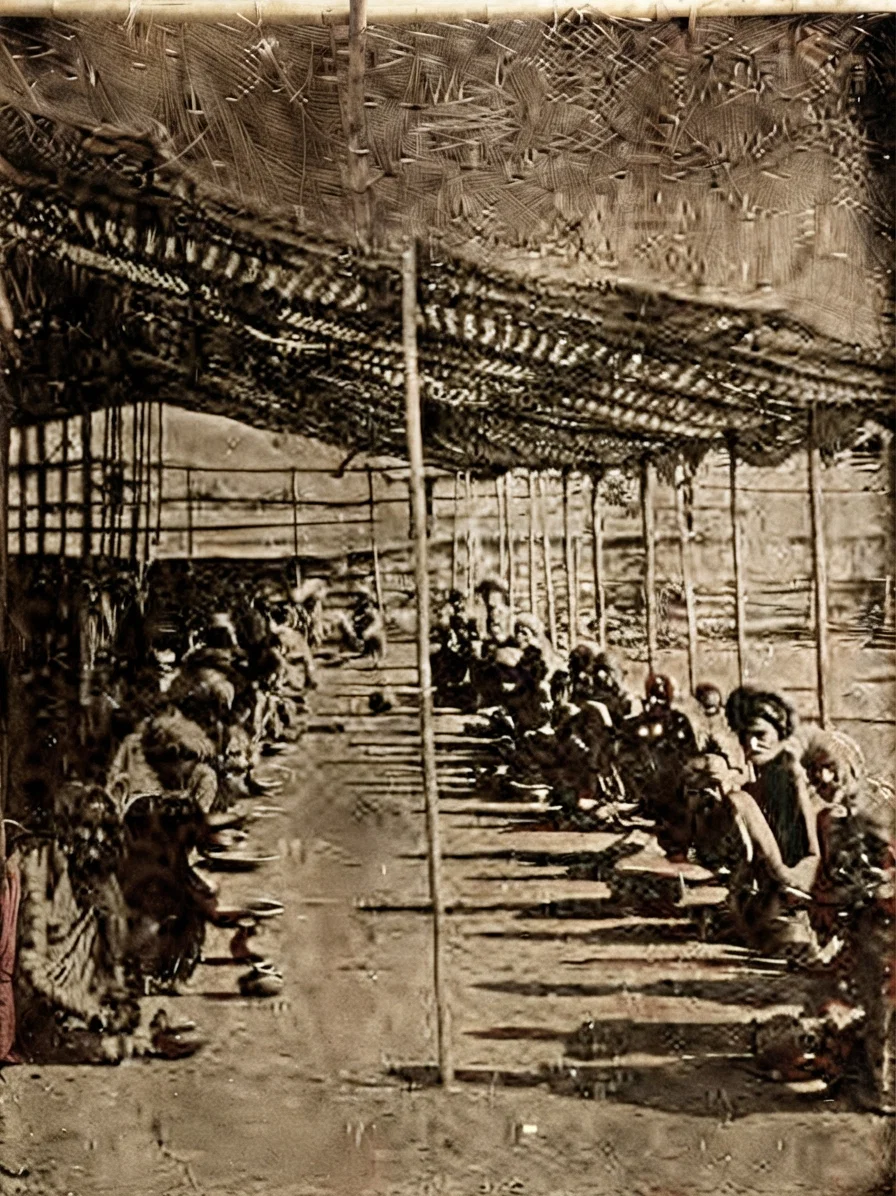
The great question now is, How shall this growth of population be met? How much more may agriculture be developed? What new industrial pursuits can be introduced? Now the government is keeping alive five and one-half millions on relief work. The Famine Relief Committee, who kindly furnish these illustrations from recent photographs, give these statistics:—
Starving Cattle Saved for Plowing.
"The famine area exceeds 450,000 square miles—greater than France and Germany combined, and equal to all New England, New York, New Jersey, Pennsylvania, Ohio, Indiana, Illinois, Michigan, and Wisconsin.
"The population involved numbers over 60,000,000. The number in extreme destitution is from 20,000,000 to 25,000,000, of whom probably 10,000,000 would be in danger of perishing unless aided.
"How far this blessed work shall go on depends largely on those who see this appeal—partly on you."
FOR INDIA'S GREATEST NEED.
By Editor
Funds Now over $2,500.
THROUGH an oversight and press of work in connection with our World's Outlook Number, the publication of the names of those who have contributed to the need of India have been undesignedly omitted. The SIGNS has now forwarded $2,400 through the Committee of One Hundred, New York. Elsewhere is given a letter from Mr. W. A. Spicer, editor of the Oriental Watchman, acknowledging the receipt of the last remittance which reached him. There are on hand of funds acknowledged through the SIGNS OF THE TIMES, $104.57. If we have failed to acknowledge any name, or have wrongly credited too much or too little to any one, we shall be glad to correct. Sometimes we receive letters containing amounts for several funds, and it is not always clear as to just what the writer intends. Sometimes the fund itself is not named. Sometimes it is almost impossible to decipher the letter. Sometimes when the letter is plain, the name might be translated two or three different things. It is not wonderful under such circumstances that mistakes do sometimes occur. The balance on hand will soon be forwarded to Mr. Spicer for India's greatest need as he sees it; whatever may come for India after this year, unless a special call is made, will be turned into the regular foreign mission fund for India. May God bless13those who have given so nobly for starving India.
Previously acknowledged, $2,383.56.
Willing Workers' Soc'y $ 2 82 Mrs. L. A. Sweet . . . $ 1 00
Amanda Mayhugh . . . 1 00 North Pacific Tract
H. Atkins . . . . . 5 00 Society . . . . . 12 31
M. E. Hart . . . . . 5 00 Mrs. C. Crouch . . . 50
A friend . . . . . 3 00 Bessie Runion . . . 09
L. R. Collins . . . 1 00 Norman Runion . . . 04
Mrs. E. J. Harris . . . 2 00 Hamilton, Ontario, S. S. 1 25
C. H. Swab . . . . 10 00 J. K. Lee . . . . . 1 00
E. J. Williams . . . 1 00 R. C. Bostetter . . . 2 00
Daisy L. Kirchline . . 10 00 Winnie Winter . . . 40
Mrs. E. W. Webster . . 25 Mrs. H. Colson . . . 50
A. T. Simons . . . . 25 A. W. Filson . . . . 5 00
Intermediate Division A. G. Wilbur . . . 2 50
Oakland S. S. . . . 2 25 H. P. Gibson . . . 1 50
Mrs. Bertha Hannan . . 50 Chas. Kenny . . . . 4 00
Mrs. M. B. Sherman . . 50 Thos. Darling . . . 5 00
Stephen Daniel . . . 1 00 L. A. Church . . . 2 00
Alice Lawson . . . . 25 A. G. Warren . . . 2 00
L. J. Burgess . . . 8 00 Droin, Oregon . . . 3 00
D. A. Blanchard . . . 1 00 F. M. Brown . . . . 25
Mrs. Blackburn . . . 1 00 Mrs. M. A. Hollister . 1 00
Oakland, Wis., Church . 2 35 Dan. Brown . . . . 1 00
Henry Miller . . . . 1 00 W. I. Harris . . . 1 50
G. H. Moser . . . . 2 00 Mrs. A. Hazelton . . 1 00
Maria E. Weed . . . 10 00 Curtis and Lewis Shingle 1 00
Total to date (November 23) . . . $2,504 57
A Relief Camp. Saved—by two cents a day.
TRUE FREEDOM.
By James Russell Lowell
Is TRUE freedom but to break
Fetters for our own dear sake,
And, with leathern hearts, forget
That we owe mankind a debt?
No; true freedom is to share
All the chains our brothers wear,
And, with heart and hand, to be
Earnest to make others free.
They are slaves who fear to speak
For the fallen and the weak;
They are slaves who will not choose
Hatred, scoffing, and abuse,
Rather than in silence shrink
From the truth they needs must think;
They are slaves who dare not be
In the right with two or three.
—James Russell Lowell.
OUR WORK AND WORKERS.
By Editor
THE Wisconsin Reporter says: "It is reported that about twenty of the 'Oneidas' have decided to obey the truth, and that several of the young people desire to attend one of our schools."
SISTER BROWN, of Seattle, Wash., who sells 200 copies of the Signs weekly, has taken 1,000 copies of the World's Outlook Number. Two other sisters dispose of 200 copies of the Life Boat weekly.
SABBATH, October 27, eight candidates received baptism at Weldon, Iowa. About as many more are reported keeping the Sabbath as the result of meetings held in that vicinity the past summer.
EIGHT persons were baptized and twelve added to the Decatur, Ill., church on October 6. Brother E. A. Curtis, who reports the item for the Recorder, adds that a church school has also been started at that place.
OWING to the previous appointment of the Colorado Conference meeting to convene December 26, the week of prayer in that conference will be held December 18-23, instead of 22-29, as appointed by the General Conference Committee for the entire field.
SISTER LULU WIGHTMAN writes us that she has just finished a series of evangelical meetings in Vine Valley, Yates Co., N. Y., and as a result six souls accepted of the precious truth, making an aggregate of thirty in the Middlesex Valley since she began labor there.
OUR brethren in Illinois have established an Industrial School at Sheridan. Sheridan is a nice little village on the Fox River, about sixty-five miles southwest of Chicago. There are no saloons in the place, and the moral tone of the community is unusually good. A good corps of teachers has been provided for the school. Any one interested should drop a card to H. A. Washburn, Sheridan, Ill., asking for a catalog.
BROTHER H. H. WILCOX reports four persons baptized at South Russell, N. Y., recently.
IN the Dakota Worker, Brother Edward Leoppke reports the baptism of twelve persons and the organization of two Sabbath-schools in North Dakota. He also reports a good interest at Anamoose, in McLean County, and expects to organize a church there in the near future.
FROM the Wisconsin Reporter we learn that on Sabbath, November 3, four persons, all of West Superior, were baptized at Duluth; on October 6 four united with the church at Bethel, and the latter part of the same month four were baptized and united with the church at Grand Rapids.
JUST now California is unusually blessed with the presence of general laborers. In addition to Sister E. G. White and Brother W. C. White, who recently came from Australia, there are Brethren J. N. Loughborough and A. G. Daniells (also from Australia via the East). Brother W. T. Knox, superintendent of General Conference District No. 6, whose headquarters are in this city, is also here at the present time.
11 "And as they heard these things, He added and spake a parable, because He was nigh to Jerusalem, and because they supposed that the kingdom of God was immediately to appear. 12 He said therefore, A certain nobleman went into a far country, to receive for himself a kingdom, and to return. 13 And he called ten servants of his, and gave them ten pounds, 14 and said unto them, Trade ye herewith till I come. But his citizens hated him, and sent an ambassage after him, saying, 15 We will not that this man reign over us. And it came to pass, when he was come back again, having received the kingdom, that he commanded these servants, unto whom he had given the money, to be called to him, that he might know 16 what they had gained by trading. And the first came before him, saying, Lord, thy pound hath made ten pounds more. 17 And he said unto him, Well done, thou good servant; because thou wast found faithful in a very little, have thou 18 authority over ten cities. And the second came, saying, Thy 19 pound, lord, hath made five pounds. And he said unto him 20 also, Be thou also over five cities. And another came, saying, Lord, behold, here is thy pound, which I kept laid up in a 21 napkin; for I feared thee, because thou art an austere man: thou takest up that thou layedst not down, and reapest that 22 thou didst not sow. He saith unto him, Out of thine own mouth will I judge thee, thou wicked servant. Thou knewest that I am an austere man, taking up that I laid not down, 23 and reaping that I did not sow; then wherefore gavest thou not my money into the bank, and I at my coming should 24 have required it with interest? And he said unto them that 25 stood by, Take away from him the pound, and give it unto 26 him that hath the ten pounds. And they said unto him, Lord, he hath ten pounds. I say unto you, that unto every one that hath shall be given; but from him that hath not, even that which he hath shall be taken away from him. 27 Howbeit these mine enemies, which would not that I should reign over them, bring hither, and slay them before me."
NOTE.—Compare with this lesson the parable of the talents, Matt. 25: 14-30. Read also Matt. 13: 12, Luke 8: 18, and commit Matt. 25: 21. This parable was spoken while Jesus was on His last journey to Jerusalem, a few days before the crucifixion.
Golden Text: "Every one of us shall give account of himself to God." Rom. 14: 12.
SUGGESTIVE QUESTIONS.
(1) Before Jesus left the house of Zaccheus, what did He speak to the people? What two reasons are given for speaking this parable at this time? V. 11. Note 1. (2) Whom does the Saviour introduce as the principal figure in the parable? What did this one do? For what purpose did he take the journey? V. 12. Note 2. (3) Before taking his departure, whom did he call to him? What did he give to them? What were they to do with the money? V. 13. (4) How did the citizens of that kingdom feel toward him? What measures did they take to prevent his receiving the kingdom? What did these persons declare? V. 14. (5) After he received his kingdom and returned, what command did he give? What was his purpose in having them called? V. 15. (6) What report did the first of the servants have to bring? V. 16. (7) How was his report received by the master? What was the servant's reward for his faithfulness? (8) What report had the second to bring? V. 18. (9) What was the reward of this one? V. 19. (10) What did another of the servants say when he came to his lord? What had he done with his lord's money? V. 20. (11) What did he offer as an excuse for bringing no increase? V. 21. (12) What did his lord say he would do with him? What did he call him? In judging this servant out of his own mouth, what did the master say the servant knew? V. 22. Note 4. (13) Claiming to know this about his master, what ought he to have done? What would the master then have received? V. 23. (14) What command did the master then give? V. 24. Note 5. (15) What did those say who stood by? V. 25. (16) What did the master then say in reference to the judgment which he had rendered? V. 26. (17) What judgment did he pronounce upon those who would not have him to reign over them? V. 27. Note 6.
NOTES.
1. Because He was nigh to Jerusalem.—Between fifteen and twenty miles from Jerusalem, a distance easily covered in one day's travel. The Messiah was to reign on the throne of David, and Jerusalem was to be the capital; and many who believed in Jesus as the Messiah believed also that He was to begin His reign in His kingdom at that time; to set Himself up as king on His entry into Jerusalem. Therefore He spake this parable to undeceive them; and had they heeded His words in this parable, they would have been fortified against the great disappointment which they suffered at His crucifixion.
2. A certain nobleman.—A man of high rank and noble blood. This would be a fitting description of Christ Himself. The kingdom was not in the far country, but the one who had the right to give it was there. Christ, after His resurrection, went to that far country, heaven. While there he receives His kingdom (the earth renewed and purified, 2 Peter 3:13) at the hands of the Father (Dan. 7:13, 14); and when He returns to the earth, He brings His capital, the New Jerusalem, with Him (Rev. 21: 1, 2). This parable seems to have been founded on facts with which the people of that time were familiar. "Two 'nobles,' Herod the Great and his son Archelaus, had actually gone from Jericho to a far country, even to Rome, for the express purpose of receiving a kingdom from the all-powerful Cæsar."—Cambridge Bible. "Archelaus, on the death of his father, Herod the Great, went to Rome, B.C. 3, to receive from Augustus the same royal dignity, and the Jews sent at the same time a deputation to the emperor, consisting of 500 Jews (according to Josephus), who were supported by 8,000 Roman Jews, asking Augustus to dethrone the cruel family of the Herodians."—Peloubet. Archelaus, on his return from Rome, rewarded those who had been loyal to him by placing them over the different cities of his dominion.
3. An austere man.—The master in this does not admit the charge of the servant, but is taking him on his own grounds, and showing that he is inconsistent with himself. Claiming to know what he did, he should have done differently from what he did. He did not take a wise course at all. If he knew that his master was an austere man, he should, for the sake of his own safety, have acted differently,—put the money at interest, instead of burying it in the ground. The servant who will not use the means intrusted to him to glorify God, should put it in the hands of those who will.
4. Take away from him the pound.—The master is not taking away from the servant anything that belonged to the servant, nor is he giving to the other servant anything that belonged to that servant. He is simply taking his own money away from the one who would not use it properly, and placing it in the hands of one who would use it as the master desired. So from him that has not been faithful, the talent which had been intrusted to him shall be taken away; and the one who had proved faithful to his trust will be given greater trust.
5. These mine enemies.—All who would not have "this man to reign over" them, and this includes every soul on earth who has refused Christ. Upon them will the judgments of God be visited in final, complete destruction (Mal. 4: 1-3), so that there will be nothing left in all the universe of God except that which is in harmony with the rule of Christ. See Rev. 5: 13.
PERIODICALS WANTED.
By Editor
(Please send post-paid.)
CLEAN copies of SIGNS. Address Otis Flum, Stoddard, Neb.
SABBATH tracts and our denominational periodicals. Address Henry Alfred Davis, Chanar, N. W. P., India.
COPIES of special numbers of the SIGNS, especially the World's Harvest Number. Address A. T. Simons, Spartanburg, S. C.
OLD or late copies of SIGNS, Review, Sentinel, Instructor, and Our Little Friend. Address H. C. Winslow, 307 S. Michigan Street, South Bend, Ind.
CLEAN copies of tracts and late periodicals; also Quarter Centennial and World's Harvest Numbers of the SIGNS. Address Mrs. R. M. Barton, Station B, Los Angeles, Cal.
A GOOD BEGINNING FOR 1901
By Editor
Will be to commence the correspondence work connected with the Medical Missionary Training School. Lessons are sent weekly to students unable to go to one of our sanitariums. We shall organize a new class in January, and will be glad to hear at once from those interested. Send for descriptive circular, giving full particulars. Address Correspondence Department Medical Missionary Training School, Battle Creek, Mich.