The Youth’s Instructor, Vol. 47, No. 34.

THE MAN WITH THE HOE

The Youth’s Instructor

Aug 24, 1899

Review and Herald Publishing Company · Battle Creek, Mich. · Aug 24, 1899

THE MAN WITH THE HOE.
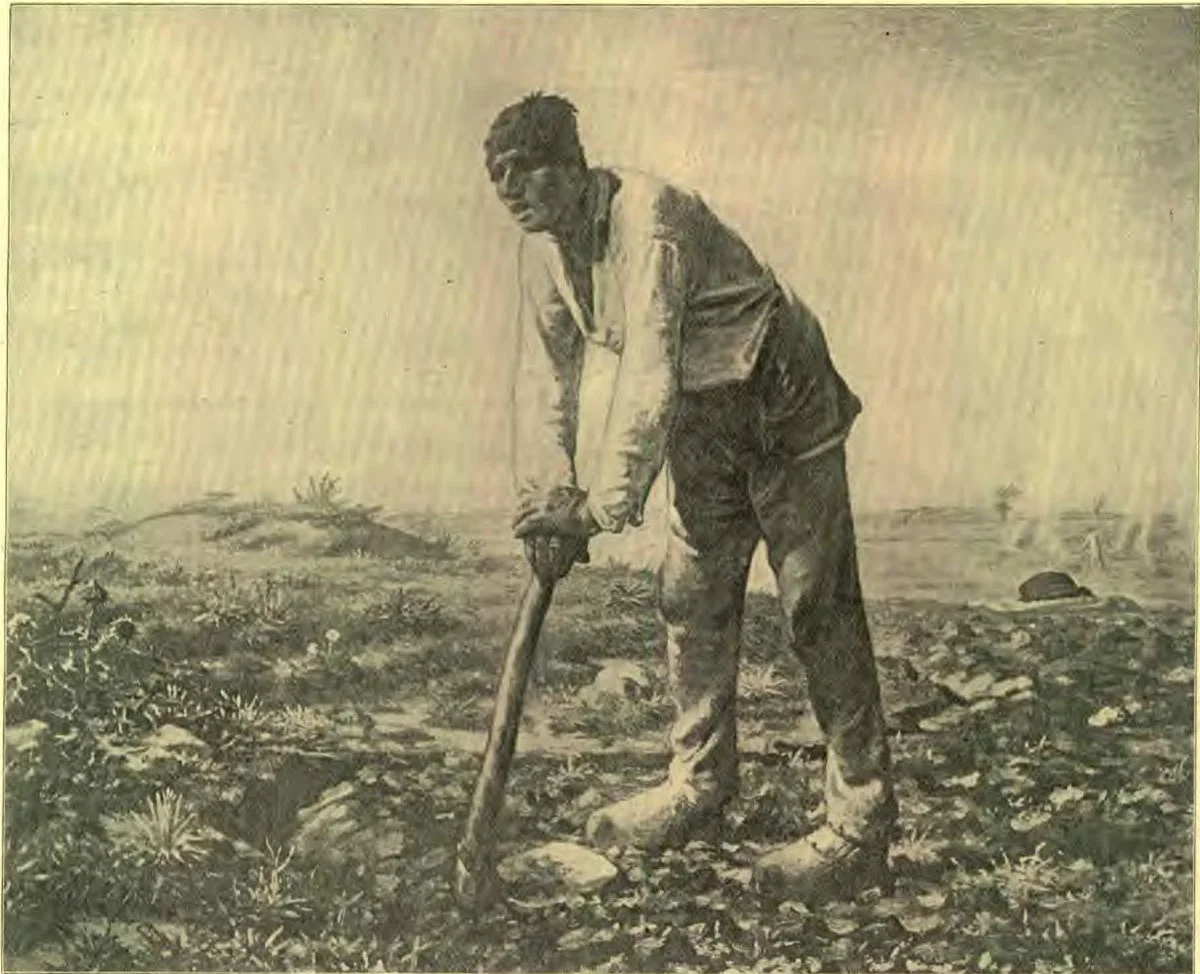
The following poem by Prof. Edwin Markham, of the University of California, has attracted a great deal of attention, because of the terrible question which it raises, and which a greedy world does not like to face:—
THE MAN WITH THE HOE.
Bowed by the weight of centuries, he leans Upon his hoe and gazes on the ground, The emptiness of ages in his face, And on his back the burden of the world.
Who made him dead to rapture and despair, A thing that grieves not and that never hopes, Stolid and stunned, a brother to the ox? Who loosened and let down this brutal jaw? Whose was the hand that slanted back this brow? Whose breath blew out the light within his brain? Is this the thing the Lord God made and gave To have dominion over sea and land;
To trace the stars, and search the heavens for power; To feel the passion of eternity? Is this the dream he dreamed who shaped the suns, And pillared the blue firmament with light? Down all the stretch of hell to its last gulf There is no shape more terrible than this,— More tongued with censure of the world's blind greed, More filled with signs and portents for the soul, More fraught with menace of the universe.
What gulfs between him and the seraphim! Slave of the wheel of labor, what to him Are Plato and the swing of Pleiades? What the long reaches of the peaks of song, The rift of dawn, the reddening of the rose? Through this dread shape the suffering ages look, Time's tragedy is in that aching stoop; Through this dread shape, humanity, betrayed Plundered, profaned, and disinherited, Cries protest to the judges of the world,— A protest that is also prophecy.
O masters, lords, and rulers in all lands! Is this the handiwork you give to God,— This monstrous thing, distorted and soul-quenched? How will you ever straighten up this shape; Touch it again with immortality; Give back the upward looking and the light; Rebuild it in the music and the dream: Make right the immemorial infamies, Perfidious wrongs, immedicable woes?
O masters, lords, and rulers in all lands! How will the future reckon with this man? How answer his brute question in that hour When whirlwinds of rebellion shake the world? How will it be with kingdoms and with kings— With those who shaped him to the thing he is— When this dumb terror shall reply to God, After the silence of the centuries?
That is a very strong production of a fearless pen; and yet, according to my mind, it falls short of its opportunity. I have therefore written a reply, which I submit, with Professor Markham's poem, to the young people who read the INSTRUCTOR, sincerely hoping that they will see and appreciate the truth that is taught in the two poems:—

TRANSFORMED.

O solemn questions for the world to take Home to its heart, and answer! But alas! It has no answer: dumb it stands, and quails Like any criminal that faces doom.
And yet there is an answer, and from man. No man need fear what any man hath borne Of penury or sorrow; and there comes Another Man, a working Man, who bears A kit of tools upon his back, and yet Walks upright, like a man before his God,— A homeless Man, who can not know the love Of wife or child; upon whose shoulders weighs The burden of all emptiness and loss; Whose heart hath seasoned been to all despair, To grief, to hopelessness, to loneliness, To utter desolation; and who, yet, Not stunned, but quick as is the naked nerve, Has felt the keen edge of the agonies That through long centuries have wrought to make That brutal jaw, that slanted brow, that brain So like the reeking fungus of a cave Deep under ground, to which no light can come.
This other Man, through all these centuries, Has walked abreast with this degenerate, As brother walks with brother; and his hand, Under the dragging end of that dense weight That pulled against his strength and kept him down, Has helped him on, although he knew it not,— Has led him by his hoe, as by his yoke An ox is led to slaughter or to stall. But not to slaughter or to stall this dumb And senseless travesty of manhood comes, As he is led to take his fitting place Amid the closing scenes of this dark world. You call him dumb; a thing; only a shape: Yet he is even that by wondrous grace And special care of that one other Man Who kept his step, and led him on till now.
And it has been no easy task to save Enough of him to lead; or e’en to keep That hoe within his hand, that he might have That much to lean upon when he should come To stand alone in sight of earth and heav- en,— The last exhibit of a selfish world, The finished product of its skill and power. This is his mission in this awful day When Lust and Love, when Satan and when Christ, Shall bring the fruit that each has harvested From loom and field, from shop and factory, From home, and church, and school, from haunts of shame,— From every place where motive, thought, or act Has grown from seed to fruit,—and in the light Of truth shall spread it out to be admired And coveted of those who love its kind. And then shall ye return, and shall discern Between the righteous and the wicked man,— Between the man that serveth God and him That serveth self,—for by his finished work The workman shall be known.

Therefore behold

The finished product of the centuries,— The man that Love hath made and perfected, Who, with the light of morning in his face,— The morning when the sun ariseth fair Without a cloud, and as the tender grass That springeth by clear shining after rain,— Doth brighten and doth feed a starving world, Darkened with age on age of midnight;—and That thing that Lust perverted from the shape To which God gave his Spirit and his breath, Until he stands, himself a clumsy tool, As dull as is the hoe on which he leans, And just as capable of being used To deal a murderous blow as plant a seed.
I see the tool, the thing of lust and greed, The stolid creature leaning on his hoe: But ah! the man—the perfect—where is he?
While yet this cry was on my questioning lips, The miracle of all the ages burst In bloom and fruit before my wondering eyes. The other Man, who bore the kit of tools,— The homeless one, who seemed bereft of all That makes the life of man in any age,— Came close and closer to that soulless thing, And breathed upon him, lip to sensual lip; And touched his eyes, and looked into their night; Folded his arms about him; held him close, Heart to his heart, brow to his slanting brow, Until the creature groaned and moved and clutched, And cried out, “Bread!” the only word he knew, The only name.
So long had he been held Subject to vanity, so long waited For what he did not know, only he thought Its name was Bread; and as a witless babe Opens its mouth on any proffered cheek As if it were its mother's breast, so he Turned always with that cry of “Bread, Bread, Bread,” To any hand that touched him.
Bread to him Was as the unknown God; and he who stood And held him answered with a tone that thrilled The very marrow of his bones, and brought Him wide-awake and opened-eyed: “Lo, I That speak to thee am Bread, the living Bread.”
He looked and saw. With eyes and heart and brain Quickened by that warm touch of loving life, He saw, and understood, and answered: “Oh, Out of the depths my soul hath cried to Thee! I have asked bread, and thou hast brought me life.”
Then once again the Man who held him laid His lips upon his mouth, and breathed through them His own sweet breath; and as a windmill wakes, And spreads its wings to catch the breath of heaven, And turns upon its axis, and begins To grind the grain, or make the water flow, So he uprew himself, his shoulders squared To bear the burden of the centuries,— Upright, and like a man,—while from his face There burst the glory of the morning light,— A morning without clouds, transparent, clear As truth, and beautiful as perfect love.
And in that light he saw his hoe, and laughed,— It looked so small a thing to lean upon, As he had leaned,—a childish thing, to toss Amid the refuse of the childish past. And as he looked and laughed, the other said, “Brother, what hast thou in thy hand?”
“A hoe,” He said, “a silly hoe.”
“Give it to me;” And as he reached it forth obediently, And as the other touched it with his hand, He laughed again,—a laugh that rose to song; For while within his hand he held the same Old hoe, it was transformed as he had been. He saw a thousand things that he could do Therewith; and if its present form should fail To meet his need, he saw a thousand forms That it might take, under a skilful hand,— That hand his own,—for in that breath of life That through his nostrils had been breathed, that breathes Still out, and in a steady tide of power, He sensed instinctive skill for any task That life should bring, as well as strength to lift And bear with manly dignity whate’er Of burden any centuries might bring. And then, with quick, glad energy, he laid His hand upon the other’s.
“Comrade, stay,” He said. “I’ve waited, groaning, long, until The manifested Son of God should be Revealed in me; but now, redeemed And saved by hope, I take this homely tool To make it work together with the things That work for good, both thine and thee. Stay thou Here with me in my long-neglected patch That I must dig, and plant, and cultivate The while you saw, and plane, and join, and build; And so this little desert place shall bloom And teem with happy life.”
And He who hears And answers every call replied, “Brother, Lo, I am with you to the end of time!” And so they took their tools, and went to work; And where the shadow of that brutal thing That leaned upon the hoe had laid, as dark As death, there fell the steady light of life, And beauty sprang fruitful from every stroke Of that old hoe. The man still delved and toiled; Knew weariness; sweat still was on his brow, Grime still upon his hands, his clothing stained Because of frequent contact with the earth: But all his face was luminous; his form Had lines of strength and grace that only spring From purity; he moved like one who knew Just where to put his foot and strike his tool: And that old patch of fallow ground rejoiced, Budded, and blossomed, and bore luscious fruit In glorious promise of the time to come, When, in the earth made new, the centuries Shall come and go, freighted with strength and joy, Without a lingering shadow of the curse. MRS. S. M. I. HENRY.

"THE WILL OF GOD CONCERNING YOU."

THROUGH the apostle John, God sends the message to his people in these days: "I know thy works, that thou art neither cold nor hot: I would thou wert cold or hot. So then, because thou art lukewarm, and neither cold nor hot, I will spew thee out of my mouth. Because thou sayest, I am rich, and increased with goods, and have need of nothing, and knowest not that thou art wretched, and miserable, and poor, and blind, and naked: I counsel thee to buy of me gold tried in the fire, that thou mayest be rich; and white raiment, that thou mayest be clothed, and that the shame of thy nakedness do not appear, and anoint thine eyes with eye-salve, that thou mayest see."
God's people are in danger of being separated from the Sun of Righteousness. "This is the will of God," the apostle says, "even your sanctification." This sanctification means perfect love, perfect obedience, entire conformity to the will of God. We are to be sanctified to him through obedience to the truth. Our conscience must be purged from dead works to serve the living God. If our lives are conformed to the life of Christ through the sanctification of mind, soul, and body, our example will have a powerful influence on the world. We are not perfect; but it is our privilege to cut away from the entanglement of self and sin, and go on unto perfection. "We all, with open face, beholding as in a glass the glory of the Lord, are changed into the same image from glory to glory, even as by the Spirit of the Lord." Great possibilities, high and holy attainments, are placed within the reach of all who have true faith. Shall we not anoint our eyes with eye-salve, that we may discern the wonderful things God has for us?
Paul's sanctification was a constant conflict with self. "I die daily," he said. Every day his will and his desires conflicted with duty and the will of God. But instead of following inclination, he did the will of God, however unpleasant and crucifying to his nature. If we would press forward to the mark of our high calling in Christ Jesus, we must show that we are emptied of all self, and supplied with the golden oil of grace. God is dealing with us through his providence. From eternity he has chosen us to be his obedient children. He gave his Son to die for us, that we might be sanctified through obedience to the truth, cleansed from all the littleness of self. Now he requires of us a personal work, a personal self-surrender. We are to be controlled by the Holy Spirit. God can be honored only when we who profess to believe in him are conformed to his image. We are to represent to the world the beauty of holiness, and we shall never enter the gates of the city of God until we perfect a Christlike character. If we, with trust in God, strive for sanctification, we shall receive it. Then, as witnesses for Christ, we may make known what the grace of God has wrought in us.
God is leading out a people to stand in perfect unity upon the platform of eternal truth. Christ gave himself for the world, that he might "purify unto himself a peculiar people, zealous of good works." This refining process is designed to purge his people from all unrighteousness and the spirit of discord and contention, that they may build up instead of tearing down, and consecrate their energies to the great work before them. God designs that his people shall come into the unity of the faith. In his prayer for his followers Christ said: "I pray not that thou shouldest take them out of the world, but that thou shouldest keep them from the evil. They are not of the world, even as I am not of the world. Sanctify them through thy truth: thy word is truth. As thou hast sent me into the world, even so have I also sent them into the world. And for their sakes I sanctify myself, that they also might be sanctified through the truth."
This touching and wonderful prayer reaches down the ages even to our day, for his words were: "Neither pray I for these alone, but for them also which shall believe on me through their word; that they all may be one; as thou, Father, art in me, and I in thee, that they also may be one in us: that the world may believe that thou hast sent me. And the glory which thou gavest me, I have given them, that they may be one, even as we are one: I in them, and thou in me, that they may be made perfect in one; and that the world may know that thou hast sent me, and hast loved them as thou hast loved me." With persevering earnestness we are to work out this prayer, pressing onward and upward, and reaching Christ's standard of holiness. We are laborers together with God, and we must work in harmony with one another and with him.
The Lord takes no pleasure in seeing us spiritually weak. "God, who commanded the light to shine out of darkness, hath shined in our hearts, to give the light of the knowledge of the glory of God in the face of Jesus Christ. But we have this treasure in earthen vessels, that the excellency of the power may be of God, and not of us." We who have named the name of Christ must awake from our indifferent, self-satisfied condition. God's people must have a fixed purpose. They will never be holy until they put all the energy of their being into the work of conforming to the will of God.
"This is the will of God concerning you, even your sanctification." Is it your will also? Your sins may be as mountains before you; but if you humble your heart and confess your sins, trusting in the merits of a crucified and risen Saviour, he will forgive, and will cleanse you from all unrighteousness. With intensity of desire, long after God, yea, pant after him, as the hart pants after the water-brooks. As your soul yearns after God, you will find more and still more of the unsearchable riches of his grace. As you contemplate these riches, you will come into possession of them, and reveal the merits of a Saviour's sacrifice, the protection of his righteousness, his inexpressible love, the fulness of his wisdom, and his power to present you before the Father without spot or wrinkle or any such thing. Those who accept of this salvation will bear the testimony: "We have redemption through his blood." "The law of the Spirit of life in Christ Jesus hath made us free from the law of sin and death." "We are more than conquerors through him that loved us." MRS. E. G. WHITE.

Winter, Tears, and the Lord's Blessing

If all my year were summer, could I know What my Lord means by his "made white as snow"? If all my days were sunny, could I say, In his fair land, "He wipes all tears away"? If I were never weary, could I keep Close to my heart, "He gives his loved ones sleep"? Were no graves mine, might I not come to deem The life eternal but a baseless dream? My winter, yea, my tears, my weariness, Even my graves, may be his way to bless. I call them ills; yet that can surely be Nothing but good that shows my Lord to me. — Selected.

A HUNDRED MILES AWAY.

The morning dawns with stifling breath Upon the great metropolis; Children lie white at doors of death, Faint with the south wind’s treacherous breath: But only a hundred miles—and swings A wild bird on the beaded grass, And plumes himself by crystal springs, Cerulean blue his-looking-glass; Coolness comes up from starry wells, From midnight comes the strength of day, Where zephyrs blow through dewy dells, Only a hundred miles away.
“THE BEGGAR'S FEET SCORCH ON THE STONE.”
The noonday sun strikes from his throne, Upon the great metropolis, The beggar’s feet scorch on the stone, Her tears fall almost with a hiss: But only a hundred miles—and bright The waters ripple, cool and sweet, Mingling and eddying in the light, And round the sleepy cattle’s feet; Leaf-shadows soften noontide’s glare, And there is glimpse of mountain gray Where zephyrs part the green portière, Only a hundred miles away.
The sun goes down in poison damps Upon the great metropolis, Leaving ten thousand red-eyed lamps To add their torrid breath to his. But only a hundred miles—and stars We love are caught in silver maze, And crickets tune their shrill guitars, And marsh musicians raise their lays; There is the song of whip-poorwill, And joy of fireflies’ twilight play— O night! how cool, and calm, and still, Only a hundred miles away!
— Selected.

MAN'S PLACE IN NATURE.

Man's Relation to Water.

In the last few talks that we had together, we spoke about the relation that man sustains to the things that surround him. You will remember that we studied man's relation to light, heat, and the atmosphere. In our study we learned that the blessings of sunlight, the sun's heat, and pure air are absolutely essential to man's happiness. Not only are they necessary, but he could not live were he deprived entirely of any one of them. While they are so useful to man, they are also necessary for the lower animals and the growth of plants. We will talk to-day with reference to man's relation to water.
Could we get along without water?—No: it is just as necessary as light, heat, and air. We could live for a short time without any one of these things except air; but this we must have in our lungs every moment, in order to sustain life. There is not a time when the lungs do not have some air in them. A person could live for several hours, and even for several days, without water; but he would finally die. Plants will live for some time without water; but you have noticed that in a time of drought, the leaves curl up and wither; and if it continues, they die. In studying geography, we learn that three fourths of the earth's surface is covered with water. The Creator causes the water in the seas and oceans to be lifted up and carried over the land surface. As it drops down upon the earth in the form of rain, it develops what we call brooks, creeks, and rivers. These flowing streams empty into the ocean, so that the water returns again to its original place. The water travels in a circle. This truth is told us by the wise man, when he says, “All the rivers run into the sea; yet the sea is not full; unto the place from whence the rivers come, thence they return again.” What is the purpose of the Creator in having the water travel in this circle?—That the earth may be watered, so it will bring forth vegetation. This vegetation constitutes food for man and for the lower animals.
It is also necessary that water should be taken into the body, in order that it may be kept in a healthy condition. What becomes of this water? Does it build up the body? If not, what is its use? Physiologists, who have studied the subject carefully, tell us that water is not a food, and does not change its form while in the body. As nearly as can be ascertained, the use of water in the body is to keep it cleansed and lubricated. Nearly three fourths of the body consists of water. It enters into all the tissues and into the blood; in fact, it circulates through the entire body, carrying particles in it which are to be thrown off as waste matter. Water is taken in at the mouth, but it is thrown off at every point of the surface of the body.
If we carefully examine the skin, we shall find that it contains many little glands, or ducts, for conveying the water to the surface. The water, when separated from the body by the process of sweating, or perspiring, is not pure, but is filled with poisonous matters that have been taken up by it, while on its journey through the body.
We see, therefore, that the business of water is to keep the body well cleansed, so that each part may do its work without interruption.
The skin not only serves to eliminate waste matter from the body, but also gives us the sense of touch. Take a small magnifying-glass, and examine with it the ends of your fingers or the palms of your hands, and notice the little ridges, called papillæ. Each one of these papillæ has in it a small nerve; this connects with larger nerves, which find their way to the brain. We can not insert a pin anywhere in the body without feeling pain. The reason for this is that the entire surface of the skin is permeated with these small nerve fibers. Thus you see that the skin serves two purposes,—that of an excretory organ, and that of an organ of touch and feeling. If we would have the sense of touch well developed, and the skin do its work of elimination properly, we must apply water to the outside of the body, thus keeping it thoroughly cleansed.
Water is also a valuable agent in restoring health. It is used by the skilled nurse, not only in the many different kinds of baths, but also in fomentations, compresses, rubs, pours, etc., etc. That which is good for us when we are in health is the best thing to restore us when we are sick. Let us see to it that we drink good, pure water; for impure water is the cause of many diseases. Is the water in your well pure? I will give you a simple test, by which you can determine whether the water you are drinking is fit for use: Place the water to be tested in a small, clean bottle; add a pinch of sugar. Leave the bottle uncorked in a warm place. If the water appears cloudy within two days, it is not fit to drink.
M. E. CADY.

Life as a Battle: Courage Over Despair

WHATEVER your sex or position, life is a battle in which you are to show your pluck; and woe be to the coward! Despair and postponement are cowardice and defeat. Men are born to succeed, not to fail.—Thoreau.

Chapter XI

FROM SINAI TO OLIVET

Chapter XI.

SHIRLEY’s search for work must be left to the imagination. If she could only have forgotten the sneer of the floor-walker, or had not been of so sensitive a nature, she would have gone about it with more confidence, and might have succeeded. But somehow that encounter with a man who was doubtless no more than thoughtless in his reply, had chilled her, and blighted the outlook before her. Her face had suddenly changed from the bright winsomeness that made it so pleasant to look upon, back to the discontent that had, during the last year, been growing habitual. It was not a face to wish to see often, or even once again. The closely drawn lips spoke of compressed feelings, which might break forth at any moment with unpleasant results. The brows, drawn down with a little frown between them, gave the eyes an almost sinister appearance. The soft, round, dimpled chin and the white throat were sweet and pretty yet, but were so sadly out of harmony with the rest of the face as to be entirely misunderstood; so that poor Shirley was handicapped from the start.
Furthermore, she was too daintily dressed. Her hands in the neatly fitting tan gloves were too shapely. Her sense of liberty gave her an imperious dignity that was not expected in one looking for house-service. And for some reason the world has come to look with suspicion upon any one who rings the door-bell and asks for employment. There seems to be an idea that labor must wait to be sought. The moment the application comes from outside of certain regularly appointed channels, it ceases to be respectable. For a woman, thoroughly lady-like as to dress, speech, complexion, shoes, and gloves, to call at the door of a city house, and ask for a place to do housework, is to be at once relegated and regarded as suspicious, if not dangerous.
The replies that Shirley received were nearly always politely given; but she saw in almost every face a reflection, if ever so shadowy, of the floor-walker’s sneer, and in the tones in which she was answered she heard a suppressed echo of the ridicule that had rung in his. She would have become thoroughly discouraged before the first day was over if it had been “in her,” but she was one of the kind that harden and stiffen under rebuffs. The first stab was the only one that had power to make her weaken, or bring a hint of tears. Besides, she must succeed; there must be some good people in the city, who would understand, and she must find them. There must be some good home, where she could do acceptable service and be happy. She must find that home; no two ways about that. And so she kept on until she began to realize that the long day had ended, and she must find a shelter for the night. Then she remembered her bag, left at the parcel-room at the store. She was miles away. But hailing a street-car, she made the best time she could, helped to her destination by kindly car-conductors, only to find that she was too late: the store was closed.
She was standing, perplexed, undecided, before the door, when who should come briskly around the corner but the little saleslady? Shirley stepped quickly toward her, with a brightening face, and touched her arm.
“Oh, I know you!” cried the pleasant voice; “you are the lady who had something to say to me this morning,” turning a cordial, inquiring look up to Shirley. “Too bad I couldn’t get a minute! Glad I met you now. You see, I have been doing a little business on my own account after closing time.”
“Oh, I am so glad to find you!” said Shirley; “I went off and left my bag in the parcel-room. Do you suppose I could get it?”
“That is unfortunate. No, not to-night. You see, we close at six, except on Saturdays, and then at one. No; it can’t be got at till morning. Where are you staying?”
The little woman’s manner toward Shirley invited confidence.
“Nowhere yet. That is one thing I wanted to ask you about. I am a stranger in the city. Don’t know anybody. I came in this morning to find work, and I wanted to ask you—for I remembered you, you know—where I could find a cheap, respectable lodging, and how to start in to find something to do.”
“I see,” and the little woman looked up at Shirley earnestly for a second; then she smiled, and said: “I know all about what that means. I came here once myself, and had to begin. ‘A cheap lodging’? How cheap?” And she looked at Shirley’s hands, still smiling.
“As cheap as possible.”
“In with other girls?”
“Why, yes: I don’t mind. If they are nice, I should like it better.”
“Well, then, suppose you come with me for to-night. There are six of us; but poor Lou got sick, and had to go to the hospital; so that leaves a place until another girl comes, which will be in two days. We have to pay the rent just the same, so we shall be glad of you, if only for one night. A few cents a day makes a difference with us, you see.”
“Thank you, oh so much!” said Shirley, with a grateful quiver coming into her voice.
“Oh, that’s nothing to be very thankful for,” said the little saleslady; “for we shall make you pay your way, you see,—have to,—but you will be thoroughly comfortable, and we are awfully nice,” with a little laugh; “respectable, too,” soberly; “must live very plainly, though, to stay respectable.”
“I don’t mind about plainness,” said Shirley. “I would like it, I know, if I could only be in a way to get on. How much will it cost a day?”
“Well, you see, we get a room for ten dollars a month. That comes to about one dollar and sixty-seven cents apiece for a month. Six of us, about six cents a day. Then we make our food come to what we can afford. You can come in and share with us—see?”
“Yes, and thank you. I shall be willing to pay more than six cents a day. I—”
“You had better take it at six, my dear. Hold on to all the money you can get in this city. A working woman has need of all she can get.”
The girls had been walking on, Shirley following the agile leading of the little saleslady until she stopped before a bakery and fruit-stand, and said: “Now here is a nice, clean place. If you do as we do, you will buy something for your supper and breakfast. We make tea over the gas in our room.”
“Thank you, I will. What had it better be?” asked Shirley, forgetting her desire to do her own way, in the presence of the kind, unobtrusive little person before her.
“Oh, whatever you like. I should get six buns,—three for supper, three for breakfast,—will cost a nickel. They don’t need as much butter as bread, you see. A nickel’s worth of tea will last you several days. A little bottle of milk for another nickel. Keep your bottle for next time. Another nickel will get sugar for a week, unless you are extravagant. Crackers—the little oyster ones—are nice, cheap, and help out with the tea beautifully. Then your butter, if you can afford it. I can’t.”
“I don’t use any tea,” said Shirley. “I will take some milk, though.”
“There, now,” when the parcels were all made into one neat package, “we are ready to go on. Do you mind walking? Saves carfare, you see.”
Shirley did not mind. She was more tired than she had ever been in her life, but her spirits had risen again to the heroic level. Her face had relaxed into its natural prettiness, and she felt able to begin the day over again.
“Seems almost like a picnic,” she said, laughing, as she held up the parcel. “Do you know this is the first time I ever bought anything in my life?”
“Is that so! Well, I understand that, too. I had a first time.” The voice was mournful, but it was relieved by the ever-ready smile.
“Did—did you—that is—how did you happen to come to the city?” asked Shirley.
“My father died. My mother followed him in a little while, then I was alone. I had one friend here in Chicago, so I came.” Her face was glowing with a sweet, happy light, that for some reason made Shirley think of Seth. “But,” she went on, “we ought to know each other’s names. Mine is Henrietta Charlton. The girls call me ‘Henry.’”
“Mine is Shirley Goss.”
“The girls will call you ‘Goslin,’ see if they don’t,” and they both laughed merrily. “We have some fun in our close quarters. We make fun out of anything that comes along. We made that agreement when we began. Sometimes it is rather hard to get it to going, but we stick to the bargain, and get up something to laugh over. I will laugh, and I will. It is so much easier sometimes to be miserable, one has to take special pains to have a merry time. We laugh at one another, or anything; so you mustn’t mind if we laugh at you, Goslin. The girls will do it if they take to you, as they are sure to.”
“All right,” said Shirley, brightly. “I like a good time as well as anybody, and shall enjoy this kind of a picnic, I know. Laugh away; but—do you know goslins grow into geese? I may be a young goose, but I don’t believe it. Maybe it is Gooses’ Nest you are taking me to.”
“Ha, ha! that’s good,” cried Henry; “we have wanted a name for it, and Gooses’ Nest it shall be. That will make the girls laugh.”
So they chatted gaily as they walked westward on Washington Street until Henry turned into a narrow, dark stairway, which led up to the place she called home. The room was in the rear, over a shop of some kind,—long, narrow, and dimly lighted by one window. It contained three beds, besides the other necessary furniture. The other four girls were already in. Shirley’s first impression was that of stepping into a suffocating crowd, and her wonder grew as to how it could be possible for six persons to eat, sleep, and live, in so small a place. The wide country spaces to which she had been accustomed; the sweet, clean atmosphere, fresh from the open fields; her home, with its ample accommodations; her own large room, with its dainty appointments, suddenly loomed up before her with an inviting attractiveness that she had never before seen in them.
While she was being introduced in girl-fashion, noisily, gaily, cordially, she was gasping in the foul, hot air, and wondering how she could ever breathe, to say nothing of eating and sleeping.
“I told her we should call her Goslin,” Henry was saying, and for just the minute it occurred to Shirley that the name might be appropriate. “And yet it is only for a night or two at the farthest,” she thought. She would get work in some good home just as soon as possible. One thing was settled on the spot,—she would not be a shop-girl, and live in a lodging. But when she remembered the anxiety with which she was standing before the closed door when Henry found her that evening, she was thankful for this shelter, and for the kindly spirit of the welcome accorded her. The girls all had a great time over the name for their lodging; and Shirley entered into the merriment with the rest. The novelty of the supper arrangements,—tea made over the gas-burner; laps for tables; papers for spreads, napkins, and dishes; the chatter of the girls, opening as it did to her a phase of life of which she had never dreamed,—while to counter-balance the discomfort was that strange delight of independence,—all this made the close of her “first day” quite in keeping with its wonderful beginning.
She slept, in spite of the scant breathing-space, the sleep of the weary, without a dream to brighten or mar its perfect rest.
MRS. S. M. I. HENRY.
(To be continued.)

Blindness to One's Own Faults

“MEN who are exceedingly blind to their own faults, are often exceedingly quick-sighted to the faults of others.”
Continue reading: OUR MEXICAN LETTER