DEAR NIECES AND NEPHEWS: We are in the midst of our rainy season now, and our hot weather is over. It rains almost every day in the afternoon, but the mornings are delightful.
Many wealthy families of this city spend the rainy season in San Pedro, a summer resort about four miles north of here. I visited this village not many days ago, and spent some time in the pottery shops for which it is celebrated. In one the men were making a very curious-looking object. They informed me that it was the Sacred Heart of Jesus, which is worshiped by the people here. The heart was made of black clay, painted a light brown after being fired. It is surrounded by a crown of thorns, and surmounted by a cross, in the midst of flames, which are painted a bright red.
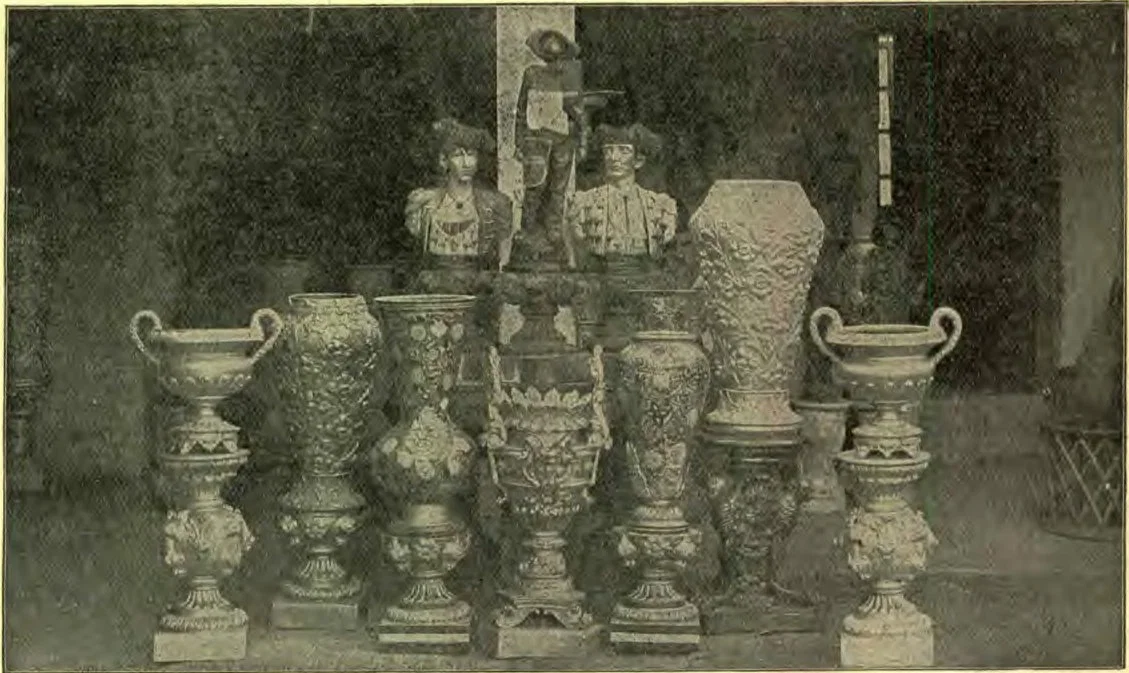
SOME MEXICAN VASES AND STANDS.
There are many schools and colleges called The Sacred Heart, also a noted charitable society of the same name.
The Sacred Heart of St. Mary occupies a prominent place in the church here. Its form is the same as the Sacred Heart of Jesus, with the exception of the crown and cross. A dagger is represented as piercing the side of the heart.
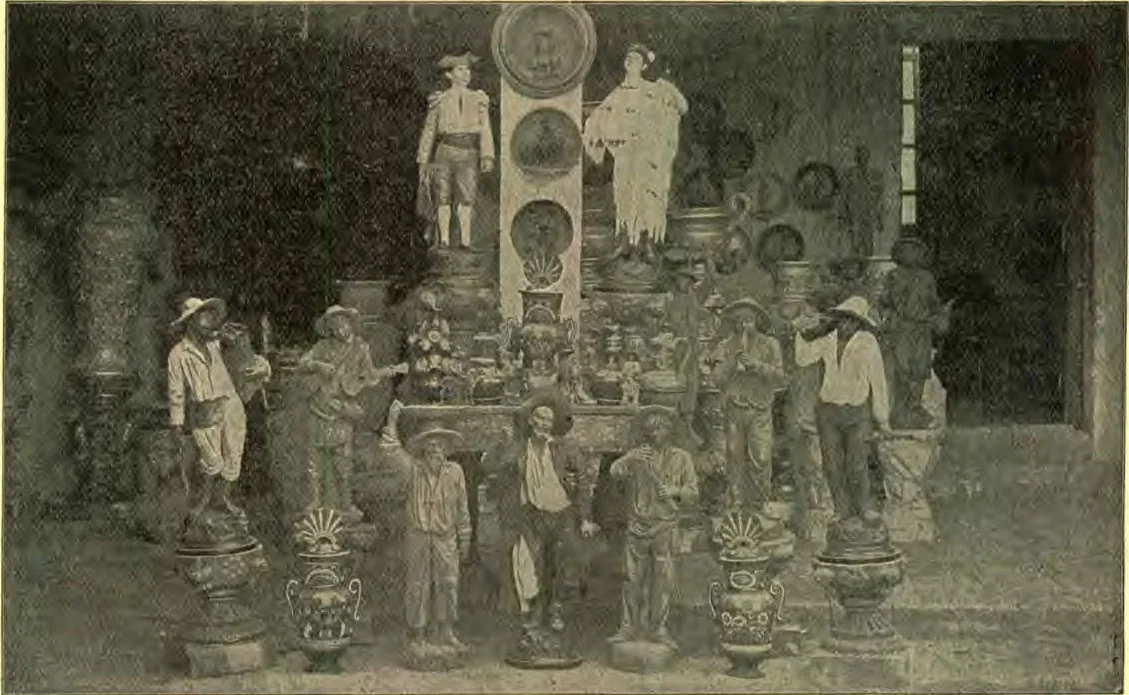
In another shop, the workmen were making figures to represent the child Jesus lying in a manger. These were made by the hundreds, to supply the demand throughout the country. They are made by hand, as are all the beautiful jars, vases, and figures of all kinds, for which Guadalajara is famous.
I purchased a small medallion of President Diaz, the size of a ten-cent piece. The bust was so tiny that it was impossible to discern the features with the naked eye, but under a microscope they were seen to be a perfect likeness.
AN EXHIBIT OF MEXICAN STATUARY AND POTTERY.
There is a man in San Pedro, called Panduro, who became quite famous during the Chicago Exposition for the perfect busts that his deft fingers modeled of those who sat for them.
Tourists delight to visit these little shops, which are full of interest and beauty,—a beauty that for me was marred by the thought that images made with hands are constantly going out from these places to deceive the people, who bow down before them and worship them.
TIA ANITA.
A YELLOW RIBBON TEN MILES LONG.
THE Silphium Laciniatum, or rosin-weed, is a plant that grows abundantly in southern Kansas, as also in many other places in the Middle and Western States; but in that locality it seems to be more vigorous, and grows to an immense size. Near a stream of water, or in damp places, or where the thick sod is broken, either by the plow or otherwise, it springs up as if by magic; and in the summer and fall is loaded with large yellow blossoms.
While on a visit to a brother in Winfield, Kan., a few years ago, my little niece Carrie came to me one day, and said: “Auntie, don't you want me to tell you a pretty story?” “Yes, dear,” I said; “I should be delighted to hear a story from you.” “We once had in our country a yellow ribbon ten miles long!” she said, and then laughed merrily at my look of astonishment; for she was a very truthful little girl, and of a rather serious turn of mind.
She went on to say that the county commissioners wished to make, or lay out, a road across the county for ten miles. The surveyors came with their surveying outfit to begin the road, and brought with them a strong team of horses and a sod-plow. As they went along measuring the road, a man followed with the plow, turning the sod, and leaving one unbroken moist furrow.
The next spring, when the rains came, the seeds of the rosin-weed came up as thick as they could stand in this furrow, and the following summer and fall they were almost weighted down with their bright yellow blossoms. And sure enough, there was the “yellow ribbon ten miles long.”
A wonderful thing is the wise provision that God has made for fuel on these broad, treeless prairies. The little black, hard seeds of the rosin-weed can not germinate under the thick, dry sod; but the farmer has only to break up the sod, and his fuel springs from the ground at his feet. The stalks are full of rosin, and the seeds are full of oil. I was told that three or four tons of this weed, pressed and dried, would supply a family with fuel for a year.
Great iron rollers are used for pressing the plants. The winds and sun soon dry it, and it is ready to be stored for use.
As we flew across the prairie in the cars, I often noticed great fields of this plant growing thick as corn, sometimes surrounded by a fence. I marveled that people should let their fields run so to this weed, until I was informed that it is their fuel.—Advance.
A VISIT TO A POTTERY.
By J. L. Shaw
You remember that the Lord, speaking to Jeremiah, told him to go down to the potter’s house, and said that there he would cause him to hear his words. If you will read, in the eighteenth chapter of Jeremiah, the account of the prophet’s visit, you will see that when he went, he noticed the work that was wrought upon the wheels.
Not long ago I had the privilege of visiting a place where pottery is made; and the first thing I saw was a wheel turning round and round very fast. Upon this the potter placed the clay. As he began his work, the first thing he did was to mix the clay; after this was thoroughly done, it was placed upon the wheel, ready for molding. When the potter had started the wheel, and dipped his hands in water, the work of molding began. It would458be impossible to tell you how marvelous was the work he did. It seemed at first as if his fingers had the touch of magic. The clay was entirely under his control, and he could do with it exactly what he wished. After he had made one thing, he would take another lump of clay, and mold something else, surprisingly new, before our eyes. When he had made several pots, some of them did not suit him; so he crushed them, and threw them back to be molded again. When asked why he did this, he replied that they were not perfect. Although they appeared so beautiful to me, he saw defects in them.
From this we learn that in order to mold clay, it must be moistened. No matter how hard the potter may try to mold it, his effort will be in vain unless it is well softened. The glory of the work belongs to the potter; for there is no power in the clay itself. If the clay were not passive, the potter could do nothing with it. Although different things are made, some more beautiful than others, the clay is all the same; and when one excels another in beauty, it is because of the wish of the potter.
Dear friends of the INSTRUCTOR, we are all clay,—human clay, if the expression may be allowed. As clay, we can be molded when our hearts are softened by the Holy Spirit; but no matter how much we may desire to be fashioned into vessels to the glory of God, we can not be molded until this change has taken place. Again, whatever is accomplished in our lives is not because of anything we can do, but because of the power of him who created us. Upon every particle of human clay that he has placed his hands, he has some wonderful design, which he will develop if only we are as clay in his hands. J. L. SHAW.
Kenilworth, South Africa.
WHERE IS OHIO?
“Where is Ohio, children, say?”
The teacher asked her girls one day.
Four little hands immediately
Went up. “I know,” said Margery,
“It's in the East.” But Susie Guest
Responded, “It is in the West.”
“’T is South,” said May; and Helen Forth
Was sure that it was “’way up North.”
Now Helen lived in Galveston,
And little May by Lake Huron,
And Margery lived ’way out West,
While in New York lived Susie Guest;
And so they all were right that day
In saying where Ohio lay;
Because so much depends, you see,
On where the children's homes may be.
— Selected.
MUSICAL WORKERS.
By Charles McIlwaine
“Buzz-z-z-z!” The music was up and down a limited scale, impatient in tone, jerky in style, earnest in execution. I marvelled where it came from. Such music was new to my library, but I soon traced the sounds to their issuing-place.
High up, on the narrow, gilded border tracing a line between wall and ceiling, a pair of mud-wasps were singing at their work.
Lifting my opera-glasses, which are always ready at hand, I watched the busy insects. Their wings moved so rapidly that their motion was as a shadow screening the sheen of their shining bodies. Perhaps they were not singing at all, but wing-pumping orchestral notes from the wonderfully delicate instrument which lies under the thorax of many insects that are musical in flight or in poising.
Strange I had not noticed these comers to my room before. They must have been dwellers with me for quite awhile. How nervously busy they were! While one with feet, mandibles, antennæ, examined every surface of the half-built mud-dome, in search of crack or crevice made in the drying, the other spread, patted, and smoothed a pellet of well-watered clay about the open, round doorway to the interior, improvising music all the while in one harmonious bizz-z-z-z!
The lady of the dome flew to the netted window, crawled through a small hole in the netting, and flew away. In exactly one minute she returned, bearing a pellet of mud clasped to her heart.
She flew heavily across the room, and attempted to rise to the ceiling, but her burden was too heavy; it carried her, exhausted, to the floor. Quickly she cut the pellet in half, and rose with a section to her domain. In silence she felt the margin of the doorway with her antennæ, eying it critically; then feeding the soft pellet with her feet to her mandibles, she dexterously built a new circle. Not until she began building did her wings begin their shadowy movement; not until then did the music begin.
All the while she was at work with her mandibles, her portable orchestra played. Why this music? Were the escaping wind from her thorax, and the fanning of her wings, necessary to the tempering of the clay? or was the rapid, shadowy movement of her wings to conceal and protect her from enemies while so intent upon her course-laying?
The architecture of her dome was not pretentious, but it was planned and executed with the skill of an accomplished architect and engineer. She flew to the floor, and gathered up the remaining half of the bisected pellet. Here was memory. She flew directly to the opening to all outdoors. Here was a good idea of location. In her rapid goings and comings for material there was industry; in her building there was purpose; in its completion there was anticipation.
Where did she get the pellets from so quickly?—The dark color of the mud told me. There was but one such deposit within easy flying-distance; that was at the end of a drain, three stories down and a hundred and fifty feet away.
Thither I went to wait her coming, and learn the mud-ball trade. She was there before me, busy with mandibles and legs, molding the oozy silt to shape as deftly as a potter handles his clay; quicker, too, from having more limbs to work with.
In two hours and a half she had built one and a quarter inches to her tubular dome. Stupendous work! Averaging the time of her trips for material for pellets at one minute, she made, carried, and deposited one hundred and fifty pellets, weighing, in all, three quarters of an ounce.
To do this she traveled over eight and a half miles. Estimating the vibrations of her wings at two hundred and twenty a second, and calculating that she had passed three quarters of the time spent upon the wing and in orchestral work, she had made with each wing one million four hundred and eighty-five thousand strokes! Think of the delicate mechanism capable of such velocity, and of the power within so minute a generator!
If mortals could move their legs as fast as my Lady Wasp can her wings, and if each step was twenty-eight inches, and the walking was good, one could, in two hours and a half, foot it from New York to within five hundred miles of Moscow, or one quarter of the way around the world.—Charles McIlwaine.
GAINING WINGS.
By Edna Dean Proctor
A twig where clung two soft cocoons
I broke from a wayside spray,
And carried home to a quiet desk
Where, long forgot, it lay.
One morn I chanced to lift the lid,
And lo! as light as air,
A moth flew up on downy wings,
And settled above my chair!
A dainty, beautiful thing it was,
Orange and silvery gray,
And I marveled how from the leafy bough
Such fairy stole away.
Had the other flown? I turned to see,
And found it striving still
To free itself from the swathing floss
And rove the air at will.
“Poor little imprisoned waif,” I said,
“You shall not struggle more;”
And tenderly I cut the threads,
And watched to see it soar.
Alas! a feeble chrysalis,
It dropped from its silken bed;
My help had been the direst harm—
The pretty moth was dead!
I should have left it there to gain
The strength that struggle brings;
’T is stress and strain, with moth or man,
That free the folded wings!
— Edna Dean Proctor.
THE MAN WHO CAN.
The March number of the Philistine contained an essay by its editor, Mr. Elbert Hubbard, that sold the entire edition of the little magazine within three days after it came from the press, and has since been circulated by the hundred thousand. The article—“The Man Who Can Carry a Message to Garcia”—has been widely reprinted; but as the situation it points out is so wide-spread and so deplorable, and the lesson set forth is so timely, it is given here, in part, for the benefit of those who have not seen it elsewhere. Mr. Hubbard says:—
No man who has endeavored to carry out an enterprise where many hands were needed, but has been well-nigh appalled at times by the imbecility of the average man—the inability or unwillingness to concentrate on a thing and do it. Slipshod assistance, foolish inattention, dowdy indifference, and half-hearted work seem the rule; and no man succeeds, unless by hook, or crook, or threat, he forces or bribes other men to assist him; or, mayhap, God in his goodness performs a miracle, and sends him an angel of light for an assistant. You, reader, put this matter to a test. You are sitting now in your office—six clerks are within call. Summon any one, and make this request: “Please look in the encyclopedia, and make a brief memorandum for me concerning the life of Correggio.”
Will the clerk quietly say, “Yes, sir,” and go do the task?
On your life, he will not. He will look at you out of a fishy eye, and ask one or more of the following questions:—
“Who was he?”
“Which encyclopedia?”
“Where is the encyclopedia?”
“Was I hired for that?”
“Don’t you mean Bismarck?”
“What’s the matter with Charlie’s doing it?”
“Is he dead?”
“Is there any hurry?”
“Shan’t I bring you the book, and let you look it up yourself?”
“What do you want to know for?”
Now, if you are wise, you will not bother to explain to your “assistants” that Correggio is indexed under the C’s, not in the K’s; but you will smile sweetly and say, “Never mind,” and go and look it up yourself.
And this incapacity for independent action, this moral stupidity, this infirmity of the will, this unwillingness to cheerfully catch hold and lift, are the things that put pure socialism so far into the future. If men will not act for themselves, what will they do when the benefit of their effort is for all?
My heart goes out to the man who does his work when the “boss” is away, as well as when he is at home. And the man who, when given a letter for Garcia, quietly takes the missive, without asking any idiotic questions, and with no lurking intention of chucking it into the nearest sewer, or of doing aught else but deliver it, never gets “laid off,” nor has to go on a strike for higher wages. Civilization is one long, anxious search for such individuals. Anything such a man asks shall be granted; his kind is so rare that no employer can afford to let him go. He is wanted in every city, town, and village—in every office, shop, store, and factory. The world cries out for such; he is needed, and needed badly—the man who can carry a message to Garcia.
Friendship's Palace Is Open Only to Those Who Pay the Toll
“FRIENDSHIP’S palace is open only to those who will pay the toll.”
TIME: A. D. 30. PERSONS: Jesus, disciples, little children, rich young ruler, Pharisees. PLACE: Perea.
QUESTIONS.
1. While in Perea, what question concerning divorce did the Pharisees ask? Matt. 19: 3. To what time and to what words did Jesus refer them in his answer? Vs. 4, 5. What conclusions did he then draw? V. 6. What further question was asked, and what reply was elicited? Vs. 7-9; note 1.
2. About this time, who were brought to Jesus, and why? How did the disciples view the matter? V. 13. In contrast with the spirit of the twelve, what did Jesus say and do? Vs. 14, 15.
3. By this tenderness to the children, who was drawn to Jesus? Luke 18: 18? With what question did he come? Matt. 19: 16. What was Jesus' answer? V. 17. In response to the ruler's question, “Which?” to what commandments did Jesus call attention? Vs. 18, 19; note 2.
4. What did the young man now say about his relation to the commandments? V. 20. What test did Jesus bring to bear upon him? V. 21. What was the effect? V. 22. What statements did Jesus then make in the hearing of his disciples? Vs. 23, 24; note 3. How did they regard his teaching, and what was their query? V. 26. With what words did Jesus seek to encourage them? V. 27.
5. Struck by this new thought, what did Peter say? V. 28. What promises were given by Jesus in reply? Vs. 29, 30. In connection with the promises, what solemn statement did he make? V. 31.
6. What useless admonition did the Pharisees give to Jesus? Luke 13: 31. What message did he send to Herod? V. 32. What words of comfort and trust did Jesus then utter? V. 33; note 4. What lamentation and prophecy was made in conclusion? Vs. 34, 35.
NOTES.
1. Marriage is a divine institution, and, with the Sabbath, comes down to us from Eden. Therefore, if one would know what marriage is in truth, he must go back to the time and place in which it was originated. In the beginning, man and woman were equal, and they were joined together by God himself. If God's plans had been carried out, that equality would always have continued, and divorce would be a thing unknown. But sin came in; and, as a result, woman became subject to man. Her lot has been a very hard one, and in some heathen countries she has been treated with less respect than the dumb brute. Even the Jews, influenced by the heathen around them, regarded her as beneath man. Hence, in the days of Moses, this hardness of heart was manifested in putting her away. In the days of Christ it was even taught that “if any man see a woman handsomer than his wife, he may dismiss his wife and marry the woman.” But Jesus, in referring his questioners to the beginning, shows that though God in his mercy has permitted men to divorce their wives, and has saved them notwithstanding, the plan instituted in Eden is the only right one. Jesus came into the world to save all that was lost; and hence he sought to restore woman to her true place in the family,—the place which was given her of God, and from which she could be lawfully separated by only one cause.
2. The Saviour referred his hearer to the commandments that define our relations to our fellow men. He who loves God will love his neighbor; for if we love not our brother whom we have seen, how can we love God, whom we have not seen? The great test of our love to God, therefore, is love to humanity. “We know that we have passed from death unto life, because we love the brethren.” Jesus does not ignore the first four commandments, but he does place much stress upon the keeping of the last six.
3. It is absolutely true that a rich man can not enter the kingdom of God. But let it be rightly understood what it is to be rich. Jesus does not say that all who hold title to property are rich, neither does he teach that those who have but little of this world's goods are poor. It is not to the amount, in dollars and cents, that God looks to determine who is poor or who is rich; but rather to the estimate that is placed upon that which one has in possession. He who has millions, and yet does not set his heart upon them, is poorer in God's sight than he who owns a nickel, and makes of it an idol. The first is a poor rich man; the second, a rich poor man. The first, like Abraham, may be very rich in cattle and goods; but all is on the altar, and he is looking for the city which hath foundations, whose builder and maker is God: his heart is not here. The second, though almost a beggar, loves this present world, and has no hope; his affections are earthly and sensual. The lesson that Jesus gave is a most forcible one, and applies to all. His words express the great truth of which Paul's statement is the echo: “The love of money is the root of all evil.” 1 Tim. 6: 10.
4. So long as Jesus' work on earth was unfinished, there was naught that he feared. The threat of the mightiest earthly ruler would have been nothing to him, much less that of Herod. The prophet could not perish from Jerusalem until that prophet's work was done. It is always thus. The child of God may pursue his appointed work without fear; for, until his work is finished, all that is done to hinder him will prove but a blessing and help. “For we can do nothing against the truth, but for the truth.” 2 Cor. 13: 8.
What occurred in the interval between the last lesson and the present? Where did the people gather at the time of the feast of tabernacles? What claimed their first attention? Why? Whence did they obtain material for the temple? When was the edict for the return issued? How long a time was required to prepare for the migration, settlement, and preparatory work? When was the building begun? Where was the foundation laid? What part did the priests bear in the ceremony? How were they clothed? Who were the singers and the players on instruments? What instruments were used? What part did the people take in the ceremony? Who shouted for joy? Who wept? Why? Who requested permission to help? What was the origin of this people? Why did Zerubbabel refuse their offer? What did they proceed to do? How long did the work stop? Until whose reign?
NOTES.
1. In the interval between this lesson and the last, about 50,000 Jews had traversed the long journey between Judea and Babylon, and had settled in their own land. Zerubbabel and Jeshua were filled with zeal to see the work accomplished for which they had come, and built first the altar for burnt-offering. At the feast of tabernacles the people gathered at Jerusalem to begin the restoration of the worship of God. Material for rebuilding the temple was provided by the free-will offering of the people, the gifts of Cyrus and his people, and from the people of the countries from which Solomon had secured material for the first temple. The edict of Cyrus was issued in 536 B. C. The temple was begun in May, 535. The site was on Mount Moriah, where the first temple stood.
2. So important seemed the step thus taken, that the day was celebrated by the Hebrews with the finest display of the old pomp on which they had yet ventured. The priest, in the rich dresses that Zerubbabel had, out of his princely munificence, furnished, blew the silver trumpets; the sons of Asaph once more clashed their brazen cymbals. Many of the psalms were used upon this occasion. One strain especially rang above all—that which runs through the 106th, 107th, 118th, and 136th psalms, “O give thanks unto the Lord, for he is good: for his mercy endureth forever.”—Stanley.
3. During the time of desolation of Judea and the captivity in Babylon, the mixed races that had been planted in the reign of Samaria had spread into the desolate land of Judea. These were, at heart, opposed to the restoration of Israel and the establishment of a government by the Jews in that land. But they decided to turn this enterprise to their own advantage in the establishment of their own power there.—“The Great Empires of Prophecy,” page 57.
4. When the Samaritans found their purpose thus frustrated, they set on foot a systematic and determined opposition to everything that the Jews designed to do. . . . In the very face of the decree of Cyrus, they “hired counselors against them, to frustrate their purpose, all the days of Cyrus king of Persia.” Daniel was still prime minister at the court of Cyrus; and, finding the work in Jerusalem hindered, and his own efforts hampered in the court of Cyrus by these hired counselors, he became greatly concerned for the work of God in the earth. However, instead of attempting to carry on a counter-intrigue against these men, he appealed to God. See Daniel 10.—Id., pages 57, 58.
5. The children of the Captivity had faith to seek first the kingdom of God; they persevered under discouragement; they went up, gave, and worked; they sought for the old paths, built on the old foundations; they sang as they built; they refused an alliance with the wicked; they co-operated with God, and relied on him alone; they did not go back into captivity because the outlook was discouraging. They that wait upon the Lord shall renew their strength. Although the literal temple was retarded, the spiritual building was going up unhindered in the hearts of those who believed. It is even so to-day. “Ye are the temple of God.” The spiritual house will be made manifest in eternal glory.
Agents Wanted for Easy-Selling Article
Send two-cent stamp to A. W. Halfrich, Clyde, Ohio (formerly St. Louis), for full particulars of one of the easiest-selling articles. No capital needed. Forty-two dollars' worth has been sold in a day by one brother. Sold only by agents.
To Reach BATTLE CREEK
FROM
CHICAGO, BUFFALO, DETROIT, OR TOLEDO,
Purchase Tickets
Reading over the MICHIGAN CENTRAL
“The Niagara Falls Route.”
A First-class Line for First-class Travel between Chicago and New York and Boston. Elegantly equipped through trains pass Battle Creek in each direction daily.
R. N. R. WHEELER, O. W. RUGGLES,
Ticket Agent, Battle Creek. Gen'l P. and T. Agt., Chicago, Ill.
TAKE THE Canadian Pacific Railway
for . . . CHATHAM, OTTAWA, MONTREAL, LONDON, GALT, QUEBEC, WOODSTOCK, TORONTO, BOSTON, PORTLAND, and
All points in New England, the Maritime Provinces, Great Britain, and the Continent.
Illustrated literature, time-tables, and full particulars, upon application to—
J. FRANCIS LEE, GEN. AGENT,
Passenger Dept. 228 SOUTH CLARK ST., CHICAGO.
Branch Offices: 76 Ottawa St., Grand Rapids, Mich. Room D, Chamber of Commerce, Cincinnati, Ohio. 315 Chestnut St., St. Louis, Mo.
Grand Trunk Railway System
Time Card in Effect February 5, 1899.
C. & G. T. DIVISION.
WEST-BOUND FROM BATTLE CREEK.
No. 11, Mail and Express, to Chicago — 12.00 M.
No. 1, Chicago Express, to Chicago — 9.00 A. M.
No. 3, Lehigh Valley Express, to Chicago — 3.40 P. M.
No. 5, Pacific Express, to Chicago, with sleeper — 12.55 A. M.
No. 75, Mixed, to South Bend — 7.30 A. M.
Nos. 11 and 75, daily, except Sunday. Nos. 1, 3, and 5, daily.
EAST-BOUND FROM BATTLE CREEK.
No. 10, Mail and Express, to Ft. Huron, East, and Detroit — 3.45 P. M.
No. 4, Lehigh Express, to Ft. Huron and East — 8.27 P. M.
No. 6, Atlantic Express, to Ft. Huron, East, and Detroit — 9.25 A. M.
No. 8, Lehigh Exp. to Saginaw, Bay City, Ft. Huron, and East — 6.50 A. M.
No. 74, Mixed, to Durand (Starts at Nichols) — 7.35 A. M.
Nos. 10 and 74, daily, except Sunday. Nos. 4, 6, and 8, daily.
E. H. HUGHES,A. S. PARKER,
A. G. P. & T. Agt. Chicago, Ill. Ticket Agent, Battle Creek.
Like A Magnet The Remington Standard Typewriter’s New Models
—draw old friends closer and attract new ones, by the power of inherent merit and unfailing service.
WYCKOFF, SEAMANS & BENEDICT,
327 Broadway, New York.
THE REMINGTON STANDARD TYPEWRITER CO.,
24 Lafayette Ave., Detroit, Mich.
Represented by H. E. Rogers,
57 Manchester St., Battle Creek, Mich.
“A LITTLE CHILD SHALL LEAD THEM.”
The day was warm, but the “cave” must be built. Patiently Margaret and Arthur scanned the lawn for unoccupied chairs, the brother building and directing, while his small sister hastened to carry out his wishes, or looked on with interest as he explained that exit by the west entrance was “no fair.” Finally all the light wooden folding-chairs were used, and Arthur brought two heavy wire ones, half carrying, half dragging, them over the long reaches of grass to the shady spot chosen for the cave. Now it is complete—all but one more chair, to make a sort of outer gate to the spot! A double chair some distance away is just the thing; and his small strength failing to move it, Margaret hastens to help. “Are n’t we strong enough?” they call, gaily, to an interested watcher, as they pull the seat along.
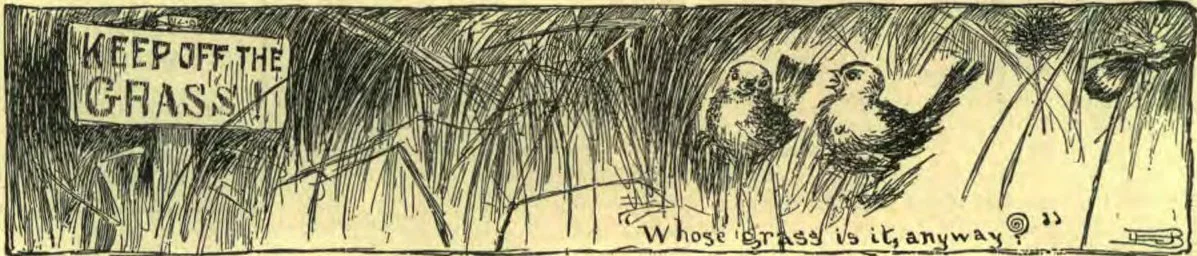
Just here an Officious Person, who had no appreciation for caves, or the patient effort put to the building of this one, passed by, and seeing the cave-chairs, hastened to help herself to one of them, though there were plenty of other seats. The north wall was thereby partly torn down; but the little laddie called out, politely, “You’re welcome to the chair,” and proceeded at once to shift the double seat to that position. “You must n’t drag the chairs around! You are spoiling the grass!” said the Officious Person (it wasn’t her grass), rising from the part of the north wall that she had just appropriated, and coming toward the children. “Here!” she added, righting the chair, and sitting down in it, “I’ll fix it so you can’t drag it along!”
Surely now the children would lose their temper! Not at all. For a moment a look of dismay passed over their eager faces; then, with unruffled sweetness, they said, “All right, we’ll take this one, then,” and replacing the chair she had first taken, went on with their play.
Dear little child-leaders! Your unconscious example brings help to a tempted soul,—one whose “rights” are being imposed on, and who feels his whole nature rise up to vindicate them. Now he asks if, after all, the way of patience and “giving up” is not also the wiser way in a world where there is so much bitterness, and decides in that moment to follow it. How much happier would we be if each one of us would give up our preferences—our “rights,” even—as graciously as did these little gentle-children!