Pacific Press Publishing Company · New York · Aug 6, 1896
CHRISTIAN CITIZENSHIP.
Christian citizenship is that citizenship which is conferred upon an individual by Christianity; and that citizenship pertains not to this earth, but to heaven.
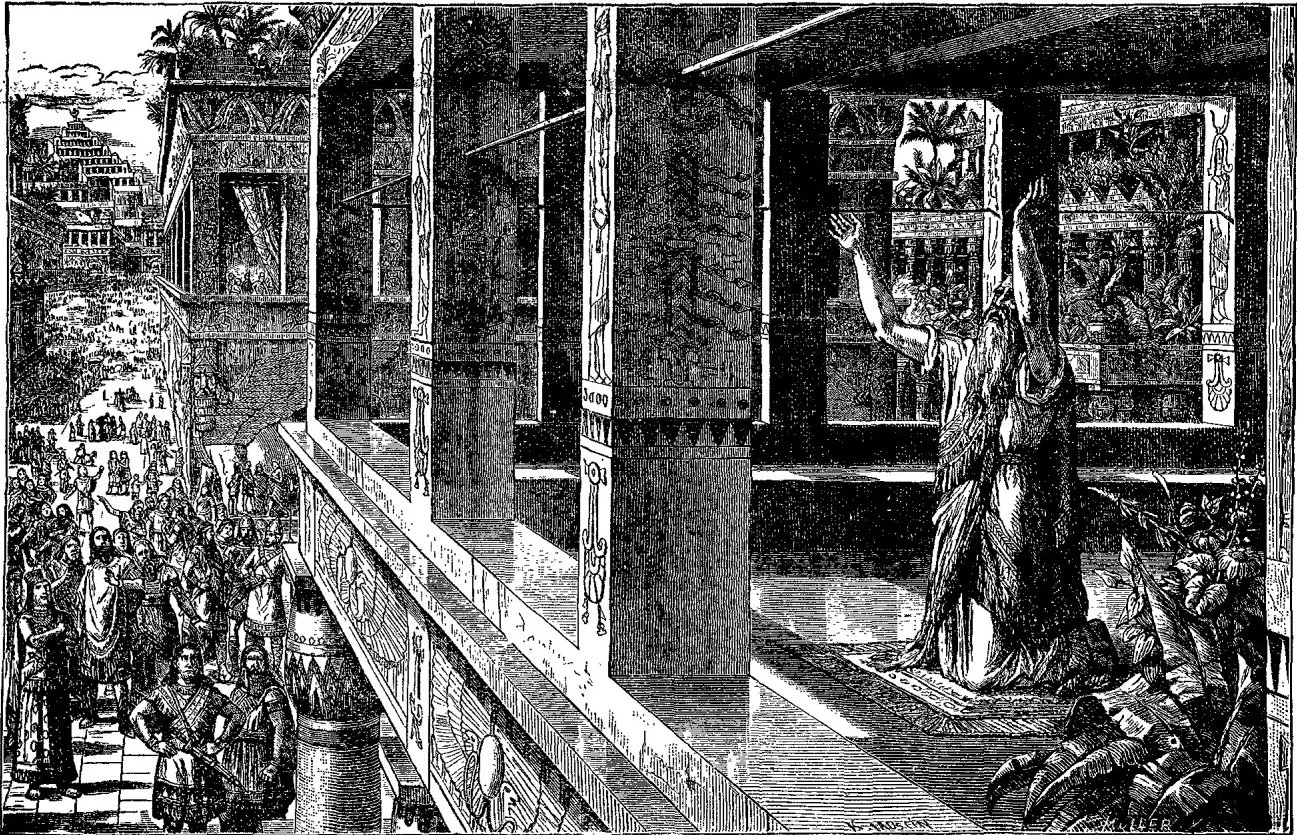
Daniel, in Babylon, Praying Toward Jerusalem.
It is true that Christian people are citizens of various earthly countries, but this fact has no real bearing upon the subject. This is a citizenship common to all classes of people. It is a citizenship which considers the relations between a man and his fellowman. It cannot take account of a man's relation to God.
There is a prevailing idea of Christian citizenship, however, which mixes these relations together, teaching that Christian citizenship pertains to the affairs of this world, and hence that those affairs should be conducted upon a religious basis. This is an altogether erroneous conception, and one most dangerous to the peace and welfare of society.
It is frequently said that a man ought to take his religion into his business; and the saying is true in the sense which is doubtless intended by those who make it, which is that a man ought to be conscientious in his business dealings, conducting them according to that standard of honesty and justice which religion—the Christian religion—reveals to him. But it would be much better to say just what is meant. Certainly, conscience ought not to be divorced from individual conduct in any relation of life; but conscience is not religion. Honesty does not constitute religion ; justice does not constitute it. The foundation of the Christian religion is faith in the word of God.
Christianity enables an individual to live rightly before both God and men, and is therefore of the highest value in any community as a promoter of peace and prosperity. We refer here to Christianity as defined by Scripture and applied by the Holy Spirit, and not to what some person or persons may call Christianity, or may attempt to apply by human law. Christianity thus perverted ceases to be Christianity, and becomes the worst disturber of the peace and enemy of prosperity. No person can be better prepared to act the part of a good citizen than he whose standard of righteousness is the law of God, whose conscience is enlightened and guided by God's word, and who has in his heart that love for his fellowmen which is the fulfilling of the second of God's two great commandments. The person of whom this may be said is a Christian. He of all men may be expected to be honest and just in all his relations with his fellows, and to aim always at that course which will preserve peace and maintain cordial relations between all about him.
This is as far as Christianity can enter into any of those relations of life which pertain to civil affairs. And, as before stated, this is not a union of Christianity with civil affairs, but only of that honesty and justice which Christianity enjoins. The Christian is actuated in all things by Christian motives; he has constantly in view the claims of the law of God, which covers both his relation to God and to his fellowmen. He will be a Christian in all places and at all times. But his honesty, his justice, and his kindness toward others, do not constitute him a Christian. Many people who have been honest and just and kind toward their fellows have not professed to be Christians at all, and had they done so, on the strength of these virtues alone, their profession would have been false. Neither one of these, nor all combined, constitute a religion. Hence they do not, by their presence in the conduct of civil affairs, unite religion with civil government.242
Testimony of the Scriptures.
But there is a true Christian citizenship, which is possessed only by Christians, and pertains to that country the only knowledge of which comes through the avenue of faith. The Scriptures speak very clearly upon this subject, and to them we naturally turn for information.
In his letter to the Ephesians, the apostle Paul points them to the change which had been wrought in their condition by their faith in Christ. He tells them that “in time past” they had been “without Christ, being aliens from the commonwealth of Israel, and strangers from the covenants of promise, having no hope, and without God in the world. But now,” he continues, “in Christ Jesus ye who sometimes were far off are made nigh by the blood of Christ. . . . Now therefore ye are no more strangers and foreigners, but fellow-citizens with the saints, and of the household of God.” Eph. 2:12–19. Here is set before us a citizenship which is shared only by the saints.
This is a citizenship which does not pertain to this world. This is clear from the fact that it is held exclusively by the saints. The most wicked of men share freely in all the privileges which this world has to bestow. But they do not share in those privileges which come through faith in Christ.
Some Eminent Examples.
The same truth is set forth in the examples left us by eminent Bible characters from earliest times. We cannot do better than to notice the course of some of these men in this respect.
Abraham was one of the prominent men of his time, being at the head of a large household, rich in worldly possessions, and having the respect and esteem of kings. He was free to go almost where he might choose, and establish himself in the enjoyment of all that which was sought and enjoyed by the heathen princes around him. But we read of Abraham that he left his native land at the command of God, and went through the country as the Lord directed him, not seeking any permanent place of abode, nor aiming to enroll his name among the great of earth. God had made Abraham a promise, and that promise, as the apostle Paul tells us, was that he should be the heir of the world. Rom. 4:13.
He Sought no Christian Citizenship on Earth.
But Abraham understood that this promise was to be realized not through “the law,” or through force of arms, or through the ballot box, but “through the righteousness of faith;” and he sought it only in that way. We read of him that “By faith he sojourned in the land of promise, as in a strange country, dwelling in tabernacles with Isaac and Jacob, the heirs with him of the same promise. For he looked for a city which hath foundations, whose builder and maker is God.” Heb. 11:9, 10. In the same connection, we are told concerning these ancient Christians that they “died in faith, not having received the promises, but having seen them afar off, and were persuaded of them, and embraced them, and confessed that they were strangers and pilgrims on the earth. For they that say such things declare plainly that they seek a country. And truly if they had been mindful of that country from which they came out, they might have had opportunity to have returned. But now they desire a better country, that is, an heavenly; wherefore God is not ashamed to be called their God, for he hath prepared for them a city.” [Italics ours.]
Abraham did not look for the fulfillment of God's promise in this present world, or by worldly means; but he looked forward by faith to a “new heavens and a new earth”—the “heavenly country”—and a city “whose builder and maker is God,” to be created in the execution of God's great gospel plan, the central act of which was the great sacrifice on Calvary. The Saviour said of Abraham, speaking to the Jews, “Your father Abraham rejoiced to see my day; and he saw it, and was glad.” John 8:56.
Joseph, the son of Jacob, was in high honor at Pharaoh's court, holding the position of governor over all the land of Egypt. He was exalted among earth's great men, but it was not upon this that he set his heart, nor upon anything connected with the land of Egypt. We read that “By faith Joseph, when he died, made mention of the departing of the children of Israel, and gave commandment concerning his bones.” Heb. 11:22. Referring to the record in Genesis, we learn that “Joseph took an oath of the children of Israel, saying, God will surely visit you, and ye shall carry up my bones from hence.” He, like Abraham, had his heart set upon another country than that in which he had achieved earthly greatness.
Moses was a man brought up at the court of Pharaoh, and honored by all in Egypt, being heir to the throne, and a man “mighty in word and in deed.” But he renounced all this and identified himself with a race of slaves, in order that he might gain that better, “heavenly” country, and share the privileges of its citizenship.
Daniel, the Hebrew captive at the court of Nebuchadnezzar, was exalted by the latter to great eminence in the government of Babylon, but in every place, and in all that he did, he maintained his integrity toward God. The illustration on the preceding page sets forth his faithfulness to God while chief of the three presidents appointed over the realm by King Darius. His enemies would not have found an occasion against him if he had not been accustomed to pray three times each day with the windows of his room opened toward Jerusalem. It was not upon anything that he had enjoyed in Babylon, under either the reign of Nebuchadnezzar or of Darius, that he had set his heart. His thoughts were upon Jerusalem. He was in Babylon as a stranger and a pilgrim. The longing of his soul, expressed in his earnest prayers to God and in his searching of the books of prophecy, was that he might see the captivity of his people turned, and the kingdom of Israel restored again in his beloved city. But that kingdom looked forward in purpose to the coming of the promised Messiah; and this it was to which the prophet looked, and which seemed by the captivity to have been set aside. Daniel looked forward to the setting up of the kingdom of Christ. He had in view the promise made by God to Abraham, which was to be fulfilled in the inheritance of the earth by the faithful.
Conscience in Secular Business.
Daniel was a man who took his conscience into his business, which was that of civil ruler in the province of Babylon. No better example does history afford of Christian integrity in the conduct of secular affairs; no better can be furnished by any man living to-day. Yet Daniel did not impose his religion upon any one. There was no mixing of religion with politics in his official life. His influence was not given to the enactment of religious laws. He simply lived a life of perfect uprightness in the sight of his fellowmen, conducting the affairs of his office with such honesty and justice that his enemies were forced to acknowledge that no fault could be found in him. And by this very thing Daniel did a wonderful work in spreading the knowledge of the true God. Would that there were many who would imitate him in the higher walks of public life to-day. It is by the life of Christian integrity that righteousness is to be preached and men brought into the path of obedience to moral requirements, and not by religious “laws.”
Christian citizenship is the same thing to-day that it was in the days of these ancient worthies. It is citizenship in the land of promise,—the promise made to Abraham that he should be the heir of the world. We read that “to Abraham and his seed were the promises made;” and “they which be of faith, the same are the children of Abraham.” Gal. 3:7, 16. Therefore those who are of faith to-day, are heirs with Abraham of the world,—not this world, with its curse and ruin caused by sin, but that new earth which shall spring forth at the word of God from the ashes of this present earth, which is to be burned up by the fires of the day of wrath. 2 Peter 3:10–13. “The meek shall inherit the earth, and shall delight themselves in the abundance of peace.” Ps. 37:11.
Christian citizenship, therefore, is not of this world. It cannot be attained by any earthly means. Wealth cannot purchase it, power cannot grasp it, votes cannot establish it anywhere. It is to be secured only by faith in Christ, just as Abraham and the other righteous men of old secured it. If we would work to spread the blessings of Christian citizenship among our fellows, we must live the life that they lived. We must follow the example of Jesus Christ. We must not proclaim that Christ's kingdom is of this world; we must not seek to have affairs which pertain to this world conducted on a religious basis.
SUNDAY CRUSADE AT GROVELAND, MASS.
By S.
THE Sunday crusade has broken in upon the public peace in the village of Groveland, near Haverhill, Mass. Close to the village is a very popular summer resort, called “The Pines,” largely patronized by laboring people who cannot afford a vacation at the seaside. Here on Sundays and other days came those who sought a change from the atmosphere of town and city, and enjoyed a trolley ride through the country to the resort, where they could obtain refreshments and listen to a band concert on Sunday afternoons.
All went quietly and pleasantly until Sunday, July 19, when several apostles of the Sunday crusade visited the resort for the purpose of getting evidence against persons engaged in secular business on the grounds. The result of their spying was that several residents of the village were fined $10 each for violating the “sabbath.” A clergyman of the village, Rev. Louis Berry, testified at the trial, and was largely instrumental in securing the convictions. So indignant were the people of Groveland made by the affair that they hung the clergyman in effigy to a beam of the Groveland bridge, where it was allowed to remain for several days. The Haverhill Bulletin, from which we gather these facts, adds: “The result can hardly be imagined, but the town is in an uproar over the occurrence, and the feeling against the minister and his colleagues is intense. Interesting developments are likely to follow, as several citizens were heard to remark that the affair was not settled by any means.”
That clergyman stood before the people of243his village as an ambassador from God, representing Him who said, “My kingdom is not of this world.” As such his business was to persuade men to become reconciled to God. But what has he done? How much influence will he now have with the people of Groveland in seeking to win them to Christ? How much has he lessened his chances for saving souls in that community, and the chances of some, if not many, of the latter of ever being saved in the kingdom of God? Instead of drawing them nearer to God and salvation by the power of love, he has driven them further away by the force of the civil arm.
This is what clergymen do every time when they step out of their God-appointed place of ambassadors, to act the part of taskmasters in forcing the people to a certain line of conduct by civil enactments. What account will they render for this in the day of God? S.
WHY THEY REFUSE OBEDIENCE.
In number 30 we gave, at some length, evidence showing that the Adventists who have been imprisoned in Tennessee and elsewhere for violation of the Sunday “laws,” hold not only that the fourth commandment enjoins abstinence from labor on the seventh day of the week, but that it also forbids a like observance of any other day; and that for this reason, and for this reason only, they subject themselves to imprisonment by working on the first day of the week.
The persecuted Adventists hold that the Roman Catholic Church, the Papacy, is the persecuting power described in Dan. 7:25, 26, and parallel texts, and that the Sunday-sabbath is the badge of its power. Commenting on Dan. 7:25, Dr. Albert Barnes says: “Can any one doubt that this is true of the Papacy? . . . Indeed, the slightest acquaintance with the history of the Papacy will convince any one that what is here said of making ‘war with the saints’ (verse 25), is strictly applicable to that power, and will accurately describe its history.”
This is the view generally entertained by Protestants, not only of the application of Dan. 7:25, but of many other scriptures. But one feature of the prophecy is very generally overlooked. Dan. 7:25 not only says of this power that he should “speak great words against the Most High,” and “wear out the saints of the Most High,” but also that he should “think to change times and laws,” evidently of the Most High. This prophecy, the Adventists believe, is fulfilled in the “change” of the Sabbath by the Papacy. The Romish Church boasts of having made the change, and appeals to that fact, and to the acquiescence of Protestants in the change, as proof of her power to establish feasts and holy days, and to command their observance “under sin.”
Change of Day and Change of Reason for Observing It.
That the Sabbath has been changed so far as it is possible for man to change that which God has established, all are agreed; but when it comes to stating the reason and manner of the change, there is not the same unanimity of sentiment. Some have endeavored to show that it was by divine authority; but for this position there is no warrant in the Scriptures; moreover, the very nature of the Sabbath law forbids the idea that it should at one time enforce one day and at another time another day.
The fourth commandment sets forth explicitly the reason for enjoining the observance of the Sabbath, namely, the creation of the world, and God’s rest on the seventh day of the creation week; and to change the day must, of necessity, change the reason for its observance. And to change the reason for an institution is to entirely change the institution itself, or rather, it is to destroy one institution and establish another in its stead. And this is just what has been done as far as man could do it, in the case of the Sabbath; for instead of the seventh day being kept as a memorial of creation, we have another day kept for another reason.
The Change Made This Side of Christ and the Apostles.
That this change was made this side of Christ and the apostles, is thus confessed by an adherent of the Sunday-sabbath:—
The selection of Sunday, thus changing the particular day designated in the fourth commandment, was brought about by the gradual concurrence of the early Christian Church; and on this basis, and on none other, does the Christian sabbath, the first day of the week, rightly rest.—Christian Work, Jan. 8, 1885.
In order that none may misunderstand what is meant by “the early Christian Church,” we supplement this quotation by another from the same paper, under date of Feb. 18, 1886, as follows:—
We hear less than we used to about the apostolic origin of the present Sunday observance, and for the reason that while the Sabbath and Sabbath rest are woven into the warp and woof of Scripture, it is now seen, as it is admitted, that we must go to later than apostolic times for the establishment of Sunday observance.
Neander’s Testimony.
This latter quotation shows clearly that the Christian Work does not think that the apostles, nor the church in the days of the apostles, had anything to do whatever with the change; and in this it is manifestly correct, as can be demonstrated by the most reliable historians. We have room in this connection for only a single extract, and until that is controverted (and it never can be), it will not be necessary to cite any other proof. Neander, of whom “McClintock and Strong’s Cyclopædia” says that he is “universally conceded to be by far the greatest of ecclesiastical historians,” gives this pointed and candid testimony:—
The festival of Sunday, like all other festivals, was always only a human ordinance, and it was far from the intentions of the apostles to establish a divine command in this respect, far from them and far from the early apostolic church, to transfer the laws of the Sabbath to Sunday. Perhaps at the end of the second century a false application of this kind had begun to take place; for men appear by that time to have considered laboring on Sunday as a sin.—Rose’s Neander, page 186.
This is a plain statement. But the fact remains that the change has been made; and if Christ and the apostles did not make it, how was it accomplished? If there is no divine authority for the change, what authority is there for it? And if it was not introduced in the days of the apostolic church, when was it brought in?
The Papacy Did It.
In answer to these questions Adventists say the Papacy made the change not only without divine authority but in direct violation of the divine law; and that to observe the day, is, in effect, to recognize this apostate power as above God, who instituted the Sabbath. But it is objected by some that, as the Sabbath was changed at least as early as the fourth century, whereas the earliest date assigned by Protestants for the establishment of the Papacy is A. D. 538, it is not possible that the Papacy changed the Sabbath a century before it (the Papacy) had an existence. But let those who make this objection remember that the Papacy was the result of growth. It did not spring into being in a day, nor did it attain full stature in a century. As early as A. D. 54, the Apostle Paul wrote:—
For the mystery of iniquity doth already work; only he who now letteth will let, until he be taken out of the way. And then shall that Wicked be revealed, whom the Lord shall consume with the spirit of his mouth, and shall destroy with the brightness of his coming. 2 Thess. 2:7, 8.
This, as all Protestants agree, is a reference to the Papacy, or at least to the apostasy which culminated in the Papacy. The fact is, that instead of being established in A. D. 538, the papal power attained its majority at that time. Its infancy and youth were far back of that date, and not a little of its work was done before that time. In his history of the “Early Church,” page 591, Killen says of the bishop of Rome:—
In the third century the chief pastor of the Western metropolis must have been known to the great officers of government, and perhaps to the emperor himself. Decius must have regarded the Roman bishop as a somewhat formidable personage when he declared that he would sooner tolerate a rival candidate for the throne, and when he proclaimed his determination to annihilate the very office.
At this time the bishop or pope of Rome exercised power over only a part of the church, but his power was the same in kind, if not in extent, that was exercised by his successors two centuries later. Those who deny that the Papacy changed the Sabbath, on the ground that the change was effected before that power had an existence, only show how limited is their knowledge of the history of the first great apostasy, and the development of the papal power.
Pagan Features in the Papacy.
Protestants all agree that the papal system has in it many features borrowed from paganism; and just so surely as it has, Sunday-keeping is one of them. Every Bible student knows that the Scriptures contain no hint of the change of the Sabbath by divine authority; scores of first-day writers have acknowledged the fact; ecclesiastical historians of note have repeatedly said that “the festival of Sunday was always only a human ordinance.” Do Adventists not justly accuse “the mystery of iniquity,” which, even in Paul’s day, was working for the corruption of the Church, with the sin of thinking to change the law of God, especially the fourth commandment, as foretold by the prophet Daniel? And do they not also do well to obey God rather than man, even when to do so involves civil penalties?
THE PEOPLE AND THE SUPREME COURT.
In view of the widespread and continued criticism of what is construed as an attack upon the national Supreme Court by a leading political party in its latest “platform,” it is instructive to call in review some action of a similar nature by a political party nearly forty years ago. We refer to an “attack” made on the Supreme Court by the Republican party “platform” of 1860.
The ground of controversy on that occasion was that “in December, 1856, five of the eight judges of the Supreme Court decided that the terms of the Missouri Compromise, which had been observed as good law since 1820, were unconstitutional, and Congress could not prohibit slavery in any of the Territories.” In view of this decision the Republican party in their national “platform” for 1860, said:—
The new dogma, that the Constitution of its own force carries slavery into any or all of the Territories244of the United States, is a dangerous political heresy, is revolutionary in its tendency and subversive of the peace and harmony of the country. We deny the authority of Congress, of a Territorial legislature, or of any individuals [meaning, doubtless, the Supreme Court], to give legal existence to slavery in any Territory of the United States.
And previous to this, in 1857, just after the rendering of the historical Dred Scott decision, the legislature of the State of New York made allusion to the Supreme Court in these words:—
The safety and peace of the nation require its reorganization, so as to admit into it a fair and equal representation from the free States, according to the ratio of population between free and slave States, which can and ought promptly to be done by act of Congress.
This was not the language of revolution, or of anarchy. It was not inconsistent with republican government; indeed, it was the voice of true republicanism, which declares that government of the people is by the people. It was based upon recognition of the truth that in civil government the people are supreme—the creator superior to the thing created. The Supreme Court could not bind the people; it was not created for that purpose.
While the Supreme Court is entitled to the highest respect from all parties, it is not a body with omniscient wisdom or unlimited power. When it comes to be venerated as speaking with the voice of infallibility, and binding the people in all cases by its decisions, so that to question one of them at any time shall be denounced as revolution and anarchy, we shall then have in this country not a republican government, but a judicial despotism.
IS THIS A PROTESTANT COUNTRY?
By S.
It is highly instructive to note the Roman Catholic position upon this point, and the use to which Catholics turn it in argument. As stated in the Catholic Standard and Times (Philadelphia), of July 26, 1896, “this is not a Protestant country,” and therefore no comparison can properly be made between religious bodies here, and those in countries distinctively Catholic, as respects their standing before the law.
This statement is an outcome of the controversy raised some time since by Methodist ministers of Chicago, regarding the disabilities imposed upon Protestants in several South American countries, by that church which in this country professes to be the strong advocate of religious liberty. A Methodist minister had recently written to the Freeman’s Journal (Catholic), published in New York City, a letter designed to set before Catholics what it was Methodists wished to accomplish. One very important thing, the letter states, was the revision of the marriage laws in those countries. The republics of Peru, Bolivia, and Ecuador, it seems, provide by constitutional enactment that only that form of marriage ceremony shall be recognized as valid which was prescribed by the Council of Trent. This means that only Roman Catholics can be legally married in those countries. “If the conditions were reversed,” says the Methodist ministers’ letter, “if a marriage ceremony for Roman Catholics in this republic performed by a Roman Catholic clergyman was not valid in the eyes of the law, the Chicago Methodist ministers—such is their intense love for religious toleration—would embark in a crusade for the removal of such an oppressive and cruel restriction.”
It has been a rather difficult matter for the papal church, with the echo of her loud assertions as the champion of liberty still ringing in the ears of the people, to get around the contradiction presented by the Catholic-ruled republics of South America; and she has not done so with any great credit to herself. The Catholic Standard takes refuge behind the fact that marriage in those countries is regulated by the National Constitution. In this it finds two grounds of defense. One is that “nations amend their constitutions somewhat slowly, and seldom, if at all, at the suggestion of outside nations. If the Pope,” it continues, “should interfere and the Peruvians should change their Constitution at his suggestion, ten to one that in the very next outburst against Catholics in this enlightened country of ours, it would be flung in our faces that it would not be safe to entrust Catholics with power, inasmuch as Catholic nations stood ready to even change their constitution at the mere beck of the Pope.”
The argument is ingenious, but without force. The Pope is not a nation, and a suggestion from him would not be taken as coming from one nation to another. Indeed, since the Pope is the visible earthly head of the Papacy, a government which enacts the papal system into its fundamental law, thereby logically places the Pope at its head, and cannot consistently refuse to disregard his will, especially in any matter relating to religious customs or observances. But if there were any force in the Standard’s position on this point, it would be sufficient to point out that the Pope might at least make a general pronouncement against such restrictions by the civil power upon religious freedom, in some one of his many encyclicals, if he was really desirous of establishing religious freedom in Catholic countries. But in all his addresses “to the princes and peoples of the universe,” nothing of the kind appears.
“This, however,” says the Standard, “is not the only ground on which the appeal of the Methodist ministers to the Pope and the Catholics of the United States is in the highest degree absurd. The point on which they hinge their appeal is that there is in their opinion a parity somewhere or other between the marriage matters in Peru, which they want adjusted, and a possible state of things here in the United States. They imagine they see a parallel between the invalid marriages in Peru and the condition which should obtain here if Roman Catholic marriages were invalid here before the law. There is, however, no parallel or parity whatever. If this were a Protestant nation with a union of Church and State, and under its Constitution only Protestant marriages were recognized, Mr. Lee’s parallel would then hold good. But we have nothing of the kind here. This is not a Protestant country, and we have no union of Church and State. We have no religion recognized by the State at all. In Mr. Lee’s supposition there would be an odious and intolerant singling out of one class, and a debarring of them from rights which every one else enjoyed. In Peru the matter is entirely different. There is no singling out of any class or discrimination against any class. There is simply a general law of the land on the subject of marriage made for the good of the commonwealth (whether rightly or wrongly made we do not pretend to say), and all who come to the country are expected to comply with the law. This is a very different thing from the supposition which Mr. Lee makes about Catholic marriages which might be invalidated here. In that supposition there would be legislation against a particular class; and class legislation, even when not proscriptive, is apt to be more or less odious.”
Yes; “This is not a Protestant country” so far as its government is concerned, and “we have” here, theoretically at least, “no union of Church and State,” in a national sense. Hence we are told that any discrimination by law against Catholics here would be an altogether different thing from a constitutional provision imposing disabilities upon them, under a union of Church and State! The former would be “class legislation,” and therefore odious; the latter would simply be a “general law of the land” and therefore not directed against any class! The Standard seems to be trying to illustrate the familiar phrase, “A distinction without a difference.” Certainly a provision of the Constitution directed against the Catholics or any other denomination would be as much “class legislation” as would be a statute of similar import enacted by a State legislature. The former would be more odious than the latter, because the scope of its operation would be wider.
If this were “a Protestant country,” and we had here a national union of Church and State, under which Roman Catholic marriages were not recognized as valid, would Catholic journals in this country allude to the discrimination against them as a “general law of the land,” which those coming here were expected to obey? Would they say there was “no singling out of any class or discrimination against any class”? Would the pope in an encyclical addressed to this country pass the matter over in silence? We know not.
Catholic prelates have of late spoken exultingly of the freedom enjoyed by “the church” in this country, and this freedom Archbishop Ireland declares to be “simple, natural justice.” If this freedom were taken away under a Protestant union of Church and State, it would not be simple, natural justice, according to his statement. And therefore in attempting to justify the attitude of the South American republics toward Protestants, Rome attempts to justify the opposite of simple, natural justice, and thereby proclaims that she would persecute Protestants in this very land if she but had the power.
It follows also from the Catholic exposition of what is proper under a union of Church and State—and Rome is the world’s best authority on this subject—that the religious combination which can get the support of the national Constitution, can make a “general law of the land” in its own favor which all others will be expected to obey, without making itself liable to the charge of discriminating against any class. Verily, this would be a privilege worth contending for, from any but a Christian point of view. And the prospect is only too fair that we shall see plenty of religious contention for this or a similar purpose in the near future.
S.
“RELIGION IN POLITICS” ILLUSTRATED.
By S.
RECENTLY we alluded to the position of Hon. William McKinley, the Republican nominee for President, on the question of Sunday enforcement. And now the chief Republican manager, Mr. Mark Hanna, puts himself on record in the same manner by declaring that Sunday shall not be desecrated by Republican campaign work if he can prevent it. A press dispatch dated Chicago, July 26, to the New York World says:—
M. A. Hanna, Chairman of the Republican National Committee, issued an order last week that the rooms of the committee in Chicago should be tightly closed on Sunday.
To-day the rooms were tightly locked. A few local politicians who had not heard of the order attempted to enter but failed.
Perry Heath, head of the literary bureau, came245down and looked over the mail, but did no business. Mr. Hanna says he will have Sunday closing in New York, and proposes to enforce sabbath observance in the campaign so far as it is in his power. It has been the custom of the Republican National Committee heretofore to work every day in the week.
Mr. Hanna is evidently bent on taking his religion into his politics, and is giving an illustration of what “religion in politics” means. If all the rest of the politicians would now also take their religion into politics, each insisting that the campaign should be conducted in accordance with his particular religious views, the phrase would be illustrated still further. It is evident that it is not synonymous with the idea of honesty and justice in politics. S.