The American Sentinel, Vol. 11, No. 31.

CHRISTIAN CITIZENSHIP
Earlier text: CHRISTIAN CITIZENSHIP

THE POWER TO OBEY.

BY J. F. BALLENGER.
“For we know that the law is spiritual.”
The reason we know that the law is spiritual is because it was spoken by a spiritual being. Says Jesus, “The words that I speak unto you, they are spirit and they are life.” John 6: 63. “And the Lord spake unto you out of the midst of the fire: ye heard the voice of his words. . . . And he declared unto you his covenant which he commanded you to perform, even ten commandments; and he wrote them upon two tables of stone.” Deut. 4: 12, 13.
We know that this is the law that Paul refers to in Romans 7: 14, which he calls spiritual; for in the seventh verse he refers to the tenth commandment and says: “I had not known lust, except the law had said, ‘Thou shalt not covet.’” Therefore the law of which one commandment says, “Thou shalt not covet,” is a spiritual law. A carnal law could not come from a spiritual being.
This spiritual law when received in the heart by faith in Christ brings to the receiver a spiritual life, or in the words of the apostle, he is a “partaker of the divine nature.” This divine or spiritual nature is wrought in the individual by the Spirit of Christ. “The spirit is life because of righteousness,” that is, the Spirit of God writes the law of righteousness in the heart, and as “the law is life,” this puts the individual in possession of “the life of God” in the soul, and by this he becomes “the epistle of Christ,” “known and read of all men.”
Any attempt on the part of any person to obtain a spiritual life without the Spirit of God is but to clothe himself with “filthy rags,” and is a sin in the sight of God. “For whatsoever is not of faith is sin,” that is, any effort on our part to obey a spiritual law without faith which brings the Spirit of God, is to reject the gospel of Christ which is the power of God to save men, and in which alone is the righteousness of God “revealed through faith.” Then for any human power to try to compel obedience to a divine or spiritual law is to assume the power and prerogative of the Holy Ghost; and this is to put man in the place of God. It is the very “mystery of iniquity.”
Says one, “We agree with you that the civil government cannot enforce the spirit of the law, but may it not compel obedience to the letter of the divine law?” We answer, No. To compel obedience to any law would be to destroy the individual’s power to disobey. Just as long as a man has power to do evil he can do it, and the government cannot hinder him. We know that men have the power to commit any crime in the calendar if they choose to do so and the civil rulers cannot help themselves. Are not crimes being committed every day, and why do not the civil rulers stop them if they have the power to do so?
To compel obedience to the law the government must have the power to prevent men from violating it. But for civil rulers to prevent men from violating the law they must know beforehand that they are going to commit the deed; to do this they must be able to read every man’s thoughts and know what they are premeditating, and even then they could not prevent the individual from violating every duty that he owes to God.
All they could do would be to confine the person whom they knew to be premeditating the crime and prevent him from trampling on the rights of others. But as it is impossible for civil rulers to know what a citizen is going to do, therefore it is impossible for them to compel him to obey. All that the government can do is to punish the person who violates the law; but this cannot reform the criminal; he may choose to harden his heart on account of the punishment and meditate revenge, or he may choose to reform his life and become a better man; but the reformation depends wholly upon his own choice and not upon the power of the government.
This fact is plainly shown in Paul’s reasoning upon the duties of the civil ruler and the citizen in Romans 13. In verses 3 and 4 he says: “Wilt thou, then, not be afraid of the power? Do that which is good. . . . But if thou do that which is evil, be afraid.” Here we see that the individual is left to choose to fear the rulers and do good and have praise of the same, or he can choose to do evil and suffer the penalty; but in either case it is left to his own choice. If he chooses to do evil, all that the minister of vengeance can do is to “execute wrath upon him that doeth evil.”
But for the government to execute wrath upon the sinner will never “take away the stony heart” out of his flesh and give him “a heart of flesh,” nor cause him to be “born of water and of the spirit,” nor make him “walk after the spirit and not after the flesh.” Neither will the execution of the penalty upon the criminal cause him to “love God with all his heart” or to “worship him in spirit and in truth,” nor “love his neighbor as himself;” and where these conditions do not exist there is no reformation of life.
It is true that man may be intimidated, or afraid to commit crimes for fear of the “avenger of wrath,” or for fear of the pains and penalties that will be inflicted upon him if he invades the rights of another. And this is all the power any civil government ever had or ever can have to prevent crime. They can compel obedience only by intimidation in executing the penalty. Take away entirely the fear of punishment from the minds of the people, and whose life, property or reputation would be safe? Not any. Nothing but the power of God in the gospel which is the love of God in the gift of his Son; and the exercise of faith which brings the spirit without the works of the law, can produce a reformation in the life and character of the individual.
How foolish then to talk about “putting God in the Constitution” and “Christian citizenship by civil law” and “Christ entering civil law through the gateway of politics.” How such “propositions,” “resolutions” and “bills” must sound in the ears of the heavenly beings! Methinks the angels must weep over such manifest departure from the divine plan to save men.

RELIGIOUS DECLINE—ITS CAUSE AND CURE.

BY H. F. KETRING.
“He who does not keep the Sabbath, does not worship God; and he who does not worship God is lost.” Never were words uttered by fallible man, containing more truth than those just quoted from a lecture delivered by W. W. Evarts of Chicago, in a Sunday convention held at Elgin, Ill. It is the negative way of saying, He who keeps the Sabbath, worships God; and he who worships God is saved. This has most logically led to the conclusion that a revival of true Sabbath-keeping means a revival of true worship.
This conclusion will be denied by no one who believes the Bible; for to obey the fourth commandment by continually remembering the Sabbath, that when it comes we may keep it holy, ever keeps the mind upon God and his law, which enables man to keep his law; for “with the mind, I myself serve the law of God.” Rom. 7:25.
Many modern religionists, having arrived at the conclusion that in promoting Sabbath observance, we promote religious worship, have adopted and act upon the old papal principle that the end justifies the means, and think that after admonition and advice have failed to secure the desired end, force can be resorted to. In such a course they ignore the teachings of the One who “spake as never man spake,” who said, “If any man hear my words, and believe not, I judge him not.”
Since the Bible does not authorize the observance of Sunday, much less the enforcement of it by law, but like the Constitution of the United States, absolutely forbids all religious legislation, those who formerly were as zealous for the enforced “religious Sunday,” for man’s salvation, are now clamoring for the enforced “civil Sunday,” for the preservation of “peace and order.”
The result of such a course can be readily seen. When mere physical rest and idleness are enjoined upon the people by the State, and called “Sabbath-keeping,” the influence, instead of awakening the latent consciences of the people regarding the claims of God’s law upon them, lulls them to sleep, and so blunts their already dormant consciences, that they soon think they are subject to no law but the civil law, which, if they obey, they have performed the whole duty of man. The old pagan political maxim of Roman government,—Vox Populi, Vox Dei,—“the voice of the people is the voice of God,”—is fast being enthroned in the minds of the average American citizen.
Still keeping in view the principle set forth at the beginning, viz.: “A revival of Sabbath-keeping means a revival of worship,” how changed is the situation when Sabbath-keeping is viewed in the light of God’s word.
When God’s true Sabbath, the seventh day, is seen in its proper relation to God and the people—a memorial of one to the other—we will see, instead of men’s consciences being blunted regarding God’s claims upon them, that they will be quickened, and will render to God the worship that belongs alone to him.
In Psalms 111:4 we read: “He hath instituted a memorial of his wonderful works.”—German Version. He also tells us in Eze. 20:12 and Ex. 20:8–11 that that memorial is “my Sabbath,” “the Sabbath of the Lord thy God.” Again he says in Eze. 20:20: “Hallow my Sabbaths; and they shall be a sign between me and you, that ye may know that I am the Lord your God.” Then God has given us the Sabbath that by it we should remember who he is—“The Lord, the Lord God, merciful and gracious, longsuffering, and abundant in goodness and truth, . . . and that will by no means clear the guilty.” Ex. 34:6, 7. “No good thing will he withhold from them that walk uprightly.” Ps. 84:11. So, then, as long as we remember the Sabbath day to keep it holy, we keep before our minds the loving and benevolent character of God, and the fact that he is continually working for our profit. Had Eve, when tempted to partake of the forbidden fruit, and when told by Satan that “God doth know that in the day ye eat thereof, then your eyes shall be opened,”—had she remembered that God withheld no good thing from her, she never would have transgressed the direct command of God, but would have known that the restraints that her Father had placed upon them was for their best good. Thus, it is plain that it is failure to remember God that leads to violation of his commands, which are all given in love.
But it is by forgetting the Sabbath—his memorial—that we forget God, for he says that if we hallow his Sabbath, we shall know or remember him. We can therefore see why it was given to man at creation; for it is clear that forgetting the loving kindness and generosity of our heavenly Father, by not remembering his Sabbath, which is the memorial of all that he is to us, is the first step leading in the way of sin.
If therefore, those who profess the name of Christians, and much more those who accept the responsibility of teaching others the way of life, would devote their time and talents to holding up God’s true Sabbath, instead of raising a false standard, they would accomplish much more in forwarding Christ’s kingdom than they are now doing.
The Lord says, “Hallow my Sabbaths; . . . that ye may know that I am the Lord;” and again, “This is life eternal, that they might know thee, the only true God.” John 17:3.
Thus we see why Satan’s hosts are arrayed against God’s Sabbath, and those who keep it. Is it possible that those who profess to be followers of Christ, have enlisted under the banner of Satan in warring against God’s “memorial.” Oh! that they might say: “Yea, in the way of thy judgments, O Lord, have we waited for thee; to thy name, and to thy memorial is the desire of our soul.” Isa. 26:8. R. V.

“POLITICS IN HEAVEN.”

THERE is abundant evidence just now of the presence of politics in the pulpit, but we deny the presence of any such thing in heaven, although we have the assertion of a Missouri clergyman to the contrary. The latter is the Rev. Mr. McAfee, a professor in Park College, Parksville, Mo. Sunday evening, the 26th inst., the professor preached to the Christian Endeavor Society, in the Second Presbyterian Church of St. Louis, Mo., a sermon on “Christianity and the Political Situation,” of which a press report said:—
In conclusion, the speaker urged that politics be brought nearer to heaven and to Christianity. He quoted the Apostle Paul as saying, “For our conversation is in heaven,” and begged to be allowed to translate it, “For our politics is in heaven,” holding that the silver question or any of the issues that divide the people into parties can best be decided in the light of Christian counsel.
Of course, in trying to preach politics to their congregations from the Word of God, the clergy will have to be allowed considerable latitude of interpretation. But when people arrive at the conclusion that “our politics”—or anybody’s politics—is in heaven, or that the currency question is an issue there, they have simply reached a degree of latitude which dispenses with the Word altogether. S.

SUNDAY IN ORTHODOX GLASGOW.

[New York Journal, July 27, 1896.]
GLASGOW, July 16.—For the first time since I left New York, a day has come which I have found almost too sorrowful to endure; a day that has crept by on leaden, awful footsteps, while I have sat in a desolate hotel, wondering what crime of an elder day had caused Providence to inflict upon a suffering people the Caledonian “saw-bath.”
Yesterday afternoon I saw indications of approaching trouble in various signs and portents, whose full significance I utterly failed to comprehend, so busy was I in the pleasures and duties of the moment. Strong gusts of wind swept up the Clyde from the gray, misty sea beyond Arran Island, with sounds of moaning and lamentation that I distinctly recall now as I sit in the sombre smoking room, deserted by all but me, and try to write my impressions of the day that is almost done.
Every public house was filled with men and women, who were devoting the whole of the afternoon and the best part of their week’s wages to the task of accumulating loads of whiskey that would carry them pleasantly through the day that lay before them. In comparison with the crowd that scrambled and fell into the compartments of the train that bore me back to Glasgow, the last Saturday night boatload of Coney Island revellers loomed up in my memory as an august, dignified and sober-minded body of citizens. Never in my life have I seen as many juvenile inebriates as I did yesterday, but never before have I seen people preparing for a Scotch “saw-bath.” On arriving at the Glasgow hotel, which had been fairly populous when I left it in the morning, I found that the guests—well-seasoned revellers all of them—were hurrying away, bag and baggage, in search of more congenial climes.
All these things passed before my eyes, but made no impression on my brain. The writing was on the wall, but I heeded it not.
When I awoke this morning I found that a silence as thick and oppressive as that which makes confinement in a dark cell at Sing Sing a terror to evil-doing convicts had settled upon the town. I dressed and went downstairs, where I found myself alone with my apprehensions.
Before long a servitor appeared, creeping along on tiptoe from the cavernous recess in which he had been lurking, and asked me in a whisper what I would like for breakfast.
“The prisoner awoke soon after daylight, and at seven o’clock sat down to a breakfast served from the warden’s table and consisting of fried eggs, beefsteak, toast, boiled potatoes and coffee, of which he partook heartily, listening at the same time to the admonitions of the Rev. Mr. Surplice, the prison chaplain, who had remained in the corridor all night, so as to be within call at a moment’s notice, if wanted.”
Yes, I would have some eggs and some coffee and toast and a dab of the inevitable marmalade that pervades the breakfast table of the three kingdoms. After that the sheriff, the death warrant, the grim procession across the cold flags of the court yard—
“In ten minutes, sir,” said the servitor, in a ghostly undertone, as he departed for the outer regions. I stepped softly through the front door and looked up and down the street. Not a single living creature was in sight. The bright morning sun shone upon a row of square, box-like houses of dull, cold gray, stretching away as far as the eye could reach, and reminding one of the pictures in old-fashioned drawing books designed to illustrate the theory of perspective.
The trees were absolutely motionless; not a bird sang or even stirred in their branches, nor could I hear any distant chiming of bells or cheerful rumble of wheels. I went down the steps to the side-walk, and for the first time in my life since the hockey-playing and apple-stealing period of my career, I shuddered at the sound of my own footsteps. When I say that I could not see a single vigorous column of smoke rising from any of the chimneys that were within the range of my vision, I am stating the simple truth. It is not lawful to keep warm or cook food in Glasgow on Sunday.
. . . The sepulchre in which I was stopping is situated near the centre of the city and remote from any of the regular arteries of travel. I walked a few squares, and then encountered a tram-car—a double-decked affair—moving at a snail’s pace, not to the burying-ground, as I supposed, but to a botanical garden which is actually kept open on Sunday as well as on week days. I was agreeably surprised to find the flowers in full bloom, and to learn that the Glasgow bailies allowed them enough moisture to keep pollen and stamen together.
After skulking about the Botanical Gardens for an hour and meeting a few people with sorrow-stricken faces, I returned to the heart of the city, passing on the way two or three churches, from whose interior came the muffled roar of sombre orthodoxy.
I went to the railway station to buy a railway ticket for London, but found it closed and sealed. A bailie who was abroad at that hour told me that it would be opened at 8 o’clock, so that the city might purge itself of Godless foreigners who did not love the Glasgow “saw-bath.”
After church hours a few birds appeared on the streets, but they did not dare sing. They simply hopped about and picked at things like theologians.
Outside of Glasgow are cool, green woods, in which the birds sing every day in the week; the great river, the Clyde, where the yachts lie at anchor, and mighty steamers are built and launched; broad meadows; . . . cheerful solitudes, that my soul hungered for, but I could not reach them because the trains do not run on Sunday, and there was not a cab to be found anywhere.
About nightfall a few of the inebriates awoke from their all-day slumbers and dispelled a little of the gloom by appearing on the public highway and holding conversation with one another in the broadest Scotch I ever listened to. Encouraged by this indication that I had passed through the worst of the sabbath, I returned to my hotel and began to jot down my impressions of Glasgow.
JAMES L. FORD.

Civil Government Ordained of God, Not to Usurp Him

CIVIL government is ordained of God, but it is not ordained to usurp the place of God.

THE WRONG STANDARD.

[Catholic Review (N. Y.), Aug. 1, 1896.]
SAYS the Independent: “This [Christian Citizenship] was the topic of a score or more of addresses Thursday evening last at the Christian Endeavor convention. We could wish that far more attention could be given to it. The leaven of an old heresy that religion and politics, religion and business, religion and amusements are antithetic terms needs to be overcome. Men refer to the sphere of religion as though it were a limited sphere, touching no other relations or activities in life. When anybody speaks about members of the Christian Endeavor Society becoming interested in civil affairs, it is as though some great sacrilege were proposed. ‘What! carry religion into politics? The next thing will be to carry politics into religion!’ And the way this is said shows that those who say it believe it to be the reductio ad absurdum, that it would bring ruin dire upon the Church, and that to dip the Church into the dirty pool of politics, would be a baptism of the devil. . . . The great need of the world is that God should be everywhere and constantly present. We want God in our business as well as in our churches; in our amusements as well as in our devotions; in our politics most of all.”
But when the Catholic bishops of Canada recently acted on the principle here so correctly advocated in favor of the Christian Endeavorers, the same Independent declared: “The Catholic papers of the Province of Quebec have all signed a mandement instructing Roman Catholics that it is their duty to vote for the Conservative candidates. That is a somewhat high-handed measure, but nothing more than might be expected among French Canadians. Such official interference is bad politics and bad religion, and it will weaken the links which connect not a few Catholics with the Church.” The Independent has two weights and two measures.

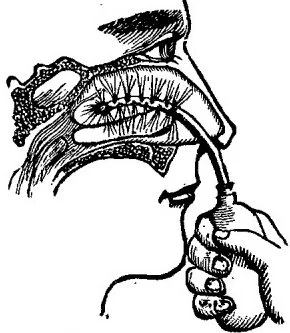
WOULD YOU Cure Your Catarrh?

If so, apply the medicine to the Nasal Cavity with the “Success” Nasal Syringe.
The best Syringe on the market for Nasal Catarrh.
The regular price of this Syringe is $1.
Sent postpaid on receipt of 75c.
Address, A. Mallett, 39 Bond St., New York.

SIR WILLIAM HARCOURT ON: SECTARIAN PUBLIC SCHOOLS.

[Christian Register, July 23, 1896.]
The attempt to introduce sectarian elements into the English Education bill brought out the withering sarcasm of Sir William Harcourt in his London speech: “If this government, or any government, aspire to deal with the education of the people, I should advise them to steer clear of the bishops. They are most excellent men, but they are the worst possible advisers. I have no doubt they are ‘as innocent as doves,’ but they are not ‘as wise as serpents.’ If we are to establish the education of the people upon a sound basis, let us establish it upon national, and not upon denominational, principles. Let us stand by the principle of popular election and popular control. The attempt on the part of the government first to cripple and then to absorb the school boards, is an attempt that has ignominiously failed, and it will not be repeated. The government tried to kill the school boards, and the school boards have killed the government. . . . There remains a good, sound basis of common sense in this nation, and it is that common sense, and not the obstruction of any party, which has destroyed the Education bill of 1896.”

WORSE THAN RUSSIA.

[The Truth Seeker, July 25, 1896.]
EVERY American, even those who are “patriotic,” must feel the force of the rebuke administered to our law-makers by a Russian Jew who, with three fellow craftsmen, was recently arrested in Williamsburg, N. Y., for working on Sunday. Said he:—
When we were in Russia, a despotic country where the Hebrew is hated, we were allowed to work on Sunday, because our Sabbath is the day before. We came to America, thinking it was a free country, but we find that the laboring man is more of a slave here than in Russia.
Americans are easily satisfied who can boast of a sort of liberty that is denounced as tyranny by a subject of the Czar.

A USELESS SCARECROW.

[An exchange prints this comment touching the traditional belief in the connection between Sunday desecration and divine judgments, which found voice recently on the occasion of a Sunday disaster on a Western lake.]
A religious paper solemnly tells its readers the gale that wrecked a Sunday excursion on Lake Pepin was a judgment of God. What then are the gales that carry ninety-nine per cent. of such excursions safely on to their desired haven? And what of the Monday gales that wreck churches and drive pious deacons to their cyclone cellars? God does not pay by the day. Nor has he given to any of us the keys to interpret his providences. Let us retire the ancient scarecrow as to Sunday judgments. Crows flock to it with laughter instead of fleeing from it. Sunday excursions are dangerous, but in a deeper sense.

BLESSING THE GROG SHOP.

[Present Truth (London, Eng.), July 23, 1896.]
THE Russian State has taken over the sale of spirits, and so the spirit traffic becomes a State monopoly. As everything the Russian State does is “Christian” it was fitting that the new departure should be inaugurated last week by religious services in many of the drink shops now transferred to the Crown. The modern “Christian” State blesses what God abhors, and curses that which God has blessed. How could it be expected otherwise when we know that Satan is “the God of this world,” and this world is composed of all the kingdoms of men? That is why we pray, “Thy kingdom come.”

MORE THAN HAS BEEN SUSPECTED.

The Sunday issue has become involved with the Prohibition issue, by reason of the compulsory holiday making an idle day, and by reason of diverting work for prohibition to prohibition one day in seven.
We have little suspected how much the civil sabbath, intervening in place of the divine Sabbath has fostered, and entrenched the liquor traffic in this country. It behooves Prohibitionists, and every one concerned about their issue, to scrutinize this matter quickly. See respecting this “The Only Alternative of Success,” by G. H. Lyon. The difference between the divine Sabbath and a civil sabbath is all a contrast.
The one makes a busy holy day, the other makes an idle day.
The one lifts up, the other drags down.
The one is the divine plan, the other is not.
Procure a copy of the pamphlet at once, and read. Price, 15 cents.
Address G. H. Lyon, Sistersville, W. Va.

OUR PREMIUM BIBLE AND WHAT THEY SAY OF IT.

“St. Helena, Cal. “The Bible was received June 11. Many thanks. It is a very fine copy. I prize it highly.”
“Broughton, Ohio. “Dear Sirs: I received my Bible the 12th in good condition and am well pleased with it. Thank you for the name on it. It seems to me to be the best bargain in Bibles I ever saw.”
“Rockville, Mo. “I received my Bible all right. Thank you; and it is a jewel. I am just delighted with it, and now I would so love to have five more. What can you afford to let anyone have them for?”
The above commendatory letters refer to the Minion Bible we have been, and are still, offering with the AMERICAN SENTINEL one year, for $3.00, but we wish to announce that we are now able to supply a Bible in every respect equal to the Minion Bible with the advantage of a much larger type (Bourgeois), which we can send, post-paid, together with the SENTINEL, one year, for $3.50. Look out for the advertisement of it in this paper soon.

“PITCAIRN ISLAND.”

One who has read the book, “The Story of Pitcairn Island,” says: “It is a most fascinating narrative and reads more like a romance than stern truth and a recitation of actual occurrences, as it really is.” The book is illustrated with twenty-six engravings by the half-tone process, and its twenty-three chapters have each a neatly-engraved heading; third edition, bound in cloth, embossed in jet and gold, price, post-paid, $1. Address Pacific Press Publishing Co., 39 Bond St., New York.

Scientific American Fiftieth Anniversary Number Review

THE 50th Anniversary Number of the Scientific American, New York, just out, is a really handsome and valuable publication of 72 pages. It reviews the progress of the past 50 years in the various sciences and industrial arts; and the various articles by the best scientific writers of the day are racily written and richly illustrated. The editors have accomplished the difficult task of presenting a compendium of information that shall be at once historical, technical and popular. The interest never flags for a moment, and the story of the half century’s growth is in itself a veritable compendium of valuable scientific information for future reference. Price, 10 cents per copy.

SAFETY PENCIL POCKET.

NEAT, CHEAP, SERVICEABLE.
It perfectly secures pen or pencil in the pocket, so that it can not fall out when stooping. Can be easily and safely attached to any part of the clothing. A small investment will prevent the loss of a valuable pen or pencil.

PRICES.

No. 1. Russia leather, for 2 pens 10c. No. 2. “ “ 3 “ 15c. No. 3. Sealskin, 2 “ 15c. No. 4. “ 3 “ 25c. No. 5. Russia leather, for 4 “ 25c. No. 6. Sealskin, 4 “ 40c.
Sent by mail on receipt of price. We guarantee these pockets superior in every particular to similar styles formerly sold and still offered at much higher prices.
PACIFIC PRESS PUB. CO.,
39 BOND STREET, - - NEW YORK CITY.

Russian Churches Filled Without Pews or Sunday Laws

“IN Russia,” writes Isabel F. Hapgood, in the Outlook, of June 20, “there is never any problem as to ‘how the men are to be induced to go to church.’ The churches are always thronged, and the men go more than the women. Moreover, the very poor go in a way which would rejoice the heart of a clergyman in New York, and the absence of pews, rented places, or seats of any sort brings about an ideal commingling of all classes which would suit the Christian theory, if not the Republican practice, of this country.” This suggests the query whether it would not be well for our “National Reform” clergy and statesmen, who are moving earth and trying to move heaven in their scheme for filling the churches, to spend some time studying the religious system of Russia. Evidently, it would be better to have some system, even as the Greek Catholic, which would fill the churches with willing and devout congregations, than to try to drive the people into them with the whip of Sunday “laws.”

The Devil-in-the-Schools Panic and Its Theological Roots

The devil-in-the-schools panic of recent occurrence in this city, which came so near involving the sacrifice of life, lays emphasis upon a popular theological error, but for which it would probably never have happened. The one with whom the scare originated affirmed that she “saw the devil,” and that he had “horns and three eyes.” If people would read their Bibles more, and especially if they would believe what the Bible tells them, they would know that the devil, if he could be seen by our eyes, would not appear as a hideous monster. The Scriptures declare that he was once “perfect in beauty” (Eze. 28:12), and though fallen, he is an angel still. It is because people imagine that where the devil is there must be something outwardly awful, that so many do not recognize him when he appears as an angel of light. 2 Cor. 11:14. This is one great reason of his success in leading people astray.

Family Religion and Family Government

“FAMILY religion and family government would do more to save the State than all the good government clubs.” So says the New York Observer, of May 28; and it states a truth very pertinent to the present situation.

Protestant Clergy, Politics, and the Papacy

THE Catholic Review, of August 1, alludes to several recent exhibitions of pulpit politics in various States and then inquires, “When will Protestant clergymen in their pulpits let partisan politics alone?” We can answer the query. It will be when they renounce the principles of the Papacy.

Massachusetts Debate Over Preaching on Public Commons

THE question is being agitated in Massachusetts whether the civil power has the right of “prohibition, by city or town law, of the free public preaching of God’s gospel to the common people on their own common lands.” The primary cause of the agitation seems to be the prohibition of preaching on Boston Common. The question is said to be on the docket which will come before the United States Supreme Court this fall.

Christ and Political Voting: An Adventist Reply

WE are told by some who think they are presenting to the people the Christian duty of the hour, that “the real Christian must ally himself on Christ’s side and work and vote for him.” This was said by one speaker at the late Christian Endeavor convention in Washington. In reply we would say that it will be time enough to “vote for” Christ when we find out to what one of the political parties he belongs. The political preachers have not yet informed us on this point, and our own vision fails to discover him in the present campaign. Indeed, so far as we can learn from Scripture, Jesus Christ was never in politics at all.

Sunday in Orthodox Glasgow: A Man-Made Sabbath

“SUNDAY in Orthodox Glasgow” (see page 246) is a forcible presentation of the undesirable nature of a man-made sabbath. “The Sabbath was made for man,” said its divine Author; it was not made to be against him, and is not against him, save as it is perverted by man’s additions and alterations. The Pharisees had a man-made sabbath—the “Jewish sabbath”—made by perversion of God’s Sabbath through their traditions. This is why they accused Christ’s disciples of breaking the Sabbath by plucking and eating some kernels of wheat in the fields. The Glasgow sabbath is simply the “Jewish sabbath” brought down to modern times.

Tiptonville Sabbath Prisoners See Improved Prospects

The outlook for the Adventists imprisoned at Tiptonville, Tenn., for Sunday work, has materially improved since our report last week. The latest word is that the costs charged against them have been greatly reduced by the non-claimance of fees by the witnesses for the prosecution, and the remission by the sheriff of his charges. In addition to this, $12, the equivalent of the overtime served by J. W. Lewis, has been deducted from the costs aforesaid, so that the amount is now reduced to about $8. Hence they will remain in jail not longer probably than the 5th of the present month. They are kindly treated by the jailer.

Catholic Press Denunciations of the A. P. A. Turned Back on Papacy

For months the Roman Catholic journals of the country have had comparatively little to say in any other line than that of denouncing the A. P. A. as a “dark-lanterned” “oath-bound” organization, secretly working to establish a religious boycott, etc. But the very denunciations in which they have been so prolific apply in full to the Papacy. That system has its secret, oath-bound organizations, is ever intermeddling with civil affairs, intolerant of all other classes, and ever plotting the overthrow of Republican government. That there are a great many members of the Catholic Church who do not know this and are honest in their profession both religiously and politically, does not affect the facts of the situation.

Christian Citizenship: Daniel's Example in Babylon

CHRISTIAN citizenship, as exemplified by Daniel in ancient Babylon (see illustration on first page), clearly shows that Daniel’s Christian citizenship had no connection with his residence or office in Babylon. By the act of praying with his windows open toward Jerusalem, the prophet testified that he sought another country than Babylon, and that in the latter he was but a sojourner. The same testimony was given by Abraham in his life. These men did not try to set up a Christian State, but they did seek a place in the eternal inheritance promised by the Lord to the faithful. Do we wish to be fellow-citizens with these glorious characters, and with those of all ages of whom this world has not been worthy? Then we must seek the same country which they sought, and we must seek it as they sought it—by faith.

Commons Vote on Sunday Opening of Museums

“The recent vote of the House of Commons in favor of opening museums, art galleries and libraries on Sunday,” says the New York Independent, “brings to an end the labors of the Sunday Opening Society, which is about to disband. On Sunday, May 23d, the number of visitors to the galleries and museums of London was 11,000. This is counted very satisfactory to the advocates of Sunday opening, among whom are the Earl of Rosebery, the Earl of Dunraven, Canon Barnet, of Bristol, and several bishops.” We fear the disbanding society will enjoy but a short-lived triumph.

Extra Copies of July 23 Issue Available

A LIMITED number of extra copies of our issue of July 23, containing the articles in reference to the Christian Endeavor convention, can be had at the usual price, one cent per copy. This is an excellent paper, and a good one to hand out to our Christian Endeavor friends.

You have reached the end of this edition.

The American Sentinel · Aug 6, 1896