The Youth’s Instructor, Vol. 65, No. 9.

God's Spotless Snow: A Carpet for the Coming Year
Earlier text: The Bat

Saved by a Hymn

I WONDER if you have heard the story of the two Americans who were once crossing the Atlantic and met in the cabin on Sunday night to sing hymns. As they sang the last hymn, “Jesus, Lover of My Soul,” one of them heard an exceedingly rich and beautiful voice behind him. He looked around, and, although he did not know the face, he thought that he knew the voice. So when the music ceased, he turned and asked the man if he had been in the Civil War.
The man replied that he had been a Confederate soldier.
“Were you at such a place on such a night?” asked the first.
“Yes,” he replied, “and a curious thing happened that night which this hymn has recalled to my mind. I was posted on sentry duty near the edge of a wood. It was a dark night and very cold, and I was a little frightened because the enemy was supposed to be very near. About midnight, when everything was still, and I was feeling homesick and miserable and weary, I thought that I would comfort myself by praying and singing a hymn. I remember singing this hymn:—
“All my trust on Thee is stayed, All my help from thee I bring; Cover my defenseless head With the shadow of thy wing.”
“After singing that, a strange peace came down upon me, and through the long night I felt no more fear.”
“Now,” said the other, “listen to my story. I was a Union soldier, and was in the wood that night with a party of scouts. I saw you standing, although I did not see your face. My men had their rifles focused upon you, waiting the word to fire, but when you sang out,—
‘Cover my defenseless head With the shadow of thy wing,’
I said: ‘Boys, lower your rifles; we will go home.’”
— Henry Drummond.
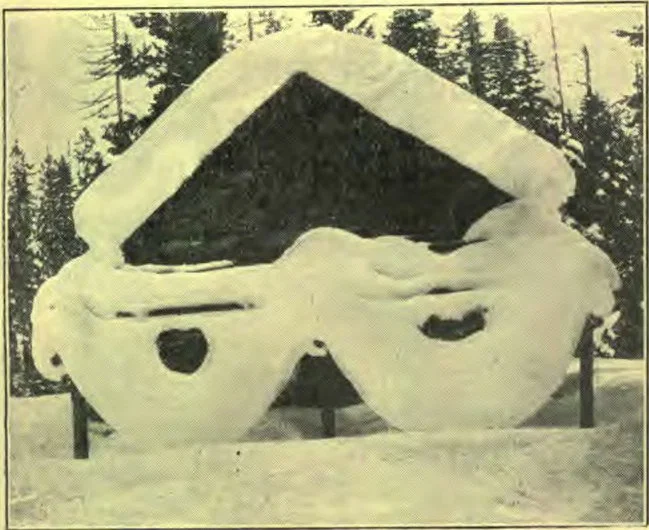
SNOW DRAPERY ON HOUSE ON MOUNT CRAIG, IDAHO

Helpful Ministry

CICERO, from Rome, said in a letter to Plautius: “Whatever friendliness you can show my friend Furnius, I shall take as done to myself.” The King of heaven says to all of us: “Whatever you can do to make life better for those near you, I will count as done unto me.”—J. M. Blake.

The Bible Year

Senior Assignment

March 4: Deuteronomy 23 to 25. Social and moral laws.
March 5: Deuteronomy 26 to 28. Blessings and cursings.
March 6: Deuteronomy 29 to 31. Mercy for the repentant; admonitions.
March 7: Deuteronomy 32 to 34. Song, blessing, and death of Moses.
March 8: Joshua 1 to 4. The new leader; the end of the journey.
March 9: Joshua 5 to 8. Obedience and victory; sin and defeat.
March 10: Joshua 9 to 13. Days of conquest.
For notes on this assignment, see the Review for March 1.

Junior Assignment

March 4: Numbers 23. Balaam blesses Israel.
March 5: Numbers 24. Balaam prophesies of Christ.
March 6: Numbers 35. The cities of refuge.
March 7: Deuteronomy 32. The song of Moses.
March 8: Deuteronomy 33. The blessing of Moses.
March 9: Deuteronomy 34. The death of Moses.
March 10: Joshua 1. Joshua, the new leader.

Cities of Refuge

This week's reading is crowded with interesting things, isn't it? There is the strange story of Balaam. Then we have the account of the death of Moses, that great leader of God's people. How these things stir our imagination! How wonderful it would have been to stand with Moses on Pisgah's lovely height while he “gazed with undimmed eye upon the scene spread out before him.” But if we are faithful, we shall see greater sights. We shall stand with the victorious throng on the sea of glass, and sing the song of Moses and the song of the Lamb,—the song of victory.
Another very interesting topic is the cities of refuge. In the East in ancient times, they had what seems to us a strange custom. If a person was slain, it was the duty of the nearest relative to pursue the murderer and kill him. Oftentimes in the excitement and anger no distinction was made between those who purposely killed another and those who might slay some one by accident. To prevent such injustice where possible, these cities of refuge were established. There were six of them,—Bezer, Ramoth in Gilead, and Golan, east of the Jordan; and Hebron, Shechem, and Kedesh, west of the river. They were so located as to be within a half day's journey from any part of the land. The roads leading to these cities were to be kept in repair, and there were signposts erected along the way, bearing the word “Refuge,” to guide the fleeing one the right way.
Once in the city, the fugitive was given a hearing before the elders. If this was satisfactory, he was given refuge, and later a regular trial was held, probably in the community where he had lived. If it was proved that the killing was not wilful, then the slayer was given a home in the city of refuge until the high priest's death, when he was free to return home unmolested. If he was found guilty of intentional murder, he was turned over to the avenger of blood. No murderer was allowed to pay money and go free, but must pay with his life.
It seems that in Israel the altar in the temple was also recognized as a place of refuge. (See Ex. 21: 12-14; 1 Kings 1: 50.)
One can imagine how a man who killed another would drop everything, and flee for his life to the city of refuge. With what fear and hope he would hasten toward the place, with perhaps the avenger in hot pursuit, and with what joy would he rush through the gate to safety.
We are told in “Patriarchs and Prophets” that “the cities of refuge appointed for God's ancient people were a symbol of the refuge provided in Christ.” By the shedding of his blood, Jesus has provided for sinners a sure retreat, and our enemy is not able to destroy us when we go to him.
“He who fled to the city of refuge could make no delay. Family and employment were left behind. There was no time to say farewell to loved ones. His life was at stake, and every other interest must be sacrificed to the one purpose,—to reach the place of safety. Weariness was forgotten, difficulties were unheeded. The fugitive dared not for one moment slacken his pace until he was within the walls of the city.
“The sinner is exposed to eternal death until he finds a hiding place in Christ; and as loitering and carelessness might rob the fugitive of his only chance for life, so delays and indifference may prove the ruin of the soul. Satan, the great adversary, is on the track of every transgressor of God's holy law, and he who is not sensible of his danger, and does not earnestly seek shelter in the eternal refuge, will fall a prey to the destroyer.
“The prisoner who at any time went outside the city of refuge was abandoned to the avenger of blood. Thus the people were taught to adhere to the methods which infinite wisdom appointed for their security. Even so, it is not enough that the sinner believe in Christ for the pardon of sin; he must, by faith and obedience, abide in him.”—“Patriarchs and Prophets,” p. 517. M. E. K.

Missionary Volunteer Society Programs for Week Ending March 10

THE programs for this date, with notes, illustrations, and other helpful material, will be found in the Church Officers' Gazette for March.

The Missionary

THE Lord of love with him has gone; The gleam is ever by his side; He has that hand to lean upon, And O, the weary world is wide!
Wide as the gloom the dawn-light leavens, Till far upsoaring skies shine out, Where all the winds of all the heavens Blow east and west and north-about.
The night is dark; the way is steep; Salt are the seas he has to swim; Lions shall roar about his sleep; Hunger and thirst shall visit him.
What dens of darkness shall he thread! What desert marches make! what foes About his way their snares shall spread, While mighty armies round him close!
But with the Presence ever near, As holy powers keep watch and ward, He goes without a pang of fear, And heartened by the living Lord! —Harriet Prescott Spofford.

X — Paul’s Visit to Macedonia

(March 10)
LESSON SCRIPTURE: Acts 20: 1-3; 6-14; 2 Cor 9: 1-8.
MEMORY VERSE: “This is my commandment, That ye love one another, as I have loved you.” John 15: 12.

Questions

1. After the riot described in our last lesson, what did Paul do? Acts 20: 1. Note 1.
2. What was his work in the churches? To what country did he then go? Verse 2.
3. How long did he stay in Greece? Who laid wait for him? At what time did they plan to take him? What change did this cause in his plans? Verse 3.
4. Where did his seven companions wait for him? Verses 4, 5. Note 2.
5. How had Paul told the Corinthians to prepare for the collection for the poor? 1 Cor. 16: 1, 2.
6. How did he commend their generous spirit? 2 Cor. 9: 2.
7. Who was sent to receive their offering? Why did Paul write to them? Verses 3-5.
8. How should we give to the Lord? Whom does he love? Verse 7.
9. What church did Paul visit? How long did it take to sail from Philippi to Troas? Acts 20: 6. Note 3.
10. What did the Christians do on Sunday? Was this day called the Sabbath? When was Paul to depart? How long did he preach? Verse 7. Note 4.
11. What is said of the place where they met? Who sat in a window? What accident occurred? Verses 8, 9.
12. How was mourning turned to joy? Verse 10. Note 5.
13. How was the remainder of the night spent? Who was there with the rest? Verses 11, 12.
14. To what place had the other brethren sailed? What did they plan to do there? How was Paul to journey till he met them? Verse 13. Note 6.

Questions for Diligent Students

1. What case of healing in the Old Testament do you find similar to the one in this lesson?
2. Prove that Paul counted Sunday as a common working day.

Notes

1. We now begin Paul’s third missionary journey. Review the first and second before beginning this.
2. During Paul’s visits to the churches he collected money for the poor brethren in Jerusalem. Seven brethren went with him from among the Gentile churches, that all might know that the funds reached their destination, and were used as planned. These delegates went to Troas and waited for Paul, while he and Luke went by Philippi.
3. “At Philippi Paul tarried to keep the Passover. Only Luke remained with him, the other members of the company passing on to Troas to await him there. The Philippians were the most loving and true-hearted of the apostle’s converts, and during the eight days of the feast he enjoyed peaceful and happy communion with them.”—“The Acts of the Apostles,” pp. 390, 391.
4. In Conybeare and Howson’s “Life and Epistles of the Apostle Paul,” this statement is made on page 520: “It was the evening which succeeded the Jewish Sabbath. On the Sunday morning the vessel was about to sail. The Christians of Troas were gathered together at this solemn time to celebrate that feast of love which the last commandment of Christ has enjoined on all his followers.”
Paul knew that he must depart the next day, and feeling that souls might be lost if they were not fully warned, continued to talk until after midnight.
5. “In one of the open windows sat a youth named Eutychus. In this perilous position he went to sleep, and fell to the court below. At once all was alarm and confusion. The youth was taken up dead, and many gathered about him with cries and mourning. But Paul, passing through the frightened company, embraced him, and offered up an earnest prayer that God would restore the dead to life. His petition was granted.”—“The Acts of the Apostles,” p. 391.
6. It took a day to sail from Troas round a promontory to Assos. Paul chose to walk across, a distance of about ten miles, and this gave him time to stay longer with those he loved.

The Meaning of the Vote

“THE liquor traffic tears down manhood; wrecks homes; lessens one's usefulness; inflames the passions; loosens the tongue of slander; poisons thought; fills almshouses and prisons; defiles the ballot box; makes miserable families; prompts to wrong-doing; prepares one for hell; desecrates the Sabbath; endangers property and personal safety; militates against insurance; invites laziness, profligacy, idleness, and crime; peoples the station houses, prisons, and chain gangs; destroys the soul; invites the incendiary to apply his midnight torch; and robs a man of his money, family, happiness, good name, his hope, and all the endearments of life. If you think this a good business to license, cast your vote for it.” But remember your vote makes you responsible in part for all the dire results of the business.

A Christmas Neglect

“BETH, don't you think ‘the Christmas spirit’ one hears so much about at the Yuletide, is limited in its application?”
“Why, I had thought the Christmas spirit too widespread, almost universal, rather than too limited, for I know many persons often spend much more than they can afford, simply because they are carried away by what is called the Christmas spirit. It certainly is both contagious and infectious.”
“O yes, that is true; but I mean the material seems to transcend the spiritual in the minds of many. It is the making of gifts that takes first place in the thought, whereas the proper reception of gifts is just as much a part of the true Christmas spirit. Perhaps the reason for my pessimistic view is that I sent a very pretty and somewhat expensive gift to a friend this Christmas. I expected a prompt recognition of the gift, but no word has yet come. She is a busy young woman, but every one can find time to write a brief note acknowledging and expressing appreciation of a gift. To neglect to do this, is not only discourteous, but reprehensible.”
“Yes, I had a similar experience last Christmas. I spent a great deal of time making a piece of lingerie for a friend. I crocheted lace for it, and embroidered the garment elaborately. It was not until March that the gift was acknowledged, and then no apology was made for the delay. You may be sure that this year I transferred my effort to one whom I believe to be more appreciative.”
“If we were the only sufferers, we might comfort each other, and think no more about the matter, but frequently I hear of some one else who has received no word from the recipient of a gift. Cannot something be done to provoke greater care in this direction? Cannot a sort of publicity or ‘safety first’ campaign be inaugurated?”
“Yes, why not secure the coöperation of all the clubs in the city in such a campaign; have a paper read at each club meeting, in a given month, allowing time after the paper is presented for lively discussion of the subject. Reporters can be given a tip, and consequent upon this publicity, round tables will be held at the homes, which no doubt will work a reform on the part of some at least.”
“That is a capital idea! Let's get it to working right away. Carnegie ought to give us a medal for this heroic venture to save injured feelings.”

Disarmament

“Put up the sword!” The voice of Christ once more Speaks, in the pauses of the cannon’s roar, O’er fields of corn by fiery sickles reaped And left dry ashes; over trenches heaped With nameless dead; o’er cities starving slow Under a rain of fire; through wards of woe Down with a groaning diapason runs From tortured brothers, husbands, lovers, sons, Of desolate women in their far-off homes, Waiting to hear the step that never comes! Oh, men and brothers! let that voice be heard. War fails, try peace; put up the useless sword! — John Greenleaf Whittier.

Mr. Roosevelt’s Idea of Good Citizenship

“The first requisite of good citizenship is that the man shall do the homely, everyday, humdrum duties well. A man is not a good citizen—I do not care how lofty his thoughts are about citizenship in the abstract—if, in the concrete, his actions do not bear them out; and it does not make much difference how high his aspirations for mankind at large may be, if he does not behave well in his own family those aspirations do not bear visible fruits. He must be a good breadwinner, he must take care of his wife and his children, he must be a neighbor whom his neighbors can trust, he must act squarely in his business relations—he must do all those everyday, ordinary duties first, or he is not a good citizen. But he must do more. In this country of ours the average citizen must devote a good deal of thought and time to the affairs of the State as a whole, or those affairs will go backward; he must devote that thought and that time steadily, intelligently.”

Bits of Wisdom

“You are successful if your true character is expressing itself harmoniously in your daily work.”
“You cannot be neutral where any man is concerned, save at your peril. You have got to take an interest in him. You must recognize his status. The measure of your indifference is the measure of your guilt.”
“The noblest work and the bravest deeds — all of them — are always done at the call of interests not personally one’s own; they are done for the other fellow.”
“What you want is an alert, critical eye to your own defects — and those of your neighbor; and then to go on loving him with a whole heart, just as you love yourself in spite of all your ugly little ways.”
“It is not enough to do the best we know; we must know the best to do.”

Extravagant Fall Shopping for Children's Linen

A FOND mother from the Middle West, whose husband not many years ago wore overalls, but whose income has recently become troublesomely large, arrived in New York to do her fall shopping for three small children. Among what she conceived to be their requirements was an outfit of linen for each. She visited one of the smart linen shops on Fifth Avenue, and in a single afternoon her purchases of linen for her three children amounted to more than seventeen thousand dollars. Each child was equipped with bibs that cost twenty-five dollars apiece. Whether or not that is extravagance is a question which every one may settle individually. The man's income is computed at one hundred thousand dollars a week, and incidentally, you would not recognize his name if it were given.—Saturday Evening Post.
THE EARLY MORNING OFTEN FOUND JESUS IN SOME SECLUDED PLACE, MEDITATING, SEARCHING THE SCRIPTURES, OR IN PRAYER.

You have reached the end of this edition.

The Youth’s Instructor · Feb 27, 1917