THE bat is a much misunderstood and misused creature. It is no uncommon thing for hunters returning from a day of sport to sharpen their shooting eye by taking shots at the common leatherwing bat, which begins to fly just before nightfall; or for large parties to journey to the fields in the vicinity of swamps, and shoot at the species commonly known as bull bats.
This is a pernicious practice, for the bat is the natural enemy of the mosquito. This flying rodent hunts its food through sense of hearing; it will follow a large moth around an electric light for some seconds before devouring it. The bat will attack only such insects as emit certain tones in their flight, and their dips, dives, and circles are made as its hearing brings it in range of some favorite insect.
The efficiency of bats in destroying mosquitoes has been proved by experiences at Mitchell Lake, a malarial locality some miles from San Antonio, Texas. All the sewage of San Antonio, some ten millions of gallons daily, flows into Mitchell Lake, and in the past it had been the breeding place of millions of mosquitoes. The locality is now entirely free from mosquitoes, thanks to the mosquito-devouring bats that were encouraged to make their homes in specially constructed bat roosts.
An experiment made by C. H. R. Campbell, M. D., showed conclusively that bats are the foes of mosquitoes.8Tens of thousands of mosquito eggs were placed in a tub of water, to which was added some organic matter to furnish food for the larvae. This tub was placed in a room, the doors and windows of which were screened. In the course of time all the eggs hatched out, and the room was filled with mosquitoes. At night, after the mosquitoes had developed into adult insects, the buzzing noise could be plainly heard several feet from the room. On one occasion the doctor entered the room with a darkened electric flash light and liberated two bats. Instantly the buzzing noise ceased, and on turning on the light it was found that the mosquitoes were clinging motionless to the wall.
The vibrations of the mosquito wings cause the well-known sounds, and to protect itself from the bat, the mosquito must stop its flight. The bat is protected from the bites of the mosquito by the peculiar formation of its hairy covering, which instead of being a round shaft, like ordinary hair, consists of lances and pockets, like morning-glories strung on a straw, with the edges of the flowers terminating in points and the bells outward.—Illustrated World.
A Short Cut
“Why that forlorn expression on your face, Jack?” asked Uncle Henry, as he saw how puzzled the boy was in his effort to divide accurately a 9¾-inch board into four equal parts.
“This looks easy enough,” said Jack, “but every time I try to divide it one division or another is larger than the rest. I am sure I shall never be enough of a mathematician to make a first-class carpenter; guess I shall have to be a doctor.”
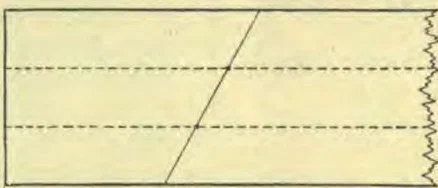
Short cut for dividing a 10½-inch board into three parts
“Aren’t you drawing conclusions too early?” said his uncle. “You have not yet learned the secrets of the trade. Now if you will make your ruler measure obliquely just 10 inches across your board, and then will make a dot on your board on every 2½ inches (one fourth of ten is two and a half), you will have the divisions indicated accurately. Or, if you have a 10½-inch board, and wish to divide it into three equal parts, place the ruler across the board so that the oblique measurement will be just 12 inches, which is a multiple of the number of parts into which it is to be divided. Then at every fourth inch mark, place a dot on your board. Now mark your divisions through these dots.”
“That is worth a box of candy, Uncle Henry. I wonder if all my troubles could be solved as easily if I only knew more.”
“Very likely; knowledge is a wonderful dissolver of troubles. Now let us make sure you have the idea so clear that no trouble of this kind will ever again hinder your work or ruffle your good nature.”
“Well, let me see,” said Jack, thinking up a problem. “I can divide a board 11 inches wide into seven equal parts by placing a ruler across it so that the oblique measurement is 14 inches, and then mark off every 2 inches; or mark off every 3 inches on an oblique line measuring 21 inches.”
“I will trust you after this to waste neither energy nor time puzzling over such a simple proposition as the accurate division of a board,” said Jack’s uncle.
“Now I am anxious, uncle, to learn more of the carpenter’s short cuts, and I believe I shall after this give more attention to my arithmetic too.”
Germany’s Substitutes
ACCORDING to the Associated Press, since the war Germany has been very successful in manufacturing for herself or in finding substitutes for imported articles, such as,—
Saltpeter, Aluminum, Oils, Rosin, Graphite
“Before the war she imported annually over $40,000,000 worth of saltpeter for agricultural and ammunition purposes, mainly from Chile. Today factories are manufacturing saltpeter, so that Germany is now able to supply the amount necessary for ammunition and for fertilizers.”
“Before the war the supply of bauxite for the manufacture of aluminum had been imported from France, and the cutting off of this supply led German scientists to discover a process of aluminum manufacture by electricity from ordinary clay.”
“Chemical experts in the German coal fields have discovered new ways of extracting oils from their coal, partly relieving the serious condition resulting from the cutting off of mineral oil products, which, in 1913, amounted to no less than $277,000,000.”
“Germany lost practically all of her imports of rubber, and to offset this shortage she has substituted steel for rubber in innumerable cases. Further, the perfection of the submarine merchantman made it possible to bring in considerable new rubber to mix with the old in the creation of a regenerated or synthetic rubber. The supply of this has been developed, until now it is said to be sufficient for another eight months.”
“Ceylon was the exclusive source of supply of graphite used in Germany before the war. Since then Germany has been dependent entirely upon the inferior Bavarian graphite; but German chemists have been able to find a process by which the Bavarian article can be purified to a 97-per-cent standard.”
“Supplies of rosin had come exclusively from America and France, but German chemists have now become able to produce all that is needed from the German forests, or are able to use as a substitute the by-products of wood and coal.”
“Paper has been adapted in innumerable instances to serve for cloth. By using protoxide of sodium, sulphite cellulose, and paper, a very durable and satisfactory thread has been evolved, which, in turn, lends itself to the creation of sacks and bags, girdles, doilies, aprons, working garments, wrapping cloth, and thread and string. The inventors have discovered a way to give the ‘paper-cloth’ great resistance to dampness.”
“Almost the only ‘unsubstitutable’ substance has been copper, but there has been found to be plenty of that on hand in German industrial plants elsewhere. In place of the copper thus taken by the government there have been installed aluminum and zinc, out of which wires and utensils of various sorts have been fashioned. In addition, zinc has been found to do just as well as copper in the manufacture of a score of articles in everyday use, and is a good substitute also for brass and bronze. Iron and steel also substitute satisfactorily in dozens of other cases. Zinc and aluminum and zincked iron find their use now in switchboards and the like, in place of marble or slate.”
Substitutes for Foods
“Imitations have played almost if not quite as large a part as substitutes for foodstuffs, of which a shortage9has been created by the war. Many of the imitations are of doubtful nutritious value. The grain supply of the empire, originally not near enough for the consumption of 70,000,000 of people, has been ‘stretched’ by potato flour. And now that the potato crop is almost a failure, potato flour will itself be substituted by barley during the first half of the present year.”
The Best Accomplishment
By Orison Swett Marden
“‘I WILL grant each of you one wish,’ assented Fate to three women,” said a writer in a magazine article.
“‘I choose beauty,’ exclaimed the youngest.
“‘Give me power,’ said another.
“‘Give me a low, persuasive voice,’ the last murmured.
“Each had her wish. The beauty of the first was ruined by an accident. The power of the second lasted but one season. But the third woman kept her talisman through a long life, and from it came many things, among them power.”
If you have a pleasing voice and can talk well, every one with whom you converse will be influenced by your power. This will give you more satisfaction and do more to help you win your way in life than any other social accomplishment.
A great many people are troubled by not being able to find topics for conversation. They are in the position of Artemus Ward, who, when called upon to make a speech without a chance to prepare, said, “I have the gift of oratory, but I haven’t it just now with me.” These people have the gift of speech, but they have nothing ready to say.
There is a good suggestion for them in the advice which Longfellow once gave to a young friend: “See some good picture,—in nature, if possible, or on a canvas,—hear a page of the best music, or read a great poem every day. You will always find a free half hour for one or the other, and at the end of the year your mind will shine with such an accumulation of jewels as will astonish even yourself.”
Also read a good newspaper and some of the best magazines.
All these things will give you food for thought and raw material for conversation. Practice talking about anything and everything you see and hear and read, your experience during the day, whatever interests you or arouses your attention. There is practically no limit to the topics of conversation available to the keen observer, the intelligent reader and thinker. Make use of these topics.
While conversation is not “swapping stories,” a practice much in vogue among Americans, a fund of anecdotes, apt and to the point, are a great aid in brightening talk or in illustrating a point one wishes to make.
Lincoln was master of the art of using anecdotes with the best effect. He knew the value of a hearty laugh in melting reserve and putting those he was talking to on a more intimate and familiar footing. He put people at ease with his stories, and made them feel so completely at home in his presence that they opened up their mental treasures to him without reserve. Strangers were always glad to talk with him because he was so cordial and quaint, and always gave more than he received.
To make yourself interesting and to hold attention, you must enter into the life of the people you are conversing with, and touch them along the lines of their interest. No matter how much you may know about a subject, if it does not happen to interest those to whom you are talking, your efforts will be largely lost. The best conversationalists are always tactful—interesting without offending. Neither do they stab people, hurt their feelings, or drag out their family skeletons, for the sake of making a witty remark.
To listen courteously and give others a chance to express themselves is as much a part of conversation as talking. The most popular conversationalist is the one who gives others a chance to reply. To be a good listener is a cardinal point in good manners, and will win more laurels than the most elaborate one-sided discourse. Indeed, the man or woman who monopolizes the talk—a monologue cannot be called conversation—is the most dreaded of all bores. Even one’s best friend grows tiresome when the talk is one-sided; when it does not permit an interchange of ideas, which is the very essence of conversation.—Orison Swett Marden, in Washington Herald.
The Ruined Gate
By I. F. Blue
IN northern India, near Najibabad, is an old fort built some three or four hundred years ago by Najeb-u-Daulah, from whom Najibabad was named. It was a formidable fort for the time. The walls are about thirty-five feet high and fifteen feet thick, and made of very hard stones that have defied the elements. Here and there in the wall are dents made by cannon balls in a siege of some former time, but there has been no damage done. The inmates must have felt secure behind the massive walls, and well they might in those times.
The gates are made of very hard wood and covered with iron. In size, each gate is thirty feet high, twenty feet wide, and about a foot thick. On the outside the gates bristle with sharp spikes, to keep any one from climbing up. I tried one gate, and found that it moved easily on its hinges, and that it still was in perfect condition. But the other gate was broken down and ruined. I looked for the cause. It had not been battered down by cannon, nor burned; but one corner had touched the ground, and the white ants had eaten the wood and ruined it. The gate that had defied the assaults of enemies and had stood the test of the elements, was lying broken and useless,—ruined by the smallest of insects. What a lesson for us as young people! Satan’s most successful plan of attacking the young is to get them to associate with the world. It may seem harmless to join the world in some things, but we will find to our sorrow that it is the plan of the enemy to deceive us, and ruin us to the cause of God. Let us keep close to Christ and “unspotted from the world.” I. F. Blue.
Missionary Volunteer Bible Year Reading Leaflets
The Missionary Volunteer Department has issued leaflets giving the assignments for both the Senior and the Junior Bible Year. It is designed that these shall be kept by the reader in his Bible, and that he shall after each day's reading cross out the assignment. This is a happy way to keep a record of one's reading. Sabbath school workers could use these to advantage in their divisions and classes. Hand them out to be used through the year, with the request that all be returned to you properly marked at the close of the year.
The Fifer’s Powder Horn
The butcher has just killed five steers. Come on, boys, that means ten new powder horns!” shouted a ragged soldier to his comrades; and with a rush the men surrounded the butcher.
“What can I do?” he gasped; “I have only ten horns and there are at least thirty of you. Stand back, I beg of you!”
The butcher gathered his horns into his apron, and looked from one to another of the excited men.
“Come, come, Master Ritter, give us the horns!” And the mob surged about the poor butcher until he stumbled and fell in the snow.
Just then a tall figure clad in a long coat of buff and blue was seen riding toward them on his white horse. At his side rode a young man with auburn hair and keen bright eyes.
“What is the matter, my men?” said a quiet voice. And the ragged men stood in confusion, and saluted their general, for it was Gen. George Washington, who, with the young French officer, Lafayette, had suddenly surprised them.
The men were so embarrassed that they could not explain, but pointed toward the butcher; and he, poor fellow, had not a word to say. The general looked from one to another, when a sixteen-year-old fifer stepped out from the group and explained matters:—
“The difficulty is this, sir: Master Ritter has ten horns from the cattle he has just slaughtered, and we were all wrangling for them. I never have had a horn, sir, and if I’m old enough to fight, I should have one. Can you not decide how this division can be made?”
General Washington looked in pity at the line of ragged, determined soldiers. They were very poorly clad; some were without shoes, while their feet were wrapped in rags to keep them from freezing. And yet these men were quarreling for powder horns, for they did not have the simplest tools of warfare.
“You ask me, as a third party, to advise you? Very well. Come, follow me to the nearest hut, and you bring the horns, Master Ritter.”
The men crowded into the rude little hut after their leader. He took paper from a pamphlet, and with a bit of charcoal wrote a number upon it and put it in his pocket.
“I have chosen a number between fifteen hundred and two thousand,” he said very quietly, “and the ten men who guess the nearest to that number may have the ten horns.” Then he gave the men slips of paper, and each wrote his number on it. One man guessed correctly,—1776,—and received the first prize. The young fifer was fortunate enough to be one of the nine others who came nearest to the number, and so he won his first powder horn.
As the men left the lowly hut, Lafayette said: “Come, boys, let us cheer the wise general;” and they all tossed their caps and cheered the commander-in-chief. Then they gave a cheer for the Declaration of Independence, and one for the soldier who wrote the number of that eventful year.
And as Washington rode away through the snowy street, the men looked after him with admiration and pride.
Who would not follow such a leader in the battle? Who would not be willing to wait patiently during a long winter of cold and hardship while he was near by, suffering with them and encouraging them? And each man in that group, whether he had won a powder horn or not from the hands of his general, had won something far more valuable—a feeling of loyalty and love for their commander and of renewed devotion to their country and the cause of liberty.
Was not Washington, as Lafayette said, a wise general?
The old stone house at Valley Forge, which was the home of the Quaker, Isaac Potts, and which was used by Washington as his headquarters that winter, is used as a museum today, and in this house may be seen an old powder horn which is marked:—
Jabez Rockwell—Ridgeway,
Conn.
His horn, made in camp at
Valley Forge
First used at Monmouth
June 28th, 1778
Last used at Yorktown
in 1781
It is the horn won by our young fifer, Jabez Rockwell by name, that day at Valley Forge. His great-grandson gave this horn to the museum, and his great-granddaughter told me this story just as I am telling it to you today.—Ladies’ Home Journal.
Ellen’s Lesson
By Ella S. Paap
ELLEN was the possessor of a very practical nature, and did not always understand as fully as she wished to the relationship between faith and works, of asking God to do for us and of doing our utmost ourselves to accomplish a desired end. Now Ellen was a lover of the Lord Jesus, and daily sought to learn more of the ways and teachings of the lowly Galilean. She trusted that sometime she would understand more perfectly.
I shall pass on to the INSTRUCTOR readers an incident which helped her to understand God’s ways better.
To reach their nearest large town, Ellen had to walk two and a half miles to a small railway station, and then go fifteen miles by train. She thought she had11allowed three quarters of an hour to walk to the station and have plenty of time, so what was her surprise and chagrin when she called at the postoffice on the way, to find that there were but fifteen minutes to train time when her watch indicated more than thirty.
She had an important engagement to fulfil in the town, and would be greatly disappointed if she had to break it. “Ask the Lord to help you to catch the train,” flashed across her mind. Then followed a mental dialogue:—
“No, God doesn’t do things like that. If people aren’t in time for trains, they miss them, that is all.”
“But God knows and understands even the smallest details of our lives, and delights to have his children ask him for small favors as well as for great blessings.”
“Yes, I know, but I wonder if he would be pleased to have me ask such a favor as to be in time to catch that train.”
“I know all things are possible with God. He could send a motor car or buggy along to hasten me on my way, or the train could be late. Yes, it is possible for God to do it, if—well if he felt it was a suitable request.”
After deciding to make the request, she realized she must show faith, and really believe that God would do that for which she asked him. Then she wondered how she would show that belief—should she walk deliberately as she had meant to do, thinking she had three quarters of an hour in which to reach the station, and trust God to get her there; or should she do the very most she could do for herself, and trust God to do the rest? She decided the latter course would be the right way, and hastened on with all speed. She fully expected to reach the train in time, even though running as she was, she could not make it in the time that remained, and she could not run all the way. If God was to send a vehicle along to take her to the station in time, why hurry so? It would not hasten matters. Still, she thought, “I must do all I possibly can, and trust that God will do for me that which I am unable to do.” So thinking, she pressed on as rapidly as her fast-beating heart and tired limbs would allow her.
Several times she glanced back, hoping, expecting to see some conveyance coming that could take her to the station, but each time only to be disappointed. But one lone figure scuttled along that country road, and that was her own. Someway, though, she felt sure, positively sure, God was not going to have her miss that train when she was determined to trust him about it.
Not a person did she see until she was within one half or three quarters of a mile of the station. It wanted but a few moments of train time, and she was so weary she felt she could run no farther.
Just then an old man in a gig, driving a draft horse, coming from the station, came in view. Of course he was going the wrong way. Ellen wondered if “doing all she possibly could herself” would include asking this man—a complete stranger—to turn around and drive her back to the station. Ellen was independent, and much disliked asking favors, but, still hurrying on, she decided it would be included in what was possible for her to do, therefore she would ask him if necessary.
But now he had reached her and drawn rein, and cheerfully inquired if she was going to catch the mail train. “Yes, I hope to catch it,” Ellen replied. “Well, you better get in and let me drive you back to the station; you must be tired, and I fear you won’t catch the train.” Ellen was soon by his side and speeding as fast as the heavy draft and his aged driver could take her.
The train was in sight when they reached the station, but Ellen had time to thank her unknown benefactor, who knew nothing of the part he was acting in the answering of her prayer.
God had truly worked, and impressed the old man’s heart to take her back the little distance that remained; but if Ellen had been two or three hundred yards farther back, even if the aged man had been willing to return to the station, they must have missed the train. Nor did Ellen forget to thank her heavenly Father, not only that he had answered her prayer, but for the lesson that she felt her heavenly Teacher had been giving her upon the fundamental principles of prayer and its answers. ELLA S. PAAP.
For the Finding-Out Club
1. WHERE is the great Rock of Gibraltar, and for what is it used?
2. What is the greatest rock in America? Why is it so regarded?
3. Where was the first English settlement made in this country?
4. Where is Independence Hall, and why does the building bear that name?
5. Why is the little wooden bridge across the Concord River, Massachusetts, one of our most famous bridges?
6. Locate the following universities and colleges: Princeton, Dartmouth, Cornell, Harvard, Yale, Amherst, Mt. Holyoke, Smith, Tufts, Vassar, Columbia, Oberlin, Radcliffe, George Washington, and Bryn Mawr.
7. For what are West Point and Annapolis noted?
8. Where is Fort Sam Houston? Why was it so named?
9. What is the Alamo sometimes called? What does the expression “Remember the Alamo” mean?
Answers to Questions in “Instructor” of January 23
1. John Wesley preached in Georgia to the settlers and Indians. He sailed from Gravesend, England, October, 1735, and landed on the banks of the Savannah River, February, 1736. While in Georgia he organized at Savannah what is said to have been the first Sunday school in America.
2. Charles II had determined to conquer the New Netherlands, and in March, 1664, granted that province to his brother James, Duke of York. On September 8 of that year, Col. Richard Nicolls, with an English force, landed at New Amsterdam, and Stuyvesant, who was then governor, was compelled to surrender the city. Upon taking possession, Colonel Nicolls, as agent for the Duke of York, renamed the city New York, and became its governor.
3. The Northwest Territory was at first a general name given to all the districts of British North America lying northwest of the St. Lawrence basin. In the British North America Act of 1867, provision was made for the admission to Canada of “Rupert’s Land and the Northwest Territory.” Manitoba was formed out of this district in 1870. The territory remaining was then called the “Northwest Territories.”
4. The genealogical researches seem to have established the connection of the Washington family with the Washingtons of Sulgrave, England. The brothers,12John and Lawrence Washington, appear in Virginia in 1658. John took up land at Bridges Creek, and died in 1676. His eldest son, Lawrence, married Mildred Warner, and to them were born three children, John, Augustine, and Mildred. Augustine married twice. By the second marriage, in 1730, there were six children, of whom George Washington was the eldest.
5. The Pilgrims were those Puritans who, having broken away from the Church of England, had in 1608 emigrated to Holland, and, after living a dozen years in Leiden, determined to go to the wildernesses of the New World, in order that they might live less as strangers in a strange country, and might rear their children where their mother tongue was spoken. The Pilgrim Fathers, with their wives and children, as borne by the “Mayflower,” which landed at Plymouth Rock in 1620, numbered one hundred and two. Miles Standish, William Bradford, Edward Winslow, John Carver, and William Brewster were among the number.
6. Anthony Wayne, called “Mad Anthony,” was an American general. He was a surveyor in early life, and later held various offices in the army. Upon Washington’s recommendation he organized a new light infantry corps, with which he performed the most daring exploit of the War of Independence—the recapture of Stony Point by a midnight attack at the point of the bayonet. This well-planned enterprise aroused the greatest enthusiasm throughout the country, and won for him the popular sobriquet “Mad Anthony.”
7. After the expiration of Burr’s term as Vice-President (March 4, 1805), he visited the Southwest, and became involved in the so-called conspiracy which has so puzzled the students of that period. The traditional view that he planned a separation of the West from the Union is now discredited. The objects of his treasonable correspondence with Merry and Yrujo, the British and Spanish ministers at Washington, were, it would seem, to secure money and to conceal his real designs, which were probably to overthrow Spanish power in the Southwest, and perhaps to found an imperial dynasty in Mexico.
8. It is almost certain that North America was reached by Northmen about 1000 A. D.; and it may have been visited by isolated bands at various times before the rediscovery by Columbus in 1492.
New York Shopping
LAST year those incredibly rich South Americans, who before the war had always made an annual pilgrimage for several months to Paris, became a definite factor in New York life. Added to this group there are this year a large number of Cubans who have grown fabulously rich through the rise in price of sugar. Like the South Americans, they arrive with their wives and relatives and troops of children and nurses and maids, hire vast suites at a hundred dollars a day, buy automobiles for use during the period of their visits, and roam the shops, paying prodigious sums for enormous quantities of everything that takes their eyes.
The manager of one of the city’s Babylonian ten-million-dollar hotels told of a woman who had set a new high point for that particular establishment in the matter of credits. She had come on from the West to do a week’s shopping. The management had had her as a guest before, and had known her for some years as a trustworthy person of moderate means, but not of conspicuous wealth. The day after her arrival, bills to the amount of a thousand dollars for C. O. D. purchases by the woman were presented at the cashier’s desk. The woman had made no deposit and had not requested the management to make payments for her. Nevertheless, the bills were met.
Upon the following day goods to the value of several thousand dollars more were delivered. Although it was an unusual proceeding, the hotel believed that the guest realized what she was doing, and paid. The third day brought another heavy consignment, and there began to be anxiety. Meanwhile the woman was going about her affairs in the most ordinary manner, apparently entirely unconscious that some sort of explanation might be in order. The third lot was paid for, but when a fourth lot arrived the manager began telegraphing West for information. Word came back that the woman’s husband was practically unlimitedly good, that during the last year he had become many times a millionaire, and that there was no reason why the guest should not have all the credit she wanted. Before her departure the hotel had paid for C. O. D. packages to the amount of fifteen thousand dollars.
As a simple matter of course and convenience the woman had adopted that method of doing her shopping.— Selected.
How New York's Waiters Fare
THE practice of tipping head waiters and captains in addition to the ordinary waiters has, like everything else, also run riot this year. Again it is the stranger who is primarily responsible. Not being known, he ingratiates himself at the plush ropes with a bill. It has grown so that head waiters and captains expect solid tips as a matter of course. They do not maneuver for them as they used to, because it is unnecessary to do so. All that they have to do is to stand still, smirk, and let their bank accounts grow. There is not so much of the sensational tipping as there once was. Hundred-dollar bills are not slipped often any more, but there is an almost unbroken flow of fives, tens, and twenties. Far more people than formerly tip, but they tip more modestly. The other night a head waiter, standing by the door of a cabaret, bowed out ten parties; something passed into his palm from some one member of six of them. It is a practical certainty that in not one instance was that something less than five dollars.
There is a tipping story current in New York this year which concerns a gentleman and a checkroom boy. The man, who has greeted his share of tardy sunrises this season in cabarets, had completed one particular evening's festivities, and flushed with wine, prosperity, and dancing, discovered, upon presenting his hat and coat check, that he had nothing left in his clothes save some large bills.
“Boy,” he said to the attendant,—who really was not a boy at all, but a thoroughly astute young business man with a wife, several children, and a small car of his own up somewhere in the Bronx,—“I'm short in change tonight. But never mind, I'll tell you what you do: Buy —,” and he whispered the name of a copper stock. Any number of those nimble youths who ease luxurious individuals out of and into overcoats can slip into the market at any time with four or five thousand dollars. This one could. He plunged, and the proceeds of the happy accident of the missing quarter or half dollar, or whatever it might have been, were sufficient to set the young man up in a business on his own account.— Saturday Evening Post.
“THE large truths of these verses are the precious fruit of distress and deliverance. Both have cleared the singer’s eyes to see, and tuned his lips to sing, a God whose doings are without a flaw, whose word is like pure gold without alloy or falsehood, whose ample protection shields all who flee to its shelter, who alone is God, the fountain of strength, who stands firm forever, the inexpugnable defense and dwelling place of men. This burst of pure adoration echoes the tones of the glorious beginning of the psalm. Happy they who, as a result of life’s experience, solve ‘the riddle of this painful earth,’ with these firm and jubilant convictions as the foundation of their very being.”—The Psalms, by A. Maclaren.
“The hopes of safety in Jehovah’s tents, of a firm standing on a rock, and of the head being lifted above surrounding foes are not the hopes of a man at ease, but of one threatened on all sides, and triumphant only because he clasps Jehovah’s hand. The first words of the psalm carry it all in germ. By a noble dead lift of confidence, the singer turns from foes and fears, to stay himself on Jehovah, his light and salvation, and then, in the strength of that assurance, bids back his rising fears to their dens. ‘I will trust, and not be afraid,’ confesses the presence of fear, and . . . unveils the only reasonable counteraction of it in contemplation of what God is. There is much to fear unless he is our light, and they who will not begin with the psalmist’s confidence have no right to repeat his courage.”—Idem.
“As in many psalms, the faith that prays passes at once into the faith that possesses. This man ‘when he stood praying, believed that he had what he asked,’ and, so believing, had it. There was no change in circumstances, but he was changed. There is no fear of going down into the pit now, and the rabble of evil-doers has disappeared. This is the blessing which every true suppliant may bear away from the throne, the peace which passeth understanding.”—Idem.
Then David, after seeking deliverance for himself, widens his petition to take in the whole flock—Israel over whom he was an undershepherd. This prayer must remind the Christian of the great prayer of the Saviour just before his passion. Read it in John 17.
“With forgiveness comes security. The penitent, praying, pardoned man is set on a rock islet in the midst of floods, whether these be conceived of as temptation to sin, or as calamities. . . . To hide in God is to be ‘preserved from trouble,’ not in the sense of being exempt, but in that of not being overwhelmed, as the beautiful last clause of verse seven shows.”—Idem.14
In this verse “a clear strain of trust springs up, like a lark’s morning song. The singer contrasts himself with his baffled foes. . . . Petition, complaint, imprecation, all merge into a song of joy and trust, and the whole ends with a refrain significantly varied and enlarged. . . . Glad praise is ever the close of the vigils of a faithful, patient heart. The deliverance won by waiting and trust should be celebrated by praise.”—Idem.
“There is deep meaning in the slight omission of ‘greatly’ in the second refrain (see verse 6). Confidence has grown. The first hope was that the waiting heart should not be much shaken (verse 2), that the tottering fence should not be quite thrown down; the second is that it shall not be shaken at all. . . . And now he has no thought of the crowd of assailants, who have faded from his sight because he is gazing on God.”—Idem.
“The second strophe (verses 5-8) celebrates another aspect of God’s manifestation by deeds, which has in like manner a message for the ends of the earth. Israel is again the immediate recipient of God’s acts, but they reverberate through the world. . . .
“The light is focused and set in a tower, that it may shine out over the sea and storm. The fire is gathered in a braiser, that it may warm all the house. . . . God is the only worthy object of trust, and remains so, whether men do in fact trust him or not. And one day, thinks the psalmist, God’s patient manifestation of his grace to Israel will tell, and all men will come to know him for what he is.”—Idem.
MEDITATION.—Father, open my eyes to see thy constant love and care; and tune my lips to sing of thy goodness. Help me always to put thee and thy love between circumstance and myself. Then the light of thy presence shall drive away the darkness of sorrow and distress, and my heart shall rest in peace. What a wonderful Father thou art! Thou art a never-failing Friend; a light in this dark world; a tower of defense from all troubles without, from all fears within. Take my life, and cleanse it from all sin, that it may reflect thy light on the pathway of others.
SPECIAL PRAYER.—Let us all pray for our Junior Missionary Volunteers, and then let us help to answer our prayers by taking an interest in these younger members, and doing what we can to encourage and help them.