The Hollanders, as a class, you know, are proverbial for their neatness; and although the inhabitants of some of its towns, as Broek and Hoorn, have carried the subject of cleanliness to such extremes as to make themselves appear almost ridiculous, any of us would prefer the very extreme of cleanliness to filthy surroundings. If our exchange has given a correct picture of Chinese filthiness, as printed below, a sense of duty only could incline us to seek a home among them. We quote as follows:—
“The most striking characteristic of China is its dirt. All the wonderful wealth of carving and gilding in the temples and public buildings, and even palaces, is incrusted with the dirt of ages. At Shanghai, dirt—foulest dirt—is the one impression which remains on the mind of the stranger. At Canton, the streets are most of them dirty; in the temples the beautiful carvings are deformed and incrusted with dirt. Even in the country the temple panels are incrusted with thick coats of dust; and a farm house was foul with accumulations of cobwebs and rubbish, every bit of woodwork being incrusted with the dirt of ages. Really handsome woodwork was so filled up with the dirt as to be almost unnoticed. But Pekin is the worst of all. Pekin dust . . . is no ordinary dust to be classified as clean dirt . . . it is the sun-dried, pulverized filth of the whole city, which, day by day, as the centuries roll on, becomes more and more unclean, and is never purified. The watering is done by pouring the slops on the streets. The habits of the people are intrinsically unclean. At meals they throw bones and scraps of food on the floor, and spill grease, but never dream of sweeping out the room. . . . Even in the houses of the rich the annual cleaning is limited to rubbing up dirty furniture and pasting clean paper over dirty windows. In winter, washing is limited to rubbing the face and neck with a flannel wrung out in hot water; but as to clothes, they are never changed, day or night. The only part of the population of China addicted to cleanliness appears to be the river population, which forms a distinct caste, almost a distinct nation, spending its whole time on the river from birth to death, not marrying or giving in marriage to the land population.”
TABLES
In the seventeenth century, Louis the Magnificent in Versailles, and the Stuart princes in England, made themselves much silver furniture, tables among them. Two or three still belong to the plate closet in Windsor Castle. One was made in the reign of William and Mary.
In the last century fine ladies had their small Chippendale tea-tables covered with a large silver salver, as large or larger than the table, and tea, then a costly beverage, was served upon it. Chippendale is a name connected with tables as with chairs. We meet with Chippendale tables of which the raised edge is in broken curves, and molded in imitation of the great salvers just mentioned; others are surrounded with little galleries made of tiny balustrades; others again are of extraordinary lightness, and called spider-tables. The workmanship, as well as the material, are admirable.
Tables covered with veneers of fine-grained woods, very finely-figured pieces of satinwood, rosewood, and other materials, were made during the latter quarter of the last century. A little satinwood toilet table can be seen in the South Kensington Museum, in London. The front is shaped like Cupid’s bow, with a heart-shaped mirror over. It is painted with garlands and other decoration, and with little figures in medallions, the work of the fair Angelica Kauffman, Cipriani, and other artists, employed eighty years ago.—Exchange.
THE TAPIR.
By W. E. L.
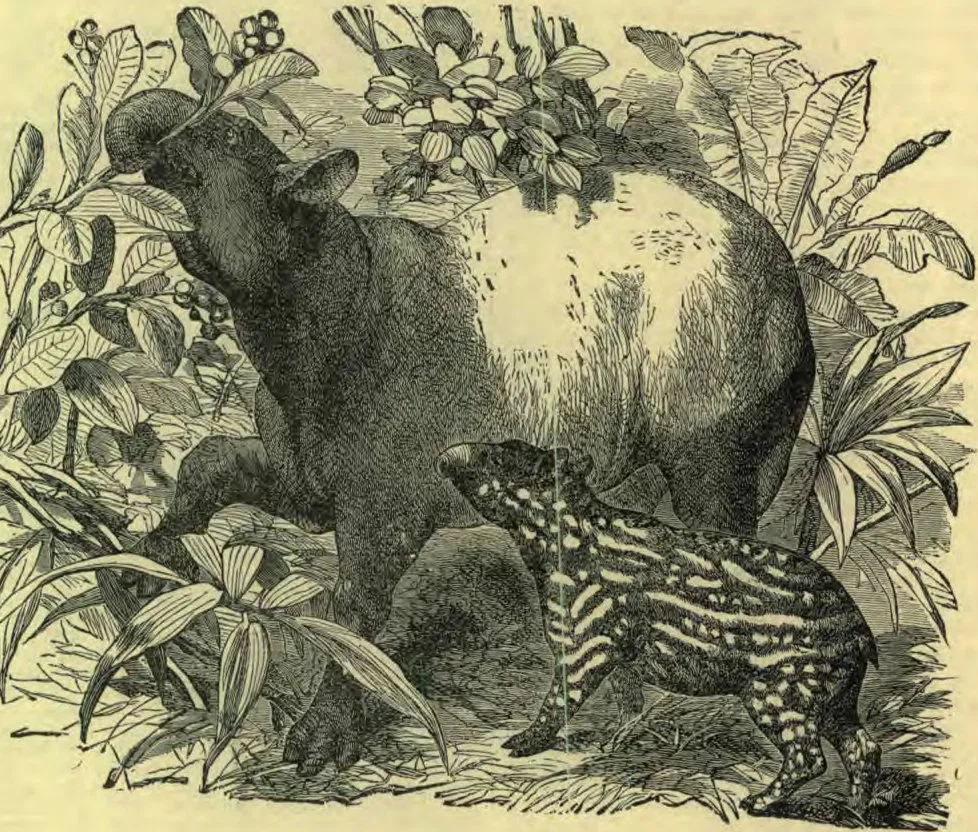
“Ah!” you exclaim, “what a strange beast this is; what a queer looking snout it has!” It looks a little like a hog and a little like an elephant. The truth is, it is a sort of distant relative to both of them, half way between them, as you might say. This is a Malay tapir. Could you find the country where he lives, on your map?
By its side you see a little animal shaped just like the big one, but with a vastly different skin. What pretty spots the little one has! The thick skin of the old tapir is covered with short, stiff hair, black except on his back, which a little way off looks as if he had a white blanket spread over him like a saddle. His ears have a white border, too. See how they stand out from his head, just as if he were listening for danger. But that cannot be the reason, for he never attacks either man or beast if let alone.
You should see what good care the mother tapir takes of her little one. The father is very careless, and never looks after it at all; but the mother is watchful to see that it does not fall into danger. If she sees a dog approach it, she makes a hissing sound; and if he does not run away, she takes the little fellow by the back with her teeth, and gives him such a shaking! while he begs hard to be let alone.
We might wonder what such a great clumsy animal was good for; and indeed it has puzzled the naturalists to find out. His great thick hide fits him well to live where God placed him; for he can go over rough rocks and through scraggy bushes without so much as scratching his skin. The tapir is very easily tamed; and when once made a pet of, never cares to go back to his wild life again. They are not hard to take care of; for they are very well satisfied, after sleeping all day, to go off at night hunting for watermelons and fruit. They do not object to eating even old rags and sticks. But after they have once been tamed, I fear we should hardly know what use to put them to, and would find it rather unpleasant to have animals as large as a small horse following us around like a dog. W. E. L.
Letter Budget.
By Editor
We think the little people would stare some if they could see what a pile of letters we have laid out to be printed in this paper. We will give you the space this time; but we want you to be made better by reading each other's letters. The first reads:—
CHARLES E. STIMSON, of Dane Co., Wis., in renewing his subscription for the INSTRUCTOR, says: “I wrote a letter to the Budget once before, but there was not room in the paper to publish it, so I thought I would write again. I would like to send you some new subscribers. One boy here says he will send for the paper when he gets some money. Pa is not a Sabbath-keeper, and so will not let me canvass for the INSTRUCTOR. I thank Eld. Canright very much for his instructions in the paper, and will try to follow them.”
EUGENE CARPENTER sends a letter from Wise Co., Texas. He says: “I have never written to the Budget before, but I love to read the letters. I am a little boy seven years old. I go to day school and am in the second reader and in the second grade. I keep the Sabbath with my grandma. Papa and mamma keep Sunday. I have two sweet little sisters, Allie and Nellie. I go to Sabbath-school, and am in Book No. 2. I always have my lessons and a verse of scripture. I am trying to be a good boy and keep God’s commandments.”
A little girl ten years old writes from Minnehaha Co., Dakota, but did not give her name. She has a sister Nellie, thirteen years old, who had gone with her papa to the missionary meeting. She had a brother five years old. They attended Sabbath-school in town, about a mile from home. She says, also: “I help do the dishes, sweep the floor, turn the wringer, and sometimes I hunt the eggs. I want to be a good girl, so that when the Saviour comes, I can meet the INSTRUCTOR family. I wrote once before, but have not seen my letter printed.”
IRMA FINCH, of Shawano Co., Wis., writes that she is ten years old, and has a brother Harry four years old, and a brother Hubert two years old, and that all the family keep the Sabbath but her papa. She learns her Sabbath-school lesson in the INSTRUCTOR. They have a sugar bush, and so in the spring have a nice time making sugar.
EMMA O. JOHNSON, of Marshall Co., Iowa, says she reads the INSTRUCTOR with much interest. She sailed across the Atlantic Ocean to this country three years ago next fall, with her parents and two youngest brothers. This truth was new to them then. One brother and sister who had been here over four years are now keeping the Sabbath with them. She is trying to be a Christian, but there are so many temptations to lead one out of the narrow path, she wishes us all to remember her.
EMILY G. OPPELT, of Leseur Co., Minn., writes very encouragingly of their Sabbath-school of thirty-six members. She also writes: “I love to read the letters in the Budget from the children, and I think what a grand school it would be were the many Sabbath-schools united in one school, all having the same lessons, all singing the same songs, and all under the same Superintendent and Teacher, the Lord of heaven. Little readers, remember the Sabbath-school at Anawauk.”
MINNIE BELL COON, of Adams Co., Wis., says that after reading her paper, she sends it to other children. She has taken the paper nearly eight years, and is much interested in it. She has always kept the Sabbath with her parents; is twelve years old, and attends their Sabbath-school of thirty-three members nearly always. She has a sister and an adopted brother.
LILLIAN B. LANE, who lives in Northern Wisconsin, on a homestead in the woods, says: “It is very nice here in the summer. I am fourteen years old and keep the Sabbath with my mother. I have a sister, who is married, and with her family keeps the Sabbath. I have two brothers, who, with my father, do not keep the Sabbath. My mother has been sick all winter. I am trying to be one of God’s children.”
EDMOND R. ALLEN, a little boy nine years old, writes from Bellafontaine Co., Wis., that they feel very lonely at his home, because his father died in January. He was sick four years and a half. His mother superintends their family Sabbath-school. He feeds the chickens, and gets in wood for his mother. He has learned the ten commandments and the Lord’s prayer, and is trying to be a good boy, and hopes to be saved.
MAUD WOLCOTT, of Battle Creek, Mich., who goes to Sabbath and day school, says, “There are five little girls of us, who meet together every Sunday and have a little meeting. I am eight years old, and am trying to be a good little girl.”
SCOTT E. HYATT writes from Washington Co., Iowa. He says: “Some kind friend has been sending me the INSTRUCTOR, and I thank him very much. I have been so much interested in reading the Budget I thought I would try to write. I am nine years old. My father is dead, and I live with my uncle. I have two brothers and one sister. I am a cripple in one of my legs, and have not been able to go to school for a year.”
TURAH AMES writes a letter from King Co., W. T. He says: “This is the third time I have written to the Budget. My first two letters were not printed. I am eleven years old. I keep the Sabbath with mamma and my sisters, and study lessons in the INSTRUCTOR, which I love to read. I received ‘Sunshine at Home’ for Christmas. It is a nice book. The superintendent of the Sabbath-school is also my teacher. I like him much. He is now attending meeting with Eld. Boyd, at Renton, where one has signed the covenant. I ask an interest in your prayers, that in the Judgment I may be accounted worthy of eternal life.”
What! almost at the end of the Budget, and twenty-nine letters of the pile yet on hand; not much more than space enough left to tell whose they are. We will crowd in the names, and so finish what were received in March. The list reads:—
From Wisconsin, EMILY BRAZIER and WM. J. SHADELL; Vermont, LILLIE G. HERSEY; Iowa, HATTIE EAGER; Idaho, ALTA and BERTHA L. CARTER; California, ELLA E. LOBDELL; Nebraska, ALLIE TOWERS; Dakota, CAROLINE PETERSON; Indiana, NETTIE BURR, EMMA F. BALTZELL, EDITH M. GRIFFITH, HARRY E. MYERS, and JAMES BOVARD; Texas, MARY NEAL; Ohio, MATTIE CROWELL; Arkansas, STELLA DANIELS; Kansas, MARY C., EMMA M. J., FLORA L., and JAMES C. ANDERSON, MAUD M. RAINES, LAWRENCE and JOSIAH MORRIS; Missouri, FLEMING W. BRANDER; Michigan, HORACE S. FENTON, WALTER A. CHAPMAN and ALLEN J. KNEELAND; Massachusetts, BURTON L. FUNK.
THE CHILDREN'S MITE.
By Augusta Larned
O LITTLE hands, be free in giving,
Little hearts, be glad to serve;
Each unselfish act of living
God fails never to observe.
Give not only gold and treasure,
Give your sympathy and care;
Love that knew not stint or measure
Jesus scattered everywhere.
All the good your hands can carry,
When you go to God on high,
Are your blessings to the weary,
To the sick and poor who sigh.
Angels garner up in heaven
Every gentle word and deed,
All the joy your life has given
To God's little ones in need.
Sing your praises to the Maker,
Love and serve your kind the while,
Of each gift you are partaker,
God rewards you with his smile.
—Augusta Larned, in Christian Register.
DO YOU MAKE WRINKLES?
Minnie liked to play, but she did not like to study or to sew. One day she ran home from school, and climbing on a high chair, looked close at her mother’s face.
“Have you any wrinkles, mother? and did I make them come?”
“Why, what do you mean, Minnie?” said Mrs. Baker.
“Old Mrs. True’s face is full of wrinkles, and her hair has turned gray. The girls say it is because Mary is a naughty girl.”
“But you are not naughty, dear, and you do try to please me.”
“O mamma! I heard you tell father that I worry you when I begin a piece of work that I do not finish. “I’ll not do it any more, mother. This afternoon I’ll try to finish something that I began a long time ago.”
“It will be hard work, particularly if you want to play.”
“I can do it though, if I try,” said Minnie.
“And if you ask God to help you.”
After dinner Minnie went to her own room. “What shall I do first?” she thought. In her basket was a handkerchief that she had begun to hem for the missionary-box. “They are to pack the box to-morrow,” she thought.
She took her needle and began to sew. But, hark! the girls were at the gate calling her. They were to pick berries along the creek. Minnie wanted to go very much. But she wanted also to please her mother, and she remembered what the minister had said in the sermon on Sabbath: “Whatsoever thy hand findeth to do, do it with thy might.” So she sat still and did her work well.
I wonder how many of you have “made the wrinkles come” in your dear mother’s face? Try hard to smooth them out with loving words and cheery helpfulness.—Selected.
MY BEST TEXT.
“Mother,” said a little girl, on coming home from the Sunday-school, “I want to ask you something.” “Well, dear, what is it?” “Do you know which is my best text?” “Tell me, my dear,” replied the mother. “Well, mother, you know that I am just seven years old, and my little text has just seven words in it, and this is it: “It is time to seek the Lord.” (Hosea 10: 12.)—Sel.
The Youth’s Instructor
IS PUBLISHED WEEKLY BY THE S. D. A. PUBLISHING ASSOCIATION, Battle Creek, Mich.
Mrs. M. J. CHAPMAN. — Editor. Miss WINNIE LOUGHBOROUGH, Ass’t Editor.
The INSTRUCTOR is an illustrated, four-pages sheet, especially adapted to the use of Sabbath-schools. Terms always in advance.
Single copy, — — — 75 cts. a year. 5 copies to one address, — 60 cts. each. 10 or more copies to one address, — 50 cts. each.