The Youth’s Instructor, Vol. 48, No. 40.

THE CARIBS

The Youth’s Instructor

Oct 11, 1900

Review and Herald Publishing Company · Battle Creek, Mich. · Oct 11, 1900

THE CARIBS
MORE than a century ago an English ship carried a cargo of ungovernable Indians from the Island of St. Vincent to the coast of Honduras. The emigrants were not all full-blooded Indians. The blood of the African race, with whom they had been compelled to labor, had been mingled with their own. Intermarriages between negro and Indian had produced a race with thick lips and woolly hair, who had all the cunning of the Indian without his filthy habits. This mixed race has spread itself along the coast of Honduras; and from a few hundred individuals, has grown to an equal number of villages—always near water; for the Carib is an amphibious creature.
Upon approaching one of their towns, we see a long line of canoes drawn up on the beach, high above the breakers, and the shining black bodies of children sporting in the surf. As our boat runs in on one of the waves, half a dozen villagers dart from the shade of the cocoanut-trees, grasp the rail of the boat, and draw us far up on the sand.
Beautiful bodies these Caribs have, erect and muscular. “Once,” they say, “before polygamy came among us, there were many giants.” Even now they are a large people. Unconfined at foot or waist, the women are almost as powerful as the men, and accomplish more work. A group of these women marching along the beach with baskets and pails upon their heads, is a sight worth seeing, they are so erect, and their step is so elastic. The children go entirely naked; but of late years, men and women, when visiting the Spanish towns, put on Hondurasian dress. About their work in the native villages, the Carib women wear a sleeveless white cotton garment, reaching a trifle below the knee. The men wear cotton trousers and a straw hat when at work, unless they are in the water.
Though polygamy is practised among the people, the family ties are held more sacred than they are among some other classes of Central Americans. With the exception of the better classes, the Caribs are the most cleanly and industrious people in Honduras. In many respects they are certainly superior to the common Spanish and Indian mixtures, from which the soldiers and petty officials of the republic are drawn.
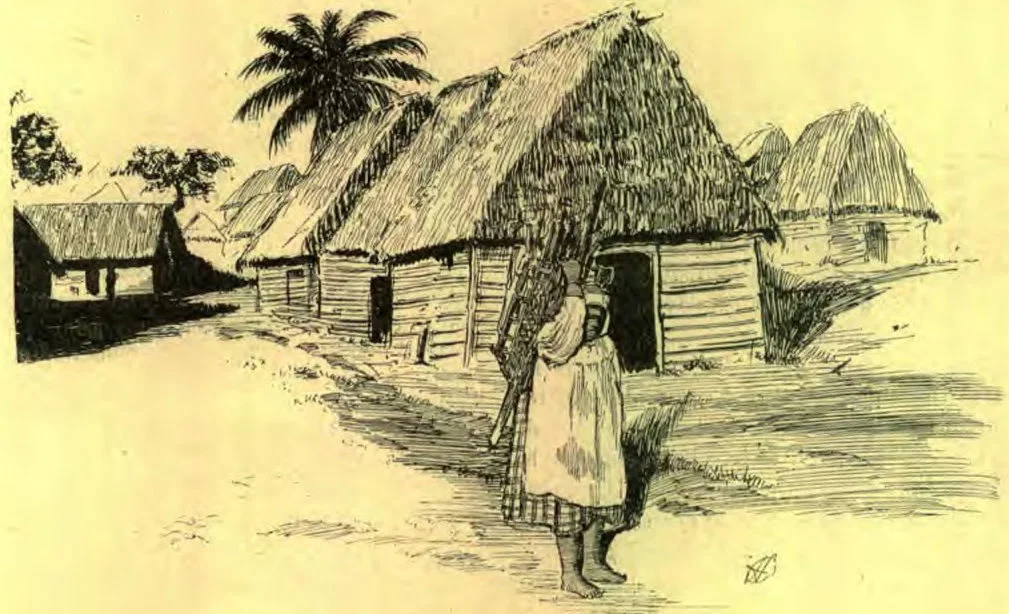
When a young Carib reaches maturity, he enters the forest, clears an acre or two of ground, and brings in the leaves of the cohune palm,—a tree closely resembling the cocoanut palm,—and spreads them out to dry. Poles are also brought, besides quantities of wild cane. The frame of his house is constructed without nails, wild vines, with which the Central American forests abound, being used in lashing the poles together. The steep roof is covered with thatch made from the cohune leaves, and our “Compy” (a word having among the Caribs much the same meaning as “John” has in America when spoken in reference to the Chinese) prepares for the “raising.” A keg of rum has been smuggled in from Belize; and there is no lack of willing help to empty the keg, and to plaster the basketwork sides and floor of the new home with red clay. Children are allowed a share in the work; for no trowels are used, the mud being thrown on out of the hand, and then smoothed down with the same tool. The doors and window shutters are hewed from cedar, a few wooden bowls are chipped out of mahogany, and a basket-like device is made to assist the young wife in carrying wood, cocoanuts, and wee Caribs. At last all is ready, and wife number one comes in possession of the home and plantation.
CARIB WOMAN CARRYING WOOD
The young husband no longer gives thought, much less labor, to the plantation that he has cleared. The woman plants the cassava, sweet potatoes, yams, and ginger, makes the cassava bread in great cakes three feet in diameter, prepares the fish soup, and keeps the house tidy. “Compy” goes off with the mahogany-cutters to new scenes and conquests.
The Caribs are great wood-choppers. They use a long-handled ax that in their hands is very effective. Often the tree that is desired for lumber has long spurs at the base, and the Carib has to build a scaffold to raise him above them. Immense trees are chopped down in this way, then squared with a broadax, and floated to the mouth of the river, where they are put on board ships bound for England or the United States.
Those who have lived with the Caribs tell us that the women speak a separate language among themselves, besides being able to converse with their husbands and sons in the Carib tongue. This strange custom is accounted for by the following legend: Centuries ago the women of the Caribs were massacred in war, and the bereaved husbands took vengeance by slaying the males of a neighboring tribe, sparing the lives of the women. In time these women became reconciled to their new homes, but never gave up their old language when conversing among themselves. Thus there is a women’s language among them to-day.
Naturally, the Caribs are black; but a sort of skin disease, which begins with an itching, and ends with a deadening and whitening of the skin, is making them a spotted people. A person afflicted with this disease suffers little, except in appearance. The contrast is shocking at first sight, and the foreigner avoids it as he would leprosy. Some have called the disease a mild form of leprosy, but resident physicians class it with eczema.
The young Caribs do as little Americans do,—imitate their parents,—diving in the surf, paddling tiny boats, and fishing. Bright fellows they are, too, who are glad to learn of better things. Already they are asking for a school to be started among them. Let us work and pray to the end that the gospel as it is known to us may be preached to them.
HERBERT OWEN.

WHERE CIVILIZATION AND BARBARISM MEET

STRANGE comminglings of primitive barbarism and modern progressiveness are found on the South Sea Islands. The customs and conveniences of civilized life have been brought to the islanders in fragments; and of those presented, the people have adopted but few, and have merged the new with the old. Thus, imported musical instruments are heard in connection with primitive gongs and sea-shell trumpets; and familiar European airs almost lose their identity as they grow to resemble more and more the weird chants of the aborigines. Bicycles (“tread-go-rounds”) are owned by natives who were never within thousands of miles of a railway, and typewriters are operated by individuals whose grandfathers not only never learned the alphabet, but had no alphabet to learn. A native dignitary who owns horses and a carriage imported from New Zealand, keeps the carriage on the veranda of his house.
A native of a remote atoll once greedily sought to obtain a package of pins that he saw in my possession, though what use he could make of them is a query, as his costume consisted merely of a strip of cloth tied about the hips. The man offered, in exchange for a few cents’ worth of pins, a fish-hook whittled from a pearl oyster shell, though he had formerly declined to sell the fish-hook for less than half a dollar. By the way, many of the island women are more accustomed to the use of a needle than of pins—an advantage not possessed by all our own countrywomen. Sewing-machines, too, are owned and used by a few of the native women, some of whom, seemingly, have no idea that white cotton thread is not suitable to use on fancy silks and velvets.
Generally the South Sea Islanders appear not to care for house decorations, but lavish their wealth and taste on ornaments for the person. Many who have no abode except a miserable hut, floorless, windowless, and furnitureless, appear on gala occasions in elaborate and expensive garb. Some of the more ambitious natives have comfortable cottages, and, in some instances, these contain a few pieces of furniture. However, the apparent signs of civilization are often only signs of vanity; for the owner not uncommonly prefers still to live in his squalid hut, to sleep wrapped in a palm-leaf mat and lying on the earth floor, and to eat his food from leaves or a wooden trough on the ground. If in the presence of white persons, a Polynesian assumes the dignity of sitting in a chair, he quickly tires of the unusual position, and resorts to the floor again. Shoes donned for a festive occasion are likely to be doffed before the festivities are ended; and instead of the few superfluous garments worn occasionally, a mere waistcloth is preferred for ordinary wear.
Having seen travelers and white residents practice photography, the islanders like to obtain portraits of themselves; but generally one copy suffices, since it is not intended as a gift to a friend, but as a means of gratifying the pride and curiosity of the individual.
The meager vocabulary of the islanders is ill adapted to the changed conditions of life there. Hence many foreign terms have been introduced. Some of these terms are hardly recognizable when pronounced by the natives. Original phrases have been devised to express newly received ideas. Thus a horse is termed puaoro-fenua (a “beast-run-land”); a goat, a “tooth beast” (probably referring to the horns); a cat, a “cry-house.” A tuberose is called an “onion flower,” because of the bulb.— Adelaide D. Wellman.

WE ARE HIS WITNESSES

III

The Lord continued to bless his followers as they bore their testimony. Believers were added to the church, the sick were healed, and wonderful works were wrought, “insomuch that they brought forth the sick into the streets, and laid them on beds and couches, that at the least the shadow of Peter passing by might overshadow some of them. There came also a multitude out of the cities round about unto Jerusalem, bringing sick folks, and them which were vexed with unclean spirits: and they were healed every one.”
Here were light and evidence that none could gainsay. But did these signs have weight with the priests and rulers?—No; they were filled with indignation, and laid their hands on the apostles, and put them in the common prison. Satan was striving to make of none effect the work of Christ, to blot his name from the earth. But Heaven was determined to give evidence to the people that Jesus was the Son of God. An angel of the Lord was commissioned to go to the prison, and say to the disciples, “Go, stand and speak in the temple to the people all the words of this life.”
Will the disciples obey the voice of God, or the voice of the men who have taken it upon themselves to close the door against knowledge and truth? “And when they heard that, they entered into the temple early in the morning, and taught. But the high priest came, and they that were with him, and called the council together, and all the senate of the children of Israel, and sent to the prison to have them brought. But when the officers came, and found them not in the prison, they returned, and told, saying, The prison truly found we shut with all safety, and the keepers standing without before the doors: but when we had opened, we found no man within. Now when the high priest and the captain of the temple and the chief priests heard these things, they doubted of them whereunto this would grow. Then came one and told them, saying, Behold, the men whom ye put in prison are standing in the temple, and teaching the people. Then went the captain with the officers, and brought them without violence: for they feared the people, lest they should have been stoned. And when they had brought them, they set them before the council; and the high priest asked them, saying, Did not we straitly command you that ye should not teach in this name? and, behold, ye have filled Jerusalem with your doctrine, and intend to bring this man’s blood upon us.”
Then the disciples told how the angel of God had released them from prison, and had bidden them go and preach Jesus to the people. “We ought to obey God rather than men,” they said. These faithful witnesses had a testimony to bear; for light from heaven had flashed upon them. “The God of our fathers,” they fearlessly declared, “raised up Jesus, whom ye slew and hanged on a tree. Him hath God exalted with his right hand to be a Prince and a Saviour, for to give repentance to Israel, and forgiveness of sins. And we are his witnesses of these things; and so is also the Holy Ghost, whom God hath given to them that obey him.”
When these words were spoken, “they were cut to the heart.” But was their spirit softened? Did they repent of their wicked rejection of the Son of God?—No; the same spirit that had prompted them to action against Christ still raged in them, to silence the voice of the apostles. “They took counsel to slay them.” But there was one man in the council who recognized the voice of God in the word spoken to them. This man, Gamaliel, a doctor of the law, “commanded to put the apostles forth a little space.” He well knew the elements he had to deal with. He knew that the murderers of Christ would hesitate at nothing, if only they might carry out their purposes. “Ye men of Israel,” he said, “take heed to yourselves what ye intend to do as touching these men. . . . Refrain from these men, and let them alone: for if this counsel or this work be of men, it will come to naught: but if it be of God, ye can not overthrow it; lest haply ye be found even to fight against God.”
“And to him they agreed: and when they had called the apostles, and beaten them, they commanded that they should not speak in the name of Jesus, and let them go. And they departed from the presence of the council, rejoicing that they were counted worthy to suffer shame for his name. And daily in the temple, and in every house, they ceased not to teach and preach Jesus Christ.”
Paul and Silas were imprisoned because they proclaimed the truth that Christ had bidden them teach. Many stripes were laid upon them, and their feet were placed in the stocks. But they did not think of murmuring. They did not say, It does not pay to preach Christ. Instead, they sang praises to God, that they were counted worthy to suffer shame for his name. All heaven was interested in these men who were suffering for Christ’s sake, and angels were sent to visit the prisoners. At their tread the prison doors were shaken open, and a bright light flooded the prison. The jailer awoke, and supposing the men to have escaped, was about to take his own life. But Paul cried out, “Do thyself no harm; for we are all here.” Then the jailer hastened into the prison, to see what manner of men these were whom he had treated so severely; and casting himself before them, he asked their forgiveness. “Sirs, what must I do to be saved?” he asked. “And they said, Believe on the Lord Jesus Christ, and thou shalt be saved, and thy house. And they spake unto him the word of the Lord, and to all that were in his house.”
The apostles did not wait until they were refreshed, and their wounds were dressed, before they began their work. This is not the spirit manifested by the natural heart; but Paul and Silas had the spirit of Christ, not the spirit of revenge. And the jailer “took them the same hour of the night, and washed their stripes; and was baptized, he and all his, straightway.”
We have a work to do in presenting Christ. We need to talk of Christ, and the practical lessons he gave, until our hearts are warmed with the love of God. We should not make much of the trials and opposition we meet. It is true they may close the door of influence for a time, but it will open to us the wider after a little. The work for us to do is rightly to represent our faith in our life and character as well as in our words. By living faith we must cling to the promises of God.
Christ says of his people, “Ye are the light of the world.” Let your light shine amid the moral darkness. You need the Spirit of Christ to dwell in your hearts by faith, if you would be prepared to teach men the way to heaven.
MRS. E. G. WHITE.

John, the Beloved

I'm growing very old. This weary head That hath so often leaned on Jesus' breast In days long past, that seem almost a dream, Is bent and hoary with its weight of years. These limbs that followed him—my Master—oft From Galilee to Judah; yea, that stood Beneath the cross, and trembled with his groans, Refuse to bear me even through the streets To preach unto my children. E'en my lips Refuse to form the words my heart sends forth. My ears are dull, they scarcely hear the sobs Of my dear children gathered round my couch; God lays his hand upon me,—yea, his hand, And not his rod,—the gentle hand that I Felt, those three years, so often pressed in mine, In friendship such as passeth woman's love.
I'm old,—so old I can not recollect The faces of my friends, and I forget The words and deeds that make up daily life; But that dear face and every word He spoke Grow more distinct as others fade away, So that I live with him and holy dead More than with the living.
Some seventy years ago I was a fisher by the sacred sea. It was at sunset. How the tranquil tide Bathed dreamily the pebbles! How the light Crept up the distant hills, and in its wake Soft, purple shadows wrapped the dewy fields! And then He came and called me. Then I gazed, For the first time, on that sweet face. Those eyes, From out of which, as from a window, shone Divinity, looked on my inmost soul, And lighted it forever. Then his words Broke on the silence of my heart, and made The whole world musical. Incarnate Love Took hold of me, and claimed me for its own. I followed in the twilight, holding fast His mantle.
Oh, what holy walks we had, Through harvest fields and desolate, dreary wastes! And oftentimes he leaned upon my arm, Wearied and wayworn. I was young and strong, And so upbore him. Lord, now I am weak, And old, and feeble! Let me rest on thee! So, put thine arm around me. Closer still! How strong thou art! The twilight draws apace. Come, let us leave these noisy streets, and take The path to Bethany; for Mary's smile Awaits us at the gate: and Martha's hands Have long prepared the cheerful evening meal. Come, James, the Master waits; and Peter, see, Has gone some steps before.
What say you, friends,— That this is Ephesus, and Christ has gone Back to his kingdom? Ay, 'tis so, 'tis so. I know it all; and yet, just now I seemed To stand once more upon my native hills, And touch my Master. Oh, how oft I've seen The touching of his garment bring back strength To palsied limbs! I feel it has to mine. UP! Bear me once more to my church! Once more There let me tell them of a Saviour's love; For, by the sweetness of my Master's voice Just now, I think he must be very near,— Coming, I trust, to break the veil which time Has worn so thin that I can see beyond, And watch his footsteps.
So, raise my head. How dark it is! I can not seem to see The faces of my flock. Is that the sea That murmurs so, or is it weeping? Hush, My little children! God so loved the world He gave his Son. So love ye one another. Love God and man. Amen. Now bear me back. My legacy unto an angry world is this. I feel my work is finished. Are the streets so full? What call the folk my name,—the Holy John? Nay, write me rather, Jesus Christ's beloved, And lover of my children.
Lay me down Once more upon my couch, and open wide The eastern window. See, there comes a light. Like that which broke upon my soul at eve, When, in the dreary Isle of Patmos, Gabriel came And touched me on the shoulder. See! it grows As when we mounted toward the pearly gates. I know the way! I trod it once before. And hark! It is the song the ransomed sang Of glory to the Lamb! How loud it sounds! And that unwritten one! Methinks my soul Can join it now O my Lord, my Lord! How bright thou art! and yet the very same I loved in Galilee! 'Tis worth the hundred years To feel this bliss! So lift me up, dear Lord, Unto thy bosom. There shall I abide. —Selected.

NO WASTE

God has given each life a vast treasure of time. Some coin this into currency, others fritter it away in dust and scraps. Perhaps the greatest waste in the world is the waste of time. Five minutes is so cheap and common—who values it? In fragments of time like those which most of us waste, some men have gained an education, others have made fortunes.
As we pass through the government's great coin factory, with an eye upon its many provisions for guarding against the dissipation of valuable material, we are reminded of all the ways in which men waste life. Especially do we recall our waste of spiritual opportunities—opportunities to receive and to impart blessings. How full and beautiful and strong our life would be, had we but used to the full our privileges of knowing and practicing the truth as it is in Jesus! Then to think of the lives we might have touched, the deeds we might have done, the words we might have spoken—now wasted forever!
No life so rich in any respect that it can afford to disregard waste.—Well-Spring.

WHEN THE HEART IS HEAVY

Worry kills. It wears upon the brain as dropping water wears away stone. The habit must be killed by eternal vigilance, resolution, and good sense. Worry, like bad air or an obnoxious person, must be driven out; and the best way to drive either out is by the introduction of the good. You can fill your mind with comforting, calming thoughts, leaving no room for harassing ones. You can flood out the enemy, just as by pouring a stream of clear water into a tumbler filled with discolored liquid, you can soon force out the muddy contents of the glass, and leave it filled with liquid crystal.
Check expression when bitter or somber feeling has the best of you. To say how sad or perplexed you feel when your heart sinks for the moment, deepens your inward trouble, and at the same time spreads it to outside people. You would not spread disease; do not spread mental distress. Your desponding words, bursting impulsively from a full heart in the presence of a friend, add to the burdens of another human being,—one, perhaps, already weighed down with cares and anxieties. So to speak is to allow yourself to be overborne by “things,” ruled by the natural course of the world. You can not rule the world, it is true; but you have the power to rule your part of it—that is, yourself.
Don’t hate, and don’t worry. This is the advice given by a hale and beneficent old man to those who asked him for the secret of length of days. He might have added, Don’t get angry.—Ada C. Sweet, in Woman’s Home Companion.

OCTOBER

OCTOBER comes across the hill Like some light ghost, she is so still, Although her cheeks are rosy; And through the floating thistledown Her trailing, brier-tangled gown Gleams like a crimson posy.
The crickets in the stubble chime; Lanterns flash out at milking-time; The daisy’s lost her ruffles; The wasps the honeyed pippin try; A film is over the blue sky— A spell the river ruffles.
The goldenrod fades in the sun; The spider’s gauzy veil is spun Athwart the drooping sedges; The nuts drop softly from their burs; No bird-song the dim silence stirs— A blight is on the hedges.
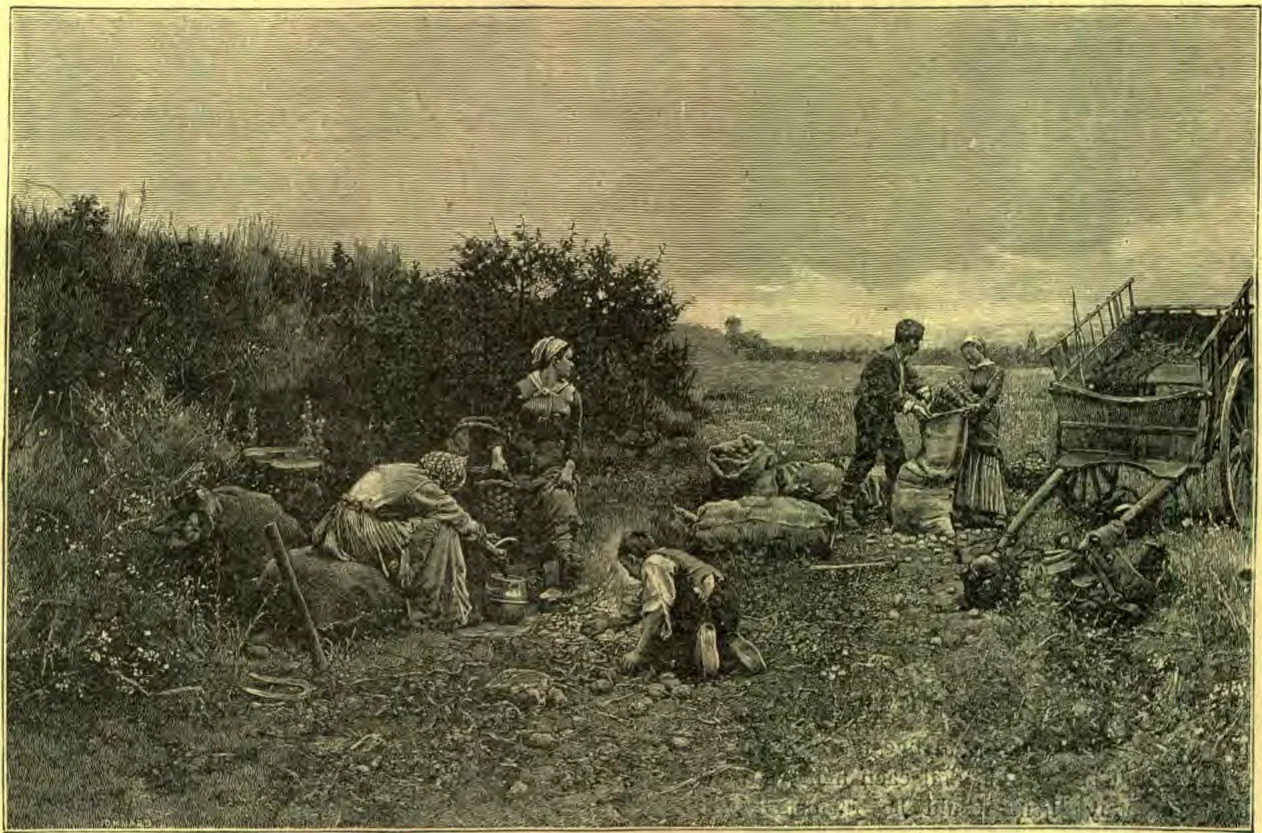
AN OCTOBER SCENE
AN OCTOBER SCENE
She listens when the dusky eves Step softly on the fallen leaves, As if for message cheering; And it must be that she can hear, Beyond November, grim and drear, The feet of Christmas nearing.
—St. Nicholas.

FLATTERY THE BLIGHT OF CHARACTER

Many a truly noble character has been hindered in its growth by a mildew of flattery. Many a soul that has successfully gained the first victory in a series of struggles, has been effectually defeated in every succeeding conflict by the weapons of flattery. Many a young man whom God has blessed, and whose efforts to water and feed the souls of others have been abundantly honored of Heaven, has had his career of usefulness brought to a sudden end by the poisoned arrows of flattery.
The character that yields itself to the deception of flattery is like a ship that is filling with water—it will soon go down. Many a young woman with both the disposition and the talent to do a great work for God has had her career cut short by words of flattery and mistaken appreciation; and the life that, by earnest application, diligent study, and humble effort, might have achieved great things in the name of Christ for the good of man, is robbed of its humility and its energy, only to become a moral derelict,—a wreck of what was once a noble character.
Dear young people, do not take the credit to yourselves for the character that God may be helping you to rear; do not say, as did Nebuchadnezzar, “Is not this great Babylon, that I have built?” Remember that when you praise yourself, either in thought or word, you are “brushing the luster off your best efforts.”
W. S. SADLER.

The Child of God Looks Forward

THE child of God does not look backward to gain fresh energy. His energy is the energy of hope, not of retrospection. He presses forward; his glance is ever onward. He anticipates revelations of God ever more and more glorious.—Stopford A. Brooke.

THE REAL COWBOY'S LIFE

I
IN the eyes of the average young American, cowboy life has ever been surrounded with a halo of romance. The very word “cowboy” seems to carry with it a picture of rough manners, unbounded generosity, and reckless daring, to the accompaniment of broad-brimmed hat, silver-mounted spurs, and pitching broncho. The imagination fills in all the minor details that go to make a striking and romantic figure; but romance and reality are widely different.
It was in Colorado that the writer spent three years on a cattle range, the country over which he followed the “round-ups” being now covered with farms and sheep ranches. But in Wyoming, Montana, Arizona, and a few other States, the cowboy still survives; and perhaps the INSTRUCTOR family would like to know what his life is really like.
Formerly most of the range cattle were raised on the broad plains of Texas. Early in the spring the Northern cattlemen would go to that State with a crew of cowboys and a camp outfit. A herd of young cattle, from five to ten thousand head, would be bought; and each man who was to accompany them would be furnished with from eight to ten horses. Then the northward journey began. The writer never drove cattle “over the trail,” so his information on that subject is second-hand. The work on the trail, however, did not differ materially from that on the round-ups, except that it lasted longer, and was consequently more monotonous. It is cheaper to transport cattle by rail now; therefore the old method has been entirely abandoned.
It is usually late in the fall before the herd reaches its destination. Then the cattle are re-branded, and turned out to shift for themselves until the following spring. Early in the spring a committee of cattlemen allot to each ranch the district over which it is to drive, mark out a course for the “outfit” to follow, and select a place for the general round-up to be held.
Each ranch is expected to furnish men in proportion to the number of cattle owned. But as not more than fifteen or twenty riders can work together to advantage, a round-up crew seldom exceeds that number. The regular “riders,” two men to take care of the saddle-horses (“horse-wranglers,” they are called), a cook, and the foreman make up the crew.
When the drive begins, all the cattle found are brought together in one herd. This is given into the charge of three or four men, while the remainder scour the country through which the outfit passes in search of more.
The routine of a cowboy’s work is about the same day after day. Breakfast is eaten before daybreak. Then the horses that have been brought up by the “night wrangler” are lassoed and saddled, and work begins about sunrise.
While actually with the herd, horses are permitted to walk, in order to prevent exciting the cattle,—not out of regard for the animals’ nerves, but because excitement makes them lose flesh. At all other times the cowboy rides at full speed, with no more regard for his horse than if it were a machine.
There is perhaps no place on earth where horses are treated with such heartless cruelty as on the cattle range. When the spring work begins, each man is supplied with eight or ten horses as plump and spirited as one could wish for. When they are returned, three months later, they are poor, lame, and sore-mouthed; their sides and flanks are often cut and scarred by the quirt and spurs of their heartless riders; and they have hardly enough life left to try to avoid the cowboy’s lasso.
As soon as breakfast is over, the cook packs everything into the “grub wagon,” and drives to the place designated by the foreman. Ten or twelve miles is the usual distance traveled when beef cattle are being driven, but sometimes it greatly exceeds that.
When the cowboys reach camp, they find dinner waiting for them. They seldom move camp in the afternoon, but sometimes the men are sent out for a short time to gather up the cattle in the immediate neighborhood. As a usual thing, however, the regular round-up for the day ends before dinner begins. In the afternoon the herd is left in charge of two or three men, while the remainder spend the time loitering around camp, gambling, or engaging in some sport that is as cruel as it is rough.
A favorite diversion, especially during branding time, is to lasso and throw three or four calves that are old enough to be strong, and young enough to be stubborn. These calves will be released at a given signal; and when they regain their feet, before they have time to realize what such rough treatment means, a cowboy will spring upon the back of each, and endeavor to stay mounted as long as possible. The frightened creatures will go kicking, jumping, and bellowing back to the herd; and sometimes the unwelcome rider is thrown before he has gone a dozen yards. The cowboy who holds his seat the longest wins the contest. J. EDGAR ROSS.
(Concluded next week)

LIVING BY PRINCIPLE RATHER THAN IMPULSE

It is our privilege to have the Spirit of God unfold to us simple, definite principles, which we may incorporate so thoroughly into our life's experience, that, like a master key, they will serve to unlock our most troublesome perplexities.
Immense tunnels are constructed by human enterprise; and although the men who dig them can not see their way ahead, the tunnel will come out within a fraction of an inch of the place planned by the engineer. This is because the master minds that supervise such undertakings follow so closely certain mathematical principles that there is not the slightest deviation to confuse the correct outcome. So in our spiritual experience: if we trust the Master, and do not seek our own way, we shall succeed; but if we lay aside living faith and guiding principle, and attempt to walk by sight and feeling, we shall soon find ourselves involved in endless difficulties.
Those who weave the magnificent tapestry produced in Oriental countries, work under the goods, and see only the rough threads hanging down beneath; but they have in mind a definite pattern of the beautiful figure that is being wrought out on the top. Often in our daily work, seeing only the loose threads, we seem to have abundant reason for discouragement; but if we work from principle, we may be sure that a divine hand is weaving out for us a glorious pattern, which will abide through all eternity.
The magnificent tile floors that are occasionally seen were laid down a bit at a time; but the workman had in mind those marvelous figures that afterward delight all observers. It requires faith to believe that every act of faithfulness, however small, is placing a stone in that temple of character which God is rearing in every human soul that is learning the sweet lesson of living by principle instead of by feeling.
An unsightly block of marble may have been used merely as a doorstep; but by and by a sculptor begins to chip off its rough corners and edges. Where others saw nothing but rough, undesirable stone, he sees the form of an angel. Every blow brings out more fully his ideal. So from the standpoint of sight and feeling, we may be only rough stones; but the various trying experiences through which God allows us to pass will, if we submit to them as does the block to the chisel, serve as a certain blow to bring out the figure of the divine where before appeared only human rubbish.
Sometimes the devil will fairly crush us by leading us to think that God will not again undertake the process of character-building that was interrupted by some sad blunder. We should never, even in the darkest hour, lose sight of the fact that although God can not tolerate sin, he will never cease, as long as there is the least prospect that he can be won, to draw the sinner to himself. We should remember that at best we have this treasure in earthen vessels, and that the treasure is of more consequence than the vessel that contains it.
An eaves-trough made of ordinary lumber may carry off as much water, provided it is so hung as to catch the drops, as one made of silver. So although, from a human standpoint, we may not be very promising, if we are willing to be placed of God where the droppings of the latter rain can fall into us, we shall be happy ourselves, and a blessing to others.
DAVID PAULSON, M. D.

A SWEET SPIRIT

The sweet-toned bell rings out sweetness, however gently or rudely it is struck; while the clanging gong can not be so touched as not to respond with a jangle. There is the same difference in people. From some you learn always to expect a snarl, or a whine, or a groan; while others give forth words of cheerfulness and joy. When the grace of God possesses mind and heart, you will respond with a sweet spirit to every touch, kind or unkind, rude or loving. You will be a voice for God, in whatever place or company you are thrown, a witness for charity and kindness and truth.
“When a man lives with God,” says Emerson, “his voice shall be as sweet as the murmur of the brook and the rustle of the corn.” Wherever you are, be as a sweet-toned bell.—Selected.

WHAT SMOKING DOES

A MEDICAL man recently, struck with the large number of boys under fifteen years of age whom he observed smoking, was led to inquire into the effect of the habit upon the general health. He took for his purpose thirty-eight boys, aged from nine to fifteen, and carefully examined them. In twenty-seven he discovered injurious traces of the habit. In twenty-two there were various disorders of the circulation and digestion, palpitation of the heart, and a more or less decided taste for strong drink. In twelve there were frequent bleedings of the nose, ten had disturbed sleep, and twelve had slight ulceration of the mucous membrane of the mouth, which disappeared on discontinuing the use of tobacco for some days. The doctor treated them all for weakness, but with little effect until the smoking was stopped, when health and strength were soon restored.—Selected.

The Road to Success

You start at the gate labeled “Push;” If it cracks on its hinge, never mind, Though many, dismayed at the sound, Turning back in despair you will find. When you enter, go on straight ahead; ’Tis the road that’s called “System” you take; There’s “Happy-go-lucky” close by— Be sure that you make no mistake! Yours leads along “Energy’s” vale, Up “Difficult” hill on the right; Then it enters “Perplexity’s” woods— Ahead there is no ray of light! You mustn’t stop here, but go on; “Purpose” River is over the crest; Once crossed, the fair plains of “Success” Offer richest refreshment and rest. —Adalbert F. Caldwell.
Continue reading: A TRUE STORY OF A GREAT MAN