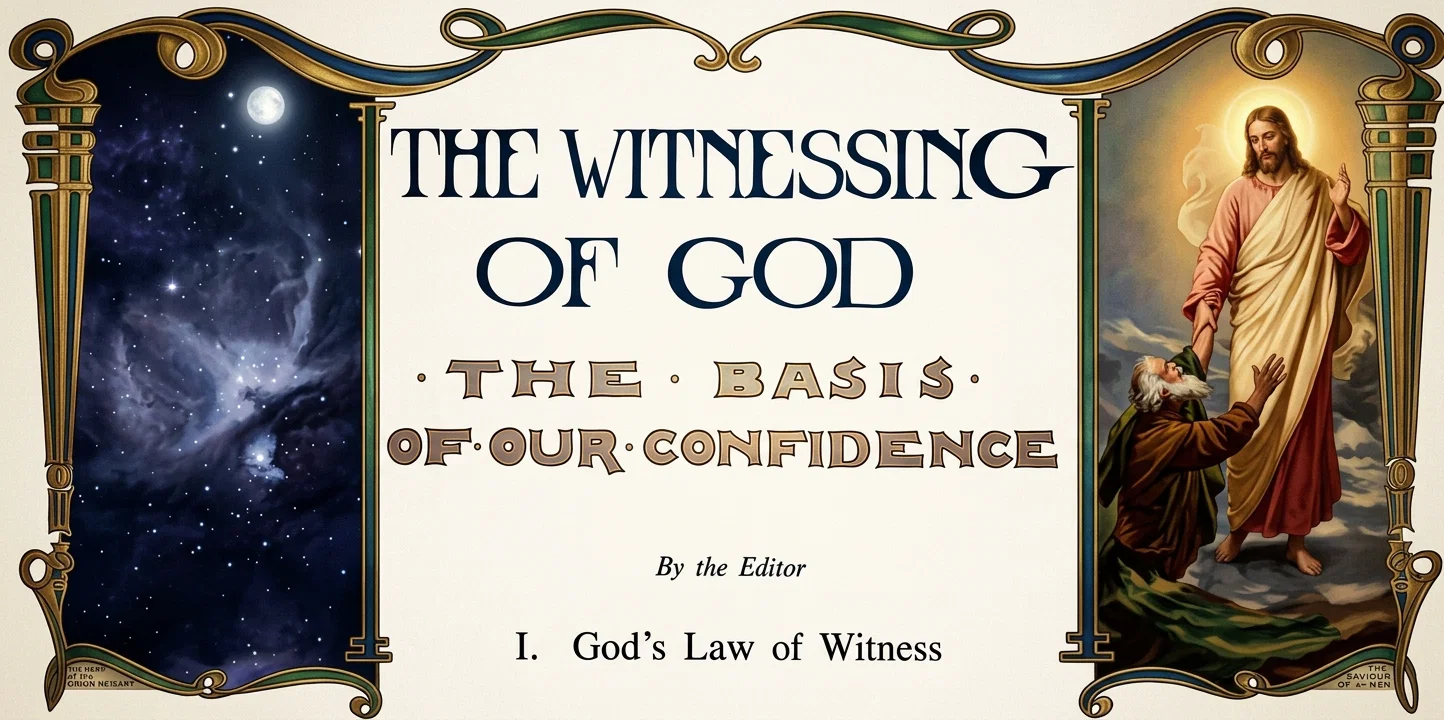
The Witnessing of God: The Basis of Our Confidence
By Editor
By the Editor
I. God’s Law of Witness
THESE are days of uncertainty in religious and philosophic thought. Souls are drifting, longing for chart and compass and star or sun to get their bearings.
In mechanical circles, problems are figured out to the nicety of an infinitesimal fraction. Men are certain of results before the theory is demonstrated.
But the religious world is in a ferment of uncertainty and insecurity.
God’s cause is on trial before the world. Men who bear His name are denying Him. They are denying His Book, denying the vicarious atonement, denying the resurrection, denying the second personal coming of Christ, denying Protestantism, as never before. Fearful of the charge of dogmatism, there is growing to be more and more a lack of definite statement of belief. Hypotheses are put forward instead of certainties. What has been held as truth for centuries is relegated to the rear, or put forward with an apology. Pulpit and press deal in vague generalities when such phases of once religious certainties as the law of God, the vicarious atonement, the second advent of Christ, are discussed. The masses are in doubt, and are drifting downward to doom.
Is there need of the uncertainty? of the doubting, the drifting? Is there a God who is the author of the Book? Is the Book uncertain? Have we then no basis of confidence? Or must we depend upon hypothesis and guesswork?
Or has God given us a sure and certain witness concerning the great and important and vital things of life and existence? We believe that He has given us witness—witness unimpeachable—upon which we may depend. And it shall be the purpose of these studies to present the simple evidence, in part, for the benefit of our readers. The studies will be neither elaborate nor exhaustive, but we sincerely pray that they may be, as far as they go, both simple and conclusive.
God’s Law of Witness
There are witnesses and witnesses in the courts of this world. Some innocent men on trial for crime are compelled to depend upon very unsatisfactory and uncertain witnesses of their innocence. Some guilty men secure immunity by the purchase of witnesses who secretly agree to testify falsely to the same thing. These are collusive witnesses. Their falsity must in many cases wait for time to demonstrate. But God’s witness is neither uncertain nor collusive, but concurring and certain.
In Heaven’s law of evidence there must at least be two or three agreeing witnesses. This is clearly stated in both Old and New Testament.
“Whoso killeth any person, the murderer shall be slain at the mouth of witnesses; but one witness shall not testify against any person that he die.” Num. 35:30.
“At the mouth of two witnesses, or three witnesses, shall he that is to die be put to death; at the mouth of one witness he shall not be put to death. The hand of the witnesses shall be first upon him to put him to death.” Deut. 17:6, 7.
“One witness shall not rise up against a man for any iniquity, or for any sin, in any sin that he sinneth: at the mouth of two witnesses, or at the mouth of three witnesses, shall a matter be established. . . . If the witness be a false witness, and have testified falsely against his brother; then shall ye do unto him, as he had thought to do unto his brother.” Deut. 19:15-19. (See also in other transactions, Isa. 8:16; Jer. 32:10-14.)
“If he hear thee not, take with thee one or two more, that at the mouth of two witnesses or three every word may be established.” Matt. 18:16. See also 2 Cor. 13:1.
“Against an elder receive not an accusation, except at the mouth of two or three witnesses.” 1 Tim. 5:19.
Thus has God safely guarded not only the life of mankind, but their property and reputation. Surely He has not left the important questions which relate to character persistent and life eternal to depend upon uncertain witness.
True it is, and ever will be, that the God of the Bible requires faith; that true character can only be formed on a faith basis. But it is also true that the reasonable God gives to His reasonable children evidence upon which that faith can be reasonably based, and which will constantly invite to larger faith.
This evidence is always twofold, and always concurring. It is never collusive. If any part of it is such that it might be so charged, there is other evidence upon the same point that in the nature of the case could not be false, misleading, or collusive. God’s twofold evidence is irrefutable.
To illustrate: Two men, Brown and Jones, might testify under oath that they saw Smith commit a certain crime in San Francisco. That evidence might be sufficient to convict, and yet wholly false. Brown and Jones have agreed together so to testify. The testimony is collusive, and is not conclusive.
But if Brown knew Smith in New York, if Smith told Brown that he had planned a certain crime for a certain day6in San Francisco, and then Smith leaves New York, Brown remaining, goes to San Francisco, and commits the crime, Jones sees the deed, and testifies to its committal, having no knowledge of Brown, two such attestations at the trial of Smith would be concurring and conclusive. God’s twofold witness is equally so.
[The next article is on the Witness of Work and Word of God.]
Traits of Carnality
By Anon.
The following are some of the features and manifestations of carnality.
The Spirit, alone, can interpret and apply this to your individual case. As you read, examine yourself as if in the immediate presence of God. Do you ever feel—
A secret spirit of pride; an exalted feeling in view of your success or position, because of your good training and appearance, because of your natural gifts and abilities; an important, independent spirit; stiffness or preciseness?
Love of human praise; a secret fondness to be noticed; love of supremacy; drawing attention to self in conversation; a swelling out of self when you have had a free time in speaking or praying?
The stirrings of anger, impatience—but worst of all, calling it nervousness or holy indignation; a touchy, sensitive spirit; a disposition to resent or retaliate when reproved or contradicted; sharp, heated flings at another?
Self-will; a stubborn, unteachable spirit; harsh, sarcastic expressions; an arguing, talkative spirit; an unyielding, headstrong disposition; a driving, commanding spirit; a disposition to criticize and pick flaws when set aside and unnoticed; a peevish, fretful spirit; a disposition that loves to be coaxed and humored?
Carnal fear; a man-fearing spirit; a shrinking from reproach and duty; reasoning around the cross; a shrinking from doing your whole duty by those of wealth or position; a fearfulness that some one may do something awkward, or get out of the spirit, and thus offend or drive some prominent person away; a compromising, holding-back spirit?
A jealous disposition; a secret spirit of envy shut up in your heart; an unpleasant sensation in view of the great prosperity and success of another; a disposition to speak of the faults and failings, rather than the gifts and virtues, of those more talented and appreciated than yourself?
Lustful stirrings; unholy actions; a carnal leaning; undue affections and familiarity toward those of the opposite sex; wandering eyes?
A dishonest, deceitful disposition; evading and covering the truth; covering up your real faults; leaving a better impression of yourself than is strictly true; false humility; exaggeration; straining the truth?
Unbelief; a spirit of discouragement in times of pressure and opposition; lack of quietness and confidence in God; lack of faith and trust in God; disposition to worry and complain in the midst of pain, poverty, or at the dispensation of divine Providence; an overanxious feeling whether everything will come out all right? — Anon.
The Pope’s Crown and 666
By D. E. Scoles
[It has been stated that upon the papal crown, or upon a papal crown, is found the inscription “Vicarius Filii Dei,” meaning the “vicegerent of the Son of God.” This has been denied on seemingly good authority as resting upon hearsay evidence; and it has been seriously questioned in the face of the statements which follow, in the article from the late Pastor D. E. Scoles, published in the Review and Herald of December 20, 1906. We reprint the article. The testimony upon which Brother Scoles relied may be true; we certainly do not impugn his word. Ed. S. of T.]
BECAUSE some of our workers have been unable to obtain a view of the pope’s crown with the inscription Vicarius Filii Dei, many of our people have concluded that no such crown has ever existed. The Catholics well know the position we occupy, and the use we make of the crown and its inscription; and let none think that Protestants have access to all portions of the Vatican, nor that their inability to find that crown proves its non-existence. I have met two men who declare that they have seen this specific crown; and their testimony is so perfectly in agreement that I am convinced that what they say is true.
The first man was M. De Latti, a Sabbath-keeper who had previously been a Catholic priest, and had spent four years in Rome. He visited me when I was pastor in St. Paul, Minnesota, several years ago. I showed him my tract, “The Seal of God and the Mark7of the Beast.” He at once told me that the inscription was not correctly placed in my illustration. He stated that he had often seen it in the museum of the Vatican, and gave a detailed and accurate description of the whole crown. When my tract was published, I was ignorant of the arrangement of the words of the Latin inscription, hence, in the illustration of the crown, placed them in one line.
Brother De Latti at once pointed out the mistake, and said the first word of the sentence was on the first crown of the triple arrangement, the second word on the second part of the crown, while the word Dei was on the lower division of the triple crown. He also explained that the first two words were in dark-colored jewels, while the Dei was composed of diamonds entirely.
During my recent tent meeting in Webb City, Missouri, I presented the subject “The Seal of God and the Mark of the Beast.” I used charts to illustrate it, one being a reproduction of the crown as Brother De Latti had described it. A Presbyterian minister was present, the Rev. B. Hoffman; and when I described the crown, he spoke out publicly, and made a statement to the congregation, saying that while in Rome studying for the priesthood, he had seen this very crown, and noted its inscription, and that the word Dei was composed of one hundred diamonds.
I met him, and learned his name, and visited him at his home, and was convinced, from his description, that this was the identical crown that Brother De Latti had seen, but which has been denied by many. I then asked him for a written statement, and he gave me the following, which explains itself:
“To Whom It May Concern:
“This is to certify that I was born in Bavaria in 1828, was educated in Munich, and was reared a Roman Catholic. In 1844 and 1845 I was a student for the priesthood in the Jesuit College in Rome.
“During the Easter service of 1845, Pope Gregory XVI wore a triple crown upon which was the inscription, in jewels, Vicarius Filii Dei. We were told that there were one hundred diamonds in the word Dei; the other words were of some other kind of precious stones, of a darker color. There was one word upon each crown, and not all on the same line. I was present at the service, and saw the crown distinctly, and noted it carefully.
“In 1850 I was converted to God and to Protestantism. Two years later I entered the Evangelical Church ministry, but later in life I united with the Presbyterian Church, of which I am now a retired pastor, having been in the ministry for fifty years.
“I have made the above statement at the request of Elder D. E. Scoles, as he states that some deny that the pope ever wore this tiara. But I know that he did, for I saw it upon his head.
“Sincerely yours in Christian service,
[Signed] “B. HOFFMAN.
“Webb City, Missouri, October 29, 1906.”
I publish these things because I am sure that God does not want us to let the enemy cheat us out of using everything truthful that will help us to expose error, and show the force and power of the truth.
The Goat of Azazel
By N. D. Anderson
By N. D. Anderson
Into the land of forgetfulness I wander,
Bearing thy forgiven sins to the desert yonder,
Standing in bonds, I saw them slay my brother.
Hast thou stood by likewise for another?
Mercy appeared to me then tigerish cruel;
Truth unfeeling, cold as the glittering jewel;
Love a refined selfishness skilfully hidden;
Justice a mockery—but hatred came unbidden.
Into the mountains I went, to the cliffs overhanging
All of the far-away tents, and faintly the clanging
Of cymbals came to me. There on the precipice hovering,
Downward I looked, and beheld, where the glory was covering.
Men and women and children, wondrously moving,
Come forth dancing, as if happy in enchantment of loving;
Out from under the pillar, from the sanctuary,
Joyously pointing their fingers at me and my aerie.
Man in Death
1. Are the dead spoken of in the Bible as being asleep?
“And the Lord said unto Moses, Behold, thou shalt sleep with thy fathers; and this people will rise up, and go a whoring after the gods of the strangers of the land, whither they go to be among them, and will forsake Me, and break My covenant which I have made with them.” Deut. 31: 16.
“And why dost Thou not pardon my transgression, and take away mine iniquity? for now shall I sleep in the dust; and Thou shalt seek me in the morning, but I shall not be.” Job 7: 21.
“Consider and hear me, O Lord my God: lighten mine eyes, lest I sleep the sleep of death.” Ps. 13: 3.
“And many of them that sleep in the dust of the earth shall awake, some to everlasting life, and some to shame and everlasting contempt.” Dan. 12: 2.
“And the graves were opened; and many bodies of the saints which slept arose, and came out of the graves after His resurrection, and went into the holy city, and appeared unto many.” Matt. 27: 52, 53.
“After that He saith unto them, Our friend Lazarus sleepeth; but I go, that I may awake him out of sleep. Then said His disciples, Lord, if he sleep, he shall do well. Howbeit Jesus spake of his death: but they thought that He had spoken of taking of rest in sleep. Then said Jesus unto them plainly, Lazarus is dead.” John 11: 11-14.
“For David, after he had served his own generation by the will of God, fell on sleep, and was laid unto his fathers, and saw corruption.” Acts 13: 36.
NOTE.—There are many other scriptures which show the Bible teaching that the dead are regarded as being asleep. They are quietly resting in the tomb, awaiting the resurrection. In perfect sleep there is complete unconsciousness. Therefore the Bible term that is used to describe man in death would denote that he is unconscious in the grave.
2. What are some of the texts which explicitly say that man is unconscious in death?
“For in death there is no remembrance of Thee: in the grave who shall give Thee thanks?” Ps. 6: 5.
“Put not your trust in princes, nor in the son of man, in whom there is no help. His breath goeth forth, he returneth to his earth; in that very day his thoughts perish.” Ps. 146: 3, 4.
“For to him that is joined to all the living there is hope: for a living dog is better than a dead lion. For the living know that they shall die: but the dead know not anything, neither have they any more a reward; for the memory of them is forgotten. Also their love, and their hatred, and their envy, is now perished; neither have they any more a portion forever in anything that is done under the sun.” “Whatsoever thy hand findeth to do, do it with thy might; for there is no work, nor device, nor knowledge, nor wisdom, in the grave, whither thou goest.” Eccl. 9: 4-6, 10.
“The grave can not praise Thee, death can not celebrate Thee: they that go down into the pit can not hope for Thy truth.” Isa. 38: 18.
3. Will the saints of all ages “together” meet Christ when He brings them forth at the resurrection, and not one at a time at death?
“But we would not have you ignorant, brethren, concerning them that fall asleep; that ye sorrow not, even as the rest, who have no hope. For if we believe that Jesus died and rose again, even so them also that are fallen asleep in Jesus will God bring with Him. For this we say unto you by the word of the Lord, that we that are alive, that are left unto the coming of the Lord, shall in no wise precede them that are fallen asleep. For the Lord Himself shall descend from heaven, with a shout, with the voice of the Archangel, and with the trump of God: and the dead in Christ shall rise first; then we that are alive, that are left, shall together with them be caught up in the clouds, to meet the Lord in the air; and so shall we ever be with the Lord. Wherefore comfort one another with these words.” 1 Thess. 4: 13-18, A.R.V.
The Value of One Talent
“THE world suffers incalculable loss because of the vast multitude of one-talented people who fail to appreciate their limited capacity, and do nothing because they can not do much. The widow and her mites, the lad and his loaves and fishes, represent the units of society and the atoms of service.”
Progress
By Llewellyn A Morrison
By Llewellyn A Morrison
Tho scant the motion, wave by wave
Yet, still, the tide creeps onward.
We climb like corals, grave by grave,
Yet lift a broad land sunward.
Tho beaten sore in many a fray,
Strengthen from Defeat we borrow,
And where the vanguard fights to-day
The rear-guard camps to-morrow.
Tho shadows veil the glory now,
The promised morn is breaking;
And rays that kiss yon mountain's brow,
Will soon these vales be waking.
Tho Pain and Poverty hold sway,
And Want keeps tryst with Sorrow,
Yet Joy's white lilies bud to-day
And Easter blooms to-morrow.
Who Will Go?
By Anon.
Through the doors that open stand,
Who will go?
Calls invite on every hand,
Who will go?
You whom Christ from sin has freed,
Hear the Lord of Glory plead
For the lands that lie in need,
Who will go?
Soul, does Jesus speak to you?
Will you go?
Has He work for you to do?
Who will go?
He has borne the cross before,
He will keep the crown in store,
Enter, then, the open door.
Who will go?
— Anon.
A Curious Sort of Sabbath-Keeping
A CHRISTIAN brother, Nicholas Kaufman, writes us that he formerly lived in Hungary, and was a member of the Roman Catholic Church, but now sees and has accepted the farther and clearer light of the great threefold message. He said that one of the books that was very sacred in their family was entitled “Saturday of the Blessed Virgin Mary, and Her 52 Miracles,” by Paul Esteras, published in Budapest. The first Hungarian edition was published in 1690, the second edition in 1701, and the third edition in 1858; and the last one was translated into the German. Having no Bible in the house, this to them was the dearest book. His father and mother used to kiss the picture of the Virgin with the child on her arm, and so did all the rest of the family. One of the strange things about the book is that the special worship of the Virgin was arranged for each of the Sabbath days,—that is, the true Sabbath of the Lord. The preface says, referring to the children of Israel, that God—
“freed the children of Israel out of Egyptian bondage and gave them on Mount Sinai the Ten Commandments, in which He specified Saturday as the rest day, which day was in later times observed by the Hebrews. This rest day was, however, transferred to the first day of the week by the Christian church, in honor of the glorious resurrection of Christ; yet the pious Christians always sanctified Saturday in honor of the blessed Virgin, which many observe at the present time; hence I believe that I shall not fall into disfavor with my readers if, in order to increase this reverence, I have arranged one dissertation for each Saturday throughout the year (fifty-two in all), out of which the Christian may draw useful instruction every Saturday; and I do not doubt at all that it will please God, answering the prayer of the pious reader of this book, both to comfort Hungary our fatherland, and to free His faithful one from all danger through the solicitation of the most blessed Virgin, who is the queen and commander of all Christian lands, especially Hungary. Therefore, dear reader, receive this book with a bold heart, and plead with me that God might protect and comfort our unhappy fatherland through the solicitations of the most blessed Virgin; plead with me for the salvation of our fellow creatures; and that our fatherland with its inhabitants may bloom anew through the solicitations of the most blessed Virgin.”
“(Signed) PAUL ESTERAS.”
And the same page tells us, “The third Hungarian edition of this book has won the greatest approval of several right reverend bishops. (Signed) The Publisher.”
We may use some other extracts from this book later on. It certainly is a strange mixture of truth and superstition. After taking from the true worship of the Lord the day which He Himself had set apart, that day is then given to the Virgin Mary, and she herself is put in the place of the only Advocate between God and man, the Man Christ Jesus. We have every respect for the mother of our Lord, but we do not believe in exalting her to the place which belongs to God and His Son. It was Jesus Himself who said, in response to one who told Him, “Behold, Thy mother and Thy brethren stand without, seeking Thee,” “Who is My mother, and who are My brethren? And stretching forth His hand toward His disciples, He said, Behold My mother and My brethren! For whosoever shall do the will of My Father that is in heaven, he is My brother, and sister, and mother.” Matt. 12: 47-50, Roman Catholic version.
Jesus meant no disrespect for His mother, but it is clearly evident that He did not count her divine nor exalt her as a Saviour.
Reformation in Life
Chapter 4, Verses 25-32, A.R.V.
Questioning the Text
1. In view of the new creation wrought in us through Christ, what ought we to do?
“Wherefore, putting away falsehood, speak ye truth each one with his neighbor: for we are members one of another.” Verse 25. Note 1.
2. What injunction is given regarding anger and wrath?
“Be ye angry, and sin not: let not the sun go down upon your wrath.” Verse 26. Note 2.
3. To whom should no place be given?
“Neither give place to the devil.” Verse 27. Note 3.
4. What admonition is given to the former transgressor of God’s law?
“Let him that stole steal no more; but rather let him labor, working with his hands the thing that is good, that he may have whereof to give to him that hath need.” Verse 28. Note 4.
5. What is said regarding conversation?
“Let no corrupt speech proceed out of your mouth, but such as is good for edifying as the need may be, that it may give grace to them that hear.” Verse 29. Note 5.
6. How ought we to regard the Holy Spirit?
“And grieve not the Holy Spirit of God, in whom we were sealed unto the day of redemption.” Verse 30. Note 6.
7. What disposition ought we to put away?
“Let all bitterness, and wrath, and anger, and clamor, and railing, be put away from you, with all malice.” Verse 31. Note 7.
8. What disposition should we cherish?
“And be ye kind one to another, tender-hearted, forgiving each other, even as God also in Christ forgave you.” Verse 32. Note 8.
Notes and Comment
1. “Putting away.”—Surely the apostle’s exhortation is pertinent, that when God has accepted the sinner,—nay, has purchased him with the precious blood of Jesus,—there should be a putting away of everything that is contrary to Him. And right at the very base of this putting away lies falsehood. Put the falsehood away. “Speak ye truth each one with his neighbor.” The heart that loves truth, that lives truth, that speaks truth, will invariably find the God of truth. It is easier to reform a thief or a drunkard or a gambler than it is an inveterate liar. Sometimes, of course, the element of falsehood lies at the base of all these other crimes. There are those who tell falsehood and persist in it, thinking that it does no harm,9until they scarcely know that they are telling lies. They do not know what truth is. If there is one thing that a person who longs to form character for eternity ought to cherish, that thing is truth. It is not always pleasant to tell the truth; sometimes it means humility of heart to us, sometimes it means unpleasant duty toward others. It always ought to be preceded by earnest prayer that truth may be told in a way to bring results for God, and not stir up the wicked passions of the heart. There are those who feel that they ought to tell unpleasant truth to others sometimes as a duty, but they put it off and put it off, until they get desperate over it, and then make the matter a great deal worse by the way in which they tell it. There is a way in which, after coming out of the audience-chamber of God, with the heart melted and tender, the truth can be told so as to win. Cherish this way of doing, first of all putting away falsehood from your own heart, and then speaking the truth in the Master’s way. One thing which will help us to do this in His way is to remember the apostle’s reason, “For we are members one of another.” We would not wish our brain to lie to our hand, or to our eye, or to any other member of our body. Let us cherish that thought. It will help us in our dealings with others.
2. “Be ye angry.”—The expression is a quotation from Ps. 4:4, not from the Hebrew version, but from the Septuagint. The Septuagint reads: “Be ye angry, and sin not;” but the latter part of the verse is not at all like our Common Version: “Feel compunction upon your beds for what ye say in your hearts.” Our Common Version is, “Stand in awe, and sin not: commune with your own heart upon your bed, and be still.” The apostle quotes only the first part. There is an anger against sin which it is well for the Christian to cherish. And that anger against sin may be cherished in a proper way without sinning more.
In 2 Cor. 7:11 the apostle tells us what true repentance wrought in the heart of the penitent Corinthians,—“what earnest care it wrought in you, yea what clearing of yourselves, yea what indignation,”—not against individuals, but against sin and the disposition to sin. We may see many deeds of injustice done which arouse our indignation because of the unrighteousness of them, but let not our anger be that which will lead us to sin, or do that which is wrong. Let it be against the deed, with pity for the doer. There may be times when our wrath is stirred because of overflowing wickedness on every side, but let not the sun go down upon it. In other words, put away these things just as soon as possible. The Greek is “provocation” instead of “wrath.” The devil will do all in his power to provoke God’s children; but before the day closes, let us settle it with God, and leave it with Him. There is nothing that will undermine health and take away all peace of heart like cherishing a hard spirit, a revengeful spirit, a wrathful spirit, toward others; and there is no other way of truly getting rid of it but in putting it away for the Master’s sake, and leaving all with Him.
3. “Neither give place to the devil.”—In other words, let there be no place in your heart for him. God has cast him out. He has, through the grace of Christ, cleansed the temple. We remember the parable of the gospels, of the demon that was cast out, and the house swept and garnished, but nothing was put in the house, and so the demon comes back and brings with him seven others worse than himself. The only means of keeping the devil out of the heart is to let Christ dwell there; as we read in the third chapter, “that Christ may dwell in your hearts through faith.” If we desire Christ to dwell there, and in a general way be better than we have been before, but specifically yield to little sins and the things that our natural hearts long for, every one of them that is admitted and cherished gives place to the devil. Every hard feeling which we indulge gives place to the devil. Jesus could truly say that “the prince of the world cometh: and he hath nothing in Me.” God and His holy will filled the heart of Jesus. If we would possess His character, free from the power of the enemy, we must let Christ in the heart, that He may fill it. James has told us, “Resist the devil, and he will flee from you.” Give him no place.
4. “Steal no more.”—It was a common thing among some of the heathen nations to make stealing a virtue. Children were taught to steal. The greater wrong seemed to be in being found out, or getting caught at the stealing. Thus they could better prey upon their enemies, for there was constant war among such. Slaves practised stealing because they felt that injustice was done them continually, and in such way they would get even with their masters. Then, too, stealing stands here as an example of the transgression of every one of God’s commandments; and the apostle would have Christians understand that whatever they had been doing in the past, before they knew Christ, they must put all these away now. “Let him that stole steal no more.” Let him that used profane language use it no more. Let him that committed adultery do it no more. Let him that worshiped idols refrain from that. And so with every other precept of God. There is a better way to do, and that is to fill heart and mind and hands with the things that are good. Let the thief labor, “working with his hands the thing that is good.” Need lies all around him. Let him give to that need of that which he himself has earned.
5. “No corrupt speech.”—It is an age of corruptness. One hardly knows how common corrupt speech is among some classes. It is common among men where men are together, and we have been told that in some cases it is not uncommon among women when women are together alone. And one of the sad things is that it gets to be more or less common even in mixed companies and neighborhoods. Sometimes it is indicated by sly and artful suggestions and insinuations, rather than in open speech, and is even more potent for evil than some things grossly corrupt. Let Christians avoid all these things. The speech of men together ought to be as clean and pure as tho they were with women. It adds naught to dignity, or strength, or power, or manliness, to indulge in anything save that which is good for edifying, or building up.
6. “Grieve not the Holy Spirit.”—Very mighty and powerful is the Spirit of God. By that agency was the earth created and the heavens garnished with beauty. The character of Jesus our Lord was formed and kept by the eternal Spirit, and by the same is the soul regenerated. Very sensitive is that Spirit. It is because of this that it is able to mold such a difficult thing as a holy character. Do not grieve it. Mere unconscious roughness will not do that; pain or sickness will not grieve the Spirit of God. Trouble or calamity or misfortune will not do it. But sin will. Sin cherished and sin followed in any form will drive away the mighty Sealer, the one thing which the Christian needs above all things else, because in the Holy Spirit is all the fulness of the Christian’s needs. We grieve the Spirit of God sometimes by the things we do not do, by the neglect of reading His voice in the Word, by failing to speak to other souls on the subject which is of more importance than anything else,—their own salvation,—by failing to rebuke wrong when duty demands it, by suffering sin upon a brother. In very many ways may the Spirit be grieved. Grieve it not.
7. “Put away.”—The apostle again recurs to the putting away. He takes in the things that are very common indeed among men, things that are not considered very sinful. They are social sins and conventions. Put them away. Put the bitterness away. Cherish none in the heart toward any one, even tho they have wronged us. Put the wrath away, and the anger. Do not clamor for rights or privileges. Do not rail against this one or that one, against the good, or the seeming good. Let all these, and all malice, be put away forever. As the apostle expresses it elsewhere, “In malice be ye children, but in understanding be ye men.” Children do not cherish malice or ill feelings. Hard feelings go from them like a swiftly passing cloud. Let the Christian cherish the same disposition as regards evil feelings.
8. “And be ye.”—First of all, “Be ye kind one to another.” There are so many rough things in this world, so many hard ways, so many cruel things.
“So many paths that wind, and wind,
While just the art of being kind
Is all the sad world needs.”
It is marvelous, the power of kindness. It is discouraging, of course, when kindness has been shown again and again, and there seems to be no response. Nevertheless it pays to be kind,—pays the individual who exercises it, whether any one else will accept the benefits or not. It develops the character of the Master. Says the psalmist to the Lord whom he worships, “Thy gentleness hath made me great.” It is hard, under some circumstances, to be kind and tender-hearted and forgiving, especially when abuse and injustice and blame have been heaped upon us by those against whom we have wrought nothing of evil. But we are not to look to this; we are to look to the One who has had mercy and compassion upon us when we for years perhaps sinned against Him. And so, whatever others may do toward us, we are to forgive,—whether they ask us or not, we are to forgive. “When ye stand praying,” says the Saviour, “forgive, if ye have aught against any.” And the apostle presses it home, “forgiving each other, . . . even as the Lord forgave you.” This is the teaching of the Lord’s prayer,—“Forgive us our trespasses as we forgive them that trespass against us.”
Christian Duty
THE duty of the Christian, nay, of every man, is thus stated by our Lord: “The Lord our God is one Lord: and thou shalt love the Lord thy God with all thy heart, and with all thy soul, and with all thy mind, and with all thy strength.” Subject to this are all other duties. Love to God in word, thought, and deed is to actuate all things else. If a man yield to do this, he will do all duties growing out of this; so it is not only true as a commandment, but as a fact, that he who loves God loves his brother also. 1 John 4:21. This love, this duty, is summed up in the keeping of God’s commandments. Eccl. 12:13.
It will be disputed by none that from a Christian point of view it, and it alone, is profitable—to do God’s will, to love Him as set forth above, to do those things that God has commanded. But it is a simple fact that God has nowhere told him to enter politics, to overturn governments, to use politic means to carry out the heavenly principles. God has set before man his duty in His holy law. He has given him an example in the life of Jesus Christ. He has furnished the power in the Spirit of God. On all political issues good men are divided. Is it probable that they are led by the Spirit of God? Is it profitable for the Christian to depart from the means and power furnished of God, and for the betterment of the world seek help in carnal means?