A MISCONCEPTION of the meaning of the term “Israel,” leads many to suppose that the Scriptures teach that the Jews will yet be gathered into their own land. We do read of the Root of Jesse (Isa. 11: 10, 12), that “He shall set up an ensign for the nations, and shall assemble the outcasts of Israel, and gather together the dispersed of Judah from the four corners of the earth,” but this has no reference whatever to those who are now called Jews. “For he is not a Jew, which is one outwardly; . . . but he is a Jew, which is one inwardly.” Rom. 2: 28, 29. “Neither, because they are the seed of Abraham, are they all children;” that is, “they which are the children of the flesh, these are not the children of God: but the children of the promise are counted for the seed.” Rom. 9: 7, 8. Or as the apostle elsewhere expresses it: “If ye be Christ’s, then are ye Abraham’s seed, and heirs according to the promise.” Gal. 3: 29.
There will be a glorious gathering, not of the Jews,—literal Israel,—but of those who are Christ’s,—the true Israel,—for “they shall come from the east, and from the west, and from the north, and from the south, and shall sit down in the kingdom of God.” Luke 13: 29. And this is the only gathering of Israel yet future, of which the Scriptures speak.
A Wrong Conception of True Reform
In the Post-Standard-Express of Syracuse, New York, of January 13, is a nice little story of Pitcairn Island. It tells the story of the mutiny of the Bounty, the survivors on Pitcairn Island, and also the religious character of the people, of an Englishman who declares that Pitcairn Islanders are the most religious and contented people on earth, and “the population, according to Mr. Hesketh’s account, now consists solely of Seventh-day Adventists, and numbers 150 all told. They have a school and a church, and the schoolmaster is preacher as well as medical adviser. There are sixty-seven children under sixteen. The food of the islanders consists of sweet potatoes, a little corn, a few yams, pumpkins, and tropical fruit. The total wealth of the islanders in English coin is about £10.” Public offices are not rewarded with a salary. The officials are a chief magistrate, two assistants, and two other officers. Every person over eighteen, male or female, has five votes in each election, one for each officer. The man who is fined works out his fine on the roads. A religious ceremony begins and ends each day’s work.
This writer in the Post-Standard says, “Such is the product of an act of lawlessness,” and the writer says, “That stubborn virtue which exists in human beings and defies all efforts to quite subdue and exterminate it” asserted itself. He declares:
“Since they could not live by drunkenness and lust and murder, they would try living by the Ten Commandments and the Sermon on the Mount. In that one tremendous experiment on Pitcairn Island was illustrated in epitome the whole descent of society from savagery to civilization. Civilization, morality, religion, sprang up spontaneously from the foul soil of lawlessness and bestiality. [Italics ours.] These restraints of law and morality, this instinct of religion, are not superficial and exotic to human beings. They are instinctive. They are the clutch of the animal at the straw which saves him from the fate of the brute.”
All of which is far wide of the mark. The one thing that saved Pitcairn Island was the life which is in God’s word, and the one power that turned them from any kind of lawlessness to the keeping of the commandments of God was the life from God. No society living ever reformed itself by itself, or in itself. No civilization on earth ever made upward strides in morality in and of its instinctive, inherent possessions. It was and always has been and always will be, if at all, by the receiving of life from God. We know the story of Pitcairn, we know those who labored there, and we are sure that every truly moral, religious soul will bear witness to the truth of what we say.
The World as One
THERE have been times in the past when the world was under one swaying scepter. It looks as tho that time would be repeated. The prophets have abundantly predicted it, and the events of the time trend strongly in that direction. The Hon. James Bryce, in a presidential address to the Historical Congress recently voiced something of the same sentiment. He said:
‘Nearly every part of the earth’s surface, except the territories of China and Japan, was either owned or controlled by five or six European races. Eight great powers swayed the political destinies of the globe. Similarly, a few European tongues had overspread all the continents, except Asia, and even there it seemed probable that those few European tongues would before long be learned and used by the educated classes in such wise as to bring those classes into touch with European ideas. . . . Already there were practically only four great religions in the world. Within a century the minor religions might have gone, and possibly only three great faiths would remain, with such accelerated swiftness did change now move. Whatever happened in any part of the globe now had a significance for every other part. Industrial disputes were felt more widely over its surface than those earthquakes in Java which the seismograph recorded at Washington. The money markets were affected simultaneously; the great wave that swung round the world made its last ripples felt in the world’s remotest corner. Finance, even more than politics, had now made the world one community, and finance was more closely interwoven with politics than ever before. World history was tending to become one history, the history no longer of many different races of mankind, occasionally affecting one another’s fortunes, but the history of mankind as a whole, the fortunes of each branch henceforth bound up with those of the others.’
Copyright by Underwood & Underwood, N. Y.
In times past, in Babylon, in pagan Rome, in papal Rome, this unification worked against God and His truth. It worked for centralization and oppression. The Scriptures of prophecy indicate that that will be the case in these last days. Mr. Bryce is but outlining, in his forcible description of the trend of the world, just what is told us in the prophecy of the Apocalypse and of Isaiah. In the latter we are told of the great peace confederation that will exalt apostasy to a throne, and in the latter book we are told that the great powers of the world will unite again in restoring the beast power, resulting in apostasy saying, “I sit a queen, and am no widow, and shall see no sorrow.” Great Babylon — the name of that apostasy — immediately after this, meets her doom, because she “made all nations drink of the wine of the wrath of her fornication.”
Courts a Disgrace
SOMETIMES when a Socialist paper like “Appeal to Reason,” or some other of kindred sentiments, declares that there is corruption in the courts of the United States, it is taken with great allowance, and oftentimes utterly discountenanced; but when an ex-president, a lawyer, a judge of commanding influence, like William H. Taft, tells us this in an address to the Yale Law School students, it would seem as tho all ought to listen. And yet that is just what he does tell us. He said, April 10: “I have had the feeling that some day the Socialists might direct their attacks on the unequal and unjust administration of the law. The failure to administer criminal law with certainty, the failure to apply the law, aids those criminals who so often escape punishment for crimes for which they deserve imprisonment. The existing condition of things in this regard is a disgrace to the civilization of this country, and should be remedied.” Then he tells us that he thinks that the members of the bar can help these matters, and says: “In the civil courts there are many and frequent delays in the application of the law by which the wealthy litigants gain an advantage. This can not be said to be an equal administration of justice.” He also tells us that something should be done to reduce the cost of litigation, that the “court room is no place to gamble with the law.”
And this very condition of things is just what the prophecy has foretold us in the Word.
Changing the Name to “American Catholic Church”
By T.
THREE years ago, at their General Convention, the Protestant Episcopal Church was appealed to by some of its leaders to drop the word “Protestant” and call themselves the “American Episcopal Church.” But now the agitators have waxed bolder, and are calling for the name to be changed to the “American Catholic Church.” The leading weekly of the Episcopal Church in this country is the “Churchman,” and its present owners and editor seem to favor the new name of “American Catholic.” They have not told us as yet just what relation this new church will sustain to the Roman Catholic Church; but judging from some things that are being said, it will be the desire that they be very warm in their sentiments toward each other.
But now a leader comes forward to represent the laymen of the Episcopal Church, and he is not kind toward the proposed change of name. This leader is Mr. Thomas Nelson Page, and the “Churchman” had the courtesy to give him space for a long article upon the subject. From his article, which bristles with Protestant sentiment, we give the following significant paragraph, which gives a fair idea of his feelings and sentiments in the matter:
“There can be no unity with Rome without complete and utter submission to her. The whole history of her past establishes the fact, and no part more absolutely than her recent past. Twenty years ago men began to talk of the liberty of the Catholic Church in America. It appeared as if it were destined to make a great name. Great ecclesiastics, honored of all men, like Archbishop Ireland and Archbishop Keane, stepped forward and took the lead with tongue and pen. Cardinal Gibbons appeared acquiescent; the great educational institution at the gates of the capital fell into the movement. What happened? Rome said “No.” The movement11stopped as tho petrified to stone. The leaders were disciplined. Ireland found himself compelled to recant and lost his cardinal’s hat. Keane was called abroad and made archbishop of Damascus, where no active Christian church had been for a thousand years. The university lost its ‘distinguished head’ and became quiescent if not reactionary. And the power of Rome was never more signally asserted than in this control of a progressive movement which was led by these honored prelates and had the good will of nearly all American Protestants as well as Roman Catholics.”
These utterances from Mr. Page show that he thinks the proposed change of name is leading his church into a closer unity with Rome, and they also show that he thinks that the Rome of to-day is not so progressive and liberal as some would have us believe.
One of the leading themes for discussion in this time is the relation that Protestants should sustain to the Roman Catholics, and how they may grow together and work in unison. They can work together harmoniously in just one way, and that is for Rome to be absolute and supreme, and the greatest supremacy she has ever enjoyed lies just before her, but it will be of only short duration.
T.
Crooks and the Police Force in San Francisco
By T.
IN 1906 San Francisco was before the world prominently because of her great disaster of earthquake and fire. Immediately following this calamity, strong and courageous men took hold most vigorously of the work of restoring the city. Those who saw San Francisco in her ruins, and who have kept track of her rebuilding, have regarded the work accomplished as nothing short of the marvelous.
This work of rebuilding has been done in the face of some severe handicaps. For instance, when the city was a tangled mass of ruins, the mayor and his council formed a league with an army of lawbreakers to reap a great harvest from vice and crime and every kind of crooked work. Detective Burns was secured to get the evidence against them, and Mr. Heney was chosen for the prosecution. But some large moneyed interests had to be met, and hence only a small portion of those who were charged with guilt were ever sentenced. A number of men, however, were sent to the penitentiary as the result of the prosecution; and the claim was made, from the rostrum and through the press, that the exposure would drive the criminal to cover with such a fright that he would never come out again.
These prosecutions of crime in San Francisco followed the celebrated land fraud cases of the Northwest. Other big cases of a similar character were fought out in various parts of the country, and men were buoyant with the thought that this exposure would give us clean governments in city, state, and nation. Expose the crime, and make the criminal odious, was the cry, and we will soon allow the right and justice to triumph. But those who held this pleasant view but little realized the strength of the forces of evil that have gathered in this time, and how strongly and permanently they are entrenched. Exposures of crime in Seattle, in Chicago, in New York City, and many other parts of the country, have been prominent in the news of the day ever since the case of San Francisco was made so prominent in 1907. And it must be apparent, to any unprejudiced observer, that conditions are growing worse and worse in all our large cities. It is not that one city is worse than another and is to be held up to the odium of ridicule and shame, but all are alike in the struggle against a deluge of criminality.
Photo by Paul Thompson, N. Y.
San Francisco had her great fight against crime in 1907. Mr. Roosevelt and other leading men of the nation were interested in the combat, and gave their influence with the forces of righteousness to stamp out the evil. Mr. Ruef, the “arch-grafter,” was sent to the penitentiary, and a few others with him. But this did not deter the forces of evil. The battle went on. It is not essential to give the details, but the present mayor of the city was elected by the better element. He was elected on a reform ticket, and expressed himself in favor of law, order, and decency. He seems to be laboring hard to give the city a good administration. He is seeking to have it represent the best of American progress when it becomes the center of attraction to the world in 1915. He has good men who are working with him to this end, but he has on his hands a stupendous task.
At the present time the city is rounding up a gang of “bunco men” and “gangsters” who have been secretly preparing the way to reap a big harvest from crime when the Panama Exposition is opened. Some of these have already been driven to acknowledge their guilt, and it is openly charged that they had formed an alliance with certain ones of the police force, and were beginning to reap in advance of the main crop that they were planning for in 1915. It is affirmed that they have stolen some $300,000 during the last three years. This seems like a small sum when compared with what has been stolen in a similar way in New York, but it shows that the rascals are organized and at work.
San Francisco can not be wholly to blame for producing this gang of criminals that are operating there now, for it has been ascertained that expert crooks have been gathering there from all parts of the world. But it must be evident to any one, that we do not have the criminal element suppressed. It must also be evident that they are becoming more and more cunning, and have perfected an organization with certain officers of the law that makes it very difficult for them to be caught and brought to justice.
It is to be hoped that Mayor Rolph of San Francisco will be successful in his efforts to dethrone the bandits who are planning to make our world’s exposition a camping-ground for thieves; and he should have the assistance, in this, of every law-abiding citizen. But we should not lose sight of the significance of this tremendous conflict that we have to fight with criminals. The love of money and of luxury is at the foundation of it with many; the love of money in order to satisfy the gnawing desires of depraved appetites and passions is at the foundation of it with many others; and perhaps all the rest would come under the head of the love of money and the determination to get it at all hazards without working for it.
One man is successful in acquiring a great fortune through some speculation, or by getting a corner on some one of the commodities of nature; another man is unsuccessful in his attempts in those directions, but by some fraud he manipulates things so that he can wrest money from his more successful brother. And in the great scramble for money, crime has ceased to be heinous in the minds of many men, if only they can keep out of the clutches of the law and gather wealth rapidly and in large sums. The cutthroats and rascals who infest San Francisco and other great cities are merely the lower order of the gang. The prevailing iniquity of the age is the scramble for money. It has always been a curse to humanity, but it is intensified in this time. It would be well to heed the following words of the apostle:
“But they that are minded to be rich fall into a temptation and a snare and many foolish and hurtful lusts, such as drown men in destruction and perdition. For the love of money is the root of all kinds of evil: which some reaching after have been led astray from the faith, and have pierced themselves through with many sorrows.” 1 Tim. 6:9; 10.
“All kinds of evil” are in the love of money, and the end is “destruction and perdition.” The nations of the past that have gone down have first given themselves to wealth and luxury, and then every kind of evil and vice and criminality has come in to produce general decay, and the end is complete overthrow. Each nation has the example of those that have gone before, but humanity seems loath to heed the warnings until it is forever too late.
T.
Convicts Contribute.
It is an interesting thing that among the contributions sent to the Ohio and Indiana flood, $41.80 was sent from Huntsville penitentiary, Texas. The men undertook the collection inside, without the knowledge of the warden, who knew nothing of the matter until the men presented the money, with the request that it be forwarded; and Governor Colquitt, of Texas, sent it on. They say to the governor: “As you have called upon all forms of organized society to respond to the need of those in trouble, we wish to donate our part to show that our hearts are touched by those who are suffering. And in obedience of the command of Him who approved the widow’s mite and was able to feed five thousand with a few loaves and a few small fishes, we desire to contribute the amount set opposite our names, and we direct that the committee which has charge of this matter be instructed to use it as their best judgment dictates. We send with this money our sincere prayers and best wishes for those who are in such distress.” It has ever been true that the jails and the prisons and the penitentiaries have many times harbored Christians and believers in the great God, and always no worse criminals inside than are found without. It seems clearly evident that there are some Christian souls in the Texas penitentiary.
The Chinese Republic
SURELY every lover of missions will be glad that the United States government is recognizing the Chinese republic, and will hope and pray that that Chinese republic will be able to stand at least until God's work is finished in the giving of His blessed gospel. The fact that that republic wishes the prayers of the Christians that are within it, ought to touch the hearts of Christians everywhere. Now is the time to press on with the gospel of Jesus Christ to the Chinese, a gospel that knows no entangling alliances with the civil power, which does not preach an American, or a German, or an English gospel, but the gospel of Jesus Christ, adapted as truly to the Chinese need as to the need of the inhabitants of any other country.
Walter H. Page Named Ambassador
The appointment of Mr. Walter H. Page, the editor of the World's Work, as the next American ambassador to Great Britain, has been received with universal favor, so far as we can learn, throughout the United States. He is truly a representative American, and an all-round, able man.
U.S. Corporate Earnings in 1912
The reports show the net earnings of the corporations in the United States to have been $3,000,000,000 for the year 1912. This was an increase of $250,000,000 over the year 1911.
A Sunday in Tahiti
By A. W. Anderson
By Pastor A. W. Anderson, Editor Australian (Melbourne) “Signs of the Times”
HALF way between Sydney and San Francisco, on the route followed by the New Zealand mail steamers, lies the island of Tahiti, one of the most charming spots in the Pacific Ocean. The mail steamer spends twenty-four hours at Papeete, the capital of the Society Islands, and thus a good opportunity is furnished to the traveler to see something of Tahitian life. As the ship enters the Society group, the towering peaks of Moorea and Tahiti afford a welcome sight to the traveler.
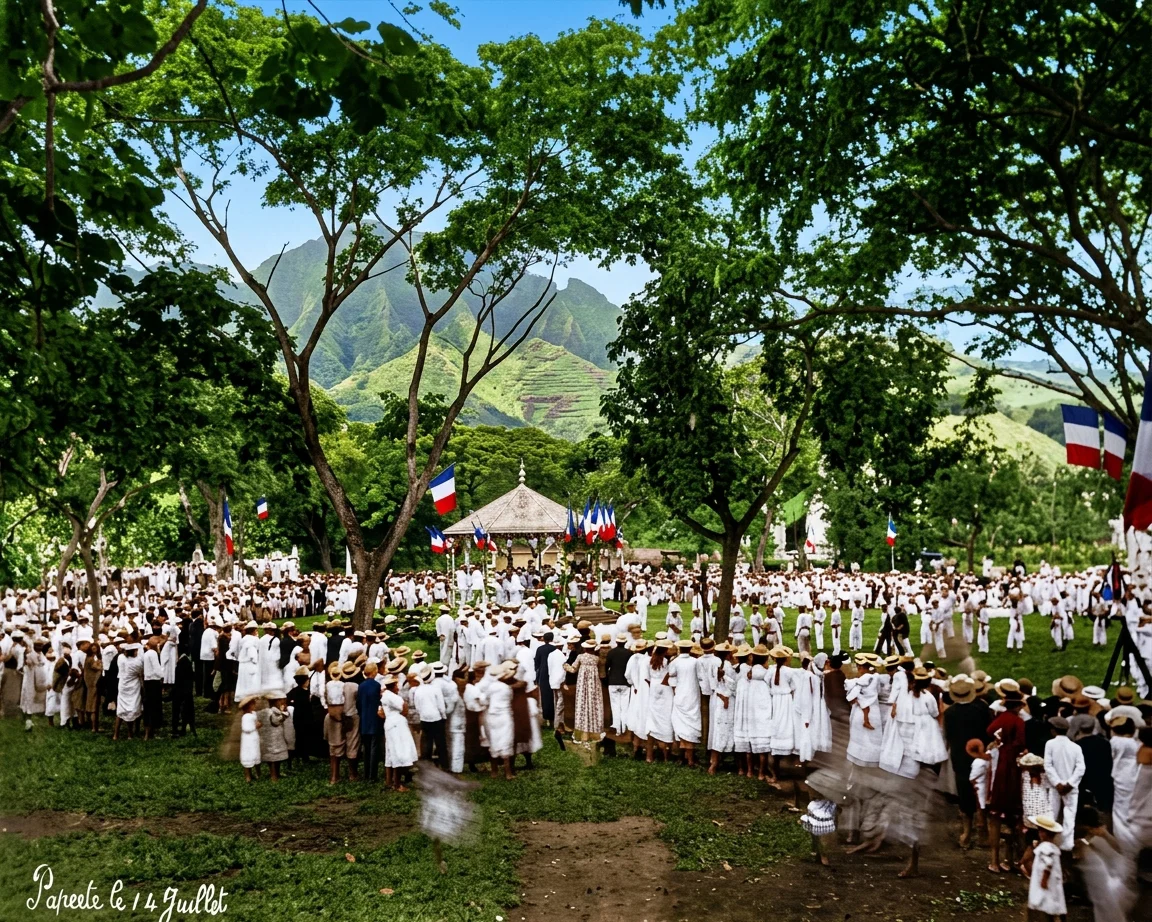
The celebration of the 14th of July. As the French rule Tahiti, the native Tahitians celebrate the great day of the French republic.
As the ship plows her way through the rolling ocean toward these two islands, the loveliness of the scene becomes enchanting. The azure sky and the deep blue of the ocean, relieved only by a few banks of cumulous clouds, and the white foam of the breakers as they dash on the reefs, contrasted with the luxuriant verdure of the tropical vegetation, interspersed with patches of rich chocolate soil which marked the spots where landslides had occurred, and the gray volcanic rocks which pushed their sharp points through the great banks of fleecy clouds that enveloped the lofty mountain peaks in their watery embrace, formed a color scheme such as no artist could ever succeed in reproducing on canvas.
Gradually the tower of the castle of the late King Pomare, various church steeples, the dome of the Observatoire de Papeete, and other public and private buildings, came into view as the vessel was steered between the two islands.
Just inside the entrance to the harbor lay a little islet on which was erected the quarantine station; while along the shore of the mainland, about a mile away, could be descried the wharves, at which were lying a few small vessels. In close proximity to these lay a French war-ship keeping guard over the port. As the Aorangi steamed leisurely up the harbor, the road skirting the beach presented a busy scene. Motor-cars, bicycles, and vehicles of various descriptions were hurrying along toward the wharf to meet the incoming mail steamer. As the vessel was slowly hauled alongside the wharf, numbers of natives, dressed in all manner of hues, patiently watched the proceedings, curious to see something of the new arrivals as they should disembark. Sundry French officials, with the effusive demonstrations for which their nationality is noted, shouted words of welcome to a few French passengers on board who were about to take up their residence in this center of French activities in the Pacific.
Having descended the gangway to the wharf and walked a couple of blocks into the town, we found ourselves amid scenes quite distinct from anything in Australia. Altho the streets of Papeete are extraordinarily narrow, yet the roadways are well constructed and kept in good repair. Numerous motor-cars flitted noiselessly past the horse-drawn vehicles which are still a predominating feature of the street traffic; but as most of the carriages were fitted with rubber tires and the roads were exceedingly smooth, very little noise was created even in the busy thorofares.
A few blocks from the wharves we came to the market square, the center of Tahitian commerce; but at that evening hour the place was almost deserted. Five o’clock on Sunday morning, we were told, was the time to see the market at its best. Inwardly we made up our minds to rise in time in the morning to obtain a little acquaintance with Tahitian life. Some of the chief shopkeepers of Papeete are Chinese, who form a considerable portion of the population of the town.
Native Tahitian girls
A few minutes’ further walk brought us to the home of Brother and Sister Johnson. After our long ocean voyage, we were glad indeed to enjoy once more the hospitality of home life, and to mingle our songs and prayers with theirs at their family altar. As Pastor Lyndon and his wife and family were also present, together with Brother and Sister Adams, who have recently joined the band of mission workers in the Society group, Brother and Sister Johnson had the privilege of entertaining the largest number of Adventist white people that had gathered together for a long time in Tahiti. While they expressed the greatest pleasure in experiencing this little break in the monotony of island life, it was indeed a most pleasurable experience to the eight Adventists who were traveling by the Aorangi to America. Three of the visiting ladies, Sisters Graham, Gregg, and Sandberg, remained at Brother Johnson’s home for the night, while Brethren C. A. Brandstater and Westby Amyes returned to the boat. Pastor Fulton and the writer and his wife, together with Pastor Lyndon and his family and Brother and Sister Adams, drove to Arue, a district lying about four miles out of Papeete, where our mission church is13things provided by Sisters Lyndon, Johnson, and Adams, there were also a number of tropical fruits cooked for the occasion by the natives. Beneath the shade of huge coconut palms a table-cloth of large banana leaves was spread, upon which were laid all manner of quaint dishes,—breadfruit, fei (cooked mountain plaintain), pawpaw, or mummy apple, mangos, oranges, guavas, bananas, and other products of the vegetable kingdom. An abundance of coconut milk was furnished by one of the native brethren, who, with wonderful agility, climbed up the smooth trunk of a huge palm to the plentiful crop of coconuts that hung amid the graceful leaves about forty feet from the ground. For a few moments it fairly rained coconuts, the ground being literally strewn with them. Quickly descending, the native tore off the husks for us, and unbottled the refreshing milk which nature so bountifully provides for the use of man in the torrid zone.
Just as we were commencing our open-air repast, a tropical shower burst forth, causing us to run for shelter, carrying with us, however, the good dishes, to which we all did justice. The rain continued to pour down as it can do only in tropical regions, until it was time for us to leave for the boat.
A drive back to Papeete of four miles through the rain concluded our very enjoyable visit to Tahiti, by which, short as it was, we were able to appreciate to some extent at least the difficulties which beset our missionaries in such places. Under ideal conditions we had the pleasure of meeting with Tahitian brethren and sisters who, through the faithful labors of our devoted missionaries, have been converted to present truth. But the contrast between these God-fearing Christians who delight in singing hymns to the praise of God, and the crowds of ungodly people who thronged the marketplace on Sunday morning, was very great. Truly our brethren and sisters in Tahiti need our prayers, for they are surrounded by the most immoral environments, and it is therefore little wonder that our laborers meet with so many disappointments in their work. Nevertheless the truth is making progress, despite all obstacles; and if our missionaries would consent to adopt the questionable expedient of lowering the high standard set for church fellowship, doubtless they would have greater numerical results to show for their labors. But this they can not consent to do, for no good reason is afforded to lower the Christian code of morality in Tahiti, because the Tahitian code of morality is low.
While the natives have been made subject to the laws of a civilized power, yet it is questionable whether they are not more difficult to reach with the simple truths of the gospel now than they were before they were brought within the pale of civilization and contaminated with the vices of the white man. Catholic churches, with their attendant priests and nuns, are to be found all through the island; and as these are largely patronized by the French civil authorities, it is only to be expected that they will exert a powerful influence over the native mind. This, of course, only tends to increase the difficulties—which already face the Christian missionary. Many of the numerous Chinese traders are intermarrying with the native women, and this is another factor which impedes the work of the missionaries. With all these conflicting interests, the missionary finds his work much hampered; for while the native is clever in many things, yet he has not a discriminating mind with which he can reason out subtle differences of principle in religious matters. Nevertheless the promises of God stand sure, and we may rest content that if we are faithful in sowing the seed, God will give the increase, for where sin abounds, grace doth much more abound.