“What are you going to do to-day,” questioned little Mildred, as she and Hetty were dressing one Wednesday morning. Wednesday being a whole holiday, the little girls felt very rich in play-time.
“‘Whatsoever thy hands find to do,’ I hope,” said mamma, smiling, before Hetty could say anything. “Suppose my little girls try to do one act of kindness every day for somebody in need; only think how it would make your lives shine with good deeds, three hundred and sixty-five a year!”
The little girls listened earnestly to what mamma said, but I’m afraid croquet and lawn-tennis soon put it out of their heads. However, before the day was over, as a very dirty, ragged little boy was passing their gate, Mildred suddenly thought of her good deed, which was still undone.
“Little boy,” she cried, running to the fence, “don’t you want to wash your face?”
“No,” answered the small boy, promptly.
“Ah, do,” coaxed the curly-headed philanthropist—“do, and I’ll give you a ginger cake.”
This changed matters, and the boy, whose name was Kit, submitted to having his face and hands scrubbed. Hetty was in despair while this washing was being done, because the sun was fast going down, and she could think of nothing to do for her day’s share; but before Kit got away, Hetty remembered a silver dime that had been given her for keeping weeds out of mamma’s flower-bed, and she hastened to bestow it upon the amazed boy, who, if he had ever heard of the millennium, would surely have thought it was dawning.
Kit was not a bad boy, though he was a very much neglected one; and as he pattered along in the direction of his dirty, tumble-down home, with clean face and hands, two ginger cakes, and a ten-cent piece, a new ambition began to grow up within him. He found his little sister (whose only remembered name was Jinx) sitting on the door-step, sucking her thumb, that being the only clean spot to be seen about her.
“Jinx,” said the young reformer, while the little girl stared at his changed appearance, “I’ll gi’ you a cake ef yer’ll wash yer face and han’s.”
Jinx promptly took the dare, but her efforts were not crowned with the brilliant success that Kit had expected. However, with his rough help, she was made to present a less startling contrast to himself, and then the two ginger cakes were in order.
This repast being concluded, the children naturally felt thirsty, and now a second inspiration seized Kit. He produced his silver dime, and proposed to buy a quart of milk for supper.
It would be twenty minutes or more before mother would come back from her day’s washing, and father would perhaps be along from his work about the same time.
With eager, inexperienced hands, Kit and Jinx washed out an old cracked, fly-specked pitcher, and took it round to the salesroom of the “Olive Dairy,” where it seemed to them they got a surprising quantity of good sweet milk. I think myself that the smiling young woman who poured it out for them gave them a bountiful measure.
And you would hardly believe how much difference the clean faces and the quart of milk made in that home: the tired father and mother, who, alas! were so often cross when they came back from work, felt somehow refreshed and rested at the sight of the clean, happy children. They were proud of their smartness in providing a treat for supper, and never had milk tasted so good before. After this, many and many a little surprise did they save up, and hunt up for one another, father, mother, and children, while the clean faces and hands became a permanent presence among them, spreading, as cleanliness does, more and more, to clothes and plates and tables and floors.
I don’t know what Mildred and Hetty had for their next good deed, but I hope it took root and grew like this one.—S. S. Advocate.
Letter Budget.
AND now comes the little people's turn to tell what they have to say, and there is space for several letters. Some of these have been in type some time.
ROBBIE MERRICK, who lives in Columbia Co., Wash. Ter., writes: “I am a little boy, and will be six years old to-morrow. My mamma is going to give me a present, but I don’t know what it is. I wash the dishes, sweep the floor, and carry in wood. My papa and mamma keep the Sabbath, and I am trying to keep it too, and to be a good boy. We live about twelve miles from Sabbath-school, and so cannot go very often. My mamma is going to give me a missionary hen, and I am going to try to get some money to send to the missionary cause. I have a little sister and brother younger than I am. We live on a farm, and have nice times playing together. Mamma wrote my letter for me, and I hope you will print it.”
LOTTIE and NINA HAYSMER write from Montcalm Co., Mich. They say: “As we have never seen but one letter from this place, we ask our mamma to write one for us. We are two little sisters, aged six and eight years. We love the INSTRUCTOR very much. We attend Sabbath-school nearly every Sabbath, and get lessons in Book No. 1. Our uncle superintends the school. We have five sisters, two attending the college, and one, with her husband, is at the Adrian Mission. Our only brother has been at the Sanitarium most of the time for the past five years. We have a pet lamb and a nice kitty. We help our mamma all we can, and are trying to be good girls, and to overcome, so we can go home with Jesus when he comes.”
Our next letter is from a little girl, who writes: “My name is H. MAY MALCOM. I live in Woodbury Co., Iowa. I have two brothers and two sisters, and we have a little cousin staying with us now. I read in fifth reader at day school. I have no Sabbath-school to attend, but I would like to go very much. I have the INSTRUCTOR sent to me. I stay at home with my parents, and am in my thirteenth year. We do not keep the Sabbath, but we would like to. I am trying to be a good girl, and hope to meet you all in the new earth. This is my first letter.”
RHODA FERRELL writes a letter from Morrison Co., Minn. She says: “I am a little girl eleven years old, the youngest of the family. I help my mother about the house, sweep the floor, and wash the dishes. I go to day school, and to Sabbath-school. At the day school I am in the fourth reader, and at the Sabbath-school in Book No. 2. I want to be a good girl, so I can be saved when Jesus comes.”
On the other side of Rhoda’s sheet was a letter from her nephew, GEORGE FERRELL, which reads: “This is my first letter, and I got my uncle to write it for me. My father died about two and a half years ago, and I am now staying with my grandparents. I get in the wood, feed the chickens, and help about the place to do chores. I am trying to be a good boy, so I can be saved when Jesus makes up his jewels. I am seven years old.”
ELSIE L. JESSUP writes from Otsego Co., Mich. She says: “I am nine years old. I have no brothers or sisters. I keep the Sabbath with my mother. My father does not keep it. I like the INSTRUCTOR real well. I get it at the Sabbath-school. I live in the country. I have a pet kitten and a bird. I hope to meet you all in a better world.”
ANNA MAY CHAPMAN, a little girl thirteen years old, writes a letter from Grant Co., Wis. She says: “I have three brothers and two sisters, and with our parents we all keep the Sabbath. I go to Sabbath-school, and study in Book No. 3. I want to be a good girl, and be saved when Jesus comes.”
THE FIRST TANGLE.
Once in an Eastern palace wide
A little girl sat weaving;
So patiently her task she plied,
The men and women at her side
Flocked round her, almost grieving.
“How is it, little one,” they said,
“You always work so cheerily?
You never seem to break your thread,
Or snarl and tangle it, instead
Of working smooth and clearly.”
“Our weaving gets so worn and soiled,
Our silk so frayed and broken;
For all we’re fretted, wept and toiled,
We know the lovely pattern’s spoiled
Before the King has spoken.”
The little child looked in their eyes,
So full of care and trouble;
And pity chased the sweet surprise
That filled her own, as sometimes flies
The rainbow in a bubble.
“I only go and tell the King,”
She said, abashed and meekly.
“You know He said in everything”—
“Why, so do we,” they cried, “we bring
Him all our troubles weekly!”
She turned her little head aside;
A moment let them wrangle;
“Ah, but,” she softly then replied,
“I go and get the knot untied
At the first little tangle!”
O little children—weavers all!
Our ’broidery we spangle
With many a tear that need not fall,
If on our King we would but call
At the first little tangle!
—Selected.
GOPHERS
By M. H. L.
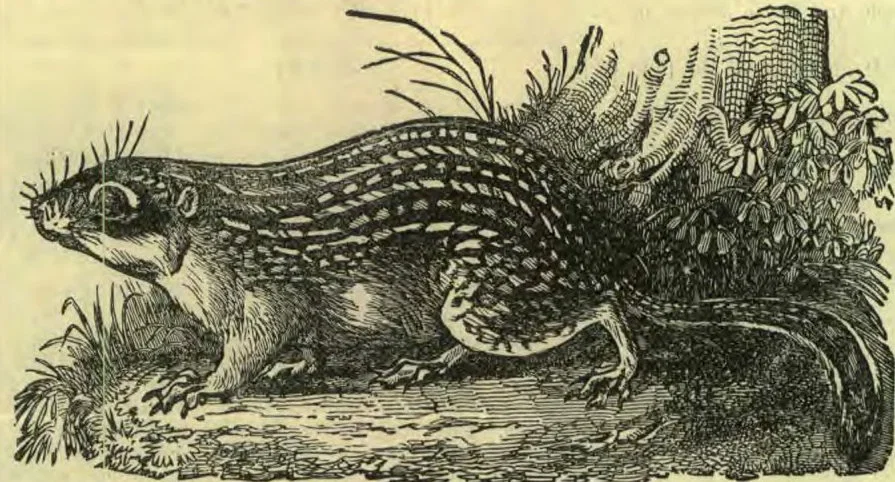
The gopher is an animal some like the squirrel, only it lives in the ground instead of in the trees. Perhaps most of you have seen the striped gopher like the one in the picture, by the road or in the field, and noticed how he will sit up like a bear, and watch you pass; but if he thinks there is any danger of being hurt, he suddenly disappears into his house under the ground.
There is also the gray gopher, whose habits are very much like those of the striped. But the pocket gopher is more peculiar than either of these. It is some larger than the others are, and nearly the color of a mouse. On each shoulder is a pocket, all nicely lined with fur, in which he carries wheat, corn, small potatoes, or whatever he finds for food. These he places there with his fore paws, and removes them by the muscular action of the pockets.
His front feet are so large and strong that they seem to be made on purpose for digging. This he can do very rapidly, and seems to enjoy it. His home differs some from that of the striped and gray gophers, because he uses the dirt which he digs out to cover the opening, or door, of his hole, so that there is nothing to be seen but a little mound of dirt.
They sometimes have a large number of these mounds, which are all connected by under-ground passages, and look like little villages. The little fellow sometimes entirely destroys fruit trees, for he not only gnaws the bark off the roots, but cuts them off with his teeth, just as the beaver cuts down trees.
We children once caught two of them, and put them in a box of sand, where we could watch them. We noticed that in digging a home they would work away furiously for a few moments, and then turn around and push the dirt out with their front paws, using them as hands. They were at first very cross, and would bite at us if we offered to touch them, but after awhile they seemed to enjoy being petted as much as a kitten. We had not kept them very long before one died, and the other was so knowing as to pile the dirt against the side of the box high enough so that he could escape over the top.
Are not the small animals of God's creation as wonderful as the large ones? M. H. L.
Do Thy Little; God Has Made
Do thy little; God has made
Million leaves for forest shade;
Smallest stars their glory bring,
God employeth every thing.