The Youth’s Instructor, Vol. 35, No. 7.

THE PLAID DRESS

The Youth’s Instructor

Feb 16, 1887

S. D. A. Publishing Association · Battle Creek, Mich. · Feb 16, 1887

THE PLAID DRESS.

Jennie was a bright, good-natured, sensible girl. Her brother Bob once said of her, “Jennie isn’t always making a fuss about things; she believes in having a good time, and doesn’t spoil it all by fretting, like some girls.” But one day there was plainly a cloud upon Jennie’s face. What could be the matter? Every one at the breakfast table wondered, but nothing was said about it until Jennie was left alone with her mother, when the trouble was revealed.
“Mother,” she said, “don’t you think you can manage in some way to get me a new dress? I am so tired of that plaid one.”
“Why, Jennie,” replied her mother, “I was thinking, the last time you wore it, how fresh and pretty it still looked.”
“Oh, to be sure,” remarked Jennie impatiently, “but all the other girls wear pretty plain-colored dresses; and actually, mother, they know me by that old plaid. When I went to Gertie’s yesterday, I heard two of the girls say, ‘There comes Jennie Hunt, I know her by her plaid dress.’ There isn’t another girl in our set who wears a dress anything like it; and it makes me feel ashamed.”
Mrs. Hunt smiled a little at Jennie’s eagerness; then kissing her affectionately, said, “Watch and see if you cannot find that there are other things by which girls are sometimes known which are more undesirable than even a plaid dress.”
Jennie went off to school thinking of her mother’s words. Of course she felt better already. She always found that her troubles were half cured when she had poured them into her mother’s ready ear, and perhaps this is the reason that the clouds so seldom settled in the girl’s face. She did not quite understand what her mother meant, but resolved to be on the watch.
Her most intimate friend, Mollie Downs, came to meet her before reaching the school-house; and while in the ante-room removing their wraps, they could hear the sound of many voices in talk and laughter from the large room where the scholars were assembling for the morning exercises.
“Ida Howells is there, I know,” said Mollie. “I can tell her by that silly laugh. I hope I never giggle as she does.”
“Yes,” replied Jennie, “and that loud voice belongs to Maggie Smith. It is too bad she talks so loud; she is a nice girl, but people think her rude and coarse because she will speak in such high tones.”
As they joined the group in the school, a quick thought flashed into Jennie’s mind: “That is what mamma meant. It is better to be known by a plaid dress than by these things.” Soon the bell rang, and in the hours that followed only once was there a reminder of the plaid dress.
When the writing exercises were returned to the girls, she heard the teacher say in a low tone to the pupil whose seat was directly behind her own: “I am sorry to see that you are still so careless with your penmanship. It is not necessary for you to affix your name to your exercise. I always know it from the others by its untidy appearance.”
“Well,” thought Jennie, “there it is again. I wonder if I am known by any disagreeable traits. I don’t believe I am.” But now that her eyes were open to observe herself, it was not many days before she discovered that there was one glaring fault which distinguished her from the other girls. It was commonly understood that anything described by Jennie Hunt was a little more highly colored than it would be by any one else. “Did Jennie Hunt tell you that? Well, you know she is apt to get things a little twisted,” she heard one say; and again, “I don’t believe it was quite so bad, Jennie exaggerates so, you know.”
This was a serious revelation to our light-hearted, easy-going Jennie, and resulted in more than one thoughtful mood in which she meditated upon the failing. She found that it was her eagerness to create excitement and surprise among her companions that had led her into the habit, and she was shocked to recall how inaccurate she had sometimes been, with no thought of being so, for Jennie loved the truth, and would never have willingly departed from it in the least.
“If I have to be marked by that plaid dress when out with the girls,” she said to herself, “I will not be known by this ridiculous fault,” and she set to work with a will to overcome it. It was then that she realized what a strength the habit had gained, and she was often discouraged to find herself tempted and overcome. But she found, too, that school girls are just as quick to discern noble and pleasing characteristics.
“This is Mary Foote’s desk; no other ever looks so nice,” was the comment one day to a visitor. Then, when the lonely French teacher was so pleased and touched by an act of kind attention from one of her class, the general verdict was rendered, “It must have been Ada; no other girl would have thought of it.”
Was it strange that while studying character in this way, and finding herself so weak to overcome what had seemed a foolish, trifling habit, Jennie should be led to study more closely than ever before the character of Jesus Christ, the perfect one, and to seek his help to make her own more true and lovable? Thus it was, and before a pretty new dress was ready to be worn, her mother’s prayers were answered, and Jennie was seeking to be known in her daily living, first of all, as a loving and faithful follower of her Lord and Saviour.—Selected.

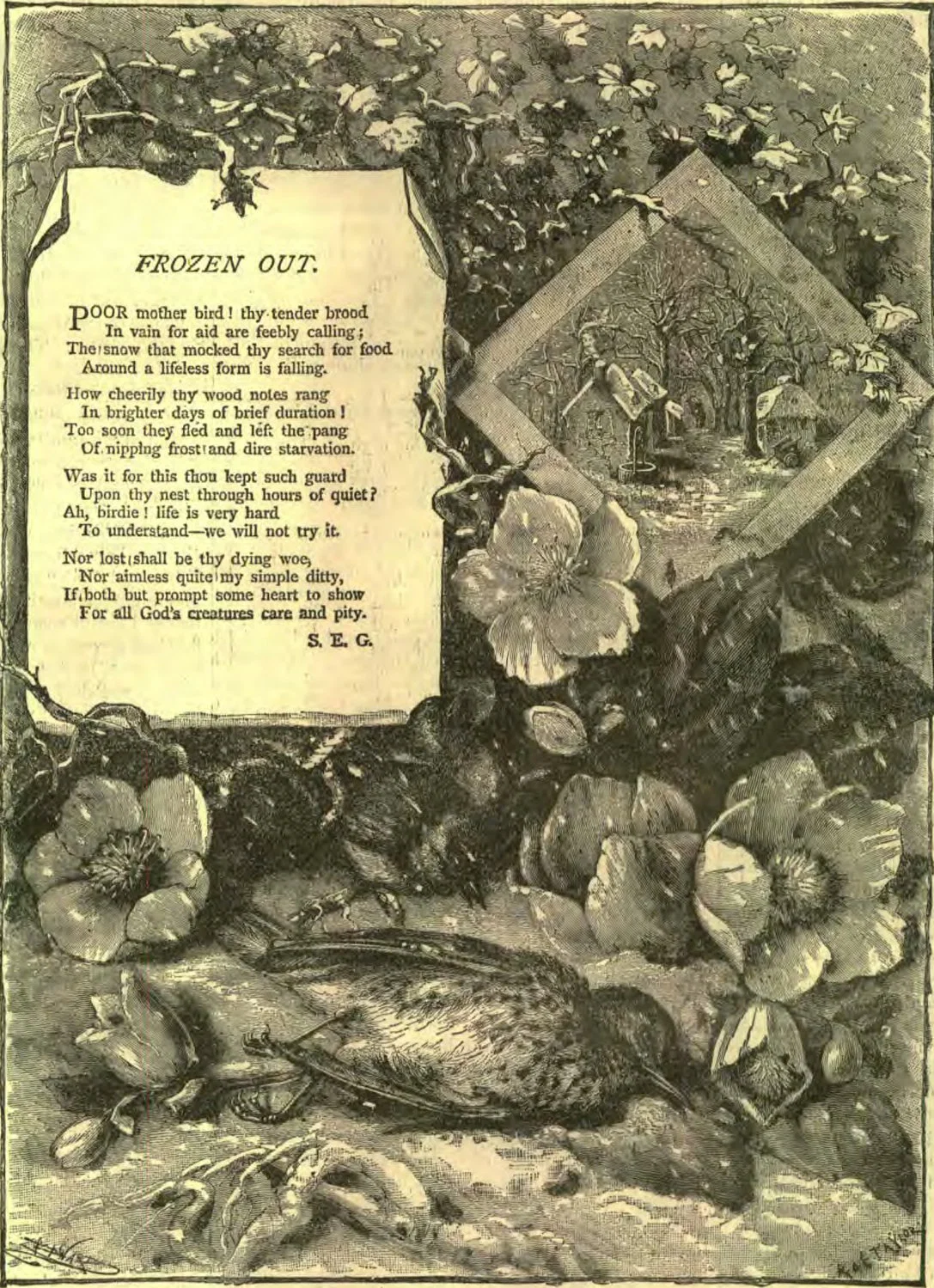
Frozen Out.

Poor mother bird! thy tender brood In vain for aid are feebly calling; The snow that mocked thy search for food Around a lifeless form is falling.
How cheerily thy wood notes rang In brighter days of brief duration! Too soon they fled and left the pang Of nipping frost and dire starvation.
Was it for this thou kept such guard Upon thy nest through hours of quiet? Ah, birdie! life is very hard To understand—we will not try it.
Nor lost shall be thy dying woe, Nor aimless quite my simple ditty, If both but prompt some heart to show For all God's creatures care and pity.
S. E. G.

A Wise Attempt Defeated Is No Failure

A WISE attempt defeated is no failure.

THE PRODUCTS, CLIMATE, AND ANIMALS OF NEW ZEALAND.

From what has already been said, it might truthfully be inferred that the soil and climate of New Zealand are adapted to semi-tropical fruits. The South Island is about 5° colder than the North. The mean temperature of the North Island is 57°, of the South 52°. The mean daily range is from 20° to the extreme range of 30°. The nights are 12° colder than the days. Farmers do not find it necessary to house their cattle in the winter. It is an established opinion that invalids rapidly recover in this country, especially such as have become enervated by a climate like that found in India. The summer mornings, even in the warmest part of the colony, are sufficiently fresh to exhilarate, without chilling, and the seasons glide imperceptibly into one another. The most beautiful part of the day is in the early morning; and at this hour, away from the busy cities and settlements, a solemn stillness pervades the air, broken only by the songs of the birds in the towering trees, and the grazing of the cattle and sheep upon the mountain sides. The summer nights are delightfully mild, and it is on such occasions that, freed from perplexing cares, the wearied laborer may hold sweet communion with his Creator.
Every kind of fruit raised in the United States of America will grow in this country. All such fruit having been imported, however, apples, peaches, pears, and other American fruits are not so common as in the Eastern, Middle, and Western States. All kinds of peaches and pears are cultivated to a greater or less extent, but not sufficiently to supply the market. Strawberries ripen in November, December, and January; apples, pears, and peaches in February; melons, figs, and grapes in March and April. Lemons grow in great abundance. Oranges are more scarce. Flowers blossom quickly, but their fragrance is not equal to those of some other portions of the earth.
There is a tree fern, which has a large trunk and grows to the height of twenty or thirty feet, with the fern leaves branching out at the top. Among these fern leaves, flowers are frequently seen growing as if intentionally planted. The seeds were blown from some surrounding plant, and perched thus, high above the ground, they thrive in their unnatural soil. Figs, peaches, grapes, and melons, ripen in the open air side by side with apples and pears, but it is not warm enough in the South Island to bring the more delicate fruits to perfection. Indian corn and potatoes grow in abundance. Wheat is raised in the South Island in large quantities.
Animal life is scarce in New Zealand. There were two species of bats. A small rat was the only mammal before the pig was introduced by Captain Cook. The rat has now become extinct. Formerly it was eaten by the natives, who considered it a great luxury. They also had a domestic dog of an inferior stamp. They have no snakes or reptiles to destroy, in all New Zealand. A small spider is found near the sea coast. A small fly infests the sandy ground. Harmless lizards are plentiful.
The bays, lakes, and rivers abound in many varieties of fish. Imported birds and animals of all kinds thrive well on the island. Sheep, cattle, and horses do remarkably well. But the effect on the native birds of importing foreign varieties, is very much as it has been with the aborigines on the advent of the white man,—the original greatly diminishes, while the imported rapidly increases. Skeletons of enormous birds are unearthed, some standing four feet high. There is now on the island a small bird of the same species, called the Kiwi. The hare and rabbit multiply rapidly, and in some places are a great pest to the farmers. Bees make honey all the year round. Dr. Hochstetter says, “Of all the colonial provinces of the British Crown, New Zealand bears the most resemblance to the mother country, by virtue of its insular position, its climate, its soil, and the whole form and structure of the country. In is an empire of islands, a double island, which—thanks to the power of steam, that nowadays shortens every distance—lies towards the neighboring Australian continent like Great Britain towards Europe. Blessed with a genial oceanic climate, so admirably suited to the Anglo-Saxon race; with a fertile soil, well watered, and splendidly adapted to agriculture and farming; with a manifold coastline, suited perfectly to the notions and habits of the first maritime nation of the world,—it is a country without dangerous animals, without poisonous plants, but rich in mineral treasures; a country where horses, cattle, and sheep thrive; where fruit, grain, and potatoes grow abundantly; a country adorned with all the charms of grand natural scenery; a country which can easily support a population of twelve million; which promises the bold and persevering emigrant a lucrative and brilliant future. Such a country appears indeed destined, before all others, to become the mother of civilized nations.” S. N. HASKELL.

Sea Tales No. 16: Harbors and Coast of South America

SEA TALES.—NO. 16.

While we are running up the coast of South America towards the equator, I will improve the opportunity to tell you what I know about the harbors, coast, etc., that is curious and interesting.
In some ports it is ruinous for a vessel to remain if only for a few weeks, so powerful is the effect of the sun, rarely clouded, and acting throughout the whole day upon the wood-work. In some of the harbors, San Blas, for instance, anchors will become badly corroded, from some unknown cause. In a surprisingly short time, they will become practically useless. At one time an English vessel lying at anchor but for a few months in the port named, was rendered unseaworthy, although a new ship. Her timbers (well-seasoned African oak) were ruined by the action of the sun, and her cables reduced one third in size, with most of the cross-bars gone. On most summer months no dew appears, and at no period of the year is there a rainy season.
Port Santa Elena, above Cameron’s Bay, is the sportsman’s paradise,—guanacos, ostrich, armadillos, and the cavie, or Patagonian hare, exist in countless numbers; while it is no exaggeration to say that birds are found by the thousands. The Indians visit this region annually; but if a trench is dug about the camp, it is a certain protection, as no Indian of that country will cross a ditch, however shallow, for any purpose.
The river Negro, which separates Patagonia from the provinces of the La Plata, has a very fine, dark quicksand on one of its banks. One night in 1827, a vessel of one hundred and sixty tons grounded on this bank, and before morning was completely buried up by it.
If a vessel should anchor anywhere in the vicinity of the La Plata River, particularly at or near Piedras Point, it would be probable that the anchors would be lost in attempting to weigh. Hard tosca (clay hardened to the consistency of half-baked brick), full of holes worn by the action of the sea, receives the flukes of the anchor, which can be loosened only by heaving up and down, and so cracking the tosca, before trying to weigh. If a sudden or forcible strain should be applied, the anchor or chain would certainly give way before the tosca.
The river La Plata is a terror to seamen, because in its vicinity hurricanes, called Pamperos, blow frequently off the land and are very severe. As we passed, we encountered a terrible one lasting nearly twelve hours. Every sail was taken in, and a storm try-sail was set, which is used in a gale in the place of a mainsail, when it is impossible to carry the latter, yet when a sail is necessary aft to control the vessel. This sail had not been used in four years. I shall never forget the appearance of the pretty craft, despoiled of all the yards of white canvas, and this diminutive, mutton-leg rag hoisted in the place of the mainsail. It gave me a chill to look at the naked spars and whistling cordage.
There can hardly be imagined a more pleasing place of residence, surrounded by more charming scenery, than the city of Rio Janeiro, although the cost of living there is three times as great as at either London or Paris. If vessels remain here long, barnacles grow quickly and fasten themselves to the copper, injuring it and impeding the sailing power of the vessel. A picture of some barnacles appeared awhile ago in the Instructor; if this is re-examined, it will become apparent how a barnacle prevents a vessel from sailing well. So many vessels frequenting this port have copper coverings, that it is dangerous to eat any fish, including oysters and shell fish, that are caught in the harbor.
In 1830 the British ship Thetis ran ashore on Cape Frio, one of the headlands of this port, and sank. There was in the cabin $800,000 in gold. An expedition was organized to recover the money, and $620,000 was brought up from the bottom of the sea. The village of St. Thomas, of which two houses still remain, was built by the party. It stood on a rise of ground one hundred yards from the beach; and evergreen shrubs bearing flowers grew in the intervals between the houses, and must have been a pretty sight. It has, however, a serious drawback, so that pretty as it is, the island will never be populated. A kind of insect called “jiggers,” common also in our Southern States, are there in millions. These pests bore their way under the skin, causing much pain and inflammation. It is said that half the men composing the expedition were constantly lame from the attacks of these insects, and unable to work.
The heat at Rio is indescribable. It is simply awful. During the night it is always calm, with much lightning. About 9 A. M. the sea breeze comes gradually, and is strongest about noon, when, by degrees, it dies away to a calm, generally about sunset. Notwithstanding the heat, the country is considered healthy.
Some four hundred miles further north lies Bahia dos Todos, or Santos, the Bay of All Saints, which was discovered by Americus Vespucius. He carried home from the coast of Santa Cruz, as the newly discovered country was first called by the Portugese, a cargo of Ibirapitanga, the dye wood, which, when cut in pieces, resembled “brazas,” coals of fire, from which circumstance it acquired the name of “Brazil-wood,” and also conferred a name upon the country—Brazil.
On the 25th of March we were in the vicinity of the Cape Verde Islands, off the coast of Africa. One of these rocks, looked at from a distance, has a striking resemblance to the pictures of George Washington, the entire bust, including the frilled shirt front, being plainly discernable.
In these islands a half dozen oranges can be purchased for a cent, and bananas are as plentiful as apples generally are in our own country. How many of the little readers of the Instructor would like to live there? But aside from the fruit, what shall I say about the parrots? No sooner does a vessel anchor at St. Vincent than the ears of all on board are pierced with the shrill cries of hundreds of these birds brought out in boats that surround the vessel for the purpose of trading. Talking except by yelling is simply impossible. The gray parrots are the best talkers, but the green ones sell more readily, owing to their bright plumage.
After passing safely the Canary Islands and the island of Madeira, we were on the 18th of April off the coast of France and in the midst of a terrible gale. An owl and two other land birds blown to sea came aboard. I tried to catch the owl, which clung to the port after-rigging; but I had to consume so much time in preparing a safety rope to cling to, the brig being rail under on the port side, and terrible seas dashing over continuously from the starboard, that before I could reach the shrouds, the poor little fellow lost strength, and just as my hand touched him, he gave a last despairing cry, let go, and was instantly engulfed in the huge sea. The mate succeeded in catching one of the other birds, but foolishly put it in a cage with a hole in the top, through which it escaped, and was drowned in the waves. At 7 P. M. we saw the light at Ushant on the coast of France, and on the 25th anchored safely on the “Downs,” where I will leave you, having told you of my sailing trip around the world, which consumed two hundred and thirty-four days of actual sailing. W. S. C.

Two Brave Boys.

Two young boys, sons of a clergyman living in Cincinnati, Ohio, went, not long ago, with their father to visit the Soldiers' Home at Dayton. After being there awhile, the clergyman left his sons in charge of an attendant, who was to show them the sights. Presently the soldier began:—
“Now that the old man has—”
“We do not know any ‘old man,’” interrupted the elder of the two boys.
“Now that the old gentleman—” said the soldier.
“We do not know any ‘old gentleman,’” once more interrupted the boy; “he is our father.”
A little while afterward the soldier began to swear. The younger brother looked up into his face, and said:—
“Please don’t use such words.”
“Why not?”
“Because we do not like to hear them; we are church folks.”
“Oh!” said the soldier, as he gave a whistle. But he did not swear any more, and he guided those boys around the grounds as respectfully and attentively as if they had been the sons of Victoria.

UPWARD GROWTH.

The noble pine, on all sides pressed In strife for light, Gains all its worth of knotless trunk, And heavenward height.
Pressed close by irk and ills of earth, Man looks above, And steady tends to clearer light And purer love.
More room I asked in which to spread: It was not given. Praise for the love that trimmed and trained My soul for Heaven.
—James Upham.

THE MINISTRATION OF ANGELS.

LESSON 5.—THE EXTENT OF THEIR WORK.

1. WHERE is God's throne, and over what does he rule? Ps. 103:19.
2. By whose ministry does he do this? Ps. 103:19-21.
3. Give evidence indicating that angels do have charge over the earth. Rev. 7:1-3.
4. Do the angels have any thing to do with the woes which come upon the nations of the earth? Rev. 8:13.
5. Who was sent to influence the affairs of Persia? Dan. 10:13, 20.
6. Who has the oversight of preaching the gospel to the nations of the earth? Rev. 14:6.
7. Then must not the angels have a deep interest in our missions?
8. What connection did an angel have with the first introduction of the gospel into Ethiopia? Acts 8:26, 27.
9. What does this suggest as to the interest we should take in missions?
10. Who has charge over the churches? Rev. 2:1, 8, 12, first part of each.
11. Give an instance showing the deep interest which angels manifest in the people and cause of God upon the earth. Zech. 1:12-14.
12. Do the angels study to understand the plan of salvation? 1 Pet. 1:12.
13. What should this suggest to us as to our interest in the matter?
14. Through whom does God communicate with men? Luke 1:19.
15. Relate another interesting case where the Lord sent a message to his people. Ex. 3:1-3.
16. Who is named in the next verse as the one speaking? Verse 4.
17. How do you explain this seeming disagreement?
18. Through whom did the Lord instruct Elijah, the prophet? 2 Kings 1:3, 15.
19. How did the Lord instruct Joseph, the father of Jesus? Matt. 1:20.
20. In what manner did the Lord send a message to Cornelius? Acts 10:22.
21. Relate as many instances as you can where angels have come as God's messengers to man.

NOTES.

God's throne in heaven.—The Bible often asserts, and everywhere assumes, that the throne of God is located in heaven, and that God dwells there. From this place he beholds and governs all his vast universe. Millions of angels wait around his throne ready to go at his command and execute his will. Under God these angels have charge over all his works, over the earth, and over the work of God in the earth.
The angel and the king of Persia.—A careful study of Daniel 9 and 10 will show that the prophet was earnestly praying for the restoration of Israel and Jerusalem. But this could be done only by a decree from the king of Persia. For this, Daniel fasts and prays. God hears him, and an angel is sent from heaven to move upon the heart of the king; but he withstands the angel till Michael comes to the assistance of the angel. Then the angel hastens to inform Daniel of what is transpiring in the Persian court, all unseen by mortals. Thus it is that God, by his angels, controls the affairs of nations when his people are concerned.
“To us it appears to be the doctrine of the Bible, and we shall therefore not shrink from it, that God employs evil men and demons, as well as saints and angels, in the government of the moral world.”—Cottage Bible, on Dan. 10:1-21.
The angels and the gospel.—Rev. 14:6, 8, 9, and many other texts plainly intimate that the angels do have the oversight of the cause of God in the earth. Doubtless they move upon the hearts of proper persons to lead out in the work and give light and inspiration to the laborers.
“Those who have fallen under temptation and have backslidden from God, need help. This class is represented in the lessons of Christ by the lost sheep. The shepherd left the ninety and nine in the wilderness, and hunted for the one lost sheep until he found it; he then returned with rejoicing, bearing it on his shoulder. Also by the illustration of the woman who searched for the lost piece of silver until she found it, and called together her neighbors to rejoice with her that the lost was found. The connection of heavenly angels with the Christian's work is here brought clearly to light. There is more joy in the presence of the angels in heaven over one sinner that repents than over ninety and nine just persons who need no repentance. There is joy with the Father and with Christ. All Heaven is interested in the salvation of man. He who is instrumental in saving a soul is at liberty to rejoice; for angels of God have witnessed his efforts with the most intense interest, and rejoice with him in his success.”—Mrs. E. G. White.
The angel spake unto Philip (Acts 8:26).—The word angel is used in the Scriptures in a great variety of significations. Here it has been supposed by some to mean literally a celestial messenger sent from God; others have supposed that it means a dream, others a vision, etc. The word properly means a messenger. . . . There is no absurdity in supposing that an angel was employed to communicate this message to Philip. See Heb. 1:14; Gen. 19:1; 22:11; Judges 4:12.—Barnes.
Angels speak in the name of the Lord.—In Ex. 3:2 it says that the angel of the Lord appeared to Moses in the bush; and in verse 4 it says that God called to him out of the bush. Of course it was the angel who spoke; but it is said that God spoke, because the angel represents God and spoke in his name and for him.

“FRED’S POUCH.”

The new plan adopted by some railroad companies of providing articles for the dressing of wounds and bruises in case of accident to the train, seems like a move in the right direction; but why furnish these only to freight-cars and freight-houses when, in case of accident to passenger-cars, the demand for them might be so much greater? However, we would not be of those who cannot enjoy the sunshine to-day for fear of clouds to-morrow, but would welcome the provision that has already been made for the comfort of any in distress, trusting that it is only a question of time before every train shall have a constant supply of comforts for the relief of the wounded. How the plan originated is given in the Companion, under the head of “Fred’s Pouch,” as follows:—
“All people who travel much by rail must have noticed that many of our passenger-cars are now provided with an axe, to be used in case of accident, in cutting away beams that may obstruct the escape of travelers. Some companies provide each train with a small chest of tools, which may serve in time of need.
“A new article of the kind is now seen hanging up in the caboose of freight-trains, as well as in the freight-houses along many lines of road. It is a leather case or bag, labelled “Fred’s Pouch,” and contains a supply of the articles most needed when a man is injured, such as court-plaster, bandages, splints, laudanum, arnica, ether, lint, twine, thread, and needles.
“‘Fred’ was a railroad man, who met with a terrible accident, and was obliged to lie upon the floor of the caboose for some hours with his wounds not dressed, and with nothing at hand to alleviate his intense sufferings. He could have been greatly relieved if there had been on the train a few of the articles now to be found in Fred’s Pouch.
“On returning to his post, after a long convalescence, he induced his company to provide freight-trains and freight-houses, all along their lines, with a repository to which Fred’s grateful comrades promptly gave his own name.”

GAS WELLS.

In boring for oil wells in the oil regions of Pennsylvania, it frequently happened that a gas vein would be drilled into, and natural gas would come rushing out with force sufficient to take tools and everything before it. These discoveries finally became so frequent in the vicinity of Pittsburg that it led to the plan of adapting it to lighting and heating purposes. S. W. Hall, in the February St. Nicholas, gives their manner of using it, as follows:—
“The spring and summer of 1884 witnessed a frantic forming of companies and drilling of wells and laying of pipes along the streets and roads, the highways and byways, until cautious people almost held their breath. Pittsburg, as the great central furnace, was especially interested in the new fuel; and besides wells sunk within the city, several lines of pipe, some twenty and thirty miles long, have been laid to bring in the gas from the great wells in different localities.
“For mill-purposes the gas is distributed under the boilers, and wherever needed, by a system of small pipes, the blaze supplying the heat directly; but for household uses, in stoves and fireplaces, the gas-pipe is usually placed at the bottom of the grates, which are filled with something to receive and hold the heat. In rooms where the open grate, burning the soft bituminous coal, has always been used, a pleasing variety in the arrangement of gas-fires is found. Some people do away with the grate altogether, and supplant it with a clever imitation in cast iron, of the old-time back-log. But the commonly accepted plan is to retain the grate, filling it generally with coarsely broken fire-brick, which, when heated, looks much like anthracite coal. Foundry-slug, properly arranged, presents a perfect representation of a soft coal fire, and is, therefore, more beautiful and desirable. Others resort to the novel plan of filling their grates with porcelain door-knobs, for which purpose they are bought by the peck or bushel! The quantity of gas burned is regulated by a valve at each fireplace; and the ease with which a gas-fire is made, regulated, and put out, coupled with its freedom from smoke, dust, and ashes, has warmed the heart of woman-kind toward it with a very great affection.”

A REMARKABLE EXPLOSION.

It occasionally happens that dealers in eggs, when transferring their commodities from one vessel to another, suffer the effects of an explosion, which, luckily, results in no more harm than the unpleasantness of a stale-egg spray. But the bursting of an ostrich egg, about a month ago, in the Peabody Museum, New Haven, was attended with quite serious consequences; for it burst with sufficient force to knock senseless the one who was experimenting with it. As published in Golden Days, it came about in this way:—
“When Dr. Baur came to New Haven, a year ago, to assist Professor Marsh in the Peabody Museum, he wrote to Dr. Atherstone, in South Africa, for some ostrich eggs. They were shipped on November 14, 1885, in the bark Aurelia. She was wrecked near Trinidad, but the eggs were saved, and reached New Haven safely. Dr. Baur found four of them in the box, and began at once to get the embryos out of the shells, for they were what he wanted to observe. He had filed two little holes in two of the shells, and had blown out their contents successfully. He wrapped a towel around the third, and began to file a hole in its shell. A hiss, and an explosion which knocked Doctor Baur senseless, followed, and when he recovered, he found himself covered with blood and the contents of the shell. None of the stuff had hit him in the eyes, but his face was considerably cut up. The explosion was felt in other parts of the building by several persons.”
“Dr. Baur says that the first two eggs had been punctured and treated with sulphate of mercury, which prevents fermentation, while the third had not, and its long voyage had stirred up a lot of powerful gas inside its 18½-inch in diameter shell, which burst as soon as the file had weakened it enough. The shell is two millimetres thick, and so tough that it can’t be broken without a hammer. As far as can be learned, it is the only accident of the kind on record.”

THE WAR OF THE ROOKS AND HERONS.

An interesting example of the reasoning power of animals is afforded in the story of the war between the herons and rooks at Dallam Tower, Westmoreland. According to Mr. Gough, its narrator, one of the groves there was resorted to by a number of herons, while the other formed one of the largest rookeries in the country. The two tribes lived peaceably for a time, but the trees occupied by the herons being at length cut down, and the young brood perishing by the fall of the timber, it became necessary for the parent birds to find a new home. The trees in the locality were not high enough for nesting purposes, so they tried to pitch their quarters in the rookery. This intrusion was fiercely resisted by the rooks, between whom and the herons bitter war was waged, in the course of which many lives were lost. The herons ultimately conquered, built their nests, and reared their young. Hostilities were again resumed in the following spring, and once more the herons were victors. Since then, peace has prevailed; the rooks, recognizing the force of facts, abandoned the part of the grove now occupied by the herons, while the latter did not trespass upon their neighbors’ trees; so both factions live together in the old unity that existed before their quarrel.—S. S. Advocate.

THE CHANGES OF THE KALEIDOSCOPE.

THE number of changes of which the kaleidoscope will admit are amazing. Some idea of them may be got from the following curious calculation:—
Supposing the instrument to contain twenty pieces of glass, etc., and that you make ten changes in each minute, it will take the inconceivable space of 462,880,899,576 years and 360 days to go through the immense variety of changes it is capable of producing; amounting (according to our frail ideas of the nature of things) to an eternity.
Or if you take only twelve small pieces, and make ten changes in each minute, it will then take 33,264 days or 91 years and 49 days to exhaust the possible variations. However exaggerated these statements may appear to some, they are actually true.—Sel.

Deep Artesian Well Supplying Hot Water at Pesth

At Pesth, in Hungary, the deepest artesian well in the world is now being bored for the purpose of supplying the public baths and other establishments with hot water. A depth of more than three thousand feet has already been reached, and it furnishes 176,000 gallons daily, at a temperature of 158° Fahrenheit.
Continue reading: KIT'S CLEAN FACE