BISHOP CHARLES H. FOWLER, in an address sent out on the above subject, names as one of "the three greatest missionary events of the Christian era since the crucifixion of Jesus," "the blowing up of the Maine." He further says:—
"But one day the Spanish touched off a magazine under us. Then the jig was up. Come what might, we must fight to the finish. We went into the air, and came down everywhere—to stay. This sent us about our providential job; this made missionaries of us. We are in Manila."
And how this nation has been a missionary in Manila, let the following summary from an eyewitness of events in Manila, tell:—
"It is a year of crime, lust, drunkenness, rape, assaults, robberies, murder, desertions, suicides, seductions, adultery, scandal, licensed infamy, licensed opium joints, licensed houses of prostitution, gambling, court-martials, intrigue, embezzlement, street fighting, swindling, counterfeiting, smuggling, stealing, canteen outrages, debauchery, and every form of devilment known to American Government of, by, and for the gin mills."—Wm. E. Johnson, in New Voice.
This is not new. It is confirmed by many. Are those who do these things missionaries of God?
THE Great Northern Railway has completed its big tunnel under a portion of the Cascade Mountains. The tunnel is over two miles in length, and was dug through solid granite, at a cost of about $5,000,000. This tunnel takes the place of the noted "switch-back" over the Cascades.
SO FAR there seems to be no agreement between the powers in reference to the settlement of affairs in China. The forces of each nation are acting under orders from home, and various punitive expeditions are carried out by the commands of the different nations. The allied army which the German field marshal was to command seems likely never to exist. Russia and England are both seeking control of the railway from Tien-tsin to Peking, and the soldiers of both nations are guarding sections of the road. All the American troops, except a strong legation guard, have been ordered to withdraw, and are preparing to do so. The Russian general at Peking has announced his intention to withdraw all his troops except a small contingent from Peking at once. As if to placate the foreign powers, the emperor of China has ordered the degradation of Prince Tuan, the well-known leader of the Boxers. Other officials also are to suffer, and the emperor orders libations and religious exercises over the graves of the German minister and the Japanese attaché. Emperor William of Germany has replied to the emperor of China that these services will not be considered adequate reparation for the murder of his minister and subjects in China. He demands that the Chinese officials who were responsible for the outbreak pay the penalty with their lives.
THE Catholic Young Men's National Union, in convention at New York on September 28, decided to "form a federation for the purpose of influencing legislation and furthering the claims of people embracing the Catholic faith." Bishop McFaul's idea of a national federation of all Catholic clubs for the purpose just stated was unanimously adopted by the convention, and committees were appointed to carry the plan into effect. In declaring for the federation, and bemoaning the present position of the government on the Indian school question, the Catholic Mirror of September 22 says: "The facts of the Indian school question constitute an urgent plea for Catholic federation. Appeals to justice and to fair play have been without effect. . . . A strong Catholic federation could have availed much at one stage of the proceedings. A remonstrance against prejudiced action from delegations representative in every sense of the word of the ten or twelve millions of Catholics in the country, would not have failed of effect. No public official, no political power, can afford to scorn so many of his fellow-citizens when it is known that they are united and can, if necessity arise, stand together in defense of their rights." There is certainly no mistaking the import of the Catholic federation.
CHARGES have been filed with the Prison Commission of Georgia against the managers of the McRee convict camp, of Lowndes County, in the form of affidavits from prominent citizens, to the effect that the managers of this convict camp have kidnapped innocent men and women, and made them work under armed guards for indefinite periods. It is charged that one practise of the convict camp managers is to employ "trappers" to arrest innocent negroes passing through the country, and, without any form of trial, to imprison and put them to work. In these convict camps prisoners of the State are rented out to contractors, and whipped and driven at their work.
THE British Admiralty has ordered twenty-five sets of Marconi's wireless telegraph instruments for installation on its war vessels, from which Marconi receives a royalty of $500 a year for a term of fifteen years. The chief of the electrical service of the English post-office is experimenting successfully with a wireless system of telegraphy and telephony. The United States Weather Bureau is also experimenting with a wireless telegraph system of its own, and it is claimed that better results have been obtained from it already than from the Marconi system.
THE American Institute of Sacred Literature, headquarters of which are in Chicago, is urging ministers all over the country, of all denominations, to use one Sunday as a "Bible Study Sunday." Well, one day is better than nothing, but it is sad indeed that conditions are such that an earnest plea must be made for that. Every sermon, the needs of every day, the conditions of the home, the church, the world, ought to stimulate Bible study among believers in God's Word. If ever there was need of it, it is now.
WITH each week there come new stories of the slaughter of defenseless Chinese, men, women, and children, at the hands of the Russian troops. One correspondent declares that over 1,500 of such non-combatants have been killed by the Russians in and around Newchwang. The correspondent adds that from all sides come reports of violence to women, and that the Russians are carrying out a policy of the destruction of property and extermination of the people. He says that whole villages have been burned and their people put to death.
A REPORT from New York states that the police department is now face to face with the united churches of that city over the matter of police blackmail, "by which millions of dollars are annually exacted from lawbreakers" for the privilege of robbing, swindling, and conducting houses of ill repute. The charges which the united churches will bring against the police will be made direct to the mayor, and even the board of police commissioners will be required to make explanations.
A SECRET circular addressed to the Russian archbishops has come to light and been published in Switzerland, which virtually excommunicates Count Tolstoi, the Russian social reformer. It declares that Tolstoi is an avowed enemy of the church (Greek Catholic), and that, therefore, unless he recants, the holy synod will prohibit the celebration of all divine services and expiatory masses in the event of his death.
REPORTS from Galveston state that there is still much suffering in that city, notwithstanding the liberal contributions that have been sent in from all parts of the country. Thousands are still without adequate shelter. The city government is facing bankruptcy, and plans are on foot for an appeal to the State Legislature to help the city government tide over its financial embarrassment.
PORTO RICO has made a novel demand on Cuba. It is for the repayment of $2,300,000 which Porto Rico was compelled to advance to Spain to help carry on military operations against Cuba. The Cubans are asking why they should repay funds loaned to the enemy for the express purpose of subduing them.
THE last remnants of the force of the Arab chief Addah have been defeated by the French in the southern Sahara. This famous chief was slain in battle with the French some time ago, and his two sons continued hostilities. In the recent battle one of the chief's sons was killed, and the force dispersed.
THE American Board of Commissioners for Foreign Missions has received advices from its missionaries in China that sixteen of them will return to their fields of labor in that country. Quite a number will return to America before again taking up missionary work in China.
A WRITER in Ainslee's Magazine tells us that "it is the experience of those who have seen much of life that the occult world, like fallen Babylon, is become the habitation of devils and the hold of every foul spirit, and a cage of every unclean and hateful bird."
AT Ryan's Hill, Penn., recently, street-railway traffic was retarded for some time by millions of potato bugs. The bugs piled over the tracks, and their crushed bodies under the wheels made the rails so slippery that little progress could be made by the cars.
ACCORDING to consular invoices, the amount of gold sent out of the Klondike region this season is $12,500,000. It is considered that a quarter of a million more has gone out without any record.
AT Frankfort, Kentucky, on September 29, James Howard was sentenced to hang for the murder of William Goebel, Democratic governor of that State.
A REPORT from Colorado states that an automobile has ascended Pike's Peak and descended in safety, thus establishing its practicability as a hill climber.
EIGHTY thousand pilgrims from Germany, France, Spain, Belgium, Poland, and Italy, are reported to have filed past the pope on September 28 and 29.
THE trustees of the University of Chicago have agreed to give free tuition to ten of the Porto Ricans who desire education in this country.
WITH 100 miles further construction, a telegraph line will soon be completed between Vancouver and Dawson City.
AN attempt to overthrow the Government of San Domingo is reported by cable from Monte Cristi.
ALCOHOL; ITS HISTORY, AND ITS EFFECTS UPON SOCIETY.
By W. H. Riley, M.D.
By W. H. Riley, M.D., Superintendent of Colorado Sanitarium, Boulder, Colo.
[All rights reserved.]
History of the Use of Alcohol.
(Concluded.)
DURING the last century, drunkenness was the rule, not the exception, in all classes of society. In the lower classes it was actually encouraged. Did the troops win a victory, did a prince come of age, 'Go home, Jack,' would say a master to his servant, 'build a big bonfire, and tell the butler to make ye all drunk.' It was quite a compliment to call an underling an 'honest, drunken fellow.' And as for the gentlefolk—well, we can hardly conceive of the state of affairs. It was part of a gentleman's education to learn to carry his port. One, two, three quarts a night was a proper and reasonable supply. After dinner the ladies retired to another room—a practise still observed—so that the men should have no embarrassing restraints; and it was a matter of course for them to drink one another under the table as fast as was convenient. In the army and navy, in the learned professions, among the gentry and nobility, and even in the royal family, heavy drinking was the rule, and not the exception, until well on into the present century.
"And they suffered for it. Their lives were shortened, their usefulness impaired, their estates squandered—and then the gout! Nowadays, with the example of Palmerston and Bismarck, Gladstone and Sherman, before our eyes, it is hard to think of a time when statesmen were incapacitated at thirty-five or forty.
But it was so. A gentleman who reached middle age without being crippled was considered either unusually lucky or a milk-sop. Lord Chatham and many, nay, most of his contemporaries were horribly tortured by gout. At critical periods in the nation's history a severe onset of gout, or the illness leading up to it, was liable to cause the retirement of the most prominent statesmen. Many of them died young. Few indeed reached a healthy and vigorous old age; for heavy drinking was not confined to the idlers and spendthrifts, the courtiers and country gentlemen; it was a custom with the ablest and most brilliant men in England.
"It must not be inferred, however, that drinking was much more prevalent in England than in other parts of the world at the same periods. Indeed, the records of Germany and Holland show quite as startling pictures. And in our own country we have not much to boast of.
"When the Puritans landed in Massachusetts in 1620, they found, to their disgust, that beer and wine were both lacking, and we find Governor Bradford complaining bitterly of the hardships of drinking water. Nor was water a more favored beverage among the settlers of Massachusetts Bay eight or ten years later."
Higginson, a minister in Massachusetts, wrote a glowing account of the country, where his health had been greatly improved. He speaks thus of his improvement: "And whereas my stomach could only digest and did require such drinke as was both strong and stale, now I can and doe oftentimes drinke New England water verie well." Another bore witness to this marvelous fact concerning New England water: "Those that drinke it be as healthful, fresh and lustie as they that drinke beere."
"The first list of necessities sent back to the home company, in 1629, is headed by an appeal for 'ministers,' and for a 'patent under seale;' and only a line or two further down is a request for 'vyne planters.' They also ask for wheat, rye, barley, and other grains, and for 'hop rootes.' By 1631 it had become necessary to pass a law for putting drunkards in the stocks; other laws followed concerning adulterations, save to savages, etc. In 1634 the price of an 'ale quart of beere' was set at a penny, and brew-houses were soon in every village, and in some places attached to every farm. By 1650 every little New England town and village had its distillery—the seaport towns had scores of them—and the rum bullion, rumbooze, or, as it was universally known, 'kill divil,' was sold freely for two shillings a gallon, and was shipped largely to the African coast in exchange for slaves.
"Liquor was not only used at dinner and supper parties, it was taken morning, noon, and night, as a matter of course. The laborer would not work at the harvest, the builders at their trades, without a liberal allowance of rum. It did not matter, either, what class of work they were doing. When the little town of Midfield, early in the last century, 'raised' the new meeting-house, there were required 'four barrels of beer, twenty-four gallons of West Indian rum, thirty gallons New England rum, thirty-five pounds loaf sugar, twenty-five pounds brown sugar, and four hundred sixty-five lemons.' A house could not be built without liquor being distributed at every stage of the operation; and this practise was not obsolete until well on into this century.
"The clergy, while keeping a strict eye upon the excesses of their parishioners, did not disdain a drop themselves, and their conventions rivaled the dinners of the non-elect. In 1792 Governor Hancock gave a dinner to the fusileers at the Merchants' Club in Boston, and for eighty dinners there were served one hundred thirty-six bowls of punch, twenty-one bottles of sherry, and lots of cider and brandy. It would be but useless repetition to discuss the drinking habits of New York and other colonies. It is enough to say that well on into the present century drunkenness was exceedingly common, and, when people could afford it, a most pardonable and venial offense.
"The world has at last found what intoxication means. Alcohol in large doses is a poison, but it is a poison that injures the family and neighbors and friends of the inebriate more than the victim himself. It shortens his life, to be sure; but think of the other lives that it shortens! And while some attack the problem with fierce and wild denunciations, and others by quieter but not less effective arguments and appeals, the world certainly owes a debt of gratitude to those who are doing so much now, and who have done so much already, to relieve mankind from the burden of inebriety." —Prof. Chas. E. Pellew, in Popular Science Monthly, July, 1897.
[The next article in the series is entitled "The Composition of Alcohol."]
THE MOTHER'S WARNING.
TOUCH it not—ye do not know,
Unless you've borne a fate like mine,
How deep a curse, how wild a woe,
Is lurking in that ruby wine.
Look on my cheek—'tis withered now;
It once was round and smooth as thine;
Look on my deeply-furrowed brow—
'Tis all the work of treacherous wine.
I had two sons, two princely boys,
As noble men as God e'er gave;
I saw them fall from honor's joys
To fill a common drunkard's grave.
I had a daughter, young and fair,
As pure as ever woman bore—
Where is she? Did you ask me where?
Bend low, I'll tell the tale once more.
I saw that fairy child of mine
Linked to a kingly bridegroom's side;
Her heart was proud and light as thine—
O, would to God she then had died!
Not many moons had filled their horn,
While she upon his bosom slept;
'Twas on a dark November morn,
She o'er a murdered husband wept.
Her drunken father dealt the blow—
Her brain grew wild, her heart grew weak;
Was ever tale of deeper woe
A mother's lips had lived to speak?
She dwells in yonder darkened halls;
No ray of reason there doth shine;
She on her murdered husband calls—
'Twas done by wine, accursed wine.
—Selected.
DAVID PAULSON, M.D
By David Paulson, M.D.
SOME POINTS REGARDING FOOD. No. 5.
Comparative Food Value.
AS TO nourishment, three-fourths of meat is simply water, and contaminated water at that, and only one-fourth of it is food substances; consequently there is more beefsteak in a pound of peas, beans, or lentils than there is in a pound of beefsteak. It takes three or four pounds of meat to contain as much nourishment as is found in a pound of beans; therefore it is necessary to buy forty or fifty cents worth of meat to equal three or four cents worth of beans. Is it any wonder that men and women are poor, when they so recklessly spend their money for that which is not bread?
A pound of peanuts contains one-half pound of fat and more than a quarter of a pound of the same food elements that are in beefsteak. The source from which to get meat is from the legumes and the nut preparations. The fatty substances can be beautifully gotten from the nut preparations, and they can, of course, be secured from cream and butter; for milk and cream on general principles are less harmful than meat. But as animals are becoming so diseased, it is evident that the time has come when we must put aside these animal products entirely, and study and plan how to live upon the products that come to us from the earth. And what a beautiful array there is of them!
Let us remember that we get the food elements in almost the natural proportions in the various grains. Several years ago I conducted an experiment by having ten young men and women eat nothing but granose; they were all engaged in both mental and physical work, and every one of them gained flesh, and they were apparently every way better for the experiment. There is no doubt but that life could be sustained upon any one grain product alone, properly prepared, if it were not that we naturally crave variety; therefore it is essential to have different foods.
DAVID PAULSON, M.D
A LITTLE TEMPER.
"HE'S the very best boy in the world; his only fault is a little temper." This was the text from which Mrs. Keyes had preached since the time when Willis was old enough to make his demands in broken, cooing words, and beat his head upon the floor with loud screams if these demands were not complied with. Sisters, cousins, and aunts had echoed the chorus, until, as Willis grew to manhood, he began to look upon his uncomfortable disposition as an enviable distinction, and was quite free in his contemptuous allusions to the boys "who hadn't a bit of spunk." In his own home, the brief restraint he had experienced from his father ended with the latter's death, when the boy was five years of age. Neither mother nor sisters dared venture to oppose his wishes, lest opposition should bring on one of his attacks; and friends became cautious and reserved in his presence, since the people who were attracted by his bright, handsome face, his generous, open ways, were disenchanted when they came in contact with the stubborn self-will and selfishness which lay concealed under that prepossessing exterior.
Yet it seemed hard and unkind to call Willis selfish. He never shirked his duties; he was fair and generous with his playmates, ready to bear his part in school or playground. He had risked his life more than once for his fellows on the skating pond or in rescuing the inexperienced from the deep waters in summer. He would watch with a sick schoolmate night after night, tending him as kindly and carefully as a woman, and he had a natural aversion to what was low and base, which made him a sort of mentor among the younger boys. Counting over to himself his numerous virtues, as was often his custom, he could never understand why it was that the boys feared him rather than loved him, and shut him so completely out of their confidences. "You know I was a little out of temper," seemed to him ample apology for any deed committed during these frequent outbursts.
Time went on, and Willis graduated from the law school, which had succeeded the academy. His joy was unbounded when he received from an old friend of his father—a famous lawyer in another part of the State—a proposal to enter his office.
"I make you this offer," wrote Judge Caton, "not only because of my old friendship for your father, but because I have heard from your instructors such favorable reports of your talents, morals, and business habits. Without these recommendations I should not have felt justified in taking you into my office, however strong my wish to help the son of an old friend might be."
It was a letter which stimulated Willis's self-conceit to the utmost. As he boarded the train which was to take him to his destination, his only feeling was, not that so great good fortune had befallen him, but that he so well deserved it.
The station where they stopped for dinner was close and crowded, and he rushed out on the platform to see, as he supposed, his valise, which he had left for a moment, vanishing up the steps of the rear car in the grasp of an elderly woman.
Willis' anger was at its height. He rushed through the crowd of hurrying passengers, elbowing his way to left and right, to the alarm and dismay of the belated host, pushed an officious brakeman to one side, swung himself to the platform, and, crowding down the aisle, brought the offender to a standstill, as he roughly snatched the valise from her grasp.
"This is my property, madam!" he began in thunder tones; "and I would advise you in future to be careful as to whose belongings you appropriate."
The roused, indignant look in the lady's eyes, as she turned toward him, only added to his wrath. Unheeding her attempt at explanation, he poured forth a torrent of rage and vituperation, until the conductor's hand upon his coat collar brought him to his senses.
"This car is for ladies and gentlemen," said that official, with a quiet emphasis on the last word. "Madam, if this valise is your property, will you kindly demonstrate it by opening it."
As she took a key from her purse and fitted it to the lock, Willis, rapidly recovering his senses, saw how refined and beautiful was the face turned toward him, how elegant the finish of the dark, plain traveling suit.
The lock yielded beneath her fingers, and the satchel opened, revealing a mass of tucked and ruffled muslin, which brought the color in a sudden flood to her accuser's cheeks.
"Is the young man satisfied?" she asked, with quite irony.
And, followed by the jeering laughter of his fellow-passengers, Willis, covered with shame and confusion, sank into his seat to brood over his discomfiture.
He had not yet recovered his spirits when he presented himself the next morning at his employer's office, nor was he reassured by the look of surprise and disappointment Judge Caton bestowed upon him.
"And you are Willis Keyes," he said slowly, piercing him through and through with his sharp glance. "For your father's sake I will pay your fare home; but I regret to say that I can not take you into my office."
"But, sir, I do not understand," faltered Willis.
"Let me explain. I was on the train yesterday at Newmarket, and witnessed the disgraceful scene in which you were the principal actor. Nothing would induce me to take into business with myself a young man so utterly lacking in deference to age and womanhood, so oblivious of the common proprieties of life, and so completely destitute of self-control. Go back to your home, young sir, and remember that no man need expect to conquer the world till he has first learned to conquer himself."
It was a bitter lesson; but Willis, in his humiliation, did not deny his need of its teachings. Then and there he registered a vow that this enemy should be struggled with and overcome. There were many battles to be fought, many temptations to meet, but in the end he conquered; and now, in his own beautiful home, surrounded by the wealth and beauty he has acquired through years of faithful and persistent toil, the one fault which is never condoned in his children, which is constantly held up before them in all its enormity, is "a little temper."—Christian Weekly.
THE LONG SKIRT AND ITS DANGERS.
By Philadelphia Press
A SCIENTIFIC man in Rome has just been conducting a very practical experiment.
All this time, since the long skirt came into fashion, doctors have been talking microbes, and warning women of the evil of their ways. But has any one thought to put a gown under the microscope and give visible proof of the truth of what he has been saying?—Not a soul, except this learned scientist in Rome.
He employed three young women to take their long skirts out on a microbe-collecting expedition. When they returned, after doing their duty thoroughly and well, he took the three garments to his laboratory and gave them a searching investigation.
He found all the microbes of the streets.
The result was horrible to relate. Allied in force, the microbes of those three skirts were found to be sufficient to contaminate the whole population of China, and that is more than four hundred and fifty millions.
Yet the number of these microbes was probably no greater than each one of us brings into the house every time we go out in that article of attire with death in its train. The wonder is that we manage to live at all.—Philadelphia Press.
CONTROLLING WRONG HABITS.
By D. H. Kress, M.D.
CAN I give up tobacco, morphine, etc.?—Yes. God dwells in man. The body is "the temple of God." "The kingdom of God is within." Every good impulse or desire comes from within. But "there is none good but one, that is, God." "It is God which worketh in you both to will [desire] and to do of His good pleasure." All good, therefore, that comes from within, proceeds from Him. Seated on His throne in these earthly temples, He desires recognition.
David says, "When Thou saidst, Seek ye My face; my heart said unto Thee, Thy face, Lord, will I seek." Ps. 27:8. When David felt a prompting to seek God's face, he recognized it as the voice of God within him, and at once responded. God is behind every good motive, every effort to do right. He is its author; it proceeds from Him. Therefore, when a man makes an effort to do right, he has God on his side; and there can be no such thing as failure; for there is nothing too hard for God, nothing impossible with Him.
When a man who is a slave to tobacco feels a desire to give it up, that desire is God's voice saying, Give it up. When he says, I will, it is done; for God works in us, not only to will, but also "to do of His good pleasure."
I have witnessed some most remarkable deliverances from old established habits in those who would will to give them up. The morphine habit, for instance, is considered incurable by many physicians; yet I have repeatedly seen cases cured by saying, I will. Few know the power of the will. When placed on the right side, it is placed on God's side, and we can expect that great things will be done. God's arm is not shortened that it can not save. There is no need of remaining a slave to any habit; for God has given us power "over all the power of the enemy."
It is right that we should place ourselves under the most favorable conditions possible, and avail ourselves of every God-given help to aid us in overcoming. Instead of being a denial, this is a confession of true faith. A pure diet, composed largely of ripe fruits, discarding pepper, mustard, the free use of salt, meat, eggs, and fried foods, and the excessive use of sweets, will be found helpful. Eliminative baths for a time and tonic treatments are also aids. One who has shattered the nervous system by a long-continued use of tobacco, whisky, morphine, tea, etc., will find it a great aid to visit a good sanitarium, where for a time he can have proper diet and treatment and the moral support of a Christian physician and nurse. There is no such thing as a hopeless case. Every evil habit can be broken.
I shall be glad to give advice to those who desire further help, and to receive testimonials from those who have experienced deliverance from any of these habits.
D. H. KRESS, M.D.
Battle Creek, Mich.
MISSIONARY EXPERIENCE IN FIJI.
By E. H. Gates
HOW good it seemed to see land again, tho we had been away from the shores of New Zealand but four and a half days! Peeping through the porthole long before daylight I could see that we were passing one of the islands of the Fiji group. The next morning the island of Viti Sevu (Big Fiji) was in plain sight, its rugged broken peaks covered with tropical vegetation. Soon we could smell the odors from the trees, which furnished a delightful contrast to the steamer smells.
In a little while we were at the wharf in Suva, the capital of the group. Nearly nine years before this we landed at this same place from our missionary ship "Pitcairn." At that time we knew not a single person in the group; this time I found quite a company of native brethren and sisters who are "looking for that blessed hope, and the glorious appearing of the great God, and our Saviour Jesus Christ." How good it seemed, in the midst of the prevailing iniquity, in an island group which a few years ago was noted for its savagery, to find a little company meeting together on God's holy Sabbath to celebrate the work of creation!
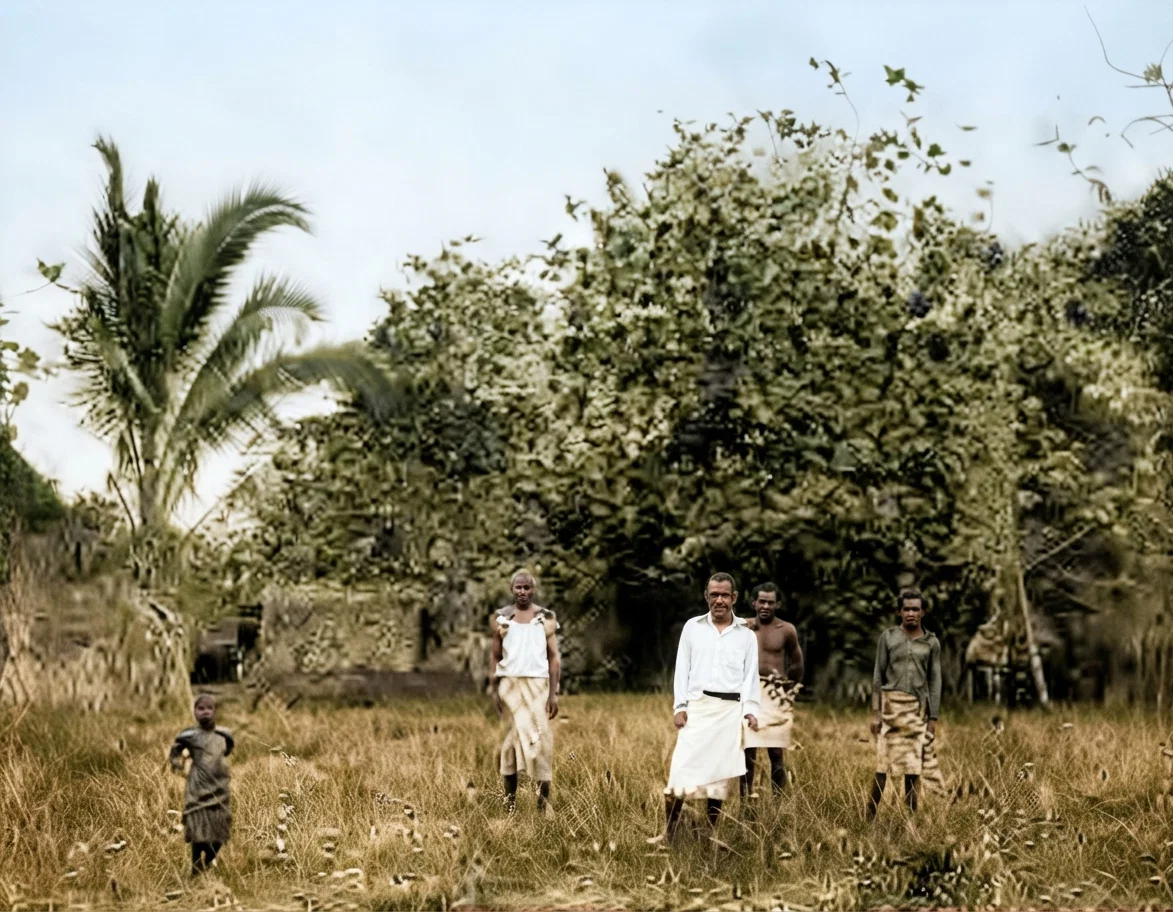
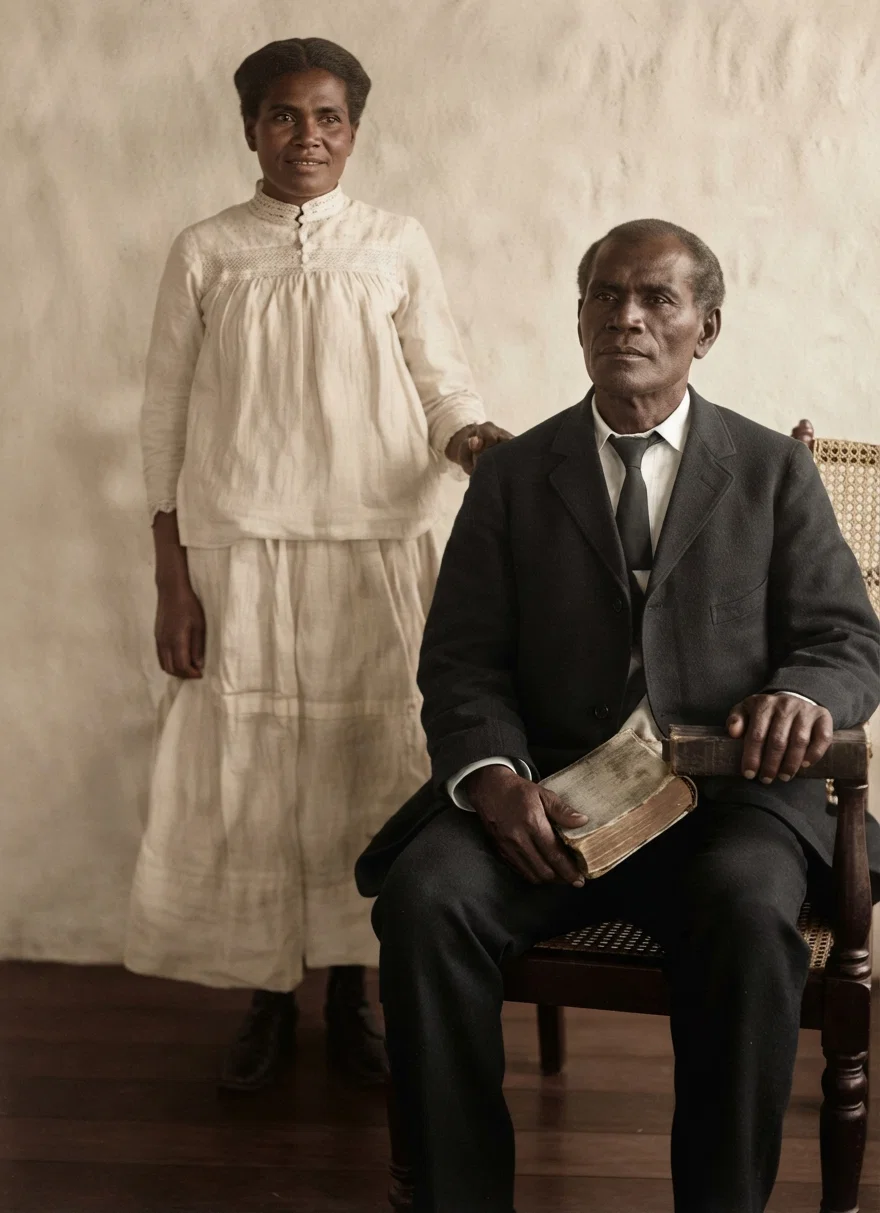
Soon after reaching the wharf I was warmly greeted by Elders Fulton and Parker, our resident missionaries, who were accompanied by Brother Ambrose and Brother Pauliasi. The former is a roko, or high chief, of Fiji, and the latter a native minister.
Only a few months ago Brother Ambrose was noted for his intemperance and generally wicked ways; now every one testifies that something has made a wonderful change in his life. Wherever he has opportunity he tells of what "the truth" has done for him. Brother Pauliasi was an ordained minister of the Wesleyan Church, having spent ten years in mission work among the savages of New Britain.
As soon as he learned by the study of his Bible of the glorious truth of Christ's soon coming, he unhesitatingly accepted them, and now preaches them as the way opens.
The mission home is located across the bay from Suva, at Suva Vou (New Suva), where we found Sisters Parker and Fulton at work in the schoolroom, surrounded by a little group of half-naked Fijian children.
From the native village a few rods away several of the brethren and sisters came to greet me with warm handshakes, and bade me welcome to their homes. Very few could speak English, but I was not in any doubt about their kind feelings toward me.
Being very weary from loss of sleep on the steamer, after a little while I asked the privilege of taking a nap, but soon after lying down, I heard soft footsteps on the veranda as one after another the barefooted natives came to greet me. So the nap had to be given up for that time.
Group of Fiji Natives. Ambrose, the roko, central figure in the foreground.
My first Sabbath with this company was to me a very interesting occasion. The first service of the day was a prayer-meeting about sunrise. At 9:30 the lala (a log hollowed out and used as a bell) was sounded to call the people to Sabbath-school. A little before 10 a few English songs were sung by the mission family, and at 10 the school began with the singing of a hymn which had been translated into Fijian by Brother Fulton, and printed with a typewriter. A small book of hymns, set to music, will soon be printed in the native language. After a prayer in Fijian, all together chanted the Lord's prayer.
After another song and a review of the previous Sabbath's lesson, the school separated into classes, the adult class taught by Brother Pauliasi, the young men and women by Brother Parker, while Sisters Parker, Fulton, and Guilliard instructed the little folks. All seemed to take the deepest interest in the study of the lesson.
The greatest reverence is shown for the house of God, the most perfect order and quiet being maintained by all, even the little children kneeling in silent prayer before seating themselves on the mats spread on the floor.
Tho the Fijians usually wear nothing but the sulu (a strip of cloth reaching from the waist nearly to the knees), I noticed that on the Sabbath all clothed the upper part of the body with neat, clean apparel. With the men this was usually a thin undershirt, tho a few wore white shirts with starched bosoms and collars. Nothing is ever worn on the head or feet. Brother Ambrose wore a neat tailor-made coat of some good, light-colored material, and a sulu made of cloth of similar appearance. Brother Pauliasi was dressed in a white sulu reaching nearly to his feet, and a long, black, clerical-looking coat. The women wore a sulu made of common calico, reaching below the knees, and over this a loose garment resembling a man's shirt, made with a yoke. Everything was neat and clean. I noticed that a few of the women wore dresses like those worn by white women, but looked stiff and awkward in such garments.
Pauliasi and Wife.
The children wore clothing like that worn by the older people, but one of the boys wore a common bath towel for a sulu.
After a short intermission I spoke to them a little while through Brother Fulton, who interpreted. At this service all followed the discourse closely, many turning to the Bible texts, while some wrote them down.
All the children sat directly in front of the pulpit, and were as quiet and orderly as any children I ever met.
Apparently they showed as much interest in the sermon as the parents.
At 3 P.M. another preaching service was held, and at sunset a prayer-meeting closed the Sabbath. The natives never tire of religious meetings, no matter how long they are held nor how frequently. E. H. GATES.
(To be continued.)
SELF-HELP IN INDIA.
IN Chingleput district of South India, Dr. William Walker represents the church as its medical missionary at the stations of Walajabad and Conjeveram. His view of the need for teaching the people self-reliance and self-respect needs to be insisted on abroad as well as at home. There is an unfortunate idea among the poor Christians that the mission is here to support them, and for years they have been doing all in their power to make it do what they consider its duty, and they seem to welcome this time of want, and will not try, as others do, to get work, but come to the mission for help. They have been told over and13over that they should support the mission and not the mission them, but they draw my attention to cases outside where many are more or less supported by missions and tell me that we are not doing our duty. At this time I feel face to face with a difficulty, as, if one or more poor Christians get help, many others will feel that they have been overlooked, and explanations that they are not so badly off as the others will not be heard or understood. This mistaken idea of what the mission should do for them is one of the greatest hindrances there is to the work among the lower classes in this district, as in some villages they refuse to hear the catechist preach, thinking in that way to force the mission to give charity to all who want it.—Free Church Monthly.
CHRIST'S "COME" AND "GO."
By J. H. MacVicar
LIST! as with weary, falt'ring feet,
We stumble through each year,
And see without, upon the street,
Scenes shifting, wild, and drear,—
A voice untuned to sin and strife
Revives each languid breast:
"Ye who are burdened—tired of life—
Come unto Me and rest."
But hark! while words of comfort drop
In ears distraught with woe,
He stands upon the mountain-top,
And bids the rested go.
Earth's weary millions, craving rest,
Untaught of Him, despair.
May we, with Christlike tenderness,
Go preach Him everywhere.
—J. H. MacVicar.