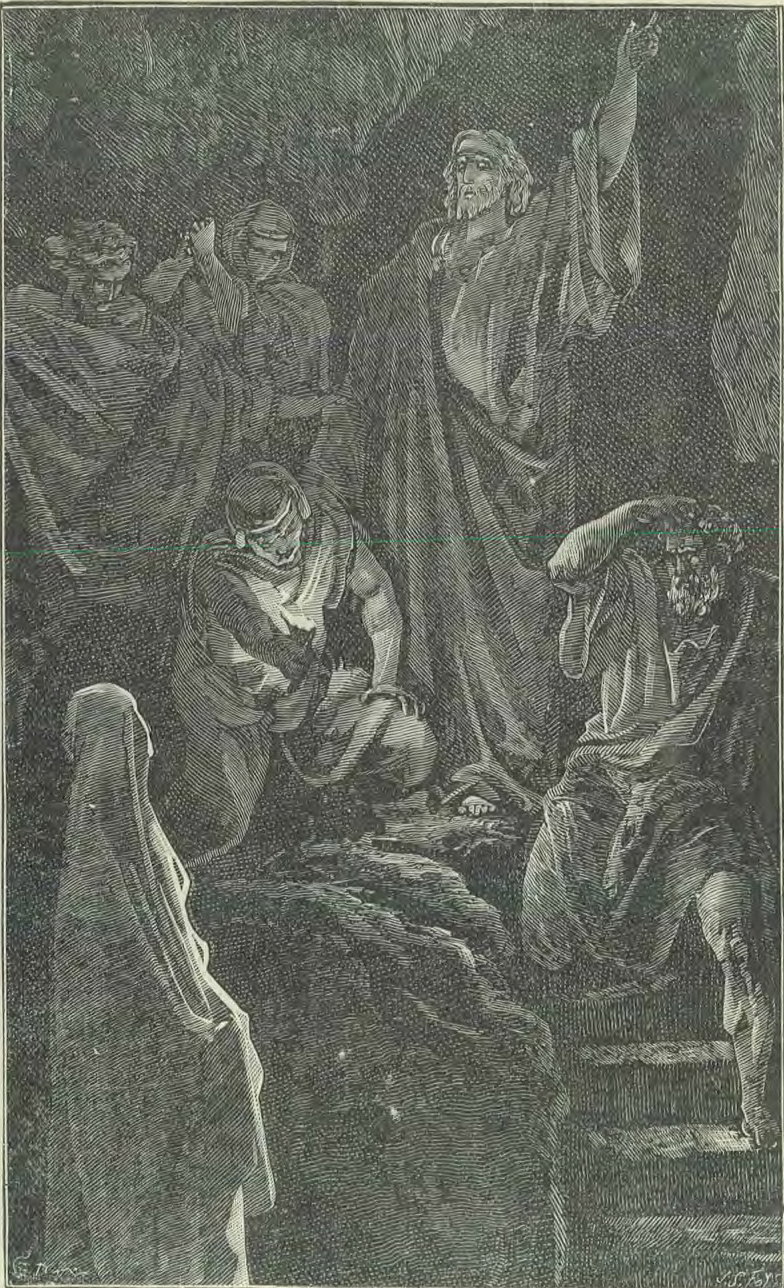
“When he had heard therefore that he was sick, he abode two days still in the same place where he was.” This delay was a mystery to the disciples. What a comfort his presence would be to the family in the severe affliction through which they are passing, the disciples thought. Christ loves all the human family, but to some he is bound by peculiarly tender recollections. His heart was knit by a strong bond of affection to the family at Bethany; and knowing this, the disciples were surprised that he did not respond to the sad message, “He whom thou lovest is sick.” Had Christ’s love changed?—No, no! and had Mary and Martha thought it had, they would have misjudged that tender, pitiful heart of human and divine love. It was for them and for his disciples that he tarried where he was for two days, apparently leaving the afflicted ones to bear their burden alone.
During this time Christ seemed to dismiss the message from his mind; for he did not speak of Lazarus. The disciples thought of John the Baptist, the forerunner of Jesus. At the time of his death, they had wondered why Jesus, with the power to perform wonderful miracles, had permitted John to languish in prison, and die a violent death. Possessing such power, why did not Christ save John’s life? This question had often been asked by the Pharisees, who presented it as an unanswerable argument against Christ’s claim to be the Son of God.
But Christ did not forget John. In the lonely prison he manifested himself to him, showing him that erelong he himself was to suffer a most shameful, ignominious death. Not only that, but he was to bear the penalty of the transgression of the law of God, not to give men liberty to continue in sin, but to take away their inclination to sin, that they might not desire to transgress. Those who receive Christ are obedient to his commands; for his mind is given to them. He imbues them with his spirit of obedience, and they return to their loyalty.
Christ’s two days’ delay after hearing that Lazarus was sick was not a neglect or a denial on his part. It was his purpose to remain where he was till the death of Lazarus took place, that he might265give the people an evidence of his divinity, not by restoring a dying man, but by raising to life a man that had been buried.
THE RAISING OF LAZARUS.
This should be an encouragement to us. We are sometimes tempted to think that the promise, “Ask, and it shall be given you; seek, and ye shall find; knock, and it shall be opened unto you,” is not fulfilled unless the answer comes immediately when the request is made. It is our privilege to ask for special blessings, and to believe that they will be given us. But if the blessings asked for are not immediately granted, we are not to think that our prayers are not heard. We shall receive, even if the answer is delayed for a time. In carrying out the plan of redemption, Christ sees enough in humanity to discourage him. But he does not become discouraged. In mercy and love he continues to offer us opportunities and privileges. So we are to rest in the Lord, and wait patiently for him. The answer to our prayers may not come as quickly as we desire, and it may not be just what we have asked; but he who knows what is for the highest good of his children will bestow a much greater good than we have asked, if we do not become faithless and discouraged.
After waiting for two days, Jesus said to his disciples, “Let us go into Judea again.” The disciples were perplexed by these words. If Jesus were going to Judea, why had he waited two days? They could see nothing but danger in the course he was about to pursue. “Master,” they said, “the Jews of late sought to stone thee; and goest thou thither again?” Jesus answered, “Are there not twelve hours in the day?” I am under the guidance of my Father, and as long as I do his will, my life is safe. My twelve hours of day are not yet ended. I have entered upon the last remnant of my day; but while any of this remains, I am safe.
“If any man walk in the day,” he continued, “he stumbleth not, because he seeth the light of this world.” He who does the will of God, who walks in the path that God has marked out, can not stumble and fall. The light of God’s guiding Spirit gives him a clear perception of his duty, and leads him aright till the close of his work. “But if a man walk in the night, he stumbleth, because there is no light in him.” He who walks in a path of his own choosing, where God has not called him, who ventures presumptuously into266danger, doing that which the Lord has not bidden him do, will stumble, because he has compassed himself about with the sparks of his own kindling. For him day is turned into night; and wherever he may be, he is not secure.
“These things said he: and after that he saith unto them, Our friend Lazarus sleepeth; and I go, that I may awake him out of sleep.” “Our friend Lazarus sleepeth!” How touching these words! How full of sympathy! In the thought of the peril their Master was about to incur by going to Jerusalem, the disciples had almost forgotten the bereaved family at Bethany. But not so Christ. The disciples felt rebuked. They had been disappointed because Christ did not respond more promptly to the message. They had been tempted to think that he had not the tender love for Lazarus and his sisters that they had thought he had, or he would have hastened back with the messenger. But the words, “Our friend Lazarus sleepeth,” awakened right feelings in their minds.
“Then said his disciples, Lord, if he sleep, he shall do well. Howbeit Jesus spake of his death: but they thought that he had spoken of taking rest in sleep.” Christ represents death as being a sleep to his believing children. Their life is hid with Christ in God; and until the last trump shall sound, those who die will sleep in him.
“Then said Jesus unto them plainly, Lazarus is dead. And I am glad for your sakes that I was not there, to the intent ye may believe; nevertheless let us go unto him.” Thomas could see nothing but death in store for his Master if he went to Judea; but he girded up his spirit, and said to the other disciples, “Let us also go, that we may die with him.” He knew the hatred of the Jews toward Christ. It was their purpose to compass his death, but this purpose had not succeeded, because some of his allotted time still remained. During this time, Jesus had the guardianship of heavenly angels; and no bodily harm could come to him, even in the regions of Judea, where the rabbis were plotting how they might take him and put him to death.
“Lazarus is dead. And I am glad for your sakes that I was not there, to the intent ye may believe.” The disciples marveled at these words. Did the Saviour by his own choice avoid the home of his suffering friends? What sorrow Mary and Martha would have felt, thought the disciples, could they have heard these words! Knowing the love that Jesus had for Mary and Martha, the disciples were unable to explain his words on this occasion. MRS. E. G. WHITE.
AN ACTED PARABLE.
THE late Alexander Proudfit once told the following story at a social gathering:—
“A good old Scotch elder, who was deeply concerned because his pastor persistently refused to allow children to be admitted to church fellowship, invited him to his house. After tea, the elder took the pastor out to see his large flock of sheep put into the fold. Taking his stand at the entrance to the sheepfold, the elder allowed the sheep to enter, but as the little lambs came up, he roughly pushed them back with a heavy stick.
“The pastor became indignant, and exclaimed, ‘What are you doing to the lambs? They need the shelter far more than the sheep do!’
“‘Just what you are doing to the children of the church,’ was the prompt reply.
“The object-lesson did its work. Never again did the pastor attempt to shut out from the fold of the church one of Christ’s little ones.”
MISSIONARY MONEY FROM GERANIUMS.
By W. S. Chapman
II.
The plants in the ground, and growing nicely, your hard work is over. But then will come the time you will need wisdom; and as these plants are missionary plants, you should in perfect faith go to the Lord daily, opening up your Bible at James 1:5, and ask for help; for God is just as much interested in your effort as you are, and is as willing to grant you wisdom and good judgment in training your plants, as he is to give the same to a mother in the training of her children.
The object will be to induce the growth of as many branches as possible, for branches mean blooms, yet at the same time to cause the plant to grow in a symmetrical, compact shape, like a well-trained apple-tree; so pinch back every branch, as it attains a length of five or six inches, until you have a shapely growth, then let it alone, simply removing every bud as fast as it forms. Cut back any wild shoots that may go off in wrong directions; keep the ground moist, watering without a sprinkler, pouring out of the spout directly on to the ground; watch for caterpillars and bugs; and stir the soil often to let in air, and keep down weeds.
About the middle of September you will want five- or six-inch pots for your plants. Some favorable day cut a flat piece of wood, such as a piece of lath, two inches long if you have bought five-inch pots, or three inches long if the pots are six-inch; and with a sharp, good-sized table-knife, proceed to cut a circle around each plant, using the piece of wood as a guide, with one end placed against the trunk and the flat of the knife against the other. Cut the soil slowly, and deeper than the pot which is to hold the plant, at the same time slanting the knife upward, not too much, that the slope may correspond with the slope of the pot. This process cuts off all superfluous roots, and leaves the plant to be lifted with a ball of earth that will just fit the pot. Thus the plant will not be seriously checked in its growth, a very important consideration.
Let the plants remain undisturbed for a week, to allow the cut roots to heal. At the end of that time, run the knife around again, gently, and with a good trowel, or with two large kitchen spoons, one on each side, lift the plant from the ground.267Perhaps you will find that the roots have penetrated deeply, and still hold the plant. If you can reach them with a pair of scissors, cut them off; otherwise tear them off with one hand while supporting the plant with the other. When clear of the ground, trim all straggling roots, and pot as directed in previous article. Water well, and replace in the holes whence they were taken, where it will be best to let them remain for several days. Then bring them close to the house, where they will be out of the wind and have less sunshine for a few days, removing them then, say, to a woodshed or summer kitchen, where doors and windows will be constantly open, gradually accustoming them to the change to an indoor life, as the weather begins to threaten frost. At last bring them into their winter quarters, and place them as near the light and sunshine as you can, a southern exposure being the best for them in winter. By this time they should show signs of budding out, and before Christmas be a mass of bloom.
Now your duty as a canvasser will begin. Procure from a dealer in butter several large sheets of oiled paper. Take two of these sheets, and cut in each a slit half-way across, the narrow way. Slip one sheet around the stem of the plant over the pot from one side, and the other sheet around the stem from the other side, and you will then have the earth in the pot securely covered; fold over and gather in the ends over the bottom of the pot, and tie securely. Open up a newspaper so that it will be two or more sheets thick, and lay the plant gently down on its side in the paper; turning in the end at the top, proceed to roll up the plant as your mother rolls up clothes after dampening them. Obtain a large basket, and line it with several thicknesses of paper; and in the bottom put a little excelsior; then lay in the plant, cover with excelsior, over which put more paper, and tie securely. You are then ready to carry your plant anywhere for inspection, no matter how cold it may be. In pleasant weather it will not be necessary to wrap the plant up, only the flower-pot; and at such times you could readily lift out the plant where you are canvassing, without taking out the excelsior at all.
Geraniums are very uncertain in regard to blooming. All will bloom with only half proper care, but some are slow at beginning, while others exhaust themselves in almost perpetual blooming. In winter much depends upon the amount of daily sunshine received. Sometimes, as in the winter just passed, geraniums bloom only fitfully, outside of greenhouses, for want of sufficient sunshine. Your plants might not be in full bloom at Christmas, but it would be evident to all that in a short time they would have flowers in plenty; hence they would be salable. However, it is not at all improbable that your plants would be ready for sale early in November.
Plants bought in May, and then planted directly into the garden bed, can be treated in two ways; first, as I have explained, by preventing any buds from blooming all summer, and by trimming into symmetrical shape; or, second, the original plant may be used to increase the stock. As soon as the plant has become accustomed to its new location, and from that time all through the month of June, take cuttings from the plant, not less than four inches long; trim off all leaves but the two upper ones, as has been explained, and insert the cuttings in the ground, some two and a half inches around, and six or eight inches from, the parent plant, and four or five from one another, pressing the ground firmly about them. Most of these will live, and in the fall you will have a good supply of fair-sized plants, which will bloom all winter, if you keep them from blooming in the summer; but they will be nothing better than can be bought in the open market. You no doubt could sell them all, particularly if you made them grow into nice shapes; and while you would receive possibly not more than twenty-five cents apiece for them, yet from your original investment of fifteen cents for the parent plant, you would have from five to ten plants to sell. If you have not the time to attend to house plants, or lack a good place in the house to grow them, I would advise you to wait until May, and then purchase one or two plants, and follow directions.
I have some thirty or forty thrifty, rooted cuttings, now in their second year, from choice named geraniums. As long as they last, I will send a cutting to any of our children who are INSTRUCTOR readers, and who can not afford to buy a plant, yet would like to have an offering to make to the Lord next winter, if they will send me their names and addresses. If you are able to do so, enclose four cents in postage-stamps for postage. When you have your letter prepared, carry it to your Sabbath-school teacher, or some officer of the Sabbath-school or church, and ask him to write a note across your writing, saying that he knows you will appreciate and properly care for the gift. This offer is made only to children who, from poverty or other cause, can not send away for plants, yet whose hearts are longing to do something for Jesus. W. S. CHAPMAN.
WHAT BREATHING MEANS TO US.
By Mrs. M. D. McKee
AFTER having learned how to hold the body correctly in standing, sitting, and walking, the next important thing to learn is how to breathe correctly. Before studying the organs of respiration, or the physiology of breathing, we must understand what breath means to us, its origin, and the necessity of knowing how to use it. True it is that one can live for several weeks without food; but life would cease in a few minutes if we could not breathe. We hear of overeating, overworking, but no one ever heard of overbreathing! Few people breathe correctly; especially is this true of women, because of the conventional dress. In order to realize the serious consequences of imperfect breathing, it is necessary to understand something about the air we breathe, and its relation to life.
Elizabeth Barrett Browning says, “He lives most life, who breathes most air.” Why?—The study of chemistry shows us that the air is composed of one part of oxygen, and four parts of nitrogen, with a very small amount of carbon dioxide. Oxygen is the great purifier of the blood, the life-giving element, without which we could not live.
God breathed into man the breath of life; and while man has this to breathe, he lives; when it is taken from him, he will die. This we learn from the “Scriptures of Truth.” Then, since oxygen is vital, the supporter of life, should it not be true that the more we breathe in, the more abounding life we have? This “breath of God” is our most valuable gift, and should be intelligently appreciated and used.
We breathe, or inhale, oxygen; it is taken up by the little red blood corpuscles, and carried, by the circulation, to every cell and tissue, where an exchange takes place. The corpuscles carry back carbonic acid gas, or carbon dioxide,—a deadly poison. This is thrown off by exhalation, or breathing out. The carbon dioxide is so poisonous that persons have died when obliged to breathe their own exhaled breath over and over again. Breathing consists of two acts,—inhaling pure air, or oxygen; and exhaling poison, or carbon dioxide.
Nitrogen serves to dilute the oxygen, and regulate its supply to the body. As our vitality depends upon the amount of oxygen we can take in, a good lung capacity is essential. This is impossible if hampered by tight clothing that “will not allow the floating ribs to float.” But more will be said later about dress.
It is true that deep, full, regular breathing denotes large vitality; while weak, quick, panting breath indicates low vital power. Exercise calls for more breath, more air; hence exercise is valuable. “He who does not take time for exercise will have to take time for illness.”
One should grow stronger and healthier every day, until the age of forty, then hold his vitality for twenty years, before the decline of age begins. Breathing properly will prolong life by increasing vital power, and consequent resistance to disease.
A résumé of this study sums up the following points:—
Breathing purifies the blood; therefore thorough oxygenation is necessary.
The diaphragm, the chief muscle of respiration, which will be more fully described later, kneads the stomach. This aids digestion by hurrying the food into the circulation, to be carried to the body for nutrition.
Compresses the liver, emptying it of stagnant blood, and hastening the flow of bile.
Hastens sluggish portal, or digestive, circulation.
Increases capacity of chest, vertically and laterally.
Is an exhilarating tonic, equalizing the entire circulation, from brain to finger-tips and toes.
Cures pulmonary troubles, headaches, colds, etc., in incipient conditions.
Restores nervous poise.
The lungs, being elastic, grow by exercise of breathing, and increase in strength as well as size.
Deep breathing and right thinking are usually compatible, because of the fact that when the brain is supplied with pure blood, the organic action of the cells is healthy, and immorality is not so apt to find a lodgment.
Baron Nils Posse says that lack of exercise is responsible for our crowded jails and penitentiaries.
This, however, will be considered more fully in another article. MRS. M. D. McKEE.
Pure Air, Food, and Exercise for Health
He who breathes pure air and eats pure food, sleeps sufficiently and exercises enough, will scarcely fail to have good health. Good and full breathing waits on sufficient exercise.
HOOFED ANIMALS.
By M. E. Cady
The animals we have studied thus far have toes which terminate in claws, but now we come to the study of a group whose toes are protected by a hard horny covering called a “hoof.” The cat and other animals which have long, sharp claws, use them in catching and holding their prey. This is never done by the hoofed animals, such as the horse, cow, and pig. The pig holds down the ear of corn with his foot while he is eating, and the horse paws away the snow to reach the grass. But the principal use made of the feet by hoofed animals is to walk and kick.
The toe of the horse is covered with a hard bony wall. When this animal is shod, the nails are driven into this hard substance. On the flat bottom of the foot, within the wall, is the frog, shaped like the letter V. Between the frog and the wall is the sole of the foot. It is just inside the shoe. The wall, frog, and sole are used to support the body of the horse.
The horse has many cousins, some of them wild and some domesticated. They include the ass, burro, mule, zebra, etc. They are unlike the horse in that they have large ears, and a rasping voice. They resemble the horse as regards their teeth, hair, lips, legs, feet, and skin. The zebras are beautifully striped animals that roam the wilds of Africa.
The burros and donkeys look as if they felt themselves much ill-treated. They are valuable on account of their great strength and power of endurance. They can carry burdens nearly equal to their own weight, through the desert without drinking for two or three days, when the thermometer registers one hundred degrees during the day.
The cow is another hoofed animal, but instead of having one toe, she has two. The horse is valuable for the work it can do, but the cow is valuable for the milk she furnishes to the household. Oxen are often used instead of horses for pulling and hauling. The cow has many wild relatives which resemble her in that they have two toes, and the body covered with hair. There are a great many different breeds of cows; some of them are natives of foreign countries.
Among the domestic cows of different countries are some odd-looking creatures. The Hungarian cow has long, straight horns. The sacred cow (zebu) of India carries a queer hump on her shoulders. The yak of Tibet has extremely long hair. It runs wild, like the buffalo, but is easily tamed.
There are several kinds of cows in this country. We may divide them into families for convenience. The Ayrshires are from Scotland. They have long, spreading horns, and in color are red and white. They yield a large quantity of milk. The Holsteins were brought from Holland, where the dairy-maids milk the cows, and where the cow-stable joins the kitchen, and is kept as clean as the kitchen. The Jersey’s native home is on an island bearing the same name, situated in the English Channel. They are small creatures, but are great butter-makers, their milk being extremely rich. The Alderney and Guernsey cows came from islands bearing their names, near Jersey Island. The round, dark-red Devons, with graceful white horns, came from Devonshire in England. Do you live on a farm? If so, what family or families of cattle are represented in your father’s dairy?
Many of the hoofed animals chew the cud. Instead of having one stomach, they have four. Their food first enters a large stomach, called the paunch. They fill the paunch, during the pleasant part of the day; and when night comes, or when the sun is hot, they lie down and chew the cud. The grass passes from the paunch into a second stomach, where it is made into small parcels, and thrown up into the mouth. Here each mouthful is well chewed and mixed with saliva, then it is sent on to the other two stomachs, where it is thoroughly digested. The tame cud-chewers are the cow, camel, sheep, and goat. The wild cud-chewers are very many; among them are the buffalo, gnu, wild sheep and goats, giraffe, elk, deer, reindeer, and antelope.
The pig is also a hoofed animal, but has four toes instead of two, like the cow. The wild relatives of the pig are the wild boar and the hippopotamus. I shall have to leave it with you to study the pig family and their wild relatives, as our time is already up. The horse and the cow are the hoofed creatures which are of the greatest service to man. The Creator made all the lower animals to love and serve man; but many of them, now, on account of sin, are his enemies.
M. E. CADY.
God Made the Beast of the Earth
“AND God made the beast of the earth after his kind, and cattle after their kind.”
TRUTH AS AN AIM.
By B.
Few will question the statement that Munkacsy’s famous painting, “Christ before Pilate,” is the most impressive picture that the art of man has ever produced. This quality attaches to this masterpiece because it successfully portrays the supreme event in the history of mankind, when were brought face to face the human impersonation of the world’s spirit of selfish hate, greed, ambition, and rapacity, and the blessed incarnation of heaven’s spirit of infinite love. Though Pilate, the representative of all things worldly, was about to pass his own short-sighted human judgment upon the most exalted spiritual being who has ever taken upon himself the “likeness of sinful flesh;” though he was about to perform the most impious act any man ever could perform, there still remained in him somewhat of that “Light, which lighteth every man that cometh into the world,” which made something of a response to the embodiment of that Light which stood before him in the person of Jesus Christ; for on that momentous occasion the proud and haughty Pilate asked this, the most important question ever propounded, “What is truth?” No right-thinking man can entertain for a moment the thought that the asking of this question by the Roman governor was a mere chance; but rather that it was in accordance with the eternal purpose of an all-wise God. How could the exceeding importance of this question be better emphasized before the universe? how could the attention of all created intelligences, celestial and terrestrial, be focused with greater intensity? how could the utter folly of this world’s best wisdom be better proved? There, in the conflux of two eternities, with the burning light of all the centuries concentrated on the scene, were gigantic Error and infinite Truth confronted; yet Pilate, the proud prince of earth, discerned not. Of a truth, the Light shone in the darkness, and the darkness comprehended it not.
This inquiry of Pilate being the one question of all questions, it follows therefore that the highest aim which any individual can have in life is to know the truth, and knowing, perform. Parents who truly love their children can have in them no loftier happiness than this so beautifully expressed by the beloved disciple John: “I have no greater joy than to hear that my children walk in truth.” But, asks one, should not simple goodness be the chief purpose of life?—Unquestionably, goodness, as far as quality is concerned, constitutes a worthy aim; but not as to extent, for the reason that many things which are true have no distinctly moral quality. For instance, it is true that the diameter of the earth is about eight thousand miles, while its circumference is about twenty-five thousand miles, so also the distance from the earth to the sun is approximately ninety-five million miles; yet these facts of science have no moral or immoral significance, in so far as human conduct is concerned; and hence do not come within the purview of what we term “goodness.” Though this be true, it is nevertheless important that we learn these and other truths of science. It will be seen, therefore, that truth is more inclusive, more comprehensive, than goodness. The fact is that truth includes all there is of goodness, and an infinity of things besides, a knowledge of which, and a conforming with which, will materially effect our power to attain to goodness. A person may be very good, and yet very ignorant. While this is true, one is not justified in remaining in ignorance in order to be good; for the highest Wisdom admonishes us to grow in grace and in the knowledge of the truth.
In whatever occupation one is engaged, he should always subordinate every other consideration to the truth. Speaking of art, Ruskin has well said: “Art (other things being equal) is great in exact proportion to the love of beauty shown by the painter, provided that love of beauty forfeit no atom of truth.” But are we not all artists, and is not good character the picture we should paint? May we not say, therefore, that life is great in exact proportion to the love of beauty—soul beauty—shown by the artist, provided that love of beauty forfeit no atom of truth? Nothing else so makes the man the man that he is as do integrity and unflinching fidelity to truth. The author last quoted, in addressing a company of working-men, uttered these words of wisdom, which all classes will do well to heed: “Here, then, is your chief duty, you workmen and tradesmen,—to be true to yourselves, and to us who would help you. We can do nothing for you, nor you for yourselves, without honesty. Get that, you get all; without that, your suffrages, your reforms, your free-trade measures, your institutions of science, are all in vain. It is useless to put your271heads together, if you can’t put your hearts together. Shoulder to shoulder, right hand to right hand, among yourselves, and no wrong hand to anybody else, and you’ll win the world yet.”
Philosopher never spoke more wisely than did Lord Bacon when he said: “No pleasure is comparable to the standing upon the vantage-ground of truth. . . . Certainly it is heaven upon earth to have a man’s mind move in charity, rest in Providence, and turn upon the poles of truth. . . . Truth, which only doth judge itself, teacheth that the inquiry of truth, which is the love-making, or wooing, of it; the knowledge of truth, which is the presence of it; and the belief of truth, which is the enjoying of it, is the sovereign good of human nature.”
In concluding the line of thought set forth on the general subject of Aim, the writer can not do better than subjoin this beautifully phrased tribute to truth, from the pen of the rising poet and platform orator, Mr. Burritt Hamilton:—
“He is a traitor to his race
Who, lured by power or awed by place,
Makes compromise with wrong:
Upon the gibbet of his lie
His soul shall shrivel, rot, and die,
And minstrelsy shall pass him by
Without the mockery of song.
“He is immortal—only he—
Who stands for right unflinchingly,
On watch from dark till dawn:
By God’s eternal stars he steers,
Nor stays for storms nor fails for fears,
For truth is truth a thousand years;
God’s heroes march forever on.”
B.
HE LOVED THEM TO THE END.
By M.
THE events of the evening previous to the betrayal, trial, and crucifixion of Christ are filled with a more tender interest to every Christian heart than any other equal period of time in the history of mankind. Jesus knew what was to happen on the morrow. It was his purpose to make this, the last meeting with his beloved followers, just that which would impress upon their minds and hearts those feelings and sentiments that he desired should remain with them throughout their lives. Loving service in humility of mind, and complete abnegation of self, seem to be the special lessons which he desired to teach, combined with the intent to touch their hearts with a lasting sense of that love which he bore them. Here was the beginning of the unfolding of that love which, with the morning light, was to show its highest earthly evidence; and from that time go on increasing in sweetness and wonder and grandeur to the appreciation and understanding of all his followers, throughout time and eternity.
The idea of the greatness and nobility of loving service was something which up to that time the world had never grasped. This was the leaven which was to permeate the world,—the leaven of humility and love. In this bitter hour the tender love that Jesus bore “his own” found expression in word and act, which are an unfailing witness to all the world, for all time, that he was indeed the Son of God; for none other could have been capable of such supreme tenderness, and such an expression of it, as should become a well-spring of unfailing joy for the refreshment of every Christian heart until he comes again to claim his own.
M.
PREPARATION
By M.
WHILE it is true that God can work with the most unpromising material, it is not true that he always chooses such to do great things. If he so willed, God could commission the paving-stones of the street, and they would rise up and cry aloud, giving his message to the world. But God does not call upon the stones to give any other than the silent message for which the centuries have prepared them. To those who study them prayerfully, they speak in unmistakable tones. But they tell only the creative story imprinted upon them by the hand of God through the preparatory ages. The men who have done God's work from the beginning, have been men who were prepared, thoroughly, by the study, the labors, the experience, through which they had passed. The leaders and heroes of the Old Testament were all men of this class.
The apostles and evangelists of the New Testament era were none the less men of long and careful preparation. Christ himself set the example in this. There is full evidence that at twelve years of age, he was competent to teach, yet he did not undertake his ministry until he was thirty years old. Then he kept his disciples under his personal oversight and instruction for three years, that they might receive sufficient and proper training for the work which they were to undertake. The schools of the prophets and of the apostles were indeed model training-schools,—there was no inefficiency nor superficiality about them. They graduated men mentally, spiritually, and physically furnished and prepared to carry God's message to the world. They are those who have carried it.