Your ShelfYour Projects

The Youth’s Instructor, Vol. 65, No. 35.

Eight Rungs to the Ladder of Success

The Youth’s Instructor

Aug 28, 1917

Review and Herald Publishing Assn. · Takoma Park Station, Washington, D. C. · Aug 28, 1917

Eight Rungs to the Ladder of Success
THE world's “billion dollar” industrial corporations are the United States Steel Corporation and the American Telephone and Telegraph Company. The chairman of the first is Elbert H. Gary, who was the first man in America known to receive a salary of $100,000 a year. He could have had twice that amount for the asking. Judge Gary, out of his varied and successful experience, has compiled the following eight rules for the young man ambitious to attain success:
“He should be honest, truthful, sincere, and serious.
“He should believe in and preach and practice the golden rule.
“He should be strong and healthy, physically and morally.”
“His habits and mode of living should be temperate and clean, and his companions selected with regard to their character and reputation.”
“He should possess good natural ability, and a determination constantly to improve his mind and memory.”
“He should possess a good education, including particularly the fundamentals, such as mathematics, grammar, spelling, writing, geography, and history; and also a technical education concerning the lines he proposes to follow.”
“He should be studious and thoughtful, keeping his mind upon a subject until it is mastered.”
“He should be conscientious, modest but courageous, energetic, persistent, even-tempered, economical, faithful and loyal to his friends and the interests he represents.”
Not one of these important rules can be followed effectively by the boy who early begins the use of tobacco and continues its use. Tobacco, therefore, closes the gateway to the world of effective service, and it never opens to the knocking of stained hands; for “the boy who smokes lowers his moral standing, stunts his body, weakens and vitiates his mind, stains his character as certainly as he stains his fingers, and opens wide the doorway for the other bad habits which are its associates.”
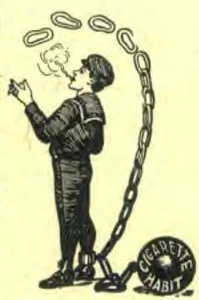
Hudson Maxim says: “The yellow finger stain is an emblem of deeper degradation and enslavement than the ball and chain.”

A Puff of Smoke—What's the Harm?

ONE puff calls for more puffs. That's the harm. And every one of these deposits a small quantity of deadly poison in the body. One needle prick of the Chinese doctor does not kill the baby; but the multiplied pricks given in the effort to banish the so-called evil spirit, drives the breath of life out of the little sufferer.
One puff does not destroy the brain or heart; but it leaves a stain, and every other puff deepens that stain, until finally the brain loses its normality, and the victim is taken to the hospital for the insane or laid in the grave.
One puff did not paralyze the young man in the wheel chair; but the many puffs that came as the result of the first puff, did. The telltale stains on the fingers were indicative of the deep stains made upon the nerve cells.
One puff did not make of the bright boy a criminal; but the many puffs that followed the first, placed him in the dungeon.
One puff did not keep the boy from winning in athletic games; but many puffs did.
One puff did not destroy his obedient, helpful spirit; but many puffs made him a disobedient, disloyal boy.
One puff did not take him from the head of his class to the foot; but many puffs did.
Beware, boys, of the first puff.

Why Tobacco Use Matters: Questions Every Young Man Should Ask

Why?
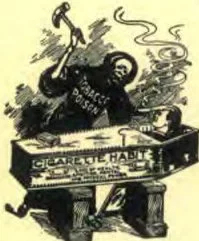
If the use of tobacco is not injurious,
WHY does the life insurance company wish to know whether the applicant smokes?
WHY does the surgeon, contemplating a serious operation, ask whether the patient smokes?
WHY are athletes, in training, forbidden to smoke?
WHY do smokers, as a rule, advise others not to smoke?
WHY is abstinence from tobacco everywhere considered a valuable asset for a young man?
WHY is the cigarette the object of special attention by temperance and anti-tobacco workers?
WHY do cigarette smokers make the vast majority of the mistakes in bookkeeping?
WHY are cigarette smokers an easy prey to disease, especially to tuberculosis?
WHY do none of the books which deal with the principles of success in life, and give advice to young men of ambition, advise the use of the cigarette?
WHY are those who begin smoking early in life, almost without exception, stunted in body or mind?
WHY do smokers never stand first in their classes?
WHY do some States forbid the selling of cigarettes to minors?
WHY is it that youthful criminals are almost invariably smokers?
WHY is smoking prohibited during the first three years at West Point and Annapolis, the government's military and naval schools?
If it does not hinder vocations, why do many firms absolutely refuse to employ boys and young men who smoke cigarettes, or else give the preference to nonsmoking persons?

Dueling and Smoking

Once men had the mistaken idea that it would be unmanly to refuse to fight a duel. But today, in view of the world's broadened ideas, true manliness demands the refusal. We are free from the idea “that honor can in any way be mended by two men standing up to take snapshots at each other.” But we have been freed from this superstitious idea because some men had enough true courage and manliness to dare to be thought unmanly and cowardly by the majority, holding the narrower and mistaken idea.
Among boys there has been an idea that to be manly, to be courageous, one must smoke. But this idea, too, is giving way to the larger and truer idea of manliness, that of total abstinence from tobacco in any form. Those who began smoking from such a misleading purpose will have to follow the man who said, “I began the use of tobacco to be a man, and I quit for the same purpose.” The manliest boys, the most courageous boys, are those who have the courage to refuse to smoke. They are the boys who will help the world of boys to come into the larger and more wholesome idea. Ex-Senator Beveridge of Indiana once said that if a boy smokes to make a man of himself, he will be a very little man.
As men of real worth have long ago forsaken dueling, so the manly boys of today and tomorrow will eschew the harmful cigarette habit.

President Wilson's Only Smoke: Killing Rose-Bush Insects

PRESIDENT WILSON never smoked but once, and that was in an effort to kill the insects on his mother's rose-bushes.

When a Boy Knows More Than His Father
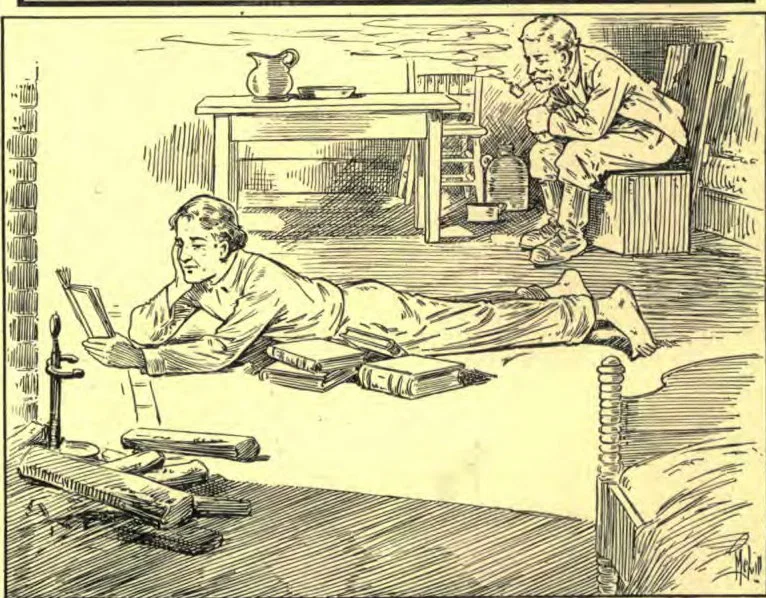
SOMETIMES a boy does know more than his father. Ours would have been a very different history if Abe Lincoln, age sixteen or so, had been guided by the wisdom of Thomas Lincoln, age thirty-six or so.
“Now, Abe,” we can imagine him saying, “don’t waste time readin’ them books. Readin’ never done me any good, and what was good enough for me’s good enough for you.”
Lincoln knew more than his father. It was a divine disobedience that led him to close his ears to the man who had brought him into the world, and open his heart to the vision that was to help him conquer the world.
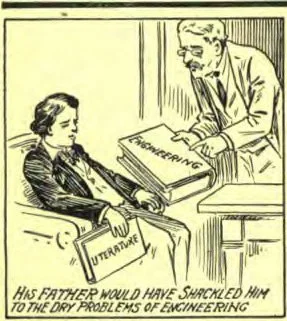
Robert Louis Stevenson knew more than his father. That father would have shackled him to the dry problems of engineering. He could not understand the obstinacy of the boy who refused to apply himself. That obstinacy saved a great author from misery as a mediocre engineer. That obstinacy enriched the ages.
THE BOY WHO
HAS NOT SOME
FIRM CONVICTIONS
AND A WILLINGNESS
TO DEFEND THEM
IS NOT LIKELY TO
AMOUNT TO MUCH, EITHER AS
A BOY OR AS A MAN
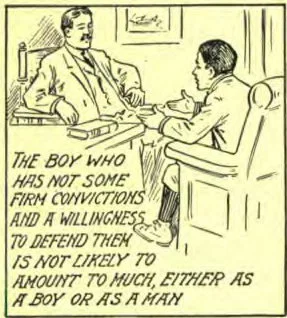
THE BOY WHO HAS NOT SOME FIRM CONVICTIONS AND A WILLINGNESS TO DEFEND THEM IS NOT LIKELY TO AMOUNT TO MUCH, EITHER AS A BOY OR AS A MAN
READIN' NEVER DONE ME ANY GOOD, ABE. DON'T WASTE TIME READIN' THEM BOOKS.
“Let no man despise thy youth,” wrote Paul to Timothy.
The boy who has not some firm convictions and a willingness to defend them, even against the arguments of those older than himself, is not likely to amount to much either as a boy or as a man.
But they must be convictions, not mere prejudices, not selfish impulses or passions.
I know two men who “knew more” than their fathers. One boy is the office manager of a large manufacturing concern, and his salary is $40 a week.
“Better go on in school,” said his father to him when he was seventeen years old. “Better go to college; better get all the education you can while you have the chance. You’ll need it afterward.”
But the boy quit school and went to work. He was promoted from office boy to bookkeeper, from bookkeeper to head bookkeeper, from head bookkeeper to office manager.
His path looked golden and long. And then suddenly he stopped.
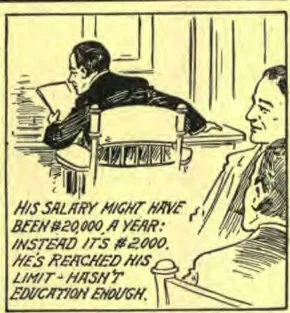
“You see that man?” said the president of his concern to me the other day. “There is a man who might have become general manager of this concern if he had had a college education. His salary might have been $20,000 a year: instead it’s $2,000. He’s reached his limit. What a shame that he hasn’t education enough to go on.”
He “knew more” than his father. And his boyish obstinacy is costing him $18,000 a year.
I know another man who “knew more” than his father. “Keep yourself clean, my son,” said the father to him. “You’ll never regret it. And some day you’ll be glad you did.” But the boy knew more than his father. He knew that every young man must sow his wild oats. So he sowed right merrily.
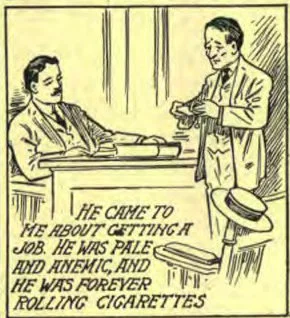
I saw him the other day. He came to me about getting a job.
He was pale, and anemic, and his hands twitched, and he was forever rolling cigarettes. He could not concentrate his mind on one subject for even two minutes.
I couldn’t give him a job; no man could. God knows what will become of him. He would starve if it were not for the few dollars he gets from his father—
The father who, he thought, didn’t know so much as he. — Bruce Barton, Editor, in Every Week.

(Concluded on page sixteen)

What a $1,200,000,000 Tobacco Investment Brings the Smokers

The Postal Life Insurance Company of New York City, having large opportunities of observation, in speaking of the effect of tobacco upon adults, says:
“Tobacco covers nearly the whole range of human ills, dyspepsia, catarrhal troubles of the nose and throat, heart disturbances, nervous irritability, trembling, and impaired eyesight.”

(Concluded on page sixteen)

What a $1,200,000,000 Tobacco Investment Brings the Smokers

(Concluded from page one)
The Life Extension Institute says:
“Tobacco used freely causes inflammation of the throat, and invites the attack of germs.”
Phipps Institute showed by a series of observations that smokers are twice as likely to have tuberculosis as non-smokers.
The founders of the Spencerian Business College, after thirty years of observation of young people, say:
“The effects of this narcotic are premature age, shattered nerves, mental weakness, stunted growth, and general physical and moral degeneracy; and therefore we decline to receive into our institution any who use this noxious weed.”
It is very rare for a smoker to take high honors in his class. In some colleges such a thing has not happened in fifty years, although the smokers are many and the abstainers few.
Nine tenths of army rejections are said to be due to tobacco heart. It has been proved that the excessive use of tobacco—
Checks growth
Causes tobacco heart
Seriously interferes with circulation and respiration
Promotes cancers
Injures eyesight, frequently causing blindness
Impairs intellect
Lowers scholarship
Injures nerves
Destroys sensitiveness of taste
Predisposes to tuberculosis
Impairs work of kidneys
Weakens morals
Excludes religion
Offends society
Makes criminals
Lessens business efficiency
Unfits for athletic sports
Creates craving oftentimes for liquor
Poisons family
Not all tobacco users suffer from all of these afflictions; yet one may be assured that if the use of tobacco is begun early in youth and continued to manhood, the majority of these ills will manifest themselves. To a regular but moderate user who did not begin until years of manhood were reached, the ill effects are not so grave, but any one of the most serious results is likely to manifest itself in an unexpected moment, and demand the death toll.

Rights of the Home Invaded

PAULINE W. HOLME

The Tiny-Dog Secret

MARGARET J. BILZ, national lecturer for the Woman’s Christian Temperance Union, said before one of the public schools of Baltimore, Maryland:
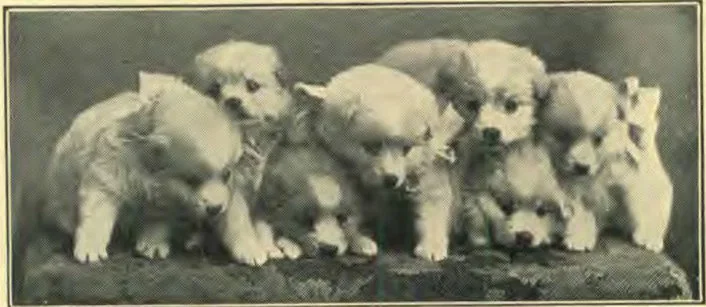
“When I was in Paris some years ago, I met a man who had very tiny dogs for sale. The mother dog, though small, was normal in size. I asked the owner how it was that her offspring were so abnormally small? What had he done to them?
“At first he refused to tell me, fearing that I would divulge his secret or become his business competitor. By a little friendly conversation, I convinced him that I was simply in pursuit of knowledge. Then, with many cautions, he confided to me his process for producing these very tiny dwarfs. ‘You see I put a little speck of nicotine in their food when they are quite young. Then I put in a little more and a little more, and then they never get big.’
We didn't take the nicotine treatment.
“‘But doesn’t the nicotine ever kill them?’ I asked. ‘Oh, yes, many of them die; but I get a big price for the little fellows that live.’”
Thus he was willing to sacrifice the lives of many of his dogs for the gain brought by the sale of the few that survived.
On our streets are hundreds of nicotine-poisoned little boys—poisoned by the nicotine in the cigarette.
“But doesn’t this nicotine poison kill them?” you ask. Oh, yes, many of them die; but the manufacturers of cigarettes keep right on making boy destroyers, that thus they may become wealthy.

Smoking Baby and Mother to Death

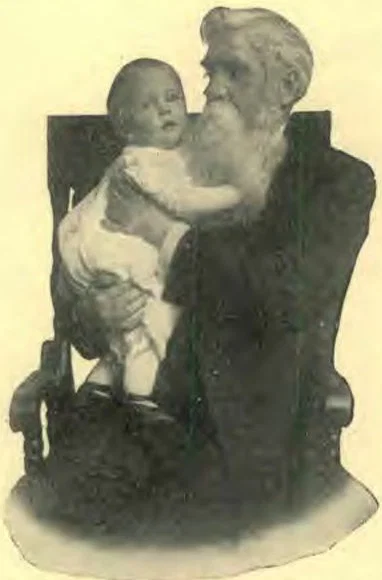
Little George has his right to pure air untrampled upon, for his father and both of his grandfathers are nonusers of tobacco.
Helpless, innocent babies, in their father’s house, often get from the atmosphere laden with smoke from the father’s cigar, the “little speck” of nicotine poison that hinders their proper development. Some of the babies die as the result of the poisoned air they are compelled to breathe; but ignorant, self-indulgent fathers refuse to believe that tobacco smoke ever kills or seriously injures babies.
The French scientist, C. Fleig, by repeated experiments with the guinea pig, proved that tobacco smoke will kill baby guinea pigs. Then why not human babies? From his careful experiments he learned these facts: When a mother guinea pig had inhaled dense tobacco smoke, her offspring were sometimes born dead. If they lived, their size was notably smaller than the average. Furthermore, they seldom lived long, generally from a few days to a month. Permanent survival was a rare exception, and in these cases the animal remained sickly and stunted. There was a diminution of the number of red corpuscles. The young females which were submitted to weak inhalations, also showed disorders of development. It is not unusual to see all of the young of one litter die at the end of one or two months. Deficiency of blood corpuscles is the rule. If these young animals themselves are placed in an atmosphere of smoke, their development is still more abnormal.
If the inhalation of tobacco smoke injures the young of brute animals, shall human fathers and mothers risk the best welfare, even the life and health, of their children in a smoke-laden atmosphere? Intelligent observers of child development know that smoking fathers are responsible for the nervous afflictions and impaired health, and very often the premature death, of many, many children.
Mrs. Clara C. Hoffman, for years recording secretary of the national Woman’s Christian Temperance Union, said:
“On a recent lecture tour, I was entertained in a most beautiful home. Wealth had bestowed many luxuries, and but one shadow darkened its happiness: the only child, who was the idol of both parents, was afflicted with the worst case of St. Vitus’s dance I have ever seen. I chanced at one time to be left alone with the child’s physician. I inquired the cause of the girl’s affliction. The doctor was reluctant to give the desired information, but as he saw my deep interest in the case, he told me the cause was nicotine poisoning, the result of tobacco smoking by her father.”
A wholesome-looking woman came to my home city a number of years ago. She was a vigorous leader, abounding in energy. Her husband prospered in business and their home was beautiful. They seemed happy and devoted to each other, but the husband was an inveterate smoker. In the summer, as they sat on their porch, the evening breezes carried away the poisonous tobacco fumes, but as winter came on, night after night, in their closed sitting-room, the wife inhaled nicotine-poisoned air, just as thousands of wives are accustomed to do. But this sensitive, high-strung woman during the winter became nervous, pale, and sickly, and not until the spring days allowed her to work in her garden and live out of doors, did she regain her vigor and again enjoy life.
The following winter had not passed before she was again attacked by nervousness and declining health, which the following summer failed to restore. Her nervousness increased, and her heart became affected, so she had not the vitality to resist an attack of pneumonia. Without doubt there was a close connection between the husband’s tobacco smoking and his wife’s death.

A Husband Who Saved His Wife

A friend gives the following report of her mother’s experience: “My father was a moderate smoker, and realized no harmful effects from the habit. My mother suffered from asthma. One day the physician said to my father, ‘I think your smoking is not only a disadvantage to yourself, but it seriously retards your wife’s recovery.’ Whereupon my father promptly declared, ‘If my smoking hurts my wife, I will never smoke again.’ Mother recovered, and father having abandoned his injurious habit, their declining years were blessed with peace and comfort.”
Fathers, will you continue your self-indulgence in sense enjoyment, even though you may thus entail lifelong suffering upon your children, and your children’s children? Husbands, will you not remember that science has demonstrated by careful observations that the nonsmoker is not exempt from harm while living with a smoker? True chivalry should free the home from tobacco smoke.
Continue reading: A Physician’s Advice to Boys