“THE boy who smokes cigarettes is a cipher with the rim knocked off.” This is the way Mr. Harris, the preacher at the tent which was pitched on the baseball lot, introduced his remarks at the Woodlawn school the morning he gave an anti-cigarette talk. He had been preaching in the tent for about three weeks to large crowds of people, and the school board, learning that he was one of the lecturers of the National Anti-Cigarette League,14invited him to the Woodlawn school to talk to the boys and girls.
This was the school that Donald Hunter attended. He had been going to the meetings in the tent from the first, and had become much interested in the truths which had been preached there, and he was glad that Mr. Harris could visit his school and talk to his schoolmates.
The preacher had been introduced by the principal of the school, and without any preliminaries had plunged at once into the heart of the subject by making the above remark, so that the children knew at once where he stood on the question of smoking.
“A cipher with the rim knocked off!” Why, that was a little less than nothing! As Donald looked around, he saw some of the boys flush and look uncomfortable, and he was afraid Mr. Harris was not going to make many friends. But the speaker continued:
“Now, boys, I do not want to make such a statement as that without proving to you that it is true. Boys’ minds are just as quick to grasp a point as the minds of those who are grown up; and when a thing is shown to them clearly, they see it just as quickly, and act upon it as readily, as grown folk. So I do not intend to tell what dreadful boys those are who smoke cigarettes, but I shall tell you what an evil thing the cigarette itself is, so that you boys who have common sense and good judgment will understand what a dangerous thing cigarette smoking is. When a boy of good sense understands the real nature of cigarettes, he will not smoke them. Therefore when you see a boy smoking, you will know that he either lacks good sense or does not know what he is smoking.”
“Who will tell what it is in the cigarette which makes it harmful?”
“There is nicotine, a poison, in the tobacco,” said the little fellow to whom the speaker pointed.
“How poisonous is nicotine?”
No one answered for a moment, then a little boy in the back of the room began to shake his hand furiously, even dancing out into the aisle in his eagerness to be called on for the answer. Finally the preacher said:
“Well, my boy, you tell us.”
“Why, sir,” said the boy, and he was so fearful some one would interrupt him before he got it out that he stammered, “Why, sir, n-n-nicotine is so p-p-poisonous that if you p-p-put one d-d-drop of it on a cat’s tail it will k-k-kill a man.”
Of course a shout of laughter followed this effort, teachers, parents, and speaker joining in it most heartily, to the confusion of the eager boy. But the speaker made him feel all right by saying:
“Well, son, that isn’t exactly the way men get their nicotine, but I know what you mean, and what you mean is all right. If you place one drop of nicotine on the tongue of a cat, it will kill the cat. That’s it, isn’t it?” And the little fellow nodded his head.
“Yes, and that is true. One drop of this terrible poison that is in all tobacco is enough to take all the nine lives of a cat. But while that is one reason why the cigarette is dangerous, there is something else about the cigarette which makes it even more dangerous.”
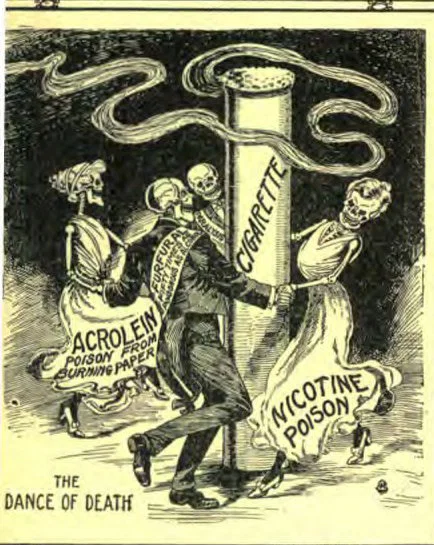
“Scientists have discovered, in a series of laboratory experiments held in London under the direction of the great scientific paper, the London Lancet, that when the cigarette is lighted the burning of the tobacco and the paper produces, or creates, a new element which is set free in the smoke to enter into the body of the boy who smokes it. This new substance which is thus created is furfural, and is the thing which makes raw whisky so poisonous. And these scientists discovered that there is just as much furfural in the smoke of one cigarette as there is in two fluid ounces of crude, raw whisky.”
Donald heard the boys all about him catch their breath, and he felt sure that some who had been smoking would stop doing so. The speaker continued:
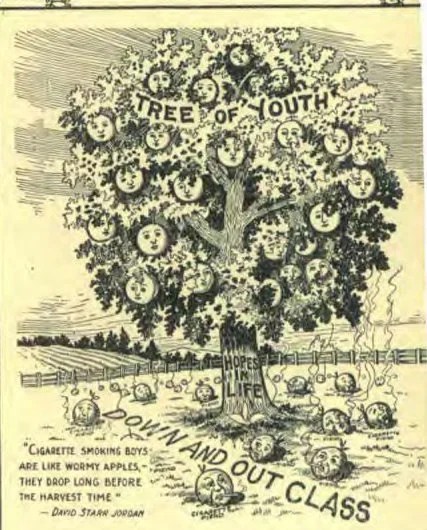
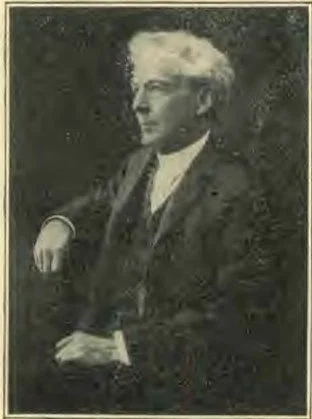
“CIGARETTE SMOKING BOYS” ARE LIKE WORMY APPLES,— THEY DROP LONG BEFORE THE HARVEST TIME.” — DAVID STARR JORDAN.
“Remember, boys, that furfural is not in the cigarette itself, it is not in the paper, or in the tobacco, and it is not put in by the maker; but no boy can smoke a cigarette without getting this into his system, for it is created by burning the cigarette,—by combustion,—and is in the smoke of every cigarette. You will see how fearfully dangerous cigarette smoking is when I tell you that furfural is fifty times more poisonous than ordinary alcohol.”
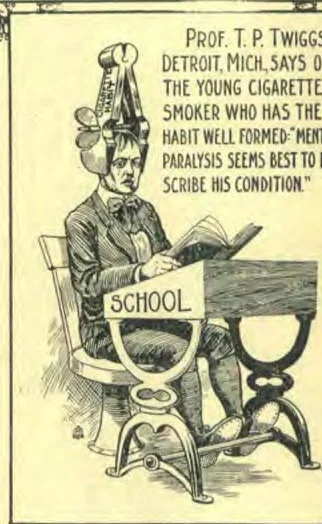
PROF. T. P. TWIGGS, DETROIT, MICH., SAYS OF THE YOUNG CIGARETTE SMOKER WHO HAS THE HABIT WELL FORMED: “MENTAL PARALYSIS SEEMS BEST TO DESCRIBE HIS CONDITION.”
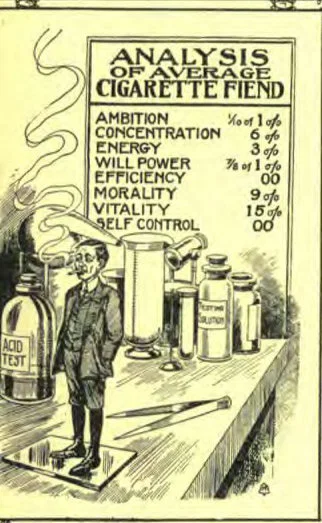
“This will show you why it is that a cigarette smoker is likely to be the most backward boy in his class. His mind is being impaired every day by these terrible poisons which he is putting into his body, so he is not able to think quickly, he cannot get his lessons easily, his brain becomes dull and heavy. Finally his lungs are unable to carry off all the poisons he smokes into them, and he gets pulmonary consumption, and soon after is carried away in the hearse and put in the cemetery, all because he would smoke cigarettes.
“Cigarette smoking has as bad an effect upon a boy’s morals as it does upon his body. A boy who smokes will soon lie and steal. Even the making of cigarettes seems to break down a man’s moral fiber, for in the advertisements appearing in the papers for popular brands of cigarettes, the manufacturers quote from the report of the laboratory experiments of the London Lancet which I have mentioned, and say that these scientists declared they found that the cigarette was the least harmful method of using tobacco. This is untrue. The report did say that there15is less nicotine in the tobacco of the cigarette than there is in that used in cigar or pipe, or in chewing tobacco; and therefore a person who smokes a cigarette is getting a smaller amount of nicotine for the tobacco he smokes than he would get in using tobacco in any other form.
“The makers of cigarettes have advertised this fact widely to give the impression that cigarette smoking is the least harmful method of using tobacco. But in doing so they have dishonestly suppressed the additional facts of the report in the Lancet from which they have quoted, and have carefully refrained from quoting those portions of the report which show that their statement that cigarette smoking is less harmful than any other method of using tobacco, is a deliberate falsehood. The report, by showing the production of furfural in the smoke, makes it plain that there is no more harmful or dangerous way of using tobacco than by smoking cigarettes.”
THE DANCE OF DEATH
In closing his talk, the minister urged the boys all to sign the anti-cigarette pledge, a copy of which he read. Many of the boys followed this counsel, much to the gratification of parents and teachers.
Food Sacrificed for Smoke
ACCORDING to a recent census of the Board of Agriculture, says Dr. Charles M. Sheldon, “there are more than 1,500,000 acres of rich land in the States of Kentucky, North Carolina, Tennessee, Virginia, Wisconsin, Ohio, and Connecticut used for the growing of tobacco. Every acre of this soil will grow useful food, potatoes, wheat, corn, cotton, cereals, grasses, and fruits.
“Suppose a crop of potatoes, at a yield of only one hundred bushels an acre at a price of only one dollar a bushel, to be obtained from this tobacco acreage, there is the tidy sum of $150,000,000 worth of food for a hungry world. Why should all this land produce nothing but smoke?
In harmony with this suggestion is the action of the Non-Smokers’ Protective League of America, which recently, through its president, sent to President Wilson an appeal to preserve the tobacco land for the growing of foodstuffs, that the hungry may be fed and the army protected from the deteriorating influence of tobacco.
Why a Young Banker Does Not Smoke
My body is too good for the cigarette, my work too important to allow its interference. The best worker is the one who keeps his body in tune by regular exercise and clean habits. I know that cigarette smoking would hurt my basket ball playing, my track work, yes, and even my swimming. It would shorten and take the keen edge off my business day. It would lessen my power of resistance toward disease, and increase my chances of being vanquished in a fight for life should I become the victim of a sudden accident or be compelled to undergo a serious operation.
Honor Roll—Tobacco Abstainers
President Wilson
William H. Taft
Charles E. Hughes
P. P. Claxton, Commissioner of Education
Arthur Capper, governor of Kansas
Ben B. Lindsey, judge of Juvenile Court, Denver
Timothy Cole, wood engraver
John Burroughs, naturalist and writer
Hiram Hadley, president of the New Mexico Anti-Tobacco League
Theodore Roosevelt
William J. Bryan
Josephus Daniels, Sec. of Navy
Lynn J. Frazier, governor of North Dakota
J. Frank Hanly, ex-governor of Indiana
Luther Burbank, the plant wizard
Charles A. Pollock, a judge in North Dakota
Gundar Olson, North Dakota
M. E. Poland, M. D., president of the No-Tobacco League of America
Oliver Stuart, ex-member Illinois Legislature
Charles H. Mayo, surgeon, Rochester, Minnesota
William J. Mayo, surgeon, Rochester, Minnesota
Howard A. Kelly, M. D., Johns Hopkins University
H. F. Emery, mayor, Fargo, North Dakota
Henry C. King, president Oberlin College
Members of U. S. Supreme Court
Louis D. Brandeis
James C. McReynolds
United States Senators
William E. Borah, Idaho
W. P. Dillingham, Vermont
P. J. McCumber, N. Dakota
Henry F. Hollis, New Hampshire
Francis E. Warren, Wyoming
Henry L. Myers, Montana
Thomas S. Martin, Virginia
Charles S. Thomas, Colorado
Joseph E. Ransdell, Louisiana
Thomas J. Walsh, Montana
Howard Sutherland, West Virginia
Bert M. Fernald, Maine
Charles Curtis, Kansas
John D. Works, California
William H. Thompson, Kansas
Thomas P. Gore, Oklahoma
W. L. Jones, Washington
Morris Sheppard, Texas
Benjamin R. Tillman, South Carolina
Atlee Pomerene, Ohio
Reed Smoot, Utah
William H. King, Utah
William M. Calder, New York
J. H. Gallinger, New Hampshire
John F. Shafroth, Colorado
William F. Kirby, Arkansas
Christian Endeavor Society Officers
Francis E. Clark, D. D., LL. D., president
Daniel A. Poling, LL. D., associate president and citizenship superintendent
William Shaw, LL. D., general secretary
Amos R. Wells, Litt. D., LL. D., editorial secretary
Ira Landrith, editor afield, Christian Endeavor World
A. J. Shartle, treasurer
Karl Lehmann, Southern States secretary
Officials of the Non-Smokers’ Protective League—No Member of Which Uses Tobacco
Charles G. Pease, D. D. S., M. D., New York City; Eugenio Di Pirani, Horace Greeley Knapp, Twyman O. Abbott, Prof. Irving Fisher, Prof. Henry W. Farnam, Dr. Charles B. Davenport.
Burt G. Wilder, B. S., M. D., Emeritus Professor of Neurology and Vertebrate Zoology, Cornell University, Ithaca, New York.
Harvey W. Wiley, A. B., A. M., M. D., B. S., Ph. D., LL. D., President of American Therapeutical Society, Washington, D. C.
Jenkin Lloyd Jones, LL. D., pastor of All Souls’ Church, Chicago, Illinois.
David Starr Jordan, M. S., M. D., Ph. D., LL. D., Chancellor, Leland Stanford Junior University, California.
Winfield S. Hall, Ph. D., M. D., Professor of Physiology in Northwestern University, Chicago, Illinois.
William A. McKeever, M. A., Ph. M., Professor of Child Welfare, the University of Kansas.
James R. Day, D. D., S. T. D., D. C. L., LL. D., Chancellor, Syracuse University, Syracuse, New York.
Thomas B. Stowell, A. M., Ph. D., Dean, and Professor in Department of Education, University of Southern California.
Stephen F. Peckham, A. M., consulting chemist for the City of New York.
Hon. William H. Douglas, New York City.
William B. Chapman, New York City.
Asa Francis Smith, member of the New York Bar.
Alphonse Major, New York City.
George A. Rutherford, New York City.
Arthur C. Lasswell, A. B., Pe. B., assistant in Biology, Manual Training High School, Brooklyn, New York.
Charles H. Valentine, member of the New York Bar.
Frederick W. Roman, A. M., Ph. D., Syracuse University, Syracuse, New York.
J. H. Kellogg, M. D., superintendent Battle Creek Sanitarium.
Walter H. Bond, member of the New York Bar.
R. S. Rutherford, member of the New York Bar.
Nelson Smith, member of the New York Bar.
Charles Elihu Slocum, M. D., Ph. D., LL. D., member Toledo Local, Ohio State and American Medical Association.
Prof. Henry Montgomery, A. B., A. M., B. S., Ph. D., University of Toronto, Canada.
Robert K. Walton, member of the New York Bar.
Tobacco Dangers to Children and Youth
TOBACCO leaf placed on the tongue of a boy who has never used tobacco causes nausea, vomiting, and serious heart and circulatory disturbances. Death has resulted from placing tobacco upon sores and cuts in children.
Mr. Edison's View of Acrolein
Acrolein is one of the most terrible drugs in its effect on the human body. The burning of ordinary cigarette paper always produces acrolein. That is what makes the smoke so irritating. I believe that it often makes boys insane. We sometimes develop acrolein in this laboratory in our experiments with glycerin. One whiff of it from the oven drove one of my assistants out of the building. I can hardly exaggerate the dangerous nature of acrolein, and yet that is what a man or a boy is dealing with every time he smokes an ordinary cigarette.
Luther Burbank, the Plant Wizard
MR. BURBANK is to the plant world what Mr. Edison is to the electric world. His wand can give to the calla lily the fragrance of violets or of water lilies, and to the plum the fragrance and flavor of the Bartlett pear. Seedless oranges, stoneless plums, white blackberries, and a long list of new varieties of fruits and flowers are products of his wizardry. Out of a black walnut tree and a California walnut he has produced a new tree that grows twice as rapidly as the combined growth of both parents. The ordinary chestnut tree of the woods requires from ten to fifteen years to pass from seedling stage to nut bearing; but Mr. Burbank has made a chestnut tree six months old bear nuts. The pineapple quince, a luscious fruit, which combines the characteristic qualities of each of the parents; the Burbank potato, known throughout the country; and the spineless cactus, which because of its economic value is regarded by some as his greatest achievement, are all products of Mr. Burbank's skill. He has produced the Australian star flower, which retains permanently its perfume and color; the scarlet poppy, yellow calla lily, new and hardy varieties of the tea rose; and besides these he has combined the field daisy with Japanese and European varieties, producing the exquisite Shasta daisy, a prince among flowers. All this has Mr. Burbank done, and much more. But there is one thing he has not done. I have asked him to tell you himself. He says:
Luther Burbank
“I have never used tobacco in any form, and, being of a nervous temperament, I am entirely satisfied that I should not have survived if I had. Many of my young friends are now in their graves, undoubtedly from cigarette smoking alone. I have never met any person who thought that cigarettes were beneficial to any one, under any circumstances. Why do people use them? That is too much for me, for the effect of them on boys is exactly like that of sand in a watch.”
Mr. Burbank absolutely refuses to employ cigarette users in his gardens, for he says that tobacco destroys the delicacy of touch necessary in his budding work. So our wonder-working plant wizard of America says, both by example and precept, that boys who wish to do things worth while must not touch the filthy weed, tobacco.
An Inventor’s Word
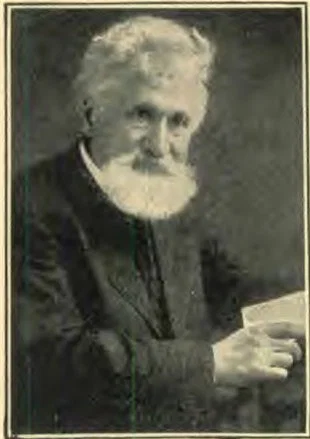
HUDSON MAXIM, the inventor of the multi-perforated smokeless powder grain; inventor of maximite, the first high explosive to be fired from a cannon with powder through armor plate; the inventor of motorite, a material which by self-combustion drives the torpedo through the water at from forty-five to sixty miles an hour; and of many other important inventions, speaks in no undertone about the evil effect of tobacco when he says: “Tobacco is a maker of invalids, criminals, and fools!” His latest word on the subject comes as a personal word to the readers of this issue. He says:
Copyright by Harris & Ewing
Hudson Maxim
“No, I do not smoke. Tobacco is one of the greatest evils of the modern world. It is one of the great degenerators of the race.
“None of my direct ancestry, as far back as I am able to trace, ever used tobacco, consequently tobacco is unusually poisonous to me through lack of immunity. Up to the time I was thirty-five years old I found the use of tobacco by others an insufferable nuisance. Frequently I would become so poisoned by tobacco smoke as to be ill for days. One time in London while attending a dinner I was made sick for six weeks.”
Undeceive the Boys
ARE the boys altogether to be censured for considering smoking as an element of manliness, when every movie hero sports a cigar or cigarette; when nearly all clothing illustrations show boys or men smoking; when high-class magazine illustrations represent the hero of the story with his cigar; when great advertising billboards show the men with pipe, cigar, or cigarette; when the daily newspapers devote whole pages to advertising matter setting forth the pleasure of the smoking habit; and when every street car has one or more signs telling of the delights of some kind of tobacco?
All this is but part of a nation-wide campaign to catch the boys as cigarette buyers, that the coffers of the American Tobacco Company may overflow with dollars from the destruction of the souls and bodies of our boys.
A duel is to be fought. The great tobacco trust is on one side, the great army of American boys on the other. One of these will succumb. Which it shall be depends upon you and me, and all the rest of those who love and believe in the boys.
It is evident that boys will be misled by the strenuous effort on the part of the tobacco trust to make them think that smoking and manliness go together. It is our part to undeceive them, and let them know that the highest manhood is divorced from the tobacco evil. It is for men to show them by total abstinence that true manhood eschews the weed. When will men sense the responsibility that rests upon them in this fight to free the boys from the cigarette curse? Right example is better for boys than sermons.
Efficiency Destroyers
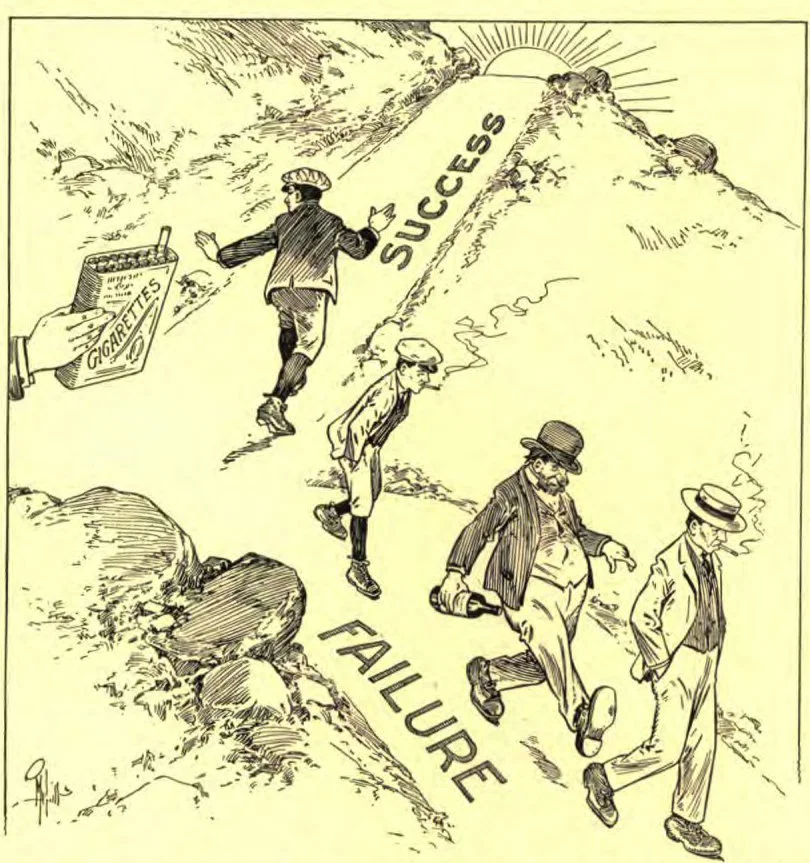
BOYS know that rum and whisky are efficiency destroyers. They look with disgust or pity upon the drunkard, the man who has voluntarily destroyed his efficiency by drinking liquor. But the boy who smokes is walking in the same path that the drunkard took. To the growing boy the cigarette is as great an evil as rum is to the man. When the man takes his first drink, and the boy smokes his first cigarette, the two start on the efficiency - destroying path; for as the first glass of whisky usually in time leads to the gutter, so the first cigarette usually leads to the inefficiency and debility of the cigarette fiend. A cigarette-smoking boy is a fifty-per-cent loss to every good cause. It has been scientifically proved that smoking produces grave effects on mind, body, and soul. Dr. A. E. Gilson, of the United States Navy, cites the following list of evils resulting from the habitual use of the harmful weed:
“It leads to impaired nutrition of the nerve centers.
“It is a fertile cause of neuralgia, vertigo, and indigestion.
“It irritates the mouth and throat, and thus destroys the purity of the voice.
“By excitation of the optic nerves it provokes amaurosis and other defects of vision.
“It causes a tremulous hand and an intermittent pulse.
“One of its conspicuous effects is to develop irritability of the heart.
“It retards the cell change upon which the development of the adolescent depends.”
“It will be remembered that when the Boer War broke out, 11,000 volunteered for service in the Manchester District alone; 8,000 of whom were at once rejected as physically unfit, and only 1,200 finally passed the doctors. The chief cause of unfitness was proved to be smoking by boys and young men.”
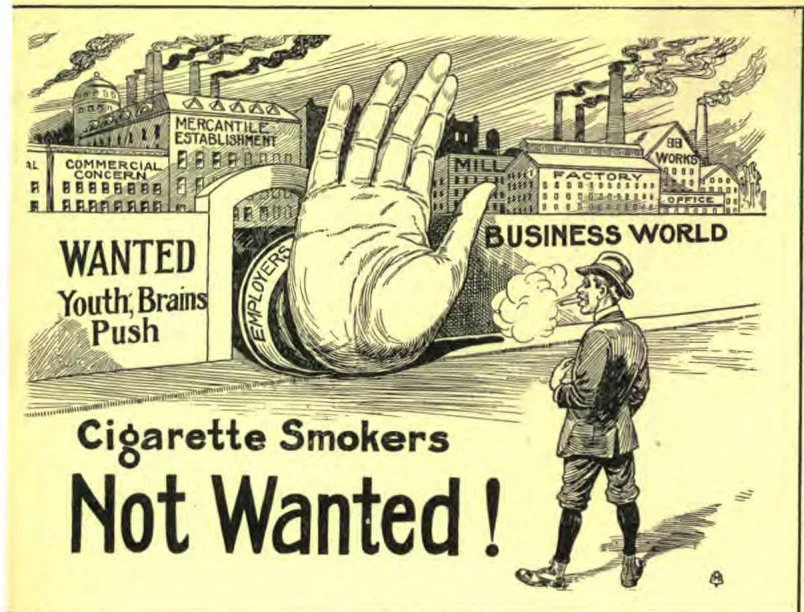
To the sensible boy the strongest testimony against the cigarette is the fact that so many of life’s business doors are closed to cigarette users.