Farnham, Richmond Co., March 16.—Commenced meetings at Bro. Lewis’s March 8, 1881. Gave seven discourses in private houses in Richmond county, and one discourse to a crowded house in Northumberland county. The people were anxious to hear, especially on the Sabbath question; but I was compelled to speak at private houses, owing to the fact that the meeting-house, which was free to us, was quite open, and was without a stove. Spoke on the Sabbath with my overcoat on. I did the best I could under the circumstances. There are three adults here keeping the Sabbath, and we have reason to believe that several more will keep it soon.
There is a disposition on the part of many to read on the present truth. Let us all pray that the “silent messengers” may do a good work with these people. The brethren here are active in the missionary work, and I think that ere long the way will open for a good work to be done.
Spoke to the small company of Sabbath-keepers in Washington, D. C., on my way to Farnham, Sabbath, March 5. Found them rejoicing in the third angel’s message. I also met with brethren from Calverton, Md., and one from Toledo, Ohio. We closed with a social meeting, in which the brethren and sisters gave warm testimonies in behalf of the truth.
Pray for me, that I may remain faithful.
HENRY A. RIFE.
GEORGIA
By W. F. Killen
Brooks Co.—I have just returned from Brooks Co., Ga. I found there four Sabbath-keepers, who are very firm indeed in the truth. Three of them, one man and two women, were baptized by Eld. C. O. Taylor before he left Georgia for Battle Creek. The other, the husband of one of these ladies, told me that he was ready for baptism, but was in feeble health, and thought it best to wait until the weather became warmer. A colored woman says she thinks I will have her to baptize when I go back there. I preached eight discourses in the county, four of them in the immediate neighborhood where I was stopping, the others in different parts of the county. I had attentive audiences. There was considerable opposition to Eld. Taylor, because he was a Northern man. They treated me very kindly indeed, and the way for the truth to be spoken in that county is fully open. Several freely acknowledged that we have the Bible Sabbath. The preaching was of a practical nature, and everywhere apparently well received.
There are a great many small farmers in the county, who do their own work; and where they have not had severe misfortune, they are generally doing pretty well. Those who run larger farms, and hire negroes, are, as a general thing badly in debt. The case is similar where I live, and everywhere else over the South, so far as I know.
I want to ask every S. D. Adventist to pray for the prosperity of God's precious truth in Georgia, and pray for me.
W. F. KILLEN.
Perry, Houston Co., March 17.
MYRRH-BEARERS
By Margaret J. Preston
Three women crept at break of day,
A group along the shadowy way
Where Joseph's tomb and garden lay.
Each in her throbbing bosom bore
A burden of such fragrant store
As never there had lain before,—
Spices, the purest, richest, best
That e'er the murky East possessed,
From Ind to Araby the Blest.
Had they, with sorrow-riven hearts,
Searched all Jerusalem's costliest marts
In quest of nards, whose pungent arts
Should the dead sepulcher imbue
With vital odors through and through;
'Twas all their love had leave to do!
Christ did not need their gifts; and yet
Did either Mary once regret
Her offering? Did Salome fret
Over those unused aloes?—Nay!
They did not count as waste that day
What they had brought their Lord. The way
Home seemed the path to Heaven. They bear
Thenceforth about the robes they wear
The clinging perfume everywhere.
So ministering, as erst did these,
Go women forth by twos and threes
(Unmindful of their morning ease),
Through tragic darkness, mirk and dim,
Where'er they see the faintest rim
Of promise—all for sake of Him
Who rose from Joseph's tomb. They hold
It just such joy as these of old
To tell the tale the Marys told.
Myrrh-bearers still—at home, abroad,
What paths have holy women trod,
Burdened with votive gifts for God,—
Rare gifts, whose chiefest worth was prized
By this one thought, that all sufficed,—
Their spices have been bruised for Christ.
—Margaret J. Preston.
OUR PERIODICALS.
By George I. Butler
BY ELD. GEO. I. BUTLER.
We feel a deep interest in the circulation of our papers, 1. Because they contain what the people need,—pure, wholesome, elevating truth, such reading as is beneficial to the reader; 2. Because that which is hurtful is excluded; 3. Because they contain special light and truth for this time, which are not found in other papers, relating to the closing work for the world.
We greatly desire that our fellow-men shall have the benefit of this light, and be saved by it. Hence we are exceedingly anxious to have our people feel the importance of taking these papers for their own benefit, and for the benefit of others whom they may reach by circulating them. In the exalted moral character of our periodicals, we are certain we are not mistaken. Ministers and people not of our faith have recognized their worth. The Lord has testified the same to us. We know it is a good work to circulate them everywhere, for they are exceedingly valuable.
Our health journal contains precious truths relative to temperance and hygiene, which the people greatly need. This journal should have a circulation of thousands where it has hundreds. By proper effort in canvassing, this result might be reached. The publishers of Good Health offer liberal inducements to canvassers, so that the work of increasing its circulation may be peculiarly profitable. Some have procured hundreds and thousands of subscribers. I have known instances where those of little experience in canvassing have obtained hundreds of subscribers, in a comparatively short time. People all over the land are interested in the subject of health, and would take this journal if its merits were properly presented. This is especially true of the reading classes in towns.
Our journals in German, Danish, Swedish, and French should be presented to those who speak these languages, and vigorous efforts should be made to increase their circulation. It is a noble work to impart the light of truth to nations and tongues who have not seen it. Who can tell the extent of its influence if those in our country should communicate it to their friends in their native land? These journals in other tongues need the fostering care of our people everywhere, for they are an expense to the Publishing Association. Yet they must not be discontinued. Our people, scattered here and there, come in contact with many who speak these languages, and could get many subscribers. Try it, brethren and sisters.
The Instructor is a precious little sheet, containing excellent Bible lessons and other interesting reading matter. It should be in every Sabbath-keeping family, and the lessons for Sabbath-schools should be learned by those who live alone as well as by those in churches. They will do the lone ones just as much good as if they had church privileges and associations. How much better to do this than to waste the Sabbath hours in sleep and idleness. Many not of our faith would love this paper if made acquainted with it. Its circulation could be much increased.
We must not forget our neat little College Record, devoted to educational interests, and calling attention to our good College. It is filled with choice reading, designed to show the importance of true education. It is a very interesting sheet to me. It is a credit to its conductors, and remarkably cheap at ten cents per annum. It should be taken generally by our people, and placed in the hands of worthy young people not of our faith, who are interested in education. If this were done, no doubt many would avail themselves of the superior advantages of our College.
We have recently spoken quite at length of the importance of the REVIEW AND HERALD. How gladly would we do anything in our power to increase the interest of our people in this most excellent paper. To me it is the most precious paper in the world, and it should be to every Seventh-day Adventist. We trust our people everywhere, and our tract and missionary workers in particular, will bring to bear all the influence possible to place it in the family of every Sabbath-keeper. They need its instruction. It is our church paper. It contains just what they need, that which they cannot get elsewhere. Our people should not in a single instance drop the REVIEW to take the Signs. Many things which our people need, will be found in the REVIEW, which it is not designed the Signs should contain. Those things which are of special interest to our own people concerning the cause in which we are engaged, are published in the REVIEW and not in the Signs. We hope our tract-society workers everywhere will look after the circulation of the REVIEW. See that each church in every Conference is thoroughly canvassed. If each family cannot be visited, have some one appointed in each district to correspond with them and find whether they are taking the REVIEW or not. If not, induce them to take it; if worthy and not able, have them supplied.
But the Signs of the Times is our pioneer paper, which is specially prepared to do missionary work. The REVIEW is not designed to occupy this field. The two fields are separate. We feel a deep interest in the prosperity of this excellent missionary paper. We long to see it go forth on its errand of love wherever the English language is spoken, bringing to the attention of all, the precious truths of the closing message. In the last Testimony to the Church, both papers are spoken of, and the importance of our people everywhere taking the REVIEW is enforced. It says of these papers, “With slight variations, the Signs has been increasing in interest and in moral worth as a pioneer sheet since its first establishment. These periodicals are one in interest. They are two instrumentalities in the great field to do their specific work in disseminating light in this day of God’s preparation. All should engage just as earnestly to build up the one as the other.”
With this we most heartily agree. What, therefore, is said of the importance of the REVIEW, to increase its circulation, should also be understood of the Signs, as each is important in its own field. Is our message a world-wide proclamation of the soon-coming Saviour, and of the truths necessary to prepare a people for that event? Does it threaten the unmixed wine of the wrath of God upon all who will not receive it? Is it necessary that the people of all lands should be warned to keep the “commandments of God and the faith of Jesus” in order to be prepared for the return of our Lord? Then we have not reached the time to slack our efforts in behalf of our missionary paper. We ought to be doing ten times as much as we are,—yes, twenty times as much, as the Lord has shown.
That the Signs is still doing a noble work, we have many evidences. Bro. Loughborough reports, both in REVIEW and in private letters, its good work in England. This encourages our hearts. We look for precious results from the circulation of 1,000 Signs this year in that country. In this manner, the truth can be introduced to many households where the living preacher could not go. In this way, it will doubtless be brought before rulers and kings; for these must hear it. The message is to go to “peoples, nations, tongues, and kings.”
Our clubs of Signs taken in this country are doing great good. Interested readers are constantly being found, and souls embrace the truth. In this way we204are sowing the seed, which will be garnered in the great day. We beseech our workers not to become “weary in well doing; for in due season we shall reap if we faint not.” Don’t let your clubs of the Signs go down. Do more, instead of less. Work while the day lasts, for the night soon cometh when no man can work.
The Signs Office greatly needs your patronage. The plan recently formed for the purpose of obtaining subscribers for the Signs among outsiders, seems to be an excellent one. The work used as a premium, “Geikie’s Life of Christ,” is a most valuable work. I have read it, and was greatly interested and instructed. It is a mine of valuable information concerning the country where our Saviour lived, the religious condition of the people, the traditions of the Rabbis and Pharisees, the state of society, and many other interesting subjects. It is a book of over 800 pages. It is an excellent book for any one to have. If properly used in canvassing for the Signs, it seems to me many subscribers might be obtained. We hope many will try it.
Dear brethren and sisters, let us not slacken our efforts in behalf of the Signs or any of our papers. Let us take hold of the good work with new interest. Our only safety is in being busy in the Lord’s work. Satan catches the unwary and idle in his net. Let us work, for the night soon cometh, when none can work.
TO THE CHURCHES IN INDIANA.
By S. H. Lane
I TAKE this method of addressing you a few lines, to which I hope you will give the most earnest heed. The time of our church quarterly meetings for April is at hand. We trust that in all our churches each member will attend the quarterly meeting. If you are situated so that you cannot, by all means report. Let your brethren know you still love the truth. Do not fail to celebrate the ordinances of the Lord's house. Let us make Sabbath, April 2, a day of humiliation and prayer.
Do not neglect the business meeting on first-day, April 3. Be sure to have your T. and M. report made out before that meeting, so that the occasion will be an interesting one. At this meeting be prepared to pay your tithes for the past quarter. This is especially necessary this quarter, as the means will be required to start all our tents in new fields,—a move which must take place during the coming quarter. Let all pay something at the quarterly meeting. If you cannot attend the business meeting, send with your report your past quarter's S. B. Let all of our scattered brethren, not connected with our churches, send their S. B. to the State treasurer, Dr. Wm. Hill, Rochester, Fulton Co., Ind.
Let each one do his duty in all these matters, and the Lord will bless us. S. H. LANE.
N. Paris, March 21, 1881
By Geo. W. Washburn
TO DIST. NO. 4, MAINE TRACT SOCIETY.
The time is drawing near when the district quarterly meeting of this society is to be held, and we feel very anxious to obtain a report from every member. We also earnestly desire to see the members face to face, and talk of the importance of missionary labor. As a general thing, I fear we do not realize the importance of the T. and M. work. We believe we are giving the last message of warning that this world will ever have, and that when it is closed, the destiny of the human family will be forever fixed. This being true, how important that we should make every effort to place the truth before those who are perishing. Now let us examine ourselves, dear brethren and sisters, and see if we have been as faithful in this direction as we should.
GEO. W. WASHBURN, Director.
N. Paris, March 21, 1881
Prayer Prefixed to Early English Bible Editions
—The following prayer was prefixed to some editions of the early English versions of the Bible: “O gracious God and most merciful Father, which hast vouchsafed us the rich and precious jewel of thy holy word, assist us by the Spirit, that it may be written in our hearts; to our everlasting comfort, to reprove us, and edify us unto the perfect building of thy Christ; sanctifying and increasing in us all heavenly virtues. Grant this, O Heavenly Father, for Jesus Christ’s sake! Amen.”
THE MORAVIANS AMONG NORTH AMERICAN INDIANS.
By M. L. H.
(Continued.)
Having been informed that some Indians on the Ohio River were anxious to hear the gospel, the excellent missionary, David Zeisberger, accompanied by two Indian assistants, made a journey thither. Exposed to cold and rain, sleeping in the open air at night, forcing their way through pathless thickets, and over extensive plains covered with such high grass that a man on horseback was nearly hidden by it, the hardships of their journey were very great.
On arriving at their destination, they found the natives sunken in the vilest abominations of heathenism. They readily consented, however, to convene an assembly in order to hear what the missionary had to say, and, after due deliberation in their council, requested that teachers might be sent to reside in their town. Accordingly, it was decided to form a missionary station at this place, and Messrs. Zeisberger and Senseman, with several Indian families, were requested to remove there for this purpose. On their way, they remained over night with a store-keeper, lodging in a room where there were barrels of gunpowder. Notwithstanding their host cautioned them in respect to fire, remarking that loose grains of the powder might be in the straw on the floor, a fellow-traveler, having a wounded foot, desired a candle, and, overcome with weariness, fell asleep leaving it burning in the room. The next morning Zeisberger called his companion out of the house, and, pulling the candle out of his pocket, communicated to him the following: “My brother,” said he, “had not the eye of Him who never slumbereth or sleepeth been upon us last night, we should all have been blown into the air, and no one would have known how it happened. I slept soundly, being extremely fatigued, and was in my first sleep, when I felt as if some one had roused me with a violent shake. I immediately sat up, and saw the wick of the candle hanging down on one side, all in a flame, and the candle itself on the point of falling into the straw, which I was just in time to prevent. After this I could not sleep again, but lay silently thanking the Lord for the extraordinary preservation which we had experienced.”
At first, the missionaries were received with every token of welcome, by the Indians, and religious services were well attended; but in a short time, the charm of novelty having subsided, a violent opposition ensued. The missionaries were regarded with malignant hatred by some of them, who determined that not only they, but their converts, should be put to death and thrown into the river. This, however, did not move them; but after a time, seeing that the opposition of their enemies increased rather than diminished, they retired to a spot fifteen miles distant, accompanied by those Indians who had become attached to the gospel. From this place they were soon obliged to move on account of an Indian war which broke out in the vicinity. After a journey of two weeks, accompanied with many perils and hardships, they found a convenient spot for a settlement near the junction of the Ohio and Beaver Creek rivers. Here also they were threatened with death by the surrounding Indians, but continuing steadfast, their hearers increased daily. One of the party that so inhumanly massacred the missionaries a few years before, was now among the most attentive hearers of the gospel.
The history of this mission from this time onward for several years, is made up of dangers, hardships, removals, the formation of new settlements, etc. Account is given of several Indian chiefs who declined the highest rank among their pagan countrymen, preferring rather to become humble followers of Christ. Finally the Delaware Indians, who had long favored the missionaries, and refused to take any part in the war between the English and the colonies, which was now in progression, united with the former, and resolved that the hatchet should fall upon the heads of those who did not follow their example. Thus the missionary settlements were placed between two cruel enemies, and their destruction appeared inevitable, particularly as the converts declined to take up arms. Having retired to more secure localities, however, they were not disturbed until 1781. The English governor at Fort Detroit, regarding them with suspicion, made arrangements with a tribe of Indians, the Hurons, to carry them off, with their congregations. Accordingly in August, three hundred warriors, accompanied by a British officer, arrived at one of the settlements. Assuming the mask of friendship, they proposed the removal of the Christian Indians to a place which they represented as almost paradise. Not succeeding in this attempt, they seized the missionaries and declared them prisoners of war. As the latter were dragged away from the settlement and conducted into the camp of the Delawares, some of the savages sang over them the death-song, while others deprived them of most of their clothing, and confined them in two huts. Here they had to sit or lie on the bare ground, with only a few rags to shield them from the cold.
In the meantime, another party of warriors marched to two other settlements, where they plundered the mission houses, and captured the missionaries, with their wives and children, singing the death-song as they led them away.
In tracing out the history of this mission, we may tire of the sameness characterizing the events narrated, but to those who experienced them, they were replete with mental and physical suffering. To them, there was no reprieve from hardships, dangers, and deprivations; and what makes their history of interest to us, is the fact that all this was endured for Christ’s sake, in order to save from eternal death men sunken in the lowest depths of sin and ignorance. At any time these missionaries might have been relieved from the distressing circumstances of their position, by simply turning their attention to their own interests, the same as others were doing. They were under no more obligation to pursue such a life of self-denial and suffering, than other men; yet they voluntarily took it upon themselves for the sake of perishing humanity, and the books containing the record of men’s lives, when opened, will vindicate the wisdom of their choice.
M. L. H.
(To be continued.)
MISSIONARY SERMONS.
By A. S. Hutchins
BY ELD. A. S. HUTCHINS.
With missionary visits, calls, and work, why should not the minister of the gospel preach home missionary sermons. Why not carry the gospel to the homes of those who are so aged or infirm that they cannot meet with the people of God at their places of worship?
“The poor have the gospel preached to them.” “To him that is afflicted, pity should be shown from his friend.” To manifest indifference or neglect toward such, is to manifest it toward Christ. Says Jesus, “The Spirit of the Lord is upon me, because he hath anointed me to preach the gospel to the poor; he hath sent me to heal the broken-hearted, to preach deliverance to the captives, and recovering of sight to the blind, to set at liberty them that are bruised.” Luke 4:18.
Cornelius sent about forty miles for Peter to come and preach the gospel to him, and his kinsmen and friends, whom he had called together; and a reformation was the result of this effort.
A few candid hearers into whose hearts the truth would sink deep, are more to be desired than a large audience who care not for the truth. Sometimes the lonely ones have neighbors who would be glad to hear preaching. Within the space of fifteen minutes, these have been called in to hear a sermon; and this ended, the minister has gone on his way rejoicing, leaving glad hearts to rejoice for the privilege.
Last first-day, some twenty-five were assembled at the home of an aged, feeble, and blind sister, to listen to a sermon preached more especially for her benefit. To comfort the same person, two sermons were preached at her residence four years since. A few weeks passed, and we were made happy to know that she and two of her children had embraced the Sabbath of the Bible. Other friends soon yielded to their convictions of duty, all of whom keep the Sabbath. The servants of God must not “despise the day of small things.” If our usefulness can be increased, let it be so.
March 17, 1881.
Science, Christianity, and the Language of Renewal
—Where science speaks of improvement, Christianity speaks of renovation; where science speaks of development, Christianity speaks of sanctification; where science speaks of progress, Christianity speaks of perfection.
Missouri Tract Society.
By Sarah Clarke
REPORT FOR QUARTER ENDING JAN. 1, 1881.
Districts
No. Members
No. Reports Returned
No. Members Added
No. Families Visited
No. Letters Written
No. Signs taken in
Subscribers obtained for Periodicals
Pages of Tracts and Pamphlets distributed
Periodicals Distributed
Annuals sold and given away
Cash rec’d on Tract Fund and Periodicals
1
23
13
3
1
7
11
.....
.....
2520
8
$44.45
2
9
6
.....
1
8
17
1
.....
1470
$23.00
3
28
2
6
12
6
22
6
.....
3147
15
$31.30
4
43
27
.....
55
80
10
.....
.....
10505
28
$65.00
5
.....
.....
.....
.....
.....
.....
.....
.....
1244
$16.00
6
12
7
.....
12
9
.....
1
.....
2376
4
.....
7
21
17
.....
39
34
.....
1
.....
6160
2
*
.....
.....
.....
.....
.....
.....
.....
.....
.....
.....
$20.85
136
72
9
120
144
60
9
.....
27422
57
NOTE.—Received for membership and on donations, $128.15; sales, $22.90; periodicals, $60.70.
MRS. SARAH CLARKE, Sec.
USE THE ONE TALENT.
By Jennie Thayer
BY JENNIE THAYER.
There seems to be a natural longing in the human heart to perform some great act by which the doer shall satisfy his conscience, gain the praise of the world, and secure the favor of Heaven. This is not easily done. But few are privileged to thus immortalize their names, while the many, having spent their lives in a vain attempt to reach the acme of their desire, die unhonored and unknown.
The wish to do something great, absorbing all others, has prevented their doing what little good they might otherwise have accomplished. What little good? Considering that “there is none good but One,” and that all good acts are prompted by his Spirit, can these good acts be regarded as little? They are written in his book, and their influence will extend through eternity; then should they be lightly esteemed by the “creatures of his hand”?
It is recorded of the lowly Nazarene that he “went about doing good,” and ought not this to be the aim of his followers? “There is nothing I can do” is, no doubt, the unspoken language of many a heart; but God requires no impossibilities, and yet he says to all, “Go work to-day in my vineyard.” Something to do will appear to those who from the heart respond, “I go.”
There is probably no work so well adapted to meet the circumstances of all as that called tract and missionary work. Here is opportunity for developing the varied powers of the human mind. The business man, as he rushes on amid the whirl of active life, can at least find time occasionally to give a tract that may be more potent than many sermons, or can, by his influence, introduce our periodicals to the homes of those with whom he deals. The brilliant conversationalist can devote his talents to the service of that Friend who gave himself a ransom for sinful man, and is soon coming to claim his own. The toiling mother can have the papers on her table, and hand one to the neighbor or stranger who may chance to call upon her. Those too timid to enter at once upon personal work in the vicinity of home, can, through our postal system, have access to people in remote portions of the world. Even the sick, the infirm, the blind, may, by the aid of friendly hands, send out the papers and tracts. And all can pray. “The effectual fervent prayer of a righteous man availeth much.” Your prayers are needed. If you can do no more, pray for this work.
Though your efforts may be regarded as small by all around you, if they are prompted by a real love for the truth, they will not so appear “unto the eyes of Him with whom we have to do.” Though they will never win earthly laurels, they will place upon the head of the humble, persevering laborer “a crown of glory that fadeth not away.”
The Day-Line.
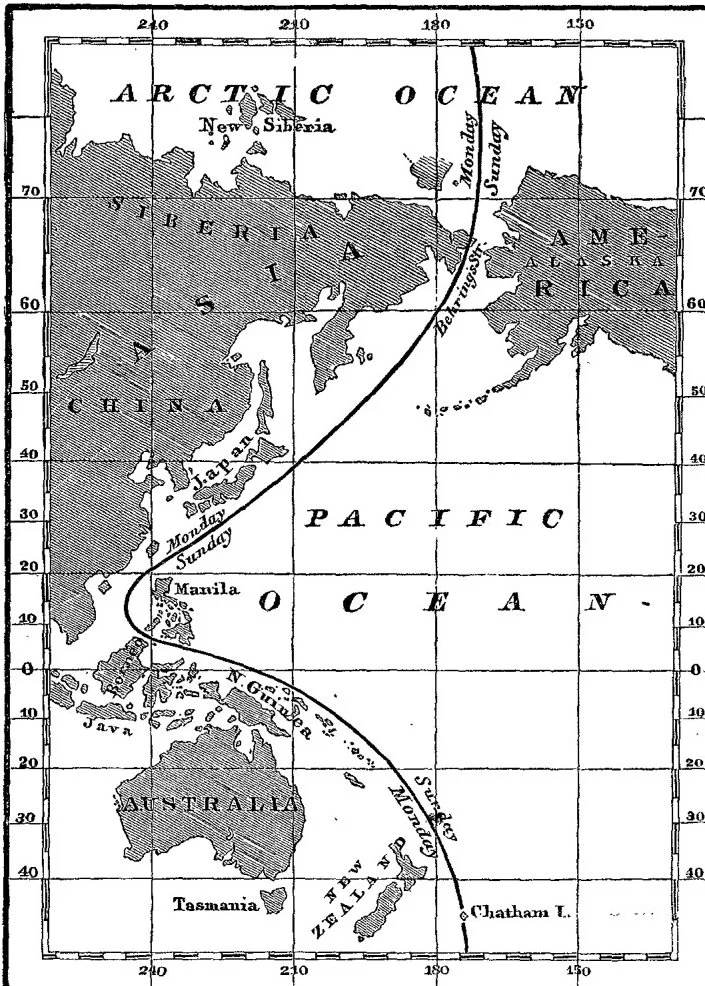
A CORRESPONDENT asks us where upon the surface of the earth the day-line is located, and what explanations can be given concerning it. Theoretically, the day-line is located on the 180th meridian from Greenwich; but practically it varies considerably from that meridian, as shown in the accompanying diagram, in which the heavy line running from north to south represents the day-line.
It passes through Behring’s Strait, and then takes a southwesterly direction to the Philippine Islands; thence, southeasterly, to Chatham Island and the south pole.
We say the line is practically located as here shown, because all those living directly east of this line are, in their reckoning, one day behind those living directly west of it. So in crossing the line from west to east, a day must be dropped; and in crossing it from east to west, a day must be added. A person crossing the line westward on Sunday noon, must change his count to Monday noon; and vice versa, a person crossing it eastward on Monday noon must drop his count back to Sunday noon.
The reason of this is apparent. When the earth was peopled the second time by the descendants of Noah, some traveling eastward carried with them the reckoning of time from their starting-point at Ararat to the eastern coast of Asia. Others, from the same point, carried the same reckoning of time westward to the western coast of Europe. In process of time, America was discovered, and the discoverers came from Europe, bringing their reckoning of time with them. From the same direction the American continent has been explored to its western extremities. Discoveries were also made westward in the Pacific Ocean. But meanwhile some islands east of Asia were peopled by inhabitants from that direction; and they established the dates they brought with them in the islands which they peopled. The two tides of migration practically came together on the line indicated in the diagram, and so dates have become established east and west of this line, as herein stated, without regard to their position relative to the 180th meridian. Thus Manila, the capital city of the Philippine Islands, is far west of Behring’s Strait; yet the day is one day behind the day at Behring’s Strait, because the Philippine Islands were peopled by persons from the American side, bringing with them their eastern dates. And the island of New Zealand, though far east of Manila, is one day in advance of the reckoning at Manila, because New Zealand was peopled from the Asiatic side, the people bringing their reckoning of time with them. And these dates having become established, it is now impracticable to change the arrangement, and place the day-line practically, as it is theoretically, on the meridian of longitude running directly north and south, through Behring’s Strait.
By this simple geographical fact, all confusion is avoided, and all difficulties arising from difference of dates are easily solved. The difference of reckoning in Alaska and Chatham Island is often referred to as an insuperable objection to the keeping of the Sabbath; but the question is evidently to be settled on this ground; namely, Alaska, lying east of the day-line, should conform in its reckoning to the American side, and those who now inhabit Chatham Island, coming from the same side, should adopt the same reckoning. The trouble in Alaska has arisen simply from the fact that those who crossed Behring’s Strait from Asia brought their Asiatic reckoning with them, instead of changing the day when they crossed the day-line, as they should have done.
The Church Surrendering.
The plainest testimony we have ever read relative to the low religious condition of the churches, as plain as any that need be given, substantiating fully all that we have ever claimed, or perhaps ever can claim, from prophecies which we think set forth this condition of things in the religious world, comes from the pen of T. DeWitt Talmage, in the following article, which was published in The Domestic Journal:—
I simply state a fact when I say that in many places the church is surrendering, and the world is conquering. Where there is one man brought into the kingdom of God through Christian instrumentality, there are ten men dragged down by dissipations. Fifty grogshops are built to one church established. Literary journals in different parts of the country are filled with scum, dandruff, and slang, controlled by the very scullions of society, depraving everything they put their hands on. Three hundred and ten newspapers and journals and magazines in New York, and more than two hundred of them depraving to the public taste, if not positively inimical to our holy Christianity! Look abroad, and see the surrender, even on the part of what pretend to be churches, to spiritualism and humanitarianism and all the forms of devilism. If a man stand in his pulpit and say, “Unless you are born again, you will be lost,” do not the light gloves of the Christian, diamonds bursting through, go up to their foreheads in humiliation and shame? It is not elegant.
There is a mighty host in the Christian church, positively professing Christianity, who do not believe in the Bible, out and out, in and in, from the first word of the first verse of the first chapter of the book of Genesis, down to the last word of the last verse of the last chapter of Revelation. And when, a few Sabbaths ago, I stood in this pulpit and said, “I fear that some of the audience will be lost for rejection of Christ,” why, four or five of the daily papers threw up their hands in surprise at it. Oh! we have magnificent church machinery in this country; we have sixty thousand American ministers; we have costly music; we have great Sunday-schools; and yet I give you the appalling statistics that in the last twenty-five years, laying aside last year—the statistics of which I have not seen—within the last twenty-five years the churches of God in this country have averaged less than two conversions a year each. There has been an average of four or five deaths in the churches. How soon, at that rate, will this world be brought to God? We gain two, we lose four. Eternal God! what will this come to? I tell you plainly, that while here and there a regiment of the Christian soldiery is advancing, the church is falling back for the most part, and falling back, and falling back; and if you do not come to complete rout—aye, to ghastly Bull Run defeat—it will be because some individual churches hurl themselves to the front, and ministers of Christ, trampling on the world and sacrificing everything, shall snatch up the torn and shattered banner of Emmanuel, and rush ahead, crying, “On! on! This is no time to run; this is the time to advance.”
THE TURKS AT BAY.
There are symptoms of a holy war brewing, if war can be called holy in which the fanaticism of the Moslem is pitted against the faith of the Christian. Under one excuse or another, the Porte has delayed executing its part of the Berlin treaty, and it has long been evident that very little could be obtained206from Turkey except under compulsion. The present Sultan has been called timid, weak, and vacillating, but his position seems to have given him dogged obstinacy, if not courage. If he defies Europe, he invites war, and if he defies the sentiment of his people, he invites the dagger of the assassin, or at least deposition. Between the two horns of the dilemma, he seemingly chooses to be a Turk, and stand by his country and all its past traditions. The telegraph asserts that as a means of exciting resistance against the demands made by the united powers of Europe, there has been put in circulation among the people a report that a prophecy has lately been discovered which points out the exact present condition of affairs as between Mohammedans and the Christians, and predicts that at this moment, the Mohammedans will come to the defense of their temporal and spiritual head, the Sultan, and not only drive back the Christian hosts who are assailing him, but enable him to carry an aggressive war into their territory. The sheiks from all the Moslem centers are hastening to the Sultan’s palace, urging him to proclaim a religious war, and to call on his people to drive the infidel dogs from Turkish soil. The situation is very critical.
The Turks nowhere in the European part of their dominions largely outnumber other sects directly opposed to them, and any religious war would have as much of an internal as an external character. The surrounding independent nations would also pour down upon Constantinople, and the end would finally come, as it should have come long ago, in the expulsion of the Turk from Europe and his final retirement to Asia. Whatever fanaticism could and did once accomplish, it is no match for the cannon and breech-loaders of modern warfare; and fanaticism, while it gives courage, cannot supply powder and ball and army rations.—Newark Advertiser.