IN the Christian Weekly of March 26, we find the following facts relative to the exceptionally hard winter through which we have just passed:—
Now that the vernal equinox is passed, we may hope that the reign of the long and rigorous winter is at an end. It has been a memorable one in its duration and severity. All parts of the land have had an unusual experience during the past season. But especially in the Northwest have its cold and storm, blizzards and blockades, and interruption of travel and business, been frequent and persistent. The newspaper dispatches have seemed almost incredible to us who live in milder climes. Even last week came news of bridges in Iowa covered with twenty feet of solid snow, and cuts, miles in length, filled with solid snow and ice twenty feet deep, and fifteen thousand cars of freight of the St. Paul Company blocked with snow! A personal letter before us gives a vivid idea of what a Minnesota winter can be. The writer, living in a railroad town, under date of March 4, says:—
“We have not had a train since the middle of January—and that one the first since Christmas. We have had snow for two weeks without ceasing. Snow on a level is six feet deep. Many near town will suffer for want of fuel and provisions, as it is impossible for them to get here for help. Many a family in town has suffered fearfully for want of the means to keep warm. They have the money, but fuel is not to be had for love or money. But for a wealthy man in St. Paul, who by immense efforts hauled wood twelve miles to us here, many would have frozen to death.”
FAITH, OR—WHAT?
SHALL we close the precious volume,
And put it away from our sight,
And say to our friends and dear ones,
“No longer walk in its light;
For the God we thought its author,
The God to whom we have prayed,
Is a ghost, a myth, a fiction,
And Nature by Nature was made”?
Shall the Book of Books be banished
From all our suffering world,
And the tender words of Jesus
To oblivion’s depths be hurled?
Shall the “still small voice” no longer
Steady our faltering feet,
And shall words of faith and prayer,
Never more bring comfort sweet!
Shall the purest, noblest, truest,
That has blessed the world, be despised;
And mankind accept and follow
What infidels have devised?
O ye poor and sick and weary,
All who sorrow’s cup must quaff,
Would ye give your faith in Heaven
For a logic of husks and chaff?
How little of life would be noble,
Unruled by a power above;
How much would be vile and wretched,
Unsaved by a Father’s love!
Oh, liberty, home, and woman,
By the hand of Him were given;
The world of art and music,
Owe their grandest works to Heaven.
“By their fruits,” then, shall ye know them,
And the Bible will stand the test;
But how of the vaunting skeptics,
Hume, Ingersoll, and the rest?
These are upas trees, which ever
Breathe poison and death to all
Who rest them beneath their shadows;
But the upas trees shall fall.
The Bible will stand forever
A rock of strength for the soul;
It cannot be crushed or broken,
Though ages on ages shall roll.
Oh, we’ll keep the precious volume!
We will keep our faith in God!
And pray that our steps may follow
Where the Master’s feet have trod.
—Petaluma Argus.
Notes of News.
—It is said that half the cattle in Dakota perished in the recent storm.
—Several shocks of earthquake have been felt on the Island of St. Thomas.
—Twenty-two persons were killed in a recent railroad accident near Bondy, France.
—Since the assassination of the Czar, many arrests have been made in St. Petersburg.
—The son of Mayor Kalloch, of San Francisco, who murdered Charles De Young, has been acquitted.
—The Baptists of Denver, Col., propose to erect a new meeting-house at a cost of not less than $80,000.
—There were 170 steam-boiler explosions in this country last year, in which 250 persons were killed and 555 wounded.
—In New York there are about five hundred persons who deal in saw-dust, and the business amounts annually to over $2,000,000.
—The king and most of the aristocracy of Spain are uneasy over the boldness of recent Federalist and Communist demonstrations.
—The gross earnings of the Chicago, Burlington, and Quincy Railroad, during the year 1880, were, according to their published report, $20,492,046.
—The chief engineer of Mexico has surveyed the Tehuantepec route, and he reports that Captain Eads’ project for constructing a ship-railway is entirely practicable.
—John Buchanan, of Philadelphia, of bogus-medical-diploma notoriety, states that there are over 20,000 bogus diplomas in use in this country, and over 40,000 in Europe.
—It seems there is some loyalty among the Russian people. It is said that peasants from all parts of the empire are making pilgrimages to the spot where the Czar was murdered.
—President Garfield has expressed the determination to have polygamy suppressed. As a preliminary step in this direction, a bill will be introduced into the next Congress to change the form of government in Utah.
—A Fenian council in Ireland has resolved to shoot a landlord who last year shot a man in self-defense during a riot. Two men have been selected to commit the murder. The police are in possession of all the facts.
—The news of another highway robbery comes from Texas. This time the San Antonio and Corpus Christi stage was stopped by four armed men, and the passengers were robbed of $400 in money, and several watches and other pieces of jewelry.
—Dr. Herz, who has been experimenting with long-distance telephones, has been enabled to carry on conversation through an actual distance of more than six hundred miles, over circuits having no special adaptation to telephonic communication.
—The Russians do not propose to be left without a civil head in case their present Emperor is assassinated. A Council of Regency has been appointed to act in such a contingency. The Empress and the Grand Dukes Vladimir and Nicholas are members.
—The Sultan of Zanzibar displays a marked interest in the suppression of the slave trade in Eastern Africa. He has organized an expedition consisting of five hundred men, under command of an English officer, and sent them out to aid in suppressing this traffic.
—The editors and managers of several of the leading French Socialist papers are suffering fine and imprisonment for their enthusiasm over the assassination of the Czar. A leading Russian paper is of the opinion that the tragedy was planned abroad, chiefly in Geneva and Paris.
—We find in the Christian Union an item stating that two genealogical tables have recently been discovered at Tung Chow, China, which Mr. Crawford, missionary of the Baptist Board, identifies with the generations of Adam (Gen. 5), and the generations of the sons of Noah (Gen. 10).
—The war between the British and the Boers in South Africa is at an end. The Boers accept the terms of peace offered by the English. All property and military stores captured by either party are to be given up, and Transvaal is to be granted independence, subject to conditions to be decided by a royal commission.
—The latest superstition of which we have heard is that of the Chinese, who attribute the influence of Bible-reading in turning people to Christianity, to the stupefying power of the ink. They believe this takes away one’s reason, and leaves him ready to believe false doctrines; and hence warnings against the purchase of foreign books are frequent.
—Turkey has at last submitted her ultimatum. She will cede to Greece Larissa, Trikala, Turnova, and the valley of Solembria, in Thessaly, but excludes Prevesa and Mehzova. No part of Albania, Epirus, or Crete is included in the proposed cession. The ambassadors will communicate this offer to their respective governments. Turkey and Greece continue their warlike preparations.
—It will be remembered that Governor Murray, of Utah, gave a certificate of election to the House of Representatives to Mr. Campbell, although the Mormon candidate had the majority of votes, basing his action on the ground that Mr. Cannon was a foreigner, and was living in violation of the laws against polygamy. The matter is to be contested, and it is claimed that Mr. Campbell has absolute proof that the papers presented by Mr. Cannon as records of his naturalization are forgeries.
—On the evening of March 23, an opera house at Nice, Italy, burned down, and sixty-nine persons perished in the flames. A gas jet set fire to the scenery; and as the curtain was down, the audience had no warning until a gas explosion left the house in darkness. In the terrible confusion that followed, as the struggling mass rushed for the narrow exits, many were thrown down and trampled to death.
—The Hudson River Tunnel Company are making preparations to resume work on the tunnel on the New York side. They expect to be ready to commence by the middle of June. Work on the New Jersey side has been pushed ahead without intermission, day or night; and the tunnel is now completed, arched and walled, for a distance of three hundred feet. Two hundred men are employed, and their average progress is four feet per day. It is now believed that the tunnel will be completed early in 1884.
—A dispatch from Berlin states that negotiations with the Vatican have resulted in the concession of several points to the latter. Regarding the bishoprics of Treves, Paderborn, Osnabrück, and Fulda, which are vacant by death, the present episcopal administrators have been informed by the government that they are dispensed from taking the oath, and will be allowed full control of the diocesan funds. The law stopping State grants for the salaries of bishops and clergy will be repealed.
—A writer in the Scientific American says that American goods, in all branches of trade, find a ready market, and have a preference in India. He says that great quantities of goods sold there are labeled American, when they are not. Genuine articles, particularly American dried fruits, are gathered up by a few dealers, and are held at a very high price. He thinks an emporium of purely American manufactured goods would supply an acknowledged want, and be a success financially.
—The funeral of the murdered Czar of Russia took place March 21. It is described by George Augustus Sala, the celebrated newspaper correspondent, as the most magnificent, most impressive, most pathetic of the pageants which, in the course of a lengthened career, accustomed to the pomps and vanities of royalty, he had ever been privileged to behold. The funeral car was a bier of ebony and silver, on wheels with carved silver spokes. The most striking figure in the procession was Alexander III., who walked just behind the hearse.
St. Elmo's Fire Lights Jura Pine Forest During Storm
—A splendid phenomenon was witnessed in the Jura at St. Cergues, where a whole forest of pine trees was seen to be aglow with light, like a phosphorescent sea in the tropics. A thunder storm was raging at the time, and at every flash of lightning the illumination entirely disappeared, but soon shone forth again until the next flash came. Before the appearance of this St. Elmo’s fire, heavy rains had fallen and soaked the forest, so as to render it conductive of electricity; and the thunder cloud overhead, heavily charged with electricity, had induced an opposite charge on the ground below, which discharged itself into the air by the pointed boughs and needles of the pine trees.
Ordinary Notices.
“Blessed are the dead which die in the Lord from henceforth.” Rev. 14:13.
GREEN.—Died of pneumonia, at Raymond, Potter Co., Pa., Feb. 25, 1881, Sarah A. Green, aged 36 years, 8 months, and 16 days. Sister Green leaves a husband and two little girls; but they mourn not as those who have no hope. Funeral discourse from Isa. 65:8, 9.
“He walks with thee, that Angel kind,
And gently whispers, ‘Be resigned;’
Bear up, bear on, the end shall tell
The dear Lord ordereth all things well!”
D. B. Oviatt.
DYE.—Died at Clyde, Allegan Co., Mich., March 18, of paralysis, Harriet E., wife of Marshall Dye. The deceased was the daughter of William Barker and wife. At the time of her death, she was 41 years of age. She leaves a husband and four children.
For a few months in the past, she has seemed to be ripening up for the final change, and her believing friends hope to meet her in the first resurrection.
The school-house was incapable of accommodating all who were in attendance upon the funeral. The funeral discourse was preached by the writer. W. H. Littlejohn.
BROCK.—Died at Barton Landing, Vt., Feb. 15, 1881, Sister Mary Brock, aged 94 years. Sister E. embraced the hope of the gospel when young. We first saw her last summer, when Bro. C. W. Stone was holding tent-meetings at the Landing. While visiting with Bro. S., we met her for the first time. She was a woman of strong powers of mind, culture, and sociability. She conversed intelligently on the truths of God’s word, and spoke on the subject of religion as one who had in her long pilgrimage had a deep and precious experience in the school of Christ. At this time she remarked that she had never been able to comprehend why the Sabbath should have been changed to the first day, adding, “But I am so far advanced in years, that I shall probably continue its observance.” She attended a few meetings at the tent, when she decided to henceforth observe the Bible Sabbath. She ever spoke of the meetings and of the light she received with gratitude.
A. S. Hutchins.
HUNT.—Died in Battle Creek, Mich., March 1, 1881. Ulysses G., son of John and Lydia Hunt, of Onondaga, Mich., aged 17 years and 4 months.
Bro. Hunt had been a humble Christian for about six years, and had demonstrated in his experience the truthfulness of the Scripture expression, “It is good for a man that he bear the yoke in his youth.” It is a great comfort to his mother, two brothers, and four sisters, who mourn their loss, to know that he sleeps in Jesus. He was taken to his home in Onondaga, where the funeral services were held on the 6th inst. A large congregation, the most of whom had known him from his infancy, assembled on the occasion to pay their last respects to him whom they had so highly esteemed, and to comfort the bereaved family with their sympathy.
Discourse by the writer, from the words: “As for me, I will behold thy face in righteousness; I shall be satisfied, when I awake, with thy likeness.” Ps. 17:15.
E. R. Jones.
(Sabbath Recorder, please copy.)
HOFFER.—Died of lung fever, at his residence in Liberty Center, Henry Co., Ohio, Henry Hoffer, aged 67 years, 11 months, and 3 days. Uncle Hoffer (as he was commonly called) was born March 25, 1813, near Hagerstown, Washington Co., Md. He professed faith in Christ and joined the Church of God in the spring of 1836. He was married to Miss Julia Ann Boyer in the spring of 1837. In 1855, he sold his farm in Maryland and moved to Seneca Co., Ohio, near Attica. In 1861, under the labors of Eld. T. J. Butler, he embraced the Sabbath, and became convinced of the near coming of the Lord, uniting his interests with those of the S. D. Adventists. He now began to make a more earnest preparation to meet the Saviour. In 1864, he exchanged his home in Seneca county, for one in Henry county, of the same State, where himself, wife, and eldest son were the only representatives of present truth for about fourteen years. In the summer of 1879, a number more commenced to keep the commandments of God and the faith of Jesus. There was a large attendance at the funeral. Sermon by the writer. Text, Num. 23:10, by request. A. A. Bigelow.
ADAMS.—Our dear brother, Horace Adams, fell asleep in Jesus, Feb. 16, 1881, at his residence in Windsor, Ohio, aged 76 years. He experienced religion at the age of eighteen. As new light appeared to him, he grasped it fearlessly, and went forward in the path of duty. He first worshiped with the Episcopal Methodists, but fearing that they upheld American slavery, he left that body, and united with the Wesleyans, when to do so involved at least a cross. He walked with them until 1874, when Eld. St. John held a series of meetings at Windsor. True to his principles, he, with a few others, commenced to keep all the commandments of God and the faith of Jesus. Two years ago, he and his wife were baptized by Eld. Canright, and united with the S. D. A. church in North Bloomfield. He was often referred to as a man who, like Enoch, walked with God. A sweet humility and meekness adorned all his words and ways. His testimony in old age was, “I have never willfully departed from my God.” He often expressed his joy in receiving the light of present truth in words like these: “I have never been so well satisfied with my Christian experience as I have since I received the light upon God’s holy Sabbath.” By his death, a wife and children, the church and community, suffer loss. Words of comfort were spoken on the funeral occasion by Eld. S. Colyer (Methodist), from Ps. 23.
R. A. Underwood.
(Signs of the Times, please copy.)
ADVENT HAROLDEN.
SIXTEEN PAGES.
A SWEDISH RELIGIOUS MONTHLY.—PUBLISHED AT BATTLE CREEK, MICHIGAN, AND CHRISTIANA, NORWAY.
ADVENT HAROLDEN is devoted to the proclamation of the second coming of Christ, the explanation of Prophecy and Bible doctrines in general, and the defense of the commandments of God and the faith of Jesus. Its family department is filled with instructive reading, accompanied with beautiful illustrations, and also gives valuable hints with reference to the preservation of health and the treatment of disease.
TERMS, INVARIABLY IN ADVANCE.
TO AMERICAN SUBSCRIBERS.
One copy, one year — 75 cents.
To new subscribers, with Way of Life as premium — $1.00.
Five or more copies to one address, per copy — 50 cents.
Ten or more copies, per copy — 40 cents.
TO EUROPEAN SUBSCRIBERS.
One copy, one year — 90 cents.
Five or more copies, per copy — 60 cents.
Ten or more copies, per copy — 50 cents.
Address REVIEW AND HERALD, or, ADVENT HAROLDEN, Battle Creek, Mich.
ADVENT TIDENDE.
SIXTEEN PAGES.
A DANISH-NORWEGIAN RELIGIOUS SEMI-MONTHLY.
Devoted to the dissemination of the great truths applicable to this time, among the Danes and Norwegians. Each number contains a beautiful illustration of some interesting Bible theme, besides a large amount of varied reading on different points of our faith. A series of Bible Lessons to be used in the Sabbath-school and the family circle is maintained, while the subjects of health and temperance and the leading events of the day, are given due attention, thus making it an invaluable household magazine.
TERMS.
To American subscribers, $1.00 a year. Six or more copies to one address, 60 cents per copy. New subscribers receive the magazine one year and the beautiful picture, The Way of Life, for $1.25.
To European subscribers the paper is sent at $1.25 a year, without premium.
Address ADVENT TIDENDE, Battle Creek, Mich.
Tracts Available from the Review Office
TRACTS.—16 pages, 2 cents each. Christ in the Old Testament—The Sabbath in the New Testament—The Spirit of Prophecy—The Old Moral Code not Revised—The Sanctuary of the Bible—The Judgment—Much in Little—The Millennium—The Two Laws—Seven Reasons—The Definite Seventh Day—Departing and Being with Christ—The Rich Man and Lazarus—Elihu on the Sabbath—First Message of Rev. 14—The Law and the Gospel.
STIMME DER WAHRHEIT.
A GERMAN MONTHLY ILLUSTRATED FAMILY JOURNAL.
Devoted to the maintenance of practical Christianity and Bible religion. It is bold and outspoken in its explanation of the prophecies and defense of the doctrines of the near coming of our Saviour, and the binding obligation of the Law of God.
Its neat appearance secures general favor, while the low price at which it is offered places it within the reach of all.
TERMS, PAYABLE IN ADVANCE.
TO AMERICAN SUBSCRIBERS.
Single copy, one year — 50 cents.
To new subscribers, with Way of Life as premium — 65 cents.
Five or more copies for missionary work, per copy — 40 cents.
Ten or more copies — 35 cents.
TO EUROPEAN SUBSCRIBERS.
Single copy, one year — 60 cents.
To new subscribers, with premium — 75 cents.
Five or more copies, per copy — 50 cents.
Ten or more copies, per copy — 45 cents.
Address REVIEW AND HERALD, or, STIMME DER WAHRHEIT, Battle Creek, Mich.
TRACTS.—8 pages, 1 cent each. The Coming of the Lord—Perfection of the Ten Commandments—Without Excuse—Thoughts for the Candid—A Sign of the Day of God—Brief Thoughts on Immortality—Which Day?—Can We Know? or Can the Prophecies be Understood?—Is the End Near?—Is Man Immortal?—The Sleep of the Dead—The Sinner’s Fate—The Law of God—What the Gospel Abrogated—100 Bible Facts about the Sabbath—Sunday not the Sabbath—“The Christian Sabbath”—Why not Found out Before?
TRACTS.—24 pages, 3 cents each. The Second Message of Rev. 14—Who Changed the Sabbath?—The Lost-Time Question—Scripture References—The End of the Wicked—Infidel Cavils Considered—The Pocasset Tragedy—Sabbaton.
TRACTS.—32 pages, 4 cents each. Redemption—The Second Advent—The Sufferings of Christ—The Present Truth—Origin and Progress of S. D. Adventists—The Celestial Railroad—The Seventh Part of Time—Ten Commandments not Abolished—The Two Covenants—Address to the Baptists—The Two Thrones—Spiritualism a Satanic Delusion—Samuel and the Witch of Endor—The Third Message of Rev. 14.
VALUABLE BOOKS OF REFERENCE.
MANUALS OF INSTRUCTION FOR SABBATH-SCHOOL TEACHERS AND BIBLE STUDENTS.
Sacred Geography and Antiquities, with maps and illustrations. By Rev. E. P. Barrows, D. D. The investigations of missionaries and explorers during the last century have thrown a flood of light on many points once involved in obscurity, and it is the aim of this book to condense and put into methodical form what has thus been collected. 685 pp. $2.25
Companion to the Bible. By E. P. Barrows, D. D. Designed to assist teachers of the Sabbath-school, ministers of the gospel, and Bible students generally, in a thorough and systematic study of the Scriptures. Part First contains a concise view of the Evidences of Revealed Religion. Parts Two and Three are introductions to the Old and New Testaments. Part Four is devoted to the principles of interpretation. 668 pp. $1.75
The Church, School, and its Officers. By J. H. Vincent, D. D. This thoroughly instructive and interesting volume was written mainly for the younger ministers of the church. It also defines the duties of the Superintendent, the Secretary, and the Chorister, upon whom the success of the school so largely depends. 224 pp. 75 cts.
The Art of Questioning, with an introductory address on Training Classes. By J. G. Fitch. 15 cts.
The Use of Illustrations in S. S. Teaching. By J. M. Freeman. 15 cts.
The Art of Securing Attention in a S. S. Class. By J. G. Fitch. 15 cts.
S. S. Institutes and Normal Classes. By J. H. Vincent, with an introduction by Alfred Taylor. This book will be especially valuable to those who contemplate holding Institutes, and who seek directions as to how the time of the sessions may be occupied to the best advantage. Many an Institute has failed because its promoters were short of just such information as is given here concerning arrangement and management. 186 pp. 75 cts.
Bible Geography, Hand-Book of. (New and Revised Edition.) Containing the Name, Pronunciation, and Meaning of every Place, Nation, and Tribe mentioned in both the Canonical and Apocryphal Scriptures. By Rev. Geo. H. Whitney, A. M. Illustrated by one hundred Engravings, and Forty Maps and Plans. Four hundred closely-printed pages. 12mo. $2.50
Bible Manners and Customs, Hand-Book of. Containing Descriptions of the Ancient Manners and Customs mentioned in the Bible, and explaining over three thousand Scripture Texts. By James M. Freeman, D. D. Illustrated by 168 Engravings, and accompanied by an Analytical Index, a Textual Index, and a Topical Index. 12mo., 515 pp. $2.50
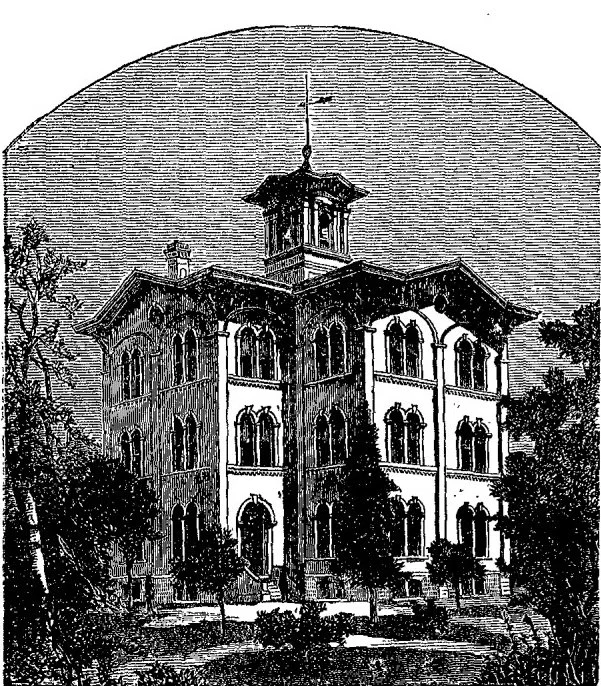
BATTLE CREEK COLLEGE.
A MODEL EDUCATIONAL INSTITUTION, COMPRISING FIVE DEPARTMENTS.
Nearly 500 Students Enrolled Annually, Coming from 32 States and Territories.
DEPARTMENTS.
I. DEPARTMENT OF THE ARTS AND SCIENCES.
This includes a Classical Course of FOUR YEARS and an English Course of three years, each with its Preparatory Course of two years.
II. NORMAL DEPARTMENT.
This includes a Teachers' Course of FOUR YEARS, and a Model School. The course in this department includes all the branches required for a first-class certificate in any State. Professional instruction in Didactics is also given to those in this department who are expecting to teach.
III. COMMERCIAL DEPARTMENT.
This includes instruction in the following topics: Book-keeping, Business Correspondence, Business Forms, Business Penmanship, Commercial Law, Banking, and Telegraphy. The common branches are also pursued in connection with the topics given above; also, French and German.
There are two sessions daily—afternoon and evening.
The courses in this department are of varying length, and the tuition ranges from $5.00 to $30.00.
Superior advantages for those desiring to prepare themselves for Tract and Missionary Secretaries and Librarians. (Send for special circular.)
IV. DEPARTMENT OF THEOLOGY.
This department has a course of three years, which includes, besides the usual common branches, Geology and Greek.
V. DEPARTMENT OF HYGIENE.
This department has a course of one year. It is designed for those who desire to obtain accurate and scientific information on all subjects pertaining to the preservation of health, together with a fundamental knowledge of anatomy and physiology, and a practical acquaintance with the nature and ordinary treatment of common diseases.
THE FACULTY
numbers fourteen members. They are all men and women of experience and critical scholarship.
The majority of the students are young men and women of true moral worth. Their influence over the unstable is highly restrictive and salutary, making it comparatively easy to maintain the most rigid discipline.
EXPENSES
Probably there is no other College in the United States where a thorough education can be obtained at so small an expense. A system of clubbing, which has become very popular among students, enables them to secure excellent board at $1.10 a week, exclusive of lodging, which costs 50 cents to $1.00 more. The annual expenses of each student, including all but traveling expenses and clothing, need not exceed $113.00. A full descriptive Catalogue will be sent free, upon application.
Address BATTLE CREEK COLLEGE, Battle Creek, Mich.
REVIEW AND HERALD PUBLISHING HOUSE.
BOOK AND JOB PRINTING,
BOOK BINDING,
Electrotyping, Stereotyping, Paper Ruling, Blank Book Manufacturing, Etc.
The largest and best equipped printing office in the State.
Orders by mail promptly attended to.
Address REVIEW AND HERALD, Battle Creek, Mich.
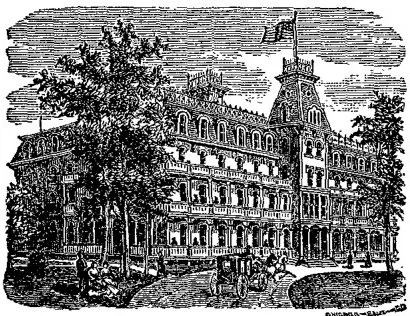
MEDICAL AND SURGICAL SANITARIUM,
By John Harvey Kellogg
Battle Creek, Michigan.
Battle Creek, Michigan.
This institution, beautifully located in one of the most healthful cities of Michigan, is everywhere recognized as the
GREAT SANITARIUM OF THE WEST.
More than 4,000 patients successfully treated. The erection of new buildings and the addition of all the most approved remedial appliances known to the profession, have made it The Most Complete Institution of the Kind in America. All modern hotel conveniences furnished. Terms very reasonable.
J. H. KELLOGG, M. D., Medical Superintendent.
Address,SANITARIUM, Battle Creek, Mich.
MICHIGAN CENTRAL RAILROAD.
By H. C. Wentworth
GOING EAST
STATIONS.
GOING WEST
Night Exp.
Statn. Exp.
N. Y. Exp.
Dry Exp.
Mail.
Local Pas.
Mail.
Day Exp.
Bre'g Exp.
Pacific Exp.
A.M.
A.M.
P.M.
P.M.
P.M.
A.M.
A.M.
A.M.
P.M.
P.M.
8.00
3.35
1.50
6.30
6.50
Ar. - Detroit, - Dep.
4.00
7.00
9.35
8.30
9.50
5.00
12.45
9.32
4.05
5.45
- Jackson, -
7.05
10.20
12.15
1.30
12.40
3.18
11.10
8.18
2.15
1.28
- BATTLE CREEK, -
8.37
12.19
1.55
1.08
2.00
2.25
10.25
7.41
1.38
12.33
- Kalamazoo, -
9.30
1.13
2.36
1.53
2.42
11.30
7.38
5.30
11.32
9.25
- Michigan City, -
12.38
4.23
5.18
5.03
5.28
9.10
6.15
3.30
9.00
7.00
Dep. - Chicago, - Ar.
3.00
6.50
7.40
7.30
8.00
P.M.
P.M.
P.M.
A.M.
A.M.
P.M.
P.M.
P.M.
P.M.
A.M.
Day Express and Mail daily, except Sunday. Pacific Express and Local Passenger west and Atlantic and N. Y. Express east run daily. Night and Evening Express daily, except Saturday and Sunday.