EVERY one who loves you
Loves to see you smile,
Loves to see you cheerful
And happy all the while.
Smiling comes so easy!
Do not wear a frown;
If you feel one rising,
Always smile it down.
— Selected.
The Hardened Soul Cannot Be Courageous
The hardened soul can not be courageous.
Work Among the Jewish Children
By F. C. Gilbert
We are sure that the young people would like to know how the work is progressing at the mission in Boston, and among the Jews in general. While the superintendent was obliged to be absent from the mission much of the time during the summer, the blessing of God attended the efforts put forth by the workers who remained, and several of the Jews became much interested. One feature is of special interest, and that is the influence of the work among the children.
Our sewing school for the children was started very soon after the mission was opened; for the Master said we must feed the lambs as well as the sheep. Part of the exercises of the school is to sing hymns and to have Bible stories. When we began to teach the children the songs, as soon as they would hear the name Jesus, they would place their fingers in their ears. After a little they would take them part way out, and listen whether that name was again mentioned. As soon as they heard that sweet name sung, their fingers would quickly close their hearing. This was embarrassing to the teachers, and a very peculiar experience to overcome. But the grace of the Lord Jesus has power sufficient to overcome every obstacle.
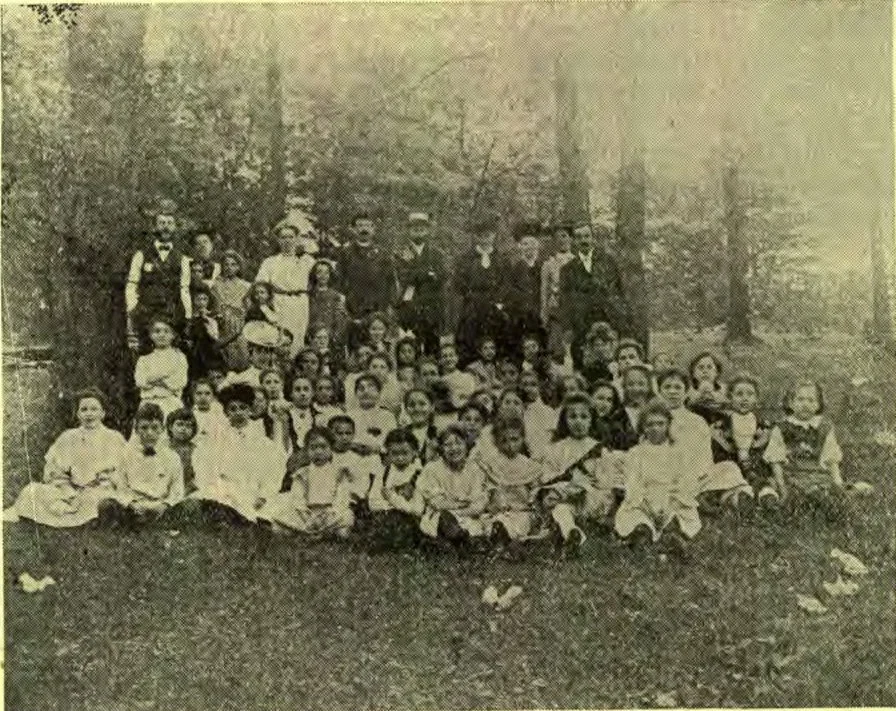
The little people continued to come for a few weeks, and what a change! We promised to take them for an outing, and we did so the last part of July. The Melrose (Mass.) Sanitarium very kindly granted us the privilege of coming to their grounds, and spending the day there. We chartered a car, and took with us an organ and hymn-books. It would certainly have made your hearts rejoice if you could have seen these same children as they rode through the Jewish Ghetto of greater Boston, singing the blessed gospel songs of the Lord Jesus, with the name of Jesus and Saviour in them, the same as any Christian child. Many of them learned to love not only to sing, but to sing the name of Jesus.
The accompanying picture was taken during the exercises of the afternoon at the picnic ground. It would doubtless surprise some to know that it was the first time that a number of these children had ever seen a wild flower or many cultivated flowers. The influence of that gathering we feel sure will bring good results.
We have begun our school again this fall. We have been hindered thus far on account of lack of teachers; but we expect that some of the sisters in the churches near by will come to the rescue, and teach these children, that they may learn to love Jesus.
One little girl, eight years old, came into the meetings the other Sabbath. She told one of the teachers that her sister had gone to the theater, but she did not want to go, as she preferred to come to the mission to hear about God. She said she loved God, and wanted to go to that beautiful home the man was preaching about.
We are glad for the interest the young people have taken in this work, and we can assure them that any assistance they can render toward making the sewing school a success will be greatly appreciated. May God help all to pray for this branch of his cause.
F. C. GILBERT.
Helping an Elephant
A VETERINARY surgeon who had won reputation was once summoned by P. T. Barnum to come to his stables to attend Hebe, a favorite elephant that had hurt her foot. She was a splendid creature, and worth a small fortune. The surgeon tells the story of his experience and its results in Our Dumb Animals:—
Hebe had stepped on a nail or a bit of iron, and it had penetrated the tender part of her foot. She was in intense agony—almost wild with pain.
Long before we reached the enclosure in which she was kept, we could hear her piteous trumpeting; and when we entered, we found her on three legs, swinging the sore foot slowly backward and forward, and uttering loud cries of anguish. Her keeper said, “Don’t you be afraid, sir. Hebe’s got sense.” But I own that I felt rather queer and shaky as I went up to the huge beast.
The men employed about the show came round us curiously as I bent down to examine the foot. While I was doing so, as gently as I could, I felt a light touch on my hair, and as I turned and saw the great trunk behind me, it had an awful suggestiveness.
“I shall have to cut, and cut deep,” I said to her keeper. He said a few words in some lingo, evidently intended for the elephant’s understanding only. Then he shouted with the utmost coolness, “Cut away!”
Well, I made one gash with the knife. I felt the grasp on my hair tighten perceptibly, yet not ungently. Cold drops of perspiration stood out all over me, and I hesitated about going on.
“Shall I cut again?” I managed to call out.
“Cut away!” came the response.
This stroke did the work. A mass of fetid matter followed the knife; the abscess was lanced.
We sprayed out the foot, packed it, and bound it up. The relief must have been immediate, for the grasp of my hair relaxed, the elephant drew a long sigh.
A year and a half after this I was called to western Massachusetts. Barnum’s show was there. You may be sure I called to inquire for my distinguished patient.
“Hebe’s well and hearty, sir,” the keeper answered me. “Come in and see her; she’ll be glad to see you.”
For a moment she looked at me indifferently, then steadily and with interest. She next reached out her trunk and laid it caressingly on my hair, and then she lifted up her foot, now whole and healthy, and showed it to me.— Youth’s Companion.
Tommy, the Hero
By Mrs. G. R. Alden
A True Incident of the Earthquake
He was by no means handsome; he had a turned-up nose, and a little squint in one eye; and Jennie Mills said you couldn’t stick a pin anywhere on his face where there wasn’t a freckle. And his hair, she said, was carrot color, which pleased the children so much that they called him “Carroty” “for short.” O, nobody ever thought of calling Tommy Carter handsome! For that matter, no one thought him a hero; yet even then he had some of the qualities which help to make heroes.
For instance, he was brave enough to go to school day after day with patched knees and elbows, the patches of quite a different color from the trousers and shirt-waist, and to say not a word at home of the boys who shouted “Hello, Patchey!” or of Jennie Mills’s asking whether she should not bring him a piece of her yellow cashmere for patches, to match his hair and freckles.
He had shed a few tears in private that day. The boys yelled and shouted so over what Jennie said that he couldn’t help it. The scholars were used to laughing at Jennie Mills’s sayings, and she was spoiling her character by always trying to think of something to say that would make people laugh.6
But on his way home Tommy stopped at the fountain on the square, and gave his eyes a good wash, so his mother would not suspect tears. Tommy knew that he had his mother to think about; she had been left in his care. Tommy was only seven when his father, Tom Carter, was crushed between two engines. Nobody seemed to know just how it happened; only the man who had charge of the other engine had been drinking; anyway, it happened. They took Tom Carter home on a stretcher; and just before he died, he said: “Good-by, Tommy. Father trusts you to take care of mother and Sissy.” After that would Tommy say anything to his mother about patches or teasing, or let her see tears?
There was another thing that Tommy had courage to do; that was to take constant care of Sissy. All day Saturday and all day Sunday, and on school-days just as much time as he could spare, Tommy gave to Sissy. It was he who fed her, and washed her face a great many times a day, and coaxed her to sleep, and took her to ride in her little cart, or walked very slowly when she chose to toddle along by his side, and changed her dress when she tumbled into the coal-box or sat down in a mud puddle. And he had been known to wash out a dress and a nightgown for Sissy when his mother was ill. There was really nothing too hard or too “girlish” for Tommy to do for his little sister. Once, somebody who saw him trying to mend a hole in the baby’s petticoat called him “Sissy,” and the name clung; for a while the school yard rang with shouts of “Sissy Carter.” But not a word of this did Mother Carter hear.
“Did you have a good time to-day?” his mother would ask, and Tommy, with Sissy in his arms, crowing with delight that she had got him again, would answer, cheerfully: “A first-rate time. I got a big ‘A’ for spelling, and teacher said I had improved in my writing;” and not a word would be hinted about the nicknames or the jeers.
But better school-days came to Tommy before that last thing happened by which people found out that he was a hero.
A new little girl came into the fourth grade. She was a pretty girl, and wore pretty dresses and a fluff of brown curls about her face. She was “smart,” too, the boys said; they said she could say “lots funnier things than Jennie Mills.” Then her name pleased them very much. It was Angela.
Whether or not she was “smarter” than Jennie Mills, it is true that Angela said some things that Jennie had never thought of.
“Tommy Carter is real good-natured,” she said one day. “And he isn’t one bit selfish. Don’t you know how he gave the best seat to little Eddie Cooper this morning, and stood off in a corner where he couldn’t see much? I like Tommy.”
The scholars stared. Somehow it had never occurred to them to “like Tommy;” but, when it had been once mentioned, they seemed to wonder that they had not thought of it. Tommy was good-natured and very obliging. Not a day passed when he did not in some small way prove this. As for his patches, Angela did not seem to notice them at all; and, if she didn’t, why should anybody? So in a few days a queer thing happened. The boys stopped teasing Tommy, and began in little ways to be kind to him. Some of the older ones, when they happened to have an extra apple or pear, fell into the habit of saying, “Here, want this?” and would toss it to Tommy. And when they discovered that he saved a piece of everything for Sissy, they did not laugh at all, for Angela said, “How nice in him to do that!”
Soon they began to save up bright little things themselves for Sissy—bits of paper, half-worn toys, once a new red ball. None of them realized it, but this was really the influence of the new little girl, with brown curls.
In that way it came to pass that Tommy lost many of his chances for being a hero, but a new one was coming.
Tommy lived in a large tenement-house on one of the back streets of San Francisco. Seven other families lived in the same house. One Monday evening Mrs. Carter told the woman who lived across the hall that she had done the hardest day’s work of her life, and was so “dead tired” that she felt as if she should like to go to bed and never get up.
At five o’clock the next morning, she, with Sissy close beside her and Tommy in a little cot at the far end of the room, were all sound asleep. Suddenly the walls of the big tenement-house began to sway from side to side in the strangest manner, and there was at the same second a terrible crashing noise; and the kitchen table in the corner tipped over, and the dishes in the corner cupboard slid to the floor and went to pieces, and the big wardrobe that was a bureau and a clothes-closet all in one moved out into the middle of the room, and the stove fell down. All these things happened so fast, and the earth was full of such strange, wild noises, that for a second nobody knew what was the matter.
Tommy Carter had got to his mother’s side before the noise was over, but he found that she could not stir; her bed was covered with bricks, and there was a great hole in the wall. Tommy did not know it then, but he understood afterward that the chimney had fallen on his mother’s bed.
“Tommy,” she gasped, “it’s an earthquake! Take Sissy and run!”
“But, mother!” he cried, “O mother! I can’t leave you.”
“Never mind me, Tommy; take her quick! She isn’t hurt. Maybe there’ll be another. Tommy, you take care of Sissy! RUN!”
And Tommy ran, with just the little shirt on in which he had been sleeping, and with an old quilt that his mother’s arms had wrapped about the sleeping baby.
What an awful street was that into which he ran! What an awful road he had to go to get to it! Part of the side wall of the house was gone, and the stairs swayed from side to side as he stepped on them; but he reached the street, and it looked as if everything on it had tumbled down, and all the people in the world were running about, wringing their hands and crying. Then suddenly an awful cry arose. “Fire! Fire! Fire!”
“Mother! O mother!” Tommy screamed, and he tried to scramble back over the fallen walls by which he had come. He must take care of his mother. But a strong hand held him.
“Keep away, youngster. Don’t you see that the wall is falling! Run!”
But where should he run? The whole city seemed to be burning, and everywhere was horror and terror. In trying to cross a street, Tommy was knocked down, and was for a second under the feet of a plunging horse. But he got out, and reached the sidewalk with Sissy still safe, and he did not know that his arm was broken.
“Wasn’t it lucky that Sissy was on the other arm?” he said, speaking to nobody.
That awful day! Nobody who lived through it will ever forget it. Tommy Carter spent it struggling, pushing, panting, tugging, trying to get somewhere with Sissy. And Sissy cried for food, and then for water; and there was none of either to give her; and then she lay back still, and he thought she was dying. The crowds swarmed and surged about him, crying, groaning, praying, cursing, yelling orders; and above all that awful din arose the awful roar of the fire. The city was burning up! Oh, where was mother? And where was a safe place for Sissy? And why did his arm hurt so? What was the matter with him? His head was whirling round and round. Was he going to die and leave Sissy? He never would!
Suddenly he roused to fresh energy. Somebody was trying to take Sissy.
“Don’t you touch her!” he cried, fiercely. “Don’t you dare! Let her alone, I say;” and he fought like a wild animal.
“But, my poor boy,” said the doctor who was bending over him. But Tommy was insane with pain and fear.
“Let her be, I say!” he screamed. “Mother said I wasn’t to let anybody take her, and I won’t! I’ll kill you if you touch her! I’ll, I’ll—” and then Tommy fell back in a dead faint.
When he waked up, he was in a large, quiet room in a clean bed. “Where is Sissy?” he called out in terror. A woman in white bent over him, and spoke low.
“Hush, dear; don’t try to move. Sissy is safe and well and happy.”
“Where is she, ma’am?” said Tommy. “I must have her right here by me. I can take care of her as well as not; I always do; and—I promised mother, you see; and she’s awfully scared of strangers.”
“She isn’t afraid of us; she is very happy here. I have sent for her to come and see you. Ah, here she comes this minute.”
And there was Sissy, smiling, in the arms of a woman in a white gown and cap, herself in the prettiest of white dresses. She laughed for joy at sight of Tommy, but was quite willing to stay in the young woman’s arms.
“Little darling!” said the nurse. “She wasn’t hurt a bit; and she is so sweet!”
“And where is mother, ma’am?” asked Tommy. “Was she hurt so that she can’t take care of Sissy? I’m feared she was. When can I go to her? I have to take care of mother. Does she know that I kept Sissy safe?”
The two nurses looked at each other, and seemed not to know just how to answer so many questions; but the doctor, who had come up a moment before, stepped forward and spoke cheerily.
Tommy smiled gratefully.
“And when can I go and take care of her, sir? Was mother hurt? I remember all about it now. Is mother safe?”
“You have been very ill, and did not know what was happening. You did not even know Sissy when we brought her to see you.”
“Oh!” said Tommy with a faint smile. “How queer! Didn’t know Sissy! It’s so nice that she takes to the pretty lady, and that mother is safe. I’m very sleepy, sir. Would it be right to go to sleep if the pretty lady can take care of Sissy for a little while?”
“Quite right, my boy. We will take the best possible care of Sissy.” The doctor’s voice was husky, and he turned away soon, as Tommy’s heavy eyes had closed, with his own eyes dim.
“O doctor!” said both nurses. But the doctor smiled.
“He is going, the brave little hero!” he said. “And we, you and I, will take care of Sissy for him.”
“Yes, indeed!” said the pretty nurse, with a sob; and she kissed Sissy.—Mrs. G. R. Alden, in Junior Christian Endeavor World.
The Pebbles’ Lesson
How smooth the sea-beach pebbles are!
But, do you know,
The ocean worked a hundred years
To make them so?
And once I saw a little girl
Sit down and cry
Because she couldn’t cure a fault
With one small “try”!
— Selected.
Bibles in Circulation and a Pearl Boat
A FLEET of eighty merchant ships, each carrying one thousand three hundred and forty tons, would be required, it is estimated, to transport all the Bibles now in circulation.
A FOREIGN jeweler has made a tiny boat formed of a single pearl. The sail is made of beaten gold, studded with diamonds, and the binnacle light is a perfect ruby. An emerald serves as its rudder, and its stand is a slab of ivory. It weighs less than half an ounce, and is valued at five thousand dollars.
The Letter Box
UTICA, MO., Oct. 17, 1906. DEAR EDITOR: This is my first letter to the INSTRUCTOR. I like to read it. I go to Sabbath-school. My teacher’s name is Alie Guthrie. I attend school at home. I went to the public school last winter. I have two sisters and one brother. WARREN CAMPBELL.
LAKE VILLAGE, ARK., Oct. 30, 1906. DEAR EDITOR: This is my first letter to the INSTRUCTOR and its readers. There is no Sabbath-school here, so we have Sabbath-school at home. I enjoy reading the INSTRUCTOR. I am thirteen years old. I am the oldest boy in our family. WILLIAM EDWARD BROWN.
OSWEGO, KAN., Oct. 19, 1906. DEAR EDITOR: I think the INSTRUCTOR is the most helpful paper ever published for the youth. I like to read it, and I get many valuable lessons from it. An intermediate church-school has just been started at this place in a new, two-room building, and I am attending it. We have an excellent opportunity to receive the necessary training to become workers in Christ’s vineyard. HAZEL BALDWIN.
LAKE VILLAGE, ARK., Oct. 30, 1906. DEAR EDITOR: I wish some of the INSTRUCTOR readers would write to me. We take the INSTRUCTOR, and I love to read it very much. I have five brothers and three sisters. We have Sabbath-school at home every Sabbath. I am nine years old. I live in the country. I have read “Easy Steps” and “Bible Stories.” I would like to go to school. There is no school near us. MARY C. BROWN.
PROCTOR, VT., Oct. 26, 1906. DEAR EDITOR: As I have not seen any letters from Proctor, I will send one. I am thirteen years old, and I have four brothers and one sister. My school is three miles from here; we ride in a wagon that has seats along the sides, and steps at the end to go up into it. We live on a farm, and have fifty-four cows, besides many calves. I want to be found faithful to the end. MARY BARTON.
CHEBOYGAN, MICH., Oct. 17, 1906. DEAR EDITOR: This is the first letter I have written to the INSTRUCTOR. I thought you would be interested to know about our company of Sabbath-keepers here. We have a Sabbath-school of twenty, known as the Hebron Sabbath-school. We have Sabbath-school at our house. Sister Irene Dingman is my teacher, and I like her very much. I am fourteen years old, and am in the seventh grade. I have to go to the public school. I like to read the INSTRUCTOR, it has so many good things in it. I like the new lessons for the intermediate class; they are easily learned. I would like to see my letter in print if it would not crowd out any others. I am trying to be a good boy, and want to meet all the readers of the INSTRUCTOR in the new earth. ADRIAN CAMPBELL.
XII — Events Connected with the Coming of Christ
(December 22)
MEMORY VERSE: “Behold, I show you a mystery; we shall not all sleep, but we shall all be changed.” 1 Cor. 15:51.
REVIEW.—The last days will be days of —. Men’s hearts will fail for —. Joel says —. Plowshares will be beaten into —, and pruning-hooks into —. This takes place just before the —. In the last days the time will be — because —. As the days of — were, when people were —, so will also the —. Likewise as it was —. They —, but the day — went from —, it rained —, and all were —. When we see all these signs, we may know —. The words of the Lord are more sure than —. The day of the Lord will come as —. Therefore we should —.
Questions
1. How many who sleep in the grave will rise again? John 5:28. What will waken them? When they hear that voice, what will they do?
2. Who will descend from heaven at that time? 1 Thess. 4:16. What voice will be heard? Who is the archangel? Who will rise from the grave first?
3. When will the wicked dead be raised? Rev. 20:5.
4. What does Paul say about this time? What will happen to those who are living when Jesus comes? 1 Cor. 15:51.
5. How long will it take to make this change? When will it take place? How will the dead be raised? 1 Cor. 15:52.
6. From what will the righteous be redeemed? Hosea 13:14.
7. As the dead awake, what will they do? Isa. 26:19.
9. Where will the righteous go after they are made immortal? 1 Thess. 4:17. Who will go with them at the same time? Whom will they meet? Where will the meeting take place? How long will they stay with their Lord?
10. For what other purpose does the Lord come? Isa. 26:21.
11. How will the wicked be destroyed? 2 Thess. 2:8.
Lesson Story
As Jesus comes in the clouds of heaven, “all the righteous that are in the graves shall hear his voice, and shall come forth.”
“For the Lord himself shall descend from heaven with a shout, with the voice of the archangel, and with the trump of God: and the dead in Christ shall rise first.” “The rest of the dead lived not again until the thousand years were finished.”
Some of the righteous will be living when Jesus comes, for “we shall not all sleep, but we shall all be changed in a moment, in the twinkling of an eye [as quickly as you can wink your eye] at the last trump; for the trumpet shall sound, and the dead shall be raised incorruptible, and we shall be changed. For this corruptible must put on incorruption, and this mortal must put on immortality. . . . Then shall be brought to pass the saying that is written, Death is swallowed up in victory.”
The Lord says: “I will ransom them from the power of the grave; I will redeem them from death. O death, I will be thy plagues; O grave, I will be thy destruction; repentance shall be hid from mine eyes.”
“Thy dead men shall live, together with my dead body shall they arise. Awake and sing, ye that dwell in dust; for thy dew is as the dew of herbs, and the earth shall cast out the dead.”
As the righteous awake, they will sing, “O death, where is thy sting? O grave, where is thy victory?”
“Then we which are alive and remain shall be caught up together with them in the clouds, to meet the Lord in the air; and so shall we ever be with the Lord.”
The Lord also comes “to punish the inhabitants of the earth for their iniquity;” and they “shall consume with the spirit of his mouth, and be destroyed with the brightness of his coming.”
Bible Questions from Oregon
By Elizabeth Rosser
NAME the person who made each of the following remarks, and tell the circumstances that called forth the saying:—
1. “Come with me, and see my zeal for the Lord.”
2. “My punishment is greater than I can bear.”
3. “Skin for skin, yea, all that a man hath will he give for his life.”
4. “Let me, I pray thee, kiss my father and my mother, and then I will follow thee.”
5. “Let me die the death of the righteous, and let my last end be like his!”
6. “All these things are against me.”
7. “If I perish, I perish.”
8. “Oh that one would give me drink of the water of the well of Bethlehem, which is by the gate!”
9. “Suffer me that I may feel the pillars whereupon the house standeth, that I may lean upon them.”
10. “There shall not a man be put to death this day: for to-day the Lord hath wrought salvation in Israel.”
11. “Depart from me; for I am a sinful man, O Lord.”
12. “It is I; be not afraid.”
ELIZABETH ROSSER.
XII — The High Calling
(December 22)
MEMORY VERSE: “How beautiful are the feet of them that preach the gospel of peace, and bring glad tidings of good things.” Rom. 10:15.
Questions
What is the experience of the minister called of God? I Cor. 9:16.
What is he to preach? When is he to deliver his message? 2 Tim. 4:2.
Whom alone should the minister endeavor to please in his preaching? 2 Tim. 2:15.
What is he to give to the people? Verse 15.
What solemn responsibility rests upon the gospel minister? Eze. 33:7, 8.
What does God say of him who fails to deliver his message? Verse 8.
What is true when the message has been faithfully delivered? Verse 9.
In this case what does the messenger become to the two classes that hear him? 2 Cor. 2:15, 16.
Since this is true, whom alone must he preach? I Cor. 2:2.
How diligent should the ministry be in the exercise of their gifts? Acts 6:4.
How has the Lord ordained that they who preach the gospel shall be supported? I Cor. 9:14.
What promise is made to those who turn many to righteousness? Dan. 12:3; note.
Note
It is said of Jesus that “for the joy that was set before him,” he “endured the cross, despising the shame.” That joy is in seeing the blood-bought throng before the throne, “filled with joy unspeakable and full of glory,” and of knowing that all this bliss could not have been experienced, had it not been for his sacrifice. Isa. 53:11. The faithful minister will share in the joy of his Lord, when he himself stands before the throne, and sees around him the vouchers of his ministry — the flock he has nourished, fed, and saved.
Sidney Lanier and the Clean-Tongued Boy
“God does not always pay at sunset, nor at the end of the week; but at last he pays.”
SIDNEY LANIER, our Southern poet, was a knightly and clean-tongued boy. Why should not every boy merit the same reputation?
NINETY-EIGHT thousand two hundred and twenty-five Bibles in the Spanish and Portuguese languages have been circulated among 1,129 towns and villages of South America by representatives of the American Bible Society.
ONE who has obtained within the past year thirty yearly subscriptions to the INSTRUCTOR says: “Every one is greatly pleased with the paper. It is a genuine joy to secure readers when I know it will prove a blessing. May the good work go on.”
THERE are in Greater New York nearly one million Jews, and nearly every State of the Union has a large representation of this people. Massachusetts has one hundred thousand, and the rest of New England has as many more. Almost without exception these know nothing of the joys of a personal Saviour. They are in need of help.
MISS PEARL STAFFORD is the first member of the Reading Circle to report having completed the work. She says:—
I have finished the five books of the Reading Circle since the first of the year. They are “Christ’s Object Lessons,” “Our Paradise Home,” “Steps to Christ,” “From Eden to Eden,” and “The Coming King.” I have received much good from them. Thanks to the Reading Circle, which encouraged me to read them.
Reign of Evil
THE city of Pittsburg has been afflicted for some time by an epidemic of crime. More than one hundred robberies and burglaries in one month, the murder of several leading citizens by midnight assassins, and the crucifixion of one young woman, has been the city's fearful record. The streets are unsafe, and one's own home offers little security.
An increase of forty per cent has been made in the police force, vigilance committees have been formed to patrol the streets at night, and large rewards have been offered, yet the mystery of the dark crimes is still unsolved.
“San Francisco’s Second Crisis”
The foregoing words recently formed the headlines to an article in one of our leading magazines, and they refer to the plague of greed and corruption with its legitimate fruit of vice and crime, that is to-day afflicting the stricken city.
The responsibility for the city’s present humiliation and travail rests upon her own citizens. Insurance companies, industrial corporations, and municipal officials have all taken part in this shameless proceeding. Blackmailing, graft, extortion, mulcting, looting, cheating, are said to be the order of the day. Even the relief fund has been tampered with.
“This know also, that in the last days perilous times shall come. . . . Evil men and seducers shall wax worse and worse.” One who keeps at all in touch with current events can but know that there is abundant evidence that we are in the last days. Let us be awake to the hour, and do what we can to stem the tide of evil.
Edythe’s Prayer
A MOTHER had gone up-stairs with her little girl to prepare her for bed. Just as she was ready to listen to the child’s prayer, she was urgently called to go down-stairs. As she arose to go, she said, “Now darling, mama must leave you for a little while. You will say your prayers by yourself to-night, won’t you, dear?”
“Yes, mama, I’ll try,” the little one answered, as her mother left the room. On her return, Mrs. B stopped at the door of the bedroom and listened. She heard little Edythe say: “Now Lord Jesus, I have told you a great deal about myself. I wish you would tell me something about yourself.” A moment of perfect silence followed, then the child sweetly lisped, “Thank you, Jesus. That was very nice you told me.”
The secret of all true communion with our Saviour is given by little Edythe. Many of us, no doubt, lose much by not waiting in silence at the altar of prayer to hear the Saviour tell us of himself. “They that wait upon the Lord shall renew their strength.”